Ecology Word Parts
1. Eco - environment
2. Auto – self
3. Hetero – others
4. Homo – same
5. Troph – eating/feeding
6. Photo – light
7. Synthesis – to make
8. Carne - meat
9. Herb – plant
10. Omni – all/every
11. -vorous –eat/swallow
What Is Ecology?
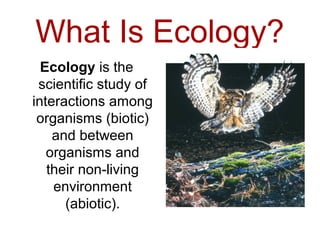
Ecology is the
scientific study of
interactions among
organisms (biotic)
and between
organisms and
their non-living
environment
(abiotic).
Energy Transfer
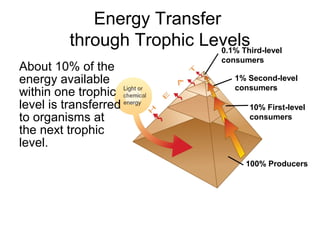
through Trophic Levels0.1% Third-level
consumers
1% Second-level
consumers
10% First-level
consumers
100% Producers
About 10% of the
energy available
within one trophic
level is transferred
to organisms at
the next trophic
level.
Types of Energy Transfers
Autotrophs/Producers – convert sunlight into
chemical energy (ex plants and bacteria)
Heterotrophs/Consumers – rely on other
organisms for energy
• Carnivores – meat eater
• Herbivore – plant eater
• Omnivore – eats plant and animals
• Detritivores – break down dead material & returns nutrients
to the soil
– Scavengers – eats scraps and leftovers
– Decomposers – eats dead and decaying organisms
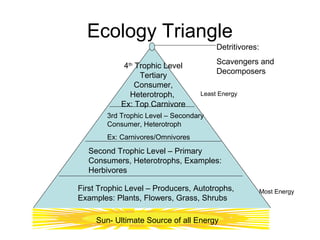
Ecology Triangle
First Trophic Level – Producers, Autotrophs,
Examples: Plants, Flowers, Grass, Shrubs
Second Trophic Level – Primary
Consumers, Heterotrophs, Examples:
Herbivores
3rd Trophic Level – Secondary
Consumer, Heterotroph
Ex: Carnivores/Omnivores
4th
Trophic Level
Tertiary
Consumer,
Heterotroph,
Ex: Top Carnivore
Sun- Ultimate Source of all Energy
Detritivores:
Scavengers and
Decomposers
Most Energy
Least Energy
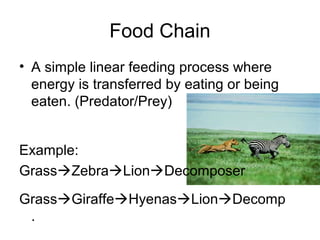
Food Chain
• A simple linear feeding process where
energy is transferred by eating or being
eaten. (Predator/Prey)
Example:
GrassZebraLionDecomposer
GrassGiraffeHyenasLionDecomp
.
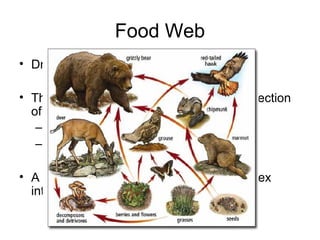
Food Web
• Drawing
• The arrow always follows the one way direction
of energy.
– High Energy  Low Energy
– Producer  Consumer
• A food web is a feeding network of complex
interactions
6 Levels of Organization
1) Individual – one organism of one species in
the environment
(one deer in the woods)
2) Population – all the organisms of one
species in an environment
(all the deer in the woods)
3) Community – all the populations in an
environment (all biotic factors) (all animals,
plants, bacteria, fungus, and protist in the
woods)
4) Ecosystem – all the abiotic and biotic
factors in the environment (all living things
as well as temperature, water, sunlight,
air, etc in the woods)
5) Biome – ecosystems with similar
climates and abiotic and biotic factors
(Temperate forest)
6) Biosphere – entire earth and all it’s
components (earth)
The Major Biomes
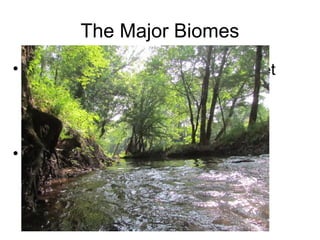
• Biomes are defined by a unique set
of abiotic and biotic factors—
***particularly climate
• Habitat – area an organism lives
The 10 Major Biomes
• Tropical Rain Forest
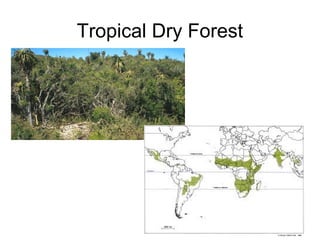
• Tropical Dry Forest
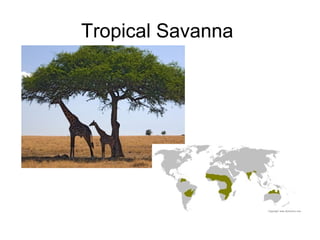
• Tropical Savanna
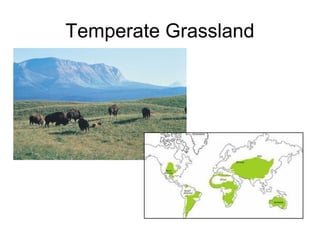
• Temperate Grassland
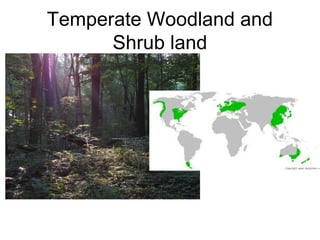
• Temperate Woodland
and Shrubland
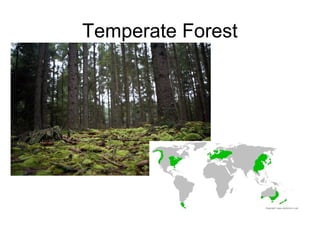
• Temperate Forest
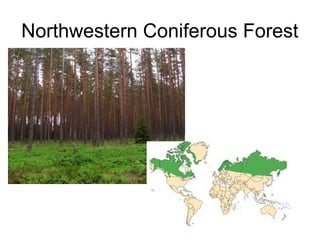
• Northwestern
Coniferous Forest
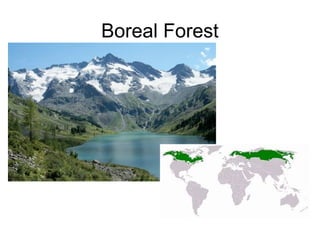
• Boreal Forest
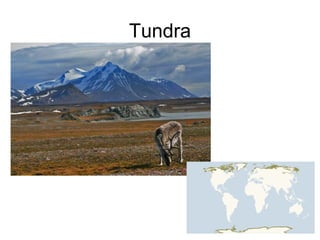
• Tundra
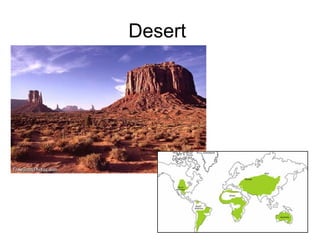
• Desert
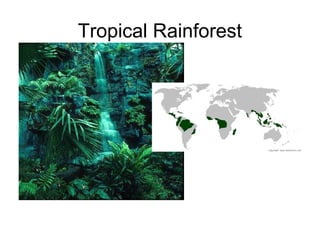
Tropical Rainforest
Tropical Dry Forest
Tropical Savanna
Temperate Grassland
Temperate Woodland and
Shrub land
Temperate Forest
Northwestern Coniferous Forest
Boreal Forest
Tundra
Desert
Three Types of Community
Interactions
1.) Competition: when organisms attempt to
use a resource in the same place at the same
time
2.) Predation: interaction when one organism
captures and feeds on another
– Predator (hunter): kills and eats
– Prey (hunted): killed and eaten
3.) Symbiosis: “living together”
• Mutualism: both benefit
(ex. Clownfish/anemone, bison/cowbirds)
• Parasitism: one benefits and the other is
harmed
(ex. fleas, ticks, tapeworms)
Niche – the role an organism plays in an
environment
Ecological Succession
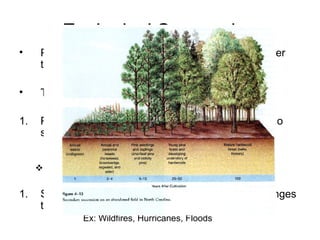
• Predictable changes that occur in a community over
time
• Two Types:
1. Primary Succession – occurs on surfaces where no
soil exists
Ex: volcanic ash, rock
 Pioneer Species – 1st
to arrive on rock (Lichen)
1. Secondary Succession – when a disturbance changes
the community without removing the soil
Ex: Wildfires, Hurricanes, Floods
Animal Behaviors
• Innate Behavior (instinct) – born with
knowledge
• Learned Behavior(aquired) – developed over
time
• Imprinting - Innate/Learned Combined
• Social – interaction between individuals
4 Types of Learned Behavior
1. Habituation – ignoring
2. Classical Conditioning – mental connection
between reward or punishment (Pavlov)
3. Operant Conditioning/Trial-and-Error –
repeated practice (Skinner Box)
4. Insight – reasoning
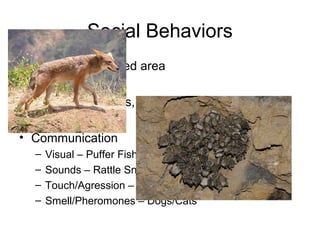
Social Behaviors
• Territory – guarded area
• Society – colonies, schools, packs
• Communication
– Visual – Puffer Fish
– Sounds – Rattle Snake
– Touch/Agression – Moose/Rams
– Smell/Pheromones – Dogs/Cats
Behavior Cycles
• Seasonal – Hibernation, Estivation,
Migration
• Daily – circadian rhythms
• Yearly – Courtship/mating
Demography
The scientific
study of populations
Four Characteristics of a
Population
1.) Geographic Distribution (range): the
area
2.) Density: number of individuals in
area
3.) Growth rate: number of births,
deaths, and immigration (in), or
emigration (out)
• Exponential growth: rapid growth (J-Shape
Curve)
• Logistic growth: slows after exponential
because of limited resources (S-Shape
Curve)
• Carrying capacity: the maximum number
• Draw
•Growth limiting factors: causes a
population growth to decrease
A: Density-Dependent- are biotic factors that
limit growth
Ex) competition, predation, parasitism, and disease
B: Density-Independent – abiotic factors that
limit growth
Ex) floods, hurricanes, tsunamis, droughts etc.
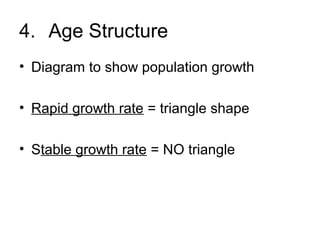
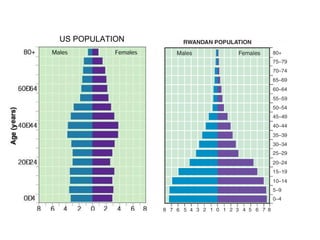
4. Age Structure
• Diagram to show population growth
• Rapid growth rate = triangle shape
• Stable growth rate = NO triangle
US POPULATION
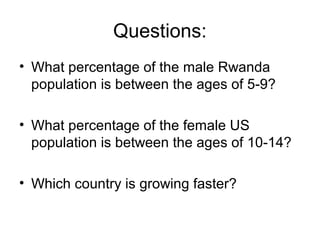
Questions:
• What percentage of the male Rwanda
population is between the ages of 5-9?
• What percentage of the female US
population is between the ages of 10-14?
• Which country is growing faster?
Biodiversity
• Sum total of all the variety of organisms in
the biosphere.
• It’s earth’s greatest natural resources. This
diversity of life gives us food, shelter, and
medicine.
• Valuable because it’s the biological life
support system of our planet
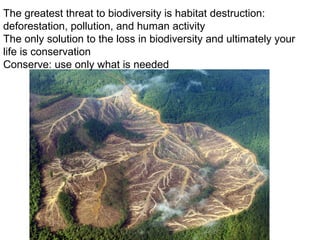
The greatest threat to biodiversity is habitat destruction:
deforestation, pollution, and human activity
The only solution to the loss in biodiversity and ultimately your
life is conservation
Conserve: use only what is needed