Chromosomal
Inheritance
Chromosomal Theory of
Inheritance
• Chromosomes contain the units of heredity
(genes)
• Pair chromosomes segregate during meiosis,
each sex cell has half of the number of
chromosomes found in a somatic cell. (Mendel’s
law of segregation)
• Chromosomes assort independently during
meiosis (Mendel’s law of independent
assortment)
• Each chromosome contain many different genes
Sex Chromosomes
• Sex chromosomes (X and Y) vs. autosomes
(chromosomes 1-22), Sex cells and somatic cells.
• Homogametic sex -- that sex containing two like sex
chromosomes. In most animals species these are
females (XX). Each egg only contain one X
chromosome.
• Heterogametic sex --- that sex containing two
different sex chromosomes . In most animal species
these are XY males. Each sperm will contain either
an X or Y. Therefore the father determines whether
the offspring is a boy or a girl (50/50 chance)
Sex Linkage
• XA = Locus on X chromosome
• XX females
– XA XA, XaXa - homozygotes
– XA Xa – heterozygote (carrier)
• XY male
– XA Y, XaY
– no carriers in males, therefore they are more
susceptible to x-linked traits.
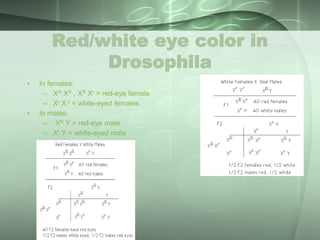
Red/white eye color in
Drosophila
• In females:
– XR XR , XR Xr = red-eye female
– Xr X r = white-eyed females
• In males:
– XR Y = red-eye male
– Xr Y = white-eyed male
Examples of Sex Linked
Traits
• Hemophilia - Recessive
• Red-Green Color Blindness - Recessive
• Muscular Dystrophy - Recessive
• Fragile X syndrome - Dominant
Nondisjunction
∙ abnormal number of autosomal
chromosomes when chromosomes fail
to separate during replication.
∙ 2n – 1 = monosomic
∙ 2n + 1 = trisomic
Nondisjunction
Nondisjunction -
Examples
• Down's -- trisomy 21 mean
life expectancy 17 years.
Short in stature, round face
and mental retardation
• Patau's -- trisomy 13 mean
life expectancy 130 days
• Edward's --- trisomy 18
mean life expectancy a few
weeks
Sexual Determination -
Males
Single Y = male, so XXY, XYY,
XXXY all male
• Klinefelter Syndrome – XXY or
XXXY. Male due to Y
chromosome, Testes and
prostrate underdeveloped, some
breast formation, no pubic or
facial hair, subnormal intelligence.
• Jacob’s Syndrome – XYY. Males
are usually taller than average,
and tend to have speech and
reading problems
Sexual Determination -
Females
• Turner’s Syndrome – X0. Female with
bull neck, short stature, nonfunctional
ovaries, no puberty
• Metafemale – 3 or more X
chromosomes. No apparent physical
abnormality except menstrual
irregularities.
Chromosomal Mutation
• Permanent change in chromosome
structure.
• Caused by exposure to radiation,
organic chemicals, viruses, replication
mistakes.
• Only mutations in sex cells are passed
onto the next generation.
Structural Changes in
Chromosomes
• Inversion – occurs when a chromosome
segment turns around 180 degrees.
• Translocation – is movement of
chromosomal segments to another non-
homologous chromosome
• Deletion – occurs when a portion of the
chromosome breaks off.
• Duplication – when a portion of a
chromosome repeats itself.
Deletions and
Duplications
Inversions and
Translocations
Linkage
• When genes are on the same chromosome, they are
called linked. They can show departures from
independent assortment
• If genes on the same chromosome are sufficiently far
apart, they can segregate independently through
crossing over.
Gene Mapping
• By studying cross-over (recombination)
frequencies of linked genes, a
chromosomal map can be constructed
– Distant genes are more likely to be
separated by crossing-over than genes
that are closer together.
– Each 1% of recombination frequency is
equivalent to 1 map unit
Crossing Over Produces
Recombinations
Constructing Gene Maps
• Crossing over frequencies can be used
to construct gene maps. For example,
– Crossing over frequency of genes A and B
is 3%, genes B and C is 9% and genes A
and C is 12%.
3 mu 9 mu
A B C
Human Genome Project
• Map of the all of the genes on the
human chromosomes.
Pedigree Analysis
Modes of Inheritance
• Autosomal dominant allele
[e.g., Huntington's Disease,
brown eyes]
– A phenotype associated with an
autosomal dominant allele will,
ideally, be present in every
individual carrying that allele. It
will be present in close to 50% of
the individuals.
– Affected children usually have
affected parents
– Two affected parents can
produce an unaffected child
– Both males and females are
affected equally.
Modes of Inheritance
• Autosomal recessive alleles [silent
carriers]
– albinism, cystic fibrosis, certain types of
hemophilia, Tay-Sachs disease, PKU,
blue eyes.
– A pedigree following a trait associated
with an autosomal recessive allele is
often marked by a skipping of
generations. That is, children may
express a trait which their parents do
not.
– In such a situation, both parents are
heterozygote, also known as silent
carriers.
– Close relatives who reproduce are more
likely to have affected children.
– Both males and females will be affected
with equal frequency
– A low number of individuals normal
affected
Modes of Inheritance
• Sex-linked dominant alleles
[sex linkage]
– A sex linked dominant allele has a
variation on the pattern displayed
by autosomal dominant alleles. That
is:
• one-half of the offspring of an afflicted
heterozygote female will be similarly
afflicted (gender independent).
• only the female progeny of males will be
afflicted (because the male donates an
X chromosome to his female progeny).
– As with any sex-linked allele, males
can pass the allele only on to their
daughters, not their sons.
Mode of Inheritance
• Sex-linked recessive alleles
– red-green color blindness,
certain types of hemophilia.
– More males affected than
females
– An affected son can have
parents who have the normal
phenotype
– For a female to have the
characteristic, her father must
also have it and the mother must
be a carrier.
– If a woman has the characteristic
all her sons will have it
– The characteristic often skips a
generation from grandfather to
grandson
Chromosomalinheritance 100807040928-phpapp02.ppt

Chromosomalinheritance 100807040928-phpapp02.ppt

  • 1.
  • 2.
    Chromosomal Theory of Inheritance •Chromosomes contain the units of heredity (genes) • Pair chromosomes segregate during meiosis, each sex cell has half of the number of chromosomes found in a somatic cell. (Mendel’s law of segregation) • Chromosomes assort independently during meiosis (Mendel’s law of independent assortment) • Each chromosome contain many different genes
  • 3.
    Sex Chromosomes • Sexchromosomes (X and Y) vs. autosomes (chromosomes 1-22), Sex cells and somatic cells. • Homogametic sex -- that sex containing two like sex chromosomes. In most animals species these are females (XX). Each egg only contain one X chromosome. • Heterogametic sex --- that sex containing two different sex chromosomes . In most animal species these are XY males. Each sperm will contain either an X or Y. Therefore the father determines whether the offspring is a boy or a girl (50/50 chance)
  • 4.
    Sex Linkage • XA= Locus on X chromosome • XX females – XA XA, XaXa - homozygotes – XA Xa – heterozygote (carrier) • XY male – XA Y, XaY – no carriers in males, therefore they are more susceptible to x-linked traits.
  • 5.
    Red/white eye colorin Drosophila • In females: – XR XR , XR Xr = red-eye female – Xr X r = white-eyed females • In males: – XR Y = red-eye male – Xr Y = white-eyed male
  • 6.
    Examples of SexLinked Traits • Hemophilia - Recessive • Red-Green Color Blindness - Recessive • Muscular Dystrophy - Recessive • Fragile X syndrome - Dominant
  • 7.
    Nondisjunction ∙ abnormal numberof autosomal chromosomes when chromosomes fail to separate during replication. ∙ 2n – 1 = monosomic ∙ 2n + 1 = trisomic
  • 8.
  • 9.
    Nondisjunction - Examples • Down's-- trisomy 21 mean life expectancy 17 years. Short in stature, round face and mental retardation • Patau's -- trisomy 13 mean life expectancy 130 days • Edward's --- trisomy 18 mean life expectancy a few weeks
  • 10.
    Sexual Determination - Males SingleY = male, so XXY, XYY, XXXY all male • Klinefelter Syndrome – XXY or XXXY. Male due to Y chromosome, Testes and prostrate underdeveloped, some breast formation, no pubic or facial hair, subnormal intelligence. • Jacob’s Syndrome – XYY. Males are usually taller than average, and tend to have speech and reading problems
  • 11.
    Sexual Determination - Females •Turner’s Syndrome – X0. Female with bull neck, short stature, nonfunctional ovaries, no puberty • Metafemale – 3 or more X chromosomes. No apparent physical abnormality except menstrual irregularities.
  • 12.
    Chromosomal Mutation • Permanentchange in chromosome structure. • Caused by exposure to radiation, organic chemicals, viruses, replication mistakes. • Only mutations in sex cells are passed onto the next generation.
  • 13.
    Structural Changes in Chromosomes •Inversion – occurs when a chromosome segment turns around 180 degrees. • Translocation – is movement of chromosomal segments to another non- homologous chromosome • Deletion – occurs when a portion of the chromosome breaks off. • Duplication – when a portion of a chromosome repeats itself.
  • 14.
  • 15.
  • 16.
    Linkage • When genesare on the same chromosome, they are called linked. They can show departures from independent assortment • If genes on the same chromosome are sufficiently far apart, they can segregate independently through crossing over.
  • 17.
    Gene Mapping • Bystudying cross-over (recombination) frequencies of linked genes, a chromosomal map can be constructed – Distant genes are more likely to be separated by crossing-over than genes that are closer together. – Each 1% of recombination frequency is equivalent to 1 map unit
  • 18.
  • 19.
    Constructing Gene Maps •Crossing over frequencies can be used to construct gene maps. For example, – Crossing over frequency of genes A and B is 3%, genes B and C is 9% and genes A and C is 12%. 3 mu 9 mu A B C
  • 20.
    Human Genome Project •Map of the all of the genes on the human chromosomes.
  • 21.
  • 22.
    Modes of Inheritance •Autosomal dominant allele [e.g., Huntington's Disease, brown eyes] – A phenotype associated with an autosomal dominant allele will, ideally, be present in every individual carrying that allele. It will be present in close to 50% of the individuals. – Affected children usually have affected parents – Two affected parents can produce an unaffected child – Both males and females are affected equally.
  • 23.
    Modes of Inheritance •Autosomal recessive alleles [silent carriers] – albinism, cystic fibrosis, certain types of hemophilia, Tay-Sachs disease, PKU, blue eyes. – A pedigree following a trait associated with an autosomal recessive allele is often marked by a skipping of generations. That is, children may express a trait which their parents do not. – In such a situation, both parents are heterozygote, also known as silent carriers. – Close relatives who reproduce are more likely to have affected children. – Both males and females will be affected with equal frequency – A low number of individuals normal affected
  • 24.
    Modes of Inheritance •Sex-linked dominant alleles [sex linkage] – A sex linked dominant allele has a variation on the pattern displayed by autosomal dominant alleles. That is: • one-half of the offspring of an afflicted heterozygote female will be similarly afflicted (gender independent). • only the female progeny of males will be afflicted (because the male donates an X chromosome to his female progeny). – As with any sex-linked allele, males can pass the allele only on to their daughters, not their sons.
  • 25.
    Mode of Inheritance •Sex-linked recessive alleles – red-green color blindness, certain types of hemophilia. – More males affected than females – An affected son can have parents who have the normal phenotype – For a female to have the characteristic, her father must also have it and the mother must be a carrier. – If a woman has the characteristic all her sons will have it – The characteristic often skips a generation from grandfather to grandson