Genetics & Health- I
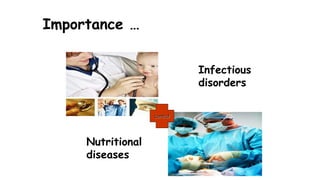
Importance …
Infectious
disorders
Nutritional
diseases
control
Importance
• 2300 hereditary diseases
• 25-40% of all cases treated by
health services
• Explain incidence ,cause and
clustering of cases in populations
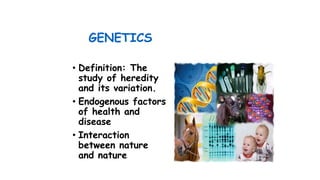
GENETICS
• Definition: The
study of heredity
and its variation.
• Endogenous factors
of health and
disease
• Interaction
between nature
and nature
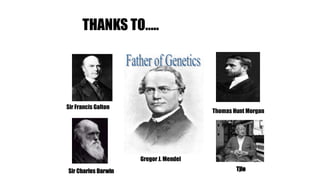
THANKS TO…..
Gregor J. Mendel
Sir Francis Galton
Thomas Hunt Morgan
Sir Charles Darwin Tjio
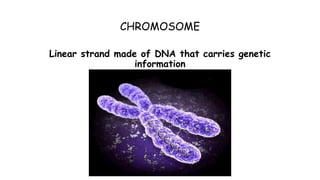
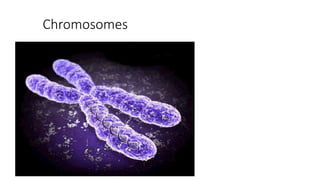
CHROMOSOME
Linear strand made of DNA that carries genetic
information
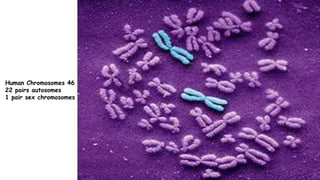
Human Chromosomes 46
22 pairs autosomes
1 pair sex chromosomes
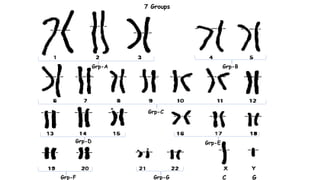
Grp-A Grp-B
Grp-C
Grp-D Grp-E
Grp-F Grp-G C G
7 Groups
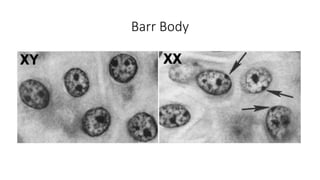
Barr Body
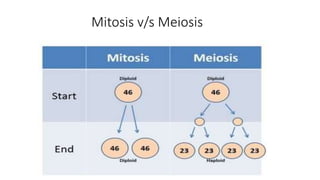
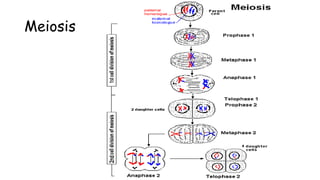
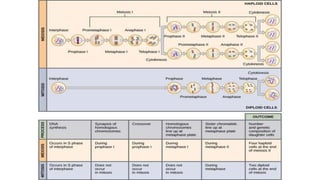
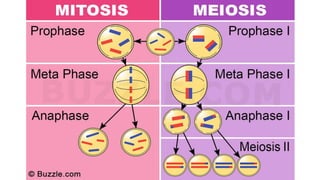
Mitosis v/s Meiosis
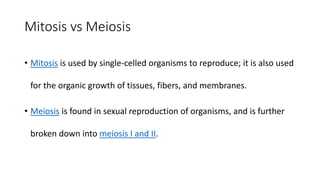
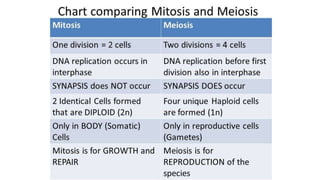
Mitosis vs Meiosis
• Mitosis is used by single-celled organisms to reproduce; it is also used
for the organic growth of tissues, fibers, and membranes.
• Meiosis is found in sexual reproduction of organisms, and is further
broken down into meiosis I and II.
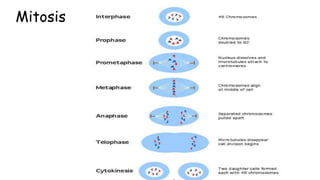
Mitosis
Meiosis
Chromosomes
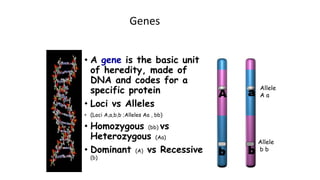
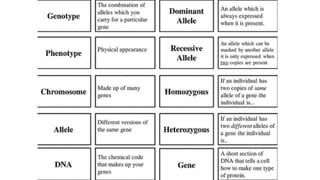
• A gene is the basic unit
of heredity, made of
DNA and codes for a
specific protein
• Loci vs Alleles
• (Loci A,a,b,b ;Alleles Aa , bb)
• Homozygous (bb) vs
Heterozygous (Aa)
• Dominant (A) vs Recessive
(b)
A a
b b
Allele
A a
Allele
b b
Genes
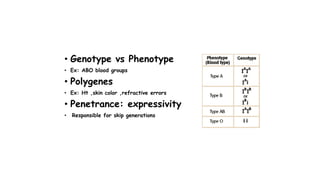
• Genotype vs Phenotype
• Ex: ABO blood groups
• Polygenes
• Ex: Ht ,skin color ,refractive errors
• Penetrance: expressivity
• Responsible for skip generations
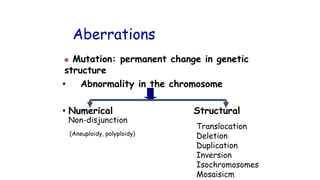
 Mutation: permanent change in genetic
structure
Aberrations
• Abnormality in the chromosome
• Numerical Structural
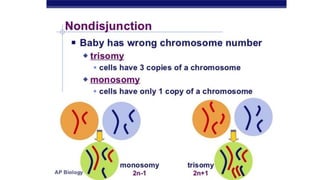
Non-disjunction
(Aneuploidy, polyploidy)
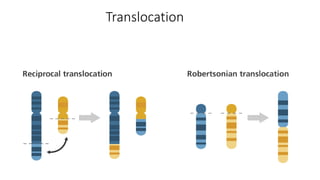
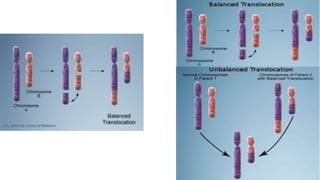
Translocation
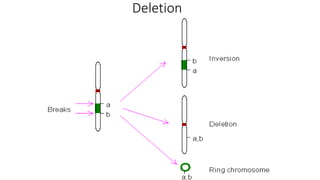
Deletion
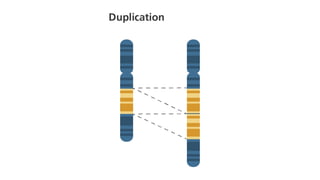
Duplication
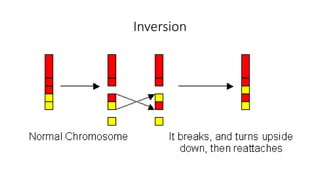
Inversion
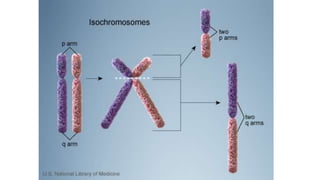
Isochromosomes
Mosaisicm
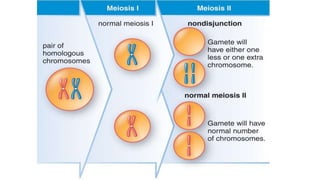
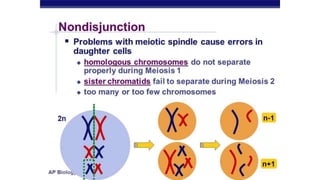
Non- Disjunction
Translocation
Inversion
Deletion
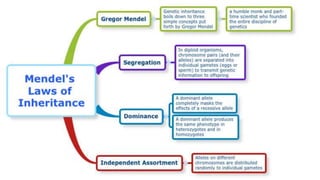
Gregor Mendel
and
Laws of Inheritance
Laws of Inheritance
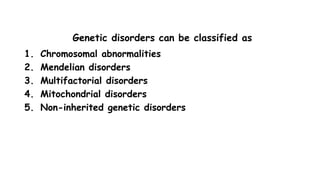
1. Chromosomal abnormalities
2. Mendelian disorders
3. Multifactorial disorders
4. Mitochondrial disorders
5. Non-inherited genetic disorders
Genetic disorders can be classified as
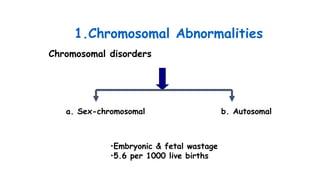
Chromosomal disorders
a. Sex-chromosomal b. Autosomal
•Embryonic & fetal wastage
•5.6 per 1000 live births
1.Chromosomal Abnormalities
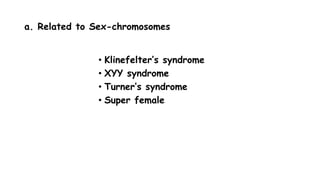
a. Related to Sex-chromosomes
• Klinefelter’s syndrome
• XYY syndrome
• Turner’s syndrome
• Super female
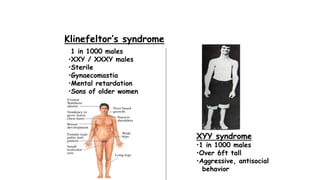
1 in 1000 males
•XXY / XXXY males
•Sterile
•Gynaecomastia
•Mental retardation
•Sons of older women
XYY syndrome
•1 in 1000 males
•Over 6ft tall
•Aggressive, antisocial
behavior
Klinefeltor’s syndrome
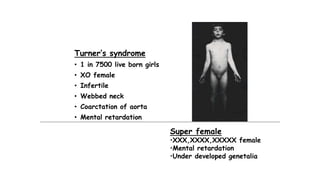
Turner’s syndrome
• 1 in 7500 live born girls
• XO female
• Infertile
• Webbed neck
• Coarctation of aorta
• Mental retardation
Super female
•XXX,XXXX,XXXXX female
•Mental retardation
•Under developed genetalia
• Down’s syndrome
• Patau’s syndrome
• Edward’s syndrome.
• Etc.,
b.Related to autosomes
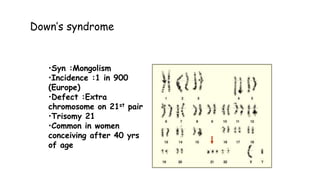
Down’s syndrome
•Syn :Mongolism
•Incidence :1 in 900
(Europe)
•Defect :Extra
chromosome on 21st pair
•Trisomy 21
•Common in women
conceiving after 40 yrs
of age
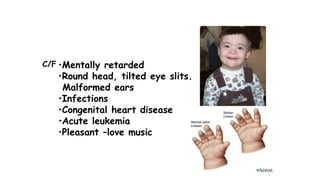
•Mentally retarded
•Round head, tilted eye slits.
Malformed ears
•Infections
•Congenital heart disease
•Acute leukemia
•Pleasant –love music
C/F
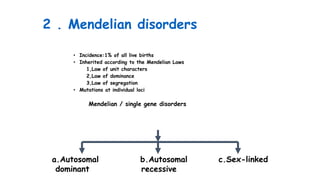
2 . Mendelian disorders
• Incidence:1% of all live births
• Inherited according to the Mendelian Laws
1,Law of unit characters
2,Law of dominance
3,Law of segregation
• Mutations at individual loci
Mendelian / single gene disorders
a.Autosomal b.Autosomal c.Sex-linked
dominant recessive
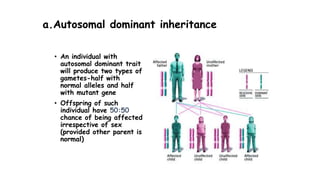
a.Autosomal dominant inheritance
• An individual with
autosomal dominant trait
will produce two types of
gametes-half with
normal alleles and half
with mutant gene
• Offspring of such
individual have 50:50
chance of being affected
irrespective of sex
(provided other parent is
normal)
• Achondroplasia
• Huntington’s chorea
• Neurofibromatosis
• Polyposis coli, familial
• Marfan’s syndrome
• Retinoblastoma
• Etc.,
Ex :
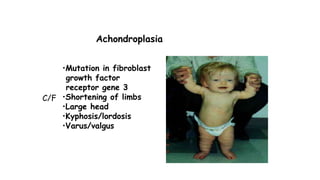
Achondroplasia
•Mutation in fibroblast
growth factor
receptor gene 3
•Shortening of limbs
•Large head
•Kyphosis/lordosis
•Varus/valgus
C/F
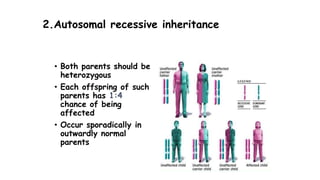
2.Autosomal recessive inheritance
• Both parents should be
heterozygous
• Each offspring of such
parents has 1:4
chance of being
affected
• Occur sporadically in
outwardly normal
parents
Ex :
• Cystic fibrosis
• Phenylketoneuria
• Albinism
• Tay-sachs disease
• Alkaptonuria
• Fibrocystic disease of pancreas
• Haemoglobinopathies
• Etc ,.
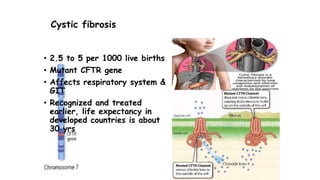
Cystic fibrosis
• 2.5 to 5 per 1000 live births
• Mutant CFTR gene
• Affects respiratory system &
GIT
• Recognized and treated
earlier, life expectancy in
developed countries is about
30 yrs
3.Sex linked inheritance
Sex linked traits
a. Recessive sex linked b. Dominant x-linked
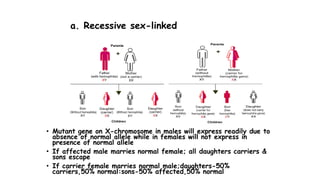
a. Recessive sex-linked
• Mutant gene on X-chromosome in males will express readily due to
absence of normal allele while in females will not express in
presence of normal allele
• If affected male marries normal female; all daughters carriers &
sons escape
• If carrier female marries normal male;daughters-50%
carriers,50% normal:sons-50% affected,50% normal
Ex :
•Haemophilia A & B
•Duchenne muscular dystrophy
•Color blindness
•G-6-PD deficiency
•Hydrocephalus
•Retinitis pigmentosa
•Etc.,
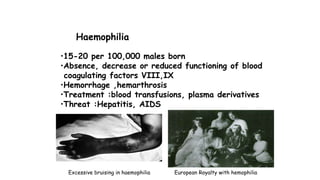
Haemophilia
•15-20 per 100,000 males born
•Absence, decrease or reduced functioning of blood
coagulating factors VIII,IX
•Hemorrhage ,hemarthrosis
•Treatment :blood transfusions, plasma derivatives
•Threat :Hepatitis, AIDS
European Royalty with hemophiliaExcessive bruising in haemophilia
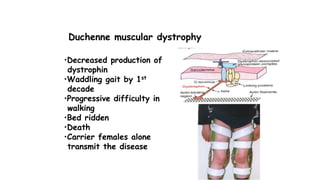
Duchenne muscular dystrophy
•Decreased production of
dystrophin
•Waddling gait by 1st
decade
•Progressive difficulty in
walking
•Bed ridden
•Death
•Carrier females alone
transmit the disease
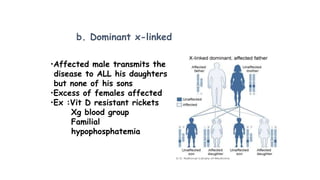
b. Dominant x-linked
•Affected male transmits the
disease to ALL his daughters
but none of his sons
•Excess of females affected
•Ex :Vit D resistant rickets
Xg blood group
Familial
hypophosphatemia

Genetics

  • 1.
  • 2.
  • 3.
    Importance • 2300 hereditarydiseases • 25-40% of all cases treated by health services • Explain incidence ,cause and clustering of cases in populations
  • 6.
    GENETICS • Definition: The studyof heredity and its variation. • Endogenous factors of health and disease • Interaction between nature and nature
  • 7.
    THANKS TO….. Gregor J.Mendel Sir Francis Galton Thomas Hunt Morgan Sir Charles Darwin Tjio
  • 8.
    CHROMOSOME Linear strand madeof DNA that carries genetic information
  • 9.
    Human Chromosomes 46 22pairs autosomes 1 pair sex chromosomes
  • 10.
  • 11.
  • 12.
  • 13.
    Mitosis vs Meiosis •Mitosis is used by single-celled organisms to reproduce; it is also used for the organic growth of tissues, fibers, and membranes. • Meiosis is found in sexual reproduction of organisms, and is further broken down into meiosis I and II.
  • 15.
  • 16.
  • 20.
  • 21.
    • A geneis the basic unit of heredity, made of DNA and codes for a specific protein • Loci vs Alleles • (Loci A,a,b,b ;Alleles Aa , bb) • Homozygous (bb) vs Heterozygous (Aa) • Dominant (A) vs Recessive (b) A a b b Allele A a Allele b b Genes
  • 23.
    • Genotype vsPhenotype • Ex: ABO blood groups • Polygenes • Ex: Ht ,skin color ,refractive errors • Penetrance: expressivity • Responsible for skip generations
  • 24.
     Mutation: permanentchange in genetic structure Aberrations • Abnormality in the chromosome • Numerical Structural Non-disjunction (Aneuploidy, polyploidy) Translocation Deletion Duplication Inversion Isochromosomes Mosaisicm
  • 25.
  • 29.
  • 33.
  • 34.
  • 35.
  • 36.
  • 37.
    1. Chromosomal abnormalities 2.Mendelian disorders 3. Multifactorial disorders 4. Mitochondrial disorders 5. Non-inherited genetic disorders Genetic disorders can be classified as
  • 38.
    Chromosomal disorders a. Sex-chromosomalb. Autosomal •Embryonic & fetal wastage •5.6 per 1000 live births 1.Chromosomal Abnormalities
  • 39.
    a. Related toSex-chromosomes • Klinefelter’s syndrome • XYY syndrome • Turner’s syndrome • Super female
  • 40.
    1 in 1000males •XXY / XXXY males •Sterile •Gynaecomastia •Mental retardation •Sons of older women XYY syndrome •1 in 1000 males •Over 6ft tall •Aggressive, antisocial behavior Klinefeltor’s syndrome
  • 41.
    Turner’s syndrome • 1in 7500 live born girls • XO female • Infertile • Webbed neck • Coarctation of aorta • Mental retardation Super female •XXX,XXXX,XXXXX female •Mental retardation •Under developed genetalia
  • 42.
    • Down’s syndrome •Patau’s syndrome • Edward’s syndrome. • Etc., b.Related to autosomes
  • 43.
    Down’s syndrome •Syn :Mongolism •Incidence:1 in 900 (Europe) •Defect :Extra chromosome on 21st pair •Trisomy 21 •Common in women conceiving after 40 yrs of age
  • 44.
    •Mentally retarded •Round head,tilted eye slits. Malformed ears •Infections •Congenital heart disease •Acute leukemia •Pleasant –love music C/F
  • 45.
    2 . Mendeliandisorders • Incidence:1% of all live births • Inherited according to the Mendelian Laws 1,Law of unit characters 2,Law of dominance 3,Law of segregation • Mutations at individual loci Mendelian / single gene disorders a.Autosomal b.Autosomal c.Sex-linked dominant recessive
  • 47.
    a.Autosomal dominant inheritance •An individual with autosomal dominant trait will produce two types of gametes-half with normal alleles and half with mutant gene • Offspring of such individual have 50:50 chance of being affected irrespective of sex (provided other parent is normal)
  • 48.
    • Achondroplasia • Huntington’schorea • Neurofibromatosis • Polyposis coli, familial • Marfan’s syndrome • Retinoblastoma • Etc., Ex :
  • 49.
    Achondroplasia •Mutation in fibroblast growthfactor receptor gene 3 •Shortening of limbs •Large head •Kyphosis/lordosis •Varus/valgus C/F
  • 50.
    2.Autosomal recessive inheritance •Both parents should be heterozygous • Each offspring of such parents has 1:4 chance of being affected • Occur sporadically in outwardly normal parents
  • 51.
    Ex : • Cysticfibrosis • Phenylketoneuria • Albinism • Tay-sachs disease • Alkaptonuria • Fibrocystic disease of pancreas • Haemoglobinopathies • Etc ,.
  • 52.
    Cystic fibrosis • 2.5to 5 per 1000 live births • Mutant CFTR gene • Affects respiratory system & GIT • Recognized and treated earlier, life expectancy in developed countries is about 30 yrs
  • 53.
    3.Sex linked inheritance Sexlinked traits a. Recessive sex linked b. Dominant x-linked
  • 54.
    a. Recessive sex-linked •Mutant gene on X-chromosome in males will express readily due to absence of normal allele while in females will not express in presence of normal allele • If affected male marries normal female; all daughters carriers & sons escape • If carrier female marries normal male;daughters-50% carriers,50% normal:sons-50% affected,50% normal
  • 55.
    Ex : •Haemophilia A& B •Duchenne muscular dystrophy •Color blindness •G-6-PD deficiency •Hydrocephalus •Retinitis pigmentosa •Etc.,
  • 56.
    Haemophilia •15-20 per 100,000males born •Absence, decrease or reduced functioning of blood coagulating factors VIII,IX •Hemorrhage ,hemarthrosis •Treatment :blood transfusions, plasma derivatives •Threat :Hepatitis, AIDS European Royalty with hemophiliaExcessive bruising in haemophilia
  • 57.
    Duchenne muscular dystrophy •Decreasedproduction of dystrophin •Waddling gait by 1st decade •Progressive difficulty in walking •Bed ridden •Death •Carrier females alone transmit the disease
  • 58.
    b. Dominant x-linked •Affectedmale transmits the disease to ALL his daughters but none of his sons •Excess of females affected •Ex :Vit D resistant rickets Xg blood group Familial hypophosphatemia

Editor's Notes

  • #34 Swapping of genetic material