Bai Saguira M. Abdulah
*
*Objectives
*Determine what is XYY Syndrome
*Find out the cause of XYY syndrome
*Determine the effect of XYY karyotype
*KEY TERMS
*ANEUPLOIDY - Condition where a copy or
copies of a chromosome are lost or gained
so the total number is more or less than
the normal 46.
*AUTOSOMES - The chromosomes that
are not sex chromosomes (i.e., those that
are the same in both sexes).
*CHROMOSOME - Structure composed of
DNA (deoxyribonucleic acid) that conveys
genetic information.
*KARYOTYPE - Chromosomal constitution of
an individual as seen in the nucleus of a
somatic cell. For a normal human male the
karyotype would be 46, XY (i.e., 46
chromosomes in total, including one X and one
Y chromosome).
*PHENOTYPE - physical characteristics of an
organism. Often not identical to the genotype
because organisms can carry genes that are
not expressed.
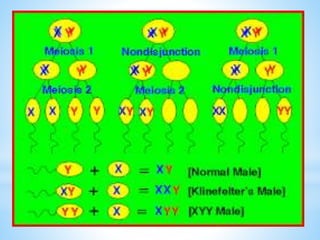
*NONDISJUNCTION – the failure of one or more pairs
of homologous chromosomes or sister chromatids to
separated normally during nuclear division.
*XYY syndrome
*XYY syndrome is a genetic condition in which
a human male has an extra male (Y)
chromosome, giving a total of 47
chromosomes instead of the more usual 46.
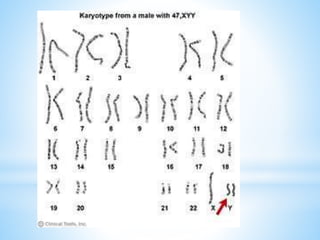
*This produces a 47,XYY karyotype, which
occurs every 1 in 1,000 male births.
*(47,XYY)-Scientific abbreviation for the
chromosomes usually found in men and boys with
XYY syndrome.
*There are 47 chromosomes, including an X
chromosome and two Y chromosomes.
*What causes XYY syndrome?
*The majority of parents with a son who has
XYY syndrome have a normal number of
chromosomes themselves. The extra Y
chromosome occurs either during the making
of the father’s sperm or shortly after an egg
and sperm come together to make a baby, at
conception. It occurs by chance and is not
caused by anything that the parents did or did
not do.
*Common characteristics
*In contrast to the other common sex
chromosome aneuploidies—47,XXX, 45,X (Turner
syndrome), and 47,XXY (Klinefelter syndrome)—
the average IQ scores of 47,XYY boys identified by
newborn screening programs were not reduced
compared to the general population.
*Learning disabilities / less than average
intelligence
*Antisocial
*Behavioral problems
*Taller than average
*Thin
*XYY diagnosis
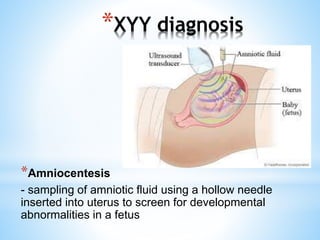
*Amniocentesis
- sampling of amniotic fluid using a hollow needle
inserted into uterus to screen for developmental
abnormalities in a fetus
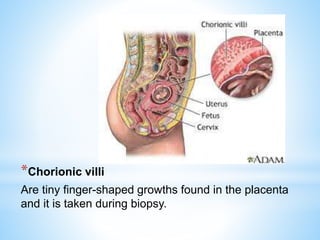
*Chorionic villi
Are tiny finger-shaped growths found in the placenta
and it is taken during biopsy.
*History
*The first recorded case of an XYY male was
reported by Avery Sandford and colleagues in
1961 at the Roswell Park Memorial Institute in
Buffalo, New York. The individual concerned was
karyotyped because his wife had given birth to a
Down syndrome child, and investigators were
looking for any chromosomal abnormalities.
*in 1965 Patricia Jacobs and colleagues
conducted a study of inmates of a Scottish
maximum security hospital. The subjects of this
study were defined as "mentally subnormal male
patients with dangerous, violent, or criminal
propensities." Jacobs found that 1 in 28 of these
subjects were XYY. This high rate, compared with
the incidence in the general population, seemed
to suggest that the XYY condition could indeed
be linked to increased violent or antisocial
behavior. Studies of other similar populations
confirmed Jacobs's findings.
*How does an extra Y
chromosome affect a person
*First year of life
*Boys born with XYY syndrome look and behave
just like other babies. They are not unusual in
weight or length. Problems at birth are no more
common than in any other children.
* Age 1 to 5 years
*Boys with XYY syndrome usually sit, crawl and
walk at the usual time, but they may be slower
to learn to talk than the average child. About
half of boys with XYY syndrome have some
delay in speech. In these boys, speech therapy
can be helpful, starting by around 3 to 4 years
of age. With help, the problem usually
disappears after a few years.
*Boys at school (5 to 16 years of age)
*Boys with XYY syndrome tend to be taller than
other boys of their age. This can mean that more
is expected from them than from other children of
the same age. They have a wide range of
abilities, just as all children do. The majority of
boys with XYY syndrome are within the normal
range for intelligence. However, research has
shown that the average intelligence of boys with
XYY syndrome is slightly lower than that of boys
with the normal number of chromosomes.
Some may have behaviour problems such as
temper tantrums, which may require specialist
support. These problems usually respond well to
treatment. Some boys are described as easily
distractible and more active physically.
*Growth in boys with XYY syndrome
*Boys with XYY syndrome grow slightly faster
than average in childhood, and their average
height is 188cm (6 feet 3 inches). Puberty is
normal and at the expected time.
*Hormones are normal and no special treatment
is needed. Homosexuality is no more common
than in the general population.
*Adulthood
*The majority of men with XYY syndrome, around
75%, are in employment, in a wide range of jobs.
*Just as many men with XYY syndrome marry, have
normal sex lives and have children, as men with
the normal number of chromosomes. They also do
not appear to be at any higher risk of having a son
with XYY syndrome themselves.
*Viewpoint …
“When the XYY type was discovered, some
researchers speculated that the presence of an
extra Y chromosome might make a male more
aggressive and prone to criminal behavior. The
popular press referred to this condition as the
"supermale" syndrome. Some early studies of
prison populations and mental institutions
seemed to confirm this hypothesis. But further
research raised questions about the initial
concept and methodology.
*Later studies of the general population, and
close studies of the maturation of XYY
individuals, cast doubt on any direct and simple
linkage between the XYY type and criminal
behavior. Initial reports of a slight deficit in
mental abilities eventually gave way to findings
of a wide spectrum of IQ scores. Researchers
have attempted to define a specific
psychological profile of XYY males, but some
researchers argue that no specific behavioral
characteristics can be related to the XYY
chromosome pattern.
*Summary
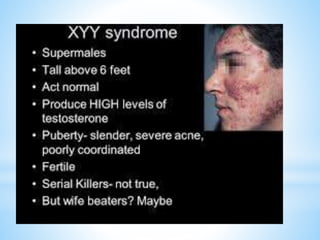
*XYY syndrome is a rare chromosomal disorder
that affects males. It is caused by the presence of
an extra Y chromosome. Males normally have one
X and one Y chromosome. However, individuals
with this syndrome have one X and two Y
chromosomes. Affected individuals are usually
very tall. Many experience severe acne during
adolescence. Additional symptoms may include
learning disabilities and behavioral problems such
as impulsivity. Intelligence is usually in the normal
range, although IQ is on average 10-15 points
lower than siblings.
*References
*http://www.scienceclarified.com/dispute/Vol-1/Are-XYY-males-more-
prone-to-aggressive-behavior-than-XY-males.html
*https://en.wikipedia.org/wiki/XYY_syndrome
*http://www.pathguy.com/xyy.htm
*http://ghr.nlm.nih.gov/condition/47xyy-syndrome
*http://www.rightdiagnosis.com/j/jacobs_syndrome/basics.htm
*http://rarediseases.org/rare-diseases/xyy-syndrome/

Xyy - a genetic disorder

  • 1.
    Bai Saguira M.Abdulah *
  • 2.
    *Objectives *Determine what isXYY Syndrome *Find out the cause of XYY syndrome *Determine the effect of XYY karyotype
  • 3.
    *KEY TERMS *ANEUPLOIDY -Condition where a copy or copies of a chromosome are lost or gained so the total number is more or less than the normal 46. *AUTOSOMES - The chromosomes that are not sex chromosomes (i.e., those that are the same in both sexes). *CHROMOSOME - Structure composed of DNA (deoxyribonucleic acid) that conveys genetic information.
  • 4.
    *KARYOTYPE - Chromosomalconstitution of an individual as seen in the nucleus of a somatic cell. For a normal human male the karyotype would be 46, XY (i.e., 46 chromosomes in total, including one X and one Y chromosome). *PHENOTYPE - physical characteristics of an organism. Often not identical to the genotype because organisms can carry genes that are not expressed.
  • 5.
    *NONDISJUNCTION – thefailure of one or more pairs of homologous chromosomes or sister chromatids to separated normally during nuclear division.
  • 6.
    *XYY syndrome *XYY syndromeis a genetic condition in which a human male has an extra male (Y) chromosome, giving a total of 47 chromosomes instead of the more usual 46. *This produces a 47,XYY karyotype, which occurs every 1 in 1,000 male births.
  • 7.
    *(47,XYY)-Scientific abbreviation forthe chromosomes usually found in men and boys with XYY syndrome. *There are 47 chromosomes, including an X chromosome and two Y chromosomes.
  • 8.
    *What causes XYYsyndrome? *The majority of parents with a son who has XYY syndrome have a normal number of chromosomes themselves. The extra Y chromosome occurs either during the making of the father’s sperm or shortly after an egg and sperm come together to make a baby, at conception. It occurs by chance and is not caused by anything that the parents did or did not do.
  • 11.
    *Common characteristics *In contrastto the other common sex chromosome aneuploidies—47,XXX, 45,X (Turner syndrome), and 47,XXY (Klinefelter syndrome)— the average IQ scores of 47,XYY boys identified by newborn screening programs were not reduced compared to the general population. *Learning disabilities / less than average intelligence *Antisocial *Behavioral problems *Taller than average *Thin
  • 14.
    *XYY diagnosis *Amniocentesis - samplingof amniotic fluid using a hollow needle inserted into uterus to screen for developmental abnormalities in a fetus
  • 15.
    *Chorionic villi Are tinyfinger-shaped growths found in the placenta and it is taken during biopsy.
  • 16.
    *History *The first recordedcase of an XYY male was reported by Avery Sandford and colleagues in 1961 at the Roswell Park Memorial Institute in Buffalo, New York. The individual concerned was karyotyped because his wife had given birth to a Down syndrome child, and investigators were looking for any chromosomal abnormalities.
  • 17.
    *in 1965 PatriciaJacobs and colleagues conducted a study of inmates of a Scottish maximum security hospital. The subjects of this study were defined as "mentally subnormal male patients with dangerous, violent, or criminal propensities." Jacobs found that 1 in 28 of these subjects were XYY. This high rate, compared with the incidence in the general population, seemed to suggest that the XYY condition could indeed be linked to increased violent or antisocial behavior. Studies of other similar populations confirmed Jacobs's findings.
  • 18.
    *How does anextra Y chromosome affect a person *First year of life *Boys born with XYY syndrome look and behave just like other babies. They are not unusual in weight or length. Problems at birth are no more common than in any other children.
  • 19.
    * Age 1to 5 years *Boys with XYY syndrome usually sit, crawl and walk at the usual time, but they may be slower to learn to talk than the average child. About half of boys with XYY syndrome have some delay in speech. In these boys, speech therapy can be helpful, starting by around 3 to 4 years of age. With help, the problem usually disappears after a few years.
  • 20.
    *Boys at school(5 to 16 years of age) *Boys with XYY syndrome tend to be taller than other boys of their age. This can mean that more is expected from them than from other children of the same age. They have a wide range of abilities, just as all children do. The majority of boys with XYY syndrome are within the normal range for intelligence. However, research has shown that the average intelligence of boys with XYY syndrome is slightly lower than that of boys with the normal number of chromosomes.
  • 21.
    Some may havebehaviour problems such as temper tantrums, which may require specialist support. These problems usually respond well to treatment. Some boys are described as easily distractible and more active physically.
  • 22.
    *Growth in boyswith XYY syndrome *Boys with XYY syndrome grow slightly faster than average in childhood, and their average height is 188cm (6 feet 3 inches). Puberty is normal and at the expected time. *Hormones are normal and no special treatment is needed. Homosexuality is no more common than in the general population.
  • 23.
    *Adulthood *The majority ofmen with XYY syndrome, around 75%, are in employment, in a wide range of jobs. *Just as many men with XYY syndrome marry, have normal sex lives and have children, as men with the normal number of chromosomes. They also do not appear to be at any higher risk of having a son with XYY syndrome themselves.
  • 24.
    *Viewpoint … “When theXYY type was discovered, some researchers speculated that the presence of an extra Y chromosome might make a male more aggressive and prone to criminal behavior. The popular press referred to this condition as the "supermale" syndrome. Some early studies of prison populations and mental institutions seemed to confirm this hypothesis. But further research raised questions about the initial concept and methodology.
  • 25.
    *Later studies ofthe general population, and close studies of the maturation of XYY individuals, cast doubt on any direct and simple linkage between the XYY type and criminal behavior. Initial reports of a slight deficit in mental abilities eventually gave way to findings of a wide spectrum of IQ scores. Researchers have attempted to define a specific psychological profile of XYY males, but some researchers argue that no specific behavioral characteristics can be related to the XYY chromosome pattern.
  • 26.
    *Summary *XYY syndrome isa rare chromosomal disorder that affects males. It is caused by the presence of an extra Y chromosome. Males normally have one X and one Y chromosome. However, individuals with this syndrome have one X and two Y chromosomes. Affected individuals are usually very tall. Many experience severe acne during adolescence. Additional symptoms may include learning disabilities and behavioral problems such as impulsivity. Intelligence is usually in the normal range, although IQ is on average 10-15 points lower than siblings.
  • 28.

Editor's Notes

  • #10 47,XYY is not inherited, but usually occurs as a random event during the formation of sperm cells. An incident in chromosome separation during anaphase II (ofmeiosis II) called nondisjunction can result in sperm cells with an extra copy of the Y-chromosome. If one of these atypical sperm cells contributes to the genetic makeup of a child, the child will have an extra Y-chromosome in each of the body's cells.[18] In some cases, the addition of an extra Y-chromosome results from nondisjunction during cell division during a post-zygotic mitosis in early embryonic development. This can produce 46,XY/47,XYY mosaics.[18]