Proponents Are:
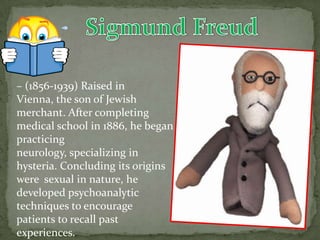
    SIGMUND FRUED

     ERIK ERIKSON

     JEAN PIAGET

 LAWRENCE KOHLBERG

 URIE BRONFENBRENNER

    LEV VYGOTSKY
– (1856-1939) Raised in
Vienna, the son of Jewish
merchant. After completing
medical school in 1886, he began
practicing
neurology, specializing in
hysteria. Concluding its origins
were sexual in nature, he
developed psychoanalytic
techniques to encourage
patients to recall past
experiences.
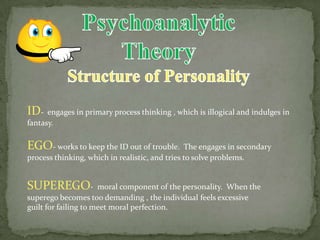
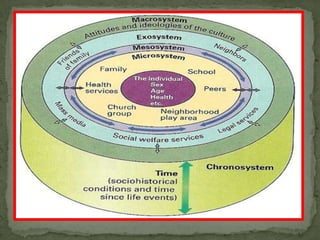
ID-   engages in primary process thinking , which is illogical and indulges in
fantasy.

EGO- works to keep the ID out of trouble.       The engages in secondary
process thinking, which in realistic, and tries to solve problems.


SUPEREGO-             moral component of the personality. When the
superego becomes too demanding , the individual feels excessive
guilt for failing to meet moral perfection.
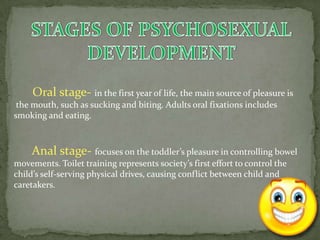
Oral stage- in the first year of life, the main source of pleasure is
 the mouth, such as sucking and biting. Adults oral fixations includes
smoking and eating.


    Anal stage- focuses on the toddler’s pleasure in controlling bowel
movements. Toilet training represents society’s first effort to control the
child’s self-serving physical drives, causing conflict between child and
caretakers.
Phallic stage-      occurs between the third and fifth years. boys
       find pleasure in self-stimulation, and compete with their
       fathers for the affection of their mothers. The Oedipus
       complex refers to sexual desires for the parent of the opposite
       sex accompanied by hostility toward the
       parent of the same sex.


Latency stage- from age 5 through puberty, sexual urges become
       suppressed as they form social relationship beyond the
       family, especially with peers.


Genital stage- begins with puberty. During adolescence,
      sexual urges can be appropriately directed toward peers of the
      opposite sex.
Goal:
      To bring to awareness unconscious
conflicts, motives, and defences so that they can
be resolved.
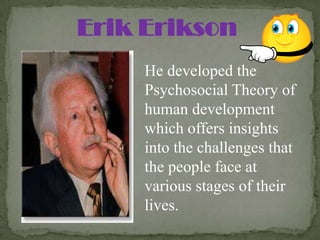
Erik Erikson
     He developed the
     Psychosocial Theory of
     human development
     which offers insights
     into the challenges that
     the people face at
     various stages of their
     lives.
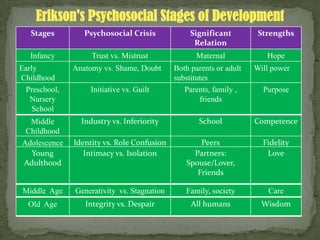
Erikson's Psychosocial Stages of Development
   Stages        Psychosocial Crisis             Significant         Strengths
                                                  Relation
   Infancy         Trust vs. Mistrust             Maternal             Hope
Early         Anatomy vs. Shame, Doubt      Both parents or adult   Will power
Childhood                                   substitutes
 Preschool,       Initiative vs. Guilt         Parents, family ,      Purpose
   Nursery                                          friends
    School
  Middle        Industry vs. Inferiority           School           Competence
 Childhood
Adolescence   Identity vs. Role Confusion          Peers              Fidelity
  Young          Intimacy vs. Isolation          Partners:             Love
Adulthood                                      Spouse/Lover,
                                                  Friends

Middle Age    Generativity vs. Stagnation      Family, society          Care
  Old Age        Integrity vs. Despair           All humans           Wisdom
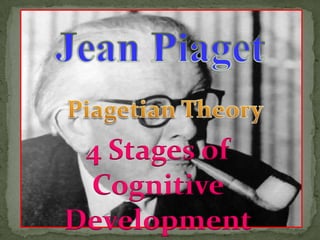
4 Stages of
 Cognitive
Development
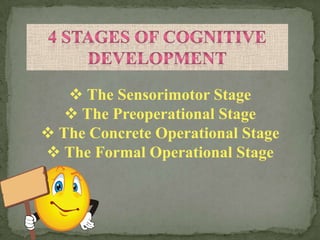
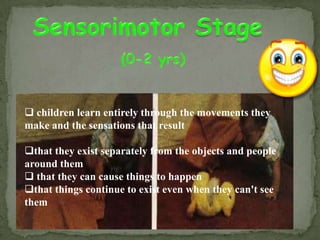
 The Sensorimotor Stage
   The Preoperational Stage
 The Concrete Operational Stage
 The Formal Operational Stage
 children learn entirely through the movements they
make and the sensations that result

that they exist separately from the objects and people
around them
 that they can cause things to happen
that things continue to exist even when they can't see
them
Preoperational Stage
                (2-7 yrs)

 once children acquire language
 they are able to use symbols to
represent objects
 thinking is still very egocentric
 they are able to understand concepts
like counting, classifying according to
similarity, and past-present-future
Concrete Operational Stage
              (7-11 yrs)
     children are able to see things from
      different points of view and to
      imagine events that occur outside
      their own lives
     order objects by size, color
      gradient, etc
Formal Operational Stage
                  (11+ yrs)

    children are able to reason in much
     more abstract ways and to test
     hypotheses using systematic logic
    there is a much greater focus on
     possibilities and on ideological issues.
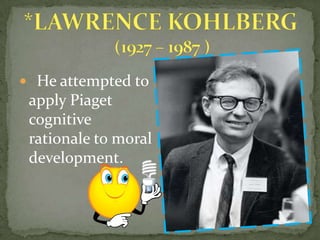
 He attempted to
 apply Piaget
 cognitive
 rationale to moral
 development.
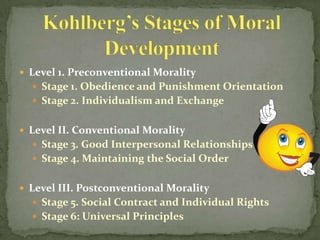
 Level 1. Preconventional Morality
   Stage 1. Obedience and Punishment Orientation
   Stage 2. Individualism and Exchange


 Level II. Conventional Morality
   Stage 3. Good Interpersonal Relationships
   Stage 4. Maintaining the Social Order


 Level III. Postconventional Morality
   Stage 5. Social Contract and Individual Rights
   Stage 6: Universal Principles
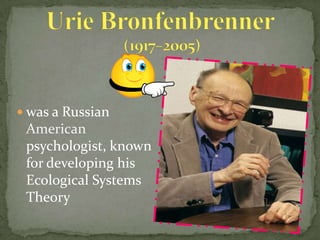
 was a Russian
 American
 psychologist, known
 for developing his
 Ecological Systems
 Theory
 Sociocultural view of development


 Holds that development reflects the
 influence of several environmental
 systems, and it identifies five environmental
 systems that an individual interacts with.
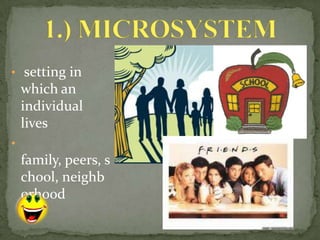
• setting in
    which an
    individual
    lives
•
    family, peers, s
    chool, neighb
    orhood
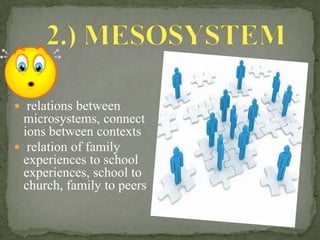
 relations between
  microsystems, connect
  ions between contexts
 relation of family
  experiences to school
  experiences, school to
  church, family to peers
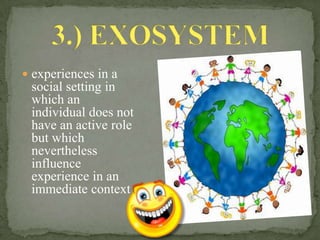
 experiences in a
 social setting in
 which an
 individual does not
 have an active role
 but which
 nevertheless
 influence
 experience in an
 immediate context
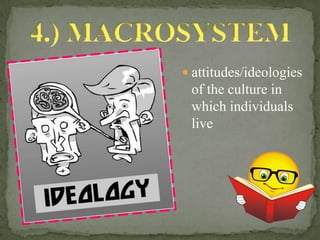
 attitudes/ideologies
 of the culture in
 which individuals
 live
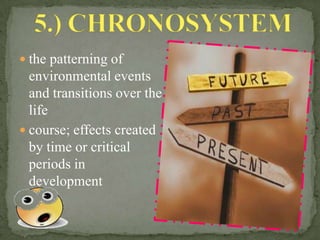
 the patterning of
  environmental events
  and transitions over the
  life
 course; effects created
  by time or critical
  periods in
  development
SOCIO-CULTURAL
    THEORY
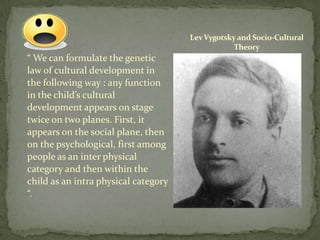
Lev Vygotsky and Socio-Cultural
                                                  Theory
“ We can formulate the genetic
law of cultural development in
the following way : any function
in the child’s cultural
development appears on stage
twice on two planes. First, it
appears on the social plane, then
on the psychological, first among
people as an inter physical
category and then within the
child as an intra physical category
“.
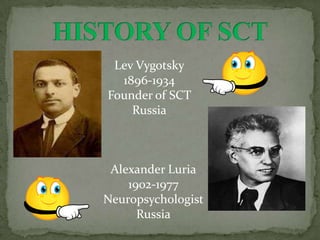
Lev Vygotsky
  1896-1934
Founder of SCT
    Russia


 Alexander Luria
    1902-1977
Neuropsychologist
      Russia
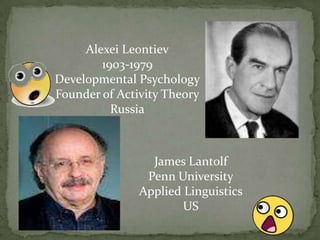
Alexei Leontiev
        1903-1979
Developmental Psychology
Founder of Activity Theory
          Russia


                 James Lantolf
                Penn University
               Applied Linguistics
                       US
Four Basic Principle Underlying The
           Vykotskian Framework
                    Language plays
Consider a
private
                    a central role in
                        mental
                                        1
speech, where        development
children speak
to themselves
to plan or guide
their own
behavior.
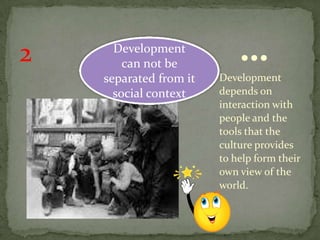
2     Development
        can not be
                            …
    separated from it   Development
      social context    depends on
                        interaction with
                        people and the
                        tools that the
                        culture provides
                        to help form their
                        own view of the
                        world.
…
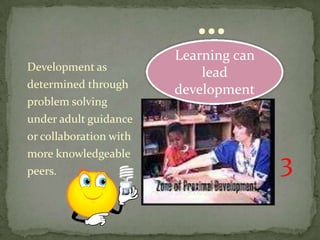
                        Learning can
Development as
                            lead
determined through
                        development
problem solving
under adult guidance
or collaboration with
more knowledgeable
peers.                                 3
Children
construct their
  knowledge
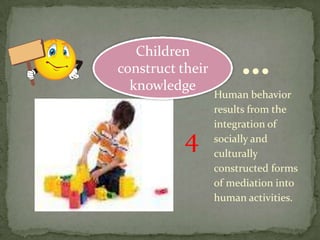
                       …
                  Human behavior
                  results from the
                  integration of
           4      socially and
                  culturally
                  constructed forms
                  of mediation into
                  human activities.
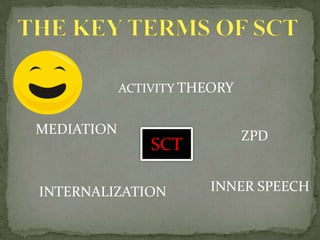
ACTIVITY THEORY


MEDIATION                     ZPD
                SCT

INTERNALIZATION        INNER SPEECH
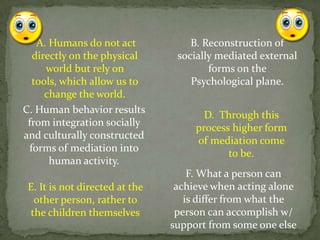
A. Humans do not act             B. Reconstruction of
  directly on the physical       socially mediated external
     world but rely on                  forms on the
  tools, which allow us to          Psychological plane.
     change the world.
C. Human behavior results              D. Through this
 from integration socially           process higher form
and culturally constructed           of mediation come
 forms of mediation into                    to be.
      human activity.
                                    F. What a person can
 E. It is not directed at the    achieve when acting alone
  other person, rather to          is differ from what the
 the children themselves         person can accomplish w/
                                support from some one else
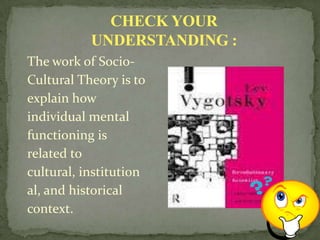
CHECK YOUR
           UNDERSTANDING :
The work of Socio-
Cultural Theory is to
explain how
individual mental
functioning is
related to
cultural, institution
al, and historical
context.

Theories of Developmental Learning(BSEII)

  • 2.
    Proponents Are:  SIGMUND FRUED  ERIK ERIKSON  JEAN PIAGET  LAWRENCE KOHLBERG  URIE BRONFENBRENNER  LEV VYGOTSKY
  • 3.
    – (1856-1939) Raisedin Vienna, the son of Jewish merchant. After completing medical school in 1886, he began practicing neurology, specializing in hysteria. Concluding its origins were sexual in nature, he developed psychoanalytic techniques to encourage patients to recall past experiences.
  • 4.
    ID- engages in primary process thinking , which is illogical and indulges in fantasy. EGO- works to keep the ID out of trouble. The engages in secondary process thinking, which in realistic, and tries to solve problems. SUPEREGO- moral component of the personality. When the superego becomes too demanding , the individual feels excessive guilt for failing to meet moral perfection.
  • 5.
    Oral stage- inthe first year of life, the main source of pleasure is the mouth, such as sucking and biting. Adults oral fixations includes smoking and eating. Anal stage- focuses on the toddler’s pleasure in controlling bowel movements. Toilet training represents society’s first effort to control the child’s self-serving physical drives, causing conflict between child and caretakers.
  • 6.
    Phallic stage- occurs between the third and fifth years. boys find pleasure in self-stimulation, and compete with their fathers for the affection of their mothers. The Oedipus complex refers to sexual desires for the parent of the opposite sex accompanied by hostility toward the parent of the same sex. Latency stage- from age 5 through puberty, sexual urges become suppressed as they form social relationship beyond the family, especially with peers. Genital stage- begins with puberty. During adolescence, sexual urges can be appropriately directed toward peers of the opposite sex.
  • 7.
    Goal: To bring to awareness unconscious conflicts, motives, and defences so that they can be resolved.
  • 8.
    Erik Erikson He developed the Psychosocial Theory of human development which offers insights into the challenges that the people face at various stages of their lives.
  • 10.
    Erikson's Psychosocial Stagesof Development Stages Psychosocial Crisis Significant Strengths Relation Infancy Trust vs. Mistrust Maternal Hope Early Anatomy vs. Shame, Doubt Both parents or adult Will power Childhood substitutes Preschool, Initiative vs. Guilt Parents, family , Purpose Nursery friends School Middle Industry vs. Inferiority School Competence Childhood Adolescence Identity vs. Role Confusion Peers Fidelity Young Intimacy vs. Isolation Partners: Love Adulthood Spouse/Lover, Friends Middle Age Generativity vs. Stagnation Family, society Care Old Age Integrity vs. Despair All humans Wisdom
  • 11.
    4 Stages of Cognitive Development
  • 12.
     The SensorimotorStage  The Preoperational Stage  The Concrete Operational Stage  The Formal Operational Stage
  • 13.
     children learnentirely through the movements they make and the sensations that result that they exist separately from the objects and people around them  that they can cause things to happen that things continue to exist even when they can't see them
  • 14.
    Preoperational Stage (2-7 yrs)  once children acquire language  they are able to use symbols to represent objects  thinking is still very egocentric  they are able to understand concepts like counting, classifying according to similarity, and past-present-future
  • 15.
    Concrete Operational Stage (7-11 yrs)  children are able to see things from different points of view and to imagine events that occur outside their own lives  order objects by size, color gradient, etc
  • 16.
    Formal Operational Stage (11+ yrs)  children are able to reason in much more abstract ways and to test hypotheses using systematic logic  there is a much greater focus on possibilities and on ideological issues.
  • 17.
     He attemptedto apply Piaget cognitive rationale to moral development.
  • 18.
     Level 1.Preconventional Morality  Stage 1. Obedience and Punishment Orientation  Stage 2. Individualism and Exchange  Level II. Conventional Morality  Stage 3. Good Interpersonal Relationships  Stage 4. Maintaining the Social Order  Level III. Postconventional Morality  Stage 5. Social Contract and Individual Rights  Stage 6: Universal Principles
  • 19.
     was aRussian American psychologist, known for developing his Ecological Systems Theory
  • 20.
     Sociocultural viewof development  Holds that development reflects the influence of several environmental systems, and it identifies five environmental systems that an individual interacts with.
  • 21.
    • setting in which an individual lives • family, peers, s chool, neighb orhood
  • 22.
     relations between microsystems, connect ions between contexts  relation of family experiences to school experiences, school to church, family to peers
  • 23.
     experiences ina social setting in which an individual does not have an active role but which nevertheless influence experience in an immediate context
  • 24.
     attitudes/ideologies ofthe culture in which individuals live
  • 25.
     the patterningof environmental events and transitions over the life  course; effects created by time or critical periods in development
  • 27.
  • 28.
    Lev Vygotsky andSocio-Cultural Theory “ We can formulate the genetic law of cultural development in the following way : any function in the child’s cultural development appears on stage twice on two planes. First, it appears on the social plane, then on the psychological, first among people as an inter physical category and then within the child as an intra physical category “.
  • 29.
    Lev Vygotsky 1896-1934 Founder of SCT Russia Alexander Luria 1902-1977 Neuropsychologist Russia
  • 30.
    Alexei Leontiev 1903-1979 Developmental Psychology Founder of Activity Theory Russia James Lantolf Penn University Applied Linguistics US
  • 31.
    Four Basic PrincipleUnderlying The Vykotskian Framework Language plays Consider a private a central role in mental 1 speech, where development children speak to themselves to plan or guide their own behavior.
  • 32.
    2 Development can not be … separated from it Development social context depends on interaction with people and the tools that the culture provides to help form their own view of the world.
  • 33.
    Learning can Development as lead determined through development problem solving under adult guidance or collaboration with more knowledgeable peers. 3
  • 34.
    Children construct their knowledge … Human behavior results from the integration of 4 socially and culturally constructed forms of mediation into human activities.
  • 35.
    ACTIVITY THEORY MEDIATION ZPD SCT INTERNALIZATION INNER SPEECH
  • 36.
    A. Humans donot act B. Reconstruction of directly on the physical socially mediated external world but rely on forms on the tools, which allow us to Psychological plane. change the world. C. Human behavior results D. Through this from integration socially process higher form and culturally constructed of mediation come forms of mediation into to be. human activity. F. What a person can E. It is not directed at the achieve when acting alone other person, rather to is differ from what the the children themselves person can accomplish w/ support from some one else
  • 37.
    CHECK YOUR UNDERSTANDING : The work of Socio- Cultural Theory is to explain how individual mental functioning is related to cultural, institution al, and historical context.