CHAPTER 1 – THE STUDY OF HUMAN DEVELOPMENT
Developmental Psychology
- refers to the discipline that attempts to describe & explain changes that
occur over time in the thought, behavior, reasoning and functioning of a
person due to biological, individiual & environmental influences.
- also known as Human Development & Lifespan Development
-lifespan is continuous
Human Development
- focuses on the scientific study of the systematic processes of change
and stability in people.
Developmental Scientists/Developmentalists
- individuals engaged in the professional study of human development
- look at ways in which people change from conception through maturity
as well as at characteristics that remain fairly stable.
Life-span Development
• Womb to tomb - conception to death
- Concept of human development as a lifelong process, which can be
studied scientifically
- Development can be either positive/negative
Debates in Human Development:
• Nature Vs. Nurture
- Nature = biological
- Nurture = environmental
◦ Twin Studies
- 1st
outcome: Nature > Nurture (considered bias)
- Final outcome: there is an interaction between 2 that can be
identified as a point on a continuum
• Pessimistic Vs. Optimistic
- Pessimistic = early experiences (ex. Freud)
- Optimistic = later choices (ex. Adler)
• Continuous Vs. Discontinuous
- Continuous = Constant/Consistent Growth
▪ Continuous Theories – assumes that development is
lifelong, multidimensional, plastic and can be affected
by many elements
- Discontinuous = Stages
▪ Stage Theories – based on observations of behavior and
the calculation of what most children can do and at what
age.
Human Development Goals:
- description, explanation, prediction and intervention
Domains of Development - interrelated (each aspect of development
affects the others)
1. Physical Development - growth of body and brain, including
patterns of change in sensory capacities, motor skills and health.
2. Cognitive Development - pattern of change in mental abilities,
such as learning, attention, memory, language, thinking,
reasoning and creativity
3. Psychosocial Development - pattern of change in emotions,
personality and social relationships
Social Construction
- A concept or practice that may appear natural and obvious to
those who accept it, but that in reality is an invention of a
particular culture/society
- Ex. division of the life span into period (childhood varies across
cultures)
Table 1 - Typical Major Developments in 8 Periods of Human
Development
- Although individual differences exist in the way people deal
with the characteristic events and issues of each period,
developmentalists suggest that certain basic needs must be met
and certain tasks mastered for normal development to occur.
Influences on Development
- Although students of development are interested in the universal
processes of development experienced by all normal human
beings, they also study individual differences in characteristics,
influences and developmental outcomes.
1. Heredity, Environment & Maturation
● Heredity - inborn traits or characteristics inherited from
the biological parents.
● Environment - the world outside the self, beginning in
the womb, and the learning that comes from experience.
(Nature vs. Nurture)
● Maturation - unfolding of a natural sequence of
physical and behavioral changes (ex. Ability to walk and
talk, brain development)
2. Contexts of Development
● Family
○ Nuclear Family - two-generational kinship,
economic and household unit consisting of one
or two parents and their biological children,
adopted children, or stepchildren.
○ Extended Family - multigenerational kinship
network of parents, children and other relatives.
● Socioeconomic Status (SES) & Neighborhood
○ Socioeconomic Status (SES) - combination of
economic and social factors describing an
individual/family, including income, education
and occupation.
- SES affects developmental processes and
outcomes indirectly, through such related factors
as the kinds of homes and neighborhoods people
live in and the quality of nutrition, medical care
and schooling available to them.
- ex. Poverty can be harmful to the physical,
cognitive, and psychosocial well-being of
children and families.
- Threats to well-being multiply if several Risk
Factors (conditions that increase the likelihood
of a negative outcome) are present.
○ The composition of neighborhood affects
children as well.
- Ex. Living in a poor neighborhood with large
numbers of unemployed people makes it less
likely that effective social support will be
available.
● Culture & Race/Ethnicity
○ Culture
- A society’s or group’s total way of life,
including customs, traditions, beliefs, values,
language & physical products (all learned
behavior, passed on from parents to children)
- Constantly changing (advanced technology)
○ Ethnic Group
- Consists of people united by a distinctive
culture, ancestry, race, religion, language, or
natural origins, which contribute to a sense of
shared identity and shared attitudes, beliefs and
values.
- Ethnic & cultural patterns affect development
by their influence on the composition of a
household, its economic and social resources,
the way its members act toward one another,
foods they eat, the way they learn, etc.
○ Race
- Identifiable biological category (social
construct)
- Still makes a difference in how individuals are
treated in the society
○ Ethnic Gloss
- Overgeneralization about an ethnic or cultural
group that obscures/blurs differences within the
group
● Historical Context
- The time in which people live
- Certain experiences, tied to time and place, affect the
course of people’s lives (longitudinal studies)
3. Normative & Nonnormative Influences
● Normative Influences - biological/environmental events
that affect many or most people in a society in similar
ways and events that touch only a certain individual.
○ Normative Age-Graded Influences
- Similar for people in a particular age group.
- Timing of biological events is fairly
predictable within a normal range
- Ex. Puberty & menopause
○ Normative History-Graded Influences
- Significant events that shape the behavior and
attitudes of a Historical Generation (group of
people strongly influenced by a major historical
event during their formative period)
- Ex. World War II
- Historical Generation is not the same as
Cohort (group of people born at about the same
time) as historical generation may contain more
than 1 cohort but cohorts are part of a historical
generation only if they experience major,
shaping historical events at a formative point in
their lives
● Nonnormative Influences
- characteristic of an unusual event that happens to a
particular person or a typical event that happens at an
unusual time of life
- unusual events that have a major impact on individual
lives because they disturb the expected sequence of the
life cycle
- They are either:
1. Typical events that happen at an atypical time of
life (death of a parent when a child is young)
2. Atypical events (surviving a plane crash)
- Sometimes, people help create their own
nonnormative life events (taking up a risky
hobby)
4. Timing of Influences
◦ Imprinting (Konrad Lorenz)
- instinctive form of learning in which, during a critical
period in early development, a young animal forms an
attachment to the first moving object it sees, usually mother.
- is the result of a Predisposition Toward Learning (readiness
of an organism’s nervous system to acquire certain
information during a brief critical period in early life)
● Critical Periods
- specific time when a given event, or its absence, has a
specific impact on development.
- If a necessary event does not occur during a critical
period of maturation, normal development will not occur
and the resulting abnormal patterns may be irreversible.
- Length is not absolutely fixed (if ducklings’ rearing
conditions are varied to slow their growth, the usual
critical period for imprinting can be extended &
imprinting may even be reversed)
- Ex. If a pregnant women contracts a disease, fetus may
show ill effects, depending on the nature of the insult,
timing and characteristics of the fetus itself
- However, critical periods in humans is controversial
because many aspects of development, even in the
physical domain, have been found to show Plasticity
(range of modifiability of performance)
- It may be more useful to think about Sensitive Periods
when a developing person is especially responsive to
certain kinds of experiences
● Sensitive Periods
- times in development when a person is particularly
open to certain kinds of experiences.
The Life-Span Developmental Approach
7 Key Principles of a Life-Span Developmental Approach:
1. Development is lifelong
- It is a lifelong process of change.
- Each period affects the other
- No period is more/less important than any other
2. Development is multidimensional
- It occurs along multiple interacting dimensions
(biological, psychological, social) each of which may
develop at varying rates
3. Development is multidirectional
- as people gain in one area, they may lose in another
4. Relative influences of biology and culture shift over the
lifespan
- process of development is influenced by both biology
and culture but the balance between these influences
changes
- Biological abilities weaken with age but cultural
supports may help compensate
5. Development involves changing resource allocations
- individuals choose to invest their resources of time,
energy, talent, money and social support in varying
ways.
- Resources may be used for: growth,
maintenance/recovery, or for dealing with loss when
maintenance & recovery are not possible
- The allocation of resources to these 3 functions changes
throughout life as the total available pool of resources
decreases
6. Development shows plasticity
- many abilities (memory, strength and endurance) can be
improved significantly with training and practice.
However, plasticity has limits that depend in part on the
various influences on development.
7. Development is influenced by the historical and cultural
context
- each person develops within multiple contexts
(circumstances/conditions defined in part by maturation
& in part by time & place)
CHAPTER 2 - THEORY AND RESEARCH
Theory
- Set of logically related concepts/statements that seek to describe
& explain development and to predict the kinds of behavior that
might occur under certain conditions
- Organize, explain & predict data (information gathered by
research)
- Helps us make sense of, and see connections between, isolated
pieces of data.
- Can be disproved but never proved, and they change to
incorporate new findings
- Research can indicate whether a theory is accurate in its
predictions but cannot conclusively show a theory to be true
Hypotheses
- Possible explanations/predictions for phenomena, used to predict
the outcome of research
- Can be tested by further research
- Research findings often suggest additional hypothesis to be
examined & provide direction for dealing with practical issues
Basic Theoretical Issues:
1. Is development Active or Reactive?
● Active Development
- people create experiences for themselves & are
motivated to learn about the world around them
- Things aren’t just happening to them, they are
involved in making their world what it is
● Reactive Development
- conceptualize the developing child as a hungry
sponge that soaks up experiences and is shaped
by this input over time
● John Locke
- Tabula Rasa - a blank slate
- How the child developed, in either
positive/negative ways, depended entirely on
experiences
● Jean Jacques Rousseau
- “Noble Savages” - children are born noble
savages who develop according to their own
positive natural tendencies if not corrupted by
society
- The debate between Locke & Rousseau led to 2
Contrasting Models of Development:
● Mechanistic Model
- people are like machines that react to
environmental input
- Machines do not operate of their own will; they
react automatically to physical forces/inputs
- Humans behavior is the same: it results from the
operation of biological parts in response to
external/internal stimuli
- If we know enough about how the human
machine is put together & the forces acting on it,
we can predict what the person will do
- Mechanistic researchers want to identify the
factors that make people behave as they do. (Ex.
To explain why some students drink too much
alcohol) - might look for environmental
influences (friends)
● Organismic Model (Rousseau - precursor)
- People are active, growing organisms that set
their own development in motion
- They initiate events; they do not just react. Thus,
the driving force for change is internal
- Environmental influences do not cause
development, though they can speed/slow it
- Development has an underlying, orderly
structure (a fertilized egg cell develops into
embryo then into fetus, it goes through a series
of changes not overtly predictable from what
came before)
- Development after birth is a progressive
sequence of stages, moving toward full
maturation.
- Ex. Why students drink too much alcohol - may
look at what kinds of situations they choose to
participate in and with whom.
2. Is development Continuous or Discontinuous?
● Continuous Development (mechanist theorists)
- Gradual & incremental
- Occurring in small incremental stages
- Development is always governed by the same
processes & involves the gradual refinement and
extension of early skills into later abilities,
allowing one to make predictions about future
characteristics on the basis of past performance
- Quantitative Change
- change in number/amount such as
height, weight or vocabulary size
- Primary characteristic is that you are
measuring fundamentally the same thing
over time, even if there might be more
or less of it
● Discontinuous Development (organismic theorists)
- marked by the emergence of new phenomena
that could not be easily predicted on the basis of
past functioning
- Development at different points in the life span
is fundamentally different in nature
- Qualitative Change
- A change in kind, structure or
organization, not just in number
- Organismic theorists are proponents of Stage
Theories (development is seen as occurring in a
series of distinct stages like stair steps)
- Each stage is different and build upon each other
- Stages cannot be skipped and development only
proceeds in a positive direction
Theoretical Perspectives
Perspectives of Human Development
1. Biological Perspectives
● Arnold Gesell (Maturational Theory)
- development unfolded in fixed sequences and was
activated by genes.
- we were born with an “internal body clock”
- on-demand parenting is necessary in the early months
▪ Maturational Account – children will go
through the same stages of development, in the
same sequence but each child will go through
the stages at their own rate. (an activity will be
learned once brain is developed)
- ex. a child who grows slowly might be cautious, even-
tempered, and patient; whereas a child who develops
more quickly might be more outgoing, happy, and quick
to react.
● John Bowlby (Attachment Theory)
- primary bond with caregivers which serve as a basis for
our future relationships
- attachment also serves to keep the infant close to the
mother, thus improving the child's chances of survival.
- not all dependencies lead to attachment
▪ Separation Anxiety
- if separation from the primary caregiver occurs
during the critical period and there is no
adequate substitute emotional care, the child will
suffer from deprivation. This will lead to
irreversible long-term consequences in the
child's intellectual, social, and emotional devt
● Konrad Lorenz (Ethological Theory)
- best known for his research of the principle of
attachment (Imprinting) , through which in some
species a bond is formed between a newborn animal and
its caregiver.
- our behavior is part of our biological structure. Just as a
child may receive certain physical characteristics passed
on from a previous generation, so to the child inherits
certain behavioral traits to survive.
● Mary Ainsworth (Attachment)
- children and infants need to develop a secure
dependence on their parents before seeking unfamiliar
situations.
▪ Strange Situation – develop to know the
attachment styles of a child
▪ Attachment – affectionate tie that one
person/animal forms between himself and
another one, a tie that binds them together in
space and endures over time.
Ainsworth’s Attachment Styles
▪ Insecure-Avoidant (Type A)
- very independent of the attachment figure
- they do not seek contact with the parent when
distressed.
- learned to accept that their emotional needs are
likely to remain unmet and continue to grow up
feeling unloved and insignificant.
- struggles with expressing their feelings and
find it hard understanding emotions
▪ Secure (Type B)
- warm & loving bond between parent &
children
- active and confident in their interaction with
others
- child showed signs of missing the mother when
she left and made efforts to reunite with her
when she returned
▪ Insecure-Ambivalent/Resistant (Type C)
- distrust caregivers and constantly seek
approval from them and they continuously
observe their surroundings for fear of being
abandoned
- emotionally dependent
▪ Disorganized
- a lack of clear attachment behavior
- often mix behaviors including avoidance and
resistance
- may develop psychopathology (adolescence)
2. Psychoanalytic Perspective
● Sigmund Freud (Psychosexual Development)
- Originator of Psychoanalytic Perspective
- Believed in Reactive development & Qualitative
changes over time
- Humans were born with a series of innate,
biologically based drives (hunger, sex,
aggression) that must be redirected to make it
possible to live in society
- People were motivated to satisfy their urges &
much of development involved learning how to
do so in socially acceptable ways
- Early experiences shaped later functioning & he
drew attention to childhood as an important
precursor to adult behavior
- There was a vast, hidden reserve to our psyche
and what we consciously know about and
experience is only the small tip of the iceberg of
who we are
- 3 Provinces of the Mind:
- Id (pleasure principle)
- Das Es/It
- Drive to seek immediate satisfaction of
their needs & desires
- When gratification is delayed, they see
themselves as separate from the outside
world
- Ego (reality principle)
- Das Ich/I
- Ego’s aim is to find realistic ways to
gratify the id that are acceptable to the
super-ego
- Superego (moralistic/idealistic
principle) (5 or 6 years old)
- Uber-ich/Over-I
- Conscience & socially approved
- Highly demanding (if standards not
met, may cause guilt & anxiety)
- Personality forms through unconscious
childhood conflicts between the inborn urges of
id and requirements of civilized life
● Erik Erikson (Psychosocial Development)
- Modified and extended Freudian theory by
emphasizing the influence of society on the
developing personality
- A pioneer in taking a life-span perspective and
believed in qualitative change
3. Learning Perspective
- maintains that development results from learning, a long
lasting change in behavior based on
experience/adaptation to the environment
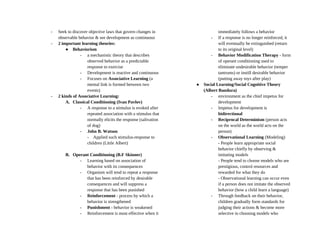
- Seek to discover objective laws that govern changes in
observable behavior & see development as continuous
- 2 important learning theories:
● Behaviorism
- a mechanistic theory that describes
observed behavior as a predictable
response to exercise
- Development is reactive and continuous
- Focuses on Associative Learning (a
mental link is formed between two
events)
- 2 kinds of Associative Learning:
A. Classical Conditioning (Ivan Pavlov)
- A response to a stimulus is evoked after
repeated association with a stimulus that
normally elicits the response (salivation
of dog)
- John B. Watson
- Applied such stimulus-response to
children (Little Albert)
B. Operant Conditioning (B.F Skinner)
- Learning based on association of
behavior with its consequences
- Organism will tend to repeat a response
that has been reinforced by desirable
consequences and will suppress a
response that has been punished
- Reinforcement - process by which a
behavior is strengthened
- Punishment - behavior is weakened
- Reinforcement is most effective when it
immediately follows a behavior
- If a response is no longer reinforced, it
will eventually be extinguished (return
to its original level)
- Behavior Modification Therapy - form
of operant conditioning used to
eliminate undesirable behavior (temper
tantrums) or instill desirable behavior
(putting away toys after play)
● Social Learning/Social Cognitive Theory
(Albert Bandura)
- environment as the chief impetus for
development
- Impetus for development is
bidirectional
- Reciprocal Determinism (person acts
on the world as the world acts on the
person)
- Observational Learning (Modeling)
- People learn appropriate social
behavior chiefly by observing &
imitating models
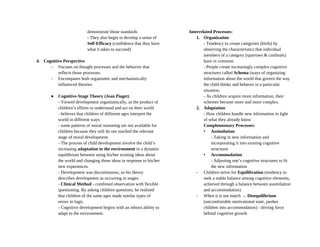
- People tend to choose models who are
prestigious, control resources and
rewarded for what they do
- Observational learning can occur even
if a person does not imitate the observed
behavior (how a child learn a language)
- Through feedback on their behavior,
children gradually form standards for
judging their actions & become more
selective in choosing models who
demonstrate those standards
- They also begin to develop a sense of
Self-Efficacy (confidence that they have
what it takes to succeed)
4. Cognitive Perspective
- Focuses on thought processes and the behavior that
reflects those processes.
- Encompases both organismic and mechanistically
influenced theories
● Cognitive-Stage Theory (Jean Piaget)
- Viewed development organismically, as the product of
children’s efforts to understand and act on their world
- believes that children of different ages interpret the
world in different ways
- some patterns of moral reasoning are not available for
children because they still do not reached the relevant
stage of moral development.
- The process of child development involve the child’s
increasing adaptation to the environment in a dynamic
equilibrium between using his/her existing ideas about
the world and changing those ideas in response to his/her
new experiences.
- Development was discontinuous, so his theory
describes development as occurring in stages.
- Clinical Method - combined observation with flexible
questioning. By asking children questions, he realized
that children of the same ages made similar types of
errors in logic.
- Cognitive development begins with an inborn ability to
adapt to the environment.
Interrelated Processes:
1. Organization
- Tendency to create categories (birds) by
observing the characteristics that individual
members of a category (sparrows & cardinals)
have in common.
- People create increasingly complex cognitive
structures called Schema (ways of organizing
information about the world that govern the way
the child thinks and behaves in a particular
situation.
- As children acquire more information, their
schemes become more and more complex.
2. Adaptation
- How children handle new information in light
of what they already know
Complementary Processes:
• Assimilation
- Taking in new information and
incorporating it into existing cognitive
structures
• Accommodation
- Adjusting one’s cognitive structures to fit
the new information
- Children strive for Equilibration (tendency to
seek a stable balance among cognitive elements;
achieved through a balance between assimilation
and accommodation)
- When it is not match → Disequilibrium
(uncomfortable motivational state, pushes
children into accommodation) - driving force
behind cognitive growth
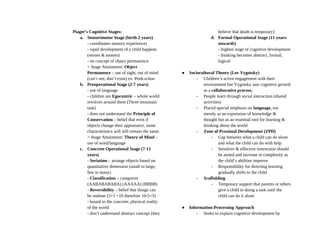
Piaget’s Cognitive Stages:
a. Sensorimotor Stage (birth-2 years)
- coordinates sensory experiences
- rapid development of a child happens
(senses & motors)
- no concept of object permanence
> Stage Attainment: Object
Permanence – out of sight, out of mind
(can’t see, don’t exist) ex. Peek-a-boo
b. Preoperational Stage (2-7 years)
- use of language
- children are Egocentric – whole world
revolves around them (Three mountain
task)
- does not understand the Principle of
Conservation – belief that even if
objects change their appearance, some
characteristics will still remain the same.
> Stage Attainment: Theory of Mind –
use of word/language
c. Concrete Operational Stage (7-11
years)
- Seriation – arrange objects based on
quantitative dimension (small to large,
few to many)
- Classification – categorize
(AABABABABA) (AAAAA) (BBBB)
- Reversibility – belief that things can
be undone (5+5 =10 therefore 10-5=5)
- bound to the concrete, physical reality
of the world
- don’t understand abstract concept (they
believe that death is temporary)
d. Formal Operational Stage (11 years-
onwards)
- highest stage of cognitive development
- thinking becomes abstract, formal,
logical
● Sociocultural Theory (Lev Vygotsky)
- Children’s active engagement with their
environment but Vygotsky saw cognitive growth
as a collaborative process.
- People learn through social interaction (shared
activities)
- Placed special emphasis on language, not
merely as an expression of knowledge &
thought but as an essential tool for learning &
thinking about the world
- Zone of Proximal Development (ZPD)
- Gap between what a child can do alone
and what the child can do with help
- Sensitive & effective instruction should
be aimed and increase in complexity as
the child’s abilities improve
- Responsibility for directing learning
gradually shifts to the child
- Scaffolding
- Temporary support that parents or others
give a child in doing a task until the
child can do it alone
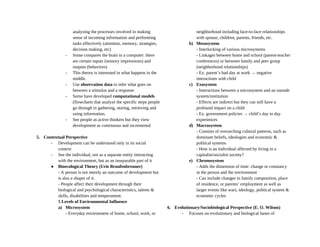
● Information-Processing Approach
- Seeks to explain cognitive development by
analyzing the processes involved in making
sense of incoming information and performing
tasks effectively (attention, memory, strategies,
decision making, etc)
- Some compares the brain to a computer: there
are certain inputs (sensory impressions) and
outputs (behaviors)
- This theory is interested in what happens in the
middle.
- Use observation data to infer what goes on
between a stimulus and a response
- Some have developed computational models
(flowcharts that analyze the specific steps people
go through in gathering, storing, retrieving and
using information.
- See people as active thinkers but they view
development as continuous and incremental
5. Contextual Perspective
- Development can be understood only in its social
context
- See the individual, not as a separate entity interacting
with the environment, but as an inseparable part of it
● Bioecological Theory (Urie Bronfenbrenner)
- A person is not merely an outcome of development but
is also a shaper of it.
- People affect their development through their
biological and psychological characteristics, talents &
skills, disabilities and temperament.
5 Levels of Environmental Influence
a) Microsystem
- Everyday environment of home, school, work, or
neighborhood including face-to-face relationships
with spouse, children, parents, friends, etc.
b) Mesosystem
- Interlocking of various microsystems
- Linkages between home and school (parent-teacher
conferences) or between family and peer group
(neighborhood relationships)
- Ex. parent’s bad day at work → negative
interactions with child
c) Exosystem
- Interactions between a microsystem and an outside
system/institution
- Effects are indirect but they can still have a
profound impact on a child
- Ex. government policies → child’s day to day
experiences
d) Macrosystem
- Consists of overarching cultural patterns, such as
dominant beliefs, ideologies and economic &
political systems
- How is an individual affected by living in a
capitalist/socialist society?
e) Chronosystem
- Adds the dimension of time: change or constancy
in the person and the environment
- Can include changes in family composition, place
of residence, or parents’ employment as well as
larger events like wars, ideology, political system &
economic cycles
6. Evolutionary/Sociobiological Perspective (E. O. Wilson)
- Focuses on evolutionary and biological bases of
behavior
- Influenced by Darwin’s theory of evolution, it draws on
findings of anthropology, ecology, genetics, ethology
and evolutionary psychology to explain the
adaptive/survival value of behavior for an
individual/species.
- Survival of the FIttest & Natural Selection (Darwin)
- Through differential reproduction success, individuals
with more adaptive characteristics pass on their traits to
future generations at higher levels than individuals who
are less adaptively fit.
- Evolved Mechanisms - behaviors that developed to
solve problems in adapting to an earlier environment.
- Ethology
- Study of the adaptive behaviors of animal species in
natural contexts.
- Such behaviors evolved through natural selection
- Focus on cross-species comparisons
• Attachment Theory (John Bowlby)
- Influenced by ethological approach
- Drew upon his knowledge of proximity-
seeking behavior in animals of different species
as he formed his ideas about attachment in
humans
- Viewed infants’ attachment to a caregiver as a
mechanism that evolved to protect them from
predators
• Evolutionary Psychology
- Related extension of the ethological approach
- Focus on humans and apply Darwinian
principles to human behavior
- Just as we have a heart specialized as a pump,
lungs specialized for air exchange, we also have
aspects of our human psychology specialized for
solving adaptive problems
- People unconsciously strive to perpetuate their
genetic legacy by seeking to maximize their
chances of having offspring who will survive to
reproduce and pass down their
CHAPTER 3 – FORMING A NEW LIFE
Fertilization (Conception)
- process by which sperm & ovum (male & female gametes/sex cells)
combine to create a single cell (Zygote)
- Zygote then duplicates itself again & again by cell division to produce
all the cells that make up a baby
Multiple Births
1. Dizygotic Twins (Fraternal Twins)
- result of 2 separate eggs being fertilized by 2 different sperm to
form 2 unique individuals
- genetically, they are like siblings who inhabit the same womb
at the same time & they can be the same/different sex
- tend to run in families and are the result of multiple eggs being
released at one time
- this tendency may have a genetic basis and seems to be passed
down from a woman’s mother
2. Monozygotic Twins (Identical Twins)
- result from the cleaving of one fertilized egg & are generally
genetically identical
- they can still differ outwardly because people are the result of
the interaction between genes & environmental influences
- ex. Twin-to-twin Transfusion Syndrome – blood vessels of
the placenta form abnormally & placenta is shared unequally
between the twins. 1 twin receives a smaller share of nutrients
than the other. Mortalitity is high but if both twins surivive, 1
twin will be significantly larger than the other.
Heredity
- genetic transmission of heritable characteristics from parents to
offspring
- science of genetics
- when ovum & sperm unite, they endow the baby with a genetic makeup
that influences a wide range of characteristics from color of eyes and hair
to health, intellect & personality
The Genetic Code
Deoxyribonucleic Acid (DNA)
- the “stuff” of heredity
- a double-helix structure of a DNA molecule resembles a long, spiraling
ladder whose steps are made of pairs of chemical units called Bases
(letters of the genetic code, which cellular machinery “reads”)
a) Adenine (A)
b) Thymine (T)
c) Cytosine (C)
d) Guanine (G)
Chromosomes
- coils of DNA that consist of smaller segments called Genes (functional
units of heredity)
- each gene is located in a definite position on its chromosome and
contains thousands of bases.
- the sequence of bases tells the cell how to make the proteins that enable
it to carry out specific functions
Human Genome
- complete sequence of genes in the human body
- every human has a unique genome
- is not meant to be a recipe for making a particular human. Rather, it is a
reference point/representative genome that shows the location of all
human genes
Meiosis
- every cell in the normal human body except the sex cells (sperm & ova)
has 23 pairs of chromosomes – 46 in all.
- through meiosis, which the sex cells undergo when they are developing,
each sex cells ends up with only 23 chromosomes (one from each pair)
- when sperm & ovum fuse at conception, they produce a zygote with 46
chromosomes (23 from father, 23 from mother)
Mitosis
- at conception, the zygote has all the biological information needed to
guide its development into a unique individual
- through mitosis, a process by which the non-sex cells divide in half
over and over again, the DNA replicates itself, so that each newly formed
cell has the same DNA structure as all the others.
- each cell division creates a genetic duplicate of the original cell, with
the same hereditary information
Mutation
- sometimes, a mistake in copying is made, and a mutation may result.
- are permanent alterations in genetic material
- when development is normal, each cell (except sex cells) continues to
have 46 chromosomes identical to those in the original zygote. As the
cells divide, they differentiate, specializing in a variety of complex
bodily functions that enable the child to grow & develop
What Determines Sex?
- at the moment of conception, the 23 chromosomes from the sperm & 23
chromosomes from the ovum form 23 pairs.
- 22 pairs are Autosomes (chromosomes that are not related to sexual
expression)
- the 23rd
pair are Sex Chromosomes (one from the father & one from
the mother) that govern the baby’s sex
Sex Chromosomes
• X Chromosomes
- sex chromosome of every ovum
• Y Chromosomes
- contains the gene for maleness (SRY Gene)
• XX – genetic female
- women tend to live longer because of extra X chromosome
(harmful changes in a gene on one X chromosome may be offset
by a backup copy on the other X chromosome)
• XY – genetic male
Patterns of Genetic Transmission
Dominant & Recessive Inheritance
• Alleles
- genes that can produce alternative expressions of a
characteristic (dimples)
- alternate versions of the same gene
- every person receives 1 maternal & 1 paternal allele for any
given trait
• Homozygous (DD, dd)
- both alleles are the same
• Heterozygous (Dd)
- both alleles are different
• Dominant Inheritance (DD, Dd)
- dominant allele is always expressed or shows up as a trait in
that person
- person will look the same whether or not he/she is
heterozygous/homozygous because the recessive allele doesn’t
show
• Recessive Inheritance (dd)
- pattern of inheritance in which a child receives identical
recessive alleles, resulting in expression of a non-dominant trait
- person must have 2 recessive alleles, one from each parent
- if a recessive trait is expressed, that person cannot have a
dominant allele
• Polygenic Inheritance
- interaction of several genes
- most traits result from this
- ex. There is no “intelligence” gene that determines whether or
not you are smart. Rather, a large number of genes work together
to determine your intellectual potential.
- although single genes often determine abnormal traits, there is
no single gene that by itself significantly accounts for individual
differences in any complex behavior
Genotypes & Phenotypes: Multifactorial Transmission
• Phenotype
- observable characteristics of a person
- product of the genotype & any relevant environmental
influences
• Genotype
- genetic makeup of a person, containing both expressed &
unexpressed characteristics
- people with different genotypes may exhibit the same
phenotype
- ex. DD will have dimples but so will Dd
- hidden alleles can also float around undetected for generations
and then be expressed if both parents carry a hidden copy
- ex. If 2 parents are both heterozygous for dimples, approx 1/4
of the children should not have dimples. Each child has a 25%
chance to inherit both of the recessive alleles.
- dimpled children: Homozygous (25%) / Heterozygous (50%)
• Multifactorial Transmission
- illustrates the action of nature & nurture influences & how they
mutually & reciprocally affect outcomes.
Epigenesis: Environmental Influence on Gene Expression
Epigenesis (“on/above the genome”)
- mechanism that turns genes on/off & determines functions of body cells
- genes are turned on/off as they are needed by the developing body or
when triggered by the environment
- refers to chemical molecules (“tags”) attached to a gene that change the
way a cell “reads” the gene’s DNA
- ex. Nutrition, smoking, sleep habits, stress & physical activity or can be
social in nature (ex. social isolation)
- may contribute to such common ailments as cancer, diabetes & heart
disease
- cells are particularly susceptible to epigenetic modification during
critical periods (puberty & pregnancy)
- epigenetic modifications, especially those that occur in early life, may
be heritable
• Genome/Genetic Imprinting
- one example of epigenesis
- differential expression of certain genetic traits, depending on
whether the trait has been inherited from the mother/father
- in imprinted gene pairs, genetic information inherited from the
parents of 1 sex is activated, but the one from the other parent is
suppressed.
- when a normal pattern of imprinting is disrupted, abnormal
fetal growth/congenital growth disorders may resulting
Genetic & Chromosomal Abnormalities
Dominant or Recessive Inheritance of Defects
• Dominant Defects
- sometimes, gene for an abnormal trait is dominant
- when one parent has 1 dominant abnormal gene and 1 recessive
gene & the other parent has 2 recessive normal genes, each of
their children has a 50-50 chance of inheriting the abnormal gene
- there are 1,800 disorders known to be transmitted by dominant
inheritance (ex. Achondroplasia – type of dwarfism &
Huntington’s Disease)
- defects are less likely to be lethal at an early age than those
transmitted by recessive inheritance because any affected
children would be likely to die before reproducing. Therefore,
gene would not be passed on to the next generation & would
soon disappear from the population
• Recessive Defects
- expressed only if the child is homozygous for that gene
- child must inherit a copy of the recessive gene from each parent
- because recessive genes are not expressed if the parent is
heterozygous for that trait, it may not always be apparent that a
child is at risk for receiving 2 alleles of a recessive gene
- defects tend to be lethal at an earlier age, in contrast to
dominant defects, because recessive genes can be transmitted by
heterozygous carriers who do not themselves have the disorder.
Thus, they are able to reproduce and pass the gene to the next
generation.
• Incomplete Dominance
- a trait is not fully expressed
- the resulting phenotype is a combination of both genes
- ex. People with only 1 sickle-cell allele and 1 normal allele do
not have sickle-cell anemia with its distinctive, abnormally
shaped blood cells. Their blood cells are intermediate shape,
which shows that the sickle-cell gene for these people is
incompletely dominant.
Sex-Linked Inheritance of Defects
- certain recessive disorders affect male & female differently because
males are XY and females are XX
- Y chromosome is smaller and carries fewer genes than X chromosome
(women has a back up copy)
- more common in males than in females
- ex. Red-green color blindness, hemophilia, Duchenne muscular
dystrophy
- for a female to have this defect, father must have a “bad” copy &
mother must also be a carrier or herself have the condition
Chromosomal Abnormalities
- typically occur because of errors in cell division, resulting in an
extra/missing chromosome
- ex. Klinefelter Syndrome – extra female sex chromosome (XXY),
Turner Syndrome – missing sex chromosome (XO)
- the likelihood of errors increase in offspring of women age 35 and older
• Down Syndrome (Trisomy-21)
- chromosomal disorder characterized by moderate-to-severe
mental retardation and by such physical signs as a downward-
sloping skin fold at the inner corners of the eyes & single
horizontal line across the palm
- most common chromosomal abnormality, accounts for about
40% of all cases of moderate-severe mental retardations
- also called Trisomy-21 because it is characterized in more than
90% of cases by an extra 21st
chromosome
- brains appear nearly normal at birth but shrink in volume by
young adulthood (hippocampal area & prefrontal cortex -
resulting in cognitive dysfunction & cerebellum – problems with
motor coordination & balance)
Genetic Counseling & Testing
• Genetic Counseling
- clinical service that advises prospective parents of their
probable risk of having children with hereditary defects
CHAPTER 4 – BIRTH & PHYSICAL DEVELOPMENT DURING
THE FIRST THREE YEARS
Birth Process
• Labor
- apt term for the process of giving birth
• Parturition
- act/process of giving birth & it typically begins about 2 weeks
before delivery, when sharply rising estrogen levels stimulate the
uterus to contract & the cervix to become more flexible
- series of uterine, cervical & other changes
• Uterine Contractions
- tightening of the uterus that typically begins about 266 days
after conception
• Braxton-Hicks Contractions
- false contractions during final months of pregnancy or as early
as the 2nd
trimester, when the muscles of the uterus tighten for up
to 2 minutes
Stages of Childbirth:
1. Dilation of Cervix
- longest (typically 12-14 hours for 1st
child, shorter for next)
- regular & increasingly frequent uterine contractions (15-20
mins apart at first) cause the cervix to shorten & dilate
- at the end, contractions occur every 2-5 minutes
- lasts until the cervix is fully open (10cm or 4 inches) so the
baby can descend into the birth canal
2. Descent & Emergence of the Baby
- lasts up to 1-2 hours
- begins when the baby’s head begins to move through the cervix
into the vaginal canal & ends when the baby emerges completely
from the mother’s body
- at the end, baby is born but is till attached to the placenta in the
mother’s body by the umbilical cord, which must be cut &
clamped
3. Expulsion of the Placenta
- lasts between 10mins-1hr
- placenta & the remainder of the umbilical cord are expelled
from the mother
Electronic Fetal Monitoring – used to track fetus’s heartbeat during
labor & delivery to indicate how the fetal heart is responding to the stress
of uterine contractions (has a high false positive rate)
Cesarean Delivery
- surgically remove the baby from the uterus through an incision in the
mother’s abdomen
- used when the labor progresses too slowly, fetus seems to be in trouble
or the mother is bleeding vaginally
- also needed when the fetus is in:
• Breech Position – feet or buttocks first
• Transverse Position – lying crosswise in the uterus
• Head is too big to pass through mother’s pelvis
Natural Childbirth – seeks to prevent pain by eliminating the mother’s
fear through education about the physiology of reproduction & training
in breathing & relaxation during delivery
Prepared Childbirth – uses instruction, breathing exercises & social
support to induce controlled physical responses to uterine contractions &
reduce fear & pain
Alternative Methods of Natural/Prepared Childbirth:
• Lamaze Method (Fernand Lamaze)
- controlled breathing & relaxation of muscles as a conditioned
response to the voice of her coach (father/friend) who attends
class with her, takes part in delivery & helps with exercises
• LeBoyer Method
- quiet room under low lights to reduce stress & newborn is
gently massaged to ease crying
• Waterbirth (Michael Odent)
- submersion of laboring mother in a soothing pool of water
• Bradley Method
- most extreme which rejects all obstetrical procedures & other
medical interventions
• Other Methods
- mental imagery, massage, gentle pushing & deep breathing
Pudendal Block – local vaginal anesthesia given during 2nd
stage of
labor or if forceps are used
Analgesic – painkiller (may slow labor, cause complications & make the
baby less alert)
Doula – experienced mentor, coach, & helper who can furnish emotional
support & information and can stay at woman’s bedside throughout labor
The Newborn Baby
Neonatal Period - first 4 weeks of life
Neonate – newborn baby
Size & Appearance
• Full term babies weigh between 5 1/2 & 10 pounds and are
between 18 & 22 inches long
• Boys slightly longer & heavier than girls
• Firstborns weigh less than laterborns
• First few days, they lose as much as 10% of their body weight
because of a loss of fluids
• They begin to gain weight again at about 5th
day and are back to
birth weight by 10th-14th day
• Large head & receding chin
• Fontanels (Soft Spots)– areas on the heads where the bones of
the skull do not meet
• Lanugo – fuzzy prenatal hair (why babies are hairy)
• Vernix Caseosa (“cheesy varnish”) – oily protection against
infection that dries within the first few days
• Witch’s Milk – secretion that sometimes leak from the swollen
breasts of newborns around 3rd
day of life (was believed to have
special healing powers)
Body Systems
• Anoxia – lack of oxygen
• Hypoxia – reduced oxygen supply
• Meconium – stringy, greenish-black waste matter formed in the
fetal intestinal tract which the infants secretes during first days
• Neonatal Jaundice – skin & eyeballs look yellow because of the
immaturity of liver
Medical & Behavioral Assessment
• Apgar Scale (Dr. Virginia Apgar)
◦ Appearance (color)
◦ Pulse (heart rate)
◦ Grimace (reflex irritability)
◦ Activity (muscle tone)
◦ Respiration (breathing)
• Brazelton Neonatal Behavioral Assessment Scale (NBAS)
- Dr. T. Berry Brazelton
- about 30 minutes of neurological & behavioral test to measure
a neonate’s responses to the environment
- suitable for infants up to 2 months old
◦ Motor organization (activity level, ability to bring a hand to
the mouth)
◦ Reflexes
◦ State Changes (irritability, excitability, quiet down)
◦ Attention & Interactive Capacities (alertness, response)
◦ Central Nervous System instability (tremors, changes in skin
color)
• Neonatal Screening for Medical Conditions
- administered soon after birth that can discover defects
- children who inherit the enzyme disorder Phenylketonuria
(PKU) will become mentally retarded unless they are fed a
special diet beginning in the first 3-6 weeks of life
States of Arousal
- infant’s physiological & behavioral status at a given moment in the
periodic daily cycle of wakefulness, sleep & activity
- regulated by internal clock
Complications of Childbirth:
*birth weight & length of gestation – 2 most important predictors of an
infant’s survival & health
Low-Birth-Weight Babies (LBW)
- neonates born weighing less than 2,500 grams (5 pounds)
2 Types of LBW:
1) Preterm/Premature Infants (born early)
- babies born before the 37th
week of gestation (typical = 40
weeks)
- closely associated with being smaller
- infants delivered between 34 & 36 weeks’ gestation, tend to
weigh more & to fare better than those born earlier in gestation
but they too are at greater risk of early death/adverse effects
- involved in nearly half of neurological defects (ex. cerebral
palsy)
2) Small-for-date/Small-for-gestational-age Infants (born small)
- born at or around their due dates but are smaller than would be
expected
- weigh less than 90% of babies of the same gestational age
- small because of other reasons, like inadequate prenatal
nutrition
Factors of having Underweight Baby
1) Demographic & Socioeconomic Factors (age, place of birth,
socioeconomic status)
2) Medical Factors Predating the Pregnancy (no children/many,
short/thin, miscarriages, genetic variants)
3) Prenatal Behavioral & Environmental Factors (poor
nutrition, inadequate prenatal care, smoking, alcohol, drugs,
stress)
4) Medical Conditions Associated with the Pregnancy (vaginal
bleeding, infections, low/high BP, anemia, depression)
Immediate Treatment & Outcomes
• Isolette
- an antiseptic, temperature-controlled cib where a low-birth-
weight/preterm baby may be place & fed through tubes
- gentle massage seems to foster growth, weight gain, motor
activity, alertness & behavioral organization
• Kangaroo Care
- a method of skin-to-skin contact in which a newborn is laid
face down between the mother’s breasts for an hour or so at a
time after birth
- can hep preemis & full term infants make the adjustment from
fetal life to the jumble of sensory stimuli in the outside world
- reduce stress on the central nervous system and help with self-
regulation of sleep & activity
• Surfactant
- an essential lung-coating substance which keeps air sacks from
collapsing
- preterm babies who lack this commonly have Respiratory
Distress Syndrome
- they may breathe irregularly or stop breathing altogether
Long Term Outcomes
- a brain lipid called Docosahexaenoic Acid (DHA) is not adequately
developed in infants born before 33 weeks’ gestation and can lea to
impaired mental development
- the less LBW children weigh at birth, the lower their IQ
- behavioral & mental health problems
- impaired motor development
- environmental factors can still make a difference
- diabetes, cardiovascular disease, early death
Protective Factors – reduce the impact of early stress
• Individual Attributes (energy, sociability, intelligence)
• Affectionate ties with at least 1 supportive family member
• Rewards at school, work, place of worship that provide as sense
of meaning and control over one’s life
Postmature
- fetus not yet born as of 2 weeks after the due date or 42 weeks after the
mother’s last menstrual period
- tend to be long & thin because they have kept growing in the womb but
had an insufficient blood supply toward the end of gestation
- at risk of brain damage/death
Stillbirth
- sudden death of fetus or after 20th
week of gestation
- sometimes diagnosed prenatally; sometimes, baby’s death is discovered
during labor/delivery
- ambiguous loss
Sudden Infant Death Syndrome (SIDS) (“crib death”)
- sudden death of an infant under 1 in which the cause of death remains
unexplained after a thourough investigation that includes an autopsy.
Early Physical Development
Principles of Development
• Cephalocaudal Principle (topdown)
- because the brain grows rapidly before birth, a newborn baby’s
head is disproportionately large
- the head becomes proportionately smaller as the child grows in
height and the lower parts of the body develop
- sensory & motor development proceed according to the same
principle: they learn to use upper parts first before the lower
• Proximodistal Principle (inner to outer)
- growth & motor development proceed from the center of the
body outward
- in the womb, the hea & trunk develop before the arms & legs,
then the hands and feet & then the fingers and toes
- during infanchy & early childhood, the limbs continue to grow
faster than hands & feet
- babies learn to use the parts of their bodies closest to the center
of their body before they learn to use the outermost parts
Growth Patterns
- children grow faster duting the first 3 years, especially during first few
months, than they ever will again
- teething usually begins around 3/4 months, when infants begin
grabbing almost everything in sight to put into their mouths but the first
tooth may not actually arrive until sometime between 5 & 9 months or
even later.
- by the 1st
birthday, babies generally have 6-8 teeth
- by age 2 1/2 they have a mouthful of 20
Nutrition
Breastfeed or Bottle?
- feeding a baby is an emotional as well as a physical act
Breastfeeding
- almost always best for infants & mothers
- it is recommended that babies be exclusively breast-fed for 6 months
- should begin immediately after birth and should continue for at least 1
year, longer if mother & baby wish
• Iron-fotified Formula
- only acceptable alternative to breast milk
- based on either cow’s milk or soy protein and contains
supplemental vitamins and minerals
- infants weaned during the 1st
year should receive this
- at 1 year, babies can switch to cow’s milk
- inadvisable if mother is infected with AIDS or any other infectious
illnes, untreated tuberculosis, exposed to radiation or drugs
The Brain & Reflex Behavior
Central Nervous System (CNS)
- brain & spinal cord & of growing peripheral network of nerves
extending to every part of the body
- Spinal Cord – bundle of nerves running through the backbone
- through this network, sensory messages travel to the brain and motor
commands travel back
Building the Brain
- the brain at birth is only about 1/4 – 1/3 of its eventual adult volume
- by age 6, it is almost adult size, but specific parts of the brain continue
to grow & develop functionally into adulthood
• Brain Growth Spurts
- fits and starts where brain’s growth occurs
- about 3 weeks after conception, the brain gradually develops from a
long hollow tube into a spherical mass of cells
Major Parts of the Brain (Diagram)
• Beginning about 3 weeks after conception, the brain gradually
develops from a long hollow tube into a spherical mass of cells
• By birth, the growth spurt of the spinal cord & brain stem has
nearly run its course
• Cerebellum grows fastest during the 1st
year of life
• Cerebrum (largest part of the brain) is divided to right & left
hemispheres each with specialized functions (Lateralization)
◦ Left Hemisphere – language & logical thinking
◦ Right Hemisphere – visual & spatial functions (mapping &
drawing)
• Corpus Callosum (tough band of tissue that allows them to
share information & coordinate commands)
• All the major sensory, motor & cognitive milestones of infancy
& toddlerhood reflect the rapid development of the brain,
particularly the Cerebral Cortex
Brain Cells
• Brain is composed of:
◦ Neurons (nerve cells)
- send & receive information
- cell bodies w/ a nucleus (center) composed of DNA
(contains the cell’s genetic programming)
◦ Glial (glial cells)
- nourish & protect the neurons (support system)
• Beginning in 2nd
month of gestation, an estimated 250,000
immature neurons are produced every minute through mitosis
(cell division)
• As the neurons multiply & develop connections, they undergo:
◦ Integration – neurons that control various groups of
muscles coordinate their activities
◦ Differentiation – each neuron takes on a specific,
specialized structure & function
• Cell Death
- as early experience shapes the brain, the paths are selected &
unused paths are pruned away
- a way to calibrate the developing brain to the local environment
& help it work more efficiently
- begins during prenatal period & continues after birth
• Only about half the neurons originally produced survive &
function in adulthood
• Glia
- credited for efficiency of neural communication which coat the
neural pathways with a fatty substance called Myelin
• Myelination
- enables signals to travel faster & more smoothly
- begins about halfway through gestation in some parts and
continues into adulthood
◦ Touch – first sense to develop (myelinated by birth)
◦ Visual – slower to mature (begins at birth & continues
during the first 5 months of life)
◦ Hearing – myelinated as early as 5th
month of gestation but
the process is not complete until about age 4
◦ Parts of the cortex that control attention & memory – not
fully myelinated until young adulthood
◦ Hippocampus – continues to increase until at least 70 years
◦ Sensory & motor pathways – before birth in the spinal cord
& after birth in cerebral cortex (may account for the
appearance & disappearance of early reflexes, a sign of
neurological organization & health)
Reflex Behavior
- automatic, involuntary, innate responses to stimulation
- controlled by lower brain centers that govern other involuntary
processes such as breathing & heart rate
• Primitive Reflexes (sucking, rooting for the nipple)
Infant Reflexes
• Rooting
- basic survival instinct
- helps the infant find onto a bottle/breast to begin feeding
- when you gently stroke the corner of the baby’s mouth, they
instinctively turn their head towards it.
• Sucking
- when something touches a baby’s palate, he/she will suck it.
- helps the infant get the food
• Moro/Startle
- sudden noises/movements will make the baby’s head shift
position abruptly and he/she will extend his arms and legs and
neck and then rapidly bring his arms together. He may even cry
uncontrollably.
- Swaddling – technique to lessen moro reflex, a traditional
practice of wrapping a baby’s body up gently in a light,
breathable blanket to help them feel calm & sleepy. (fetal
position)
• Righting/Labyrinthe
- correct the orientation of the body when it is taken out of its
normal position (aligned head & spinal cord)
• Tongue Thrust/Extrusion (4-7 months)
- touching the tip of the tongue, causing the tongue to “thrust” or
stick out of the mouth
- to prevent choking
• Withdrawal
- spinal reflex to protect the body from damaging stimuli
- attempt to avoid pain; self-protection
• Fencing/Tonic Neck
- when a baby’s head is turned to one side, arm on that side
stretches out and the opposite arm bends up at the elbow.
- hands should always be seen to develop hand-eye coordination
• Grasp (Darwinian)
- stroking the palm of a baby’s hand causes the baby to close his
fingers in a grasp
- changed in voluntary behavior as we grow older (to allow
transfer of objects)
> Palmar Grasp – palm/hands
> Plantar Grasp – feet
>Pincer Grasp (9 months) – forefinger/middle finger and
thumb together to pinch or grasp an object.
• Babinski
- toe will fan out and curl when the sole of the foot is stroked
from heel to toe
• Babkin
- both of baby’s palms are stroked at once
• Stepping
- legs move in stepping like motions when feet touch a smooth
surface
- changed in voluntary behavior as we grow older
• Sitting (5-9 months)
• Locomotor
- walking & swimming reflexes
Early Sensory Capacities
• Touch
- first sense to develop & most mature sensory system for the
first several months
• Smell
- preference for pleasant odors seems to be learned in utero &
during the first few days after birth & the odors transmitted
through the mother’s breast milk may further contribute to this
learning
• Taste
- certain taste preferences seem to be largely innate
- newborns prefer sweet tastes to sour, bitter or salty (breast milk
is sweet)
• Hearing
- functional before birth; fetuses respond to sounds & seem to
learn to recognize them
• Sight
- least developed sense at birth
- neonate’s eyes focus best from about 1 foot away (distance
from the face of a person holding it)
- binocular vision does not develop until 4/5 months
Motor Development
• Systems of Action
- increasingly complex combinations of motor skills, which
permit a wider/more precise range of movement & more control
of the environment
• Denver Developmental Screening Test
- used to chart progress between ages 1 month-6 years to identify
children who are not developing normally
- measures:
◦ Gross motor skills (using large muscles)
◦ Fine motor skills (using small muscles)
- also assesses language, personality & social development
Social Referencing
- infants learn to look to caregivers for clues as to whether a situation is
secure or frightening
Walking – major motor achievement of infancy
Visual Guidance – use of the eyes to guide movements of the hands or
other parts of the body
Depth Perception – ability to perceive objects & surfaces 3-
dimensionally
Haptic Perception – ability to acquire information about properties of
objects, such as size, weight & texture, by handling them
Ecological Theory of Perception (Eleanor & James Gibson)
• Aims to know if babies would willingly crawl over the deep end
of the visual cliff when urged to do so by their mothers
• Visual Cliff – apparatus designed to give an illusion of depth &
used to assess depth perception in infants
• Locomotor development depends on infants’ increasing
sensitivity to the interaction between their changing physical
characteristics & new and varied characteristics of their
environment
• “Learning to learn”
- outcome of both perception & action
- involves visual & manual exploration, testing alternatives &
flexible problem solving
- what worked at one time may not work now
Dynamic Systems Theory (Ester Thelen)
• Holds that motor development is a dynamic process of active
coordination of multiple systems within the infant in relation to
the environment
• Behavior emerges in the moment from the self-organization of
multiple components
CHAPTER 5: COGNITIVE DEVELOPMENT DURING THE
FIRST THREE YEARS
6 Approaches on Studying Cognitive Development:
1. Behaviorist Approach
- studies the basic mechanics of learning
- concerned with how behavior changes in response to
experience
• Classical Conditioning
- person learns to make a reflex or involuntary response to a
stimulus that originally did not bring about the response
- enables infants to anticipate/predict an event before it
happens
- will become extinct if not reinforced repeatedly
• Operant Conditioning
- learning based on association of behavior with its
consequences
2. Psychometric Approach
- measures quantitative differences in abilities that make up
intelligence by using tests that indicate/predict these abilities
• Intelligence – enables people to acquire, remember and use
knowledge to understand concepts & relationships & to
solve everyday problems
• Intelligent Behavior – behavior that is goal-oriented &
adaptive to circumstances & conditions of life
• Binet-Simon Scale (Alfred Binet & Theodore Simon)
- first intelligence test
- to identify children who can’t handle academic work
• Psychometric Testing
- to measure quantitatively the factors that are thought to
make up intelligence & from the results of that
measurement, to predict future performance
• IQ (Intelligence Quotient) Test
- psychometric tests that seek to measure intelligence by
comparing a test-taker’s performance w/ standardized norms
• Because babies cannot tell us what they know & what they
think, the most obvious way to gauge their intelligence is by
assessing what they can do (Development Tests)
• Bayley Scales of Infant & Toddler Development
- developmental test designed to assess children from 1
month to 3 1/2 years
- standardized test of infants’ and toddlers’ mental & motor
development
- 5 developmental areas: cognitive, language, motor, socio-
emotional & adaptive behavior
• Behavior Rating Scale – optional, basis of
information from the child’s caregiver
• Developmental Quotients (DQ) – separate scores
that are calculated for each scale
• Home Observation for Measurement of the Environment
(HOME) – instrument to measure the influence of the home
environment on children’s cognitive growth
• Early Intervention – systematic process of planning &
providing therapeutic & educational services for families
that need help in children’s developmental needs
3. Piagetian Approach
- looks at changes/stages in the quality of cognitive functioning
- concerned with how the mind structures its activities and adapts
to the environment
• Sensorimotor Stage
- first of Piaget’s 4 stages of cognitive development
- infants learn about themselves & their world through their
developing sensory & motor activity
• Schemes – organized patterns of thought & behavior used in
particular situation
• Circular Reactions – processes in which an infant learns to
reproduce desired occurrences originally discovered by
chance
6 Substages:
a) Use of Reflexes (birth-1m)
- infants exercise their inborn reflexes & gain some
control over them
b) Primary Circular Reactions (1-4m)
- infants repeat pleasurable behaviors that first occur by
chance
c) Secondary Circular Reactions (4-8m)
- infants become more interested in the environment,
repeating actions that bring interesting results
d) Coordination of Secondary Schemes (8-12m)
- behavior is more deliberate & purposeful as they
coordinate previously learned schemes
e) Tertiary Circular Reactions (12-18m)
- shows curiosity & experimentation
f) Mental Combinations (18-24m)
- symbolic thought enables them to think & anticipate
events
• Representational Ability – capacity to store mental
images/symbols of objects & events
• Imitation – important means of learning
a) Visible Imitation – imitation with parts of one’s body
that one can see
b) Invisible Imitation – imitation with parts of one’s body
that one cannot see
c) Deferred Imitation – reproduction of an observed
behavior after the passage of time by calling up a stored
symbol for it
d) Elicited Imitation – infants/toddlers are induced to
imitate a specific series of actions they have seen but not
necessarily done before
• Object Concept
- idea that objects have their own independent existence,
characteristics & locations in space
- basis for children’s awareness that they exist apart from
objects & other people
• Object Permanence – realization that an object/person
continues to exist when out of sight
▪ Dynamic Systems Theory (Esther Telens)
- decision where to search for a hidden object is not
about what babies know; but about what they do and
why.
- one factor is how much time has elapsed between the
infant’s seeing the object hidden in a new place and the
infant’s reaching for it.
- if time is brief – the infant is more likely to reach for
the object in new location.
- if longer – the memory of having previously found the
object in the old place inclines the infant to search there
again, and that inclination grows stronger the more times
infant has found it there.
• A-not-B Error
- an incomplete or absent schema of object permanence
- looking for an object in a place where they first found it
after seeing it hidden, even if they later saw it being moved
to another place
• Symbols – intentional representations of reality
• Pictorial Competence – ability to understand the nature of
pictures
• Scale Error – momentary misperception of the relative sizes
of objects (ex. Putting hat that is too small for their heads)
• Dual Representation Hypothesis
- proposal that children under age 3 have difficulty grasping
spatial relationships because of the need to keep more than 1
mental representation in mind at the same time
- ex: a toy chair (miniature chair or chairs are for sitting in).
- According to this hypothesis, it is difficult for toddlers to
simultaneously mentally represent both the actual object and
the symbolic nature of what it stands for.
4. Information-Processing Approach
- focuses on perception, learning, memory & problem solving
- aims to discover how children process information from the
time they encounter it until they use it
• Habituation – type of learning in which familiarity/repeated
exposure with a stimulus reduces, slows or stops a response
• Dishabituation – increase in responsiveness after
presentation of new stimulus
• Visual Preference – tendency of infants to spend more time
looking at one sight than another
• Novelty Preference – tendency to prefer new sights to
familiar ones
• Visual Recognition Memory – ability to distinguish a
familiar visual stimulus from an unfamiliar one when shown
both at the same time
• Visual reaction time and visual anticipation can be measured
by the:
▪ Visual expectation paradigm.
- In this research design, a series of computer - generated
pictures briefly appears, some on the right and some on
the left side of an infant’s peripheral visual field.
- The same sequence of pictures is repeated several
times.
- The infant’s eye movements are measured to see how
quickly his or her gaze shifts to a picture that has just
appeared (visual reaction time) or to the place where the
infant expects the next picture to appear (visual
anticipation).
- These measurements are though to indicate
attentiveness and processing speed & tendency to form
expectations on the basis of experience.
• Cross-Modal Transfer
- ability to use information gained by one sense to guide
another
- ex. Negotiating a dark room by feeling for the location of
familiar objects
• Joint Attention
- when babies follow an adults’ gaze by looking or pointing
in the same direction
• Categorization
- Adults can understand that plants and animals are both
living things.
- Further more, adults understand that some dogs are pets,
that among those pets are cats and dogs, and that a
Chihuahua is a type of dog.
- These nested relationships are known as categories
(foundation of language, reasoning, problem solving &
memory)
- Infants at first seem to categorize on the basis of
perceptual features (shape, color, pattern)
- By 12-14 months, it become conceptual features (real-
world knowledge, function
- In 2 years old, language becomes a factor in ability to
categorize.
• Infants at first seem to categorize on the basis of:
a) Perceptual Features – shape, color & pattern
b) Conceptual Features – real-world knowledge, function
• Causality
- Principle/understanding that one event causes another (ex.
squeezing → quacking)
- Information-processing studies suggest that an
understanding of causality may emerge earlier, when infants
have gained experience in observing how & when objects
move, than what Piaget proposed.
- Infants 6 ½ months old seem to see a difference between
events that are the immediate cause of other events (such as
a brick striking a second brick, which is then pushed out of
position)
- Hidden causes
• Violation-of-expectation
- Because infant development research methodologies were
more limited then, they have developed a paradigm that
could ask babies the question in a different way:
- Research method in which dishabituation to a stimulus that
conflicts with experience is taken as evidence that an infant
recognizes the new stimulus as surprising.
- Begins with a familiarization phase in which infants see an
event happen normally. After becoming bored & habituated,
the event is changed in a way that conflicts with/violates
normal expectations.
- Infants showed surprise by looking longer at the
“impossible” event, indicating that the “impossible” event
violated their expectations.
- This was important to the study of object permanence
because for babies to be surprised by the carrot’s (for
example) failure to show they needed to be able to remember
that the carrot continued to exist.
5. Cognitive Neuroscience Approach
- identify what brain structures are involved in specific aspects of
cognition
• Current brain research bears out Piaget’s assumption that
neurological maturation is a major factor in cognitive
development.
• Some researchers have used brain scans to determine which
brain structures are tied to cognitive functions and to chart
developmental changes. These scans provided physical
evidence of the location of 2 separate long-term memory
systems:
a) Implicit memory (habit/skill)
- Unconscious recall, generally of habits and skills;
sometimes called procedural memory
- Ex: knowing how to tie your shoe
b) Explicit memory (Declarative Memory)
- Intentional and conscious memory, generality of facts,
names, and events or things can be stated or declared
- Delayed imitation of complex behaviors is evidence
that declarative memory is developing in late infancy
and toddlerhood.
c) Working memory
- Short-termed storage of information the brain is
actively processing or working on
- Developed the second half of the 1st
year
- ex. Calculating payments
6. Social-Contextual Approach
- examines the effects of environmental aspects of the learning
process, particularly the role of parents & other caregivers
- Influenced by Vygotsky’s sociocultural theory
• Guided participation
- Adult’s participation in a child’s activity that helps to
structure it and bring the child’s understanding of it closer to
the adult’s.
- This concept was inspired by Vygotsky’s view of learning
as a collaborative process.
- Often occurs in shared play and in ordinary, everyday
activities in which children learn informally the skills,
knowledge and values important in their culture
- Cultural differences affected the types of guided
participation the researchers observed.
Language Development
• Language
- Is the communication system based on words and grammar
- Once children know words, they can use them to represent
objects and actions.
• Prelinguistic speech
- Forerunner of linguistic speech; utterance of sounds that are not
words.
- Includes crying, cooing, babbling, and accidental and deliberate
imitation of sounds without understanding their meaning.
• Crying
- Newborn’s first means of communication.
- Different pitches, patterns, and intensities signal hunger,
sleepiness, or anger.
- Adults find crying aversive for reason-it motivates them to
find the source of the problem and fix it. Thus, crying has great
adaptive value.
• Cooing
- Between 6 weeks – 3 months, babies start cooing when they
are happy (squealing, gurgling & making vowel sounds like
“ahhh”)
• Babbling
- Repeating consonant-vowel strings (ma-ma-ma)
- Occurs between 6-10 months and is often mistaken for a
baby’s first word.
- Becomes more wordlike overtime
• Imitation
- is key to early language development.
- First, infants accidentally imitate language sounds and then
imitate themselves making these sounds.
- Generally, they are reinforced by their parents’ positive
responses, thus encouraged to produce such sounds more and
more over time.
- Then, about 9-10 months infants deliberately imitate sounds
without understanding them.
- Once they have a reportoire of sounds, they string them
together in prelinguistic speech patterns that sound like language
but seem to have no meaning.
- Finally, after infants become familiar with the sounds of words
and phrases, they begin to attach meanings to them.
• Perceiving Language Sounds and Structure
- Imitation of language sounds requires the ability to perceive
subtle differences between sounds.
- Infants’ brains seem to be preset to discriminate basic linguistic
units, perceive linguistic patterns, and categorize them as similar
or different.
- This process of sound discrimination apparently begins in the
womb.
◦ Phonemes – smallest unit of word (d, o, g)
◦ Phonology
- System of sounds
- Every language has its own unique phonology that are used
in the production of speech
- However, in time, the ongoing process of pattern perception &
categorization commits the brain’s neural networks to further
learning of the patterns of the infant’s native language &
constrains future learning of non native language patterns.
- Babies will recognize both languages if a mother speaks to it
regularly & babies will show different responses to both
languages suggesting that they know that 2 languages are
involve
- By 6-7 months, babies learned to recognize approx 40
phonemes (basic sounds) of their native languages
• Gestures
- Before babies can speak, they point.
- Pointing is important to language acquisition and serves several
functions.
- Symbolic gestures, such as blowing to mean “hot” often
emerge around the same time that babies say their first words,
and they function much like words.
- Toddlers often combine gestures with words.
• First Words
- The average baby says a first word sometime between 10 and
14 months, initiating linguistic speech.
◦ Linguistic speech
- Verbal expression designed to convey meaning.
◦ Holophrase
- Single word that conveys a complete thought.
• First Sentences
- The next important linguistic breakthrough comes when a
toddler puts two words together to express one idea.
◦ Telegraphic Speech
- Early form of sentence use consisting of only a few
essential words.
- Damma deep, for example, means “Grandma is
sweeping the floor.”
◦ Syntax
- Rules for forming sentences in a particular language.
Characteristics of Early Speech
- Early speech is characterized by:
• Oversimplification
• Underextending (car = koo-ka) and Overextending (gray-
haired man = Gampa) word meanings
• Overregularizing (Daddy goed to the store).
Classic Theories of Language Acquisition: The Nature-Nurture
Debate
- Is linguistic Ability learned or inborn?
• Learning Theory (B.F Skinner) - nurture
- language learning is based on experience & learned
associations (through the process of operant conditioning)
- babies imitate the sounds they hear adults make & are
reinforced for doing so
• Nativism (Noam Chomsky) – nature
- human brain has an innate capacity for acquiring knowledge
◦ Language Acquisition Device (LAD)
- inborn mechanism that programs children’s brains to
analyze the language they hear & to figure out its rules
- almost all children master their native language in the same
age-related sequence without formal teaching
- an inborn mechanism for sound & language processing may be
localized in the larger hemisphere of the brain (left for most)
◦ Hand-babbling - repetitive movements that are confined to
a limited area in front of the body similar to the sign-
phonetic space used in sign languages.
Influences on Early Language Development
Brain Development
• The tremendous brain growth during the early months & years is
closely linked w/ language & development
• A newborn’s cries are controlled by the brain stem & pons (the
most primitive parts of the brain & the earlies to develop)
• Repetitive babbling may emerge with the maturation of parts of
the motor cortex (controls the movements of the face & larynx)
• Language exposure helps shape the developing brain, which
helps the infant learn language
• Toddlers with large vocabularies --> brain activation tends to
focus on the Left Temporal & Parietal Lobes
• Small vocabularies --> brain activation is more scattered
• In 98% of people, the left hemisphere (controls activity on the
right side of the body) is dominant for language but the right
hemispheres participates as well
Social Interaction: The Role of Parents & Caregivers
• At the babbling stage, adults help an infant advance toward true
speech by repeating the sounds the baby makes & rewarding him
• In households where more than 1 language is spoken, babies
achieve similar milestones in each language on the same
schedule as children who hear only 1 language
• However, children learning 2 languages tend to have smaller
vocabularies in each language than children learning only 1
• Code Mixing – use of elements of 2 languages, sometimes in the
same utterance, by young children in households where both
languages are spoke
• Code Switching – ability to shift from one language to another
to match the situation, as in people who are bilingual
Child-Directed Switch
• Child-Directed Speech (CDS)
- sometimes called parentese, motherese, or baby talk
- talking to babies in slow simplified speech, high-pitched tone,
exaggerated vowel sounds & repitition
Preparing for Literacy: The Benefits of Reading Aloud
• The frequency with which caregivers read to them can influence
how well children speak & how well & soon they develop
Literacy (ability to read & write)
• Early language ability is affecter more by home environment
than genetics
3 Styles of Reading to Children:
◦ Describer – describing what is going on in the picture
◦ Comprehender – encourages the child to look more deeply
at the meaning of a story & to make inferences/predictions
◦ Performance-Oriented – reads the story straight through,
introducing the main themes beforehand & asking questions
afterward
CHAPTER 6: PSYCHOSOCIAL DEVELOPMENT DURING THE
FIRST 3 YEARS
Foundations of Psychosocial Development
• Personality
- relatively consistent blend of emotions, temperament, thought
& behavior that makes each person unique
• Psychosocial Development
- personality development intertwined with social relationships
Emotions
- subjective reactions to experience that are associated with physiological
and behavioral changes
- person’s characteristic pattern of emotional reactions begins to develop
during infancy & is a basic element of personality
First Signs of Emotions
• Crying
- most powerful way infants can communicate their needs
4 Patterns of Crying:
◦ Hunger Cry
- rhythmic cry, which is not always associated w/ hunger
◦ Angry Cry
- excess air is forced through the vocal cords
◦ Pain Cry
- sudden onset of loud crying without preliminary moaning,
sometimes followed by holding the breath
◦ Frustration Cry
- two or three drawn-out cries with no prolonged breath-
holding
• Smiling & Laughing
- earliest faint smiles occur soon after birth, apparently as a result
of subcortical nervous system activity
- frequently appear during periods of REM sleep
◦ Social Smiling
- newborns gaze at their parents & smile at them (develops
during 2nd
month)
- signals the infants’ active, positive participation in the
relationship
- Laughter = mroe common between 4-12 months
◦ Anticipatory Smiling
- infants smile at an object & then gaze at an adult while
continuing to smile
- rises sharply between 8-10 months & seems to be among
the first types of communication in which the infant refers to
an object/experience
When Do Emotions Appear?
- Emotional development is an orderly process; complex emotions unfold
from simpler ones.
- According to one model:
• First 6 months: Shows sign of contentment, interest &
distress soon after birth. (Diffusive, reflexive, mostly
physiological responses to sensory stimulation/internal
processes)
• Next 6 months or so: Early emotional states differentiate into
true emotions: Joy, surprose, sadness, disgust & then anger &
fear (reaction to events that have meaning for the infant)
• 15 to 24 months: Self-conscious emotions (embarassment,
empathy & envy) arise only after children have developed self-
awareness (cognitive understanding that they have a
recognizable identity, separate & different from the rest)
• 2 1/2 to 3 years: Self-awareness plus knowledge about their
society’s accepted standards, rules & goals. They develop Self-
evaluative emotions (pride, guilt, shame) to what is considered
socially appropriate.
Brain Growth & Emotional Development
- Emotional experiences are affected by brain development & can have
long-lasting effects on the structure of the brain
- 4 Major Shifts in Brain Organization:
a) First 3 Months:
- Differentiation of basic emotions begins as the cerebral cortex
becomes functional, bringing cognitive perceptions into play.
- REM sleep & reflexive behavior (including neonatal smile)
diminish.
b) 9 or 10 Months:
- Frontal Lobes begin to interact with the Limbic system (seat of
emotional reactions).
- Limbic structures (such as Hippocampus) become larger &
more adultlike.
- Connections between the Frontal cortex & Hypothalamus &
Limbic system (process sensory information) may facilitate the
realtionship between cognitive & emotional spheres.
- As these connections become denser & more elaborate, an
infant can experience & interpret emotions at the same time
c) 2 Years:
- Infants develop self-awareness, self-conscious emotions &
greater capacity for regulating their emotions & activities
- These changes, which coincide w/ greater phsyical mobility &
exploratory behavior, may be related to myelination of the
Frontal lobes.
d) 3 Years:
- Hormonal changes inn the autonomic nervous system
(involuntary) coincide w/ the emergence of evaluative
emotions.
- Underlying the development of such emotions as shame may
be a shift away from dominance by the sympathetic system
(prepares the body for action), as the parasympathetic system
(involved in excretion & sexual excitation) matures.
Altruistic Helping, Empathy & Social Cognition
• Altruistic Behavior
- activity intended to help another person with no expectation of
reward
- comes naturally to toddlers (2 years old)
- environment also influences how much altruism they engage in
(ex. When they don’t appear to be having trouble/needing help)
• Empathy
- ability to put oneself in another person’s place
- can be see in eary infancy (2-3 months old)
- 6 months old engage in social evaluation (valuing someone on
the basis of that persons’ treatment of others)
• Mirror Neurons
- fire when a person does something or observers someone else
doing the same thing
- by “mirroring” the activities & motivations of others, they
allow a person to see the world from someone’s pov
- may underlie empathy & altruism
• Social Cognition
- ability to understand that others have mental states & gauge
their feelings & intentions
- ways in which we process information about others
- begins in the 1st
year of life
Temperament
- early individual differences
- early-appearing, biologically based tendency to respond to the
environment in predictable ways
- characteristic disposition/style of approaching/reacting to situations
- relatively consistent & enduring
3 Main Types of Temperament:
1. Easy Children – generally happy, rhythmic in biological
functioning & accepting new experiences
2. Difficult Children – more irritable & harder to please, irregular
in biological rhythms & more intense in expressing emotion
3. Slow to Warm Up Children – mild but slow to adapt to new
people & situations
How Stable is Temperament?
- Temperament appears to be largely inborn, probably hereditary but it
doesn’t mean that it is fully formed at birth; it develops as various
emotions & self-regulatroy capacities appear & can change in response
to parental treatment & other life experienes
• Goodness of Fit
- match between a child’s temperament & the environmental
demands & constraints the child must deal with
- ex. If a very active child is expected to sit still for long periods,
tension may occur
Influences of Biology & Culture
• Behavioral Inhibition
- biologically-based that has to do with how boldly/cautiously a
child approaches unfamiliar objects & situations
- is associated with certain biological characteristics
- clearly seen when babies are presented with new stimulus:
- babies high in behavioral inhibition: become overly aroused,
pumping their arms & legs vigorously & sometimes arching their
backs (20%)
- babies low in behavioral inhibition: relaxed (40%)
- these differences may be the result of difference in physiology
• Inhibited children
- may be born with an unusually excitable amygdala (detects &
reacts to unfamiliar events)
- more likely to have thin body, narrow face & blue eyes
- higher & less variable heart rates
- pupils are dilated more
• Uninhibited children
- taller, heavier & brown eyed
Gender Differences in Infants & Toddlers
• Boys
- longer & heavier
- slightly stronger but are physically more vulnerable
- more active
- brain at birth are about 10% larger (continues in adulthood)
- play more aggressively
• Girls
- less reactive to stress & more likely to survive infancy
• 9-12 months: can tell the difference between male & female
faces (basis of hair & clothing)
• 19 months: start to use gender labels (mommies, daddies)
• 2 years: associate gender-typical toys
• Gender-typing – socialization process by which children, at an
early age, learn appropriate gender roles
Developmental Issues in Infancy
Developing Trust
• Basic Sense of Trust Vs Mistrust
- Erikson’s first stage in psychosocial development in which
infants develop a sense of the reliability of people/objects
- begins in infancy & continues until about 18 months
- ideally, babies develop a balance between trust (intimate
relationships) & mistrust (protect themselves)
- if trust predominates --> develop hope & belief that they can
fulfill their needs & obtain their desires
- if mistrust predominates --> view the world as unfriendly &
unpredictable
- Critical element in developing trust: sensitive, responsive,
consistent caregiving
• Feeding – setting for establishin the right mix of trust & mistrust
Developing Attachment
Attachment
- reciprocal, enduring emotional tie between an infant & a caregiver,
each of whom contributes to the quality of relationship
- evolutionary: attachments have adaptive value for babies, ensuring that
their psychosocial & physical needs will be met
- ethological: infants & parents are biologically predisposed to become
attached to each other & it promotes a baby’s survival
John Bowlby
- pioneer in the study of bonding in animals
- from his knowledge of Harlow’s work w/ monkeys, he became
convinced of the mother-baby bond & warned against separating mother
& baby without providing good substitute care
- attachment styles are the result of repeated interactions w/ a caregiver
- ex. Cry --> mother responds quickly = baby forms expectation
• Working models
- sets of expectation that became the blueprint for the dynamics
of the relationship
- if the mother changes the behavior repeatedly, baby may revise
the model & security attachment may change
- related to Erikson’s basic trust (secure attachment = trust,
insecure = mistrust)
Mary Ainsworth
- student of Bowlby
- diagnostic: what the infant do when the caregiver returns
• Strange Situation
- laboratory technique used to study infant attachment
- applies to children aged 10 to 24 months
3 Main Patterns of Attachment:
◦ Secure Attachment
- an infant cries/protests when the primary caregiver leaves
& actively seeks out the caregiver on his/her return
- flexible & resilient in the face of stress
- sometimes cry when a caregiver leaves but quickly obtain
the comfort once the caregiver returns
◦ Avoidant Attachment
- infant rarely cries when separated from the primary
caregivers & avoids contact on his/her return
- unaffected when caregiver leaves
◦ Ambivalent (Resistant) Attachment
- infant becomes anxious before the primary caregiver
leaves, is extremely upset during his/her absense & both
seeks & resist contact on his/her return
- shows a mix of proximity-seeking & angry behaviors
Others identified a 4th
pattern:
◦ Disorganized-Disoriented Attachment
- after separation, infant shows contradictory, repetitous or
misdirected behaviors on his/her return
- ex. Seeking closeness to the stranger instead of the mother
or showing a fear response upon the caregiver’s entry
- lack a cohesive strategy to deal w/ the stress of Strange
Situation
- most prevalent with mothers who are insensitive, intrusive,
abusive, fearful & frightening
Alternative Methods of Attachment Study
• Waters & Deane Attachment Q-Set (AQS)
- study of children in natural settings (home)
Stranger Anxiety
- wariness of strange people & places, shown by some infants during the
second half of the 1st
year
- babies rarely reacts negatively to strangers before 6 months but
commonly do by 8 or 9 months
Separation Anxiety
- distress when a familiar caregiver leaves
Mutual Regulation
- ability of both infant & caregiver to respond appropriately & sensitively
to each other’s mental & emotional states
- infants take part by sending behavioral signals (ex. Smile) that
influence the way caregivers behave toward them
- helps them learn to read others’ behavior & to respond appropriately
Social Referencing
- understanding an ambiguous situation by seeking another person’s
perception of it
- as children age, it becomes less dependent on facial expression & more
dependent on language
- 4 and & years: more likely to trust information from their mother than
from a stranger
Developmental Issues in Toddlerhood
- halfway between 1 and 2 years
The Emerging Sense of Self
• Self-Concept – sense of self; descriptive & evaluative mental
picture of one’s abilities & traits
• 3 months: pay attention to their mirror image
• 4 to 9 months: show more interest in images of others than of
themselves (perceptual discrimination)
• 4 and 10 months: when infants learn to reach, grasp & make
things happen, they experience a sense of personal agency
(realization that they can control external events)
- at about this time, infants develop self-coherence (sense of
being a physical whole w/ boundaries separate from the rest of
the world)
- occur in interaction w/ caregivers in games (peekaboo)
• 15 and 18 months: develop the foundation of the conceptual
self-awareness (conscious knowledge of the self as a distinct,
identifiable being)
• 20 to 24 months: begin to use first-person pronouns
• 19 and 30 months: apply descriptive terms & evaluative terms
to themselves
Autonomy (Self-Determination)
• Autonomy Vs Shame & Doubt
- Erikson’s 2nd
stage in which children achieve a balance
between self-determination & control by others
- shift from external control to self-control
• Toddlers begin to substitute their own judgment for their
caregivers
• Toilet training – important step toward autonomy & self-control
(so is language)
• Toddlers need adults too to set appropriate limits & shame &
doubt help them recognize the need for that
The Roots of Moral Development
• Socialization
- development of habits, skill, valies & motives shared by
responsible, productive members of a society
- compliance w/ parental expectations can be seen as first step
toward compliance w/ societel standards
• Internalization
- during socialization, process by which children accept societal
standards of conduct as their own
- they obey societal/parental dictates, not because they are aftraif
of punishment bu because they believe them to be right & true
• Self-Regulation (takes at least 3 years)
- child’s independent control of behavior to conform to
understood social expectations, even without a caregiver present
- foundation of socialization & it links all domains of
development (physical, cognitive, emotional & social)
• Maternal Sensitivity – parents’ tendency to use mental terms
when talking to the child
• Before they can control their own behavior, they may need to be
able to regulate/control their attentional processes & to
modulate negative emotions (also enables children to develop
willpower & cope w/ frustration)
• ex. May help child to be distracted to prevent stealing the
cookies temptingly cooling on the counter
• Conscience – internal standards of behavior, which usually
control one’s conduct & produce emotional discomfot when
violated
• Origins of Conscience (Konchasca):
◦ Situational Compliance
- obedience of a parent’s orders only in the presence of signs
of ongoing parental control
◦ Commited Compliance
- wholehearted obedience of a parent’s orders without
reminders or lapses
◦ Receptive Cooperation
- eager willingness to cooperate harmoniously w/ a parent in
daily interactions, including routines, chores, hygiene & play
- enables a child to be an active partner in socialization
• Constructive Conflict – involves negotiation, reasoning &
resolution that can help children develop moral understanding by
enabling them to see another pov
Contact with Other Children
• Siblings
- sibling conflict can become a vehicle for understanding social
relationships
- constructive conflict w/ siblings help children recognize each
other’s needs, wishes & pov & helps them learn how to fight,
disagree & compromise within the relationship
• Non-Siblings
- 6 to 12 months: smile, touch & babble at other babies
- 1 year: pay less attention to other people (doesn’t last long)
- 1 1/2 to 3 years: growing interest in what other children do &
an increasing understanding of how to deal w/ them
- 2 to 3 years: cooperative activity develops as social
understanding grows
- toddlers learn by Imitation
Children of Working Parents
• Relative care: 30% = grandparents; 25% = fathers; 11% = other
relatives and more than 30% = day care/preschools
• Quality of care can be measured by:
◦ Structural characteristics (staff training & ration of
children to caregivers
◦ Process characteristics (warmth, sensitivity &
responsiveness of caregivers & developmental
appropriateness of activities)
Maltreatment
Types: (same child can be a victim of more than 1 type)
• Physical abuse – injury to the body
• Neglect – failure to meet a child’s basic needs
• Sexual abuse – any sexual activity of a child & older person
• Emotional Maltreatment – rejection, terrorization, isolation,
exploitation, degradation, ridicule or failure to provide emotional
support, love & affection
- Younger children are more likely to be victims than older children
(particularly those under age 3)
• Nonorganic failure to thrive
- slowed/arresteed physical growth w/ no known medical cause,
accompanied by poor developmental & emotional functioning
- babies who do not receive nurturance & affection/neglected
- symptoms: lack of appropriate weight gain, irritability,
excessive sleepiness & fatigue, avoidance of eye contact
• Shaken baby syndrome
- shaking an infant/toddler can cause brain damage, paralysis or
death
- under 2 years old (mostly infants)
- Bronfenbrenner’s bioecological theory: abuse & neglect are not
caused by 1 thing; causes are in all those places.
- In more than 8 out of 10, perpetrators are the child’s parents, usually
the mother & 78.5% of these cases involve neglect
- 6% = other relatives; 4.4% = unmarried partners/parents
- 3 out 4 perpetrators who are family friends & neighbors commit sexual
abuse
- 2 cultural factors associated w/ child abuse: societal violence &
physical punishment of children
CHAPTER 7: PHYSICAL & COGNITIVE DEVELOPMENT IN
EARLY CHILDHOOD
Physical Development
Bodily Growth & Change
• Children grow rapidly between ages 3 and 6
• Both boys & girls typically grow about 2 to 3 inches a year
during early childhood & gain approx 4 to 6 pounds annually
Sleep Patterns & Problems
• Sleep disturbances may be caused by:
◦ accidental activation of the brain’s motor control system
◦ incomplete arousal from a deep sleep
◦ triggered by disordered breathing or restless leg movements
• Sleep Terrors – occur mostly between ages 3 & 13 and affect
boys more than girls
• Enuresis that persist beyond ages 8-10 may be a sign of poor
self-concept or other psychological problems
Brain Development
• 3 years: brain is approx 90% of adult weight
• 3-6 years: most rapid brain growth occurs in frontal areas that
regulate planning & goal setting
• 4 years: density of synapses in prefrontal cortex peaks &
myelination of pathways for hearing is completed
• 6 years: brain has attained about 95% of its peak volume
• 6-11 years: rapid brain growth occurs in areas that support
associative thinking, language & spatial relations
• Corpus Callosum
- thick band of nerve fibers that connects both hemispheres of
the brain & allows them to communicate with each other
- continues to be myelinized until 15 years old allowing more
rapid & efficient integration between hemispheres & improved
coordination of the senses, attention, arousal, speech & hearing
Motor Skills
• Gross motor skills – physical skills that involve large muscles
• Fine motor skills – physical skills that involve small muscles &
eye-hand coordination
• Systems of action – increasingly complex combinations of
skills, which permit a wider or more precise range of movement
& more control of the environment
Handedness
• Preference for using a particular hand
• Evident by about 3 years old
• Because the left hemisphere of the brain (controls right side of
the body) is usually dominant, most people favor their right side
• Boys are more likely to be left-handed than girls
Artistic Development
Individualistic Model (Kellogg’s)
• 2 years: scribble in patterns (vertical & zigzag lines)
• 3 years: draw shapes & then begin combining the shapes into
more complex designs
• 4 and 5 years: pictorial stage
• Developmental sequence occurs by processes internal to the
child; the less adult involvement the better
Vygotsky’s View:
• Development of drawing skills is occurring in the context of
social interactions
• Children pick up the features of adult drawing that are within
their zone of proximal development (ZPD)
• They also learn by looking at & talking about each other’s
drawings
Health & Safety
Obesity
• Greatest increase in prevalence is among children in low-income
families
• Can be hereditary but the main factors driving the obesity are
environmental (calorie intake & lack of exercise)
3 Factors in Preventing Obesity:
◦ Regularly eating an evening meal together as family
◦ Getting adequate amounts of sleep
◦ Watching less than 2 hours of tv a day
Undernutrition
• Underlying cause in more than half of all deaths before age 5
Food Allergies
• Abnormal immune system response to a specific food
Deaths & Accidental Injuries
• Most deaths from injuries among preschoolers occur in home
(often from fires, drowning in bathtubs, suffocation, poisoning or
falls)
Environmental Influences
Socioeconomic Status (SES)
• The lower a family’s SES, the greater a child’s risks of illness,
injury & death
Homelessness
• Results from complex circumstances that force people to choose
between food, shelter & other basic needs
Exposure to Smoking, Air Pollution, Pesticides & Lead
• Pesticide exposure is greater among children in agricultural &
inner-city families
• Children can get elevated concentrations of lead from
contaminated food/water, airborne industrial wastes of from
inhaling dust or playing w/ paint chips on places where there is
peeling lead-based paint
• Lead poisoning can interfere w/ cognitive development & can
lead to irreversible neurobiological & behavioral problems
Cognitive Development
1. Piagetian Approach: Preoperational Child
• Preoperational Stage (2 to 7 years)
- symbolic thought expands but children cannot yet use logic
- Language: most profound system of symbolic representation
Advances of Preoperational Thought
- accompanied by a growing understanding of space, causality, identities,
categorization & number
• Symbolic Function
- ability to use mental representations (words, numbers or
images) to which a child has attached meaning
- being able to think about something in the absence of sensory
or motor cues
Ways Preschoolers show Symbolic Function:
◦ Deferred Imitation
- children imitate an action at some point after having
observed it
- becomes more robust after 18 months
- related to symbolic function because it requires a child to
have kept a mental representation of an observed action
◦ Pretend Play (Fantasy/dramatic/imaginary Play)
- play involving imaginary people & situations
- children use an object to represent something else
- Language: most extensive use of symbolic function
• Objects in Space
- understanding the symbols that describe physical spaces but the
process is slow
- 3 years: most children reliably grasp the relationships between
pictures, maps or scale models & the objects/spaces they
represent
• Causality
- children cannot reason logically about cause & effect but they
reason by:
◦ Transduction – mentally link particular phenomena,
whether or not there is logically a causal relationship
- ex. They may think that their “bad” thoughts/behavior
caused their sibling’s illness
• Identities & Categorization
◦ Identities – concept that people & many things are basically
the same even if they change in outward form, size or
appearance (ex. Putting a wig = not a different person)
◦ Categorization (classification)
- requires a child to identify similarities & differences.
- 4 years: they can classify by 2 criteria (color & shape)
▪ Animism
- tendency to attribute life to objects that are not alive
- children attribute animism to items that share
characteristics w/ living things (things that move, make
sounds or have lifelike features such as eyes)
• Number
◦ Karen Wynn – suggests that infants 4 1/2 months have a
rudimentary concept of number
◦ Ordinality – concept of comparing quantities (more/less)
begins at around 9 to 11 months
◦ 4 years: most have words for comparing quantities (bigger)
and can solve simple numerical ordinality problems
◦ Cardinality
- principle in counting begins at 2 1/2 or older
- ex. When asked to count 6 items, they tend to recite the
number-names 1 to 6
◦ 5 years: can count to 20 or more & know the relative sizes
of the numbers 1-10
◦ Elementary school: develop basic number sense
Immature Aspects of Preoperational Thought
- 1 of the main characteristics of preoperational thouth is:
• Centration
- tendency to focus on 1 aspect of a situation & neglect others
- can limit child’s thinking about both social & physical
relationships
- according to Piaget, preschoolers come to illogical conclusions because
they cannot Decenter (think simultaneously about several aspects of a
situation)
- children commonly think as if they were watching a slide show w/ a
series of static frames: they focus on successive states and do not
recognize the transformation from 1 state to another
Forms of Centration:
• Egocentrism
- inability to consider another person’s pov
- Piaget used 3-mountain task to study egocentrism
- children may show egocentrism primarily in situations beyond
their immediate experience
• Conservation
- awareness that 2 objects that are equal according to a certain
measure remain equal in the face of perceptual alteration so long
as nothing has been added to/taken away from either object
- children don’t fully grasp this principle until concrete
operational stage
2 immature aspects of thought:
◦ Centration – focusing on 1 dimension only
◦ Irreversibility – failure to understand that an operation can
go in 2 or more directions
Theory of Mind
- awareness of the broad range of human mental states (beliefs, intents,
desires, dreams) & understanding that others have their own distinctive
beliefs, desires & intentions.
- according to Piaget, children younger than 6 have no theory of mind
• Thinking & Mental States
- 3 and 5 years: they come to understand that thinking goes on
inside the mind; that it can deal w/ either real/imaginary things
- preschoolers: believe that mental activity starts & stops &
have no awareness that other people think in words
- middle childhood: knows that mind is continuously active
- 11 years: realize that they cannot control their dreams
• False Beliefs & Deception
- 4 years: consistently pass false belief tasks
- 6 years: realize that 2 people who see/hear the same thing may
interpret it differently
◦ Deception
- effort to plant a false belief in someone’s mind
- children become capable of this as early as 2 or 3 years
and others at 4 or 5 years
• Appearance & Reality
- 5 or 6 years: understand the distinction between what seems to
be and what is
• Fantasy & Reality
- 18 to 3 years: learn to distinguish between real & imagined
events
- 3 years: know the difference between a real dog & dog in a
dream & between something invisible & imaginary
- Magical thinking in children ages 3 & older is a way to
explain events that don’t seem to have obvious realistic
explanations or to indulge in pleasurable pretending (declines
near the end of preschool period)
• Influences on Individual Differences in Theory of Mind
Development
- infant’s social attention significantly predicted later theory of
mind
- social competence & language development contribute to an
understanding of thoughts & emotions
- families that encourage pretend play stimulate development of
theory of mind skills
- bilingual children do better on certain theory of mind tasks
- neural activity in prefrontal cortex is necessary
2. Information-Processing Approach: Memory Development
- memory can be described as a filing system that has 3 processes:
a) Encoding
- information is prepared for long-term storage & later retrieval
- it attaches a “code”/”label” to the information so it will be
easier to find when needed
- ex. “Red” – apples, stop signs, hearts
b) Storage
- retention of information in memory for future use
- where the information is kept
c) Retrieval
- information is assessed/recalled from memory storage
3 Types of Storage:
a) Sensory Memory
- initial, brief, temporary storage of sensory information
b) Working Memory
- short-term storage of information being actively processed
- where information being encoded/retrieved is kept
- located in prefrontal cortex
- may permit the development of Executive Function
(conscious control of thoughts, emotions & actions to
accomplish goals/solve problems & enables children to plan
& carry out goal-directed mental activity)
c) Long-Term Memory
- storage of virtually unlimited capacity that holds
information for long periods
- if the information is important
a) Central executive
- controls processing operations in working memory.
- orders information encoded for transfer to long-term
memory
- retrieves information from long-term memory for
further processing
- can temporarily expand the capacity of working
memory by moving information into 2 separate
subsidiary systems while the central executive is
occupied with other tasks: verbal information &
visual-spatial images
2 Types of Retrieval:
◦ Recall – ability to reproduce material from memory
◦ Recognition – ability to identify a previously encountered
stimulus
Forming & Retaining Childhood Memories
3 Types of Childhood Memory:
a) Generic Memory
- memory that produces script of familiar routines to guide
behavior (begins at 2 years old)
◦ Script – general remembered outline of a familiar, repeated
event, used to guide behavior (ex. Riding a bus)
b) Episodic Memory
- long-term memory of specific experiences/events, linked to
time & place
- are temporary because of a child’s limited memory capacity
c) Autobiographical Memory
- memory of specific events in one’s life
- memories that have a special, personal meaning to the child
- emerges between ages 3 and 4
- slow because they can’t store in memory events about their
own lives until they develop self-concept
Influences on Memory Retention
• Social Interaction Model – children construct autobiographical
memories through conversation w/ adults about shared events
• Elaborative Talk – promotes autobiographical memory by
providing verbal labels for aspects of an event & giving it an
orderly, comprehensible structure
• Low Elaborative Style – parents repeat their own previous
statements/questions when the child gets stuck
• High Elaborative Style – parents ask a question that elicits
more information
3. Psychometric & Vygotskian Approaches: Intelligence
Intelligence – ability to learn from situations, adapt to new experiences
& manipulate abstract concepts
2 ways intelligence is measured:
a) Traditional Psychometric Measures
- 2 most commonly used individual tests for preschoolers:
◦ Stanford-Binet Intelligence Scales
- for ages 2 & up used to measure fluid reasoning (solve
abstract/novel problems), knowledge, quantitative reasoning,
visual-spatial processing & working memory
◦ Wechsler Preschool & Primary Scale of Intelligence,
Revised (WPPSI-IV)
- for ages 2 1/2 to 7 that yields verbal & performance scores
and combined score
b) Newer Tests of Cognitive Potential
Influences on Measured Intelligence
• IQ score is simply a measure of how well a child can do certain
tasks at a certain time in comparison with other children of the
same age
Testing & Teaching based on Vygotsky’s Theory
• According to Vygotsky, children learn by internalizing the
results of interactions w/ adults
• This interactive learning is most effective in helping children
cross Zone of Proximal Development (ZPD)
• ZPD can be assessed by:
◦ Dynamic tests
- provide a better measure of children’s intellectual potential
than traditional psychodynamic tests that measure what
children have already mastered.
- emphasize potential rather than present achievement &
strive to measure learning processes directly rather than
through the products of past learning
• Scaffolding should be aimed at the ZPD ideally (ex. Playing w/
someone who’s just a bit better than you is will challenge you)
Language Development
Vocabulary
• 3 years: child knows & can use 900-1,000 words
• 6 years: expressive vocabulary of 2,600 words & understands
more than 2,000 words
• Fast mapping – process by which child absorbs the meaning of
a new word after hearing it once or twice in conversation
• Names of objects (nouns) seem to be easier to fast map than
names of actions (verbs), which are less concrete
Grammar & Syntax
• Grammar – deep underlying structure of a language that
enables us to both produce & understand utterances
• Syntax – rules for putting together sentences in a particular
language
• 3 years: begin to use plurals, possessives & past tense and
sentences are short, simple & declarative
• 4-5 years: sentences average 4-5 words & may be declarative,
negative, interrogative or imperative
• 5-7 years: speech becomes quite adultlike, longer & more
complicated sentences
Pragmatics & Social Speech
• Pragmatics
- practical knowledge needed to use language for communicative
purposes
- ex. “May I please have a cookie?” than “Give me a cookie”
• Social Speech
- speech intended to be understood by a listener
Private Speech
- talking aloud to oneself with no intent to communicate with others
- sign of cognitive immaturity
Preparation for Literacy
• Emergent Literacy
- preschooler’s development of skills, knowledge & attitudes
that underlie reading & writing
- ex. Development of pre-reading skills that eventually lead to
being able to read
• 2 Subtypes of Prereading Skills:
◦ Oral language skills – vocabulary, syntax, structure
◦ Specific phonological skills – linking letters w/ sounds
Media & Cognition
• 3 years: children are active media users
Early Childhood Education
Types of Preschools
• Montessori Method (Maria Montessori) - underpriveleged
- children’s natural intelligence involves rational, spiritual &
empirical aspects
- stresses the importance of children learning independently at
their own pace, as they work with developmentally appropriate
materials & self-chosen tasks
- grouped into multiage classrooms:
◦ Unconscious absorment mind: infancy to age 3
◦ Conscious absorment mind: age 3 to 6
• Reggio Emilia Approach (Loris Malaguzzi) – post-WWII
- education based on relationships
- less formal than Montessori
- teachers follow children’s interests & support them in
exploring ideas & feelings through words, movement & music
- they ask questions that draw out children’s ideas
Compensatory Preschool Programs
- designed to aid children who would enter school poorly prepared to
learn
CHAPTER 8: PSYCHOSOCIAL DEVELOPMENT IN EARLY
CHILDHOOD
The Developing Self
Self-Concept & Cognitive Development
• Self-Concept
- sense of self; descriptive & evaluative mental picture of one’s
abilities & traits
- has a social aspect: children incorporate into their self image
their growing understanding of how others see them
- begins to come into focus in toddlerhood, as children develop
self-awareness
Changes in Self-Definition: The 5 to 7 Shift
• Self-Definition
- cluster of characteristics used to describe oneself
- changes between 5-7 years (self-concept development)
• 5 to 7 Shift
- dramatic changes in children’s cognitive functioning that occur
between the ages of roughly 5 and 7.
- ex. When you explain to your 5-year-old nephew that his
mother is your sister, he stares at you in disbelief. His 7-year-old
sister, however, immediately understands that her mother could
also be someone’s sister.
Stages of Development of Self-Definition: 3 Steps of the
5 to 7 Shift: (Neo-Piagetian)
◦ Single Representations
- children describe themselves in term of individual,
unconnected characteristics & in all-or-nothing terms
- unable to imagine having 2 emotions at once
- can’t acknowledge that their real self (actual self) is not
the same as their ideal self (self one would like to be)
- ex. “I like Pizza” “I’m really strong”
◦ Representational Mappings
- children make logical connection between aspects of the
self but still sees these characteristic complete positive and
in all-or-nothing terms
- ex. “I can run fast and I can climb high. I’m also strong”
◦ Representational Systems
- children begin to integrate specific features of the self into
a general, multidimensional concept (in middle childhood)
- all-or-nothing thinking declines, self-descriptions will be
more balanced & realistic
- ex. “I’m good at hockey but bad at mathematics”
Self-Esteem
- self- evaluative part of the self-concept
- the judgment a person makes about his/her self-worth
- children’s growing cognitive ability to describe & define themselves
• Most young children overestimate their abilities as their self-
esteem is not based on reality because their self-esteem is the
result of feedback received from other people & adults tend to
give positive & uncritical feedback
• Children’s self-esteem is also unidimensional; they believe that
they are either all good or all bad
• Middle childhood: self-esteem will become more realistic as
personal evaluations of competence based on internalization of
parental & societal standards begin to shape & maintain self-
worth
Contingent Self-Esteem: The “Helpless” Pattern
• When self-esteem is high, a child is generally motivated to
achieve. If self-esteem is contingent on success, child may view
failure/criticism as an indictment of their worth & may feel
helpless to do better
Understanding & Regulating Emotions
• The ability to understand & regulate/control one’s feelings is one
of the key advances of early childhood
• Emotional self-regulation helps children guide their behavior
• 3 years: understands conflicting emotions
• Emotions directed toward the self (guilt, shame & pride) develop
by the end of 3rd
year, after children gain self-awareness &
accept the standards of behavior their parents have set
Erikson: Initiative Vs Guilt
• Children balance the urge to pursue goals w/ reservations about
doing so
Gender
• Gender Identity – awareness of one’s femaleness/maleness &
an important aspect of the developing self-concept
• Gender Differences – psychological/behavioral differences
between males & females
• Gender Similarities Hypothesis – boys & girls on average
remain more alike than different
• Some differences:
◦ Girls: verbal fluency, math computations & memory for
location of objects
◦ Boys: verbal analogies, math word problems & memory for
spatial configurations
3 Aspects of Gender Identity
• Gender Roles
- behaviors, interests, attitudes, skills & traits that a culture
considers appropriate for each sex
- differ for males & females
• Gender-Typing
- socialization process whereby children learn appropriate gender
roles (takes place in early childhood)
• Gender Stereotypes
- preconceived generalizations about male/female role behavior
Perspectives on Gender Development
• Biological Approach
◦ 5 years: when the brain reaches approx adult size, boy’s
brains are about 10% larger that girl’s (because boys have a
greater proportion of gray matter in the cerebral cortex &
girls have greater neuronal density)
◦ Higher testosterone levels = male-typical play
◦ Girls with a disorder Congenital Adrenal Hyperplasia
(CAH) have high prenatal levels of androgens (male sex
hormones) so they show preferences for boy’s toys, play and
strong spatial skills
• Evolutionary Approach
◦ Sees gendered behavior as biologically based with a purpose
◦ Theory of Sexual Selection (Charles Darwin)
- the selection of sexual partners is a response to the
differing reproductive pressures that early men & women
confronted in the struggle of survival of the species
- the more widely a man can “spread his seed”, the greater
his chances to pass on his genetic inheritance so they tend to
prefer more sexual partners
- woman invests more time & energy in pregnancy so she
looks for a mate who will remain with her & support her
◦ Male competitiveness & aggressiveness and female
nurturance develop during childhood as preparation for these
adult roles
• Pyschoanalytic Approach (Sigmund Freud)
◦ Identification
- process by which a young child adopts characteristics,
beliefs, attitudes, values & behaviors of the parent of the
same sex
- it will occur when a child represses/gives up the wish to
possess the parent of other sex & identifies w/ the parent of
the same sex
• Cognitive Approach
◦ Cognitive Developmental Theory (Lawrence Kohlberg)
- gender knowledge precedes gender behavior
- children actively search for cues about gender in their
social world. As they realize which gender they belong to,
they adopt behaviors they perceive as consistent w/ being
male or female
- the acquisition of gender roles hinges on gender
constancy/sex-category constancy (awareness that one will
always be male/female)
◦ 3 Stages of Gender Constancy:
▪ Gender Identity – awareness of one’s own gender &
that of others typically occurs between ages 2 & 3
▪ Gender Stability – awareness that gender does not
change. However, they base their judgments about
gender on superficial appearances (clothing/hairstyle) &
stereotyped behaviors
▪ Gender Consistency – realization that a girl remains a
girl even w/ short haircut occurs between ages 3 & 7
◦ Today, they no longer claim that gender constancy must
precede gender-typing. Instead, gender-typing may be
heightened by the more sophisticated understanding that
gender constancy brings
◦ Gender-Schema Theory (Bem)
- children socialize themselves in their gender roles by
developing a mentally organized network of information
about what it means to be male/female in a particular culture
- gender schemas promote gender streotypes by influencing
judgments about behavior
- 4-6 years: constructing & consolidating gender schemas
-5-6 years: develop a repertoire of rigid sterotypes about
gender that they apply to themselves & others
- 7-8 years: schemas can be more complex as children begin
to take in & integrate contradictory information (girls may
have short hair)
• Social Learning Approach
◦ Walter Mischel
- children acquire gender roles by imitating models & being
rewarded for gender-appropriate behavior
- behavioral feedback with direct teaching by parents/adults
reinforces gender-typing
◦ Social Cognitive Theory (Albert Bandura)
- expansion of social learning theory which holds that
children learn gender roles through socialization
- observation enables children to learn about gender-typed
behaviors before performing them
- they select/create their environments through their choice
of playmates & activities
- socialization begins in infancy
Play: The Business of Early Childhood
Cognitive Levels of Play (Smilansky)
• Functional Play (Locomotor Play)
- involving repetitive large muscular movements
- ex. rolling a ball
- begins during infancy
• Constructive Play (Object Play)
- involving use of objects/materials to make something
- ex. House of blocks, crayon drawing
• Dramatic Play (Pretend/Fantasy/Imaginative Play)
- involving imaginary people/situations & rests on the symbolic
function (last part of the 2nd
year – preschool)
• Formal games w/ rules
- organized games w/ known procedures & penalties (schoolage)
Social Dimension of Play (Mildred Parten)
- ranging from least to most social
• Unoccupied Behavior
- child doesn’t seem to be playing but watches anything of
momentary interest
• Onlooked Behavior
- spends most of the time watching other children play, talks to
them, asking questions/suggestions, but does not enter into play
• Solitary Independent Play
- plays alone with toys that are different from those used by
nearby children & makes no effort to get close to them
• Parallel Play
- plays independently but among the other children, playing with
toys like those used by the other children but not necessarily
playing with them in the same way
- playing beside and not with the others & does not try to
influence the other children’s play
• Associative Play
- playing with other children (no division of labor)
• Cooperative/Organized Supplementary Play
- plays in a group organized for some goal (to make something),
play a formal game or dramatize a situation
- by division of labor, they take on different roles
• Reticent Play
- combination of Parten’s unoccupied & onlooker categories, is
often a manifestation of shyness
How Gender Influences Play
• Gender Segregation
- tendency to select playmates of one’s own gender
Parenting
• Discipline – methods of molding children’s character & teaching
them to exercise self-control & engage in acceptable behavior
Forms of Discipline
• Reinforcement & Punishment
◦ External Reinforcement
- may be tangible (treats, more playtime) & intangible
(smile, word of praise)
◦ Internal Reinforcement
- sense of pleasure/accomplishment
◦ Punishment
- should be calmly, in private & aimed at eliciting
compliance, not guilt
◦ Corporal Punishment
- use of physical force with the intention of causing pain but
not injury so as to correct/control behavior
• Inductive Techniques
- disciplinary techniques designed to induce desirable behavior
by appealing to a child’s sense of reason & fairness
• Power Assertion
- designed to discourage undesirable behavior through physical
or verbal enforcement of parental control
- demands, threats, withdrawal of privileges, spanking
• Withdrawal of Love
- ignoring, isolating or showing dislike for a child
Parenting Styles (Diana Baumrind)
• Authoritarian Parenting
- emphasizing control & unquestioning obedience
- make children conform to a set standard of conduct & punish
them forcefully for violating it
- less warm parents= discontented, withdrawn & distrustful child
• Permissive Parenting
- emphasizing self-expression & self-regulation
- make few demands & consult w/ children about policy
decisions & rarely punish
- warm, noncontrolling parents=immature child
• Authoritative Parenting
- blending respect for a child’s individuality with an effort to
instill social values
- loving & accepting parents but also demand good behavior &
are firm in maintaining standards = secured, self-reliant child
• Neglectful/Uninvolved (Eleanor Maccoby & John Martin)
- focus on their needs rather than those of the child because of
stress or depression
Special Behavioral Concerns
• Prosocial Behavior
- any involuntary behavior intended to help others
• Altruism
- behavior intended to help others out of inner concern &
without expectation of external reward
- may involve self-denial/self-sacrifice
3 preferences for sharing resources
◦ With close relations
◦ Reciprocity (helping people who have shared with you)
◦ Indirect Reciprocity (helping people who share with others)
• Aggression
◦ Instrumental Aggression
- aggressive behavior used as a means of achieving a goal
- ex. Snatching a toy
◦ Overt (Direct) Aggression
- openly directed at its target (often in boys)
◦ Relational Aggression (Indirect)
- aimed at damaging/interfering w/ another person’s
relationships, reputation or psychological well-being
- often in girls
• Fearfulness
- stem largely from their intense fantasy life & tendency to
confuse appearance with reality
The Only Child
• Perform slightly better, more motivated & have higher self-
esteem
• According to evolutionary theory, this is because parents focus
more attention on only children
Playmates & Friends
• Preschoolers usually like to play with same age & sex
CHAPTER 9: PHYSICAL & COGNITIVE DEVELOPMENT IN
MIDDLE CHILDHOOD
Physical Development
- growth slows down
Aspects of Physical Development
• Height & Weight
- children grow about 2-3 inches each year between 6-11 years
- girls retain more fatty tissue than boys (until adulthood)
• Nutrition & Sleep
- schoolchildren need 2,400 calories every day
- 5 years: 11 hours of sleep a day
- 9 years: a little more than 10 hours
- 13 years: 9 hours
• Brain Development
◦ Magnetic Resonance Imaging (MRI) – to observe how the
brain changes over time & how these changes vary from one
child to another
◦ Brain consists of:
▪ Gray Matter – composed of closely packed neurons in
the cerebral cortex
▪ White Matter – made of glial cells (which provide
support for neurons) & of myelinated axons (transmit
information across neurons)
◦ Loss in the density of gray matter
- important maturational change
- reflects pruning of unused dendrites in which brains
becomes “tuned” to the experiences of the child
- balanced by increase in white matter
◦ Gray matter volume in:
▪ Beneath the cortex, caudate (part of basal ganglia
involved in control of movement & muscle tone & in
mediating higher cognitive functions, attention &
emotional states) – peaks at age 7 in girls & 10 in boys
▪ Parietal lobes (deals w/ spatial understanding) &
frontal lobes (handle higher-order functions) – peaks at
age 11 in girls & 12 for boys
▪ Temporal lobes (deal w/ language) – age 16 for both
▪ Frontal Cortex (largely genetic) – likely linked w/
differences in IQ
◦ Some suggests that the key may be on the pattern of
development of the prefrontal cortex (peaks in thickness by
age 8 & then gradually thins as unneeded connections are
pruned)
◦ Increase in white matter
- connections between neurons thicken & myelinate,
beginning w/ frontal lobes & moving to the rear of the brain
- may not begin to drop off until well into adulthood
- 6-13 years: striking growth occurs in connections between
temporal & parietal lobes
◦ Changes in the thickness of cortex
- 5-11 years: cortical thickening in regions of temporal &
frontal lobes & thinning in the rear portion of the frontal &
parietal cortex in the brain’s left hemisphere
- correlates w/ improved performance on the vocabulary
portion of an intelligence test
• Motor Development
◦ Recess-Time Play
- informal & spontaneously organized
◦ Rough & Tumble Play
- vigorous play involving wrestling, hitting & chasing, often
accompanied by laughing & screaming
- peaks in middle childhood
- hones skeletal & muscle development, offers safe practice
for hunting & fighting skills & channels competition
Health, Fitness & Safety
• Obesity & Body Image
◦ Boys are likely to be overweight than girls
◦ Body Image – descriptive & evaluative beliefs about one’s
appearance
◦ Obesity often results from an inherited tendency aggravated
by too little exercise & too much/wrong kinds of foods
◦ To avoid overweight, children should get only 10% of their
total calories from saturated fat
• Other Medical Conditions
◦ Acute Medical Conditions – illnesses that last a short time
◦ Chronic Medical Conditions – illnesses that persist for at
least 3 months
▪ Asthma – sudden attacks of coughing, wheezing &
difficulty in breathing
▪ Diabetes – high levels of glucose in the blood as a result
of defective insulin production, ineffective insulin action
or both
Cognitive Development
Piagetian Approach: Concrete Operational Child
• Concrete Operational (7-12 years)
- children develop logical but not abstract thinking
• Cognitive Advances
◦ Spatial Relationships
interpreting a map, finds way to school, remember routes
◦ Causality
- ability to make judgments about cause & effect
◦ Categorization
▪ Seriation
- ability to order/arrange items in a series according to 1
or more dimension (time, length color)
▪ Transitive Inferences
- understanding the relationship between 2 objects by
knowing the relationship of each to a 3rd
object
- if a < b and b < c then a < c
▪ Class Inclusion
- understanding of the relationship between a whole &
its parts
◦ Logical Reasoning
▪ Inductive Reasoning
- moves from particular observations about members of
a class to a general conclusion about that class
- ex. If 1 neighbor’s dog barks & another neighbor’s dog
barks, then it might be that all dogs bark
▪ Deductive Reasoning
- moves from a general premise about a class to a
conclusion about a particular member(s) of the class
- ex. If the belief is all dogs bark & a new dog comes
along, it would be reasonable to conclude that the new
dog will also bark
▪ Piaget believed that children in concrete operations only
used inductive reasoning (deductive = adolescence)
◦ Conservation
- children can now solve conservation problems because:
▪ They understand the principle of identity
▪ They understand the principle of reversibility
▪ They can decenter
◦ Number & Mathematics
- 6-7 years: can count in their heads
• Moral Reasoning
◦ Immature moral judgments center only on the degree of
offense; more mature judgments consider intent
◦ Moral reasoning develops in 3 stages:
▪ Rigid Obedience to Authority (2-7 years)
- pre-operational stage
- egocentric & tend to see things only from their pov
- can’t imagine that there is more than 1 way of looking
at a moral issue & they are rigid in their views
- their behavior is either right or wrong & any offenses
deserve punishment, regardless of intent
▪ Increasing Flexibility (7/8-10/11 years)
- concrete operational
- they discard the idea that there is a single, absolute
standard of right & wrong and develop their own sense
of justice based on fairness/equal treatment for all
- make more subtle moral judgments
▪ Equity (11-12 years)
- taking specific circumstances into account
- might say that a 2 year old who spilled ink in the table
should be held to a less demanding moral standard than a
10 year old
Information-Processing Approach: Planning, Attention & Memory
• Executive Function
◦ Conscious control of thoughts, emotions & actions to
accomplish goals or solve problems
◦ Allows children to be more thoughtful in their cognition &
behavior & these skills are vital to successful development
◦ Accompanied by brain development in prefrontal cortex
◦ As unneeded synapses are pruned away & pathways become
myelinated, processing speed improves dramatically
• Selective Attention
◦ Ability to deliberately direct one’s attention & shut out
distractions
◦ Growth in selective attention may hinge on the executive
skills of inhibitory control (voluntary suppression of
unwanted responses)
• Working Memory
◦ Involves short-term storage of information that is being
actively processed, like a mental workspace
• Metamemory
◦ Understanding of processes of memory
• Mnemonic Device
◦ Strategy to aid memory
▪ External Memory Aids
- using something outside the person
- ex. Writing down, setting a number
▪ Rehearsal
- keep an item in working memory through conscious
repetition
▪ Organization
- categorizing material to be remembered
▪ Elaboration
- associating items with something else (scene/story)
- visualizing/imagining the things to be remembered
Psychometric Approach: Assessment of Intelligence
• Wechsler Intelligence Scale for Children (WISC-IV)
- individual intelligence test for school-age children, which
yields verbal & performance scores and combined score
• Otis-Lennon School Ability Test (OLSAT8)
- group intelligence test for kindergarten through 12th
grade
• Culture-free Tests
- tests that if they were possible to design, would have no
culturally linked content
• Culture-fair Tests
- tests that deal with experiences common to various cultures, in
an attempt to avoid cultural bias
• Multiple Intelligence
◦ Conventional IQ Tests
- good at predicting school performance but less useful at
predicting success in real world
◦ Theory of Multiple Intelligences (Gardner)
- each person has several distinct forms of intelligence
8 Independent Kinds of Intelligence:
▪ Linguistic
- use & understand words & nuances
▪ Logical-mathematical
- manipulate numbers & solve logical problems
▪ Spatial
- find one’s way around in an environment & judge
relationships between objects in space (architecture)
▪ Musical
- perceive & create patterns of pitch & rhythm
▪ Bodily-kinesthetic
- move w/ precision (dancing, athletics, surgery)
▪ Interpersonal
- understand & communicate w/ others
▪ Intrapersonal
- understand the self
▪ Naturalist
- distinguish species & their characteristics
◦ All distinct from each other & high intelligence in 1 area
does not accompany high intelligence in any of the other
◦ Triarchic Theory of Intelligence (Sternberg)
- focuses on the processes involved in intelligent behavior
3 elements of intelligence:
▪ Componential Element
- analytic aspect of intelligence
- determines how efficiently people process information
& helps people solve problems, monitor solutions &
evaluate the results
▪ Experiental Element
- insightful/creative aspect
- determines how people approach novel/familiar tasks
& enables them to compare new information w/ what
they already know & to come up w/ new ways of putting
facts together (to think originally)
▪ Contextual Element
- practical aspect
- ability to size up a situation & decide what to do &
helps people deal w/ their environment
◦ Everyone has these 3 abilities to a greater/lesser extent. A
person may be strong in one, two or all three
◦ Sternberg Triarchic Abilities Test (STAT)
- seeks to measure each of the 3 aspects through multiple
choice & essay question
- because he focused on processes rather than content, 3
domains of intelligence are assessed: verbal, quantitative &
figural (spatial)
◦ Tacit Knowledge
- Sternberg’s term for information that is not formally
thought/openly expressed but is necessary to get ahead
• Other Directions in Intelligence Testing
◦ Kaufman Assessment Battery for Children (K-ABC-II)
- nontraditional individual intelligence test designed to
provide fair assessments of minority children & children w/
disabilities
◦ Dynamic tests
- tests based on Vygotsky’s theory that emphasize potential
rather than past learning
Language & Literacy
• Vocabulary, Grammar & Syntax
◦ Syntax – deep underlying structure of language that
organizes words into understandable phrases & sentences
• Pragmatics
◦ Social context of language
◦ Major area of linguistic growth during school years
◦ Includes both conversational & narrative skills
• Second-Language Learning
◦ English-immersion approach (ESL)
- approach to teaching English as a second language in
which instruction is presented only in English
◦ Bilingual Education
- system of teaching non-English-speaking children in their
native language while they learn English & later switching to
all-English instruction
◦ Two-way (Dual-language) Learning
- approach to second-language education in which English
speakers & non-English-speakers learn together in their own
& each other’s languages
• Becoming Literate
◦ Decoding
- process of phonetic analysis by which a printed word is
converted to spoken form before retrieval from long-term
memory
Ways to Teaching Reading:
▪ Phonetic (Code-Emphasis) Approach
- emphasizes decoding of unfamiliar words
- child sounds out the word, translating it from print to
speech before retrieving it from long-term memory
- to do this, child must master the phonetic code that
matches the printed alphabet to spoken sounds
▪ Whole-Language Approach
- emphasizes visual retrieval & use of contextual clues
- based on the belief that children can learn to read &
write naturally, much as they learn to understand and
use speech
 Visually based retrieval
- process of retrieving the sound of a printed word
when seeing the word as a whole
◦ Metacognition
- thinking about thinking or awareness of one’s own mental
processes
- can help children monitor their understanding of what they
read & develop strategies to address challenges
Child In School
• First Grade – milestone in academic development
Children with Learning Problems
• Intellectual Disability (Cognitive disability/Mental Retardation)
- significantly subnormal cognitive functioning
- IQ of 70 or less coupled with a deficiency in age-appropriated
adaptive behavior (communication, social skills, self-care)
• Learning Disorders
- 2 most common are Learning Disability (LD) and ADHD
• Learning Disabilities
◦ Dyslexia
- developmental disorder in which reading achievement is
substantially lower than predicted by IQ or age
◦ Learning Disability (LD)
- disorder that interfere w/ specific aspects of learning &
school achievement
• ADHD
- most common mental disorder in childhood
- persistent inattention & distractibility, impulsivity, low
tolerance for frustration & inappropriate overactivity
Gifted Children
- the traditional criterion of giftedness is high general intelligence as
shown by an IQ score of 130 or higher excluding highly creative
children, children from minority groups & with specific aptitudes
• Defining & Measuring Creativity
◦ Creativity – ability to see situations in a new way, to
produce innovations or to discern previously unidentified
problems & find novel solutions
◦ Torrance Tests of Creative Thinking – one of the most
widely known tests of creativity
2 Kinds of Thinking:
◦ Convergent Thinking – thinking aimed at finding the one
right answer to a problem
◦ Divergent Thinking – thinking that produces a variety of
fresh, diverse possibilities
• Educating Gifted Children
◦ Enrichment Programs
- for educating the gifted that broaden & deepen knowledge
& skills through extra activities, projects, field trips or
mentoring
◦ Acceleration Programs
- for educating the gifted that move them through the
curriculum at an unusually rapid pace
- ex. Early school entrance, grade skipping, advanced course
CHAPTER 10: PSYCHOSOCIAL DEVELOPMENT IN MIDDLE
CHILDHOOD
The Developing Self
Self-Concept Development: Representational Systems
• Representational Systems (7-8 years)
- in Neo-Piagetian term, the 3rd
stage in development of self-
definition, characterized by breadth, balance & the integration
& assessment of various aspects of self
- judgments about the self become more conscious, realistic,
balanced & comprehensive
Industry Vs. Inferiority
- children must learn the productive skills their culture requires or else
face feelings of inferiority
Emotional Growth & Prosocial Behavior
• Emotional Self-Regulation
- effortful (voluntary) control of emotions, attention & behavior
- ex. Fake liking a gift
• Children are more empathic & inclined to prosocial behavior
The Child in the Family
Family Atmosphere
Responses to Family Conflict:
• Internalizing Behavior
- emotional problems are turned inward
- ex. Anxiety or depression
• Externalizing Behavior
- child acts out emotional difficulties
- ex. Aggression or hostility
Parenting Issues
• Social power becomes more equal between parent & child
• Coregulation – transitional stage in the control of behavior in
which parents exercise general supervision & children exercise
moment-to-moment self-regulation
• Parents more likely to use inductive techniques & physical
discipline
The Child in the Peer Group
Negative Effects of Peer Relations
• Prejudice – unfavorable attitude toward members of certain
groups outside one’s own especially racial/ethnic groups
Popularity
Sociometric Popularity:
• Positive Nomination – who they like the most
• Negative Nomination – who they don’t like the most
Friendship
Selman’s Stages of Friendship
• Stage 0: Momentary Playmateship (3-7 years)
- undifferentiated level of friendship
- children think only about what they want from a relationship
(physical closeness & material/physical attributes)
- ex. “She lives on my street”
• Stage 1: One-way Assistance (4-9 years)
- unilateral level
- a “good friend” does what the child wants the friend to do
- ex. “She wouldn’t go with me, she’s not my friend anymore”
• Stage 2: Two-way Fair-weather Cooperation (6-12 years)
- reciprocal level
- give-and-take but still serves many separate self-interests,
rather than the common interests of the 2 friends
- ex. “We are friends. We do things for each other”
• Stage 3: Intimate, mutually shared relationships (9-15)
- mutual level
- friendship as an ongoing, systematic, committed relationship
that incorporates more than doing things for each other
- friends become possessive & demand exclusivity
- ex. “I’ll feel bad if she is trying to make other friends too”
• Stage 4: Autonomous Interdependence (12 years)
- interdependent stage
- respect friends’ needs for both dependency & autonomy
Aggression
• 6-7 years: becomes less aggressive as they grow less egocentric,
more empathic, cooperative & better able to communicate
• Instrumental Aggression – aimed at achieving an objective
(hallmark of the preschool period) becomes much less common
• Hostile Aggression – intended to hurt another person, increases
◦ Hostile Attributional Bias – tendency to perceive others as
trying to hurt one & to strike out in retaliation/self-defense
Bullying
• Aggression deliberately & persistently directed against a
particular target/victim, typically one who is weak, vulnerable
& defenseless
• Can be:
◦ Proactive – to show dominance, power or win admiration
◦ Reactive – responding to a real/imagined attack
• Cyberbullying – bullying in social media
Mental Health
Disruptive Conduct Disorders
• Oppositional Defiant Disorder (ODD)
- pattern of behavior, persisting into middle childhood, marked
by negativity, hostility & defiance that lasts 6 months
- constantly fight, lose temper, snatch things, & angry
• Conduct Disorder (CD)
- repetitive, persistent pattern of aggressive, antisocial behavior
violating societal norms or the rights of others
- truancy, setting fires, habitual lying, fighting, theft, assults
Phobia & Anxiety Disorders
• School Phobia
- unrealistic fear of going to school; may be a form of separation
anxiety disorder or social phobia
-
• Social Phobia (Social Anxiety)
- extreme fear and/or avoidance of social situations
• Separation Anxiety Disorder (SAD)
- excessive, prolonged anxiety concerning separation from home
or people to whom a person is attached for at least 4 weeks
• Generalized Anxiety Disorder (GAD)
- worrying about everything
• Obsessive-Compulsive Disorder (OCD)
- repetitive, intrusive thoughts, images or impulses, often leading
to compulsive ritual behaviors
Childhood Depression
- mood disorder characterized by prolonged sense of friendlessness,
inability to have fun/concentrate, fatigue, extreme activity/apathy,
feelings of worthlessness, weight change, physical complaints &
thoughts of death/suicide
Genes Related to Depression:
• 5-HTT – helps control the brain chemical serotonin & affects
mood
• SERT-s – controls serotonin & is associated w/ enlargement of
the pulvinar (brain region involved in negative emotions)
Treatment Techniques
• Individual Psychology
- therapist sees a troubled person one-on-one to help child gain
insights into his/her personality & relationships
• Family Therapy
- sees the whole family together to analyze patterns of family
functioning
• Behavior Therapy (Behavior Modification)
- therapeutic approach using principles of learning theory to
encourage desired behaviors or eliminate undesired ones
• Art Therapy
- allows a person to expressed troubled feelings without words,
using a variety of art materials & media
• Play Therapy
- uses play to help a child cope w/ emotional distress
• Drug Therapy
- administration of drugs to treat emotional disorders
Stress & Resilience
• David Elkind
- called today’s child the “hurried child”
- warns the pressures of modern life are forcing children to grow
up too soon & making their childhood too stressful
• Resilient Children
- who weather adverse circumstances, function well despite
challenges/threats or bounce back from traumatic events
• Protective Factors
- influences that reduce the impact of early stress & tend to
predict positive outcomes
2 Most Important Protective Factors:
◦ Good family relationships
◦ Cognitive functioning
CHAPTER 11: PHYSICAL & COGNITIVE DEVELOPMENT IN
ADOLESCENCE
Adolescence: A Developmental Transition (11-19/20 years)
• Adolescence – transition between childhood & adulthood
entailing major physical, cognitive & pscyhosocial changes
• Puberty
- important physical change in adolescence
- person attains sexual maturity & ability to reproduce
- lasts 3-4 years & begins at age 8 (girls) & age 9 (boys)
Physical Development
Puberty
• How Puberty Begins: Hormonal Changes
◦ Hypothalamus releases elevated levels of Gonadotropin
Releasing Hormone (GnRH) which then triggers a rise in
Lutenizing Hormone (LH) & Follicle-Stimulating Hormone
(FSH) – these hormones exert their actions differently on
boys & girls:
▪ Boys – LH inititates the release of 2 additional
hormones: testosterone & androstendione
▪ Girls – increased levels of FSH lead to the onset of
menstruation
◦ Puberty can be broken down into 2 basic stages:
▪ Adrenarche (6-8 years)
- adrenal glands secrete increasing levels of androgens,
most notably dehydroepiandrosterone (DHEA)
- levels increase gradually but consistently & by the time
of 10 years old, levels of DHEA are 10x what they were
between ages 1 and 4
- DHEA influences growth of pubic, axillary (underarm)
and facial hair & faster body growth, oilier skin &
development of body odor
▪ Gonadarche
- maturing of the sex organs, which triggers a second
burst of DHEA production
- Girls: varies increase their input of estrogen which
stimulates the growth of genitals, breasts, pubic &
underarm hair
- Boys: testes increase the production of androgens,
especially testosterone which leads to growth of genitals,
muscle mass & body hair
◦ What determines the timing of when puberty begins?
▪ Reaching a critical amount of body fat necessary for
successful reproduction
▪ Increased levels of Leptin (hormone associating with
obesity) may signal the pituitary gland & sex glands to
increase their secretion of hormones (more freq in girls)
• Primary Sex Characteristics
- organs directly related to reproduction, which enlarge & mature
during adolescence
- Girls: ovaries, fallopian tubes, uterus, clitoris & vagina
- Boys: testes, penis, scrotum, seminal vesicles & prostate gland
• Secondary Sex Characteristics
- physiological signs of sexual maturation that do not involve sex
organs. (ex. Breast development & growth of body hair)
• Signs of Puberty
◦ First external signs:
▪ Girls: Breast tissue & pubic hair
▪ Boys: Enlargement of testes
◦ Areolae (pigmented areas surrounding the nipples) enlarge
& breasts assume first a conical & then a rounded shape
◦ Pubic hair becomes coarse, dark & curly
◦ Voice deepens partly in response to the growth of the larynx
& partly to the production of male hormones
◦ Skin becomes coarser & oilier = pimples & blackheads
◦ Acne – more common in boys because of increased amounts
of testosterone
• Adolescent Growth Spurt
- sharp increase in height & weight that precedes sexual maturity
- begins at 9 1/2 – 14 1/2 (girls) & 10 1/2 – 16 (boys)
- lasts for 2 years; ends = young person reaches sexual maturity
- girls’ growth spurt occurs 2 years earlier than boys that’s why
they tend to be taller, heavier & stronger at first
- full height: at 15 (girls) & 17 (boys)
• Principal Signs of Sexual Maturity
◦ Menstruation – girls’ monthly shedding of tissue from the
lining of the womb
▪ Menarche – first menstruation
◦ Sperm Production
▪ Spermarche
- first ejaculation (age 13)
 Nocturnal Emmission/Wet Dream (involunary
ejaculation of semen)
• Influences on & Effects of Timing of Puberty
◦ Secular Trend – trend that can be seen only by observing
several generations
◦ Drop in the ages when puberty begins & when young people
reach adult height & sexual maturity
The Adolescent Brain
• Risk-taking result from the interaction of 2 brain networks:
◦ Socio-emotional Network
- sensitive to social & emotional stimuli (ex. Peer influence)
- more active in puberty
◦ Cognitive-control Network
- regulates responses to stimuli
- matures more gradually in adulthood
• Steady increase in White matter
- nerve fibers that connect distant portions of the brain
- allows nerve impulses to be transmitted more rapidly & helps
neurons synchronize their firing rate, thus improving
adolescents’ information-processing abilities
- increased is most marked in the Corpus Callosum (band of
axon fibers that connect the 2 hemispheres of the brain)
- during adolescence, this band thickens leading to better
communication between hemispheres
• Changes in Gray matter composition
- major spurt in production of gray matter in frontal lobes begins
- after the growth spurt, density of gray matter declines,
particularly in prefrontal cortex, as unused synapses are pruned
- pruning process begins in the rear portions of the brain &
moves forward, reaching frontal lobes during adolescence
- by middle-late adolescence: have fewer but stronger, smoother
& more effective neuronal connections, making cognitive
processing more efficient
• Changes in white & gray matter in the amygdala & prefrontal
cortex explains why teens sometimes make bad choices based
on their emotions rather than logic & foresight
• Amygdala (strong emotional reactions) matures before the
prefrontal cortex (planning, reasoning, judgment, control)
Physical & Mental Health
• Sleep Needs & Problems
◦ Adolescents need as much/more sleep than when they were
younger
◦ Timing of secretion of melatonin takes place later at night
• Nutrition & Eating Disorders
◦ Body Image
- descriptive & evaluative beliefs about one’s appearance
◦ Anorexia Nervosa
- self-starvation because of distorted body image
◦ Bulimia Nervosa
- person regularly eats huge quantities of food & then purges
the body by laxatives, induced vomiting, fasting & exercise
• Use & Abuse of Drugs
◦ Substance Abuse
- repeated, harmful use of a substance (alcohol/drugs)
◦ Substance Dependence (Addiction)
- addiction (physiologica/psychological or both) to a harmful
substance that continue into adulthood
◦ Binge Drinking – consuming 5/more drinks on 1 occassion
◦ Adolescents exposed to alcohol & drugs before 15
demonstrate an increased risk for substance disorders, risky
sexual behavior, low educational attainment & crime
• Depression
◦ Girls are more likely to be depressed
• Death
◦ From vehicle accidents & firearms
◦ Suicide
Cognitive Development
Aspects of Cognitive Maturation
• Formal Operations (Piaget)
- final stage of cognitive development characterized by the
ability to think abstractly (11 years)
- moving away from their reliance on concrete, real-world
stimuli & develop capacity for abstract thought
• Hypothetical-Deductive Reasoning (Piaget)
- ability to accompany the stage of formal operations, to
develop, consider & test hypotheses
- methodical, scientific approach to problem solving
• Changes in Information Processing
◦ Structural Change
- changes in both working memory capacity & the increasing
amount of knowledge stored in long-term memory
- expansion of working memory enables them to deal w/
complex problems/decisions
Information stored in long-term memory may be:
▪ Declarative Knowledge
- acquired factual knowledge
- ex. 2+2=4
▪ Procedural Knowledge
- acquired skills
- ex. How to drive a car
▪ Conceptual Knowledge
- acquired interpretive understandings
- ex, Why an equation is correct
◦ Functional Change
- processes for obtaining, handling & retaining information
▪ Continued increase in processing speed
▪ Further development of executive function, which
includes such skills as selective attention, decision
making, inhibitory control of impulsive responses &
management of working memory
• Language Development
◦ Knows approx 80,000 words
◦ Can define & discuss abstracts (love, justice & freedom)
◦ More skilled in social perspective-taking
◦ Adolescent speech constitutes a dialect of its own:
Pubilect (“social dialect of puberty”) – Marcel Danesi
• Moral Reasoning: Kohlberg’s Theory
◦ Heinz’s Dilemma
- moral development was a consequence of moral reasoning,
which depended heavily on cognitive development
- at the heart of every dilemma was the concept of justice
- moral reasoning was fundamentally concerned w/ sound
reasoning about principles of justice
◦ Kohlberg’s 3 Levels of Moral Reasoning
▪ Level I: Preconventional Morality (2-10 years)
 Stage 1 – Obedience & punishment orientation
- moraljudgments are driven by a need to avoid
punishment
 Stage 2 – Instrumental-relativist orientation
- moral judgments are driven by the desire to meet
personal needs (self interest/rewards)
▪ Level II: Conventional Morality (Morality of
Conventional Role Conformity) (9 years & older)
 Stage 3 – Goodboy/Goodgirl Orientation
- driven by a need to be accepted by others
 Stage 4 – Law & Order Orientation
- driven by a desire to adhere to the law or the
authorities
▪ Level III: Postconventional Morality (Morality of
Autonomous Moral Principles) (12 years & older)
 Stage 5 – Social Contract Orientation
- adherence to laws that are set up as social contracts
for the common good
 Stage 6 – Principled Conscience-driven
Orientation
- arise from adherence to personal principles
- based on conscience
Kohlberg also proposed another stage since few
people seem to attain stage 6:
 Cosmic Stage
- people consider the effect of their actions not only
on other people but on the universe as a whole
- people can achieve a sense of unity w/ the cosmos,
nature or God which enabled them to see moral
issues from the standpoint of the universe as a whole
• An Ethic of Care: Gilligan’s Theory
◦ Asserted that Kohlberg’s theory was sexist & oriented
toward values more important to men than women
◦ Men viewed morality in terms of justice & fairness while
women held a different set of values that placed caring &
avoiding harm as higher goals than justice
• Prosocial Moral Reasoning
- reasoning about moral dilemmas in which one person’s needs
conflict with those of others in situations in which social
rules/norms are unclear/non-existent
- ex. A child faced w/ a dilemma of deciding whether or not to
intervene when a friend is being teased might run the risk of
becoming a target of bullies too
CHAPTER 12: PSYCHOSOCIAL DEVELOPMENT IN
ADOLESCENCE
The Search for Identity
Identity
- according to Erikson, a coherent conception of the self, made up of
goals, values & beliefs to which a person is solidly committed
- adolescent’s cognitive development enables them to construct a “theory
of the self”
Identity Vs Identity (Role) Confusion (Erikson)
- adolescent seeks to develop a coherent sense of self including the role
he/she is to play in society
- according to Erikson, women unlike men develop identity through
intimacy, not before it
• Identity forms as young people resolve 3 major issues:
◦ Choice of an occupation
◦ Adoption of values to live by
◦ Development of satisfying sexual identity
• Psychosocial Moratorium
- time-out period which was ideal for the development of identity
& allowed young people the opportunity to search for
commitments to which they could be faithful
• Fidelity
- sustained loyalty, faith or sense of belonging that results from
the successful resolution of the identity crisis
• Cliquishness & Intolerance of Differences
- hallmarks of adolescent social scene & defenses against
identity confusion
Identity Statuses (James Marcia)
- states of ego development that depend on the presence/absence of crisis
(period of conscious decision making) & commitment (personal
investment in an occupation/ideology)
• Identity Achievement
- crisis --> commitment
• Foreclosure
- commitment without crisis
• Moratorium
- crisis with no commitment yet
• Identity Diffusion
- no commitment, no crisis
Gender Differences in Identity Formation
• Carol Gilligan’s View
- female sense of self develops not so much through achieving a
separate identity as through establishing relationships
- women judge themselves on their handling of their
responsibilities & on their ability to care for others & themselves
• Erikson’s View
- for women, identity & intimacy develop together but changes
in social structure & increased role of women in the workplace,
these gender differences are less important than they were
previously & individual differences may play more of a role now
Ethnic Factors in Identity Formation
• Cultural Socialization – parental practices that teach children
about their racial/ethnic heritage & promote cultural pride
Sexuality
• Sexual Orientation
- focus of consistent sexual, romantic & affectionate interest,
either heterosexual, homosexual or bisexual
2 Major Concerns for Adolescent Sexual Activity:
• Sexually Transmitted Infections (STIs)
- infections & diseases spread by sexual contact
- most common curable: chlamydia & gonorrhea
- highly contagious & chronic: genital herpes
- HIV causes AIDS
• Teenage Pregnancy & Childbearing
Relationships w/ Family, Peers & Adult Society
Adolescent Rebellion
• Pattern of emotional turmoil, characteristic of a minority of
adolescents, that may involve conflict w/ family, alienation
from society, reckless behavior & rejection of adult values
Adolescents & Parents
• Individuation
- adolescents’ struggle for autonomy & personal identity
- begins in infancy & continues throughout adolescence
- ex. Dressing different style from parents
- may result to family conflict
• Parental Monitoring
- one of the most consistently identified protective factors for
teens
◦ Prudential Issues (smoking, drinking, drug use)
◦ Moral Issues (lying)
◦ Conventional Issues (bad manners, swearing)
◦ Multifaceted/Borderline Issues (seeing an R-rated movie)
Adolescents & Siblings
• Spend less time with siblings, relationships with them become
more equal & they become more similar in level of competence
Adolescents & Peers
• Cliques – structured groups of friends who do things together
• Crowd – larger type of grouping which does not exist before
adolescence and is based not on personal interactions but on
reputation, image or identity
• Romantic Relationships – central part of their social worlds
3 Common forms of Dating Violence:
◦ Physical (hit, pinched, shoved, kicked)
◦ Emotional (threatened, verbally abused)
◦ Sexual (forced in a nonconsensual sex act)
Antisocial Behavior & Juvenile Delinquency
Juvenile Delinquency
- the habitual committing of criminal acts/offenses by a young person,
especially one below the age at which ordinary criminal prosecution is
possible
How Family, Peer & Community Influences Interact
2 Types of Antisocial Behavior:
• Early-onset
- begins by age 11, which leads to chronic juvenile delinquency
in adolescence
- influenced by interacting factors ranging from microsystem
influences to macrosystem influences
• Late-onset
- begins after puberty, which arise temporarily in response to
changes of adolescence: mismatch between biological & social
maturity, increased desire for autonomy & decreased adult
supervision
- tend to commit relatively minor offenses
Long-Term Prospects
• Delinquency peaks at about age 15 and declines as most
adolescents & their families come to terms w/ young people’s
need to assert independence
CHAPTER 13: PHYSICAL & COGNITIVE DEVELOPMENT IN
EMERGING & YOUNG ADULTHOOD
Emerging Adulthood
- proposed transitional period between adolescence & adulthood
commonly found in industrialized countries
Physical Development
Health
• Most common causes of activity limitations: arthritis & other
muscular & skeletal disorders
• Peak in rates of injury, homicide & substance use
• Risky Drinking – consuming more than 14 days a week or 4
drinks on any single day for men & more than 7 drinks a week or
3 drinks on any single day for women
2 Aspects of Social Environment that can Promote Health:
◦ Social Integration – active engagement in a broad range of
social relationships, activities & roles
◦ Social Support – material, informational & psychological
resources derived from the social network, on which a
person can rely for help in coping w/ stress
Mental Health Problems
• Alcoholism – chronic disease involving dependence on use of
alcohol, causing interference w/ normal functioning
• Drug Use & Abuse – peaks at 18-25 years
• Depression
◦ Depressive Mood
- extended period of sadness
◦ Depressive Syndrome
- extended period of sadness along with a variety of other
symptoms (crying, feelings of worthlessness)
◦ Major Depressive Disorder
- clinical diagnosis w/ a specific set of symptoms
Sexual & Reproductive Issues
• Sexually Transmitted Infections (STIs)
- illnesses that are transmitted by having sex
• Menstrual Disorders
◦ Premenstrual Syndrome (PMS)
- disorder producing symptoms of physical discomfort &
emotional tension for up to 2 weeks before a menstrual
period
- affect older women (30 years & older)
◦ Dysmenorrhea
- painful menstruation/cramps that is caused by contractions
of the uterus, which are set by motion by prostaglandin
(hormone-like substance)
- affect younger women
- can be treated w/ prostaglandin inhibitors (ibuprofen)
• Infertility
- inability to conceive a child after 12 months of sexual
intercourse without the use of birth control
- women are not able to become pregnant without the use of
Artificial Reproduction Technologies (ART) by the age of 40
- men’s fertility is less affected by age
- most common cause is men’s production of too few sperm,
blocked ejaculatory duct & women’s blockage of fallopian tubes,
failure to produce normal ova, mucus in cervix & disease of the
uterine lining
Cognitive Development
Perpectives on Adult Cognition
• Piaget’s View
- pinnacle of cognitive development was formal operations
thought where adults were presumed to be capable of fully
abstract thought & formal hypothesis testis
Neo-Piagetian Theories:
• Reflective Thinking (abstract reasoning) – John Dewey
- type of logical thinking that becomes more prominent in
adulthood, involving continuous, active evaluation of
information & beliefs in the light of evidence & implications
- they continually question supposed facts, draw inferences &
make connections (critical thinking)
- 20-25 years: brain forms new neurons, synapses & dendritic
connections & the cortical regions that handle higher-level
thinking become fully myelinated
• Postformal Thought
- mature type of thinking that relies on subjective experience,
intuition & logic and allows room for ambiguity, uncertainty
contradiction, imperfection & compromise
- just like reflective thinking, exposure to higher education is
often a catalyst for the development of this ability
Characteristics of Postformal Thought:
◦ Ability to deal w/ inconsistency, contradiction &
compromise
◦ Flexibility – it draws on different aspects of cognition when
needed (intuition, emotion, logic)
◦ Relativistic – acknowledges that there may be more than
one valid way of viewing an issue
Life-Span Model of Cognitive Development (Warner Schaie)
- looks at the developing uses of intellect & cognition within a social
context & his 7 stages revolve around what motivates cognition at
various stages of life
- these goals shift from acquisition of information & skills (what I need
to know) -> practical integration of knowledge & skills (how to use
what I know) -> search for meaning & purpose (why I should know)
• Acquisitive Stage (childhood & adolescence)
- acquire information & skills mainly for their own sake or as
preparation for participation in society
- ex. Child may read about dinosaurs out of pure interest
• Achieving Stage (late teens/early 20s-30s)
- use what they know to pursue goals (career & family)
- ex. Young adult may take college class for a career
• Responsible Stage (late 30s-early 60s)
- use their minds to solve practical problems associated w/
responsibilities to others
- ex. Adult may figure out more efficient way to complete a task
• Executive Stage (30s/40s-middle age)
- responsible for societal systems/social movements & deal w/
complex relationships on multiple levels
- ex. Adult may mediate a disagreement between 2 coworkers so
the office runs more smoothly
• Reorganizational Stage (end of middle age-beginning of late
adulthood)
- reorganize their lives & intellectual energies around meaningful
pursuits that take the place of paid work
- ex. Retired adult may decide to volunteer at a local garden
• Reintegrative Stage (late adulthood)
- focus on the purpose of what they do & concentrate on tasks
that have the most meaning for them
- ex. Adult feeling the effects of age on her joints may decide to
take a daily walk rather than a run for health
• Legacy-creating Stage (advanced old age)
- create instructions for the disposition of prized possessions,
make funeral arrangements, provide oral histories or write their
stories as a legacy for their loved ones
- ex. Older adult may complete an advance directive & distribute
that to his children
Sternberg’s View: 3 Elements of the Triarchic Theory of Intelligence
• Componential Knowledge – helps in examinations & situations
in which academic rigor is important
• Experiental Knowledge – how insightful/creative a person is
• Contextual Knowledge – practical aspect of intelligence
◦ Tacit Knowledge (inside information, know-how, savvy)
- information that is not formally taught but is necessary to
get ahead (ex How to win a promotion)
- commonsense knowledge of how to get ahead
- unrelated to IQ but predicts job performance better
▪ Self-management – motivate oneself & organize time
▪ Management of tasks – write a term paper
▪ Management of others – when & how to reward others
Emotional Intelligence (EI)
- coined by Peter Salovey & John Mayer
- ability to understand & regulate emotions & is an important component
of effective, intelligent behavior
- refers to 4 related skills: perceive, use, understand & manage/regulate
emotions (own or of others) to achieve goals
• Mayer-Salovey-Caruso Emotional Intelligence Test
(MSCEIT)
- use to measure emotional intelligence
Moral Reasoning
Gilligan’s Levels of Moral Development in Women
• Level 1: Orientation of Individual Survival
- woman concentrates on herself, what is practical & best for her
◦ Transition 1: From selfishness to responsibility
- she realizes her connection to others & thinks about what
the responsible choice would be in terms of other people
(including her unborn baby) & herself
• Level 2: Goodness as Self-sacrifice
- sacrificing her own wishes to what other people want
- considers herself responsible for the actions of others, while
holding others responsible for her own choices
- her indirect efforts to exert control turns into manipulation
◦ Transition 2: From goodness to truth
- assesses her decisions not on the basis of how others will
react to them but on her intentions & the consequences of
her actions
- she wants to be good by being responsible to others but
also wants to be honest by being responsible to herself
- survival returns as a major concern
• Level 3: Morality of Nonviolence
- by elevating the injuction against hurting anyone & herself to a
principle that governs all moral judgment & action, she
establishes a “moral equality” between herself & others and is
then able to assume the responsibility for choice in moral
dilemmas
Education & Work
• College – important path to adulthood & can be a time of
intellectual discovery & personal growth
• Commitment within relativism – students make their own
judgments, decide for themselves
• Spillover Hypothesis – there is a carryover of cognitive gains
from work to leisure that explains the positive relationship
between activities in the quality of intellectual functioning
CHAPTER 14: PSYCHOSOCIAL DEVELOPMENT IN
EMERGING & YOUNG ADULTHOOD
Emerging Adulthood: Patterns & Tasks
• Some emerging adults have more resources (financial &
developmental) than others. Much depends on ego development
(combination of ability to understand oneself & one’s world,
integrate & synthesize what one perceives & knows and to take
charge of planning one’s life course)
• Emerging adulthood offers a moratorium/time out from
developmental pressures & allows young people the freedom to
experiment w/ various roles & lifestyles
• However, it also represents a turning point during which adult
role commitments gradually crystallize
• Recentering
- primary task of emerging adulthood which is the process that
underlies the shift to an adult identity
- is a 3-stage process in which power, responsibility & decision
making gradually shift from the family of origin to the
independent young adult:
◦ Stage 1 (beginning of emerging adulthood)
- still embedded in the family origin but expectations for
self-reliance & self-directedness begin to increase
- ex. Young adult might still live at home but expected to
monitor & schedule his activities during nonschool hours
◦ Stage 2 (during emerging adulthood)
- remains connected but no longer embedded within the
family of origin
- ex. A student might live in a dorm but still supported
financially by her parents
◦ Stage 3 (age 30; moves into young adulthood)
- independence from the family of origin (while retaining
close ties to it) & commitment to career, partner, children
4 Views of Personality Development
1. Normative-Stage Models
- describe psychosocial development in terms of a definite sequence of
age-related changes
- changes are normative in that they are common for most members of a
population at a particular time
- supports the idea that development is continuous throughout life span
- ex. Erikson’s psychosocial stages
• Intimacy Vs Isolation (Erikson)
- young adults either form strong, long-lasting bonds w/ friends
& romantic partners or face a possible sense of isolation
2. Timing of Events Models (Bernice Neugarten)
- describe adult psychosocial development as a response to the
expected/unexpected occurrence & timing of important life events
• Normative Life Events (Normative age-graded events)
- commonly life experiences that occur at customary times
- ex. Marriage, parenthood, retirement
• Social Clock
- set of cultural norms/expectations for the times of life when
certain important events should occur
- people are usually aware of both their timing & social clock
- if events don’t occur on time/unexpected event occur, stress can result
3. Trait Models
- focus on mental, emotional, temperamental & behavioral traits/attribute
- traits are continuous & not changing in any appreciable way after the
age of 30
• Five-Factor Model (Mccrae & Costa)
- consisting of factors/dimensions that seem to underlie 5 groups
of associated traits known as the Big Five (OCEAN):
a) Openness – try new things, & embrace new ideas
b) Conscientiousness – achievers, competent, orderly, dutiful,
deliberate & disciplined
c) Extraversion – warmth, gregariousness, assertiveness,
activity, excitement-seeking & positive emotions
d) Agreeableness – trusting, straightforward, altruistic,
compliant, modest & easily swayed
e) Neuroticism – anxiety, hostility, depression, self-
consciousness, impulsiveness & vulnerability
- each personality trait (cluster) has a number of traits/facets
associated with it
4. Typological Models
- identifies broad personality types/styles & seeks to complement &
expand trait research by looking at personality as a functioning whole
3 Personality Types:
a) Ego-resilient
- well-adjusted, self-confident, independent, articulate, attentive,
helpful, cooperative & task-focused
b) Overcontrolled
- shy, quiet, anxious, dependable, keep their thoughts to
themselves, withdraw from conflict & most subject to depression
c) Undercontrolled
- active, energetic, impulsive, stubborn & easily distracted
These 3 types differ in:
• Ego-resiliency – adaptability to stress
• Ego-control – self-control/self-regulation
Ego resiliency interacts w/ ego control to determine whether or not
behavior is adaptive or maladaptive
- ex. Undercontrol can lead to creativity; excessive: antisocial behaviors
Extreme forms of either overcontrol/undercontrol are associated w/ low
levels of ego resilience
Foundations of Intimate Relationships
2 Expressions of Intimacy in Young Adulthood:
• Friendship
- friendship during young adulthood are often less stable because
people in this stage relocate more frequently
- tend to center on work or parenting activities
◦ Fictive Kin – friends who are considered as family
• Love
◦ Triangular Theory of Love (Sternberg)
- the way love develops is a story. The lovers are its authors
& the story they create reflects their personalities &
conceptions of love
- patterns of love hinge on the balance among 3 elements:
▪ Intimacy (emotional element)
- self-disclosure which leads to connection, warmth &
trust (ex. New lovers share childhood stories)
▪ Passion (motivational element)
- based on inner drives that translate physiological
arousal into sexual desire
- feelings of sexual attraction/activity, intrusive thoughts
▪ Commitment (cognitive element)
- decision to love & stay with beloved
- ex. Marrying
• Patterns of Loving (Sternberg)
◦ Nonlove – no intimacy, passion & commitment (casual)
◦ Liking – intimacy only
◦ Infatuation – passion only (love at first sight)
◦ Empty Love – commitment only (long-term relationships)
◦ Romantic Love – intimacy & passion (arranged marriages)
◦ Companionate Love – intimacy & commitment
◦ Fatuous Love – passion & commitment
◦ Consummate Love – intimacy, passion & commitment
Marital & Nonmarital Lifestyles
Cohabitation
- unmarried couple involved in a sexual relationship live together
CHAPTER 15: PHYSICAL & COGNITIVE DEVELOPMENT IN
MIDDLE ADULTHOOD
Middle Age
Middle Adulthood – ages 40-65
“Use it or lose it” – applies in mind & body
Physical Development
Physical Changes
• Presbyopia (farsightedness) – age-related, progressive loss of
the eyes’ ability to focus on near objects due to loss of elasticity
in the lens
• Myopia – nearsightedness
• Presbycusis – age-related, gradual loss of hearing especially w/
regard to sounds at higher frequencies (after 55 years old)
• Basal Metabolism – minimum amount of energy that your body
needs to maintain vital functions while resting (goes down)
• Ability to ignore distractions (multitask) declines with age
• Myelin (helps impulses move faster) breaks down w/ age
• When people show atrophy in the left insula (area of the brain
associated w/ speech production) they experience the tip-of-the-
tongue (TOT) phenomenon (cannot access the word even if
he/she knows the word)
• Older brains are still flexible & can respond positively
• Melanin (pigmenting agent) declines = gray hair
• Shrinkage of the Intervertebral disks = lose height
• Accumulation of body fat = gain weight
• Vital Capacity – maximum amount of air the lungs can draw in
with a deep breath & expelled (diminish)
• Menopause
- cessation of menstruation & ability to bear child
- not a single event; it is a process called menopausal transition
• Perimenopause (climacteric)
- period of several years during which a woman experiences
physiological changes of menopause
- woman’s production of mature ova begins to decline & ovaries
produce less estrogen
- menstruation becomes less regular, less flow & longer time
between menstrual periods
- includes first year after end of menstruation
• Erectile Dysfunction
- inability of a man to achieve/maintain an erect penis sufficient
for satisfactory sexual performance
• Men’s decline in testosterone has also been associated w/
reductions in bone density & muscles mass
Physical & Mental Health
• Hypertension – chronically high blood pressure
• Diabetes – body does not produce/properly use insulin
(hormone that converts sugar, starches & other foods into energy
needed for daily life)
• Female hormone estrogen’s beneficial effects on cardiovascular
health before the menopause & the genetic protection given by
the second X chromosome = longer lives for women than men
• Osteoporosis (porous bones)
- bones become thin & brittle as a result of rapid calcium
depletion
- more in women since after menopause, levels of estrogen
(helps in calcium absorption) fall
- marked loss in height & hunchbacked posture
• Breast Cancer – can be hereditary because of the mutations of
the BRCA1 & BRCA2 genes
◦ Mammography – diagnostic x-ray examination of breasts
• Hormone Therapy (HT)
- treatment w/ artificial estrogen, sometimes in combination w/
the hormone progesterone, to relieve/prevent symptoms caused
by decline in estrogen levels after menopause
• Stress – response to physical/psychological demands
• Stressors – perceived environmental demands that may produce
stress
• Fight of Flight (adrenal glands) – more of men, activated in part
by testosterone
• Tend & Befriend (oxytocin) – women’s response; nurturant
activities that promote safety & reliance on social networks
Cognitive Development
Measuring Cognitive Abilities in Middle Age
• Seattle Longitudinal Study (Schaie)
- first to use sequential research design; unique as a cohort-
sequential longitudinal study, examining cognitive and
psychosocial change in multiple birth cohorts over the same
chronological age span.
- findings suggest that during young old age, the slopes of
decline for several of the primary mental abilities have
significantly flattened
- cross-sectional studies overestimate age changes prior to the
60s for those variables that show negative cohort gradients and
underestimate age changes for those variables with positive
cohort gradients
• Horn & Cattell’s Studies
2 Aspects of Intelligence:
◦ Fluid Intelligence
- ability to solve novel problems & is relatively independent
of educational & cultural influences
- problems require little/no previous knowledge
- abilities needed for abstract reasoning and speeded
performance
- ex. Discovering pattern in a sequence of figures
- peak in young adulthood
- losses of fluid intelligence may be offset by improvements
in crystallized intelligence
◦ Crystallized Intelligence
- ability to remember & use learned information & is largely
dependent on education & culture
- fixed (as the structure of ice)
- ex. Finding a synonym word, solving math problems
- measured by tests of vocabulary, general information,
responses to social situations & dilemmas
- increases through middle age until near the end of life
Distinctiveness of Adult Cognition
• Expertise (Specialized Knowledge)
- form of crystallized intelligence that is related to the process of
encapsulation (process that allows expertise to compensate for
declines in information-processing ability by bundling relevant
knowledge together)
◦ Postformal Thought – intuitive, experience-based thinking
▪ Integrative Thought – important feature of postformal
thought which integrate logic w/ intuition & emotion.
Putting together conflicting ideas & compare new
information w/ what they already know
Creativity
- not strongly related to general intelligence/IQ
- no strong genetic contributions
- is a product of particular social/ environmental contexts & individual
differences
Work & Education
• Phased Retirement – gradual transition before retirement
(reducing work hours, work on part-time basis)
• Bridge Employment – switching to another company or a new
line of work
• Literacy – ability to use printed & written information to
function in society, achieve goals & develop knowledge
CHAPTER 16: PSYCHOSOCIAL DEVELOPMENT IN MIDDLE
ADULTHOOD
Change at Midlife: Theoretical Approaches
• Humanistic Theorists
◦ Maslow - full realization of human potential (self-
actualization) can come only with maturity
◦ Rogers – full human functioning requires a constant,
lifelong process of bringing the self in harmony w/
experience
Trait Models
• Slow change during middle & older years is common
• Conscientiousness is highest in middle age because of work
experience or increased in social maturity & emotional stability
Normative Stage Models
• Individuation & Transcendence (Carl Jung)
◦ Healthy midlife development calls for Individuation
(emergence of the true self through balancing of integration
of conflicting parts of the personality)
◦ Midlife as a time of turning inward: people shift their
preoccupation to their inner, spiritual selves
◦ Both men & women seek a union of opposites by
expressing their previously disowned aspects
◦ Individuation involves combining the various conscious &
unconscious aspects of the psyche into an integrated whole
◦ 2 necessary but difficult tasks of midlife: giving up the
youth & acknowledging mortality
◦ The need to acknowledge mortality requires a search for
meaning within the self
• Generativity Vs Stagnation (Erik Erikson)
◦ Middle-aged develops a concern w/ establishing, guiding &
influencing the next generation/else experiences stagnation
◦ Stagnation – sense of inactivity/lifelessness
◦ Midlife is a time of outward turn
◦ Care – virtue; a commitment to take care of the persons,
products & ideas one has learned to take care for
• George Vaillant & Daniel Levinson
◦ Vaillant
- like Jung, reported a lessening of gender differentiation at
midlife & a tendency for men to become more nurturant &
expressive
- echoed Jung’s concept of turning inward
◦ Levinson
- men at midlife became less obsessed w/ personal
achievement & more concerned w/ relationships
- transition to middle adulthood was stressful enough to be
considered a crisis
◦ Interiority (Bernice Neugarten) – introspective tendency at
midlfe
The Self at Midlife : Issues & Themes
Midlife Crisis
- stressful life period precipitated by the review & reevaluation of one’s
past, typically occurring in the early to middle 40s
- brings on by awareness of mortality
Quarterlife Crisis
- emerging adults seek to settle into satisfying work & relationships
- mid 20s-30s
Turning Points
- psychological transition that involve significant change/transformation
in the perceived meaning, purpose or direction of a person’s life
- triggered by major life events, normative changes/a new understanding
of past experience (positive/negative) & they may be stressful
Midlife Review
- introspective examination that often occurs in middle age, leading to
reappraisal & revision of values & priorities
Developmental Deadlines
- time constraints on certain ability (ex. Ability to have a child)
Identity Development
• Identity Process Theory (IPT) – Susan Krauss Whitbourne
- based on processes of assimilation & accommodation
- identity is made up of accumulated perceptions of self
- perceived physical characteristics, cognitive abilities &
personality traits are incorporated in Identity Schemas
(accumulated perceptions of self shaped by incoming
information from intimate relationships, work-related situations
& community & other experiences)
◦ Identity Assimilation
- effort to fit new experience into an existing self-concept
◦ Identity Accommodation
- adjusting the self-concept to fit new experience
◦ Identity Balance
- maintain a stable sense of self while adjusting their self-
schemas to incorporate new information (effects of aging)
- people who constantly assimilate = inflexible & do not
learn from experience (denial of aging)
◦ People who constantly accommodate = weak & highly
vulnerable to criticism
• Narrative Psychology
- views the development of the self as a continuous process of
constructing one’s life story
- provides a person with a “narrative identity” (script)
◦ Generativity Scripts – feature a theme of redemption
(deliverance from suffering & are associated w/
psychological well-being)
• Gender Identity & Gender Roles (Guttman)
◦ Gender Crossover
- reversal of gender roles after the end of active parenting
- once active parenting is over, reversal of roles occur
• Multiple Dimensions of Well-Being (Carol Ryff)
- midlife is a period of generally positive mental health
◦ Self-Acceptance
- positive attitude toward the self that acknowledges both
good & bad qualities
◦ Positive Relations w/ Others
- warm, trusting relationships w/ others & an understanding
of the dynamics oh human relationships
◦ Autonomy
- independent & assured in interactions & beliefs
◦ Environmental Mastery
- ability to manage the environment to achieve goals by
choosing/creating contexts to maximize opportunities
◦ Purpose in Life
- having goals & sense of directedness
◦ Personal Growth
- feeling of continued development & openness to new
experiences
Relationships at Midlife
Theories of Social Contact
• Social Convoy Theory (Kahn & Antonucci)
- people move through life surrounded by social convoys (circles
of close friends & family members of varying degrees of
closeness) on whom they can rely for assistance, well-being &
social support & whom they can offer care & concern
• Socioemotional Selective Theory (Carstensen)
- people select social contacts on the basis of the changing
relative importance of social interaction & based on their ability
to meet our goals
3 Main Goals of Social Interaction:
◦ Source of information (childhood-young adulthood)
◦ Helps people develop & maintain a sense of self
◦ Source of pleasure & comfort or emotional well-being
(infancy & middle age)
Consensual Relationships
• Marriage
◦ Marital satisfaction hits bottom early in middle age, when
many couples have teenage children & are heavily involved
in careers
◦ Satisfaction reaches a height when children are grown;
retired & lifetime accumulation of assets
• Cohabitation
◦ Cohabitating men are more likely to be depressed (may need
the kind of care that wives traditionally provide)
• Divorce
◦ Marital Capital
- financial & emotional benefits built up during a long-
standing marriage which tend to hold a couple together
Relationships w/ Maturing Children
• Parenthood is a process of letting go (usually in middle age)
• Empty Nest – transitional phase of parenting following the
last/youngest child’s leaving the parents’ home
• Chronic Emergency of Parenthood (Guttman) – feeling of
relief brought by the empty nest since they can now purse their
own interests as they bask in their children’s accomplishments
• Revolving Door Syndrome (Boomerang Phenomenon)
- tendency for young adults who have left home to return to their
parents’ household in times of financial, marital or other trouble
• An adult’s child autonomy is a sign of parental success
Other Kinship Ties
• Relationships with Aging Parents
◦ Filial Maturity (Marcoen)
- stage of life in which middle-aged children, as the outcome
of a filial crisis, learn to accept & meet their parents’ need to
depend on them
- ex. Driving for parents
◦ Filial Crisis (Marcoen)
- normative development of middle age, in which adults
learn to balance love & duty to their parents w/ autonomy
within a two-way relationship
◦ Sandwich Generation
- middle-aged adults squeezed by competing needs to raise
or launch children & care for elderly parents
◦ Caregiver Burnout
- physical, mental & emotional exhaustion affecting adults
who provide continuous care for sick/aged persons
◦ Respite Care
- substitute supervised care by visiting nurses or home health
aides
• Grandparenthood
◦ Sometimes served as parents by default
◦ Kinship care – care of children living without parents in the
home of grandparents or other relatives with or without a
change of legal custody
CHAPTER 17: PHYSICAL & COGNITIVE DEVELOPMENT IN
LATE ADULTHOOD
Old Age Today
• Japan: Old age is a status symbol
• United States: Aging is seen as undesirable
• Most consistent stereotype in aging: Although they are seen as
warm & loving, they are incompetent & low of status -> this
affects older people’s expectation about their behavior & often
acting as self-fulfilling prophecies
• Ageism – prejudice/discrimination against a person (older) based
on age
2 Philosophies of Aging:
◦ Primary Aging (Nature)
- gradual, inevitable process of bodily deterioriation
througout the life span
◦ Secondary Aging (Nurture)
- aging that result from disease & bodily abuse & disuse and
are often preventable
3 Groups of Older Adults
◦ Young Old (65-74) – active, vital & vigorous
◦ Old old (75-84)
◦ Oldest old (85 & above) – more likely to be frail & infirm &
to have difficulty managing activities of daily living
(ADLs) – essential activities that support survival (eating,
dressing, bathing & getting around the house) So, they
consume a disproportionate number of resources
(pensions/health care costs) given their population size
• Functional Age – measure of a person’s ability to function
effectively in his/her physical & social environment in
comparison w/ others of the same chronological age
• Gerontology – study of the aged & process of aging
Physical Development
Longevity & Aging
• Life Expectancy
- age to which a person in a particular cohort is statistically likely
to live, given his/her current age & health status, on the basis of
average longetivity of a population
- based on Longetivity (length of an individual’s life)
- gains in life expectancy = declines in Mortality/Death rate
(proportions of a total population or of certain age group who die
in a given year)
• Life Span – longest period that members of a species can live
◦ Jeanne Clement – longest life span who died at 122 years
Why People Age
• Senescence – period of the life span marked by declines in
physical functioning usually associated w/ aging; begins at
different ages for different people
2 Theories About Biological Aging:
• Genetic-Programming Theories
- biological aging as resulting from a genetically determined
developmental timetable
- people’s bodies age according to instructions built into the
genes & aging is a normal part of the development
- twin studies show that genetic differences account for about 1/4
of the variance in the adult human life span & the genetic
influence on aging become stronger over time, especially after60
- aging may also be influenced by specific genes “switching off”
after wich age-related losses (declines in vision, hearing) occur
- the fragmentation of Mitochondria (tiny organisms that
generate energy for cell processes & play an important role in
helping cells survive under stress) prompted cells to self-destruct
which may be a major cause of aging
- every time a cell divides, replicating its genetic code, the
Telomeres (protective fragments of DNA on the tips of
chromosomes) become shorter. When cells can no longer divide,
the body loses its ability to repair damaged tissue & thus begins
to age
- telomere length may predict how many years of life are healthy
(ex. Telomere change is affected by stress, which is predictive of
cardiovascular disease & cancer, both can shorten life)
- the above processes are related & interacting. Mitochondrial
dysfunction may lead to damage in DNA which may lead to a
more rapid shortening of telomere length & accelerated aging
◦ Programmed Senescence Theory – aging is the result of
the sequential switching on & off of certain genes
◦ Endocrine Theory – biological clocks act through
hormones to control the pace of aging
◦ Immunological Theory – a programmed decline in immune
system functions leads to increased vulnerability to
infectious disease & thus to aging & death
◦ Evolutionary Theory – aging is an evolved trait thus genes
that promote reproduction are selected at higher rates than
geneds that extend life
• Variable-Rate Theories
- biological aging as a result of processes that involve damage to
biological systems & that vary from person to person
- also called Error Theories because it involves damage due to
chance errors in/environmental assaults on biological systems
◦ Wear-and-tear Theory
- cells & tissues have vital parts that wear out
- body ages as a result of accumulated damage to the system
at the molecular level
- when the person’s body is unable to repleace
damaged/useless cells, it eventually runs down
◦ Free-radical Theory
- accumulated damage from oxygen radicals causes cells &
eventually organs to stop functioning
- aging results from the formation of Free radicals
(unstable, highly reactive atoms/molecules w/ unpaired
electrons, formed during metabolism, that can cause internal
bodily damage)
- associated w/ arthritis, muscular dystrophy, cataracts,
cancer, late-onset diabetes & neurological disorders
◦ Rate-of-living Theory
- the greater/faster an organism’s rate of metabolism, the
shorter its life span & vice versa
- reduced calorie diets, which result in slowed metabolism,
increase longevity
◦ Autoimmune Theory
- immune system becomes confused & release antibodies
that attack the body’s own cells (autoimmunity)
- Autoimmunity – tendency of an aging body to mistake its
own tissues for foreign invaders & attack & destroy them
How Far Can the Life Span be Extended?
• Survival Curve
- a cruve on a graph showing the percentage of people/animals
alive at various ages
- support the idea of a biological limit to the life span because
more members of a species die as they approach the upper limit
- human: curve ends roughtly at age 100
• Hayflick Limit (Leonard Hayflick)
- genetically controlled limit on the number of times cells can
divide in members of a species
- found that human cells will divide in the laboratory no more
than 50 times
- 110 years: biological limit to the life span of human life
• Death rates actually decrease after 100
Physical Changes
• Older adults become shorter as the disks between their spinal
vertebrae atrophy
• Thinning of the bones may cause kyphosis (dowager’s hump) –
an exaggerated curvature of the spine that occurs between ages
50-59 especially in women w/ osteoporosis
• Reserve Capacity (Organ Reserve)
- ability of body organs & systems to put forth 4-10 times as
much effort as usual under acute stress
- backup capacity that helps body systems function to their
utmost limits in times of stress
- with age, reserve levels drop & older people cannot respond to
extra physical demands as they once did
• Brain’s continued flexibility & plasticity is responsible for the
fact that although processing speed, memory & inhibition all
decline w/ age, there are increases in prefrontal activity
• When engaged in cognitive tasks, brains of older adults show
more diffuse activation than in younger adults
• In late adulthood, brain gradually diminishes in volume &
weight, particulary in frontal cortex, which controls executive
functioning = cognitive declines
• Decrease in the number/density of dopamine neurotransmitters
(help in regulating attention) due to loss of synapses
• Mid 50’s: Myelin sheath (enables nuronal impulses to travel
rapidly between brain regions) begins to thin out
• This deterioration of tha brain’s myelin/white matter is
associated w/ cognitive & motor declines
• Loss of executive function in frontal cortex can lessen the ability
to inhibit irrelevant/unwanted thoughts = older adults may talk
too much that are unconnected to the topic
• Amygdala shows lessened response to negative events
Vision & Hearing
• Cataracts – cloudy/opaque areas in the lens of the eye, which
cause blurred vision
• Age-related Macular Degeneration
- leading cause of irreversible visual impairment in older adults
in which the center of the retina gradually loses its ability to
discern fine details (becomes blurry)
- the retinal cells in Macula (small spot in the center of the retina
that helps us keep objects directly in our line of sight in sharp
focus)
• Glaucoma – 2nd
leading cause of blindness; irreversible damage
to the optic nerve caused by increased pressure in the eye which
can cause blindness if left untreated
• Men are more likely to experience hearing loss than women
Strength, Endurance, Balance & Reaction Time
• Adults generally lose about 10-20% of their strength up to age
70 and more after that
• Falls & injuries – leading cause of hospitalization
• Tae Kwan Do – helps in improving balance & walking ability
Physical & Mental Health
• Poor health is not an inevitable consequence of aging
Common Chronic Conditions
• Heart disease, cancer, stroke, chronic lower respiratory disease,
diabetes, influenza/pneuomonia, hypertension, arthritis
• Leading cause of death at 60: Heart disease, stroke, chronic
pulmonary disease, lower respiratory infections & lung cancer
• Women: hypertension, stroke, asthma, chronic bronchitis,
emphysema & arthritis
• Men: heart disease, cancer & diabetes
Disabilities & Activity Limitations
• In the presence of chronic conditions & loss of reserve capacity,
even a minor illness/injury can have serious repercussions
Lifestyle Influences on Health & Longevity
1. Physical Activity
• Strengthen the heart & lungs
• Decreases stress
• Protect against hypertension, hardening of arteries, heart disease,
osteoporosis & diabetes
• Maintain speed, stamina, strength & endurance
• Improves mental alertness & cognitive performance
• Enhance feelings of mastery & well-being
◦ Inactivity – heart disease, diabetes, colon cancer,
hypertension, obesity, degenerative disorders
2. Nutrition
• Susceptibility to atherosclerosis, heart disease & diabetes
• Excessive body fat = cancer
• Excessive weight loss = muscle weakness & frailty
• Periodontal Disease – chronic inflammation of the gums caused
by the bacteria in plaque that can result in tender/bleeding gums
& eventual tooth loss = related to cognitive declines,
cardiovascular disease & may impair regulation of blood sugar
Mental & Behavioral Problems
• Depression
- risk factors in late adult: chronic illness/disability, cognitive
decline, divorce, separation or widowhood
• Dementia
- deterioration in cogntive & behavioral functioning due to
physiological causes
- caused by Alzheimer’s Disease (progressive, irreversible,
degenerative brain disorder characterized by cognitive
deterioration&loss of control of body functions, leading to death)
- Parkinson’s Disease – progressive, irreversible degenerative
neurological disorder characterized by tremor, stiffness, slowed
movement & unstable posture
- Multi-Infarct Dementia (MD) – caused by a series of small
strokes
Protection against Dimentia:
◦ High extraversion, low neuroticism & high
conscientiousness
◦ Education, challenging job, lifelong bilingualism, high
linguistic ability in early life, social networks
• Alzheimer’s Disease (AD)
- classic symptoms: memory impairment, deterioration of
language & deficits in visual & spatial processing
- most prominent symptom: inability to recall recent events or
take in new information
- personality changes: rigidity, apathy, egocentricity & impaired
emotional control
◦ Causes:
- accumulation of an abnormal protein Beta amyloid
peptide
- brain contains excessive amounts of neurofibrillary
tangles (twisted masses of protein fibers) and large waxy
clumps of amyloid plaque (insoluble/non functioning tissue
formed by beta amyloid in the spaces between neurons)
- strongly heritable (a variant of the AOPE gene contribute
to susceptibility to late-onset AD – most common form)
- SORLI gene & Cathepsine D stimulate the formation of
amyloid plaque
◦ Protection:
- ongoing cognitive activity may build Cognitive reserve
(hypothesized fund of energy that may enable a deteriorating
brain to continue to function normally) & thus delay the
onset of dementia
Cognitive Development
• William Carlos Williams – old age “adds as it takes away”
• Balte’s Life-Span Development Approach – age brings gains
as well as losses
Aspects of Cognitive Development
1. Intelligence & Processing Abilities
• Impact of cognitive changes is influenced by:
◦ Earlier cognitive ability
- childhood intelligence test scores reliably predict cognitive
ability at age 80
- higher childhood intelligence may predict whether or not
declines are likely
◦ SES & Educational status/level
- predict cognitive status after age 70
• Wechsler Adult Intellicence Scale (WAIS)
- intelligence test for adults that yields verbal & performance
scores as well as a combined score
- standardized measure that allows assessment of a person’s
intellectual functioning at different ages
- older adults do not perform well compared to younger adults
primarily in processing speed & nonverbal performance
◦ Classic aging pattern
- on the 5 subtests in the performance scale, scores drop w/
age but on the 6 tests making up the verbal scale, scores fall
only slightly
- consequence of muscular & neurological slowing
• The Seattle Longitudinal Study: Use It or Lose It
- brain responds to use & declines if not engaged
- perceptual speed – decline earliest & most rapidly
- very few people weakened in all abilities & many improved in
some areas
- some showed declines during 40s but a few maintained full
functioning very late in life
• A general slow down in CNS functioning is a major contributor
to losses of efficiency of information processing & changes in
cognitive abilities
• Speed of processing is related to health status, balance & gait
and to performance of activities of daily living
2. Memory
• Short-Term Memory
- assessed by asking a person to repeat a sequence of numbers,
either in the order in which they were presented (digit span
forward) or in reverse order (digit span backward)
- digit span forward holds up well w/ advancing age
◦ Sensory Memory
- initial, brief, temporary storage of sensory information
- forward repetition requires only sensory memory, which
retains efficiency throughout life (declines are rare)
◦ Working Memory
- short-term storage of information being actively processed
- backward repetition requires manipulation of information
in working memory (shrinks in capacity w/ age), making it
harder to handle more than 1 task at a time
- a key factor in memory performance is the complexity of task
- tasks that require only rehearsal/repetition show very little
decline & tasks that require reorganization/elaboration show
greater falloff
• Long-Term Memory
- information-processing researchers divide long-term memory
into 3 major systems:
◦ Episodic Memory
- specific experiences/events, linked to time & place
- most likely to deteriorate w/ age
◦ Semantic Memory
- general factual knowledge, social customs & language
- mental encyclopedia
- shows little decline w/ age
◦ Procedural Memory (Implicit Memory)
- memory of motor skills, habits & ways of doing things,
which can be recalled without conscious effort
- unaffected by age
• Tip-of-the-tongue (TOT) Phenomenon
- inability to come up w/ a word that you knew well
- results from a failure in working memory
• 3 Steps to Process Information:
◦ Encoding
- older adults have greater difficulty encoding new episodic
memories because of difficulties in forming & later recalling
a coherent & cohesive episode
◦ Storage
- material in storage may deteriorate to the point where
retrieval becomes difficult/impossible
◦ Retrieval
• Neurological Change
◦ Alzheimer’s disease disrupts working memory (prefrontal
cortex), semantic & episodic memory (frontal & temporal
lobes)
◦ Parkinson’s affects procedural memory (cerebellum, basal
ganglia & other areas)
◦ Frontal Lobes
- active in both encoding & retrieval of episodic memories
- dysfunction of this may cause false memories
◦ Hippocampus
- centrally located structure deep in the temporal lobe that is
critical to the ability to store new information in episodic
memory
- lesions in this or other brain structures involved in episodic
memory may result in loss of recent memories
◦ Brain often compensates for age-related declines in
specialized regions by tapping other regions to help
3. Wisdom
- exceptional breadth & depth of knowledge about the conditions of life
& human affairs and reflective judgment about the application of this
knowledge
- may involve insight & awareness of uncertain, paradoxical nature of
reality & may lead to transcendence (detachment from preoccupation
with the self)
- an extension of postformal thought, a synthesis of reason & emotion
- ability to navigate the messiness of life
- involves understanding how people work & how to accomplish goals
• Paul Baltes’ Study
- most extensive research on wisdom as a cognitive ability
- participants showed more wisdom about decisions applicable to
their own stage of life
CHAPTER 18: PSYCHOSOCIAL DEVELOPMENT IN LATE
ADULTHOOD
Theory & Research on Personality Development
• B.F Skinner – “Age & growth is a contradiction in terms”
• Erik Erikson: Normative-Stage Theories
◦ Growth depends on carrying out the psychological tasks of
each stage of life in an emotionally healthy way
◦ The crowning achievement of late adulthood is a sense of
ego integrity (integrity of the self; an achievement based on
reflection about one’s life)
◦ Ego Integrity Vs Despair – late adults either achieve a
sense of integrity of the self by accepting the lives they have
lived & accepts death or yield to despair that their lives
cannot be relieved
◦ Wisdom
- virtue that may develop in this stage; informed & detached
concern w/ life itself in the face of death itself
- accepting the life one has lived, without major regrets
• Five-Factor Model: Personality Traits in Old Age
◦ Change in personality in late life depend on the way stability
& change are measured
◦ Long-term stability reported by McCrae & Costa is in
average levels of various traits within a population
◦ Rank-order comparisons
- one way to measure stability/change of different people on
a given trait
- relative differences among individuals seem to become
increasingly stable for a period of time & then plateau
◦ Personality is a strong predictor of emotionality & subjective
well-being
◦ Socioemotional Selectivity Theory (Carstensen)
- as people get older, they tend to seek out activities &
people that give them emotional gratification
◦ Extraversion -> high levels of positive emotions
◦ Neurotic -> negative emotions
◦ Conscientiousness – predicts health & mortality
Well-Being in Late Adulthood
• Older adults have fewer mental disorders & are happier in life
• Coping
- adaptive thinking/behavior aimed at reducing/relieving stress
that arises from harmful, threatening or challenging conditions
2 Theoretical Approaches:
◦ Adaptive Defenses (George Vaillant)
- an important predictive factor of positive mental health in
old age is the use of mature adaptive defenses in coping w/
problems in earlier life (altruism, humor, suppression, etc)
- they can change people’s perception of realities they are
powerless to change
- may be unconscious or intuitive
◦ Cognitive-Appraisal Model (Lazarus & Folkman)
- on the basis of continuous appraisal of their relationship w/
the environment, people choose appropriate coping strategies
to deal w/ situations that tax their normal resources
- people respond to stressful or challenging situations on the
basis of 2 types of analyses:
▪ Primary Appraisal
- people analyze a situation & decide, at some level,
whether or not the situation is a threat to their well-being
▪ Secondary Appraisal
- people evaluate what can be done to prevent harm &
choose a coping strategy to handle the situation
Coping Strategies:
▪ Problem-Focused Coping
- use of instrumental/action-oriented strategies to
eliminate, manage or improve a stressful condition
- more common when a person sees a realistic chance to
change the situation
- ex. Spend more time studying to pass the exam
▪ Emotion-Focused Coping
- attempting to manage the emotional response to a
stressful situation to relieve or lessen its
physical/psychological impact
- when people conclude that little/nothing can be done
about the situation itself, thus they direct their energy
toward “feeling better” rather than any solutions
- ex. Go out with friends to lessen pressure in exam
- done more by older adults
- can be useful in coping ambiguous loss (loss that is
not clearly defined or does not bring closure)
 Proactive – confronting emotion, seeking support
 Passive – avoidance, denial, suppression, acceptance
• Successful/Optimal Aging
◦ Largely replaced the idea that aging results from inevitable,
intrinsic processes of loss & decline
◦ Some people may age more successfully that others
◦ 3 Main Components of Successful Aging:
▪ Avoidance of disease/disease-related disability
▪ Maintenance of high physical & cognitive functioning
▪ Sustained, active engagement in social activities
◦ Theories of Aging:
▪ Disengagement Theory
- successful aging is characterized by mutual withdrawal
of the older person & society
- a normal part of aging involves a gradual reduction in
social involvement & greater preoccupation w/ the self
- becomes mutual because society stops providing useful
roles for older adults
▪ Activity Theory
- the more active older people remain, the better they age
▪ Continuity Theory (Atchley)
- to age successfully, people must maintain a balance of
continuity of previous lifestyle & change in both internal
& external structures of their lives
◦ Selective Optimization w/ Compensation (SOC)
- enhancing overall cognitive functioning by using stronger
abilities to compensate that have weakened
- older adults conserve their resources by:
▪ Selecting fewer & more meaningful activities/goals
▪ Optimizing or making the most of resources that they
have to achieve their goals
▪ Compensating for losses by using resources in
alternative ways to achieve their goals
Practical & Social Issues Related to Aging
• Work & Retirement
• Living Arrangements
◦ Aging In Place – remaining in one’s own home with or
without assistance
◦ Retirement Hotel – hotel/apartment remodeled to meet the
needs of independent older adults (maid service, msg center)
◦ Retirement Community – large, self-contained
development w/ owned/rental units or both
◦ Shared Housing – by adult parents, children, friends or
social agencies match people who need a place
◦ Accessory Apartment or Elder Cottage Housing
Opportunity (ECHO) – independent unit for an older
person to love in remodeled single-family home or in a
portable unit on the grounds of a single-family home
◦ Congregate Housing – private/government-subsidized
rental apartment complexes/mobile home parks for olders’
meals, housekeeping, transportation, activities, etc
▪ Group Home – a social agency that owns/rents a house
brings together a small number of elderly residents &
hires helpers to shop, cook, clean for them
◦ Assisted-living Facility – semi-independent living in one’s
own room/apartment which is similar to congregate housing
but residents receive personal care according to their needs
▪ Board & Care Homes – similar but smaller & offer
more personal care & supervision
◦ Foster-Care Home – owners of a single-family residence
take in an unrelated older adult & provide meals & care
◦ Continuing Care Retirement Community – long-term
housing planned to provide a full range of accommodations
& services for affluent elderly people as their needs change
▪ Life-Care Communities – similar but guarantee
housing & medical/nursing care for a specified period
Personal Relationships in Late Life
• Theories of Social Contact & Social Support
◦ Social Convoy Theory
- aging adults maintain their level of social support by
identifying members of their social network who can help
them & avoiding those who are not supportive
◦ Sociemotional Selectivity Theory
- as remaining time becomes short, older adults choose to
spend time w/ people & in activities that meet immediate
emotional needs
Marital Relationships
• Long-Term Marriage
◦ MacArthur Successful Aging Study – men receive social
support primarily from their wives whereas women rely
more heavily on friends, relatives & children
◦ Men are more likely to be married than women
• Widowhood
◦ Women are more likely to be widowed than men
Nonmarital Lifestyles & Relationships
• Cohabitation
◦ Older adults’s cohabitation typically comes after a prior
marriage, not before marriage
• Friendships
◦ Older people enjoy time spent w/ friends than in families
Nonmarital Kinship Ties
• Relationships w/ Adult Children
◦ Parent-child bonds remain strong in old age-
• Relationships w/ Siblings
◦ Sibling Commitment – degree to which siblings keep in
contact with & help each other out (stable across lifespan)
CHAPTER 19: DEALING WITH DEATH & BEREAVEMENT
The Many & Changing Meanings of Death & Dying
Mortality Revolution
• Advances in medicine & sanitation, new treatments & a better-
educated, more health-conscious population
• Thanatology – study of death & dying
Care of the Dying
• Hospice Care
- personal, patient & family centered care for a person w/ a
terminal illness
- provides Palliative Care (relieving pain & suffering &
allowing the person to die in peace, comfort & dignity)
Facing Death & Loss
Physical & Cognitive Changes Preceding Death
• Terminal Drop (Terminal Decline)
- observed decline in cognitive abilities near the end of life
• Near-Death Experience (NDE)
- altered functioning of temporal lobes
Confronting One’s Own Death
• Elisabeth Kubler-Ross
- found that most of dying people welcomed an opportunity to
speak openly about their condition & were aware of being close
to death, even when they had not been told
5 Stages of Grief: (not needed to be in sequence)
◦ Denial (“This cant be happening to me”)
◦ Anger (“Why me?”)
◦ Bargaining (“If I can only live to see my son married”)
◦ Depression
◦ Acceptance
Patterns of Grieving
• Grief
- emotional response experienced in the early phases of
bereavement
• Bereavement
- loss, due to death, of someone to whom one feels close & the
process of adjustment to the loss
• Classic Grief Work Model
◦ Grief Work – working out of psychological issues
connected w/ grief
3 Stages: (not sequential)
▪ Shock & Disbelief
- lost & confused then initial numbness gives way to
overwhelming feelings of sadness & frequent crying
▪ Preoccupation w/ the memory of the dead person
- come to terms w/ death but cannot yet accept it
- lasts 6 months – 2 years or so
▪ Resolution
- renews interest in everyday activities
• 3 Main Patterns of Grieving
◦ Commonly Expected Pattern
- mourner goes from high to low distress
◦ Absent Grief Pattern
- does not experience intense distress
◦ Chronic Grief Pattern
- remains distressed for a long time
- may be painful & most difficult acceptance when a loss is
ambiguous (missing loved one then presumed dead)
• Ambiguous loss – no tangible confirmation of a death
• Resilience Pattern – low & gradually diminishing distress
• Helping Someone Who Lost a Loved One:
◦ Share the sorrow
◦ Don’t offer false comfort
◦ Offer practical help
◦ Be patient
◦ Suggest professional help when necessary
Attitudes About Death Across Life Span
• Timing-of-events Model – death does not mean the same thing
to different ages
• Childhood & Adolescence
◦ 5-7 years
- most understand 3 components about death:
▪ It is irreversible (dead person can’t come to life again)
▪ It is universal (all living things die)
▪ It is inevitable (can’t be avoided)
▪ Dead person is nonfunctional (all life functions end)
• Adolescence
- taking unnecessary risks (reckless driving, drugs, sex)
• Adulthood
- extremely frustrated when faced w/ a fatal illness
- prepare for death emotionally (will, planning funerals, etc)
Significant Losses
Mourning a Miscarriage
• Mizuko Kuyo
- rite of apology & remembrance & observed as a means of
making amends to the aborted life (Tokyo)
- Mizuko (water child)
Medical, Legal & Ethical Issues: The “Right to Die”
Suicide
- suicide rates rise w/ age & higher among men
- a hereditary vulnerability may be related to low activity of the brain
chemical serotonin (mood & impulse-regulating) in the prefrontal
cortex (seat of judgment, planning & inhibition)
Suicide Attempt
- higher among women
Hastening Death
• Euthanasia (Good Death)
- intended to end suffering or to allow a terminally ill person to
die with dignity
◦ Passive Euthanasia
- withholding/discontinuation of life-prolonging treatment
- legal
◦ Active Euthanasia (Mercy killing)
- deliberate action taken to shorten the life of the person
- illegal
• Advance Directives
◦ Advance Directive (Living Will)
- document specifying the type of care wanted by the maker
in the event of a terminal illness
- contains instructions for when & how to discontinue
medical care
◦ Durable Power of Attorney
- legal instrument that appoints an individual to make
decisions in the event of another person’s incapacitation
• Assisted Suicide
- a physician or someone else helps a person take his/her life
- person who wants to die performs the actual deed
- ex. Prescribing drugs
Finding Meaning & Purpose in Life & Death
• Life Review
- reminiscence about one’s life in order to see its significance
- can foster ego integrity
- recording an autobiography, family tree, photoalbums, old
letters, scrapbooks, reuniting with former friends

developmental psychology blepp reviewers

  • 1.
    CHAPTER 1 –THE STUDY OF HUMAN DEVELOPMENT Developmental Psychology - refers to the discipline that attempts to describe & explain changes that occur over time in the thought, behavior, reasoning and functioning of a person due to biological, individiual & environmental influences. - also known as Human Development & Lifespan Development -lifespan is continuous Human Development - focuses on the scientific study of the systematic processes of change and stability in people. Developmental Scientists/Developmentalists - individuals engaged in the professional study of human development - look at ways in which people change from conception through maturity as well as at characteristics that remain fairly stable. Life-span Development • Womb to tomb - conception to death - Concept of human development as a lifelong process, which can be studied scientifically - Development can be either positive/negative Debates in Human Development: • Nature Vs. Nurture - Nature = biological - Nurture = environmental ◦ Twin Studies - 1st outcome: Nature > Nurture (considered bias) - Final outcome: there is an interaction between 2 that can be identified as a point on a continuum • Pessimistic Vs. Optimistic - Pessimistic = early experiences (ex. Freud) - Optimistic = later choices (ex. Adler) • Continuous Vs. Discontinuous - Continuous = Constant/Consistent Growth ▪ Continuous Theories – assumes that development is lifelong, multidimensional, plastic and can be affected by many elements - Discontinuous = Stages ▪ Stage Theories – based on observations of behavior and the calculation of what most children can do and at what age. Human Development Goals: - description, explanation, prediction and intervention Domains of Development - interrelated (each aspect of development affects the others) 1. Physical Development - growth of body and brain, including patterns of change in sensory capacities, motor skills and health. 2. Cognitive Development - pattern of change in mental abilities, such as learning, attention, memory, language, thinking, reasoning and creativity 3. Psychosocial Development - pattern of change in emotions, personality and social relationships Social Construction - A concept or practice that may appear natural and obvious to those who accept it, but that in reality is an invention of a particular culture/society - Ex. division of the life span into period (childhood varies across cultures)
  • 2.
    Table 1 -Typical Major Developments in 8 Periods of Human Development - Although individual differences exist in the way people deal with the characteristic events and issues of each period, developmentalists suggest that certain basic needs must be met and certain tasks mastered for normal development to occur. Influences on Development - Although students of development are interested in the universal processes of development experienced by all normal human beings, they also study individual differences in characteristics, influences and developmental outcomes. 1. Heredity, Environment & Maturation ● Heredity - inborn traits or characteristics inherited from the biological parents. ● Environment - the world outside the self, beginning in the womb, and the learning that comes from experience. (Nature vs. Nurture) ● Maturation - unfolding of a natural sequence of physical and behavioral changes (ex. Ability to walk and talk, brain development) 2. Contexts of Development ● Family ○ Nuclear Family - two-generational kinship, economic and household unit consisting of one or two parents and their biological children, adopted children, or stepchildren. ○ Extended Family - multigenerational kinship network of parents, children and other relatives. ● Socioeconomic Status (SES) & Neighborhood ○ Socioeconomic Status (SES) - combination of economic and social factors describing an individual/family, including income, education and occupation. - SES affects developmental processes and outcomes indirectly, through such related factors as the kinds of homes and neighborhoods people live in and the quality of nutrition, medical care and schooling available to them. - ex. Poverty can be harmful to the physical, cognitive, and psychosocial well-being of children and families. - Threats to well-being multiply if several Risk Factors (conditions that increase the likelihood of a negative outcome) are present. ○ The composition of neighborhood affects children as well. - Ex. Living in a poor neighborhood with large numbers of unemployed people makes it less likely that effective social support will be available. ● Culture & Race/Ethnicity ○ Culture - A society’s or group’s total way of life, including customs, traditions, beliefs, values, language & physical products (all learned behavior, passed on from parents to children) - Constantly changing (advanced technology) ○ Ethnic Group - Consists of people united by a distinctive
  • 3.
    culture, ancestry, race,religion, language, or natural origins, which contribute to a sense of shared identity and shared attitudes, beliefs and values. - Ethnic & cultural patterns affect development by their influence on the composition of a household, its economic and social resources, the way its members act toward one another, foods they eat, the way they learn, etc. ○ Race - Identifiable biological category (social construct) - Still makes a difference in how individuals are treated in the society ○ Ethnic Gloss - Overgeneralization about an ethnic or cultural group that obscures/blurs differences within the group ● Historical Context - The time in which people live - Certain experiences, tied to time and place, affect the course of people’s lives (longitudinal studies) 3. Normative & Nonnormative Influences ● Normative Influences - biological/environmental events that affect many or most people in a society in similar ways and events that touch only a certain individual. ○ Normative Age-Graded Influences - Similar for people in a particular age group. - Timing of biological events is fairly predictable within a normal range - Ex. Puberty & menopause ○ Normative History-Graded Influences - Significant events that shape the behavior and attitudes of a Historical Generation (group of people strongly influenced by a major historical event during their formative period) - Ex. World War II - Historical Generation is not the same as Cohort (group of people born at about the same time) as historical generation may contain more than 1 cohort but cohorts are part of a historical generation only if they experience major, shaping historical events at a formative point in their lives ● Nonnormative Influences - characteristic of an unusual event that happens to a particular person or a typical event that happens at an unusual time of life - unusual events that have a major impact on individual lives because they disturb the expected sequence of the life cycle - They are either: 1. Typical events that happen at an atypical time of life (death of a parent when a child is young) 2. Atypical events (surviving a plane crash) - Sometimes, people help create their own nonnormative life events (taking up a risky hobby)
  • 4.
    4. Timing ofInfluences ◦ Imprinting (Konrad Lorenz) - instinctive form of learning in which, during a critical period in early development, a young animal forms an attachment to the first moving object it sees, usually mother. - is the result of a Predisposition Toward Learning (readiness of an organism’s nervous system to acquire certain information during a brief critical period in early life) ● Critical Periods - specific time when a given event, or its absence, has a specific impact on development. - If a necessary event does not occur during a critical period of maturation, normal development will not occur and the resulting abnormal patterns may be irreversible. - Length is not absolutely fixed (if ducklings’ rearing conditions are varied to slow their growth, the usual critical period for imprinting can be extended & imprinting may even be reversed) - Ex. If a pregnant women contracts a disease, fetus may show ill effects, depending on the nature of the insult, timing and characteristics of the fetus itself - However, critical periods in humans is controversial because many aspects of development, even in the physical domain, have been found to show Plasticity (range of modifiability of performance) - It may be more useful to think about Sensitive Periods when a developing person is especially responsive to certain kinds of experiences ● Sensitive Periods - times in development when a person is particularly open to certain kinds of experiences. The Life-Span Developmental Approach 7 Key Principles of a Life-Span Developmental Approach: 1. Development is lifelong - It is a lifelong process of change. - Each period affects the other - No period is more/less important than any other 2. Development is multidimensional - It occurs along multiple interacting dimensions (biological, psychological, social) each of which may develop at varying rates 3. Development is multidirectional - as people gain in one area, they may lose in another 4. Relative influences of biology and culture shift over the lifespan - process of development is influenced by both biology and culture but the balance between these influences changes - Biological abilities weaken with age but cultural supports may help compensate 5. Development involves changing resource allocations - individuals choose to invest their resources of time, energy, talent, money and social support in varying ways. - Resources may be used for: growth, maintenance/recovery, or for dealing with loss when maintenance & recovery are not possible - The allocation of resources to these 3 functions changes throughout life as the total available pool of resources decreases 6. Development shows plasticity - many abilities (memory, strength and endurance) can be
  • 5.
    improved significantly withtraining and practice. However, plasticity has limits that depend in part on the various influences on development. 7. Development is influenced by the historical and cultural context - each person develops within multiple contexts (circumstances/conditions defined in part by maturation & in part by time & place) CHAPTER 2 - THEORY AND RESEARCH Theory - Set of logically related concepts/statements that seek to describe & explain development and to predict the kinds of behavior that might occur under certain conditions - Organize, explain & predict data (information gathered by research) - Helps us make sense of, and see connections between, isolated pieces of data. - Can be disproved but never proved, and they change to incorporate new findings - Research can indicate whether a theory is accurate in its predictions but cannot conclusively show a theory to be true Hypotheses - Possible explanations/predictions for phenomena, used to predict the outcome of research - Can be tested by further research - Research findings often suggest additional hypothesis to be examined & provide direction for dealing with practical issues Basic Theoretical Issues: 1. Is development Active or Reactive? ● Active Development - people create experiences for themselves & are motivated to learn about the world around them - Things aren’t just happening to them, they are involved in making their world what it is ● Reactive Development - conceptualize the developing child as a hungry sponge that soaks up experiences and is shaped by this input over time ● John Locke - Tabula Rasa - a blank slate - How the child developed, in either positive/negative ways, depended entirely on experiences ● Jean Jacques Rousseau - “Noble Savages” - children are born noble savages who develop according to their own positive natural tendencies if not corrupted by society - The debate between Locke & Rousseau led to 2 Contrasting Models of Development: ● Mechanistic Model - people are like machines that react to environmental input - Machines do not operate of their own will; they react automatically to physical forces/inputs - Humans behavior is the same: it results from the operation of biological parts in response to external/internal stimuli - If we know enough about how the human
  • 6.
    machine is puttogether & the forces acting on it, we can predict what the person will do - Mechanistic researchers want to identify the factors that make people behave as they do. (Ex. To explain why some students drink too much alcohol) - might look for environmental influences (friends) ● Organismic Model (Rousseau - precursor) - People are active, growing organisms that set their own development in motion - They initiate events; they do not just react. Thus, the driving force for change is internal - Environmental influences do not cause development, though they can speed/slow it - Development has an underlying, orderly structure (a fertilized egg cell develops into embryo then into fetus, it goes through a series of changes not overtly predictable from what came before) - Development after birth is a progressive sequence of stages, moving toward full maturation. - Ex. Why students drink too much alcohol - may look at what kinds of situations they choose to participate in and with whom. 2. Is development Continuous or Discontinuous? ● Continuous Development (mechanist theorists) - Gradual & incremental - Occurring in small incremental stages - Development is always governed by the same processes & involves the gradual refinement and extension of early skills into later abilities, allowing one to make predictions about future characteristics on the basis of past performance - Quantitative Change - change in number/amount such as height, weight or vocabulary size - Primary characteristic is that you are measuring fundamentally the same thing over time, even if there might be more or less of it ● Discontinuous Development (organismic theorists) - marked by the emergence of new phenomena that could not be easily predicted on the basis of past functioning - Development at different points in the life span is fundamentally different in nature - Qualitative Change - A change in kind, structure or organization, not just in number - Organismic theorists are proponents of Stage Theories (development is seen as occurring in a series of distinct stages like stair steps) - Each stage is different and build upon each other - Stages cannot be skipped and development only proceeds in a positive direction Theoretical Perspectives Perspectives of Human Development 1. Biological Perspectives ● Arnold Gesell (Maturational Theory) - development unfolded in fixed sequences and was activated by genes. - we were born with an “internal body clock”
  • 7.
    - on-demand parentingis necessary in the early months ▪ Maturational Account – children will go through the same stages of development, in the same sequence but each child will go through the stages at their own rate. (an activity will be learned once brain is developed) - ex. a child who grows slowly might be cautious, even- tempered, and patient; whereas a child who develops more quickly might be more outgoing, happy, and quick to react. ● John Bowlby (Attachment Theory) - primary bond with caregivers which serve as a basis for our future relationships - attachment also serves to keep the infant close to the mother, thus improving the child's chances of survival. - not all dependencies lead to attachment ▪ Separation Anxiety - if separation from the primary caregiver occurs during the critical period and there is no adequate substitute emotional care, the child will suffer from deprivation. This will lead to irreversible long-term consequences in the child's intellectual, social, and emotional devt ● Konrad Lorenz (Ethological Theory) - best known for his research of the principle of attachment (Imprinting) , through which in some species a bond is formed between a newborn animal and its caregiver. - our behavior is part of our biological structure. Just as a child may receive certain physical characteristics passed on from a previous generation, so to the child inherits certain behavioral traits to survive. ● Mary Ainsworth (Attachment) - children and infants need to develop a secure dependence on their parents before seeking unfamiliar situations. ▪ Strange Situation – develop to know the attachment styles of a child ▪ Attachment – affectionate tie that one person/animal forms between himself and another one, a tie that binds them together in space and endures over time. Ainsworth’s Attachment Styles ▪ Insecure-Avoidant (Type A) - very independent of the attachment figure - they do not seek contact with the parent when distressed. - learned to accept that their emotional needs are likely to remain unmet and continue to grow up feeling unloved and insignificant. - struggles with expressing their feelings and find it hard understanding emotions ▪ Secure (Type B) - warm & loving bond between parent & children - active and confident in their interaction with others - child showed signs of missing the mother when she left and made efforts to reunite with her when she returned
  • 8.
    ▪ Insecure-Ambivalent/Resistant (TypeC) - distrust caregivers and constantly seek approval from them and they continuously observe their surroundings for fear of being abandoned - emotionally dependent ▪ Disorganized - a lack of clear attachment behavior - often mix behaviors including avoidance and resistance - may develop psychopathology (adolescence) 2. Psychoanalytic Perspective ● Sigmund Freud (Psychosexual Development) - Originator of Psychoanalytic Perspective - Believed in Reactive development & Qualitative changes over time - Humans were born with a series of innate, biologically based drives (hunger, sex, aggression) that must be redirected to make it possible to live in society - People were motivated to satisfy their urges & much of development involved learning how to do so in socially acceptable ways - Early experiences shaped later functioning & he drew attention to childhood as an important precursor to adult behavior - There was a vast, hidden reserve to our psyche and what we consciously know about and experience is only the small tip of the iceberg of who we are - 3 Provinces of the Mind: - Id (pleasure principle) - Das Es/It - Drive to seek immediate satisfaction of their needs & desires - When gratification is delayed, they see themselves as separate from the outside world - Ego (reality principle) - Das Ich/I - Ego’s aim is to find realistic ways to gratify the id that are acceptable to the super-ego - Superego (moralistic/idealistic principle) (5 or 6 years old) - Uber-ich/Over-I - Conscience & socially approved - Highly demanding (if standards not met, may cause guilt & anxiety) - Personality forms through unconscious childhood conflicts between the inborn urges of id and requirements of civilized life ● Erik Erikson (Psychosocial Development) - Modified and extended Freudian theory by emphasizing the influence of society on the developing personality - A pioneer in taking a life-span perspective and believed in qualitative change 3. Learning Perspective - maintains that development results from learning, a long lasting change in behavior based on experience/adaptation to the environment
  • 9.
    - Seek todiscover objective laws that govern changes in observable behavior & see development as continuous - 2 important learning theories: ● Behaviorism - a mechanistic theory that describes observed behavior as a predictable response to exercise - Development is reactive and continuous - Focuses on Associative Learning (a mental link is formed between two events) - 2 kinds of Associative Learning: A. Classical Conditioning (Ivan Pavlov) - A response to a stimulus is evoked after repeated association with a stimulus that normally elicits the response (salivation of dog) - John B. Watson - Applied such stimulus-response to children (Little Albert) B. Operant Conditioning (B.F Skinner) - Learning based on association of behavior with its consequences - Organism will tend to repeat a response that has been reinforced by desirable consequences and will suppress a response that has been punished - Reinforcement - process by which a behavior is strengthened - Punishment - behavior is weakened - Reinforcement is most effective when it immediately follows a behavior - If a response is no longer reinforced, it will eventually be extinguished (return to its original level) - Behavior Modification Therapy - form of operant conditioning used to eliminate undesirable behavior (temper tantrums) or instill desirable behavior (putting away toys after play) ● Social Learning/Social Cognitive Theory (Albert Bandura) - environment as the chief impetus for development - Impetus for development is bidirectional - Reciprocal Determinism (person acts on the world as the world acts on the person) - Observational Learning (Modeling) - People learn appropriate social behavior chiefly by observing & imitating models - People tend to choose models who are prestigious, control resources and rewarded for what they do - Observational learning can occur even if a person does not imitate the observed behavior (how a child learn a language) - Through feedback on their behavior, children gradually form standards for judging their actions & become more selective in choosing models who
  • 10.
    demonstrate those standards -They also begin to develop a sense of Self-Efficacy (confidence that they have what it takes to succeed) 4. Cognitive Perspective - Focuses on thought processes and the behavior that reflects those processes. - Encompases both organismic and mechanistically influenced theories ● Cognitive-Stage Theory (Jean Piaget) - Viewed development organismically, as the product of children’s efforts to understand and act on their world - believes that children of different ages interpret the world in different ways - some patterns of moral reasoning are not available for children because they still do not reached the relevant stage of moral development. - The process of child development involve the child’s increasing adaptation to the environment in a dynamic equilibrium between using his/her existing ideas about the world and changing those ideas in response to his/her new experiences. - Development was discontinuous, so his theory describes development as occurring in stages. - Clinical Method - combined observation with flexible questioning. By asking children questions, he realized that children of the same ages made similar types of errors in logic. - Cognitive development begins with an inborn ability to adapt to the environment. Interrelated Processes: 1. Organization - Tendency to create categories (birds) by observing the characteristics that individual members of a category (sparrows & cardinals) have in common. - People create increasingly complex cognitive structures called Schema (ways of organizing information about the world that govern the way the child thinks and behaves in a particular situation. - As children acquire more information, their schemes become more and more complex. 2. Adaptation - How children handle new information in light of what they already know Complementary Processes: • Assimilation - Taking in new information and incorporating it into existing cognitive structures • Accommodation - Adjusting one’s cognitive structures to fit the new information - Children strive for Equilibration (tendency to seek a stable balance among cognitive elements; achieved through a balance between assimilation and accommodation) - When it is not match → Disequilibrium (uncomfortable motivational state, pushes children into accommodation) - driving force behind cognitive growth
  • 11.
    Piaget’s Cognitive Stages: a.Sensorimotor Stage (birth-2 years) - coordinates sensory experiences - rapid development of a child happens (senses & motors) - no concept of object permanence > Stage Attainment: Object Permanence – out of sight, out of mind (can’t see, don’t exist) ex. Peek-a-boo b. Preoperational Stage (2-7 years) - use of language - children are Egocentric – whole world revolves around them (Three mountain task) - does not understand the Principle of Conservation – belief that even if objects change their appearance, some characteristics will still remain the same. > Stage Attainment: Theory of Mind – use of word/language c. Concrete Operational Stage (7-11 years) - Seriation – arrange objects based on quantitative dimension (small to large, few to many) - Classification – categorize (AABABABABA) (AAAAA) (BBBB) - Reversibility – belief that things can be undone (5+5 =10 therefore 10-5=5) - bound to the concrete, physical reality of the world - don’t understand abstract concept (they believe that death is temporary) d. Formal Operational Stage (11 years- onwards) - highest stage of cognitive development - thinking becomes abstract, formal, logical ● Sociocultural Theory (Lev Vygotsky) - Children’s active engagement with their environment but Vygotsky saw cognitive growth as a collaborative process. - People learn through social interaction (shared activities) - Placed special emphasis on language, not merely as an expression of knowledge & thought but as an essential tool for learning & thinking about the world - Zone of Proximal Development (ZPD) - Gap between what a child can do alone and what the child can do with help - Sensitive & effective instruction should be aimed and increase in complexity as the child’s abilities improve - Responsibility for directing learning gradually shifts to the child - Scaffolding - Temporary support that parents or others give a child in doing a task until the child can do it alone ● Information-Processing Approach - Seeks to explain cognitive development by
  • 12.
    analyzing the processesinvolved in making sense of incoming information and performing tasks effectively (attention, memory, strategies, decision making, etc) - Some compares the brain to a computer: there are certain inputs (sensory impressions) and outputs (behaviors) - This theory is interested in what happens in the middle. - Use observation data to infer what goes on between a stimulus and a response - Some have developed computational models (flowcharts that analyze the specific steps people go through in gathering, storing, retrieving and using information. - See people as active thinkers but they view development as continuous and incremental 5. Contextual Perspective - Development can be understood only in its social context - See the individual, not as a separate entity interacting with the environment, but as an inseparable part of it ● Bioecological Theory (Urie Bronfenbrenner) - A person is not merely an outcome of development but is also a shaper of it. - People affect their development through their biological and psychological characteristics, talents & skills, disabilities and temperament. 5 Levels of Environmental Influence a) Microsystem - Everyday environment of home, school, work, or neighborhood including face-to-face relationships with spouse, children, parents, friends, etc. b) Mesosystem - Interlocking of various microsystems - Linkages between home and school (parent-teacher conferences) or between family and peer group (neighborhood relationships) - Ex. parent’s bad day at work → negative interactions with child c) Exosystem - Interactions between a microsystem and an outside system/institution - Effects are indirect but they can still have a profound impact on a child - Ex. government policies → child’s day to day experiences d) Macrosystem - Consists of overarching cultural patterns, such as dominant beliefs, ideologies and economic & political systems - How is an individual affected by living in a capitalist/socialist society? e) Chronosystem - Adds the dimension of time: change or constancy in the person and the environment - Can include changes in family composition, place of residence, or parents’ employment as well as larger events like wars, ideology, political system & economic cycles 6. Evolutionary/Sociobiological Perspective (E. O. Wilson) - Focuses on evolutionary and biological bases of
  • 13.
    behavior - Influenced byDarwin’s theory of evolution, it draws on findings of anthropology, ecology, genetics, ethology and evolutionary psychology to explain the adaptive/survival value of behavior for an individual/species. - Survival of the FIttest & Natural Selection (Darwin) - Through differential reproduction success, individuals with more adaptive characteristics pass on their traits to future generations at higher levels than individuals who are less adaptively fit. - Evolved Mechanisms - behaviors that developed to solve problems in adapting to an earlier environment. - Ethology - Study of the adaptive behaviors of animal species in natural contexts. - Such behaviors evolved through natural selection - Focus on cross-species comparisons • Attachment Theory (John Bowlby) - Influenced by ethological approach - Drew upon his knowledge of proximity- seeking behavior in animals of different species as he formed his ideas about attachment in humans - Viewed infants’ attachment to a caregiver as a mechanism that evolved to protect them from predators • Evolutionary Psychology - Related extension of the ethological approach - Focus on humans and apply Darwinian principles to human behavior - Just as we have a heart specialized as a pump, lungs specialized for air exchange, we also have aspects of our human psychology specialized for solving adaptive problems - People unconsciously strive to perpetuate their genetic legacy by seeking to maximize their chances of having offspring who will survive to reproduce and pass down their CHAPTER 3 – FORMING A NEW LIFE Fertilization (Conception) - process by which sperm & ovum (male & female gametes/sex cells) combine to create a single cell (Zygote) - Zygote then duplicates itself again & again by cell division to produce all the cells that make up a baby Multiple Births 1. Dizygotic Twins (Fraternal Twins) - result of 2 separate eggs being fertilized by 2 different sperm to form 2 unique individuals - genetically, they are like siblings who inhabit the same womb at the same time & they can be the same/different sex - tend to run in families and are the result of multiple eggs being released at one time - this tendency may have a genetic basis and seems to be passed down from a woman’s mother 2. Monozygotic Twins (Identical Twins) - result from the cleaving of one fertilized egg & are generally genetically identical - they can still differ outwardly because people are the result of the interaction between genes & environmental influences - ex. Twin-to-twin Transfusion Syndrome – blood vessels of
  • 14.
    the placenta formabnormally & placenta is shared unequally between the twins. 1 twin receives a smaller share of nutrients than the other. Mortalitity is high but if both twins surivive, 1 twin will be significantly larger than the other. Heredity - genetic transmission of heritable characteristics from parents to offspring - science of genetics - when ovum & sperm unite, they endow the baby with a genetic makeup that influences a wide range of characteristics from color of eyes and hair to health, intellect & personality The Genetic Code Deoxyribonucleic Acid (DNA) - the “stuff” of heredity - a double-helix structure of a DNA molecule resembles a long, spiraling ladder whose steps are made of pairs of chemical units called Bases (letters of the genetic code, which cellular machinery “reads”) a) Adenine (A) b) Thymine (T) c) Cytosine (C) d) Guanine (G) Chromosomes - coils of DNA that consist of smaller segments called Genes (functional units of heredity) - each gene is located in a definite position on its chromosome and contains thousands of bases. - the sequence of bases tells the cell how to make the proteins that enable it to carry out specific functions Human Genome - complete sequence of genes in the human body - every human has a unique genome - is not meant to be a recipe for making a particular human. Rather, it is a reference point/representative genome that shows the location of all human genes Meiosis - every cell in the normal human body except the sex cells (sperm & ova) has 23 pairs of chromosomes – 46 in all. - through meiosis, which the sex cells undergo when they are developing, each sex cells ends up with only 23 chromosomes (one from each pair) - when sperm & ovum fuse at conception, they produce a zygote with 46 chromosomes (23 from father, 23 from mother) Mitosis - at conception, the zygote has all the biological information needed to guide its development into a unique individual - through mitosis, a process by which the non-sex cells divide in half over and over again, the DNA replicates itself, so that each newly formed cell has the same DNA structure as all the others. - each cell division creates a genetic duplicate of the original cell, with the same hereditary information Mutation - sometimes, a mistake in copying is made, and a mutation may result. - are permanent alterations in genetic material - when development is normal, each cell (except sex cells) continues to have 46 chromosomes identical to those in the original zygote. As the cells divide, they differentiate, specializing in a variety of complex bodily functions that enable the child to grow & develop
  • 15.
    What Determines Sex? -at the moment of conception, the 23 chromosomes from the sperm & 23 chromosomes from the ovum form 23 pairs. - 22 pairs are Autosomes (chromosomes that are not related to sexual expression) - the 23rd pair are Sex Chromosomes (one from the father & one from the mother) that govern the baby’s sex Sex Chromosomes • X Chromosomes - sex chromosome of every ovum • Y Chromosomes - contains the gene for maleness (SRY Gene) • XX – genetic female - women tend to live longer because of extra X chromosome (harmful changes in a gene on one X chromosome may be offset by a backup copy on the other X chromosome) • XY – genetic male Patterns of Genetic Transmission Dominant & Recessive Inheritance • Alleles - genes that can produce alternative expressions of a characteristic (dimples) - alternate versions of the same gene - every person receives 1 maternal & 1 paternal allele for any given trait • Homozygous (DD, dd) - both alleles are the same • Heterozygous (Dd) - both alleles are different • Dominant Inheritance (DD, Dd) - dominant allele is always expressed or shows up as a trait in that person - person will look the same whether or not he/she is heterozygous/homozygous because the recessive allele doesn’t show • Recessive Inheritance (dd) - pattern of inheritance in which a child receives identical recessive alleles, resulting in expression of a non-dominant trait - person must have 2 recessive alleles, one from each parent - if a recessive trait is expressed, that person cannot have a dominant allele • Polygenic Inheritance - interaction of several genes - most traits result from this - ex. There is no “intelligence” gene that determines whether or not you are smart. Rather, a large number of genes work together to determine your intellectual potential. - although single genes often determine abnormal traits, there is no single gene that by itself significantly accounts for individual differences in any complex behavior Genotypes & Phenotypes: Multifactorial Transmission • Phenotype - observable characteristics of a person - product of the genotype & any relevant environmental influences • Genotype - genetic makeup of a person, containing both expressed & unexpressed characteristics - people with different genotypes may exhibit the same phenotype
  • 16.
    - ex. DDwill have dimples but so will Dd - hidden alleles can also float around undetected for generations and then be expressed if both parents carry a hidden copy - ex. If 2 parents are both heterozygous for dimples, approx 1/4 of the children should not have dimples. Each child has a 25% chance to inherit both of the recessive alleles. - dimpled children: Homozygous (25%) / Heterozygous (50%) • Multifactorial Transmission - illustrates the action of nature & nurture influences & how they mutually & reciprocally affect outcomes. Epigenesis: Environmental Influence on Gene Expression Epigenesis (“on/above the genome”) - mechanism that turns genes on/off & determines functions of body cells - genes are turned on/off as they are needed by the developing body or when triggered by the environment - refers to chemical molecules (“tags”) attached to a gene that change the way a cell “reads” the gene’s DNA - ex. Nutrition, smoking, sleep habits, stress & physical activity or can be social in nature (ex. social isolation) - may contribute to such common ailments as cancer, diabetes & heart disease - cells are particularly susceptible to epigenetic modification during critical periods (puberty & pregnancy) - epigenetic modifications, especially those that occur in early life, may be heritable • Genome/Genetic Imprinting - one example of epigenesis - differential expression of certain genetic traits, depending on whether the trait has been inherited from the mother/father - in imprinted gene pairs, genetic information inherited from the parents of 1 sex is activated, but the one from the other parent is suppressed. - when a normal pattern of imprinting is disrupted, abnormal fetal growth/congenital growth disorders may resulting Genetic & Chromosomal Abnormalities Dominant or Recessive Inheritance of Defects • Dominant Defects - sometimes, gene for an abnormal trait is dominant - when one parent has 1 dominant abnormal gene and 1 recessive gene & the other parent has 2 recessive normal genes, each of their children has a 50-50 chance of inheriting the abnormal gene - there are 1,800 disorders known to be transmitted by dominant inheritance (ex. Achondroplasia – type of dwarfism & Huntington’s Disease) - defects are less likely to be lethal at an early age than those transmitted by recessive inheritance because any affected children would be likely to die before reproducing. Therefore, gene would not be passed on to the next generation & would soon disappear from the population • Recessive Defects - expressed only if the child is homozygous for that gene - child must inherit a copy of the recessive gene from each parent - because recessive genes are not expressed if the parent is heterozygous for that trait, it may not always be apparent that a child is at risk for receiving 2 alleles of a recessive gene - defects tend to be lethal at an earlier age, in contrast to dominant defects, because recessive genes can be transmitted by heterozygous carriers who do not themselves have the disorder. Thus, they are able to reproduce and pass the gene to the next generation.
  • 17.
    • Incomplete Dominance -a trait is not fully expressed - the resulting phenotype is a combination of both genes - ex. People with only 1 sickle-cell allele and 1 normal allele do not have sickle-cell anemia with its distinctive, abnormally shaped blood cells. Their blood cells are intermediate shape, which shows that the sickle-cell gene for these people is incompletely dominant. Sex-Linked Inheritance of Defects - certain recessive disorders affect male & female differently because males are XY and females are XX - Y chromosome is smaller and carries fewer genes than X chromosome (women has a back up copy) - more common in males than in females - ex. Red-green color blindness, hemophilia, Duchenne muscular dystrophy - for a female to have this defect, father must have a “bad” copy & mother must also be a carrier or herself have the condition Chromosomal Abnormalities - typically occur because of errors in cell division, resulting in an extra/missing chromosome - ex. Klinefelter Syndrome – extra female sex chromosome (XXY), Turner Syndrome – missing sex chromosome (XO) - the likelihood of errors increase in offspring of women age 35 and older • Down Syndrome (Trisomy-21) - chromosomal disorder characterized by moderate-to-severe mental retardation and by such physical signs as a downward- sloping skin fold at the inner corners of the eyes & single horizontal line across the palm - most common chromosomal abnormality, accounts for about 40% of all cases of moderate-severe mental retardations - also called Trisomy-21 because it is characterized in more than 90% of cases by an extra 21st chromosome - brains appear nearly normal at birth but shrink in volume by young adulthood (hippocampal area & prefrontal cortex - resulting in cognitive dysfunction & cerebellum – problems with motor coordination & balance) Genetic Counseling & Testing • Genetic Counseling - clinical service that advises prospective parents of their probable risk of having children with hereditary defects CHAPTER 4 – BIRTH & PHYSICAL DEVELOPMENT DURING THE FIRST THREE YEARS Birth Process • Labor - apt term for the process of giving birth • Parturition - act/process of giving birth & it typically begins about 2 weeks before delivery, when sharply rising estrogen levels stimulate the uterus to contract & the cervix to become more flexible - series of uterine, cervical & other changes • Uterine Contractions - tightening of the uterus that typically begins about 266 days after conception • Braxton-Hicks Contractions - false contractions during final months of pregnancy or as early as the 2nd trimester, when the muscles of the uterus tighten for up to 2 minutes
  • 18.
    Stages of Childbirth: 1.Dilation of Cervix - longest (typically 12-14 hours for 1st child, shorter for next) - regular & increasingly frequent uterine contractions (15-20 mins apart at first) cause the cervix to shorten & dilate - at the end, contractions occur every 2-5 minutes - lasts until the cervix is fully open (10cm or 4 inches) so the baby can descend into the birth canal 2. Descent & Emergence of the Baby - lasts up to 1-2 hours - begins when the baby’s head begins to move through the cervix into the vaginal canal & ends when the baby emerges completely from the mother’s body - at the end, baby is born but is till attached to the placenta in the mother’s body by the umbilical cord, which must be cut & clamped 3. Expulsion of the Placenta - lasts between 10mins-1hr - placenta & the remainder of the umbilical cord are expelled from the mother Electronic Fetal Monitoring – used to track fetus’s heartbeat during labor & delivery to indicate how the fetal heart is responding to the stress of uterine contractions (has a high false positive rate) Cesarean Delivery - surgically remove the baby from the uterus through an incision in the mother’s abdomen - used when the labor progresses too slowly, fetus seems to be in trouble or the mother is bleeding vaginally - also needed when the fetus is in: • Breech Position – feet or buttocks first • Transverse Position – lying crosswise in the uterus • Head is too big to pass through mother’s pelvis Natural Childbirth – seeks to prevent pain by eliminating the mother’s fear through education about the physiology of reproduction & training in breathing & relaxation during delivery Prepared Childbirth – uses instruction, breathing exercises & social support to induce controlled physical responses to uterine contractions & reduce fear & pain Alternative Methods of Natural/Prepared Childbirth: • Lamaze Method (Fernand Lamaze) - controlled breathing & relaxation of muscles as a conditioned response to the voice of her coach (father/friend) who attends class with her, takes part in delivery & helps with exercises • LeBoyer Method - quiet room under low lights to reduce stress & newborn is gently massaged to ease crying • Waterbirth (Michael Odent) - submersion of laboring mother in a soothing pool of water • Bradley Method - most extreme which rejects all obstetrical procedures & other medical interventions • Other Methods - mental imagery, massage, gentle pushing & deep breathing Pudendal Block – local vaginal anesthesia given during 2nd stage of labor or if forceps are used Analgesic – painkiller (may slow labor, cause complications & make the baby less alert) Doula – experienced mentor, coach, & helper who can furnish emotional
  • 19.
    support & informationand can stay at woman’s bedside throughout labor The Newborn Baby Neonatal Period - first 4 weeks of life Neonate – newborn baby Size & Appearance • Full term babies weigh between 5 1/2 & 10 pounds and are between 18 & 22 inches long • Boys slightly longer & heavier than girls • Firstborns weigh less than laterborns • First few days, they lose as much as 10% of their body weight because of a loss of fluids • They begin to gain weight again at about 5th day and are back to birth weight by 10th-14th day • Large head & receding chin • Fontanels (Soft Spots)– areas on the heads where the bones of the skull do not meet • Lanugo – fuzzy prenatal hair (why babies are hairy) • Vernix Caseosa (“cheesy varnish”) – oily protection against infection that dries within the first few days • Witch’s Milk – secretion that sometimes leak from the swollen breasts of newborns around 3rd day of life (was believed to have special healing powers) Body Systems • Anoxia – lack of oxygen • Hypoxia – reduced oxygen supply • Meconium – stringy, greenish-black waste matter formed in the fetal intestinal tract which the infants secretes during first days • Neonatal Jaundice – skin & eyeballs look yellow because of the immaturity of liver Medical & Behavioral Assessment • Apgar Scale (Dr. Virginia Apgar) ◦ Appearance (color) ◦ Pulse (heart rate) ◦ Grimace (reflex irritability) ◦ Activity (muscle tone) ◦ Respiration (breathing) • Brazelton Neonatal Behavioral Assessment Scale (NBAS) - Dr. T. Berry Brazelton - about 30 minutes of neurological & behavioral test to measure a neonate’s responses to the environment - suitable for infants up to 2 months old ◦ Motor organization (activity level, ability to bring a hand to the mouth) ◦ Reflexes ◦ State Changes (irritability, excitability, quiet down) ◦ Attention & Interactive Capacities (alertness, response) ◦ Central Nervous System instability (tremors, changes in skin color) • Neonatal Screening for Medical Conditions - administered soon after birth that can discover defects - children who inherit the enzyme disorder Phenylketonuria (PKU) will become mentally retarded unless they are fed a special diet beginning in the first 3-6 weeks of life States of Arousal - infant’s physiological & behavioral status at a given moment in the periodic daily cycle of wakefulness, sleep & activity - regulated by internal clock Complications of Childbirth: *birth weight & length of gestation – 2 most important predictors of an
  • 20.
    infant’s survival &health Low-Birth-Weight Babies (LBW) - neonates born weighing less than 2,500 grams (5 pounds) 2 Types of LBW: 1) Preterm/Premature Infants (born early) - babies born before the 37th week of gestation (typical = 40 weeks) - closely associated with being smaller - infants delivered between 34 & 36 weeks’ gestation, tend to weigh more & to fare better than those born earlier in gestation but they too are at greater risk of early death/adverse effects - involved in nearly half of neurological defects (ex. cerebral palsy) 2) Small-for-date/Small-for-gestational-age Infants (born small) - born at or around their due dates but are smaller than would be expected - weigh less than 90% of babies of the same gestational age - small because of other reasons, like inadequate prenatal nutrition Factors of having Underweight Baby 1) Demographic & Socioeconomic Factors (age, place of birth, socioeconomic status) 2) Medical Factors Predating the Pregnancy (no children/many, short/thin, miscarriages, genetic variants) 3) Prenatal Behavioral & Environmental Factors (poor nutrition, inadequate prenatal care, smoking, alcohol, drugs, stress) 4) Medical Conditions Associated with the Pregnancy (vaginal bleeding, infections, low/high BP, anemia, depression) Immediate Treatment & Outcomes • Isolette - an antiseptic, temperature-controlled cib where a low-birth- weight/preterm baby may be place & fed through tubes - gentle massage seems to foster growth, weight gain, motor activity, alertness & behavioral organization • Kangaroo Care - a method of skin-to-skin contact in which a newborn is laid face down between the mother’s breasts for an hour or so at a time after birth - can hep preemis & full term infants make the adjustment from fetal life to the jumble of sensory stimuli in the outside world - reduce stress on the central nervous system and help with self- regulation of sleep & activity • Surfactant - an essential lung-coating substance which keeps air sacks from collapsing - preterm babies who lack this commonly have Respiratory Distress Syndrome - they may breathe irregularly or stop breathing altogether Long Term Outcomes - a brain lipid called Docosahexaenoic Acid (DHA) is not adequately developed in infants born before 33 weeks’ gestation and can lea to impaired mental development - the less LBW children weigh at birth, the lower their IQ - behavioral & mental health problems - impaired motor development - environmental factors can still make a difference - diabetes, cardiovascular disease, early death
  • 21.
    Protective Factors –reduce the impact of early stress • Individual Attributes (energy, sociability, intelligence) • Affectionate ties with at least 1 supportive family member • Rewards at school, work, place of worship that provide as sense of meaning and control over one’s life Postmature - fetus not yet born as of 2 weeks after the due date or 42 weeks after the mother’s last menstrual period - tend to be long & thin because they have kept growing in the womb but had an insufficient blood supply toward the end of gestation - at risk of brain damage/death Stillbirth - sudden death of fetus or after 20th week of gestation - sometimes diagnosed prenatally; sometimes, baby’s death is discovered during labor/delivery - ambiguous loss Sudden Infant Death Syndrome (SIDS) (“crib death”) - sudden death of an infant under 1 in which the cause of death remains unexplained after a thourough investigation that includes an autopsy. Early Physical Development Principles of Development • Cephalocaudal Principle (topdown) - because the brain grows rapidly before birth, a newborn baby’s head is disproportionately large - the head becomes proportionately smaller as the child grows in height and the lower parts of the body develop - sensory & motor development proceed according to the same principle: they learn to use upper parts first before the lower • Proximodistal Principle (inner to outer) - growth & motor development proceed from the center of the body outward - in the womb, the hea & trunk develop before the arms & legs, then the hands and feet & then the fingers and toes - during infanchy & early childhood, the limbs continue to grow faster than hands & feet - babies learn to use the parts of their bodies closest to the center of their body before they learn to use the outermost parts Growth Patterns - children grow faster duting the first 3 years, especially during first few months, than they ever will again - teething usually begins around 3/4 months, when infants begin grabbing almost everything in sight to put into their mouths but the first tooth may not actually arrive until sometime between 5 & 9 months or even later. - by the 1st birthday, babies generally have 6-8 teeth - by age 2 1/2 they have a mouthful of 20 Nutrition Breastfeed or Bottle? - feeding a baby is an emotional as well as a physical act Breastfeeding - almost always best for infants & mothers - it is recommended that babies be exclusively breast-fed for 6 months - should begin immediately after birth and should continue for at least 1 year, longer if mother & baby wish • Iron-fotified Formula - only acceptable alternative to breast milk - based on either cow’s milk or soy protein and contains supplemental vitamins and minerals
  • 22.
    - infants weanedduring the 1st year should receive this - at 1 year, babies can switch to cow’s milk - inadvisable if mother is infected with AIDS or any other infectious illnes, untreated tuberculosis, exposed to radiation or drugs The Brain & Reflex Behavior Central Nervous System (CNS) - brain & spinal cord & of growing peripheral network of nerves extending to every part of the body - Spinal Cord – bundle of nerves running through the backbone - through this network, sensory messages travel to the brain and motor commands travel back Building the Brain - the brain at birth is only about 1/4 – 1/3 of its eventual adult volume - by age 6, it is almost adult size, but specific parts of the brain continue to grow & develop functionally into adulthood • Brain Growth Spurts - fits and starts where brain’s growth occurs - about 3 weeks after conception, the brain gradually develops from a long hollow tube into a spherical mass of cells Major Parts of the Brain (Diagram) • Beginning about 3 weeks after conception, the brain gradually develops from a long hollow tube into a spherical mass of cells • By birth, the growth spurt of the spinal cord & brain stem has nearly run its course • Cerebellum grows fastest during the 1st year of life • Cerebrum (largest part of the brain) is divided to right & left hemispheres each with specialized functions (Lateralization) ◦ Left Hemisphere – language & logical thinking ◦ Right Hemisphere – visual & spatial functions (mapping & drawing) • Corpus Callosum (tough band of tissue that allows them to share information & coordinate commands) • All the major sensory, motor & cognitive milestones of infancy & toddlerhood reflect the rapid development of the brain, particularly the Cerebral Cortex Brain Cells • Brain is composed of: ◦ Neurons (nerve cells) - send & receive information - cell bodies w/ a nucleus (center) composed of DNA (contains the cell’s genetic programming) ◦ Glial (glial cells) - nourish & protect the neurons (support system) • Beginning in 2nd month of gestation, an estimated 250,000 immature neurons are produced every minute through mitosis (cell division) • As the neurons multiply & develop connections, they undergo: ◦ Integration – neurons that control various groups of muscles coordinate their activities ◦ Differentiation – each neuron takes on a specific, specialized structure & function • Cell Death - as early experience shapes the brain, the paths are selected & unused paths are pruned away - a way to calibrate the developing brain to the local environment & help it work more efficiently - begins during prenatal period & continues after birth • Only about half the neurons originally produced survive & function in adulthood
  • 23.
    • Glia - creditedfor efficiency of neural communication which coat the neural pathways with a fatty substance called Myelin • Myelination - enables signals to travel faster & more smoothly - begins about halfway through gestation in some parts and continues into adulthood ◦ Touch – first sense to develop (myelinated by birth) ◦ Visual – slower to mature (begins at birth & continues during the first 5 months of life) ◦ Hearing – myelinated as early as 5th month of gestation but the process is not complete until about age 4 ◦ Parts of the cortex that control attention & memory – not fully myelinated until young adulthood ◦ Hippocampus – continues to increase until at least 70 years ◦ Sensory & motor pathways – before birth in the spinal cord & after birth in cerebral cortex (may account for the appearance & disappearance of early reflexes, a sign of neurological organization & health) Reflex Behavior - automatic, involuntary, innate responses to stimulation - controlled by lower brain centers that govern other involuntary processes such as breathing & heart rate • Primitive Reflexes (sucking, rooting for the nipple) Infant Reflexes • Rooting - basic survival instinct - helps the infant find onto a bottle/breast to begin feeding - when you gently stroke the corner of the baby’s mouth, they instinctively turn their head towards it. • Sucking - when something touches a baby’s palate, he/she will suck it. - helps the infant get the food • Moro/Startle - sudden noises/movements will make the baby’s head shift position abruptly and he/she will extend his arms and legs and neck and then rapidly bring his arms together. He may even cry uncontrollably. - Swaddling – technique to lessen moro reflex, a traditional practice of wrapping a baby’s body up gently in a light, breathable blanket to help them feel calm & sleepy. (fetal position) • Righting/Labyrinthe - correct the orientation of the body when it is taken out of its normal position (aligned head & spinal cord) • Tongue Thrust/Extrusion (4-7 months) - touching the tip of the tongue, causing the tongue to “thrust” or stick out of the mouth - to prevent choking • Withdrawal - spinal reflex to protect the body from damaging stimuli - attempt to avoid pain; self-protection • Fencing/Tonic Neck - when a baby’s head is turned to one side, arm on that side stretches out and the opposite arm bends up at the elbow. - hands should always be seen to develop hand-eye coordination • Grasp (Darwinian) - stroking the palm of a baby’s hand causes the baby to close his fingers in a grasp - changed in voluntary behavior as we grow older (to allow transfer of objects)
  • 24.
    > Palmar Grasp– palm/hands > Plantar Grasp – feet >Pincer Grasp (9 months) – forefinger/middle finger and thumb together to pinch or grasp an object. • Babinski - toe will fan out and curl when the sole of the foot is stroked from heel to toe • Babkin - both of baby’s palms are stroked at once • Stepping - legs move in stepping like motions when feet touch a smooth surface - changed in voluntary behavior as we grow older • Sitting (5-9 months) • Locomotor - walking & swimming reflexes Early Sensory Capacities • Touch - first sense to develop & most mature sensory system for the first several months • Smell - preference for pleasant odors seems to be learned in utero & during the first few days after birth & the odors transmitted through the mother’s breast milk may further contribute to this learning • Taste - certain taste preferences seem to be largely innate - newborns prefer sweet tastes to sour, bitter or salty (breast milk is sweet) • Hearing - functional before birth; fetuses respond to sounds & seem to learn to recognize them • Sight - least developed sense at birth - neonate’s eyes focus best from about 1 foot away (distance from the face of a person holding it) - binocular vision does not develop until 4/5 months Motor Development • Systems of Action - increasingly complex combinations of motor skills, which permit a wider/more precise range of movement & more control of the environment • Denver Developmental Screening Test - used to chart progress between ages 1 month-6 years to identify children who are not developing normally - measures: ◦ Gross motor skills (using large muscles) ◦ Fine motor skills (using small muscles) - also assesses language, personality & social development Social Referencing - infants learn to look to caregivers for clues as to whether a situation is secure or frightening Walking – major motor achievement of infancy Visual Guidance – use of the eyes to guide movements of the hands or other parts of the body Depth Perception – ability to perceive objects & surfaces 3- dimensionally Haptic Perception – ability to acquire information about properties of objects, such as size, weight & texture, by handling them
  • 25.
    Ecological Theory ofPerception (Eleanor & James Gibson) • Aims to know if babies would willingly crawl over the deep end of the visual cliff when urged to do so by their mothers • Visual Cliff – apparatus designed to give an illusion of depth & used to assess depth perception in infants • Locomotor development depends on infants’ increasing sensitivity to the interaction between their changing physical characteristics & new and varied characteristics of their environment • “Learning to learn” - outcome of both perception & action - involves visual & manual exploration, testing alternatives & flexible problem solving - what worked at one time may not work now Dynamic Systems Theory (Ester Thelen) • Holds that motor development is a dynamic process of active coordination of multiple systems within the infant in relation to the environment • Behavior emerges in the moment from the self-organization of multiple components CHAPTER 5: COGNITIVE DEVELOPMENT DURING THE FIRST THREE YEARS 6 Approaches on Studying Cognitive Development: 1. Behaviorist Approach - studies the basic mechanics of learning - concerned with how behavior changes in response to experience • Classical Conditioning - person learns to make a reflex or involuntary response to a stimulus that originally did not bring about the response - enables infants to anticipate/predict an event before it happens - will become extinct if not reinforced repeatedly • Operant Conditioning - learning based on association of behavior with its consequences 2. Psychometric Approach - measures quantitative differences in abilities that make up intelligence by using tests that indicate/predict these abilities • Intelligence – enables people to acquire, remember and use knowledge to understand concepts & relationships & to solve everyday problems • Intelligent Behavior – behavior that is goal-oriented & adaptive to circumstances & conditions of life • Binet-Simon Scale (Alfred Binet & Theodore Simon) - first intelligence test - to identify children who can’t handle academic work • Psychometric Testing - to measure quantitatively the factors that are thought to make up intelligence & from the results of that measurement, to predict future performance • IQ (Intelligence Quotient) Test - psychometric tests that seek to measure intelligence by comparing a test-taker’s performance w/ standardized norms • Because babies cannot tell us what they know & what they think, the most obvious way to gauge their intelligence is by assessing what they can do (Development Tests) • Bayley Scales of Infant & Toddler Development - developmental test designed to assess children from 1 month to 3 1/2 years
  • 26.
    - standardized testof infants’ and toddlers’ mental & motor development - 5 developmental areas: cognitive, language, motor, socio- emotional & adaptive behavior • Behavior Rating Scale – optional, basis of information from the child’s caregiver • Developmental Quotients (DQ) – separate scores that are calculated for each scale • Home Observation for Measurement of the Environment (HOME) – instrument to measure the influence of the home environment on children’s cognitive growth • Early Intervention – systematic process of planning & providing therapeutic & educational services for families that need help in children’s developmental needs 3. Piagetian Approach - looks at changes/stages in the quality of cognitive functioning - concerned with how the mind structures its activities and adapts to the environment • Sensorimotor Stage - first of Piaget’s 4 stages of cognitive development - infants learn about themselves & their world through their developing sensory & motor activity • Schemes – organized patterns of thought & behavior used in particular situation • Circular Reactions – processes in which an infant learns to reproduce desired occurrences originally discovered by chance 6 Substages: a) Use of Reflexes (birth-1m) - infants exercise their inborn reflexes & gain some control over them b) Primary Circular Reactions (1-4m) - infants repeat pleasurable behaviors that first occur by chance c) Secondary Circular Reactions (4-8m) - infants become more interested in the environment, repeating actions that bring interesting results d) Coordination of Secondary Schemes (8-12m) - behavior is more deliberate & purposeful as they coordinate previously learned schemes e) Tertiary Circular Reactions (12-18m) - shows curiosity & experimentation f) Mental Combinations (18-24m) - symbolic thought enables them to think & anticipate events • Representational Ability – capacity to store mental images/symbols of objects & events • Imitation – important means of learning a) Visible Imitation – imitation with parts of one’s body that one can see b) Invisible Imitation – imitation with parts of one’s body that one cannot see c) Deferred Imitation – reproduction of an observed behavior after the passage of time by calling up a stored symbol for it d) Elicited Imitation – infants/toddlers are induced to imitate a specific series of actions they have seen but not necessarily done before • Object Concept - idea that objects have their own independent existence, characteristics & locations in space - basis for children’s awareness that they exist apart from objects & other people
  • 27.
    • Object Permanence– realization that an object/person continues to exist when out of sight ▪ Dynamic Systems Theory (Esther Telens) - decision where to search for a hidden object is not about what babies know; but about what they do and why. - one factor is how much time has elapsed between the infant’s seeing the object hidden in a new place and the infant’s reaching for it. - if time is brief – the infant is more likely to reach for the object in new location. - if longer – the memory of having previously found the object in the old place inclines the infant to search there again, and that inclination grows stronger the more times infant has found it there. • A-not-B Error - an incomplete or absent schema of object permanence - looking for an object in a place where they first found it after seeing it hidden, even if they later saw it being moved to another place • Symbols – intentional representations of reality • Pictorial Competence – ability to understand the nature of pictures • Scale Error – momentary misperception of the relative sizes of objects (ex. Putting hat that is too small for their heads) • Dual Representation Hypothesis - proposal that children under age 3 have difficulty grasping spatial relationships because of the need to keep more than 1 mental representation in mind at the same time - ex: a toy chair (miniature chair or chairs are for sitting in). - According to this hypothesis, it is difficult for toddlers to simultaneously mentally represent both the actual object and the symbolic nature of what it stands for. 4. Information-Processing Approach - focuses on perception, learning, memory & problem solving - aims to discover how children process information from the time they encounter it until they use it • Habituation – type of learning in which familiarity/repeated exposure with a stimulus reduces, slows or stops a response • Dishabituation – increase in responsiveness after presentation of new stimulus • Visual Preference – tendency of infants to spend more time looking at one sight than another • Novelty Preference – tendency to prefer new sights to familiar ones • Visual Recognition Memory – ability to distinguish a familiar visual stimulus from an unfamiliar one when shown both at the same time • Visual reaction time and visual anticipation can be measured by the: ▪ Visual expectation paradigm. - In this research design, a series of computer - generated pictures briefly appears, some on the right and some on the left side of an infant’s peripheral visual field. - The same sequence of pictures is repeated several times. - The infant’s eye movements are measured to see how quickly his or her gaze shifts to a picture that has just appeared (visual reaction time) or to the place where the infant expects the next picture to appear (visual anticipation). - These measurements are though to indicate attentiveness and processing speed & tendency to form
  • 28.
    expectations on thebasis of experience. • Cross-Modal Transfer - ability to use information gained by one sense to guide another - ex. Negotiating a dark room by feeling for the location of familiar objects • Joint Attention - when babies follow an adults’ gaze by looking or pointing in the same direction • Categorization - Adults can understand that plants and animals are both living things. - Further more, adults understand that some dogs are pets, that among those pets are cats and dogs, and that a Chihuahua is a type of dog. - These nested relationships are known as categories (foundation of language, reasoning, problem solving & memory) - Infants at first seem to categorize on the basis of perceptual features (shape, color, pattern) - By 12-14 months, it become conceptual features (real- world knowledge, function - In 2 years old, language becomes a factor in ability to categorize. • Infants at first seem to categorize on the basis of: a) Perceptual Features – shape, color & pattern b) Conceptual Features – real-world knowledge, function • Causality - Principle/understanding that one event causes another (ex. squeezing → quacking) - Information-processing studies suggest that an understanding of causality may emerge earlier, when infants have gained experience in observing how & when objects move, than what Piaget proposed. - Infants 6 ½ months old seem to see a difference between events that are the immediate cause of other events (such as a brick striking a second brick, which is then pushed out of position) - Hidden causes • Violation-of-expectation - Because infant development research methodologies were more limited then, they have developed a paradigm that could ask babies the question in a different way: - Research method in which dishabituation to a stimulus that conflicts with experience is taken as evidence that an infant recognizes the new stimulus as surprising. - Begins with a familiarization phase in which infants see an event happen normally. After becoming bored & habituated, the event is changed in a way that conflicts with/violates normal expectations. - Infants showed surprise by looking longer at the “impossible” event, indicating that the “impossible” event violated their expectations. - This was important to the study of object permanence because for babies to be surprised by the carrot’s (for example) failure to show they needed to be able to remember that the carrot continued to exist. 5. Cognitive Neuroscience Approach - identify what brain structures are involved in specific aspects of cognition • Current brain research bears out Piaget’s assumption that neurological maturation is a major factor in cognitive development.
  • 29.
    • Some researchershave used brain scans to determine which brain structures are tied to cognitive functions and to chart developmental changes. These scans provided physical evidence of the location of 2 separate long-term memory systems: a) Implicit memory (habit/skill) - Unconscious recall, generally of habits and skills; sometimes called procedural memory - Ex: knowing how to tie your shoe b) Explicit memory (Declarative Memory) - Intentional and conscious memory, generality of facts, names, and events or things can be stated or declared - Delayed imitation of complex behaviors is evidence that declarative memory is developing in late infancy and toddlerhood. c) Working memory - Short-termed storage of information the brain is actively processing or working on - Developed the second half of the 1st year - ex. Calculating payments 6. Social-Contextual Approach - examines the effects of environmental aspects of the learning process, particularly the role of parents & other caregivers - Influenced by Vygotsky’s sociocultural theory • Guided participation - Adult’s participation in a child’s activity that helps to structure it and bring the child’s understanding of it closer to the adult’s. - This concept was inspired by Vygotsky’s view of learning as a collaborative process. - Often occurs in shared play and in ordinary, everyday activities in which children learn informally the skills, knowledge and values important in their culture - Cultural differences affected the types of guided participation the researchers observed. Language Development • Language - Is the communication system based on words and grammar - Once children know words, they can use them to represent objects and actions. • Prelinguistic speech - Forerunner of linguistic speech; utterance of sounds that are not words. - Includes crying, cooing, babbling, and accidental and deliberate imitation of sounds without understanding their meaning. • Crying - Newborn’s first means of communication. - Different pitches, patterns, and intensities signal hunger, sleepiness, or anger. - Adults find crying aversive for reason-it motivates them to find the source of the problem and fix it. Thus, crying has great adaptive value. • Cooing - Between 6 weeks – 3 months, babies start cooing when they are happy (squealing, gurgling & making vowel sounds like “ahhh”) • Babbling - Repeating consonant-vowel strings (ma-ma-ma) - Occurs between 6-10 months and is often mistaken for a baby’s first word. - Becomes more wordlike overtime
  • 30.
    • Imitation - iskey to early language development. - First, infants accidentally imitate language sounds and then imitate themselves making these sounds. - Generally, they are reinforced by their parents’ positive responses, thus encouraged to produce such sounds more and more over time. - Then, about 9-10 months infants deliberately imitate sounds without understanding them. - Once they have a reportoire of sounds, they string them together in prelinguistic speech patterns that sound like language but seem to have no meaning. - Finally, after infants become familiar with the sounds of words and phrases, they begin to attach meanings to them. • Perceiving Language Sounds and Structure - Imitation of language sounds requires the ability to perceive subtle differences between sounds. - Infants’ brains seem to be preset to discriminate basic linguistic units, perceive linguistic patterns, and categorize them as similar or different. - This process of sound discrimination apparently begins in the womb. ◦ Phonemes – smallest unit of word (d, o, g) ◦ Phonology - System of sounds - Every language has its own unique phonology that are used in the production of speech - However, in time, the ongoing process of pattern perception & categorization commits the brain’s neural networks to further learning of the patterns of the infant’s native language & constrains future learning of non native language patterns. - Babies will recognize both languages if a mother speaks to it regularly & babies will show different responses to both languages suggesting that they know that 2 languages are involve - By 6-7 months, babies learned to recognize approx 40 phonemes (basic sounds) of their native languages • Gestures - Before babies can speak, they point. - Pointing is important to language acquisition and serves several functions. - Symbolic gestures, such as blowing to mean “hot” often emerge around the same time that babies say their first words, and they function much like words. - Toddlers often combine gestures with words. • First Words - The average baby says a first word sometime between 10 and 14 months, initiating linguistic speech. ◦ Linguistic speech - Verbal expression designed to convey meaning. ◦ Holophrase - Single word that conveys a complete thought. • First Sentences - The next important linguistic breakthrough comes when a toddler puts two words together to express one idea. ◦ Telegraphic Speech - Early form of sentence use consisting of only a few essential words. - Damma deep, for example, means “Grandma is sweeping the floor.” ◦ Syntax - Rules for forming sentences in a particular language.
  • 31.
    Characteristics of EarlySpeech - Early speech is characterized by: • Oversimplification • Underextending (car = koo-ka) and Overextending (gray- haired man = Gampa) word meanings • Overregularizing (Daddy goed to the store). Classic Theories of Language Acquisition: The Nature-Nurture Debate - Is linguistic Ability learned or inborn? • Learning Theory (B.F Skinner) - nurture - language learning is based on experience & learned associations (through the process of operant conditioning) - babies imitate the sounds they hear adults make & are reinforced for doing so • Nativism (Noam Chomsky) – nature - human brain has an innate capacity for acquiring knowledge ◦ Language Acquisition Device (LAD) - inborn mechanism that programs children’s brains to analyze the language they hear & to figure out its rules - almost all children master their native language in the same age-related sequence without formal teaching - an inborn mechanism for sound & language processing may be localized in the larger hemisphere of the brain (left for most) ◦ Hand-babbling - repetitive movements that are confined to a limited area in front of the body similar to the sign- phonetic space used in sign languages. Influences on Early Language Development Brain Development • The tremendous brain growth during the early months & years is closely linked w/ language & development • A newborn’s cries are controlled by the brain stem & pons (the most primitive parts of the brain & the earlies to develop) • Repetitive babbling may emerge with the maturation of parts of the motor cortex (controls the movements of the face & larynx) • Language exposure helps shape the developing brain, which helps the infant learn language • Toddlers with large vocabularies --> brain activation tends to focus on the Left Temporal & Parietal Lobes • Small vocabularies --> brain activation is more scattered • In 98% of people, the left hemisphere (controls activity on the right side of the body) is dominant for language but the right hemispheres participates as well Social Interaction: The Role of Parents & Caregivers • At the babbling stage, adults help an infant advance toward true speech by repeating the sounds the baby makes & rewarding him • In households where more than 1 language is spoken, babies achieve similar milestones in each language on the same schedule as children who hear only 1 language • However, children learning 2 languages tend to have smaller vocabularies in each language than children learning only 1 • Code Mixing – use of elements of 2 languages, sometimes in the same utterance, by young children in households where both languages are spoke • Code Switching – ability to shift from one language to another to match the situation, as in people who are bilingual Child-Directed Switch • Child-Directed Speech (CDS) - sometimes called parentese, motherese, or baby talk - talking to babies in slow simplified speech, high-pitched tone, exaggerated vowel sounds & repitition
  • 32.
    Preparing for Literacy:The Benefits of Reading Aloud • The frequency with which caregivers read to them can influence how well children speak & how well & soon they develop Literacy (ability to read & write) • Early language ability is affecter more by home environment than genetics 3 Styles of Reading to Children: ◦ Describer – describing what is going on in the picture ◦ Comprehender – encourages the child to look more deeply at the meaning of a story & to make inferences/predictions ◦ Performance-Oriented – reads the story straight through, introducing the main themes beforehand & asking questions afterward CHAPTER 6: PSYCHOSOCIAL DEVELOPMENT DURING THE FIRST 3 YEARS Foundations of Psychosocial Development • Personality - relatively consistent blend of emotions, temperament, thought & behavior that makes each person unique • Psychosocial Development - personality development intertwined with social relationships Emotions - subjective reactions to experience that are associated with physiological and behavioral changes - person’s characteristic pattern of emotional reactions begins to develop during infancy & is a basic element of personality First Signs of Emotions • Crying - most powerful way infants can communicate their needs 4 Patterns of Crying: ◦ Hunger Cry - rhythmic cry, which is not always associated w/ hunger ◦ Angry Cry - excess air is forced through the vocal cords ◦ Pain Cry - sudden onset of loud crying without preliminary moaning, sometimes followed by holding the breath ◦ Frustration Cry - two or three drawn-out cries with no prolonged breath- holding • Smiling & Laughing - earliest faint smiles occur soon after birth, apparently as a result of subcortical nervous system activity - frequently appear during periods of REM sleep ◦ Social Smiling - newborns gaze at their parents & smile at them (develops during 2nd month) - signals the infants’ active, positive participation in the relationship - Laughter = mroe common between 4-12 months ◦ Anticipatory Smiling - infants smile at an object & then gaze at an adult while continuing to smile - rises sharply between 8-10 months & seems to be among the first types of communication in which the infant refers to an object/experience When Do Emotions Appear? - Emotional development is an orderly process; complex emotions unfold from simpler ones. - According to one model:
  • 33.
    • First 6months: Shows sign of contentment, interest & distress soon after birth. (Diffusive, reflexive, mostly physiological responses to sensory stimulation/internal processes) • Next 6 months or so: Early emotional states differentiate into true emotions: Joy, surprose, sadness, disgust & then anger & fear (reaction to events that have meaning for the infant) • 15 to 24 months: Self-conscious emotions (embarassment, empathy & envy) arise only after children have developed self- awareness (cognitive understanding that they have a recognizable identity, separate & different from the rest) • 2 1/2 to 3 years: Self-awareness plus knowledge about their society’s accepted standards, rules & goals. They develop Self- evaluative emotions (pride, guilt, shame) to what is considered socially appropriate. Brain Growth & Emotional Development - Emotional experiences are affected by brain development & can have long-lasting effects on the structure of the brain - 4 Major Shifts in Brain Organization: a) First 3 Months: - Differentiation of basic emotions begins as the cerebral cortex becomes functional, bringing cognitive perceptions into play. - REM sleep & reflexive behavior (including neonatal smile) diminish. b) 9 or 10 Months: - Frontal Lobes begin to interact with the Limbic system (seat of emotional reactions). - Limbic structures (such as Hippocampus) become larger & more adultlike. - Connections between the Frontal cortex & Hypothalamus & Limbic system (process sensory information) may facilitate the realtionship between cognitive & emotional spheres. - As these connections become denser & more elaborate, an infant can experience & interpret emotions at the same time c) 2 Years: - Infants develop self-awareness, self-conscious emotions & greater capacity for regulating their emotions & activities - These changes, which coincide w/ greater phsyical mobility & exploratory behavior, may be related to myelination of the Frontal lobes. d) 3 Years: - Hormonal changes inn the autonomic nervous system (involuntary) coincide w/ the emergence of evaluative emotions. - Underlying the development of such emotions as shame may be a shift away from dominance by the sympathetic system (prepares the body for action), as the parasympathetic system (involved in excretion & sexual excitation) matures. Altruistic Helping, Empathy & Social Cognition • Altruistic Behavior - activity intended to help another person with no expectation of reward - comes naturally to toddlers (2 years old) - environment also influences how much altruism they engage in (ex. When they don’t appear to be having trouble/needing help) • Empathy - ability to put oneself in another person’s place - can be see in eary infancy (2-3 months old) - 6 months old engage in social evaluation (valuing someone on the basis of that persons’ treatment of others) • Mirror Neurons - fire when a person does something or observers someone else
  • 34.
    doing the samething - by “mirroring” the activities & motivations of others, they allow a person to see the world from someone’s pov - may underlie empathy & altruism • Social Cognition - ability to understand that others have mental states & gauge their feelings & intentions - ways in which we process information about others - begins in the 1st year of life Temperament - early individual differences - early-appearing, biologically based tendency to respond to the environment in predictable ways - characteristic disposition/style of approaching/reacting to situations - relatively consistent & enduring 3 Main Types of Temperament: 1. Easy Children – generally happy, rhythmic in biological functioning & accepting new experiences 2. Difficult Children – more irritable & harder to please, irregular in biological rhythms & more intense in expressing emotion 3. Slow to Warm Up Children – mild but slow to adapt to new people & situations How Stable is Temperament? - Temperament appears to be largely inborn, probably hereditary but it doesn’t mean that it is fully formed at birth; it develops as various emotions & self-regulatroy capacities appear & can change in response to parental treatment & other life experienes • Goodness of Fit - match between a child’s temperament & the environmental demands & constraints the child must deal with - ex. If a very active child is expected to sit still for long periods, tension may occur Influences of Biology & Culture • Behavioral Inhibition - biologically-based that has to do with how boldly/cautiously a child approaches unfamiliar objects & situations - is associated with certain biological characteristics - clearly seen when babies are presented with new stimulus: - babies high in behavioral inhibition: become overly aroused, pumping their arms & legs vigorously & sometimes arching their backs (20%) - babies low in behavioral inhibition: relaxed (40%) - these differences may be the result of difference in physiology • Inhibited children - may be born with an unusually excitable amygdala (detects & reacts to unfamiliar events) - more likely to have thin body, narrow face & blue eyes - higher & less variable heart rates - pupils are dilated more • Uninhibited children - taller, heavier & brown eyed Gender Differences in Infants & Toddlers • Boys - longer & heavier - slightly stronger but are physically more vulnerable - more active - brain at birth are about 10% larger (continues in adulthood) - play more aggressively
  • 35.
    • Girls - lessreactive to stress & more likely to survive infancy • 9-12 months: can tell the difference between male & female faces (basis of hair & clothing) • 19 months: start to use gender labels (mommies, daddies) • 2 years: associate gender-typical toys • Gender-typing – socialization process by which children, at an early age, learn appropriate gender roles Developmental Issues in Infancy Developing Trust • Basic Sense of Trust Vs Mistrust - Erikson’s first stage in psychosocial development in which infants develop a sense of the reliability of people/objects - begins in infancy & continues until about 18 months - ideally, babies develop a balance between trust (intimate relationships) & mistrust (protect themselves) - if trust predominates --> develop hope & belief that they can fulfill their needs & obtain their desires - if mistrust predominates --> view the world as unfriendly & unpredictable - Critical element in developing trust: sensitive, responsive, consistent caregiving • Feeding – setting for establishin the right mix of trust & mistrust Developing Attachment Attachment - reciprocal, enduring emotional tie between an infant & a caregiver, each of whom contributes to the quality of relationship - evolutionary: attachments have adaptive value for babies, ensuring that their psychosocial & physical needs will be met - ethological: infants & parents are biologically predisposed to become attached to each other & it promotes a baby’s survival John Bowlby - pioneer in the study of bonding in animals - from his knowledge of Harlow’s work w/ monkeys, he became convinced of the mother-baby bond & warned against separating mother & baby without providing good substitute care - attachment styles are the result of repeated interactions w/ a caregiver - ex. Cry --> mother responds quickly = baby forms expectation • Working models - sets of expectation that became the blueprint for the dynamics of the relationship - if the mother changes the behavior repeatedly, baby may revise the model & security attachment may change - related to Erikson’s basic trust (secure attachment = trust, insecure = mistrust) Mary Ainsworth - student of Bowlby - diagnostic: what the infant do when the caregiver returns • Strange Situation - laboratory technique used to study infant attachment - applies to children aged 10 to 24 months 3 Main Patterns of Attachment: ◦ Secure Attachment - an infant cries/protests when the primary caregiver leaves & actively seeks out the caregiver on his/her return - flexible & resilient in the face of stress - sometimes cry when a caregiver leaves but quickly obtain the comfort once the caregiver returns ◦ Avoidant Attachment - infant rarely cries when separated from the primary
  • 36.
    caregivers & avoidscontact on his/her return - unaffected when caregiver leaves ◦ Ambivalent (Resistant) Attachment - infant becomes anxious before the primary caregiver leaves, is extremely upset during his/her absense & both seeks & resist contact on his/her return - shows a mix of proximity-seeking & angry behaviors Others identified a 4th pattern: ◦ Disorganized-Disoriented Attachment - after separation, infant shows contradictory, repetitous or misdirected behaviors on his/her return - ex. Seeking closeness to the stranger instead of the mother or showing a fear response upon the caregiver’s entry - lack a cohesive strategy to deal w/ the stress of Strange Situation - most prevalent with mothers who are insensitive, intrusive, abusive, fearful & frightening Alternative Methods of Attachment Study • Waters & Deane Attachment Q-Set (AQS) - study of children in natural settings (home) Stranger Anxiety - wariness of strange people & places, shown by some infants during the second half of the 1st year - babies rarely reacts negatively to strangers before 6 months but commonly do by 8 or 9 months Separation Anxiety - distress when a familiar caregiver leaves Mutual Regulation - ability of both infant & caregiver to respond appropriately & sensitively to each other’s mental & emotional states - infants take part by sending behavioral signals (ex. Smile) that influence the way caregivers behave toward them - helps them learn to read others’ behavior & to respond appropriately Social Referencing - understanding an ambiguous situation by seeking another person’s perception of it - as children age, it becomes less dependent on facial expression & more dependent on language - 4 and & years: more likely to trust information from their mother than from a stranger Developmental Issues in Toddlerhood - halfway between 1 and 2 years The Emerging Sense of Self • Self-Concept – sense of self; descriptive & evaluative mental picture of one’s abilities & traits • 3 months: pay attention to their mirror image • 4 to 9 months: show more interest in images of others than of themselves (perceptual discrimination) • 4 and 10 months: when infants learn to reach, grasp & make things happen, they experience a sense of personal agency (realization that they can control external events) - at about this time, infants develop self-coherence (sense of being a physical whole w/ boundaries separate from the rest of the world) - occur in interaction w/ caregivers in games (peekaboo) • 15 and 18 months: develop the foundation of the conceptual self-awareness (conscious knowledge of the self as a distinct, identifiable being)
  • 37.
    • 20 to24 months: begin to use first-person pronouns • 19 and 30 months: apply descriptive terms & evaluative terms to themselves Autonomy (Self-Determination) • Autonomy Vs Shame & Doubt - Erikson’s 2nd stage in which children achieve a balance between self-determination & control by others - shift from external control to self-control • Toddlers begin to substitute their own judgment for their caregivers • Toilet training – important step toward autonomy & self-control (so is language) • Toddlers need adults too to set appropriate limits & shame & doubt help them recognize the need for that The Roots of Moral Development • Socialization - development of habits, skill, valies & motives shared by responsible, productive members of a society - compliance w/ parental expectations can be seen as first step toward compliance w/ societel standards • Internalization - during socialization, process by which children accept societal standards of conduct as their own - they obey societal/parental dictates, not because they are aftraif of punishment bu because they believe them to be right & true • Self-Regulation (takes at least 3 years) - child’s independent control of behavior to conform to understood social expectations, even without a caregiver present - foundation of socialization & it links all domains of development (physical, cognitive, emotional & social) • Maternal Sensitivity – parents’ tendency to use mental terms when talking to the child • Before they can control their own behavior, they may need to be able to regulate/control their attentional processes & to modulate negative emotions (also enables children to develop willpower & cope w/ frustration) • ex. May help child to be distracted to prevent stealing the cookies temptingly cooling on the counter • Conscience – internal standards of behavior, which usually control one’s conduct & produce emotional discomfot when violated • Origins of Conscience (Konchasca): ◦ Situational Compliance - obedience of a parent’s orders only in the presence of signs of ongoing parental control ◦ Commited Compliance - wholehearted obedience of a parent’s orders without reminders or lapses ◦ Receptive Cooperation - eager willingness to cooperate harmoniously w/ a parent in daily interactions, including routines, chores, hygiene & play - enables a child to be an active partner in socialization • Constructive Conflict – involves negotiation, reasoning & resolution that can help children develop moral understanding by enabling them to see another pov Contact with Other Children • Siblings - sibling conflict can become a vehicle for understanding social relationships - constructive conflict w/ siblings help children recognize each
  • 38.
    other’s needs, wishes& pov & helps them learn how to fight, disagree & compromise within the relationship • Non-Siblings - 6 to 12 months: smile, touch & babble at other babies - 1 year: pay less attention to other people (doesn’t last long) - 1 1/2 to 3 years: growing interest in what other children do & an increasing understanding of how to deal w/ them - 2 to 3 years: cooperative activity develops as social understanding grows - toddlers learn by Imitation Children of Working Parents • Relative care: 30% = grandparents; 25% = fathers; 11% = other relatives and more than 30% = day care/preschools • Quality of care can be measured by: ◦ Structural characteristics (staff training & ration of children to caregivers ◦ Process characteristics (warmth, sensitivity & responsiveness of caregivers & developmental appropriateness of activities) Maltreatment Types: (same child can be a victim of more than 1 type) • Physical abuse – injury to the body • Neglect – failure to meet a child’s basic needs • Sexual abuse – any sexual activity of a child & older person • Emotional Maltreatment – rejection, terrorization, isolation, exploitation, degradation, ridicule or failure to provide emotional support, love & affection - Younger children are more likely to be victims than older children (particularly those under age 3) • Nonorganic failure to thrive - slowed/arresteed physical growth w/ no known medical cause, accompanied by poor developmental & emotional functioning - babies who do not receive nurturance & affection/neglected - symptoms: lack of appropriate weight gain, irritability, excessive sleepiness & fatigue, avoidance of eye contact • Shaken baby syndrome - shaking an infant/toddler can cause brain damage, paralysis or death - under 2 years old (mostly infants) - Bronfenbrenner’s bioecological theory: abuse & neglect are not caused by 1 thing; causes are in all those places. - In more than 8 out of 10, perpetrators are the child’s parents, usually the mother & 78.5% of these cases involve neglect - 6% = other relatives; 4.4% = unmarried partners/parents - 3 out 4 perpetrators who are family friends & neighbors commit sexual abuse - 2 cultural factors associated w/ child abuse: societal violence & physical punishment of children CHAPTER 7: PHYSICAL & COGNITIVE DEVELOPMENT IN EARLY CHILDHOOD Physical Development Bodily Growth & Change • Children grow rapidly between ages 3 and 6 • Both boys & girls typically grow about 2 to 3 inches a year during early childhood & gain approx 4 to 6 pounds annually Sleep Patterns & Problems • Sleep disturbances may be caused by: ◦ accidental activation of the brain’s motor control system ◦ incomplete arousal from a deep sleep ◦ triggered by disordered breathing or restless leg movements
  • 39.
    • Sleep Terrors– occur mostly between ages 3 & 13 and affect boys more than girls • Enuresis that persist beyond ages 8-10 may be a sign of poor self-concept or other psychological problems Brain Development • 3 years: brain is approx 90% of adult weight • 3-6 years: most rapid brain growth occurs in frontal areas that regulate planning & goal setting • 4 years: density of synapses in prefrontal cortex peaks & myelination of pathways for hearing is completed • 6 years: brain has attained about 95% of its peak volume • 6-11 years: rapid brain growth occurs in areas that support associative thinking, language & spatial relations • Corpus Callosum - thick band of nerve fibers that connects both hemispheres of the brain & allows them to communicate with each other - continues to be myelinized until 15 years old allowing more rapid & efficient integration between hemispheres & improved coordination of the senses, attention, arousal, speech & hearing Motor Skills • Gross motor skills – physical skills that involve large muscles • Fine motor skills – physical skills that involve small muscles & eye-hand coordination • Systems of action – increasingly complex combinations of skills, which permit a wider or more precise range of movement & more control of the environment Handedness • Preference for using a particular hand • Evident by about 3 years old • Because the left hemisphere of the brain (controls right side of the body) is usually dominant, most people favor their right side • Boys are more likely to be left-handed than girls Artistic Development Individualistic Model (Kellogg’s) • 2 years: scribble in patterns (vertical & zigzag lines) • 3 years: draw shapes & then begin combining the shapes into more complex designs • 4 and 5 years: pictorial stage • Developmental sequence occurs by processes internal to the child; the less adult involvement the better Vygotsky’s View: • Development of drawing skills is occurring in the context of social interactions • Children pick up the features of adult drawing that are within their zone of proximal development (ZPD) • They also learn by looking at & talking about each other’s drawings Health & Safety Obesity • Greatest increase in prevalence is among children in low-income families • Can be hereditary but the main factors driving the obesity are environmental (calorie intake & lack of exercise) 3 Factors in Preventing Obesity: ◦ Regularly eating an evening meal together as family ◦ Getting adequate amounts of sleep ◦ Watching less than 2 hours of tv a day Undernutrition • Underlying cause in more than half of all deaths before age 5 Food Allergies • Abnormal immune system response to a specific food Deaths & Accidental Injuries • Most deaths from injuries among preschoolers occur in home (often from fires, drowning in bathtubs, suffocation, poisoning or
  • 40.
    falls) Environmental Influences Socioeconomic Status(SES) • The lower a family’s SES, the greater a child’s risks of illness, injury & death Homelessness • Results from complex circumstances that force people to choose between food, shelter & other basic needs Exposure to Smoking, Air Pollution, Pesticides & Lead • Pesticide exposure is greater among children in agricultural & inner-city families • Children can get elevated concentrations of lead from contaminated food/water, airborne industrial wastes of from inhaling dust or playing w/ paint chips on places where there is peeling lead-based paint • Lead poisoning can interfere w/ cognitive development & can lead to irreversible neurobiological & behavioral problems Cognitive Development 1. Piagetian Approach: Preoperational Child • Preoperational Stage (2 to 7 years) - symbolic thought expands but children cannot yet use logic - Language: most profound system of symbolic representation Advances of Preoperational Thought - accompanied by a growing understanding of space, causality, identities, categorization & number • Symbolic Function - ability to use mental representations (words, numbers or images) to which a child has attached meaning - being able to think about something in the absence of sensory or motor cues Ways Preschoolers show Symbolic Function: ◦ Deferred Imitation - children imitate an action at some point after having observed it - becomes more robust after 18 months - related to symbolic function because it requires a child to have kept a mental representation of an observed action ◦ Pretend Play (Fantasy/dramatic/imaginary Play) - play involving imaginary people & situations - children use an object to represent something else - Language: most extensive use of symbolic function • Objects in Space - understanding the symbols that describe physical spaces but the process is slow - 3 years: most children reliably grasp the relationships between pictures, maps or scale models & the objects/spaces they represent • Causality - children cannot reason logically about cause & effect but they reason by: ◦ Transduction – mentally link particular phenomena, whether or not there is logically a causal relationship - ex. They may think that their “bad” thoughts/behavior caused their sibling’s illness • Identities & Categorization ◦ Identities – concept that people & many things are basically the same even if they change in outward form, size or appearance (ex. Putting a wig = not a different person) ◦ Categorization (classification) - requires a child to identify similarities & differences. - 4 years: they can classify by 2 criteria (color & shape)
  • 41.
    ▪ Animism - tendencyto attribute life to objects that are not alive - children attribute animism to items that share characteristics w/ living things (things that move, make sounds or have lifelike features such as eyes) • Number ◦ Karen Wynn – suggests that infants 4 1/2 months have a rudimentary concept of number ◦ Ordinality – concept of comparing quantities (more/less) begins at around 9 to 11 months ◦ 4 years: most have words for comparing quantities (bigger) and can solve simple numerical ordinality problems ◦ Cardinality - principle in counting begins at 2 1/2 or older - ex. When asked to count 6 items, they tend to recite the number-names 1 to 6 ◦ 5 years: can count to 20 or more & know the relative sizes of the numbers 1-10 ◦ Elementary school: develop basic number sense Immature Aspects of Preoperational Thought - 1 of the main characteristics of preoperational thouth is: • Centration - tendency to focus on 1 aspect of a situation & neglect others - can limit child’s thinking about both social & physical relationships - according to Piaget, preschoolers come to illogical conclusions because they cannot Decenter (think simultaneously about several aspects of a situation) - children commonly think as if they were watching a slide show w/ a series of static frames: they focus on successive states and do not recognize the transformation from 1 state to another Forms of Centration: • Egocentrism - inability to consider another person’s pov - Piaget used 3-mountain task to study egocentrism - children may show egocentrism primarily in situations beyond their immediate experience • Conservation - awareness that 2 objects that are equal according to a certain measure remain equal in the face of perceptual alteration so long as nothing has been added to/taken away from either object - children don’t fully grasp this principle until concrete operational stage 2 immature aspects of thought: ◦ Centration – focusing on 1 dimension only ◦ Irreversibility – failure to understand that an operation can go in 2 or more directions Theory of Mind - awareness of the broad range of human mental states (beliefs, intents, desires, dreams) & understanding that others have their own distinctive beliefs, desires & intentions. - according to Piaget, children younger than 6 have no theory of mind • Thinking & Mental States - 3 and 5 years: they come to understand that thinking goes on inside the mind; that it can deal w/ either real/imaginary things - preschoolers: believe that mental activity starts & stops & have no awareness that other people think in words - middle childhood: knows that mind is continuously active - 11 years: realize that they cannot control their dreams • False Beliefs & Deception - 4 years: consistently pass false belief tasks - 6 years: realize that 2 people who see/hear the same thing may interpret it differently
  • 42.
    ◦ Deception - effortto plant a false belief in someone’s mind - children become capable of this as early as 2 or 3 years and others at 4 or 5 years • Appearance & Reality - 5 or 6 years: understand the distinction between what seems to be and what is • Fantasy & Reality - 18 to 3 years: learn to distinguish between real & imagined events - 3 years: know the difference between a real dog & dog in a dream & between something invisible & imaginary - Magical thinking in children ages 3 & older is a way to explain events that don’t seem to have obvious realistic explanations or to indulge in pleasurable pretending (declines near the end of preschool period) • Influences on Individual Differences in Theory of Mind Development - infant’s social attention significantly predicted later theory of mind - social competence & language development contribute to an understanding of thoughts & emotions - families that encourage pretend play stimulate development of theory of mind skills - bilingual children do better on certain theory of mind tasks - neural activity in prefrontal cortex is necessary 2. Information-Processing Approach: Memory Development - memory can be described as a filing system that has 3 processes: a) Encoding - information is prepared for long-term storage & later retrieval - it attaches a “code”/”label” to the information so it will be easier to find when needed - ex. “Red” – apples, stop signs, hearts b) Storage - retention of information in memory for future use - where the information is kept c) Retrieval - information is assessed/recalled from memory storage 3 Types of Storage: a) Sensory Memory - initial, brief, temporary storage of sensory information b) Working Memory - short-term storage of information being actively processed - where information being encoded/retrieved is kept - located in prefrontal cortex - may permit the development of Executive Function (conscious control of thoughts, emotions & actions to accomplish goals/solve problems & enables children to plan & carry out goal-directed mental activity) c) Long-Term Memory - storage of virtually unlimited capacity that holds information for long periods - if the information is important a) Central executive - controls processing operations in working memory. - orders information encoded for transfer to long-term memory - retrieves information from long-term memory for further processing - can temporarily expand the capacity of working memory by moving information into 2 separate subsidiary systems while the central executive is occupied with other tasks: verbal information &
  • 43.
    visual-spatial images 2 Typesof Retrieval: ◦ Recall – ability to reproduce material from memory ◦ Recognition – ability to identify a previously encountered stimulus Forming & Retaining Childhood Memories 3 Types of Childhood Memory: a) Generic Memory - memory that produces script of familiar routines to guide behavior (begins at 2 years old) ◦ Script – general remembered outline of a familiar, repeated event, used to guide behavior (ex. Riding a bus) b) Episodic Memory - long-term memory of specific experiences/events, linked to time & place - are temporary because of a child’s limited memory capacity c) Autobiographical Memory - memory of specific events in one’s life - memories that have a special, personal meaning to the child - emerges between ages 3 and 4 - slow because they can’t store in memory events about their own lives until they develop self-concept Influences on Memory Retention • Social Interaction Model – children construct autobiographical memories through conversation w/ adults about shared events • Elaborative Talk – promotes autobiographical memory by providing verbal labels for aspects of an event & giving it an orderly, comprehensible structure • Low Elaborative Style – parents repeat their own previous statements/questions when the child gets stuck • High Elaborative Style – parents ask a question that elicits more information 3. Psychometric & Vygotskian Approaches: Intelligence Intelligence – ability to learn from situations, adapt to new experiences & manipulate abstract concepts 2 ways intelligence is measured: a) Traditional Psychometric Measures - 2 most commonly used individual tests for preschoolers: ◦ Stanford-Binet Intelligence Scales - for ages 2 & up used to measure fluid reasoning (solve abstract/novel problems), knowledge, quantitative reasoning, visual-spatial processing & working memory ◦ Wechsler Preschool & Primary Scale of Intelligence, Revised (WPPSI-IV) - for ages 2 1/2 to 7 that yields verbal & performance scores and combined score b) Newer Tests of Cognitive Potential Influences on Measured Intelligence • IQ score is simply a measure of how well a child can do certain tasks at a certain time in comparison with other children of the same age Testing & Teaching based on Vygotsky’s Theory • According to Vygotsky, children learn by internalizing the results of interactions w/ adults • This interactive learning is most effective in helping children cross Zone of Proximal Development (ZPD) • ZPD can be assessed by: ◦ Dynamic tests - provide a better measure of children’s intellectual potential
  • 44.
    than traditional psychodynamictests that measure what children have already mastered. - emphasize potential rather than present achievement & strive to measure learning processes directly rather than through the products of past learning • Scaffolding should be aimed at the ZPD ideally (ex. Playing w/ someone who’s just a bit better than you is will challenge you) Language Development Vocabulary • 3 years: child knows & can use 900-1,000 words • 6 years: expressive vocabulary of 2,600 words & understands more than 2,000 words • Fast mapping – process by which child absorbs the meaning of a new word after hearing it once or twice in conversation • Names of objects (nouns) seem to be easier to fast map than names of actions (verbs), which are less concrete Grammar & Syntax • Grammar – deep underlying structure of a language that enables us to both produce & understand utterances • Syntax – rules for putting together sentences in a particular language • 3 years: begin to use plurals, possessives & past tense and sentences are short, simple & declarative • 4-5 years: sentences average 4-5 words & may be declarative, negative, interrogative or imperative • 5-7 years: speech becomes quite adultlike, longer & more complicated sentences Pragmatics & Social Speech • Pragmatics - practical knowledge needed to use language for communicative purposes - ex. “May I please have a cookie?” than “Give me a cookie” • Social Speech - speech intended to be understood by a listener Private Speech - talking aloud to oneself with no intent to communicate with others - sign of cognitive immaturity Preparation for Literacy • Emergent Literacy - preschooler’s development of skills, knowledge & attitudes that underlie reading & writing - ex. Development of pre-reading skills that eventually lead to being able to read • 2 Subtypes of Prereading Skills: ◦ Oral language skills – vocabulary, syntax, structure ◦ Specific phonological skills – linking letters w/ sounds Media & Cognition • 3 years: children are active media users Early Childhood Education Types of Preschools • Montessori Method (Maria Montessori) - underpriveleged - children’s natural intelligence involves rational, spiritual & empirical aspects - stresses the importance of children learning independently at their own pace, as they work with developmentally appropriate materials & self-chosen tasks - grouped into multiage classrooms: ◦ Unconscious absorment mind: infancy to age 3 ◦ Conscious absorment mind: age 3 to 6 • Reggio Emilia Approach (Loris Malaguzzi) – post-WWII - education based on relationships
  • 45.
    - less formalthan Montessori - teachers follow children’s interests & support them in exploring ideas & feelings through words, movement & music - they ask questions that draw out children’s ideas Compensatory Preschool Programs - designed to aid children who would enter school poorly prepared to learn CHAPTER 8: PSYCHOSOCIAL DEVELOPMENT IN EARLY CHILDHOOD The Developing Self Self-Concept & Cognitive Development • Self-Concept - sense of self; descriptive & evaluative mental picture of one’s abilities & traits - has a social aspect: children incorporate into their self image their growing understanding of how others see them - begins to come into focus in toddlerhood, as children develop self-awareness Changes in Self-Definition: The 5 to 7 Shift • Self-Definition - cluster of characteristics used to describe oneself - changes between 5-7 years (self-concept development) • 5 to 7 Shift - dramatic changes in children’s cognitive functioning that occur between the ages of roughly 5 and 7. - ex. When you explain to your 5-year-old nephew that his mother is your sister, he stares at you in disbelief. His 7-year-old sister, however, immediately understands that her mother could also be someone’s sister. Stages of Development of Self-Definition: 3 Steps of the 5 to 7 Shift: (Neo-Piagetian) ◦ Single Representations - children describe themselves in term of individual, unconnected characteristics & in all-or-nothing terms - unable to imagine having 2 emotions at once - can’t acknowledge that their real self (actual self) is not the same as their ideal self (self one would like to be) - ex. “I like Pizza” “I’m really strong” ◦ Representational Mappings - children make logical connection between aspects of the self but still sees these characteristic complete positive and in all-or-nothing terms - ex. “I can run fast and I can climb high. I’m also strong” ◦ Representational Systems - children begin to integrate specific features of the self into a general, multidimensional concept (in middle childhood) - all-or-nothing thinking declines, self-descriptions will be more balanced & realistic - ex. “I’m good at hockey but bad at mathematics” Self-Esteem - self- evaluative part of the self-concept - the judgment a person makes about his/her self-worth - children’s growing cognitive ability to describe & define themselves • Most young children overestimate their abilities as their self- esteem is not based on reality because their self-esteem is the result of feedback received from other people & adults tend to give positive & uncritical feedback • Children’s self-esteem is also unidimensional; they believe that they are either all good or all bad • Middle childhood: self-esteem will become more realistic as personal evaluations of competence based on internalization of parental & societal standards begin to shape & maintain self-
  • 46.
    worth Contingent Self-Esteem: The“Helpless” Pattern • When self-esteem is high, a child is generally motivated to achieve. If self-esteem is contingent on success, child may view failure/criticism as an indictment of their worth & may feel helpless to do better Understanding & Regulating Emotions • The ability to understand & regulate/control one’s feelings is one of the key advances of early childhood • Emotional self-regulation helps children guide their behavior • 3 years: understands conflicting emotions • Emotions directed toward the self (guilt, shame & pride) develop by the end of 3rd year, after children gain self-awareness & accept the standards of behavior their parents have set Erikson: Initiative Vs Guilt • Children balance the urge to pursue goals w/ reservations about doing so Gender • Gender Identity – awareness of one’s femaleness/maleness & an important aspect of the developing self-concept • Gender Differences – psychological/behavioral differences between males & females • Gender Similarities Hypothesis – boys & girls on average remain more alike than different • Some differences: ◦ Girls: verbal fluency, math computations & memory for location of objects ◦ Boys: verbal analogies, math word problems & memory for spatial configurations 3 Aspects of Gender Identity • Gender Roles - behaviors, interests, attitudes, skills & traits that a culture considers appropriate for each sex - differ for males & females • Gender-Typing - socialization process whereby children learn appropriate gender roles (takes place in early childhood) • Gender Stereotypes - preconceived generalizations about male/female role behavior Perspectives on Gender Development • Biological Approach ◦ 5 years: when the brain reaches approx adult size, boy’s brains are about 10% larger that girl’s (because boys have a greater proportion of gray matter in the cerebral cortex & girls have greater neuronal density) ◦ Higher testosterone levels = male-typical play ◦ Girls with a disorder Congenital Adrenal Hyperplasia (CAH) have high prenatal levels of androgens (male sex hormones) so they show preferences for boy’s toys, play and strong spatial skills • Evolutionary Approach ◦ Sees gendered behavior as biologically based with a purpose ◦ Theory of Sexual Selection (Charles Darwin) - the selection of sexual partners is a response to the differing reproductive pressures that early men & women confronted in the struggle of survival of the species - the more widely a man can “spread his seed”, the greater his chances to pass on his genetic inheritance so they tend to prefer more sexual partners - woman invests more time & energy in pregnancy so she looks for a mate who will remain with her & support her
  • 47.
    ◦ Male competitiveness& aggressiveness and female nurturance develop during childhood as preparation for these adult roles • Pyschoanalytic Approach (Sigmund Freud) ◦ Identification - process by which a young child adopts characteristics, beliefs, attitudes, values & behaviors of the parent of the same sex - it will occur when a child represses/gives up the wish to possess the parent of other sex & identifies w/ the parent of the same sex • Cognitive Approach ◦ Cognitive Developmental Theory (Lawrence Kohlberg) - gender knowledge precedes gender behavior - children actively search for cues about gender in their social world. As they realize which gender they belong to, they adopt behaviors they perceive as consistent w/ being male or female - the acquisition of gender roles hinges on gender constancy/sex-category constancy (awareness that one will always be male/female) ◦ 3 Stages of Gender Constancy: ▪ Gender Identity – awareness of one’s own gender & that of others typically occurs between ages 2 & 3 ▪ Gender Stability – awareness that gender does not change. However, they base their judgments about gender on superficial appearances (clothing/hairstyle) & stereotyped behaviors ▪ Gender Consistency – realization that a girl remains a girl even w/ short haircut occurs between ages 3 & 7 ◦ Today, they no longer claim that gender constancy must precede gender-typing. Instead, gender-typing may be heightened by the more sophisticated understanding that gender constancy brings ◦ Gender-Schema Theory (Bem) - children socialize themselves in their gender roles by developing a mentally organized network of information about what it means to be male/female in a particular culture - gender schemas promote gender streotypes by influencing judgments about behavior - 4-6 years: constructing & consolidating gender schemas -5-6 years: develop a repertoire of rigid sterotypes about gender that they apply to themselves & others - 7-8 years: schemas can be more complex as children begin to take in & integrate contradictory information (girls may have short hair) • Social Learning Approach ◦ Walter Mischel - children acquire gender roles by imitating models & being rewarded for gender-appropriate behavior - behavioral feedback with direct teaching by parents/adults reinforces gender-typing ◦ Social Cognitive Theory (Albert Bandura) - expansion of social learning theory which holds that children learn gender roles through socialization - observation enables children to learn about gender-typed behaviors before performing them - they select/create their environments through their choice of playmates & activities - socialization begins in infancy Play: The Business of Early Childhood Cognitive Levels of Play (Smilansky) • Functional Play (Locomotor Play)
  • 48.
    - involving repetitivelarge muscular movements - ex. rolling a ball - begins during infancy • Constructive Play (Object Play) - involving use of objects/materials to make something - ex. House of blocks, crayon drawing • Dramatic Play (Pretend/Fantasy/Imaginative Play) - involving imaginary people/situations & rests on the symbolic function (last part of the 2nd year – preschool) • Formal games w/ rules - organized games w/ known procedures & penalties (schoolage) Social Dimension of Play (Mildred Parten) - ranging from least to most social • Unoccupied Behavior - child doesn’t seem to be playing but watches anything of momentary interest • Onlooked Behavior - spends most of the time watching other children play, talks to them, asking questions/suggestions, but does not enter into play • Solitary Independent Play - plays alone with toys that are different from those used by nearby children & makes no effort to get close to them • Parallel Play - plays independently but among the other children, playing with toys like those used by the other children but not necessarily playing with them in the same way - playing beside and not with the others & does not try to influence the other children’s play • Associative Play - playing with other children (no division of labor) • Cooperative/Organized Supplementary Play - plays in a group organized for some goal (to make something), play a formal game or dramatize a situation - by division of labor, they take on different roles • Reticent Play - combination of Parten’s unoccupied & onlooker categories, is often a manifestation of shyness How Gender Influences Play • Gender Segregation - tendency to select playmates of one’s own gender Parenting • Discipline – methods of molding children’s character & teaching them to exercise self-control & engage in acceptable behavior Forms of Discipline • Reinforcement & Punishment ◦ External Reinforcement - may be tangible (treats, more playtime) & intangible (smile, word of praise) ◦ Internal Reinforcement - sense of pleasure/accomplishment ◦ Punishment - should be calmly, in private & aimed at eliciting compliance, not guilt ◦ Corporal Punishment - use of physical force with the intention of causing pain but not injury so as to correct/control behavior • Inductive Techniques - disciplinary techniques designed to induce desirable behavior by appealing to a child’s sense of reason & fairness • Power Assertion - designed to discourage undesirable behavior through physical or verbal enforcement of parental control - demands, threats, withdrawal of privileges, spanking
  • 49.
    • Withdrawal ofLove - ignoring, isolating or showing dislike for a child Parenting Styles (Diana Baumrind) • Authoritarian Parenting - emphasizing control & unquestioning obedience - make children conform to a set standard of conduct & punish them forcefully for violating it - less warm parents= discontented, withdrawn & distrustful child • Permissive Parenting - emphasizing self-expression & self-regulation - make few demands & consult w/ children about policy decisions & rarely punish - warm, noncontrolling parents=immature child • Authoritative Parenting - blending respect for a child’s individuality with an effort to instill social values - loving & accepting parents but also demand good behavior & are firm in maintaining standards = secured, self-reliant child • Neglectful/Uninvolved (Eleanor Maccoby & John Martin) - focus on their needs rather than those of the child because of stress or depression Special Behavioral Concerns • Prosocial Behavior - any involuntary behavior intended to help others • Altruism - behavior intended to help others out of inner concern & without expectation of external reward - may involve self-denial/self-sacrifice 3 preferences for sharing resources ◦ With close relations ◦ Reciprocity (helping people who have shared with you) ◦ Indirect Reciprocity (helping people who share with others) • Aggression ◦ Instrumental Aggression - aggressive behavior used as a means of achieving a goal - ex. Snatching a toy ◦ Overt (Direct) Aggression - openly directed at its target (often in boys) ◦ Relational Aggression (Indirect) - aimed at damaging/interfering w/ another person’s relationships, reputation or psychological well-being - often in girls • Fearfulness - stem largely from their intense fantasy life & tendency to confuse appearance with reality The Only Child • Perform slightly better, more motivated & have higher self- esteem • According to evolutionary theory, this is because parents focus more attention on only children Playmates & Friends • Preschoolers usually like to play with same age & sex CHAPTER 9: PHYSICAL & COGNITIVE DEVELOPMENT IN MIDDLE CHILDHOOD Physical Development - growth slows down Aspects of Physical Development • Height & Weight - children grow about 2-3 inches each year between 6-11 years - girls retain more fatty tissue than boys (until adulthood)
  • 50.
    • Nutrition &Sleep - schoolchildren need 2,400 calories every day - 5 years: 11 hours of sleep a day - 9 years: a little more than 10 hours - 13 years: 9 hours • Brain Development ◦ Magnetic Resonance Imaging (MRI) – to observe how the brain changes over time & how these changes vary from one child to another ◦ Brain consists of: ▪ Gray Matter – composed of closely packed neurons in the cerebral cortex ▪ White Matter – made of glial cells (which provide support for neurons) & of myelinated axons (transmit information across neurons) ◦ Loss in the density of gray matter - important maturational change - reflects pruning of unused dendrites in which brains becomes “tuned” to the experiences of the child - balanced by increase in white matter ◦ Gray matter volume in: ▪ Beneath the cortex, caudate (part of basal ganglia involved in control of movement & muscle tone & in mediating higher cognitive functions, attention & emotional states) – peaks at age 7 in girls & 10 in boys ▪ Parietal lobes (deals w/ spatial understanding) & frontal lobes (handle higher-order functions) – peaks at age 11 in girls & 12 for boys ▪ Temporal lobes (deal w/ language) – age 16 for both ▪ Frontal Cortex (largely genetic) – likely linked w/ differences in IQ ◦ Some suggests that the key may be on the pattern of development of the prefrontal cortex (peaks in thickness by age 8 & then gradually thins as unneeded connections are pruned) ◦ Increase in white matter - connections between neurons thicken & myelinate, beginning w/ frontal lobes & moving to the rear of the brain - may not begin to drop off until well into adulthood - 6-13 years: striking growth occurs in connections between temporal & parietal lobes ◦ Changes in the thickness of cortex - 5-11 years: cortical thickening in regions of temporal & frontal lobes & thinning in the rear portion of the frontal & parietal cortex in the brain’s left hemisphere - correlates w/ improved performance on the vocabulary portion of an intelligence test • Motor Development ◦ Recess-Time Play - informal & spontaneously organized ◦ Rough & Tumble Play - vigorous play involving wrestling, hitting & chasing, often accompanied by laughing & screaming - peaks in middle childhood - hones skeletal & muscle development, offers safe practice for hunting & fighting skills & channels competition Health, Fitness & Safety • Obesity & Body Image ◦ Boys are likely to be overweight than girls ◦ Body Image – descriptive & evaluative beliefs about one’s appearance ◦ Obesity often results from an inherited tendency aggravated by too little exercise & too much/wrong kinds of foods ◦ To avoid overweight, children should get only 10% of their
  • 51.
    total calories fromsaturated fat • Other Medical Conditions ◦ Acute Medical Conditions – illnesses that last a short time ◦ Chronic Medical Conditions – illnesses that persist for at least 3 months ▪ Asthma – sudden attacks of coughing, wheezing & difficulty in breathing ▪ Diabetes – high levels of glucose in the blood as a result of defective insulin production, ineffective insulin action or both Cognitive Development Piagetian Approach: Concrete Operational Child • Concrete Operational (7-12 years) - children develop logical but not abstract thinking • Cognitive Advances ◦ Spatial Relationships interpreting a map, finds way to school, remember routes ◦ Causality - ability to make judgments about cause & effect ◦ Categorization ▪ Seriation - ability to order/arrange items in a series according to 1 or more dimension (time, length color) ▪ Transitive Inferences - understanding the relationship between 2 objects by knowing the relationship of each to a 3rd object - if a < b and b < c then a < c ▪ Class Inclusion - understanding of the relationship between a whole & its parts ◦ Logical Reasoning ▪ Inductive Reasoning - moves from particular observations about members of a class to a general conclusion about that class - ex. If 1 neighbor’s dog barks & another neighbor’s dog barks, then it might be that all dogs bark ▪ Deductive Reasoning - moves from a general premise about a class to a conclusion about a particular member(s) of the class - ex. If the belief is all dogs bark & a new dog comes along, it would be reasonable to conclude that the new dog will also bark ▪ Piaget believed that children in concrete operations only used inductive reasoning (deductive = adolescence) ◦ Conservation - children can now solve conservation problems because: ▪ They understand the principle of identity ▪ They understand the principle of reversibility ▪ They can decenter ◦ Number & Mathematics - 6-7 years: can count in their heads • Moral Reasoning ◦ Immature moral judgments center only on the degree of offense; more mature judgments consider intent ◦ Moral reasoning develops in 3 stages: ▪ Rigid Obedience to Authority (2-7 years) - pre-operational stage - egocentric & tend to see things only from their pov - can’t imagine that there is more than 1 way of looking at a moral issue & they are rigid in their views - their behavior is either right or wrong & any offenses deserve punishment, regardless of intent
  • 52.
    ▪ Increasing Flexibility(7/8-10/11 years) - concrete operational - they discard the idea that there is a single, absolute standard of right & wrong and develop their own sense of justice based on fairness/equal treatment for all - make more subtle moral judgments ▪ Equity (11-12 years) - taking specific circumstances into account - might say that a 2 year old who spilled ink in the table should be held to a less demanding moral standard than a 10 year old Information-Processing Approach: Planning, Attention & Memory • Executive Function ◦ Conscious control of thoughts, emotions & actions to accomplish goals or solve problems ◦ Allows children to be more thoughtful in their cognition & behavior & these skills are vital to successful development ◦ Accompanied by brain development in prefrontal cortex ◦ As unneeded synapses are pruned away & pathways become myelinated, processing speed improves dramatically • Selective Attention ◦ Ability to deliberately direct one’s attention & shut out distractions ◦ Growth in selective attention may hinge on the executive skills of inhibitory control (voluntary suppression of unwanted responses) • Working Memory ◦ Involves short-term storage of information that is being actively processed, like a mental workspace • Metamemory ◦ Understanding of processes of memory • Mnemonic Device ◦ Strategy to aid memory ▪ External Memory Aids - using something outside the person - ex. Writing down, setting a number ▪ Rehearsal - keep an item in working memory through conscious repetition ▪ Organization - categorizing material to be remembered ▪ Elaboration - associating items with something else (scene/story) - visualizing/imagining the things to be remembered Psychometric Approach: Assessment of Intelligence • Wechsler Intelligence Scale for Children (WISC-IV) - individual intelligence test for school-age children, which yields verbal & performance scores and combined score • Otis-Lennon School Ability Test (OLSAT8) - group intelligence test for kindergarten through 12th grade • Culture-free Tests - tests that if they were possible to design, would have no culturally linked content • Culture-fair Tests - tests that deal with experiences common to various cultures, in an attempt to avoid cultural bias • Multiple Intelligence ◦ Conventional IQ Tests - good at predicting school performance but less useful at predicting success in real world ◦ Theory of Multiple Intelligences (Gardner) - each person has several distinct forms of intelligence
  • 53.
    8 Independent Kindsof Intelligence: ▪ Linguistic - use & understand words & nuances ▪ Logical-mathematical - manipulate numbers & solve logical problems ▪ Spatial - find one’s way around in an environment & judge relationships between objects in space (architecture) ▪ Musical - perceive & create patterns of pitch & rhythm ▪ Bodily-kinesthetic - move w/ precision (dancing, athletics, surgery) ▪ Interpersonal - understand & communicate w/ others ▪ Intrapersonal - understand the self ▪ Naturalist - distinguish species & their characteristics ◦ All distinct from each other & high intelligence in 1 area does not accompany high intelligence in any of the other ◦ Triarchic Theory of Intelligence (Sternberg) - focuses on the processes involved in intelligent behavior 3 elements of intelligence: ▪ Componential Element - analytic aspect of intelligence - determines how efficiently people process information & helps people solve problems, monitor solutions & evaluate the results ▪ Experiental Element - insightful/creative aspect - determines how people approach novel/familiar tasks & enables them to compare new information w/ what they already know & to come up w/ new ways of putting facts together (to think originally) ▪ Contextual Element - practical aspect - ability to size up a situation & decide what to do & helps people deal w/ their environment ◦ Everyone has these 3 abilities to a greater/lesser extent. A person may be strong in one, two or all three ◦ Sternberg Triarchic Abilities Test (STAT) - seeks to measure each of the 3 aspects through multiple choice & essay question - because he focused on processes rather than content, 3 domains of intelligence are assessed: verbal, quantitative & figural (spatial) ◦ Tacit Knowledge - Sternberg’s term for information that is not formally thought/openly expressed but is necessary to get ahead • Other Directions in Intelligence Testing ◦ Kaufman Assessment Battery for Children (K-ABC-II) - nontraditional individual intelligence test designed to provide fair assessments of minority children & children w/ disabilities ◦ Dynamic tests - tests based on Vygotsky’s theory that emphasize potential rather than past learning Language & Literacy • Vocabulary, Grammar & Syntax ◦ Syntax – deep underlying structure of language that organizes words into understandable phrases & sentences • Pragmatics ◦ Social context of language ◦ Major area of linguistic growth during school years
  • 54.
    ◦ Includes bothconversational & narrative skills • Second-Language Learning ◦ English-immersion approach (ESL) - approach to teaching English as a second language in which instruction is presented only in English ◦ Bilingual Education - system of teaching non-English-speaking children in their native language while they learn English & later switching to all-English instruction ◦ Two-way (Dual-language) Learning - approach to second-language education in which English speakers & non-English-speakers learn together in their own & each other’s languages • Becoming Literate ◦ Decoding - process of phonetic analysis by which a printed word is converted to spoken form before retrieval from long-term memory Ways to Teaching Reading: ▪ Phonetic (Code-Emphasis) Approach - emphasizes decoding of unfamiliar words - child sounds out the word, translating it from print to speech before retrieving it from long-term memory - to do this, child must master the phonetic code that matches the printed alphabet to spoken sounds ▪ Whole-Language Approach - emphasizes visual retrieval & use of contextual clues - based on the belief that children can learn to read & write naturally, much as they learn to understand and use speech  Visually based retrieval - process of retrieving the sound of a printed word when seeing the word as a whole ◦ Metacognition - thinking about thinking or awareness of one’s own mental processes - can help children monitor their understanding of what they read & develop strategies to address challenges Child In School • First Grade – milestone in academic development Children with Learning Problems • Intellectual Disability (Cognitive disability/Mental Retardation) - significantly subnormal cognitive functioning - IQ of 70 or less coupled with a deficiency in age-appropriated adaptive behavior (communication, social skills, self-care) • Learning Disorders - 2 most common are Learning Disability (LD) and ADHD • Learning Disabilities ◦ Dyslexia - developmental disorder in which reading achievement is substantially lower than predicted by IQ or age ◦ Learning Disability (LD) - disorder that interfere w/ specific aspects of learning & school achievement • ADHD - most common mental disorder in childhood - persistent inattention & distractibility, impulsivity, low tolerance for frustration & inappropriate overactivity Gifted Children - the traditional criterion of giftedness is high general intelligence as shown by an IQ score of 130 or higher excluding highly creative children, children from minority groups & with specific aptitudes • Defining & Measuring Creativity ◦ Creativity – ability to see situations in a new way, to
  • 55.
    produce innovations orto discern previously unidentified problems & find novel solutions ◦ Torrance Tests of Creative Thinking – one of the most widely known tests of creativity 2 Kinds of Thinking: ◦ Convergent Thinking – thinking aimed at finding the one right answer to a problem ◦ Divergent Thinking – thinking that produces a variety of fresh, diverse possibilities • Educating Gifted Children ◦ Enrichment Programs - for educating the gifted that broaden & deepen knowledge & skills through extra activities, projects, field trips or mentoring ◦ Acceleration Programs - for educating the gifted that move them through the curriculum at an unusually rapid pace - ex. Early school entrance, grade skipping, advanced course CHAPTER 10: PSYCHOSOCIAL DEVELOPMENT IN MIDDLE CHILDHOOD The Developing Self Self-Concept Development: Representational Systems • Representational Systems (7-8 years) - in Neo-Piagetian term, the 3rd stage in development of self- definition, characterized by breadth, balance & the integration & assessment of various aspects of self - judgments about the self become more conscious, realistic, balanced & comprehensive Industry Vs. Inferiority - children must learn the productive skills their culture requires or else face feelings of inferiority Emotional Growth & Prosocial Behavior • Emotional Self-Regulation - effortful (voluntary) control of emotions, attention & behavior - ex. Fake liking a gift • Children are more empathic & inclined to prosocial behavior The Child in the Family Family Atmosphere Responses to Family Conflict: • Internalizing Behavior - emotional problems are turned inward - ex. Anxiety or depression • Externalizing Behavior - child acts out emotional difficulties - ex. Aggression or hostility Parenting Issues • Social power becomes more equal between parent & child • Coregulation – transitional stage in the control of behavior in which parents exercise general supervision & children exercise moment-to-moment self-regulation • Parents more likely to use inductive techniques & physical discipline The Child in the Peer Group Negative Effects of Peer Relations • Prejudice – unfavorable attitude toward members of certain groups outside one’s own especially racial/ethnic groups Popularity Sociometric Popularity: • Positive Nomination – who they like the most • Negative Nomination – who they don’t like the most
  • 56.
    Friendship Selman’s Stages ofFriendship • Stage 0: Momentary Playmateship (3-7 years) - undifferentiated level of friendship - children think only about what they want from a relationship (physical closeness & material/physical attributes) - ex. “She lives on my street” • Stage 1: One-way Assistance (4-9 years) - unilateral level - a “good friend” does what the child wants the friend to do - ex. “She wouldn’t go with me, she’s not my friend anymore” • Stage 2: Two-way Fair-weather Cooperation (6-12 years) - reciprocal level - give-and-take but still serves many separate self-interests, rather than the common interests of the 2 friends - ex. “We are friends. We do things for each other” • Stage 3: Intimate, mutually shared relationships (9-15) - mutual level - friendship as an ongoing, systematic, committed relationship that incorporates more than doing things for each other - friends become possessive & demand exclusivity - ex. “I’ll feel bad if she is trying to make other friends too” • Stage 4: Autonomous Interdependence (12 years) - interdependent stage - respect friends’ needs for both dependency & autonomy Aggression • 6-7 years: becomes less aggressive as they grow less egocentric, more empathic, cooperative & better able to communicate • Instrumental Aggression – aimed at achieving an objective (hallmark of the preschool period) becomes much less common • Hostile Aggression – intended to hurt another person, increases ◦ Hostile Attributional Bias – tendency to perceive others as trying to hurt one & to strike out in retaliation/self-defense Bullying • Aggression deliberately & persistently directed against a particular target/victim, typically one who is weak, vulnerable & defenseless • Can be: ◦ Proactive – to show dominance, power or win admiration ◦ Reactive – responding to a real/imagined attack • Cyberbullying – bullying in social media Mental Health Disruptive Conduct Disorders • Oppositional Defiant Disorder (ODD) - pattern of behavior, persisting into middle childhood, marked by negativity, hostility & defiance that lasts 6 months - constantly fight, lose temper, snatch things, & angry • Conduct Disorder (CD) - repetitive, persistent pattern of aggressive, antisocial behavior violating societal norms or the rights of others - truancy, setting fires, habitual lying, fighting, theft, assults Phobia & Anxiety Disorders • School Phobia - unrealistic fear of going to school; may be a form of separation anxiety disorder or social phobia - • Social Phobia (Social Anxiety) - extreme fear and/or avoidance of social situations • Separation Anxiety Disorder (SAD) - excessive, prolonged anxiety concerning separation from home or people to whom a person is attached for at least 4 weeks • Generalized Anxiety Disorder (GAD) - worrying about everything
  • 57.
    • Obsessive-Compulsive Disorder(OCD) - repetitive, intrusive thoughts, images or impulses, often leading to compulsive ritual behaviors Childhood Depression - mood disorder characterized by prolonged sense of friendlessness, inability to have fun/concentrate, fatigue, extreme activity/apathy, feelings of worthlessness, weight change, physical complaints & thoughts of death/suicide Genes Related to Depression: • 5-HTT – helps control the brain chemical serotonin & affects mood • SERT-s – controls serotonin & is associated w/ enlargement of the pulvinar (brain region involved in negative emotions) Treatment Techniques • Individual Psychology - therapist sees a troubled person one-on-one to help child gain insights into his/her personality & relationships • Family Therapy - sees the whole family together to analyze patterns of family functioning • Behavior Therapy (Behavior Modification) - therapeutic approach using principles of learning theory to encourage desired behaviors or eliminate undesired ones • Art Therapy - allows a person to expressed troubled feelings without words, using a variety of art materials & media • Play Therapy - uses play to help a child cope w/ emotional distress • Drug Therapy - administration of drugs to treat emotional disorders Stress & Resilience • David Elkind - called today’s child the “hurried child” - warns the pressures of modern life are forcing children to grow up too soon & making their childhood too stressful • Resilient Children - who weather adverse circumstances, function well despite challenges/threats or bounce back from traumatic events • Protective Factors - influences that reduce the impact of early stress & tend to predict positive outcomes 2 Most Important Protective Factors: ◦ Good family relationships ◦ Cognitive functioning CHAPTER 11: PHYSICAL & COGNITIVE DEVELOPMENT IN ADOLESCENCE Adolescence: A Developmental Transition (11-19/20 years) • Adolescence – transition between childhood & adulthood entailing major physical, cognitive & pscyhosocial changes • Puberty - important physical change in adolescence - person attains sexual maturity & ability to reproduce - lasts 3-4 years & begins at age 8 (girls) & age 9 (boys) Physical Development Puberty • How Puberty Begins: Hormonal Changes ◦ Hypothalamus releases elevated levels of Gonadotropin Releasing Hormone (GnRH) which then triggers a rise in Lutenizing Hormone (LH) & Follicle-Stimulating Hormone
  • 58.
    (FSH) – thesehormones exert their actions differently on boys & girls: ▪ Boys – LH inititates the release of 2 additional hormones: testosterone & androstendione ▪ Girls – increased levels of FSH lead to the onset of menstruation ◦ Puberty can be broken down into 2 basic stages: ▪ Adrenarche (6-8 years) - adrenal glands secrete increasing levels of androgens, most notably dehydroepiandrosterone (DHEA) - levels increase gradually but consistently & by the time of 10 years old, levels of DHEA are 10x what they were between ages 1 and 4 - DHEA influences growth of pubic, axillary (underarm) and facial hair & faster body growth, oilier skin & development of body odor ▪ Gonadarche - maturing of the sex organs, which triggers a second burst of DHEA production - Girls: varies increase their input of estrogen which stimulates the growth of genitals, breasts, pubic & underarm hair - Boys: testes increase the production of androgens, especially testosterone which leads to growth of genitals, muscle mass & body hair ◦ What determines the timing of when puberty begins? ▪ Reaching a critical amount of body fat necessary for successful reproduction ▪ Increased levels of Leptin (hormone associating with obesity) may signal the pituitary gland & sex glands to increase their secretion of hormones (more freq in girls) • Primary Sex Characteristics - organs directly related to reproduction, which enlarge & mature during adolescence - Girls: ovaries, fallopian tubes, uterus, clitoris & vagina - Boys: testes, penis, scrotum, seminal vesicles & prostate gland • Secondary Sex Characteristics - physiological signs of sexual maturation that do not involve sex organs. (ex. Breast development & growth of body hair) • Signs of Puberty ◦ First external signs: ▪ Girls: Breast tissue & pubic hair ▪ Boys: Enlargement of testes ◦ Areolae (pigmented areas surrounding the nipples) enlarge & breasts assume first a conical & then a rounded shape ◦ Pubic hair becomes coarse, dark & curly ◦ Voice deepens partly in response to the growth of the larynx & partly to the production of male hormones ◦ Skin becomes coarser & oilier = pimples & blackheads ◦ Acne – more common in boys because of increased amounts of testosterone • Adolescent Growth Spurt - sharp increase in height & weight that precedes sexual maturity - begins at 9 1/2 – 14 1/2 (girls) & 10 1/2 – 16 (boys) - lasts for 2 years; ends = young person reaches sexual maturity - girls’ growth spurt occurs 2 years earlier than boys that’s why they tend to be taller, heavier & stronger at first - full height: at 15 (girls) & 17 (boys) • Principal Signs of Sexual Maturity ◦ Menstruation – girls’ monthly shedding of tissue from the lining of the womb ▪ Menarche – first menstruation
  • 59.
    ◦ Sperm Production ▪Spermarche - first ejaculation (age 13)  Nocturnal Emmission/Wet Dream (involunary ejaculation of semen) • Influences on & Effects of Timing of Puberty ◦ Secular Trend – trend that can be seen only by observing several generations ◦ Drop in the ages when puberty begins & when young people reach adult height & sexual maturity The Adolescent Brain • Risk-taking result from the interaction of 2 brain networks: ◦ Socio-emotional Network - sensitive to social & emotional stimuli (ex. Peer influence) - more active in puberty ◦ Cognitive-control Network - regulates responses to stimuli - matures more gradually in adulthood • Steady increase in White matter - nerve fibers that connect distant portions of the brain - allows nerve impulses to be transmitted more rapidly & helps neurons synchronize their firing rate, thus improving adolescents’ information-processing abilities - increased is most marked in the Corpus Callosum (band of axon fibers that connect the 2 hemispheres of the brain) - during adolescence, this band thickens leading to better communication between hemispheres • Changes in Gray matter composition - major spurt in production of gray matter in frontal lobes begins - after the growth spurt, density of gray matter declines, particularly in prefrontal cortex, as unused synapses are pruned - pruning process begins in the rear portions of the brain & moves forward, reaching frontal lobes during adolescence - by middle-late adolescence: have fewer but stronger, smoother & more effective neuronal connections, making cognitive processing more efficient • Changes in white & gray matter in the amygdala & prefrontal cortex explains why teens sometimes make bad choices based on their emotions rather than logic & foresight • Amygdala (strong emotional reactions) matures before the prefrontal cortex (planning, reasoning, judgment, control) Physical & Mental Health • Sleep Needs & Problems ◦ Adolescents need as much/more sleep than when they were younger ◦ Timing of secretion of melatonin takes place later at night • Nutrition & Eating Disorders ◦ Body Image - descriptive & evaluative beliefs about one’s appearance ◦ Anorexia Nervosa - self-starvation because of distorted body image ◦ Bulimia Nervosa - person regularly eats huge quantities of food & then purges the body by laxatives, induced vomiting, fasting & exercise • Use & Abuse of Drugs ◦ Substance Abuse - repeated, harmful use of a substance (alcohol/drugs) ◦ Substance Dependence (Addiction) - addiction (physiologica/psychological or both) to a harmful substance that continue into adulthood ◦ Binge Drinking – consuming 5/more drinks on 1 occassion ◦ Adolescents exposed to alcohol & drugs before 15 demonstrate an increased risk for substance disorders, risky
  • 60.
    sexual behavior, loweducational attainment & crime • Depression ◦ Girls are more likely to be depressed • Death ◦ From vehicle accidents & firearms ◦ Suicide Cognitive Development Aspects of Cognitive Maturation • Formal Operations (Piaget) - final stage of cognitive development characterized by the ability to think abstractly (11 years) - moving away from their reliance on concrete, real-world stimuli & develop capacity for abstract thought • Hypothetical-Deductive Reasoning (Piaget) - ability to accompany the stage of formal operations, to develop, consider & test hypotheses - methodical, scientific approach to problem solving • Changes in Information Processing ◦ Structural Change - changes in both working memory capacity & the increasing amount of knowledge stored in long-term memory - expansion of working memory enables them to deal w/ complex problems/decisions Information stored in long-term memory may be: ▪ Declarative Knowledge - acquired factual knowledge - ex. 2+2=4 ▪ Procedural Knowledge - acquired skills - ex. How to drive a car ▪ Conceptual Knowledge - acquired interpretive understandings - ex, Why an equation is correct ◦ Functional Change - processes for obtaining, handling & retaining information ▪ Continued increase in processing speed ▪ Further development of executive function, which includes such skills as selective attention, decision making, inhibitory control of impulsive responses & management of working memory • Language Development ◦ Knows approx 80,000 words ◦ Can define & discuss abstracts (love, justice & freedom) ◦ More skilled in social perspective-taking ◦ Adolescent speech constitutes a dialect of its own: Pubilect (“social dialect of puberty”) – Marcel Danesi • Moral Reasoning: Kohlberg’s Theory ◦ Heinz’s Dilemma - moral development was a consequence of moral reasoning, which depended heavily on cognitive development - at the heart of every dilemma was the concept of justice - moral reasoning was fundamentally concerned w/ sound reasoning about principles of justice ◦ Kohlberg’s 3 Levels of Moral Reasoning ▪ Level I: Preconventional Morality (2-10 years)  Stage 1 – Obedience & punishment orientation - moraljudgments are driven by a need to avoid punishment  Stage 2 – Instrumental-relativist orientation - moral judgments are driven by the desire to meet personal needs (self interest/rewards) ▪ Level II: Conventional Morality (Morality of
  • 61.
    Conventional Role Conformity)(9 years & older)  Stage 3 – Goodboy/Goodgirl Orientation - driven by a need to be accepted by others  Stage 4 – Law & Order Orientation - driven by a desire to adhere to the law or the authorities ▪ Level III: Postconventional Morality (Morality of Autonomous Moral Principles) (12 years & older)  Stage 5 – Social Contract Orientation - adherence to laws that are set up as social contracts for the common good  Stage 6 – Principled Conscience-driven Orientation - arise from adherence to personal principles - based on conscience Kohlberg also proposed another stage since few people seem to attain stage 6:  Cosmic Stage - people consider the effect of their actions not only on other people but on the universe as a whole - people can achieve a sense of unity w/ the cosmos, nature or God which enabled them to see moral issues from the standpoint of the universe as a whole • An Ethic of Care: Gilligan’s Theory ◦ Asserted that Kohlberg’s theory was sexist & oriented toward values more important to men than women ◦ Men viewed morality in terms of justice & fairness while women held a different set of values that placed caring & avoiding harm as higher goals than justice • Prosocial Moral Reasoning - reasoning about moral dilemmas in which one person’s needs conflict with those of others in situations in which social rules/norms are unclear/non-existent - ex. A child faced w/ a dilemma of deciding whether or not to intervene when a friend is being teased might run the risk of becoming a target of bullies too CHAPTER 12: PSYCHOSOCIAL DEVELOPMENT IN ADOLESCENCE The Search for Identity Identity - according to Erikson, a coherent conception of the self, made up of goals, values & beliefs to which a person is solidly committed - adolescent’s cognitive development enables them to construct a “theory of the self” Identity Vs Identity (Role) Confusion (Erikson) - adolescent seeks to develop a coherent sense of self including the role he/she is to play in society - according to Erikson, women unlike men develop identity through intimacy, not before it • Identity forms as young people resolve 3 major issues: ◦ Choice of an occupation ◦ Adoption of values to live by ◦ Development of satisfying sexual identity • Psychosocial Moratorium - time-out period which was ideal for the development of identity & allowed young people the opportunity to search for commitments to which they could be faithful • Fidelity - sustained loyalty, faith or sense of belonging that results from the successful resolution of the identity crisis • Cliquishness & Intolerance of Differences
  • 62.
    - hallmarks ofadolescent social scene & defenses against identity confusion Identity Statuses (James Marcia) - states of ego development that depend on the presence/absence of crisis (period of conscious decision making) & commitment (personal investment in an occupation/ideology) • Identity Achievement - crisis --> commitment • Foreclosure - commitment without crisis • Moratorium - crisis with no commitment yet • Identity Diffusion - no commitment, no crisis Gender Differences in Identity Formation • Carol Gilligan’s View - female sense of self develops not so much through achieving a separate identity as through establishing relationships - women judge themselves on their handling of their responsibilities & on their ability to care for others & themselves • Erikson’s View - for women, identity & intimacy develop together but changes in social structure & increased role of women in the workplace, these gender differences are less important than they were previously & individual differences may play more of a role now Ethnic Factors in Identity Formation • Cultural Socialization – parental practices that teach children about their racial/ethnic heritage & promote cultural pride Sexuality • Sexual Orientation - focus of consistent sexual, romantic & affectionate interest, either heterosexual, homosexual or bisexual 2 Major Concerns for Adolescent Sexual Activity: • Sexually Transmitted Infections (STIs) - infections & diseases spread by sexual contact - most common curable: chlamydia & gonorrhea - highly contagious & chronic: genital herpes - HIV causes AIDS • Teenage Pregnancy & Childbearing Relationships w/ Family, Peers & Adult Society Adolescent Rebellion • Pattern of emotional turmoil, characteristic of a minority of adolescents, that may involve conflict w/ family, alienation from society, reckless behavior & rejection of adult values Adolescents & Parents • Individuation - adolescents’ struggle for autonomy & personal identity - begins in infancy & continues throughout adolescence - ex. Dressing different style from parents - may result to family conflict • Parental Monitoring - one of the most consistently identified protective factors for teens ◦ Prudential Issues (smoking, drinking, drug use) ◦ Moral Issues (lying) ◦ Conventional Issues (bad manners, swearing) ◦ Multifaceted/Borderline Issues (seeing an R-rated movie) Adolescents & Siblings • Spend less time with siblings, relationships with them become more equal & they become more similar in level of competence Adolescents & Peers • Cliques – structured groups of friends who do things together
  • 63.
    • Crowd –larger type of grouping which does not exist before adolescence and is based not on personal interactions but on reputation, image or identity • Romantic Relationships – central part of their social worlds 3 Common forms of Dating Violence: ◦ Physical (hit, pinched, shoved, kicked) ◦ Emotional (threatened, verbally abused) ◦ Sexual (forced in a nonconsensual sex act) Antisocial Behavior & Juvenile Delinquency Juvenile Delinquency - the habitual committing of criminal acts/offenses by a young person, especially one below the age at which ordinary criminal prosecution is possible How Family, Peer & Community Influences Interact 2 Types of Antisocial Behavior: • Early-onset - begins by age 11, which leads to chronic juvenile delinquency in adolescence - influenced by interacting factors ranging from microsystem influences to macrosystem influences • Late-onset - begins after puberty, which arise temporarily in response to changes of adolescence: mismatch between biological & social maturity, increased desire for autonomy & decreased adult supervision - tend to commit relatively minor offenses Long-Term Prospects • Delinquency peaks at about age 15 and declines as most adolescents & their families come to terms w/ young people’s need to assert independence CHAPTER 13: PHYSICAL & COGNITIVE DEVELOPMENT IN EMERGING & YOUNG ADULTHOOD Emerging Adulthood - proposed transitional period between adolescence & adulthood commonly found in industrialized countries Physical Development Health • Most common causes of activity limitations: arthritis & other muscular & skeletal disorders • Peak in rates of injury, homicide & substance use • Risky Drinking – consuming more than 14 days a week or 4 drinks on any single day for men & more than 7 drinks a week or 3 drinks on any single day for women 2 Aspects of Social Environment that can Promote Health: ◦ Social Integration – active engagement in a broad range of social relationships, activities & roles ◦ Social Support – material, informational & psychological resources derived from the social network, on which a person can rely for help in coping w/ stress Mental Health Problems • Alcoholism – chronic disease involving dependence on use of alcohol, causing interference w/ normal functioning • Drug Use & Abuse – peaks at 18-25 years • Depression ◦ Depressive Mood - extended period of sadness ◦ Depressive Syndrome - extended period of sadness along with a variety of other symptoms (crying, feelings of worthlessness)
  • 64.
    ◦ Major DepressiveDisorder - clinical diagnosis w/ a specific set of symptoms Sexual & Reproductive Issues • Sexually Transmitted Infections (STIs) - illnesses that are transmitted by having sex • Menstrual Disorders ◦ Premenstrual Syndrome (PMS) - disorder producing symptoms of physical discomfort & emotional tension for up to 2 weeks before a menstrual period - affect older women (30 years & older) ◦ Dysmenorrhea - painful menstruation/cramps that is caused by contractions of the uterus, which are set by motion by prostaglandin (hormone-like substance) - affect younger women - can be treated w/ prostaglandin inhibitors (ibuprofen) • Infertility - inability to conceive a child after 12 months of sexual intercourse without the use of birth control - women are not able to become pregnant without the use of Artificial Reproduction Technologies (ART) by the age of 40 - men’s fertility is less affected by age - most common cause is men’s production of too few sperm, blocked ejaculatory duct & women’s blockage of fallopian tubes, failure to produce normal ova, mucus in cervix & disease of the uterine lining Cognitive Development Perpectives on Adult Cognition • Piaget’s View - pinnacle of cognitive development was formal operations thought where adults were presumed to be capable of fully abstract thought & formal hypothesis testis Neo-Piagetian Theories: • Reflective Thinking (abstract reasoning) – John Dewey - type of logical thinking that becomes more prominent in adulthood, involving continuous, active evaluation of information & beliefs in the light of evidence & implications - they continually question supposed facts, draw inferences & make connections (critical thinking) - 20-25 years: brain forms new neurons, synapses & dendritic connections & the cortical regions that handle higher-level thinking become fully myelinated • Postformal Thought - mature type of thinking that relies on subjective experience, intuition & logic and allows room for ambiguity, uncertainty contradiction, imperfection & compromise - just like reflective thinking, exposure to higher education is often a catalyst for the development of this ability Characteristics of Postformal Thought: ◦ Ability to deal w/ inconsistency, contradiction & compromise ◦ Flexibility – it draws on different aspects of cognition when needed (intuition, emotion, logic) ◦ Relativistic – acknowledges that there may be more than one valid way of viewing an issue Life-Span Model of Cognitive Development (Warner Schaie) - looks at the developing uses of intellect & cognition within a social context & his 7 stages revolve around what motivates cognition at various stages of life - these goals shift from acquisition of information & skills (what I need to know) -> practical integration of knowledge & skills (how to use what I know) -> search for meaning & purpose (why I should know)
  • 65.
    • Acquisitive Stage(childhood & adolescence) - acquire information & skills mainly for their own sake or as preparation for participation in society - ex. Child may read about dinosaurs out of pure interest • Achieving Stage (late teens/early 20s-30s) - use what they know to pursue goals (career & family) - ex. Young adult may take college class for a career • Responsible Stage (late 30s-early 60s) - use their minds to solve practical problems associated w/ responsibilities to others - ex. Adult may figure out more efficient way to complete a task • Executive Stage (30s/40s-middle age) - responsible for societal systems/social movements & deal w/ complex relationships on multiple levels - ex. Adult may mediate a disagreement between 2 coworkers so the office runs more smoothly • Reorganizational Stage (end of middle age-beginning of late adulthood) - reorganize their lives & intellectual energies around meaningful pursuits that take the place of paid work - ex. Retired adult may decide to volunteer at a local garden • Reintegrative Stage (late adulthood) - focus on the purpose of what they do & concentrate on tasks that have the most meaning for them - ex. Adult feeling the effects of age on her joints may decide to take a daily walk rather than a run for health • Legacy-creating Stage (advanced old age) - create instructions for the disposition of prized possessions, make funeral arrangements, provide oral histories or write their stories as a legacy for their loved ones - ex. Older adult may complete an advance directive & distribute that to his children Sternberg’s View: 3 Elements of the Triarchic Theory of Intelligence • Componential Knowledge – helps in examinations & situations in which academic rigor is important • Experiental Knowledge – how insightful/creative a person is • Contextual Knowledge – practical aspect of intelligence ◦ Tacit Knowledge (inside information, know-how, savvy) - information that is not formally taught but is necessary to get ahead (ex How to win a promotion) - commonsense knowledge of how to get ahead - unrelated to IQ but predicts job performance better ▪ Self-management – motivate oneself & organize time ▪ Management of tasks – write a term paper ▪ Management of others – when & how to reward others Emotional Intelligence (EI) - coined by Peter Salovey & John Mayer - ability to understand & regulate emotions & is an important component of effective, intelligent behavior - refers to 4 related skills: perceive, use, understand & manage/regulate emotions (own or of others) to achieve goals • Mayer-Salovey-Caruso Emotional Intelligence Test (MSCEIT) - use to measure emotional intelligence Moral Reasoning Gilligan’s Levels of Moral Development in Women • Level 1: Orientation of Individual Survival - woman concentrates on herself, what is practical & best for her ◦ Transition 1: From selfishness to responsibility - she realizes her connection to others & thinks about what the responsible choice would be in terms of other people (including her unborn baby) & herself • Level 2: Goodness as Self-sacrifice - sacrificing her own wishes to what other people want
  • 66.
    - considers herselfresponsible for the actions of others, while holding others responsible for her own choices - her indirect efforts to exert control turns into manipulation ◦ Transition 2: From goodness to truth - assesses her decisions not on the basis of how others will react to them but on her intentions & the consequences of her actions - she wants to be good by being responsible to others but also wants to be honest by being responsible to herself - survival returns as a major concern • Level 3: Morality of Nonviolence - by elevating the injuction against hurting anyone & herself to a principle that governs all moral judgment & action, she establishes a “moral equality” between herself & others and is then able to assume the responsibility for choice in moral dilemmas Education & Work • College – important path to adulthood & can be a time of intellectual discovery & personal growth • Commitment within relativism – students make their own judgments, decide for themselves • Spillover Hypothesis – there is a carryover of cognitive gains from work to leisure that explains the positive relationship between activities in the quality of intellectual functioning CHAPTER 14: PSYCHOSOCIAL DEVELOPMENT IN EMERGING & YOUNG ADULTHOOD Emerging Adulthood: Patterns & Tasks • Some emerging adults have more resources (financial & developmental) than others. Much depends on ego development (combination of ability to understand oneself & one’s world, integrate & synthesize what one perceives & knows and to take charge of planning one’s life course) • Emerging adulthood offers a moratorium/time out from developmental pressures & allows young people the freedom to experiment w/ various roles & lifestyles • However, it also represents a turning point during which adult role commitments gradually crystallize • Recentering - primary task of emerging adulthood which is the process that underlies the shift to an adult identity - is a 3-stage process in which power, responsibility & decision making gradually shift from the family of origin to the independent young adult: ◦ Stage 1 (beginning of emerging adulthood) - still embedded in the family origin but expectations for self-reliance & self-directedness begin to increase - ex. Young adult might still live at home but expected to monitor & schedule his activities during nonschool hours ◦ Stage 2 (during emerging adulthood) - remains connected but no longer embedded within the family of origin - ex. A student might live in a dorm but still supported financially by her parents ◦ Stage 3 (age 30; moves into young adulthood) - independence from the family of origin (while retaining close ties to it) & commitment to career, partner, children 4 Views of Personality Development 1. Normative-Stage Models - describe psychosocial development in terms of a definite sequence of age-related changes
  • 67.
    - changes arenormative in that they are common for most members of a population at a particular time - supports the idea that development is continuous throughout life span - ex. Erikson’s psychosocial stages • Intimacy Vs Isolation (Erikson) - young adults either form strong, long-lasting bonds w/ friends & romantic partners or face a possible sense of isolation 2. Timing of Events Models (Bernice Neugarten) - describe adult psychosocial development as a response to the expected/unexpected occurrence & timing of important life events • Normative Life Events (Normative age-graded events) - commonly life experiences that occur at customary times - ex. Marriage, parenthood, retirement • Social Clock - set of cultural norms/expectations for the times of life when certain important events should occur - people are usually aware of both their timing & social clock - if events don’t occur on time/unexpected event occur, stress can result 3. Trait Models - focus on mental, emotional, temperamental & behavioral traits/attribute - traits are continuous & not changing in any appreciable way after the age of 30 • Five-Factor Model (Mccrae & Costa) - consisting of factors/dimensions that seem to underlie 5 groups of associated traits known as the Big Five (OCEAN): a) Openness – try new things, & embrace new ideas b) Conscientiousness – achievers, competent, orderly, dutiful, deliberate & disciplined c) Extraversion – warmth, gregariousness, assertiveness, activity, excitement-seeking & positive emotions d) Agreeableness – trusting, straightforward, altruistic, compliant, modest & easily swayed e) Neuroticism – anxiety, hostility, depression, self- consciousness, impulsiveness & vulnerability - each personality trait (cluster) has a number of traits/facets associated with it 4. Typological Models - identifies broad personality types/styles & seeks to complement & expand trait research by looking at personality as a functioning whole 3 Personality Types: a) Ego-resilient - well-adjusted, self-confident, independent, articulate, attentive, helpful, cooperative & task-focused b) Overcontrolled - shy, quiet, anxious, dependable, keep their thoughts to themselves, withdraw from conflict & most subject to depression c) Undercontrolled - active, energetic, impulsive, stubborn & easily distracted These 3 types differ in: • Ego-resiliency – adaptability to stress • Ego-control – self-control/self-regulation Ego resiliency interacts w/ ego control to determine whether or not behavior is adaptive or maladaptive - ex. Undercontrol can lead to creativity; excessive: antisocial behaviors Extreme forms of either overcontrol/undercontrol are associated w/ low levels of ego resilience Foundations of Intimate Relationships 2 Expressions of Intimacy in Young Adulthood: • Friendship - friendship during young adulthood are often less stable because people in this stage relocate more frequently - tend to center on work or parenting activities ◦ Fictive Kin – friends who are considered as family
  • 68.
    • Love ◦ TriangularTheory of Love (Sternberg) - the way love develops is a story. The lovers are its authors & the story they create reflects their personalities & conceptions of love - patterns of love hinge on the balance among 3 elements: ▪ Intimacy (emotional element) - self-disclosure which leads to connection, warmth & trust (ex. New lovers share childhood stories) ▪ Passion (motivational element) - based on inner drives that translate physiological arousal into sexual desire - feelings of sexual attraction/activity, intrusive thoughts ▪ Commitment (cognitive element) - decision to love & stay with beloved - ex. Marrying • Patterns of Loving (Sternberg) ◦ Nonlove – no intimacy, passion & commitment (casual) ◦ Liking – intimacy only ◦ Infatuation – passion only (love at first sight) ◦ Empty Love – commitment only (long-term relationships) ◦ Romantic Love – intimacy & passion (arranged marriages) ◦ Companionate Love – intimacy & commitment ◦ Fatuous Love – passion & commitment ◦ Consummate Love – intimacy, passion & commitment Marital & Nonmarital Lifestyles Cohabitation - unmarried couple involved in a sexual relationship live together CHAPTER 15: PHYSICAL & COGNITIVE DEVELOPMENT IN MIDDLE ADULTHOOD Middle Age Middle Adulthood – ages 40-65 “Use it or lose it” – applies in mind & body Physical Development Physical Changes • Presbyopia (farsightedness) – age-related, progressive loss of the eyes’ ability to focus on near objects due to loss of elasticity in the lens • Myopia – nearsightedness • Presbycusis – age-related, gradual loss of hearing especially w/ regard to sounds at higher frequencies (after 55 years old) • Basal Metabolism – minimum amount of energy that your body needs to maintain vital functions while resting (goes down) • Ability to ignore distractions (multitask) declines with age • Myelin (helps impulses move faster) breaks down w/ age • When people show atrophy in the left insula (area of the brain associated w/ speech production) they experience the tip-of-the- tongue (TOT) phenomenon (cannot access the word even if he/she knows the word) • Older brains are still flexible & can respond positively • Melanin (pigmenting agent) declines = gray hair • Shrinkage of the Intervertebral disks = lose height • Accumulation of body fat = gain weight • Vital Capacity – maximum amount of air the lungs can draw in with a deep breath & expelled (diminish) • Menopause - cessation of menstruation & ability to bear child - not a single event; it is a process called menopausal transition
  • 69.
    • Perimenopause (climacteric) -period of several years during which a woman experiences physiological changes of menopause - woman’s production of mature ova begins to decline & ovaries produce less estrogen - menstruation becomes less regular, less flow & longer time between menstrual periods - includes first year after end of menstruation • Erectile Dysfunction - inability of a man to achieve/maintain an erect penis sufficient for satisfactory sexual performance • Men’s decline in testosterone has also been associated w/ reductions in bone density & muscles mass Physical & Mental Health • Hypertension – chronically high blood pressure • Diabetes – body does not produce/properly use insulin (hormone that converts sugar, starches & other foods into energy needed for daily life) • Female hormone estrogen’s beneficial effects on cardiovascular health before the menopause & the genetic protection given by the second X chromosome = longer lives for women than men • Osteoporosis (porous bones) - bones become thin & brittle as a result of rapid calcium depletion - more in women since after menopause, levels of estrogen (helps in calcium absorption) fall - marked loss in height & hunchbacked posture • Breast Cancer – can be hereditary because of the mutations of the BRCA1 & BRCA2 genes ◦ Mammography – diagnostic x-ray examination of breasts • Hormone Therapy (HT) - treatment w/ artificial estrogen, sometimes in combination w/ the hormone progesterone, to relieve/prevent symptoms caused by decline in estrogen levels after menopause • Stress – response to physical/psychological demands • Stressors – perceived environmental demands that may produce stress • Fight of Flight (adrenal glands) – more of men, activated in part by testosterone • Tend & Befriend (oxytocin) – women’s response; nurturant activities that promote safety & reliance on social networks Cognitive Development Measuring Cognitive Abilities in Middle Age • Seattle Longitudinal Study (Schaie) - first to use sequential research design; unique as a cohort- sequential longitudinal study, examining cognitive and psychosocial change in multiple birth cohorts over the same chronological age span. - findings suggest that during young old age, the slopes of decline for several of the primary mental abilities have significantly flattened - cross-sectional studies overestimate age changes prior to the 60s for those variables that show negative cohort gradients and underestimate age changes for those variables with positive cohort gradients • Horn & Cattell’s Studies 2 Aspects of Intelligence: ◦ Fluid Intelligence - ability to solve novel problems & is relatively independent of educational & cultural influences - problems require little/no previous knowledge - abilities needed for abstract reasoning and speeded performance
  • 70.
    - ex. Discoveringpattern in a sequence of figures - peak in young adulthood - losses of fluid intelligence may be offset by improvements in crystallized intelligence ◦ Crystallized Intelligence - ability to remember & use learned information & is largely dependent on education & culture - fixed (as the structure of ice) - ex. Finding a synonym word, solving math problems - measured by tests of vocabulary, general information, responses to social situations & dilemmas - increases through middle age until near the end of life Distinctiveness of Adult Cognition • Expertise (Specialized Knowledge) - form of crystallized intelligence that is related to the process of encapsulation (process that allows expertise to compensate for declines in information-processing ability by bundling relevant knowledge together) ◦ Postformal Thought – intuitive, experience-based thinking ▪ Integrative Thought – important feature of postformal thought which integrate logic w/ intuition & emotion. Putting together conflicting ideas & compare new information w/ what they already know Creativity - not strongly related to general intelligence/IQ - no strong genetic contributions - is a product of particular social/ environmental contexts & individual differences Work & Education • Phased Retirement – gradual transition before retirement (reducing work hours, work on part-time basis) • Bridge Employment – switching to another company or a new line of work • Literacy – ability to use printed & written information to function in society, achieve goals & develop knowledge CHAPTER 16: PSYCHOSOCIAL DEVELOPMENT IN MIDDLE ADULTHOOD Change at Midlife: Theoretical Approaches • Humanistic Theorists ◦ Maslow - full realization of human potential (self- actualization) can come only with maturity ◦ Rogers – full human functioning requires a constant, lifelong process of bringing the self in harmony w/ experience Trait Models • Slow change during middle & older years is common • Conscientiousness is highest in middle age because of work experience or increased in social maturity & emotional stability Normative Stage Models • Individuation & Transcendence (Carl Jung) ◦ Healthy midlife development calls for Individuation (emergence of the true self through balancing of integration of conflicting parts of the personality) ◦ Midlife as a time of turning inward: people shift their preoccupation to their inner, spiritual selves ◦ Both men & women seek a union of opposites by expressing their previously disowned aspects ◦ Individuation involves combining the various conscious & unconscious aspects of the psyche into an integrated whole ◦ 2 necessary but difficult tasks of midlife: giving up the youth & acknowledging mortality ◦ The need to acknowledge mortality requires a search for
  • 71.
    meaning within theself • Generativity Vs Stagnation (Erik Erikson) ◦ Middle-aged develops a concern w/ establishing, guiding & influencing the next generation/else experiences stagnation ◦ Stagnation – sense of inactivity/lifelessness ◦ Midlife is a time of outward turn ◦ Care – virtue; a commitment to take care of the persons, products & ideas one has learned to take care for • George Vaillant & Daniel Levinson ◦ Vaillant - like Jung, reported a lessening of gender differentiation at midlife & a tendency for men to become more nurturant & expressive - echoed Jung’s concept of turning inward ◦ Levinson - men at midlife became less obsessed w/ personal achievement & more concerned w/ relationships - transition to middle adulthood was stressful enough to be considered a crisis ◦ Interiority (Bernice Neugarten) – introspective tendency at midlfe The Self at Midlife : Issues & Themes Midlife Crisis - stressful life period precipitated by the review & reevaluation of one’s past, typically occurring in the early to middle 40s - brings on by awareness of mortality Quarterlife Crisis - emerging adults seek to settle into satisfying work & relationships - mid 20s-30s Turning Points - psychological transition that involve significant change/transformation in the perceived meaning, purpose or direction of a person’s life - triggered by major life events, normative changes/a new understanding of past experience (positive/negative) & they may be stressful Midlife Review - introspective examination that often occurs in middle age, leading to reappraisal & revision of values & priorities Developmental Deadlines - time constraints on certain ability (ex. Ability to have a child) Identity Development • Identity Process Theory (IPT) – Susan Krauss Whitbourne - based on processes of assimilation & accommodation - identity is made up of accumulated perceptions of self - perceived physical characteristics, cognitive abilities & personality traits are incorporated in Identity Schemas (accumulated perceptions of self shaped by incoming information from intimate relationships, work-related situations & community & other experiences) ◦ Identity Assimilation - effort to fit new experience into an existing self-concept ◦ Identity Accommodation - adjusting the self-concept to fit new experience ◦ Identity Balance - maintain a stable sense of self while adjusting their self- schemas to incorporate new information (effects of aging) - people who constantly assimilate = inflexible & do not learn from experience (denial of aging) ◦ People who constantly accommodate = weak & highly vulnerable to criticism • Narrative Psychology - views the development of the self as a continuous process of constructing one’s life story
  • 72.
    - provides aperson with a “narrative identity” (script) ◦ Generativity Scripts – feature a theme of redemption (deliverance from suffering & are associated w/ psychological well-being) • Gender Identity & Gender Roles (Guttman) ◦ Gender Crossover - reversal of gender roles after the end of active parenting - once active parenting is over, reversal of roles occur • Multiple Dimensions of Well-Being (Carol Ryff) - midlife is a period of generally positive mental health ◦ Self-Acceptance - positive attitude toward the self that acknowledges both good & bad qualities ◦ Positive Relations w/ Others - warm, trusting relationships w/ others & an understanding of the dynamics oh human relationships ◦ Autonomy - independent & assured in interactions & beliefs ◦ Environmental Mastery - ability to manage the environment to achieve goals by choosing/creating contexts to maximize opportunities ◦ Purpose in Life - having goals & sense of directedness ◦ Personal Growth - feeling of continued development & openness to new experiences Relationships at Midlife Theories of Social Contact • Social Convoy Theory (Kahn & Antonucci) - people move through life surrounded by social convoys (circles of close friends & family members of varying degrees of closeness) on whom they can rely for assistance, well-being & social support & whom they can offer care & concern • Socioemotional Selective Theory (Carstensen) - people select social contacts on the basis of the changing relative importance of social interaction & based on their ability to meet our goals 3 Main Goals of Social Interaction: ◦ Source of information (childhood-young adulthood) ◦ Helps people develop & maintain a sense of self ◦ Source of pleasure & comfort or emotional well-being (infancy & middle age) Consensual Relationships • Marriage ◦ Marital satisfaction hits bottom early in middle age, when many couples have teenage children & are heavily involved in careers ◦ Satisfaction reaches a height when children are grown; retired & lifetime accumulation of assets • Cohabitation ◦ Cohabitating men are more likely to be depressed (may need the kind of care that wives traditionally provide) • Divorce ◦ Marital Capital - financial & emotional benefits built up during a long- standing marriage which tend to hold a couple together Relationships w/ Maturing Children • Parenthood is a process of letting go (usually in middle age) • Empty Nest – transitional phase of parenting following the last/youngest child’s leaving the parents’ home • Chronic Emergency of Parenthood (Guttman) – feeling of relief brought by the empty nest since they can now purse their
  • 73.
    own interests asthey bask in their children’s accomplishments • Revolving Door Syndrome (Boomerang Phenomenon) - tendency for young adults who have left home to return to their parents’ household in times of financial, marital or other trouble • An adult’s child autonomy is a sign of parental success Other Kinship Ties • Relationships with Aging Parents ◦ Filial Maturity (Marcoen) - stage of life in which middle-aged children, as the outcome of a filial crisis, learn to accept & meet their parents’ need to depend on them - ex. Driving for parents ◦ Filial Crisis (Marcoen) - normative development of middle age, in which adults learn to balance love & duty to their parents w/ autonomy within a two-way relationship ◦ Sandwich Generation - middle-aged adults squeezed by competing needs to raise or launch children & care for elderly parents ◦ Caregiver Burnout - physical, mental & emotional exhaustion affecting adults who provide continuous care for sick/aged persons ◦ Respite Care - substitute supervised care by visiting nurses or home health aides • Grandparenthood ◦ Sometimes served as parents by default ◦ Kinship care – care of children living without parents in the home of grandparents or other relatives with or without a change of legal custody CHAPTER 17: PHYSICAL & COGNITIVE DEVELOPMENT IN LATE ADULTHOOD Old Age Today • Japan: Old age is a status symbol • United States: Aging is seen as undesirable • Most consistent stereotype in aging: Although they are seen as warm & loving, they are incompetent & low of status -> this affects older people’s expectation about their behavior & often acting as self-fulfilling prophecies • Ageism – prejudice/discrimination against a person (older) based on age 2 Philosophies of Aging: ◦ Primary Aging (Nature) - gradual, inevitable process of bodily deterioriation througout the life span ◦ Secondary Aging (Nurture) - aging that result from disease & bodily abuse & disuse and are often preventable 3 Groups of Older Adults ◦ Young Old (65-74) – active, vital & vigorous ◦ Old old (75-84) ◦ Oldest old (85 & above) – more likely to be frail & infirm & to have difficulty managing activities of daily living (ADLs) – essential activities that support survival (eating, dressing, bathing & getting around the house) So, they consume a disproportionate number of resources (pensions/health care costs) given their population size • Functional Age – measure of a person’s ability to function effectively in his/her physical & social environment in comparison w/ others of the same chronological age • Gerontology – study of the aged & process of aging
  • 74.
    Physical Development Longevity &Aging • Life Expectancy - age to which a person in a particular cohort is statistically likely to live, given his/her current age & health status, on the basis of average longetivity of a population - based on Longetivity (length of an individual’s life) - gains in life expectancy = declines in Mortality/Death rate (proportions of a total population or of certain age group who die in a given year) • Life Span – longest period that members of a species can live ◦ Jeanne Clement – longest life span who died at 122 years Why People Age • Senescence – period of the life span marked by declines in physical functioning usually associated w/ aging; begins at different ages for different people 2 Theories About Biological Aging: • Genetic-Programming Theories - biological aging as resulting from a genetically determined developmental timetable - people’s bodies age according to instructions built into the genes & aging is a normal part of the development - twin studies show that genetic differences account for about 1/4 of the variance in the adult human life span & the genetic influence on aging become stronger over time, especially after60 - aging may also be influenced by specific genes “switching off” after wich age-related losses (declines in vision, hearing) occur - the fragmentation of Mitochondria (tiny organisms that generate energy for cell processes & play an important role in helping cells survive under stress) prompted cells to self-destruct which may be a major cause of aging - every time a cell divides, replicating its genetic code, the Telomeres (protective fragments of DNA on the tips of chromosomes) become shorter. When cells can no longer divide, the body loses its ability to repair damaged tissue & thus begins to age - telomere length may predict how many years of life are healthy (ex. Telomere change is affected by stress, which is predictive of cardiovascular disease & cancer, both can shorten life) - the above processes are related & interacting. Mitochondrial dysfunction may lead to damage in DNA which may lead to a more rapid shortening of telomere length & accelerated aging ◦ Programmed Senescence Theory – aging is the result of the sequential switching on & off of certain genes ◦ Endocrine Theory – biological clocks act through hormones to control the pace of aging ◦ Immunological Theory – a programmed decline in immune system functions leads to increased vulnerability to infectious disease & thus to aging & death ◦ Evolutionary Theory – aging is an evolved trait thus genes that promote reproduction are selected at higher rates than geneds that extend life • Variable-Rate Theories - biological aging as a result of processes that involve damage to biological systems & that vary from person to person - also called Error Theories because it involves damage due to chance errors in/environmental assaults on biological systems ◦ Wear-and-tear Theory - cells & tissues have vital parts that wear out - body ages as a result of accumulated damage to the system at the molecular level - when the person’s body is unable to repleace damaged/useless cells, it eventually runs down ◦ Free-radical Theory
  • 75.
    - accumulated damagefrom oxygen radicals causes cells & eventually organs to stop functioning - aging results from the formation of Free radicals (unstable, highly reactive atoms/molecules w/ unpaired electrons, formed during metabolism, that can cause internal bodily damage) - associated w/ arthritis, muscular dystrophy, cataracts, cancer, late-onset diabetes & neurological disorders ◦ Rate-of-living Theory - the greater/faster an organism’s rate of metabolism, the shorter its life span & vice versa - reduced calorie diets, which result in slowed metabolism, increase longevity ◦ Autoimmune Theory - immune system becomes confused & release antibodies that attack the body’s own cells (autoimmunity) - Autoimmunity – tendency of an aging body to mistake its own tissues for foreign invaders & attack & destroy them How Far Can the Life Span be Extended? • Survival Curve - a cruve on a graph showing the percentage of people/animals alive at various ages - support the idea of a biological limit to the life span because more members of a species die as they approach the upper limit - human: curve ends roughtly at age 100 • Hayflick Limit (Leonard Hayflick) - genetically controlled limit on the number of times cells can divide in members of a species - found that human cells will divide in the laboratory no more than 50 times - 110 years: biological limit to the life span of human life • Death rates actually decrease after 100 Physical Changes • Older adults become shorter as the disks between their spinal vertebrae atrophy • Thinning of the bones may cause kyphosis (dowager’s hump) – an exaggerated curvature of the spine that occurs between ages 50-59 especially in women w/ osteoporosis • Reserve Capacity (Organ Reserve) - ability of body organs & systems to put forth 4-10 times as much effort as usual under acute stress - backup capacity that helps body systems function to their utmost limits in times of stress - with age, reserve levels drop & older people cannot respond to extra physical demands as they once did • Brain’s continued flexibility & plasticity is responsible for the fact that although processing speed, memory & inhibition all decline w/ age, there are increases in prefrontal activity • When engaged in cognitive tasks, brains of older adults show more diffuse activation than in younger adults • In late adulthood, brain gradually diminishes in volume & weight, particulary in frontal cortex, which controls executive functioning = cognitive declines • Decrease in the number/density of dopamine neurotransmitters (help in regulating attention) due to loss of synapses • Mid 50’s: Myelin sheath (enables nuronal impulses to travel rapidly between brain regions) begins to thin out • This deterioration of tha brain’s myelin/white matter is associated w/ cognitive & motor declines • Loss of executive function in frontal cortex can lessen the ability to inhibit irrelevant/unwanted thoughts = older adults may talk too much that are unconnected to the topic • Amygdala shows lessened response to negative events
  • 76.
    Vision & Hearing •Cataracts – cloudy/opaque areas in the lens of the eye, which cause blurred vision • Age-related Macular Degeneration - leading cause of irreversible visual impairment in older adults in which the center of the retina gradually loses its ability to discern fine details (becomes blurry) - the retinal cells in Macula (small spot in the center of the retina that helps us keep objects directly in our line of sight in sharp focus) • Glaucoma – 2nd leading cause of blindness; irreversible damage to the optic nerve caused by increased pressure in the eye which can cause blindness if left untreated • Men are more likely to experience hearing loss than women Strength, Endurance, Balance & Reaction Time • Adults generally lose about 10-20% of their strength up to age 70 and more after that • Falls & injuries – leading cause of hospitalization • Tae Kwan Do – helps in improving balance & walking ability Physical & Mental Health • Poor health is not an inevitable consequence of aging Common Chronic Conditions • Heart disease, cancer, stroke, chronic lower respiratory disease, diabetes, influenza/pneuomonia, hypertension, arthritis • Leading cause of death at 60: Heart disease, stroke, chronic pulmonary disease, lower respiratory infections & lung cancer • Women: hypertension, stroke, asthma, chronic bronchitis, emphysema & arthritis • Men: heart disease, cancer & diabetes Disabilities & Activity Limitations • In the presence of chronic conditions & loss of reserve capacity, even a minor illness/injury can have serious repercussions Lifestyle Influences on Health & Longevity 1. Physical Activity • Strengthen the heart & lungs • Decreases stress • Protect against hypertension, hardening of arteries, heart disease, osteoporosis & diabetes • Maintain speed, stamina, strength & endurance • Improves mental alertness & cognitive performance • Enhance feelings of mastery & well-being ◦ Inactivity – heart disease, diabetes, colon cancer, hypertension, obesity, degenerative disorders 2. Nutrition • Susceptibility to atherosclerosis, heart disease & diabetes • Excessive body fat = cancer • Excessive weight loss = muscle weakness & frailty • Periodontal Disease – chronic inflammation of the gums caused by the bacteria in plaque that can result in tender/bleeding gums & eventual tooth loss = related to cognitive declines, cardiovascular disease & may impair regulation of blood sugar Mental & Behavioral Problems • Depression - risk factors in late adult: chronic illness/disability, cognitive decline, divorce, separation or widowhood • Dementia - deterioration in cogntive & behavioral functioning due to physiological causes - caused by Alzheimer’s Disease (progressive, irreversible, degenerative brain disorder characterized by cognitive deterioration&loss of control of body functions, leading to death) - Parkinson’s Disease – progressive, irreversible degenerative neurological disorder characterized by tremor, stiffness, slowed movement & unstable posture
  • 77.
    - Multi-Infarct Dementia(MD) – caused by a series of small strokes Protection against Dimentia: ◦ High extraversion, low neuroticism & high conscientiousness ◦ Education, challenging job, lifelong bilingualism, high linguistic ability in early life, social networks • Alzheimer’s Disease (AD) - classic symptoms: memory impairment, deterioration of language & deficits in visual & spatial processing - most prominent symptom: inability to recall recent events or take in new information - personality changes: rigidity, apathy, egocentricity & impaired emotional control ◦ Causes: - accumulation of an abnormal protein Beta amyloid peptide - brain contains excessive amounts of neurofibrillary tangles (twisted masses of protein fibers) and large waxy clumps of amyloid plaque (insoluble/non functioning tissue formed by beta amyloid in the spaces between neurons) - strongly heritable (a variant of the AOPE gene contribute to susceptibility to late-onset AD – most common form) - SORLI gene & Cathepsine D stimulate the formation of amyloid plaque ◦ Protection: - ongoing cognitive activity may build Cognitive reserve (hypothesized fund of energy that may enable a deteriorating brain to continue to function normally) & thus delay the onset of dementia Cognitive Development • William Carlos Williams – old age “adds as it takes away” • Balte’s Life-Span Development Approach – age brings gains as well as losses Aspects of Cognitive Development 1. Intelligence & Processing Abilities • Impact of cognitive changes is influenced by: ◦ Earlier cognitive ability - childhood intelligence test scores reliably predict cognitive ability at age 80 - higher childhood intelligence may predict whether or not declines are likely ◦ SES & Educational status/level - predict cognitive status after age 70 • Wechsler Adult Intellicence Scale (WAIS) - intelligence test for adults that yields verbal & performance scores as well as a combined score - standardized measure that allows assessment of a person’s intellectual functioning at different ages - older adults do not perform well compared to younger adults primarily in processing speed & nonverbal performance ◦ Classic aging pattern - on the 5 subtests in the performance scale, scores drop w/ age but on the 6 tests making up the verbal scale, scores fall only slightly - consequence of muscular & neurological slowing • The Seattle Longitudinal Study: Use It or Lose It - brain responds to use & declines if not engaged - perceptual speed – decline earliest & most rapidly - very few people weakened in all abilities & many improved in some areas - some showed declines during 40s but a few maintained full
  • 78.
    functioning very latein life • A general slow down in CNS functioning is a major contributor to losses of efficiency of information processing & changes in cognitive abilities • Speed of processing is related to health status, balance & gait and to performance of activities of daily living 2. Memory • Short-Term Memory - assessed by asking a person to repeat a sequence of numbers, either in the order in which they were presented (digit span forward) or in reverse order (digit span backward) - digit span forward holds up well w/ advancing age ◦ Sensory Memory - initial, brief, temporary storage of sensory information - forward repetition requires only sensory memory, which retains efficiency throughout life (declines are rare) ◦ Working Memory - short-term storage of information being actively processed - backward repetition requires manipulation of information in working memory (shrinks in capacity w/ age), making it harder to handle more than 1 task at a time - a key factor in memory performance is the complexity of task - tasks that require only rehearsal/repetition show very little decline & tasks that require reorganization/elaboration show greater falloff • Long-Term Memory - information-processing researchers divide long-term memory into 3 major systems: ◦ Episodic Memory - specific experiences/events, linked to time & place - most likely to deteriorate w/ age ◦ Semantic Memory - general factual knowledge, social customs & language - mental encyclopedia - shows little decline w/ age ◦ Procedural Memory (Implicit Memory) - memory of motor skills, habits & ways of doing things, which can be recalled without conscious effort - unaffected by age • Tip-of-the-tongue (TOT) Phenomenon - inability to come up w/ a word that you knew well - results from a failure in working memory • 3 Steps to Process Information: ◦ Encoding - older adults have greater difficulty encoding new episodic memories because of difficulties in forming & later recalling a coherent & cohesive episode ◦ Storage - material in storage may deteriorate to the point where retrieval becomes difficult/impossible ◦ Retrieval • Neurological Change ◦ Alzheimer’s disease disrupts working memory (prefrontal cortex), semantic & episodic memory (frontal & temporal lobes) ◦ Parkinson’s affects procedural memory (cerebellum, basal ganglia & other areas) ◦ Frontal Lobes - active in both encoding & retrieval of episodic memories - dysfunction of this may cause false memories ◦ Hippocampus - centrally located structure deep in the temporal lobe that is critical to the ability to store new information in episodic
  • 79.
    memory - lesions inthis or other brain structures involved in episodic memory may result in loss of recent memories ◦ Brain often compensates for age-related declines in specialized regions by tapping other regions to help 3. Wisdom - exceptional breadth & depth of knowledge about the conditions of life & human affairs and reflective judgment about the application of this knowledge - may involve insight & awareness of uncertain, paradoxical nature of reality & may lead to transcendence (detachment from preoccupation with the self) - an extension of postformal thought, a synthesis of reason & emotion - ability to navigate the messiness of life - involves understanding how people work & how to accomplish goals • Paul Baltes’ Study - most extensive research on wisdom as a cognitive ability - participants showed more wisdom about decisions applicable to their own stage of life CHAPTER 18: PSYCHOSOCIAL DEVELOPMENT IN LATE ADULTHOOD Theory & Research on Personality Development • B.F Skinner – “Age & growth is a contradiction in terms” • Erik Erikson: Normative-Stage Theories ◦ Growth depends on carrying out the psychological tasks of each stage of life in an emotionally healthy way ◦ The crowning achievement of late adulthood is a sense of ego integrity (integrity of the self; an achievement based on reflection about one’s life) ◦ Ego Integrity Vs Despair – late adults either achieve a sense of integrity of the self by accepting the lives they have lived & accepts death or yield to despair that their lives cannot be relieved ◦ Wisdom - virtue that may develop in this stage; informed & detached concern w/ life itself in the face of death itself - accepting the life one has lived, without major regrets • Five-Factor Model: Personality Traits in Old Age ◦ Change in personality in late life depend on the way stability & change are measured ◦ Long-term stability reported by McCrae & Costa is in average levels of various traits within a population ◦ Rank-order comparisons - one way to measure stability/change of different people on a given trait - relative differences among individuals seem to become increasingly stable for a period of time & then plateau ◦ Personality is a strong predictor of emotionality & subjective well-being ◦ Socioemotional Selectivity Theory (Carstensen) - as people get older, they tend to seek out activities & people that give them emotional gratification ◦ Extraversion -> high levels of positive emotions ◦ Neurotic -> negative emotions ◦ Conscientiousness – predicts health & mortality Well-Being in Late Adulthood • Older adults have fewer mental disorders & are happier in life • Coping - adaptive thinking/behavior aimed at reducing/relieving stress that arises from harmful, threatening or challenging conditions
  • 80.
    2 Theoretical Approaches: ◦Adaptive Defenses (George Vaillant) - an important predictive factor of positive mental health in old age is the use of mature adaptive defenses in coping w/ problems in earlier life (altruism, humor, suppression, etc) - they can change people’s perception of realities they are powerless to change - may be unconscious or intuitive ◦ Cognitive-Appraisal Model (Lazarus & Folkman) - on the basis of continuous appraisal of their relationship w/ the environment, people choose appropriate coping strategies to deal w/ situations that tax their normal resources - people respond to stressful or challenging situations on the basis of 2 types of analyses: ▪ Primary Appraisal - people analyze a situation & decide, at some level, whether or not the situation is a threat to their well-being ▪ Secondary Appraisal - people evaluate what can be done to prevent harm & choose a coping strategy to handle the situation Coping Strategies: ▪ Problem-Focused Coping - use of instrumental/action-oriented strategies to eliminate, manage or improve a stressful condition - more common when a person sees a realistic chance to change the situation - ex. Spend more time studying to pass the exam ▪ Emotion-Focused Coping - attempting to manage the emotional response to a stressful situation to relieve or lessen its physical/psychological impact - when people conclude that little/nothing can be done about the situation itself, thus they direct their energy toward “feeling better” rather than any solutions - ex. Go out with friends to lessen pressure in exam - done more by older adults - can be useful in coping ambiguous loss (loss that is not clearly defined or does not bring closure)  Proactive – confronting emotion, seeking support  Passive – avoidance, denial, suppression, acceptance • Successful/Optimal Aging ◦ Largely replaced the idea that aging results from inevitable, intrinsic processes of loss & decline ◦ Some people may age more successfully that others ◦ 3 Main Components of Successful Aging: ▪ Avoidance of disease/disease-related disability ▪ Maintenance of high physical & cognitive functioning ▪ Sustained, active engagement in social activities ◦ Theories of Aging: ▪ Disengagement Theory - successful aging is characterized by mutual withdrawal of the older person & society - a normal part of aging involves a gradual reduction in social involvement & greater preoccupation w/ the self - becomes mutual because society stops providing useful roles for older adults ▪ Activity Theory - the more active older people remain, the better they age ▪ Continuity Theory (Atchley) - to age successfully, people must maintain a balance of continuity of previous lifestyle & change in both internal & external structures of their lives ◦ Selective Optimization w/ Compensation (SOC) - enhancing overall cognitive functioning by using stronger
  • 81.
    abilities to compensatethat have weakened - older adults conserve their resources by: ▪ Selecting fewer & more meaningful activities/goals ▪ Optimizing or making the most of resources that they have to achieve their goals ▪ Compensating for losses by using resources in alternative ways to achieve their goals Practical & Social Issues Related to Aging • Work & Retirement • Living Arrangements ◦ Aging In Place – remaining in one’s own home with or without assistance ◦ Retirement Hotel – hotel/apartment remodeled to meet the needs of independent older adults (maid service, msg center) ◦ Retirement Community – large, self-contained development w/ owned/rental units or both ◦ Shared Housing – by adult parents, children, friends or social agencies match people who need a place ◦ Accessory Apartment or Elder Cottage Housing Opportunity (ECHO) – independent unit for an older person to love in remodeled single-family home or in a portable unit on the grounds of a single-family home ◦ Congregate Housing – private/government-subsidized rental apartment complexes/mobile home parks for olders’ meals, housekeeping, transportation, activities, etc ▪ Group Home – a social agency that owns/rents a house brings together a small number of elderly residents & hires helpers to shop, cook, clean for them ◦ Assisted-living Facility – semi-independent living in one’s own room/apartment which is similar to congregate housing but residents receive personal care according to their needs ▪ Board & Care Homes – similar but smaller & offer more personal care & supervision ◦ Foster-Care Home – owners of a single-family residence take in an unrelated older adult & provide meals & care ◦ Continuing Care Retirement Community – long-term housing planned to provide a full range of accommodations & services for affluent elderly people as their needs change ▪ Life-Care Communities – similar but guarantee housing & medical/nursing care for a specified period Personal Relationships in Late Life • Theories of Social Contact & Social Support ◦ Social Convoy Theory - aging adults maintain their level of social support by identifying members of their social network who can help them & avoiding those who are not supportive ◦ Sociemotional Selectivity Theory - as remaining time becomes short, older adults choose to spend time w/ people & in activities that meet immediate emotional needs Marital Relationships • Long-Term Marriage ◦ MacArthur Successful Aging Study – men receive social support primarily from their wives whereas women rely more heavily on friends, relatives & children ◦ Men are more likely to be married than women • Widowhood ◦ Women are more likely to be widowed than men Nonmarital Lifestyles & Relationships • Cohabitation ◦ Older adults’s cohabitation typically comes after a prior marriage, not before marriage
  • 82.
    • Friendships ◦ Olderpeople enjoy time spent w/ friends than in families Nonmarital Kinship Ties • Relationships w/ Adult Children ◦ Parent-child bonds remain strong in old age- • Relationships w/ Siblings ◦ Sibling Commitment – degree to which siblings keep in contact with & help each other out (stable across lifespan) CHAPTER 19: DEALING WITH DEATH & BEREAVEMENT The Many & Changing Meanings of Death & Dying Mortality Revolution • Advances in medicine & sanitation, new treatments & a better- educated, more health-conscious population • Thanatology – study of death & dying Care of the Dying • Hospice Care - personal, patient & family centered care for a person w/ a terminal illness - provides Palliative Care (relieving pain & suffering & allowing the person to die in peace, comfort & dignity) Facing Death & Loss Physical & Cognitive Changes Preceding Death • Terminal Drop (Terminal Decline) - observed decline in cognitive abilities near the end of life • Near-Death Experience (NDE) - altered functioning of temporal lobes Confronting One’s Own Death • Elisabeth Kubler-Ross - found that most of dying people welcomed an opportunity to speak openly about their condition & were aware of being close to death, even when they had not been told 5 Stages of Grief: (not needed to be in sequence) ◦ Denial (“This cant be happening to me”) ◦ Anger (“Why me?”) ◦ Bargaining (“If I can only live to see my son married”) ◦ Depression ◦ Acceptance Patterns of Grieving • Grief - emotional response experienced in the early phases of bereavement • Bereavement - loss, due to death, of someone to whom one feels close & the process of adjustment to the loss • Classic Grief Work Model ◦ Grief Work – working out of psychological issues connected w/ grief 3 Stages: (not sequential) ▪ Shock & Disbelief - lost & confused then initial numbness gives way to overwhelming feelings of sadness & frequent crying ▪ Preoccupation w/ the memory of the dead person - come to terms w/ death but cannot yet accept it - lasts 6 months – 2 years or so ▪ Resolution - renews interest in everyday activities • 3 Main Patterns of Grieving ◦ Commonly Expected Pattern - mourner goes from high to low distress ◦ Absent Grief Pattern - does not experience intense distress
  • 83.
    ◦ Chronic GriefPattern - remains distressed for a long time - may be painful & most difficult acceptance when a loss is ambiguous (missing loved one then presumed dead) • Ambiguous loss – no tangible confirmation of a death • Resilience Pattern – low & gradually diminishing distress • Helping Someone Who Lost a Loved One: ◦ Share the sorrow ◦ Don’t offer false comfort ◦ Offer practical help ◦ Be patient ◦ Suggest professional help when necessary Attitudes About Death Across Life Span • Timing-of-events Model – death does not mean the same thing to different ages • Childhood & Adolescence ◦ 5-7 years - most understand 3 components about death: ▪ It is irreversible (dead person can’t come to life again) ▪ It is universal (all living things die) ▪ It is inevitable (can’t be avoided) ▪ Dead person is nonfunctional (all life functions end) • Adolescence - taking unnecessary risks (reckless driving, drugs, sex) • Adulthood - extremely frustrated when faced w/ a fatal illness - prepare for death emotionally (will, planning funerals, etc) Significant Losses Mourning a Miscarriage • Mizuko Kuyo - rite of apology & remembrance & observed as a means of making amends to the aborted life (Tokyo) - Mizuko (water child) Medical, Legal & Ethical Issues: The “Right to Die” Suicide - suicide rates rise w/ age & higher among men - a hereditary vulnerability may be related to low activity of the brain chemical serotonin (mood & impulse-regulating) in the prefrontal cortex (seat of judgment, planning & inhibition) Suicide Attempt - higher among women Hastening Death • Euthanasia (Good Death) - intended to end suffering or to allow a terminally ill person to die with dignity ◦ Passive Euthanasia - withholding/discontinuation of life-prolonging treatment - legal ◦ Active Euthanasia (Mercy killing) - deliberate action taken to shorten the life of the person - illegal • Advance Directives ◦ Advance Directive (Living Will) - document specifying the type of care wanted by the maker in the event of a terminal illness - contains instructions for when & how to discontinue medical care ◦ Durable Power of Attorney - legal instrument that appoints an individual to make decisions in the event of another person’s incapacitation
  • 84.
    • Assisted Suicide -a physician or someone else helps a person take his/her life - person who wants to die performs the actual deed - ex. Prescribing drugs Finding Meaning & Purpose in Life & Death • Life Review - reminiscence about one’s life in order to see its significance - can foster ego integrity - recording an autobiography, family tree, photoalbums, old letters, scrapbooks, reuniting with former friends