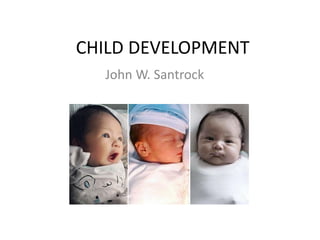
CHILD DEVELOPMENT
John W. Santrock
DEVELOPMENT
• The pattern of change that begins at
conception and continues through the life
span.
CHILD DEVELOPMENT
• Historical views of childhood
• Improving the lives of today’s children
• The modern study of child development
• Resilience, social policy, and children’s
development
Historical views of Childhood
• Original sin view
• Tabula rasa view
• Innate goodness view
Original sin view
• Advocate during the middle ages
• Children were perceived being born as evil
beings
• Goal of child rearing was to provide salvation,
to remove sin from child’s life
Tabula rasa view
• Proposed by English philosopher John Locke
• Argued that children are not innately ad but
like a “blank tablet”
• He believed that childhood experiences are
important in determining adult characteristics
• Advised parents to spend time with children
and to help in contributing in the society.
Innate goodness view
• Swiss-born French philosopher Jean-Jacques
Rousseau
• Stressed that children are inherently good
• They should be permitted to grow naturally,
with little parental monitoring or constraint.
THE MODERN STUDY OF
CHILD DEVELOPMENT
1. Methods for a New Science
• The direct study of children which
investigators directly observe children’s
behavior, conduct experiments, and obtain
information about children by questioning
their parents and teachers had an
auspicious/positive start in the work of these
child study experts.
2. Theories for a New Science-Gesell
• Charles Darwin’s Evolutionary theory
– had made the scientific study of children when he
developed a baby journal for recording systematic
observations
Cont.
• Stages of Sigmund Freud
– Psychoanalytic theory believed that children are
rarely aware of the motives and reasons for their
behavior and the bulk of their mental life is
unconscious
– Child’s experiences with parents in the five (5)
years of life are important determinants of later
personality development
Cont.
• John Watson (1928) theory of behaviorism
– argued that children can be shaped into whatever
society wishes by examining and changing the
environment
– Believed that systematic observation of children’s
behavior under controlled conditions
Cont.
• James Mark Baldwin
– A pioneer in the study of children’s thought
– Introduced the term “GENETIC
EPISTEMOLOGY”(study of how children’s
knowledge changes over the course of their
development)
– Later Jean Piaget adopted his concept
Improving the Lives of Today’s Children
• Health & Well-being
– Jeopardized around the world because of many
factors like poverty, AIDS, starvation, poor, health
care, inadequate nutrition & exercise, alcohol &
drug abuse, & sexual abuse
• Families & Parenting
– Parent’s frustration is that they receive conflicting
messages about how to deal with their children.
• One expert urges them to be more permissive with
their children
• Another warns that their children should be controlled
& discipline to avoid being spoiled brats
• Education
– Extremely important of children’s lives
– Mentoring involves a more experienced, usually
older individual acting as a guide, role model, or
teacher to help someone who is less experienced
become more competent
Sociocultural Contexts: Culture,
Ethnicity and Socioeconomic Status
• Culture
– encompasses the behavior patterns, beliefs and all
other products of a particular group of people
that are passed on from generation to generation.
• Ethnicity
– refers to characteristics that are rooted in cultural
heritage, including nationality, race, religion and
language
– Central to the development of ETHNIC IDENTITY
(a sense of membership in an ethnic group, based
on share language, religion, customs, values,
history and race)
• Socio-economic status (SES)
– refers to the grouping of people with similar
occupational, educational and economic
characteristics
– implies certain inequalities
• Gender
– involves the psychological & sociocultural
dimensions of being female or male
– Sex refers to the biological dimension of being a
female or male
RESILIENCE, SOCIAL POLICY &
CHILDREN’s DEVELOPMENT
• Children who bounce back and/or triumph
over poverty becomes “Resilient”
• Social policy
– A government’s course of action designed to
promote the welfare of its citizens including
children.
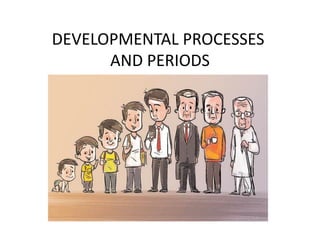
DEVELOPMENTAL PROCESSES
AND PERIODS
Biological, Cognitive &
Socio-emotional Processes
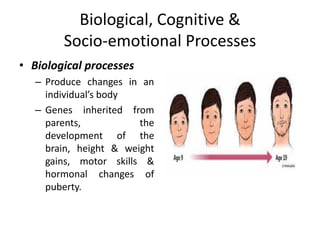
• Biological processes
– Produce changes in an
individual’s body
– Genes inherited from
parents, the
development of the
brain, height & weight
gains, motor skills &
hormonal changes of
puberty.
• Cognitive processes
– refers to changes in an
individual’s thought,
intelligence, & language
– Ex: putting together a
two-word sentence,
memorizing a poem,
solving a math problem
and imagining what it
would be like to be a
movie star
• Socio-emotional
processes
– involve changes in an
individual’s relationships
with other people,
changes in emotions, &
changes in personality

HUMAN-DEVELOPMENT-pdf.pdf

  • 1.
  • 2.
    DEVELOPMENT • The patternof change that begins at conception and continues through the life span.
  • 3.
    CHILD DEVELOPMENT • Historicalviews of childhood • Improving the lives of today’s children • The modern study of child development • Resilience, social policy, and children’s development
  • 4.
    Historical views ofChildhood • Original sin view • Tabula rasa view • Innate goodness view
  • 5.
    Original sin view •Advocate during the middle ages • Children were perceived being born as evil beings • Goal of child rearing was to provide salvation, to remove sin from child’s life
  • 6.
    Tabula rasa view •Proposed by English philosopher John Locke • Argued that children are not innately ad but like a “blank tablet” • He believed that childhood experiences are important in determining adult characteristics • Advised parents to spend time with children and to help in contributing in the society.
  • 7.
    Innate goodness view •Swiss-born French philosopher Jean-Jacques Rousseau • Stressed that children are inherently good • They should be permitted to grow naturally, with little parental monitoring or constraint.
  • 8.
    THE MODERN STUDYOF CHILD DEVELOPMENT
  • 9.
    1. Methods fora New Science • The direct study of children which investigators directly observe children’s behavior, conduct experiments, and obtain information about children by questioning their parents and teachers had an auspicious/positive start in the work of these child study experts.
  • 10.
    2. Theories fora New Science-Gesell • Charles Darwin’s Evolutionary theory – had made the scientific study of children when he developed a baby journal for recording systematic observations
  • 11.
    Cont. • Stages ofSigmund Freud – Psychoanalytic theory believed that children are rarely aware of the motives and reasons for their behavior and the bulk of their mental life is unconscious – Child’s experiences with parents in the five (5) years of life are important determinants of later personality development
  • 12.
    Cont. • John Watson(1928) theory of behaviorism – argued that children can be shaped into whatever society wishes by examining and changing the environment – Believed that systematic observation of children’s behavior under controlled conditions
  • 13.
    Cont. • James MarkBaldwin – A pioneer in the study of children’s thought – Introduced the term “GENETIC EPISTEMOLOGY”(study of how children’s knowledge changes over the course of their development) – Later Jean Piaget adopted his concept
  • 14.
    Improving the Livesof Today’s Children • Health & Well-being – Jeopardized around the world because of many factors like poverty, AIDS, starvation, poor, health care, inadequate nutrition & exercise, alcohol & drug abuse, & sexual abuse
  • 15.
    • Families &Parenting – Parent’s frustration is that they receive conflicting messages about how to deal with their children. • One expert urges them to be more permissive with their children • Another warns that their children should be controlled & discipline to avoid being spoiled brats
  • 16.
    • Education – Extremelyimportant of children’s lives – Mentoring involves a more experienced, usually older individual acting as a guide, role model, or teacher to help someone who is less experienced become more competent
  • 17.
  • 18.
    • Culture – encompassesthe behavior patterns, beliefs and all other products of a particular group of people that are passed on from generation to generation.
  • 19.
    • Ethnicity – refersto characteristics that are rooted in cultural heritage, including nationality, race, religion and language – Central to the development of ETHNIC IDENTITY (a sense of membership in an ethnic group, based on share language, religion, customs, values, history and race)
  • 20.
    • Socio-economic status(SES) – refers to the grouping of people with similar occupational, educational and economic characteristics – implies certain inequalities
  • 21.
    • Gender – involvesthe psychological & sociocultural dimensions of being female or male – Sex refers to the biological dimension of being a female or male
  • 22.
    RESILIENCE, SOCIAL POLICY& CHILDREN’s DEVELOPMENT
  • 23.
    • Children whobounce back and/or triumph over poverty becomes “Resilient” • Social policy – A government’s course of action designed to promote the welfare of its citizens including children.
  • 24.
  • 25.
    Biological, Cognitive & Socio-emotionalProcesses • Biological processes – Produce changes in an individual’s body – Genes inherited from parents, the development of the brain, height & weight gains, motor skills & hormonal changes of puberty.
  • 26.
    • Cognitive processes –refers to changes in an individual’s thought, intelligence, & language – Ex: putting together a two-word sentence, memorizing a poem, solving a math problem and imagining what it would be like to be a movie star
  • 27.
    • Socio-emotional processes – involvechanges in an individual’s relationships with other people, changes in emotions, & changes in personality