TALENT ACQUISITION STRATEGY
 Using Checkland’s Soft Systems Methodology (SSM)
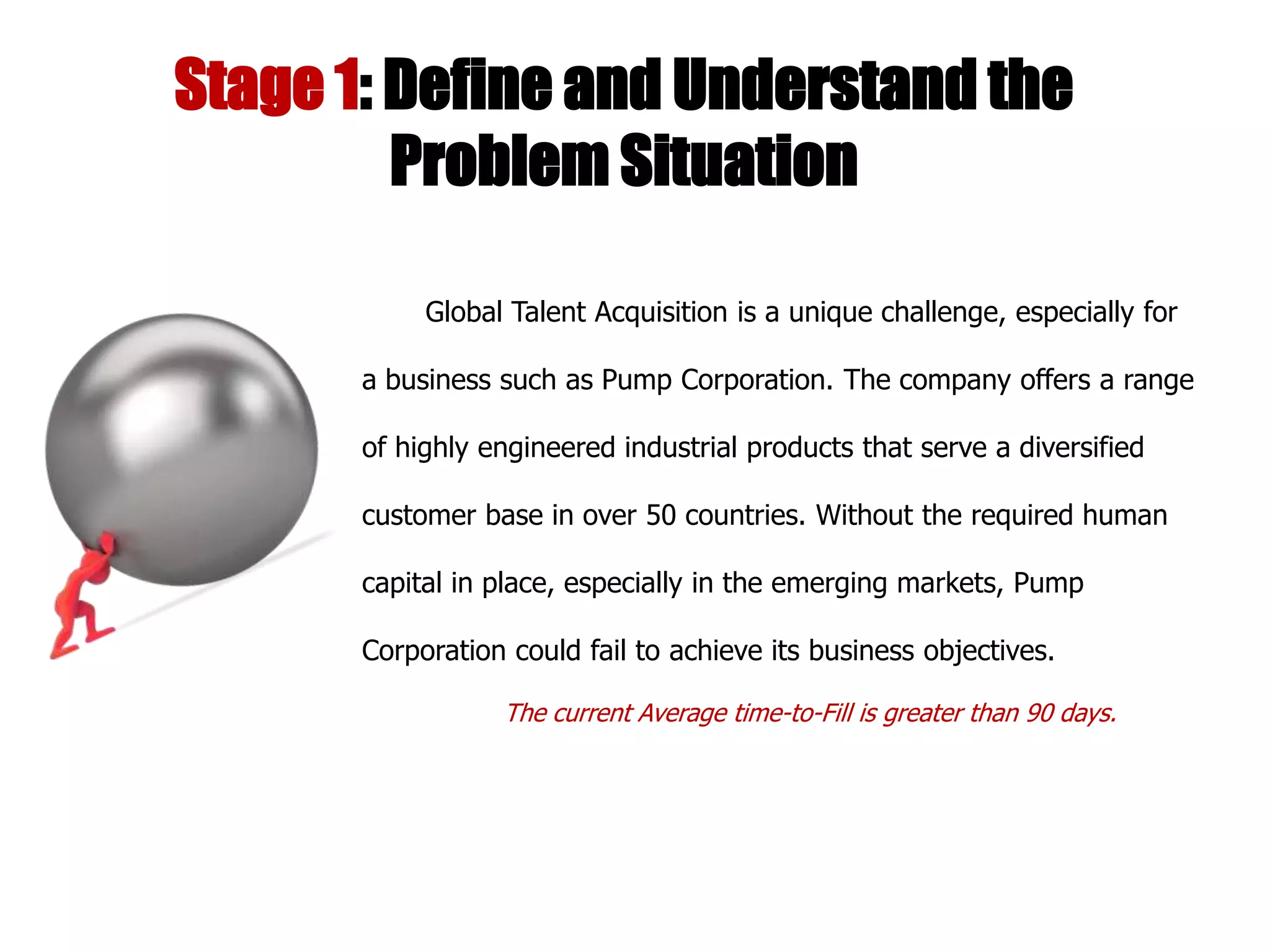
Stage 1: Define and Understand the
         Problem Situation

            Global Talent Acquisition is a unique challenge, especially for

       a business such as Pump Corporation. The company offers a range

       of highly engineered industrial products that serve a diversified

       customer base in over 50 countries. Without the required human

       capital in place, especially in the emerging markets, Pump

       Corporation could fail to achieve its business objectives.

                  The current Average time-to-Fill is greater than 90 days.
Stage 2: Express the Problem Situation
                                                                 Economy


                                                         Customer Demand


                                                       Business Requirements
   E                                                                                                                                                            E
   c                                                                                                                                                            c
   o                                                                                                                                                            o
   n                                                                                                                                                            n


                                                                                                                            Internal Talent Pool
   o
                                                                                                     Internal Transfers /                                       o
       Business Objectives                                                                           Promotions                                                 m
   m
   y
       1. Budget                                             Workforce Plan                                                                                     y
       2. Criticality / Timing
       3. Geography
       4. Internal Equity
                                                                      Employment / Labor Law
                                                                      Organization Hiring Policies
                                                                      Selection Practices
                                                                                                                                                   Retirement


                                                    Prospective External Candidates


                                           Types of Positions
                                 Knowledge, Skills & Abilities


                                                          External Labor Pool
                                                                                                                                        Attrition


                                                            Economy
Stage 3: Select how to view the situation
           from various perspectives
         Subsystems                                                       Interdependencies

Economic subsystem          Small changes in the global economy can cause tremendous changes in talent supply and demand, which
                            can be greatly exacerbated in certain local markets. This adds to the complexity of the system as the macro
                            economy is an aggregate of several economies that are at varying points of maturity.
Customer Subsystem          There is a constant feedback cycle between the business operations and the ever-changing demands of the
                            customers. As the needs of the customers evolve, the talent needs of the business shift accordingly.
Business Requirements       Through its annual planning cycle, Pump Corporation re-examines its headcount plans, pivotal skillset needs,
                            and plots them against business segments and geographic locations. These human capital plans drive the
                            talent acquisition activity levels of the organization. The primary business constraints such as budget,
                            timing, geography, internal equity of compensation, etc. have to be taken into consideration while
                            formulating the talent acquisition plan for each segment, region, and location of the overall corporation.


Workforce Plan              It is a dynamic process that changes along with the business requirements, the attrition of existing talent
                            and the availability of external talent. The business requirements set the level of the stock, the attrition is
                            the outflow and the promotion of internal talent as well as the addition of external talent is the inflow.

Internal Talent Subsystem   Human capital is less mobile than financial or technical capital, local economic conditions in certain markets
                            can cause unusual imbalances between supply and demand. For example, Pump Corporation may have a
                            greater supply of engineers in a developed market than in an emerging market, but it is often not possible
                            for the engineering talent to relocate to where it is needed. This immobility of talent results in an imbalance
                            in the emerging market and could cause that particular emerging market to become a leverage point on the
                            entire system.
External Labor Pool         The scale of the external labor pool is contingent upon many factors such as the local economic growth, the
Subsystem                   unemployment rate and demographic trends of the populations (including age, educational level, ability to
                            relocate, etc.).
Prospective External        This subsystem is a derivative of the external labor pool. The main criteria to create inflow into this
Candidate Subsystem         subsystem are matching the specific talent needs of a position to the skills of the available candidates. The
                            resulting filtering sometimes produces counterintuitive consequences. For example, a population with a high
                            unemployment rate may still not produce enough candidates to meet demand if the skill levels are not
                            adequate.
Stage 4: Build conceptual models of the
         system requirements
                                                   Business
                                                Requirements /
            Qualified                                                                    Turnover /
                                                Workforce Plan
            External                                                                     Retirement
           Candidates
                            Prospective                                Internal Talent
                           External Talent                                  Pool
                                Pool


                                             External hires to meet
                                             desired staffing levels


                                                Discrepancy


•   The business requirements/workforce plan is the balancing feedback loop.
•   The greater the discrepancy between internal talent and the desired staffing levels, the greater
    the need for the organization to find talent externally.
•   The external talent pool is a renewable stock, but replenishment is not immediate.
Stage 5: Compare the conceptual models
   (stage 4) to the real world expression (stage 2)


                Donella Meadows                                                   Ludwig von Bertalanffy
The concept of buffers: A buffer’s ability to stabilize a system   The concept of feedback and homeostasis: Ideally, the
is important when the stock amount is much higher or lower         system should be at homeostasis when there is an even
than the potential amount of inflows/outflows                      match between supply and demand within the system.
Because the global business environment is very competitive,       However, because the talent acquisition system is highly
the buffer of talent at any given time is quite small. If there    dynamic, with many leverage points and few buffers, there is
is a sudden increase in demand, there is very little excess        rarely a good match between supply and demand and the
talent capacity to absorb the demand. This results in a            system is rarely in homeostasis.
dramatic increase in demand relative to supply. Similarly
when local market conditions turn adverse, there is a
relatively small financial buffer in the system, resulting in an
increase in supply relative to demand, and therefore, the
need to adjust the talent base quickly to meet the
environmental conditions.
Stage 6: Identify feasible and desirable
        changes to improve the situation


1.   Take care of the stocks
2.   Create an increased flow in critical growth markets while ensuring there are no system leakages
3.   Reduce system delays by proactively identifying sourcing channels
4.   Stay tuned to the cloud
5.   Have a dynamic workforce planning process
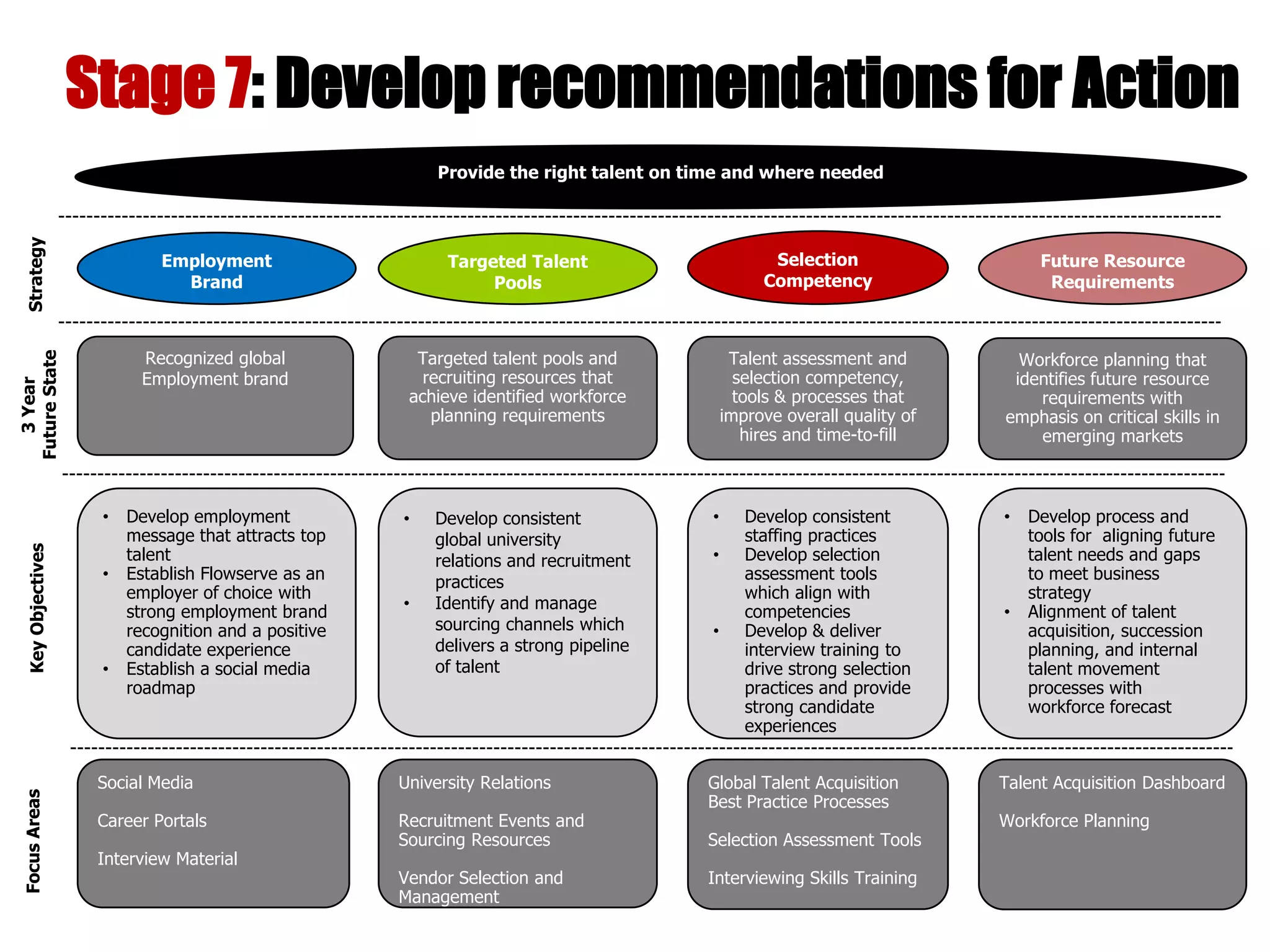
Stage 7: Develop recommendations for Action
                                                          Provide the right talent on time and where needed
  Strategy


                            Employment                     Targeted Talent                        Selection                   Future Resource
                              Brand                             Pools                            Competency                    Requirements


                         Recognized global             Targeted talent pools and             Talent assessment and         Workforce planning that
Future State


                         Employment brand               recruiting resources that             selection competency,       identifies future resource
   3 Year


                                                      achieve identified workforce            tools & processes that         requirements with
                                                         planning requirements              improve overall quality of   emphasis on critical skills in
                                                                                               hires and time-to-fill        emerging markets


                    •   Develop employment           •   Develop consistent             •      Develop consistent        •   Develop process and
                        message that attracts top        global university                     staffing practices            tools for aligning future
  Key Objectives


                        talent                           relations and recruitment      •      Develop selection             talent needs and gaps
                    •   Establish Flowserve as an        practices                             assessment tools              to meet business
                        employer of choice with                                                which align with              strategy
                        strong employment brand      •   Identify and manage                   competencies              •   Alignment of talent
                        recognition and a positive       sourcing channels which        •      Develop & deliver             acquisition, succession
                        candidate experience             delivers a strong pipeline            interview training to         planning, and internal
                    •   Establish a social media         of talent                             drive strong selection        talent movement
                        roadmap                                                                practices and provide         processes with
                                                                                               strong candidate              workforce forecast
                                                                                               experiences


                    Social Media                     University Relations              Global Talent Acquisition         Talent Acquisition Dashboard
 Focus Areas


                                                                                       Best Practice Processes
                    Career Portals                   Recruitment Events and                                              Workforce Planning
                                                     Sourcing Resources                Selection Assessment Tools
                    Interview Material
                                                     Vendor Selection and              Interviewing Skills Training
                                                     Management
Questions? Comments?

Talent acquisition strategy

  • 1.
    TALENT ACQUISITION STRATEGY Using Checkland’s Soft Systems Methodology (SSM)
  • 3.
    Stage 1: Defineand Understand the Problem Situation Global Talent Acquisition is a unique challenge, especially for a business such as Pump Corporation. The company offers a range of highly engineered industrial products that serve a diversified customer base in over 50 countries. Without the required human capital in place, especially in the emerging markets, Pump Corporation could fail to achieve its business objectives. The current Average time-to-Fill is greater than 90 days.
  • 4.
    Stage 2: Expressthe Problem Situation Economy Customer Demand Business Requirements E E c c o o n n Internal Talent Pool o Internal Transfers / o Business Objectives Promotions m m y 1. Budget Workforce Plan y 2. Criticality / Timing 3. Geography 4. Internal Equity Employment / Labor Law Organization Hiring Policies Selection Practices Retirement Prospective External Candidates Types of Positions Knowledge, Skills & Abilities External Labor Pool Attrition Economy
  • 5.
    Stage 3: Selecthow to view the situation from various perspectives Subsystems Interdependencies Economic subsystem Small changes in the global economy can cause tremendous changes in talent supply and demand, which can be greatly exacerbated in certain local markets. This adds to the complexity of the system as the macro economy is an aggregate of several economies that are at varying points of maturity. Customer Subsystem There is a constant feedback cycle between the business operations and the ever-changing demands of the customers. As the needs of the customers evolve, the talent needs of the business shift accordingly. Business Requirements Through its annual planning cycle, Pump Corporation re-examines its headcount plans, pivotal skillset needs, and plots them against business segments and geographic locations. These human capital plans drive the talent acquisition activity levels of the organization. The primary business constraints such as budget, timing, geography, internal equity of compensation, etc. have to be taken into consideration while formulating the talent acquisition plan for each segment, region, and location of the overall corporation. Workforce Plan It is a dynamic process that changes along with the business requirements, the attrition of existing talent and the availability of external talent. The business requirements set the level of the stock, the attrition is the outflow and the promotion of internal talent as well as the addition of external talent is the inflow. Internal Talent Subsystem Human capital is less mobile than financial or technical capital, local economic conditions in certain markets can cause unusual imbalances between supply and demand. For example, Pump Corporation may have a greater supply of engineers in a developed market than in an emerging market, but it is often not possible for the engineering talent to relocate to where it is needed. This immobility of talent results in an imbalance in the emerging market and could cause that particular emerging market to become a leverage point on the entire system. External Labor Pool The scale of the external labor pool is contingent upon many factors such as the local economic growth, the Subsystem unemployment rate and demographic trends of the populations (including age, educational level, ability to relocate, etc.). Prospective External This subsystem is a derivative of the external labor pool. The main criteria to create inflow into this Candidate Subsystem subsystem are matching the specific talent needs of a position to the skills of the available candidates. The resulting filtering sometimes produces counterintuitive consequences. For example, a population with a high unemployment rate may still not produce enough candidates to meet demand if the skill levels are not adequate.
  • 6.
    Stage 4: Buildconceptual models of the system requirements Business Requirements / Qualified Turnover / Workforce Plan External Retirement Candidates Prospective Internal Talent External Talent Pool Pool External hires to meet desired staffing levels Discrepancy • The business requirements/workforce plan is the balancing feedback loop. • The greater the discrepancy between internal talent and the desired staffing levels, the greater the need for the organization to find talent externally. • The external talent pool is a renewable stock, but replenishment is not immediate.
  • 7.
    Stage 5: Comparethe conceptual models (stage 4) to the real world expression (stage 2) Donella Meadows Ludwig von Bertalanffy The concept of buffers: A buffer’s ability to stabilize a system The concept of feedback and homeostasis: Ideally, the is important when the stock amount is much higher or lower system should be at homeostasis when there is an even than the potential amount of inflows/outflows match between supply and demand within the system. Because the global business environment is very competitive, However, because the talent acquisition system is highly the buffer of talent at any given time is quite small. If there dynamic, with many leverage points and few buffers, there is is a sudden increase in demand, there is very little excess rarely a good match between supply and demand and the talent capacity to absorb the demand. This results in a system is rarely in homeostasis. dramatic increase in demand relative to supply. Similarly when local market conditions turn adverse, there is a relatively small financial buffer in the system, resulting in an increase in supply relative to demand, and therefore, the need to adjust the talent base quickly to meet the environmental conditions.
  • 8.
    Stage 6: Identifyfeasible and desirable changes to improve the situation 1. Take care of the stocks 2. Create an increased flow in critical growth markets while ensuring there are no system leakages 3. Reduce system delays by proactively identifying sourcing channels 4. Stay tuned to the cloud 5. Have a dynamic workforce planning process
  • 9.
    Stage 7: Developrecommendations for Action Provide the right talent on time and where needed Strategy Employment Targeted Talent Selection Future Resource Brand Pools Competency Requirements Recognized global Targeted talent pools and Talent assessment and Workforce planning that Future State Employment brand recruiting resources that selection competency, identifies future resource 3 Year achieve identified workforce tools & processes that requirements with planning requirements improve overall quality of emphasis on critical skills in hires and time-to-fill emerging markets • Develop employment • Develop consistent • Develop consistent • Develop process and message that attracts top global university staffing practices tools for aligning future Key Objectives talent relations and recruitment • Develop selection talent needs and gaps • Establish Flowserve as an practices assessment tools to meet business employer of choice with which align with strategy strong employment brand • Identify and manage competencies • Alignment of talent recognition and a positive sourcing channels which • Develop & deliver acquisition, succession candidate experience delivers a strong pipeline interview training to planning, and internal • Establish a social media of talent drive strong selection talent movement roadmap practices and provide processes with strong candidate workforce forecast experiences Social Media University Relations Global Talent Acquisition Talent Acquisition Dashboard Focus Areas Best Practice Processes Career Portals Recruitment Events and Workforce Planning Sourcing Resources Selection Assessment Tools Interview Material Vendor Selection and Interviewing Skills Training Management
  • 10.