
Adult DevelopmentAdult Development
TheoriesTheories
Class 3Class 3
ADLT 601 – The Adult LearnerADLT 601 – The Adult Learner
Spring 2006Spring 2006
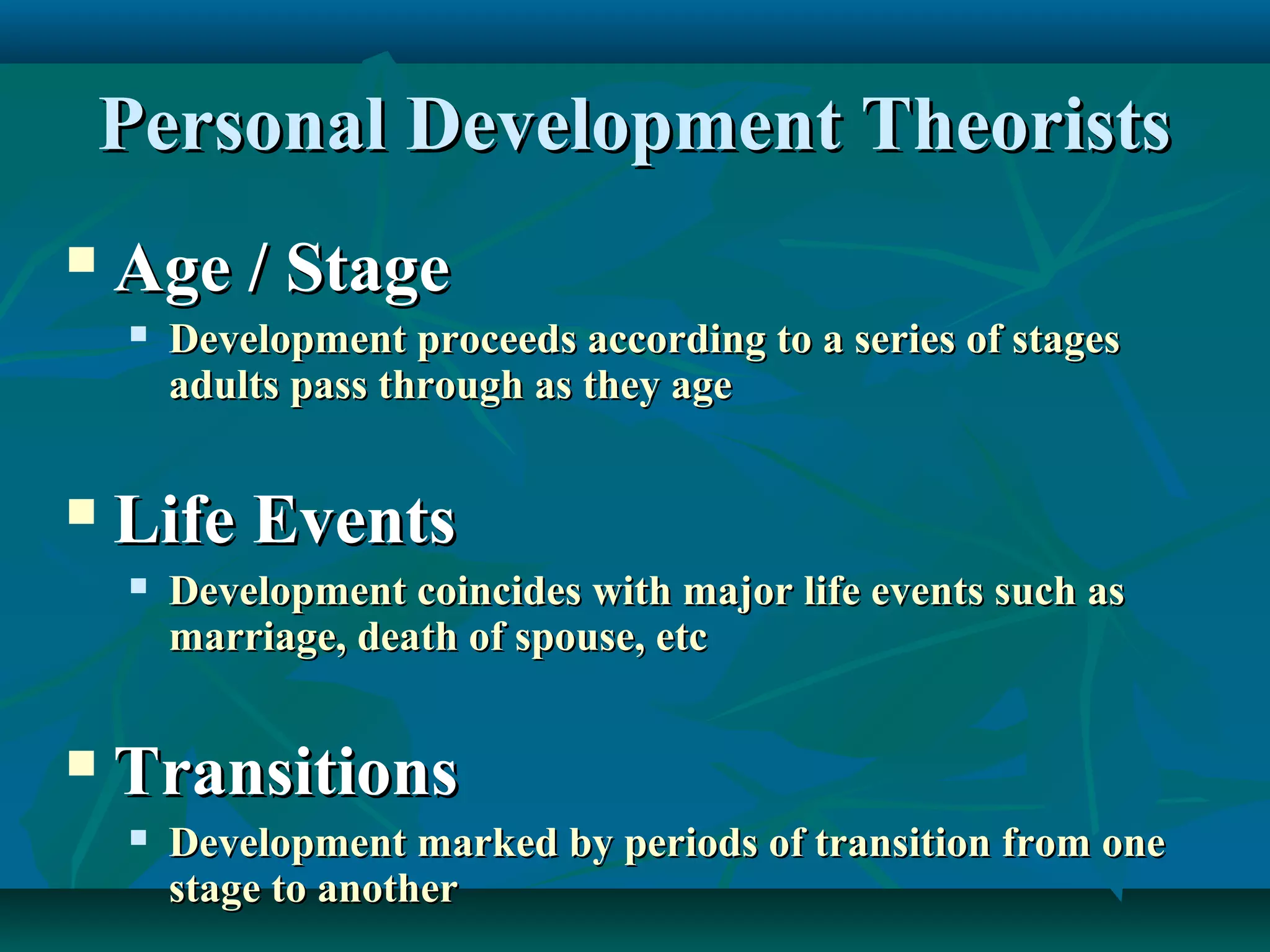
Personal Development TheoristsPersonal Development Theorists
 Age / StageAge / Stage
 Development proceeds according to a series of stagesDevelopment proceeds according to a series of stages
adults pass through as they ageadults pass through as they age
 Life EventsLife Events
 Development coincides with major life events such asDevelopment coincides with major life events such as
marriage, death of spouse, etcmarriage, death of spouse, etc
 TransitionsTransitions
 Development marked by periods of transition from oneDevelopment marked by periods of transition from one
stage to anotherstage to another
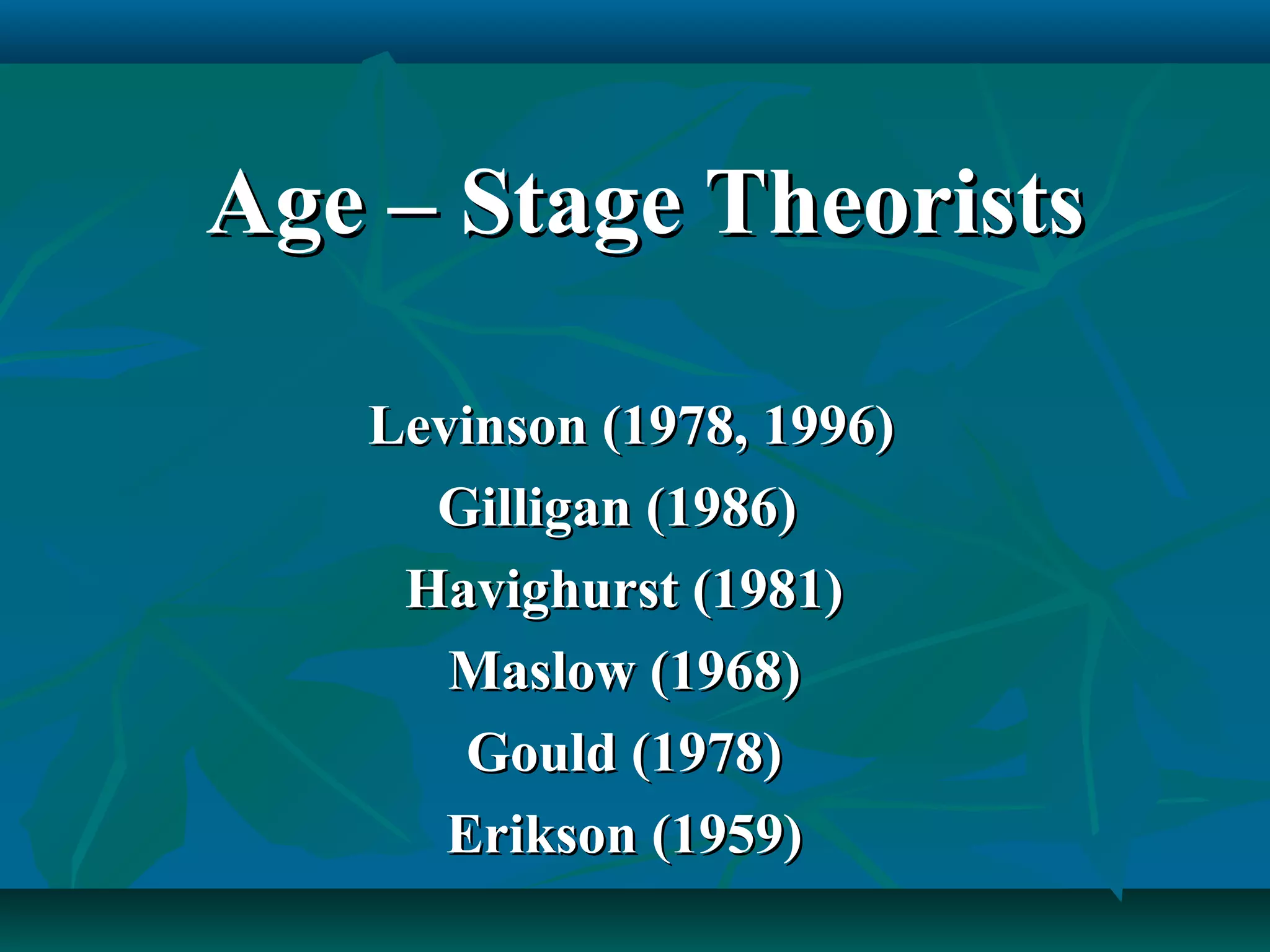
Age – Stage TheoristsAge – Stage Theorists
Levinson (1978, 1996)Levinson (1978, 1996)
Gilligan (1986)Gilligan (1986)
Havighurst (1981)Havighurst (1981)
Maslow (1968)Maslow (1968)
Gould (1978)Gould (1978)
Erikson (1959)Erikson (1959)
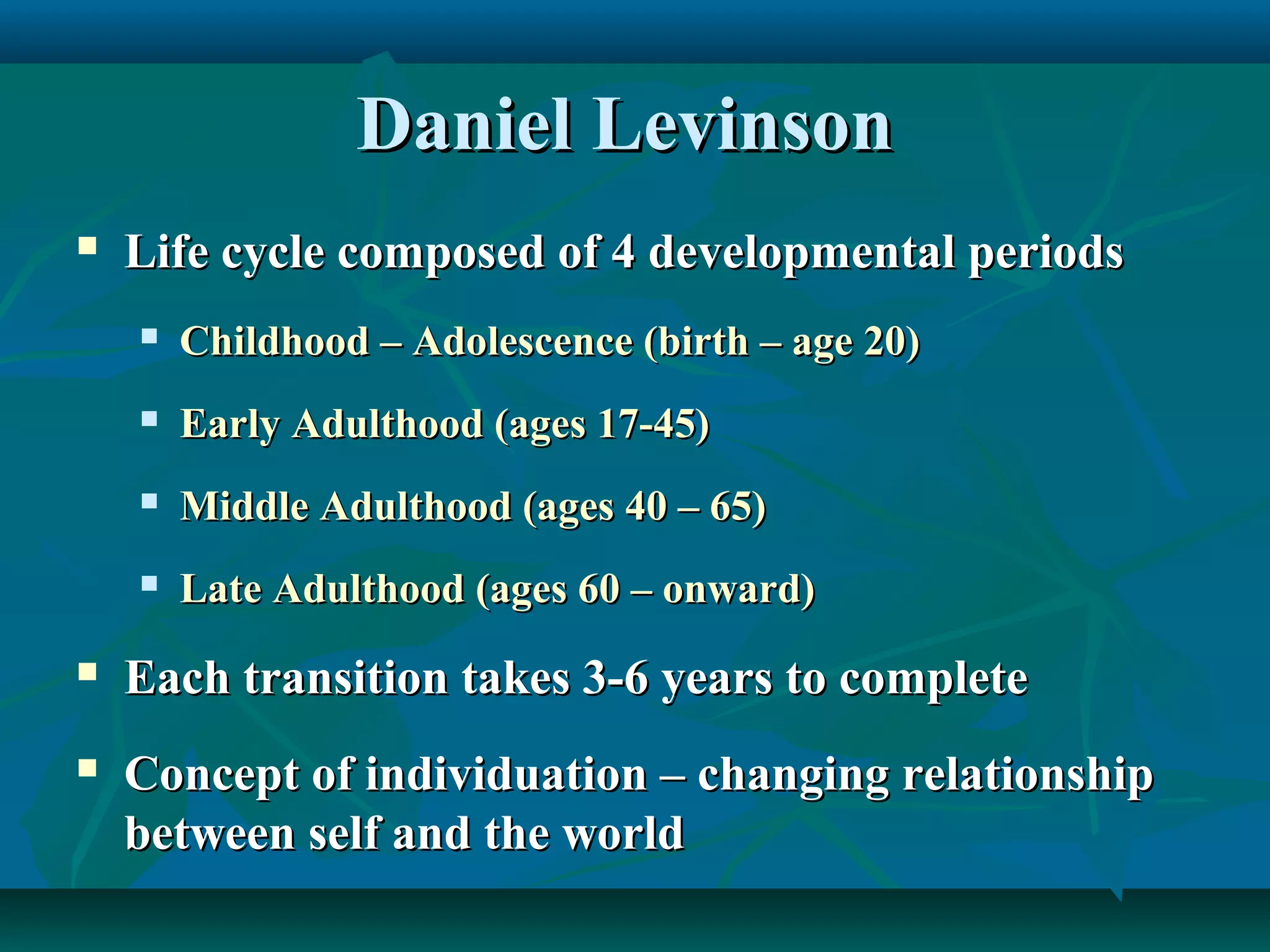
Daniel LevinsonDaniel Levinson
 Life cycle composed of 4 developmental periodsLife cycle composed of 4 developmental periods
 Childhood – Adolescence (birth – age 20)Childhood – Adolescence (birth – age 20)
 Early Adulthood (ages 17-45)Early Adulthood (ages 17-45)
 Middle Adulthood (ages 40 – 65)Middle Adulthood (ages 40 – 65)
 Late Adulthood (ages 60 – onward)Late Adulthood (ages 60 – onward)
 Each transition takes 3-6 years to completeEach transition takes 3-6 years to complete
 Concept of individuation – changing relationshipConcept of individuation – changing relationship
between self and the worldbetween self and the world
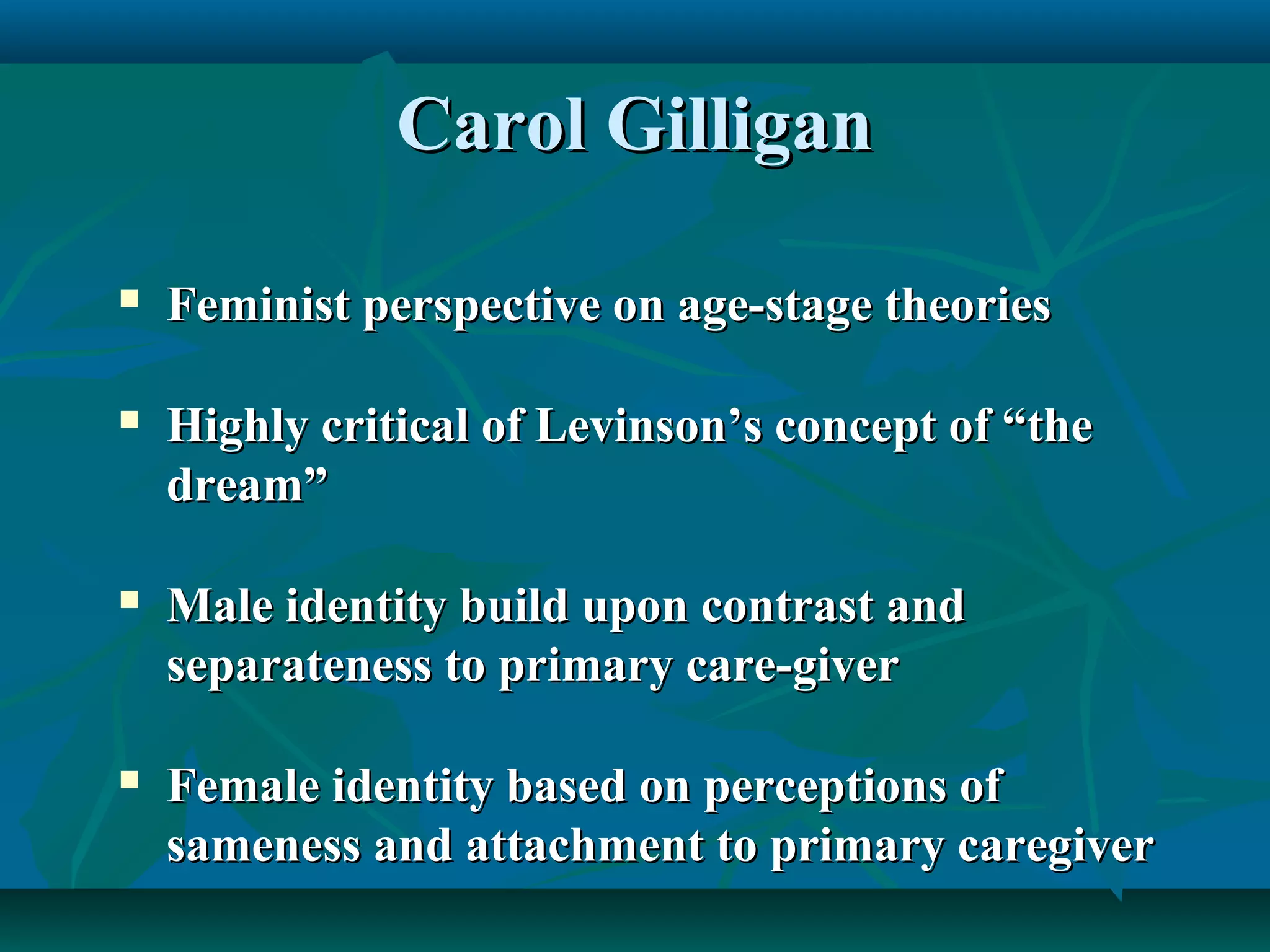
Carol GilliganCarol Gilligan
 Feminist perspective on age-stage theoriesFeminist perspective on age-stage theories
 Highly critical of Levinson’s concept of “theHighly critical of Levinson’s concept of “the
dream”dream”
 Male identity build upon contrast andMale identity build upon contrast and
separateness to primary care-giverseparateness to primary care-giver
 Female identity based on perceptions ofFemale identity based on perceptions of
sameness and attachment to primary caregiversameness and attachment to primary caregiver
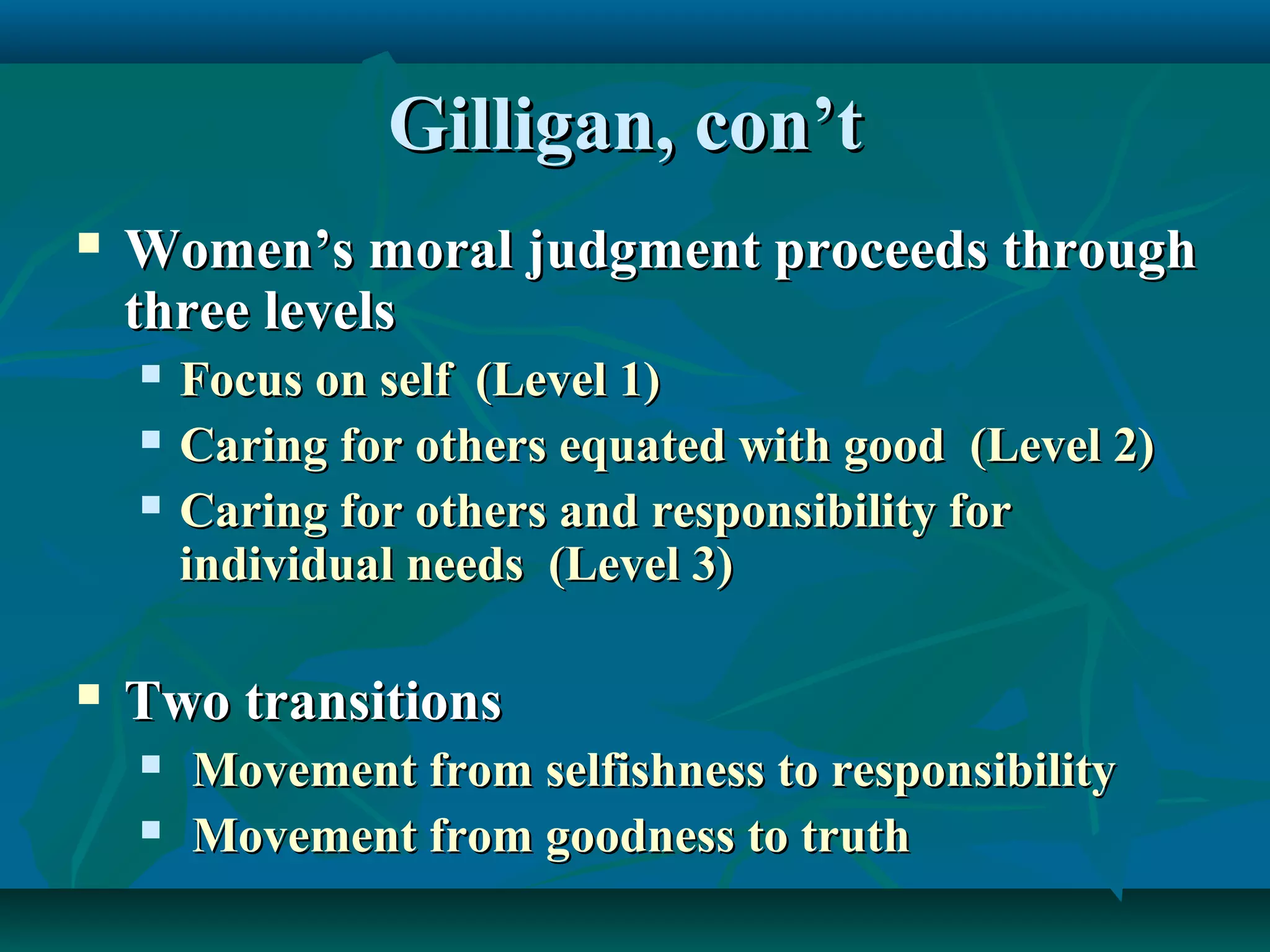
Gilligan, con’tGilligan, con’t
 Women’s moral judgment proceeds throughWomen’s moral judgment proceeds through
three levelsthree levels
 Focus on self (Level 1)Focus on self (Level 1)
 Caring for others equated with good (Level 2)Caring for others equated with good (Level 2)
 Caring for others and responsibility forCaring for others and responsibility for
individual needs (Level 3)individual needs (Level 3)
 Two transitionsTwo transitions
 Movement from selfishness to responsibilityMovement from selfishness to responsibility
 Movement from goodness to truthMovement from goodness to truth
HavighurstHavighurst
ickering and Havighurstickering and Havighurst
 Concept of the “teachable moment” whenConcept of the “teachable moment” when
the learning opportunity coincides withthe learning opportunity coincides with
the life task at handthe life task at hand
 Identified developmental tasks specific toIdentified developmental tasks specific to
white, middle-class North Americanswhite, middle-class North Americans
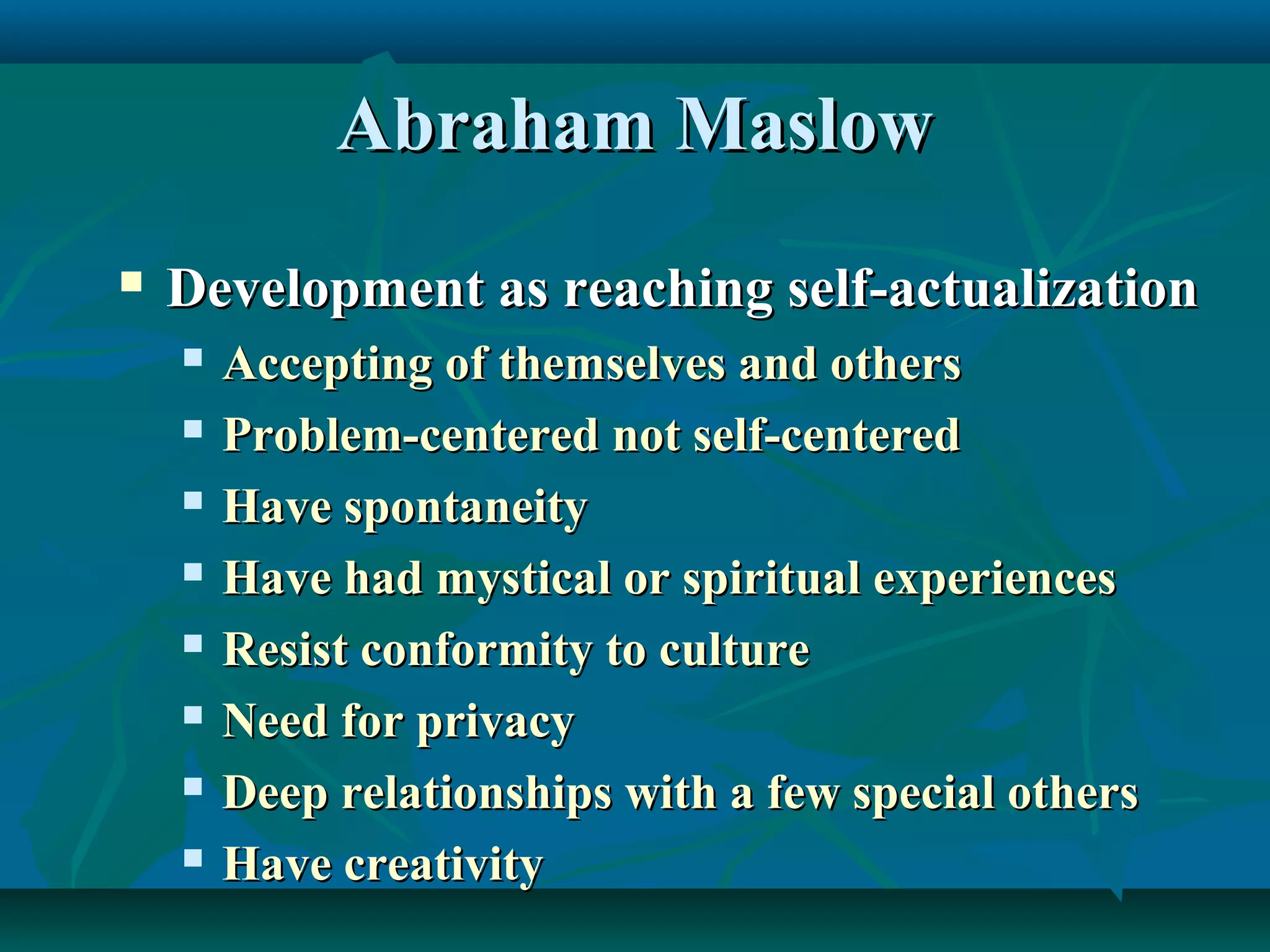
Abraham MaslowAbraham Maslow
 Development as reaching self-actualizationDevelopment as reaching self-actualization
 Accepting of themselves and othersAccepting of themselves and others
 Problem-centered not self-centeredProblem-centered not self-centered
 Have spontaneityHave spontaneity
 Have had mystical or spiritual experiencesHave had mystical or spiritual experiences
 Resist conformity to cultureResist conformity to culture
 Need for privacyNeed for privacy
 Deep relationships with a few special othersDeep relationships with a few special others
 Have creativityHave creativity
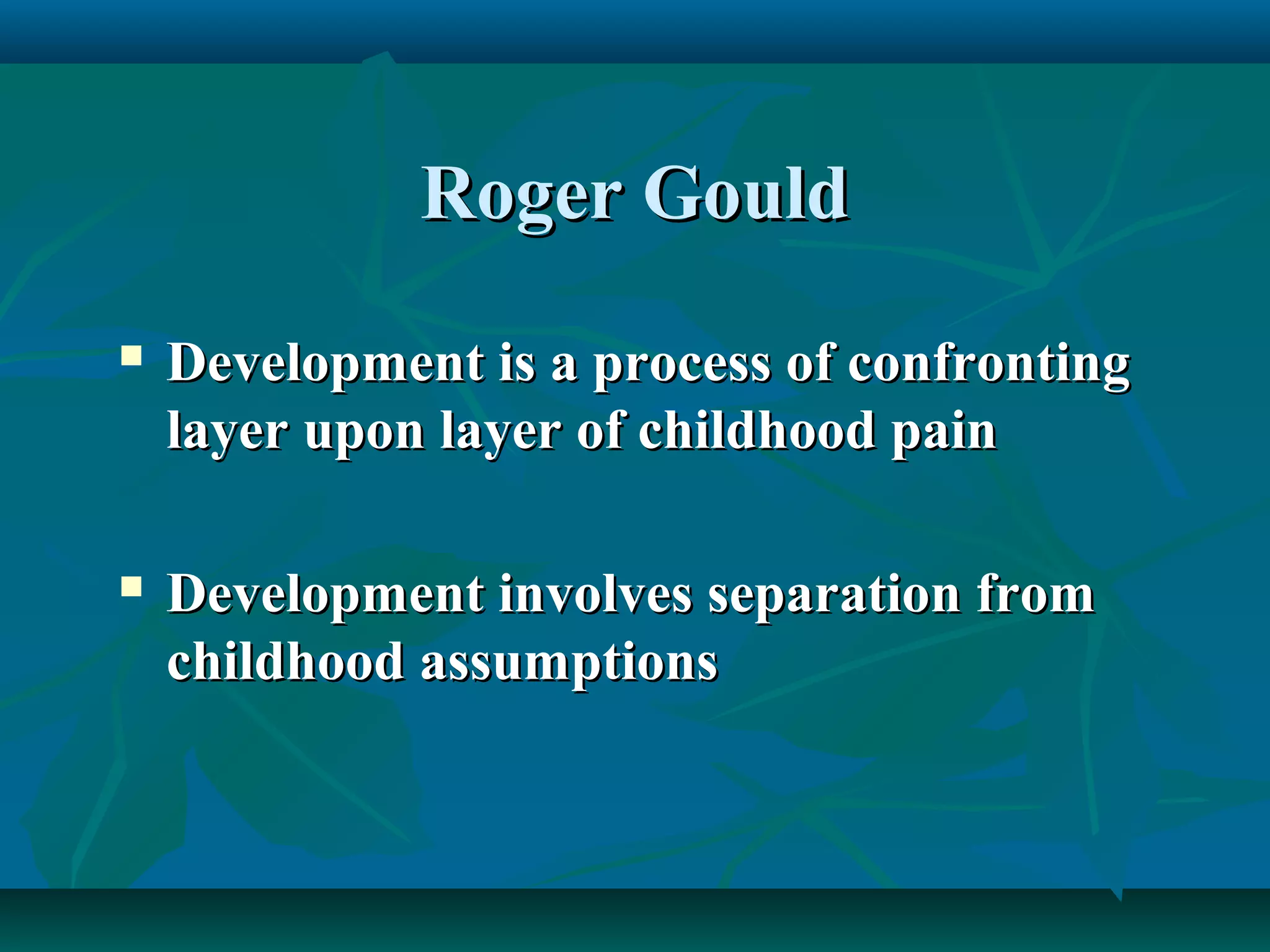
Roger GouldRoger Gould
 Development is a process of confrontingDevelopment is a process of confronting
layer upon layer of childhood painlayer upon layer of childhood pain
 Development involves separation fromDevelopment involves separation from
childhood assumptionschildhood assumptions
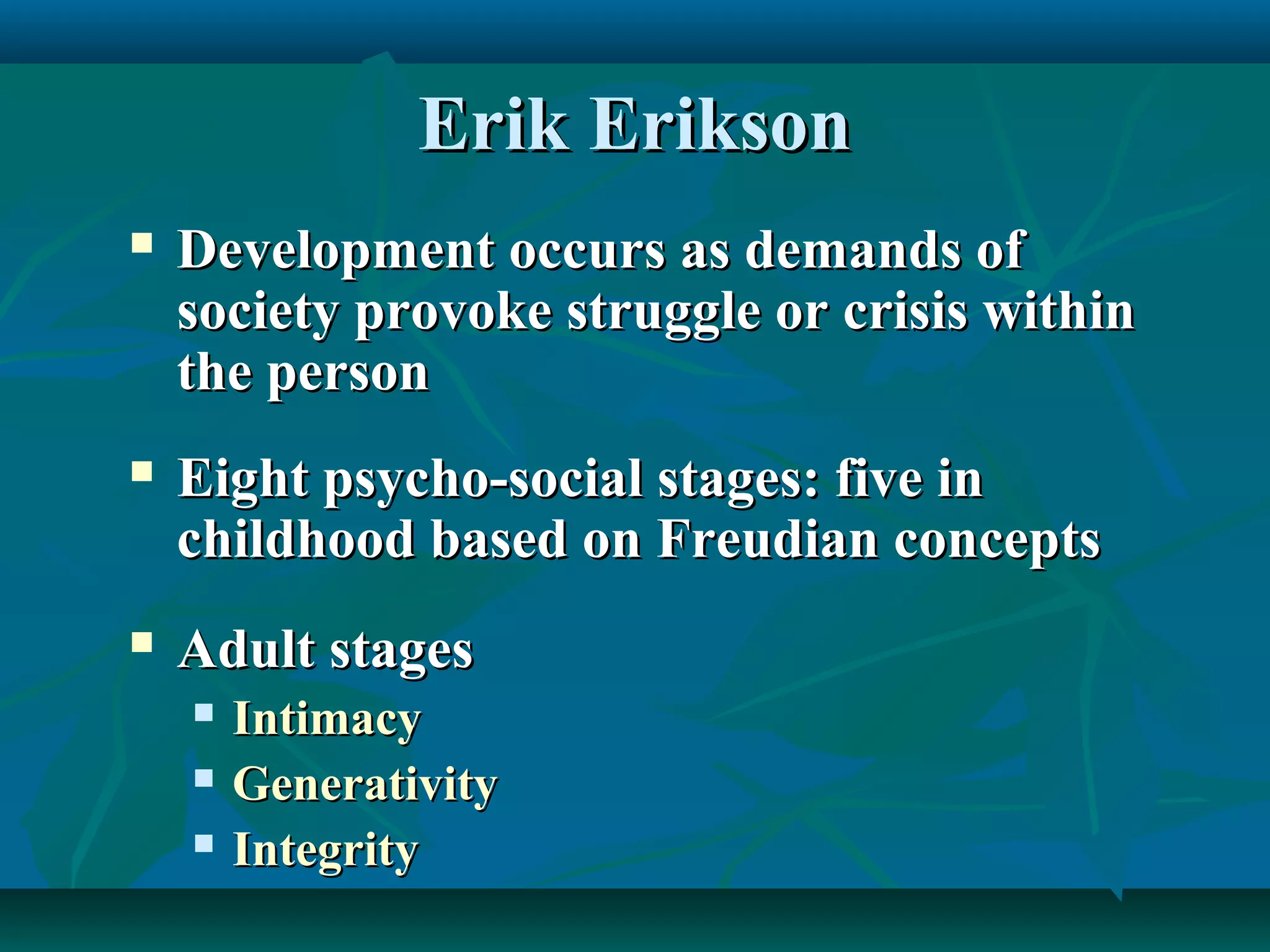
Erik EriksonErik Erikson
 Development occurs as demands ofDevelopment occurs as demands of
society provoke struggle or crisis withinsociety provoke struggle or crisis within
the personthe person
 Eight psycho-social stages: five inEight psycho-social stages: five in
childhood based on Freudian conceptschildhood based on Freudian concepts
 Adult stagesAdult stages
 IntimacyIntimacy
 GenerativityGenerativity
 IntegrityIntegrity
Life Events TheoristsLife Events Theorists
Neugarten (1976)Neugarten (1976)
Baltes et al. (1980)Baltes et al. (1980)
Riegel (1976)Riegel (1976)
Merriam and Clark (1991)Merriam and Clark (1991)
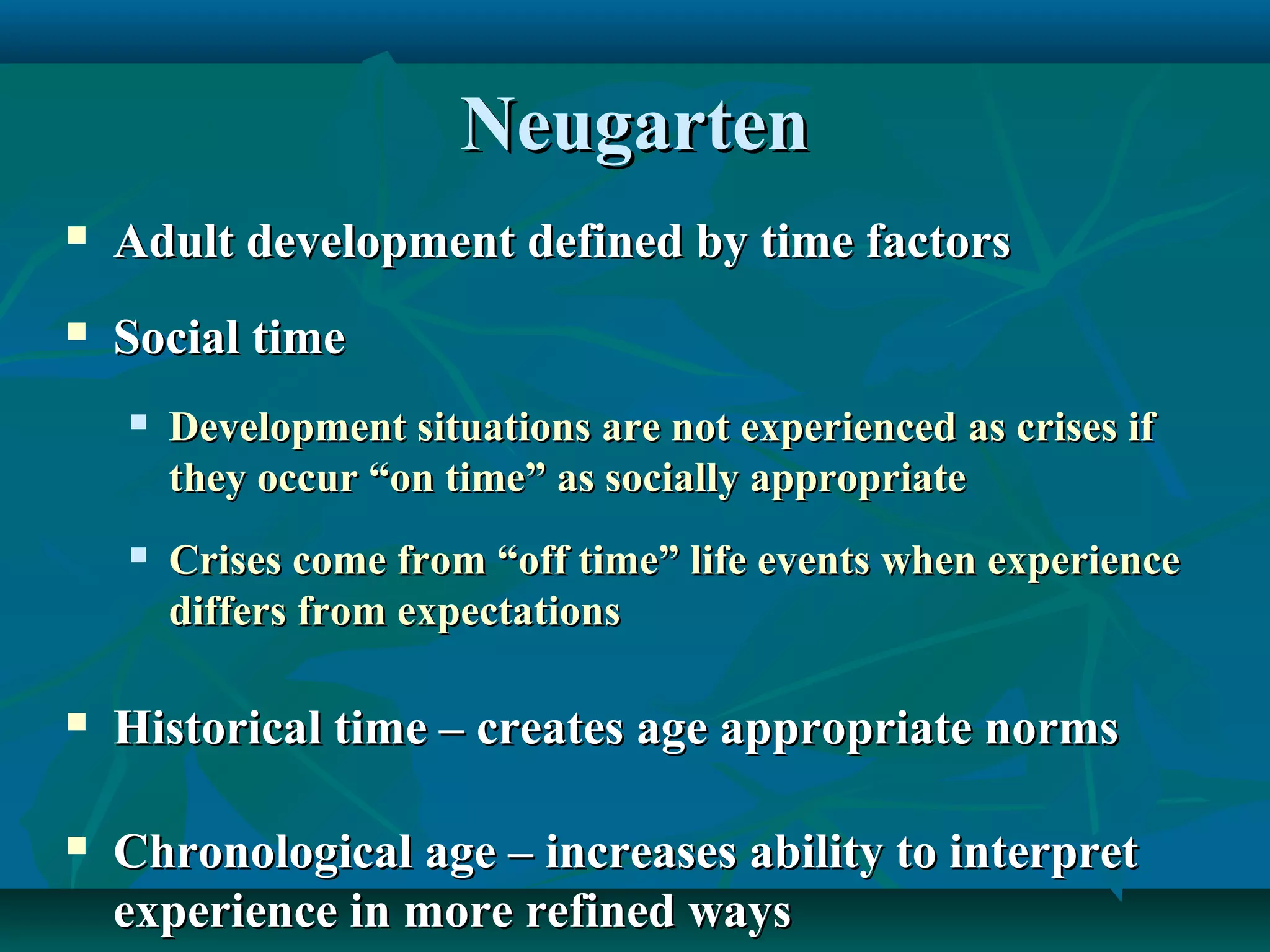
NeugartenNeugarten
 Adult development defined by time factorsAdult development defined by time factors
 Social timeSocial time
 Development situations are not experiencedDevelopment situations are not experienced as crises ifas crises if
they occur “on time” as socially appropriatethey occur “on time” as socially appropriate
 Crises come from “off time” life events when experienceCrises come from “off time” life events when experience
differs from expectationsdiffers from expectations
 Historical time – creates age appropriate normsHistorical time – creates age appropriate norms
 Chronological age – increases ability to interpretChronological age – increases ability to interpret
experience in more refined waysexperience in more refined ways
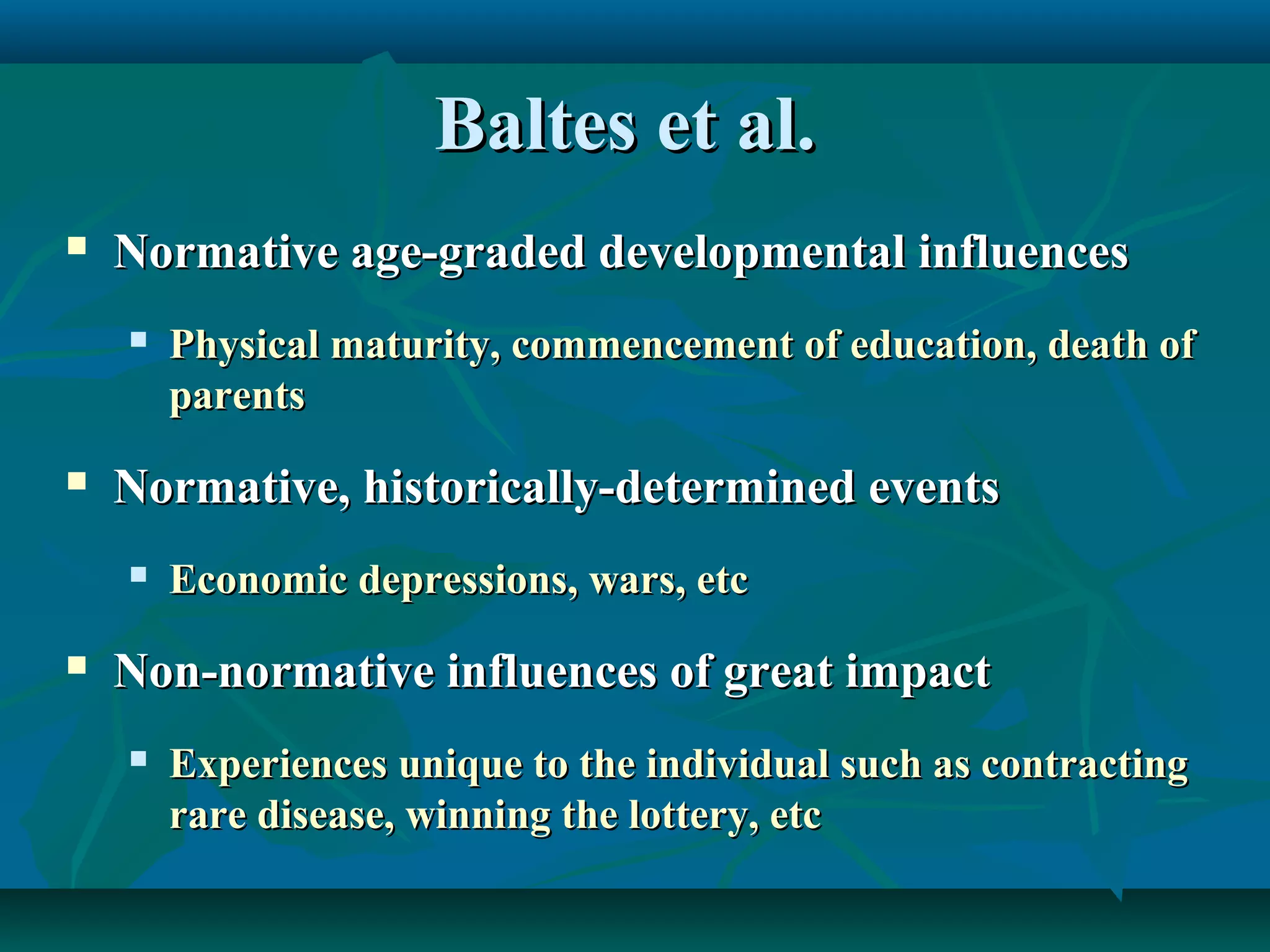
Baltes et al.Baltes et al.
 Normative age-graded developmental influencesNormative age-graded developmental influences
 Physical maturity, commencement of education, death ofPhysical maturity, commencement of education, death of
parentsparents
 Normative, historically-determined eventsNormative, historically-determined events
 Economic depressions, wars, etcEconomic depressions, wars, etc
 Non-normative influences of great impactNon-normative influences of great impact
 Experiences unique to the individual such as contractingExperiences unique to the individual such as contracting
rare disease, winning the lottery, etcrare disease, winning the lottery, etc
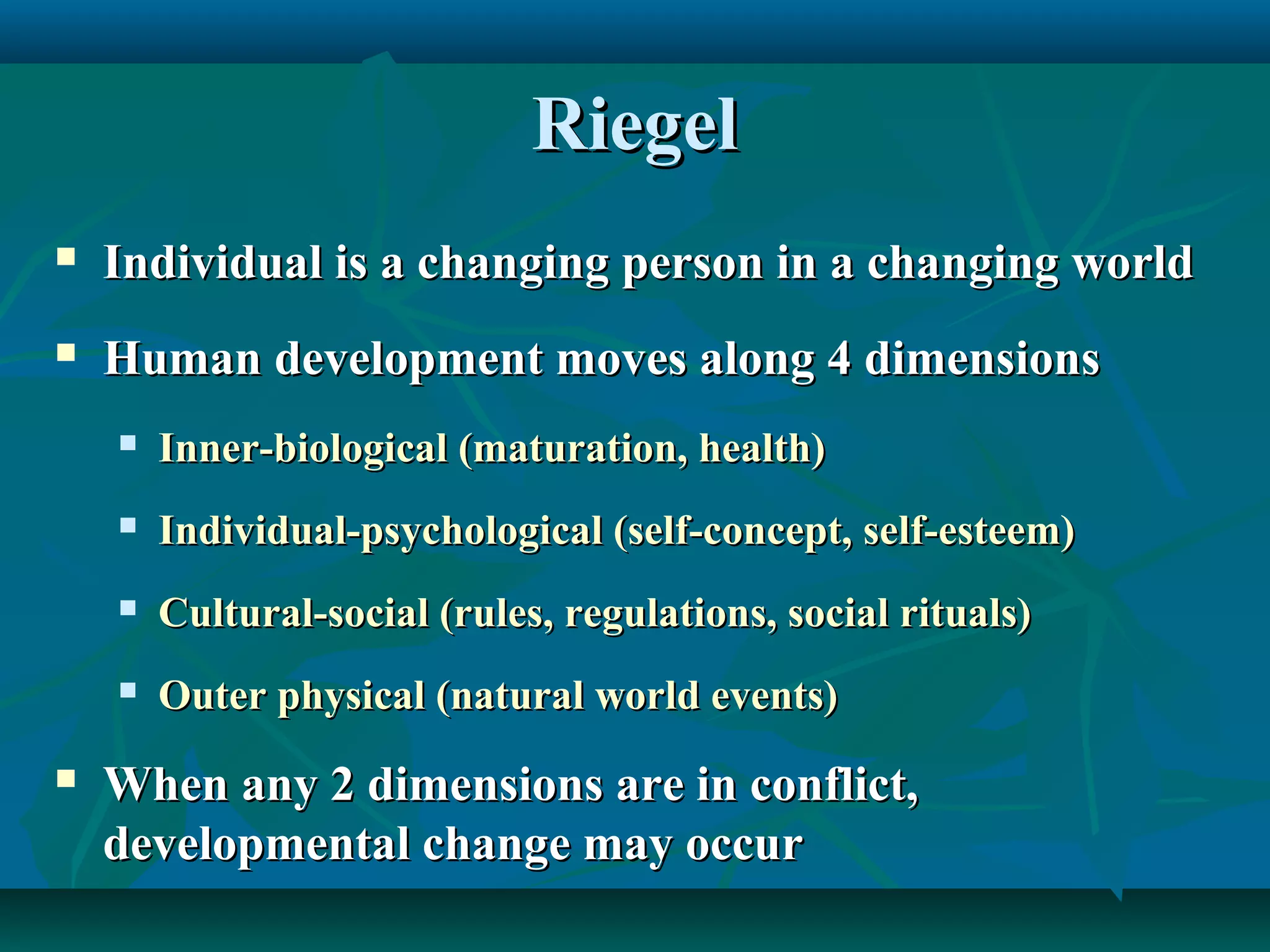
RiegelRiegel
 Individual is a changing person in a changing worldIndividual is a changing person in a changing world
 Human development moves along 4 dimensionsHuman development moves along 4 dimensions
 Inner-biological (maturation, health)Inner-biological (maturation, health)
 Individual-psychological (self-concept, self-esteem)Individual-psychological (self-concept, self-esteem)
 Cultural-social (rules, regulations, social rituals)Cultural-social (rules, regulations, social rituals)
 Outer physical (natural world events)Outer physical (natural world events)
 When any 2 dimensions are in conflict,When any 2 dimensions are in conflict,
developmental change may occurdevelopmental change may occur
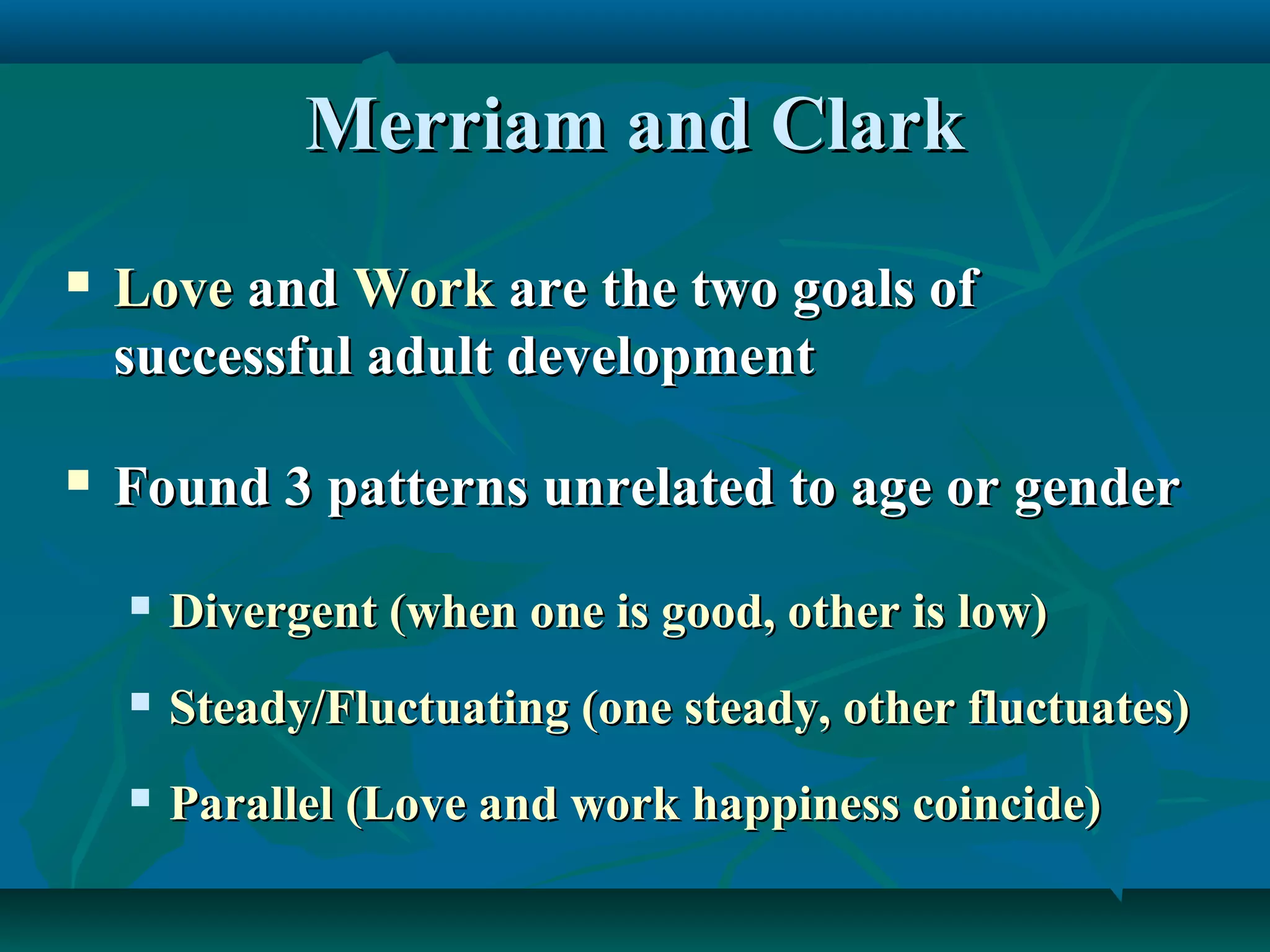
Merriam and ClarkMerriam and Clark
 LoveLove andand WorkWork are the two goals ofare the two goals of
successful adult developmentsuccessful adult development
 Found 3 patterns unrelated to age or genderFound 3 patterns unrelated to age or gender
 Divergent (when one is good, other is low)Divergent (when one is good, other is low)
 Steady/Fluctuating (one steady, other fluctuates)Steady/Fluctuating (one steady, other fluctuates)
 Parallel (Love and work happiness coincide)Parallel (Love and work happiness coincide)
Transitions TheoristsTransitions Theorists
Bridges (1980)Bridges (1980)
Sugarman (1986)Sugarman (1986)
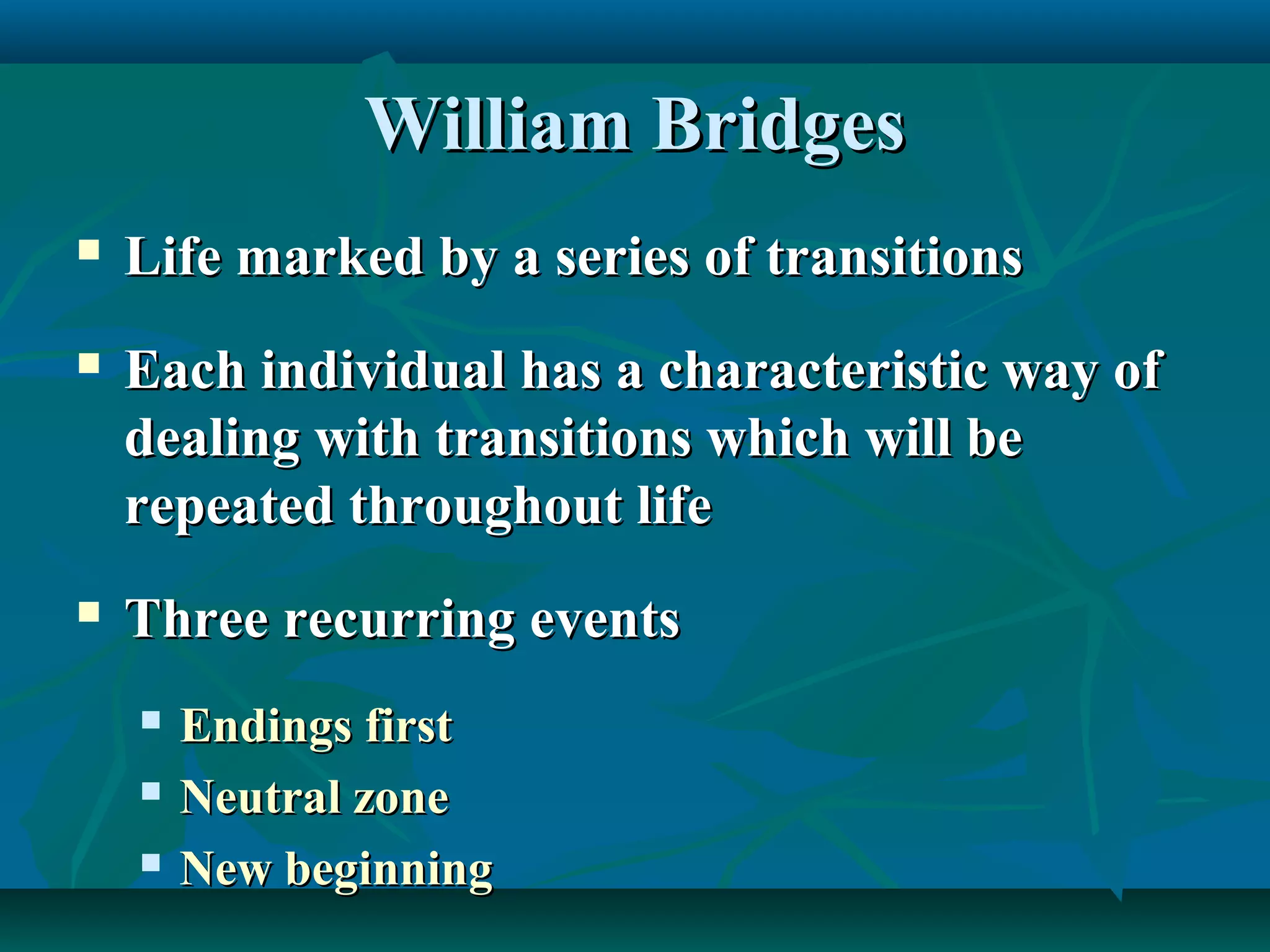
William BridgesWilliam Bridges
 Life marked by a series of transitionsLife marked by a series of transitions
 Each individual has a characteristic way ofEach individual has a characteristic way of
dealing with transitions which will bedealing with transitions which will be
repeated throughout liferepeated throughout life
 Three recurring eventsThree recurring events
 Endings firstEndings first
 Neutral zoneNeutral zone
 New beginningNew beginning
SugarmanSugarman
 Change experience follows a characteristic patternChange experience follows a characteristic pattern
 Immobilization – sense of being overwhelmedImmobilization – sense of being overwhelmed
 Reaction – sharp mood swings from elation to despairReaction – sharp mood swings from elation to despair
 Denial - minimizing the impactDenial - minimizing the impact
 Letting go of the pastLetting go of the past
 Testing – exploring new optionsTesting – exploring new options
 Searching for meaning – a conscious effort to learn fromSearching for meaning – a conscious effort to learn from
the experiencethe experience
 Integration – feeling at home with the changeIntegration – feeling at home with the change

Class 5 adult development theories___longer_version

  • 1.
    Adult DevelopmentAdult Development TheoriesTheories Class3Class 3 ADLT 601 – The Adult LearnerADLT 601 – The Adult Learner Spring 2006Spring 2006
  • 2.
    Personal Development TheoristsPersonalDevelopment Theorists  Age / StageAge / Stage  Development proceeds according to a series of stagesDevelopment proceeds according to a series of stages adults pass through as they ageadults pass through as they age  Life EventsLife Events  Development coincides with major life events such asDevelopment coincides with major life events such as marriage, death of spouse, etcmarriage, death of spouse, etc  TransitionsTransitions  Development marked by periods of transition from oneDevelopment marked by periods of transition from one stage to anotherstage to another
  • 3.
    Age – StageTheoristsAge – Stage Theorists Levinson (1978, 1996)Levinson (1978, 1996) Gilligan (1986)Gilligan (1986) Havighurst (1981)Havighurst (1981) Maslow (1968)Maslow (1968) Gould (1978)Gould (1978) Erikson (1959)Erikson (1959)
  • 4.
    Daniel LevinsonDaniel Levinson Life cycle composed of 4 developmental periodsLife cycle composed of 4 developmental periods  Childhood – Adolescence (birth – age 20)Childhood – Adolescence (birth – age 20)  Early Adulthood (ages 17-45)Early Adulthood (ages 17-45)  Middle Adulthood (ages 40 – 65)Middle Adulthood (ages 40 – 65)  Late Adulthood (ages 60 – onward)Late Adulthood (ages 60 – onward)  Each transition takes 3-6 years to completeEach transition takes 3-6 years to complete  Concept of individuation – changing relationshipConcept of individuation – changing relationship between self and the worldbetween self and the world
  • 5.
    Carol GilliganCarol Gilligan Feminist perspective on age-stage theoriesFeminist perspective on age-stage theories  Highly critical of Levinson’s concept of “theHighly critical of Levinson’s concept of “the dream”dream”  Male identity build upon contrast andMale identity build upon contrast and separateness to primary care-giverseparateness to primary care-giver  Female identity based on perceptions ofFemale identity based on perceptions of sameness and attachment to primary caregiversameness and attachment to primary caregiver
  • 6.
    Gilligan, con’tGilligan, con’t Women’s moral judgment proceeds throughWomen’s moral judgment proceeds through three levelsthree levels  Focus on self (Level 1)Focus on self (Level 1)  Caring for others equated with good (Level 2)Caring for others equated with good (Level 2)  Caring for others and responsibility forCaring for others and responsibility for individual needs (Level 3)individual needs (Level 3)  Two transitionsTwo transitions  Movement from selfishness to responsibilityMovement from selfishness to responsibility  Movement from goodness to truthMovement from goodness to truth
  • 7.
    HavighurstHavighurst ickering and Havighurstickeringand Havighurst  Concept of the “teachable moment” whenConcept of the “teachable moment” when the learning opportunity coincides withthe learning opportunity coincides with the life task at handthe life task at hand  Identified developmental tasks specific toIdentified developmental tasks specific to white, middle-class North Americanswhite, middle-class North Americans
  • 8.
    Abraham MaslowAbraham Maslow Development as reaching self-actualizationDevelopment as reaching self-actualization  Accepting of themselves and othersAccepting of themselves and others  Problem-centered not self-centeredProblem-centered not self-centered  Have spontaneityHave spontaneity  Have had mystical or spiritual experiencesHave had mystical or spiritual experiences  Resist conformity to cultureResist conformity to culture  Need for privacyNeed for privacy  Deep relationships with a few special othersDeep relationships with a few special others  Have creativityHave creativity
  • 9.
    Roger GouldRoger Gould Development is a process of confrontingDevelopment is a process of confronting layer upon layer of childhood painlayer upon layer of childhood pain  Development involves separation fromDevelopment involves separation from childhood assumptionschildhood assumptions
  • 10.
    Erik EriksonErik Erikson Development occurs as demands ofDevelopment occurs as demands of society provoke struggle or crisis withinsociety provoke struggle or crisis within the personthe person  Eight psycho-social stages: five inEight psycho-social stages: five in childhood based on Freudian conceptschildhood based on Freudian concepts  Adult stagesAdult stages  IntimacyIntimacy  GenerativityGenerativity  IntegrityIntegrity
  • 11.
    Life Events TheoristsLifeEvents Theorists Neugarten (1976)Neugarten (1976) Baltes et al. (1980)Baltes et al. (1980) Riegel (1976)Riegel (1976) Merriam and Clark (1991)Merriam and Clark (1991)
  • 12.
    NeugartenNeugarten  Adult developmentdefined by time factorsAdult development defined by time factors  Social timeSocial time  Development situations are not experiencedDevelopment situations are not experienced as crises ifas crises if they occur “on time” as socially appropriatethey occur “on time” as socially appropriate  Crises come from “off time” life events when experienceCrises come from “off time” life events when experience differs from expectationsdiffers from expectations  Historical time – creates age appropriate normsHistorical time – creates age appropriate norms  Chronological age – increases ability to interpretChronological age – increases ability to interpret experience in more refined waysexperience in more refined ways
  • 13.
    Baltes et al.Balteset al.  Normative age-graded developmental influencesNormative age-graded developmental influences  Physical maturity, commencement of education, death ofPhysical maturity, commencement of education, death of parentsparents  Normative, historically-determined eventsNormative, historically-determined events  Economic depressions, wars, etcEconomic depressions, wars, etc  Non-normative influences of great impactNon-normative influences of great impact  Experiences unique to the individual such as contractingExperiences unique to the individual such as contracting rare disease, winning the lottery, etcrare disease, winning the lottery, etc
  • 14.
    RiegelRiegel  Individual isa changing person in a changing worldIndividual is a changing person in a changing world  Human development moves along 4 dimensionsHuman development moves along 4 dimensions  Inner-biological (maturation, health)Inner-biological (maturation, health)  Individual-psychological (self-concept, self-esteem)Individual-psychological (self-concept, self-esteem)  Cultural-social (rules, regulations, social rituals)Cultural-social (rules, regulations, social rituals)  Outer physical (natural world events)Outer physical (natural world events)  When any 2 dimensions are in conflict,When any 2 dimensions are in conflict, developmental change may occurdevelopmental change may occur
  • 15.
    Merriam and ClarkMerriamand Clark  LoveLove andand WorkWork are the two goals ofare the two goals of successful adult developmentsuccessful adult development  Found 3 patterns unrelated to age or genderFound 3 patterns unrelated to age or gender  Divergent (when one is good, other is low)Divergent (when one is good, other is low)  Steady/Fluctuating (one steady, other fluctuates)Steady/Fluctuating (one steady, other fluctuates)  Parallel (Love and work happiness coincide)Parallel (Love and work happiness coincide)
  • 16.
    Transitions TheoristsTransitions Theorists Bridges(1980)Bridges (1980) Sugarman (1986)Sugarman (1986)
  • 17.
    William BridgesWilliam Bridges Life marked by a series of transitionsLife marked by a series of transitions  Each individual has a characteristic way ofEach individual has a characteristic way of dealing with transitions which will bedealing with transitions which will be repeated throughout liferepeated throughout life  Three recurring eventsThree recurring events  Endings firstEndings first  Neutral zoneNeutral zone  New beginningNew beginning
  • 18.
    SugarmanSugarman  Change experiencefollows a characteristic patternChange experience follows a characteristic pattern  Immobilization – sense of being overwhelmedImmobilization – sense of being overwhelmed  Reaction – sharp mood swings from elation to despairReaction – sharp mood swings from elation to despair  Denial - minimizing the impactDenial - minimizing the impact  Letting go of the pastLetting go of the past  Testing – exploring new optionsTesting – exploring new options  Searching for meaning – a conscious effort to learn fromSearching for meaning – a conscious effort to learn from the experiencethe experience  Integration – feeling at home with the changeIntegration – feeling at home with the change