The Integumentary system
refers to the
SKIN
HAIR
SCALP
NAILS
SKIN
 Use the senses of sight , smell and touch while
performing inspection and palpation of the skin.
 Assessment of the skin reveals the patient’s health
status related to Oxygenation , Circulation , Nutrition,
local tissue damage and hydration.
 Adequate lighting is needed for assessment the skin
properly.
COLOUR
 Bluish(Cyanosis)- Increased amount of
deoxygenated hemoglobin associated with hypoxia
e.g. Heart or Lung disease, cold environment(Nail
beds, lips ,mouth, skin)
 Pallor(decrease in color)-Reduced amount of
oxyhemoglobin e.g Anaemia(Face , conjunctiva ,
nail beds , palms)
 Loss of pigmentation-Vitiligo e.g Congenital or
autoimmune condition(Patchy areas on skin over
face, hands , arms)
Continued………
 Yellow orange(Jaundice)-Increased deposit of
bilirubin in tissues e.g Liver disease, Destruction
of RBC(Sclera , mucous membrane ,skin)
 Red(Erythema)-Increased visibility of
oxyhemoglobin caused by dilation or increased
blood flow(Face, pressure area)
 Tan brown-Increased amount of melanin e.g
Suntan , pregnancy(Face , arms)
Moisture
 The hydration of skin and mucous mambranes
help to reveal body fluid imbalances, changes in
the environment of the skin and regulation of
body temperature.
 Dry skin is caused by lack of humidity, exposure to
sun, smoking, stress, excessive perspiration and
dehydration.
Temperature
 Increased or decreased skin temperatrure indicates
an increase and decrease blood flow.
 An increased skin temperature often accompanies
localized erythema or redness of the skin,
inflammation , infection.
 A reduction indicates pallor and decresed blood
flow.
Texture
 Texture refers to the character of the surface
of the skin and how the deeper layers feel.
 By palpating it can be felt that the patient’s
skin is smooth or rough , thin or thick , tight
or supple and indurated or soft.
 Localized skin changes result from trauma,
surgical wound or lesions.
Turgor
 Turgor refers to the elasticity of the skin.
 Normally the skin loses its elasticity with age , but
fluid balance can also affect skin turgor.
 Edema or dehydration diminishes turgor.
 To assess the skin turgor grasp a fold of skin on the
back of the forearm with the fingertips and release.
 Normally the skin lifts easily and falls immediately
back to its resting position..
 When turgor is poor it stays pinched and shows
tenting.
Vascularity
 Vascularity occurs in localized area and lead
to the appearance of superficial blood
vessels.
 Petechiae are non blanching pinpoint size ,
red or purple spots on the skin caused by
small haemorrhages in the skin layer.
Edema
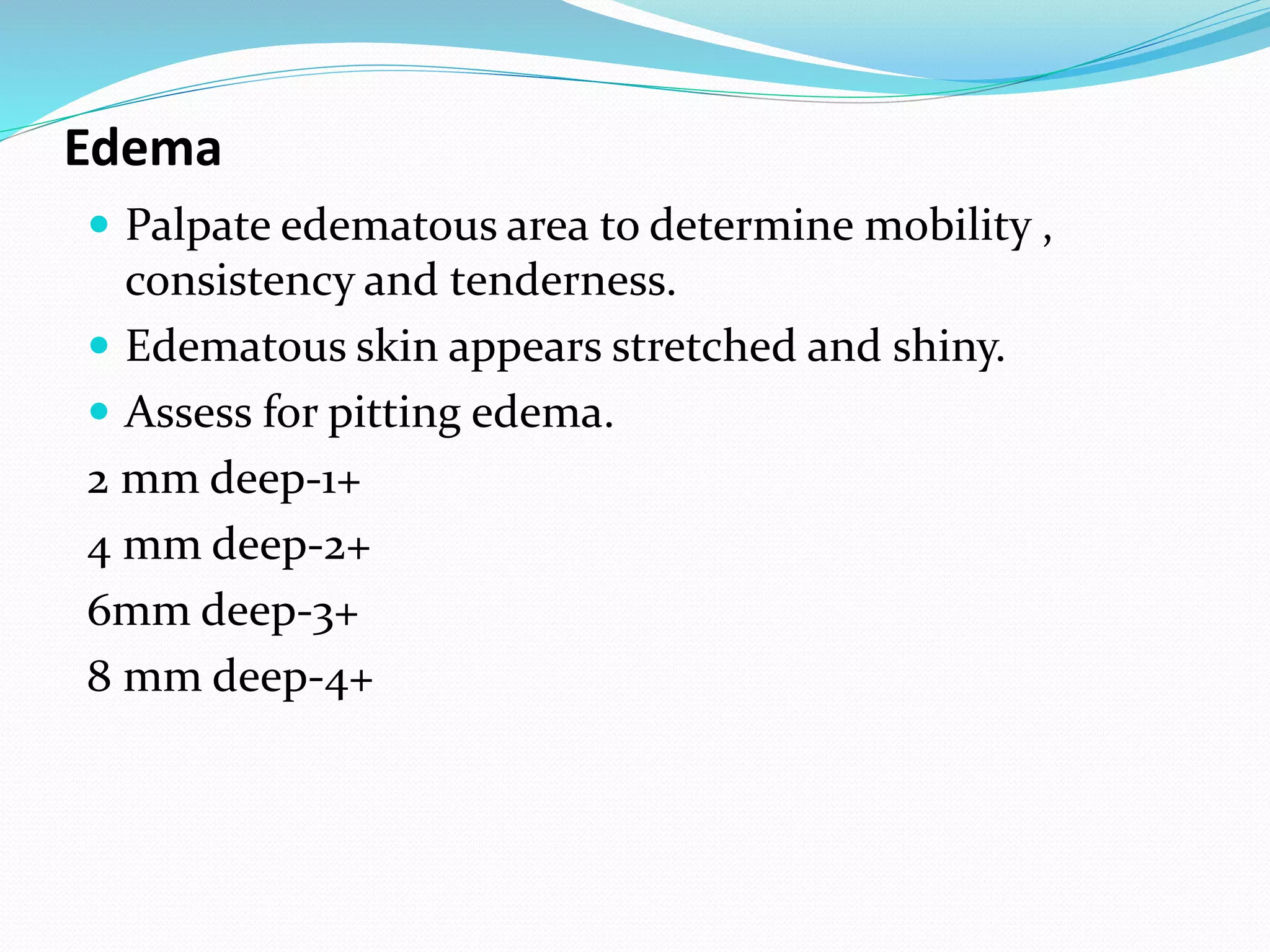
 Palpate edematous area to determine mobility ,
consistency and tenderness.
 Edematous skin appears stretched and shiny.
 Assess for pitting edema.
2 mm deep-1+
4 mm deep-2+
6mm deep-3+
8 mm deep-4+

ASSESSMENT OF INTEGUMENTARY SYSTEM.pptx

  • 2.
    The Integumentary system refersto the SKIN HAIR SCALP NAILS
  • 3.
    SKIN  Use thesenses of sight , smell and touch while performing inspection and palpation of the skin.  Assessment of the skin reveals the patient’s health status related to Oxygenation , Circulation , Nutrition, local tissue damage and hydration.  Adequate lighting is needed for assessment the skin properly.
  • 4.
    COLOUR  Bluish(Cyanosis)- Increasedamount of deoxygenated hemoglobin associated with hypoxia e.g. Heart or Lung disease, cold environment(Nail beds, lips ,mouth, skin)  Pallor(decrease in color)-Reduced amount of oxyhemoglobin e.g Anaemia(Face , conjunctiva , nail beds , palms)  Loss of pigmentation-Vitiligo e.g Congenital or autoimmune condition(Patchy areas on skin over face, hands , arms)
  • 5.
    Continued………  Yellow orange(Jaundice)-Increaseddeposit of bilirubin in tissues e.g Liver disease, Destruction of RBC(Sclera , mucous membrane ,skin)  Red(Erythema)-Increased visibility of oxyhemoglobin caused by dilation or increased blood flow(Face, pressure area)  Tan brown-Increased amount of melanin e.g Suntan , pregnancy(Face , arms)
  • 6.
    Moisture  The hydrationof skin and mucous mambranes help to reveal body fluid imbalances, changes in the environment of the skin and regulation of body temperature.  Dry skin is caused by lack of humidity, exposure to sun, smoking, stress, excessive perspiration and dehydration.
  • 7.
    Temperature  Increased ordecreased skin temperatrure indicates an increase and decrease blood flow.  An increased skin temperature often accompanies localized erythema or redness of the skin, inflammation , infection.  A reduction indicates pallor and decresed blood flow.
  • 8.
    Texture  Texture refersto the character of the surface of the skin and how the deeper layers feel.  By palpating it can be felt that the patient’s skin is smooth or rough , thin or thick , tight or supple and indurated or soft.  Localized skin changes result from trauma, surgical wound or lesions.
  • 9.
    Turgor  Turgor refersto the elasticity of the skin.  Normally the skin loses its elasticity with age , but fluid balance can also affect skin turgor.  Edema or dehydration diminishes turgor.  To assess the skin turgor grasp a fold of skin on the back of the forearm with the fingertips and release.  Normally the skin lifts easily and falls immediately back to its resting position..  When turgor is poor it stays pinched and shows tenting.
  • 10.
    Vascularity  Vascularity occursin localized area and lead to the appearance of superficial blood vessels.  Petechiae are non blanching pinpoint size , red or purple spots on the skin caused by small haemorrhages in the skin layer.
  • 11.
    Edema  Palpate edematousarea to determine mobility , consistency and tenderness.  Edematous skin appears stretched and shiny.  Assess for pitting edema. 2 mm deep-1+ 4 mm deep-2+ 6mm deep-3+ 8 mm deep-4+