DECISION MAKING
SNEHA T B
ASST PROF
MECHATRONICS
Decision-Making Process
“Decision Making is the process of making choices by setting goals, gathering
information, and assessing alternative occupations.”
• Step 1: Identify the problem.
• Step 2: Gather relevant information.
• Step 3: Identify alternatives.
• Step 4: Weigh evidence.
• Step 5: Choose among alternatives.
• Step 6: Take action.
• Step 7: Review decision and consequences.
Types of Decisions
• Strategic decisions
• Tactical decisions
• Operational decisions
Types of Decisions
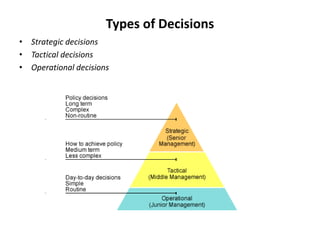
• Strategic decisions are long term, complex decisions made by senior
management. These decisions will affect the entire direction of the firm.
An example may be to become the market leader in their field.
• Tactical decisions are medium term, less complex decisions made by
middle managers. They follow on from strategic decisions and aim to meet
the objectives stated in any strategic decision.
• Operational decisions are day to day decisions made by junior managers
that are simple and routine. This could involve the regular ordering of
supplies or the creation of a staff rotation.
Decision Making Under Certainty, Uncertainty and Risk
• Taking Decisions under Certainty
– If the outcomes are known and the values of the outcomes are certain,
the task of the decision maker is to compute the optimal alternative or
outcome with some optimization criterion in mind.
• Taking Decisions under Risk
– The making of decisions under risk is done only when the probabilities
of various outcomes are known, is similar to certainty.
• Taking Decisions under Uncertainty
– Decisions under uncertainty (outcomes known but not the
probabilities) must be handled differently because, without
probabilities, the optimization criteria cannot be applied.
Programmed & Non-Programmed Decisions
Programmed Decision
Programmed decisions are those that are traditionally made using
standard operating procedures or other well-defined methods.
Features
• Programmed decisions made using standard operating procedures.
• Deals with frequently occurring situations.
• In programmed decisions managers make a real decision only once and
program itself specifies procedures to follow when similar circumstances
arise.
• Leads to the formulation of rules, procedures, and policies.
Programmed & Non-Programmed Decisions
Non-Programmed Decision
“Non-programmed decisions are unique. They are often ill-structured, one-shot
decisions. Traditionally they have been handled by techniques such as
judgment, intuition, and creativity”
Features
• Situations for Non-programmed decisions are unique, ill-structured.
• Non-programmed decisions are one-shot decisions.
• Handled by techniques such as judgment, intuition, and creativity.
• A logical approach to deal with extraordinary, unexpected, and unique problems.
• Managers take heuristic problem-solving approaches in which logic; common
sense and trial and error are used.
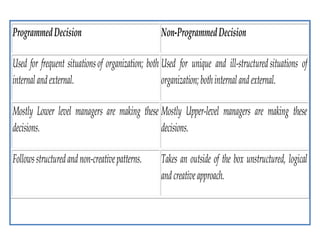
ProgrammedDecision Non-ProgrammedDecision
Used for frequent situations of organization; both
internal andexternal.
Used for unique and ill-structured situations of
organization;bothinternalandexternal.
Mostly Lower level managers are making these
decisions.
Mostly Upper-level managers are making these
decisions.
Followsstructuredand non-creativepatterns. Takes an outside of the box unstructured, logical
andcreativeapproach.

Hs300 m4 3 decision making

  • 1.
    DECISION MAKING SNEHA TB ASST PROF MECHATRONICS
  • 2.
    Decision-Making Process “Decision Makingis the process of making choices by setting goals, gathering information, and assessing alternative occupations.” • Step 1: Identify the problem. • Step 2: Gather relevant information. • Step 3: Identify alternatives. • Step 4: Weigh evidence. • Step 5: Choose among alternatives. • Step 6: Take action. • Step 7: Review decision and consequences.
  • 3.
    Types of Decisions •Strategic decisions • Tactical decisions • Operational decisions
  • 4.
    Types of Decisions •Strategic decisions are long term, complex decisions made by senior management. These decisions will affect the entire direction of the firm. An example may be to become the market leader in their field. • Tactical decisions are medium term, less complex decisions made by middle managers. They follow on from strategic decisions and aim to meet the objectives stated in any strategic decision. • Operational decisions are day to day decisions made by junior managers that are simple and routine. This could involve the regular ordering of supplies or the creation of a staff rotation.
  • 5.
    Decision Making UnderCertainty, Uncertainty and Risk • Taking Decisions under Certainty – If the outcomes are known and the values of the outcomes are certain, the task of the decision maker is to compute the optimal alternative or outcome with some optimization criterion in mind. • Taking Decisions under Risk – The making of decisions under risk is done only when the probabilities of various outcomes are known, is similar to certainty. • Taking Decisions under Uncertainty – Decisions under uncertainty (outcomes known but not the probabilities) must be handled differently because, without probabilities, the optimization criteria cannot be applied.
  • 6.
    Programmed & Non-ProgrammedDecisions Programmed Decision Programmed decisions are those that are traditionally made using standard operating procedures or other well-defined methods. Features • Programmed decisions made using standard operating procedures. • Deals with frequently occurring situations. • In programmed decisions managers make a real decision only once and program itself specifies procedures to follow when similar circumstances arise. • Leads to the formulation of rules, procedures, and policies.
  • 7.
    Programmed & Non-ProgrammedDecisions Non-Programmed Decision “Non-programmed decisions are unique. They are often ill-structured, one-shot decisions. Traditionally they have been handled by techniques such as judgment, intuition, and creativity” Features • Situations for Non-programmed decisions are unique, ill-structured. • Non-programmed decisions are one-shot decisions. • Handled by techniques such as judgment, intuition, and creativity. • A logical approach to deal with extraordinary, unexpected, and unique problems. • Managers take heuristic problem-solving approaches in which logic; common sense and trial and error are used.
  • 8.
    ProgrammedDecision Non-ProgrammedDecision Used forfrequent situations of organization; both internal andexternal. Used for unique and ill-structured situations of organization;bothinternalandexternal. Mostly Lower level managers are making these decisions. Mostly Upper-level managers are making these decisions. Followsstructuredand non-creativepatterns. Takes an outside of the box unstructured, logical andcreativeapproach.