STAFFING
SNEHA T B
ASST PROF
Staffing
 Staffing is the process of filling positions/posts
in the organization with adequate and qualified
personnel .
 Staffing is the process of acquiring, deploying,
and retaining a workforce of sufficient quantity
and quality to create positive impacts on the
organization's effectiveness
Definitions
 According to McFarland,
“Staffing is the function by which managers build an
organization through the recruitment, selection, and
development of individuals as capable employees.”
 According to Koontz, O’Donnell and Heinz
Weihrich,
“The management function of staffing is defined as
filling
position in the organization structure through
identifying
workforce requirements, inventorying the people
available, recruitment, selection, placement,
promotion, appraisal, compensation, and training of
needed people”
Features of Staffing
 All pervasive function of management.
 Dynamic function.
 Vast scope.
Major Objectives
 To understand all function of in an
organization.
 To understand manpower planning so that
people are available at right time and at a
right place.
 To understand issues related to job analysis
and to overcome the problem
Importance
 Training and Development.
 Effective Co-ordination.
 Effective Recruitment & Placement.
 Building effective human resource
 Optimum Use of Resource.
 Enhances Corporate Image.
 Job Satisfaction.
Elements of Staffing
 Manpower planning
 Job analysis
 Recruitment and selection
 Training and Development
 Performance appraisal
Scope of HR Planning
 Hiring
 Motivation
 Employee maintenance
 Human relations
Staffing Process
 Planning : It is human resource planning, where the total number of
staff members required in various grade will be determined.
 Recruitment and Selection: It deals with the selection of qualified
applicants to fill the jobs in the organization.
 Training and development : It is concerned with providing training to
new staff members as well as existing staff members.
 Performance Operation: It deals with assessment of work done by
the staff in an organization. A standard may be fixed in order to
evaluate the efficiency of the staff members.
Empowerment
 Authority & Power : Power is the ability of individuals or groups to
induce or influence the beliefs or actions of other persons or groups
whereas Authority is the right in a position to exercise discretion in
making decisions affecting others.
 Empowerment: It means that employees, managers or teams at
all levels in the organization are given the power to make decisions
without asking their superiors for permission.
 Always power should be equal to responsibility. Greater power with
lesser responsibility will result in autocratic behavior. When
responsibility is greater than power it may result in frustration
Line & Staff Concepts
 Line authority gives a superior line of authority over a subordinate.
It exists in all organizations as an uninterrupted scale or series of
steps.
 The nature of staff relationship is advisory. Their function is to
investigate, research, and give advice to line managers.
 Functional Authority: It is the right delegated to an individual or a
department to control specified processes, practices, or other
matters relating to activities undertaken by persons in other
departments. It is a small slice of authority of a line superior. In
some cases line managers are deprived of some authority which is
delegated by their common superior to a staff specialist or to a
manager in another department.
Delegation of Authority
 Delegation happens when a superior gives a subordinate the
authority to take decisions.
Delegation Process:
 1. Determining the results expected from a position
 2. Assigning tasks to the position
 3. Delegating Authority for accomplishing these tasks
 4. Holding the person in that position responsible for the
accomplishment of the tasks.
Elements of Delegation
 1.Assignments of duties or responsibilities
 2.Delegation of Authority
 3.Accountability
Splintered Authority
 Splintered authority exists wherever a problem is solved by a
decision made with pooling the authority of two or more managers.
 E.g. If the superintendent of Plant A wants to make some changes
in the process to reduce the cost in Plant A and Plant B. Both the
superintendents have to agree and pool their authority and take
decision.
The Art of Delegation – Personal Attitudes
toward Delegation
Personal Attitudes
Receptiveness: The manager who does the delegation should have a willingness to
give other people’s ideas a chance.
Willingness to let go: Managers should not continue taking decisions for the post,
which they have left and already delegated to the subordinate.
Willingness to allow mistakes by Subordinates: Mistakes can be allowed to an
extent and by careful explanation without discouraging subordinates it should be
corrected.
Willingness to trust subordinates: A manager should trust his subordinate once
delegation is done. The manager should train the subordinate to raise to the
occasion or assign somebody else who is capable to act.
Willingness to establish and use broad controls: A manger should use goals,
policies, plans etc… as basic standards for judging the activities of subordinates,
effective control will be very difficult in an organization.
Overcoming Weak Delegation
 Define assignments and delegate authority in light of results
expected.
 Select the person in light of the job to be done.
 Maintain open lines of communication
 Establish proper controls.
 Reward effective delegation and successful assumption of authority
Decentralization &
Recentralization of Authority
 Decentralization is the tendency to disperse decision making
authority in an organized structure. If there is absolute centralization
of authority in an organization there will not have any subordinate
managers. If managers delegate all their authority, their positions
will no longer exist. So absolute centralization or absolute
decentralization is not possible in a structured organization.
Recentralization of Authority
 There can be circumstances at which an organization decides to do
recentralization. It is not a complete reversal of decentralization as
the authority delegated is not completely withdrawn. The process is
a centralization of authority over a certain type of activity or function.
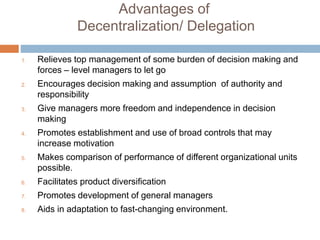
Advantages of
Decentralization/ Delegation
1. Relieves top management of some burden of decision making and
forces – level managers to let go
2. Encourages decision making and assumption of authority and
responsibility
3. Give managers more freedom and independence in decision
making
4. Promotes establishment and use of broad controls that may
increase motivation
5. Makes comparison of performance of different organizational units
possible.
6. Facilitates product diversification
7. Promotes development of general managers
8. Aids in adaptation to fast-changing environment.
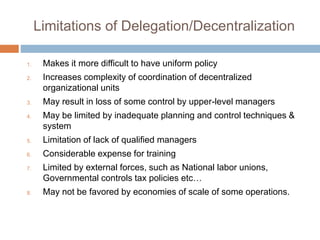
Limitations of Delegation/Decentralization
1. Makes it more difficult to have uniform policy
2. Increases complexity of coordination of decentralized
organizational units
3. May result in loss of some control by upper-level managers
4. May be limited by inadequate planning and control techniques &
system
5. Limitation of lack of qualified managers
6. Considerable expense for training
7. Limited by external forces, such as National labor unions,
Governmental controls tax policies etc…
8. May not be favored by economies of scale of some operations.
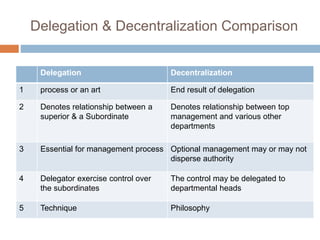
Delegation & Decentralization Comparison
Delegation Decentralization
1 process or an art End result of delegation
2 Denotes relationship between a
superior & a Subordinate
Denotes relationship between top
management and various other
departments
3 Essential for management process Optional management may or may not
disperse authority
4 Delegator exercise control over
the subordinates
The control may be delegated to
departmental heads
5 Technique Philosophy
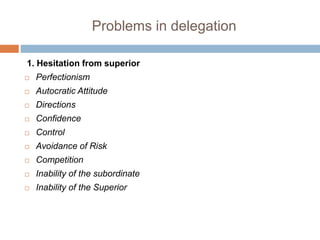
Problems in delegation
1. Hesitation from superior
 Perfectionism
 Autocratic Attitude
 Directions
 Confidence
 Control
 Avoidance of Risk
 Competition
 Inability of the subordinate
 Inability of the Superior
Problems in delegation
 2. Hesitation from Subordinates
 Love of Spoon feeding
 Easier to ask
 Fear of criticism
 Lack of resource
 Lack of self confidence
 Other work
 Inadequate incentives
 Fear of failure
Thank you

Hs300 m5 1 staffing

  • 1.
  • 2.
    Staffing  Staffing isthe process of filling positions/posts in the organization with adequate and qualified personnel .  Staffing is the process of acquiring, deploying, and retaining a workforce of sufficient quantity and quality to create positive impacts on the organization's effectiveness
  • 3.
    Definitions  According toMcFarland, “Staffing is the function by which managers build an organization through the recruitment, selection, and development of individuals as capable employees.”  According to Koontz, O’Donnell and Heinz Weihrich, “The management function of staffing is defined as filling position in the organization structure through identifying workforce requirements, inventorying the people available, recruitment, selection, placement, promotion, appraisal, compensation, and training of needed people”
  • 4.
    Features of Staffing All pervasive function of management.  Dynamic function.  Vast scope.
  • 5.
    Major Objectives  Tounderstand all function of in an organization.  To understand manpower planning so that people are available at right time and at a right place.  To understand issues related to job analysis and to overcome the problem
  • 6.
    Importance  Training andDevelopment.  Effective Co-ordination.  Effective Recruitment & Placement.  Building effective human resource  Optimum Use of Resource.  Enhances Corporate Image.  Job Satisfaction.
  • 7.
    Elements of Staffing Manpower planning  Job analysis  Recruitment and selection  Training and Development  Performance appraisal
  • 8.
    Scope of HRPlanning  Hiring  Motivation  Employee maintenance  Human relations
  • 9.
    Staffing Process  Planning: It is human resource planning, where the total number of staff members required in various grade will be determined.  Recruitment and Selection: It deals with the selection of qualified applicants to fill the jobs in the organization.  Training and development : It is concerned with providing training to new staff members as well as existing staff members.  Performance Operation: It deals with assessment of work done by the staff in an organization. A standard may be fixed in order to evaluate the efficiency of the staff members.
  • 10.
    Empowerment  Authority &Power : Power is the ability of individuals or groups to induce or influence the beliefs or actions of other persons or groups whereas Authority is the right in a position to exercise discretion in making decisions affecting others.  Empowerment: It means that employees, managers or teams at all levels in the organization are given the power to make decisions without asking their superiors for permission.  Always power should be equal to responsibility. Greater power with lesser responsibility will result in autocratic behavior. When responsibility is greater than power it may result in frustration
  • 11.
    Line & StaffConcepts  Line authority gives a superior line of authority over a subordinate. It exists in all organizations as an uninterrupted scale or series of steps.  The nature of staff relationship is advisory. Their function is to investigate, research, and give advice to line managers.  Functional Authority: It is the right delegated to an individual or a department to control specified processes, practices, or other matters relating to activities undertaken by persons in other departments. It is a small slice of authority of a line superior. In some cases line managers are deprived of some authority which is delegated by their common superior to a staff specialist or to a manager in another department.
  • 12.
    Delegation of Authority Delegation happens when a superior gives a subordinate the authority to take decisions. Delegation Process:  1. Determining the results expected from a position  2. Assigning tasks to the position  3. Delegating Authority for accomplishing these tasks  4. Holding the person in that position responsible for the accomplishment of the tasks.
  • 13.
    Elements of Delegation 1.Assignments of duties or responsibilities  2.Delegation of Authority  3.Accountability
  • 14.
    Splintered Authority  Splinteredauthority exists wherever a problem is solved by a decision made with pooling the authority of two or more managers.  E.g. If the superintendent of Plant A wants to make some changes in the process to reduce the cost in Plant A and Plant B. Both the superintendents have to agree and pool their authority and take decision.
  • 15.
    The Art ofDelegation – Personal Attitudes toward Delegation Personal Attitudes Receptiveness: The manager who does the delegation should have a willingness to give other people’s ideas a chance. Willingness to let go: Managers should not continue taking decisions for the post, which they have left and already delegated to the subordinate. Willingness to allow mistakes by Subordinates: Mistakes can be allowed to an extent and by careful explanation without discouraging subordinates it should be corrected. Willingness to trust subordinates: A manager should trust his subordinate once delegation is done. The manager should train the subordinate to raise to the occasion or assign somebody else who is capable to act. Willingness to establish and use broad controls: A manger should use goals, policies, plans etc… as basic standards for judging the activities of subordinates, effective control will be very difficult in an organization.
  • 16.
    Overcoming Weak Delegation Define assignments and delegate authority in light of results expected.  Select the person in light of the job to be done.  Maintain open lines of communication  Establish proper controls.  Reward effective delegation and successful assumption of authority
  • 17.
    Decentralization & Recentralization ofAuthority  Decentralization is the tendency to disperse decision making authority in an organized structure. If there is absolute centralization of authority in an organization there will not have any subordinate managers. If managers delegate all their authority, their positions will no longer exist. So absolute centralization or absolute decentralization is not possible in a structured organization. Recentralization of Authority  There can be circumstances at which an organization decides to do recentralization. It is not a complete reversal of decentralization as the authority delegated is not completely withdrawn. The process is a centralization of authority over a certain type of activity or function.
  • 18.
    Advantages of Decentralization/ Delegation 1.Relieves top management of some burden of decision making and forces – level managers to let go 2. Encourages decision making and assumption of authority and responsibility 3. Give managers more freedom and independence in decision making 4. Promotes establishment and use of broad controls that may increase motivation 5. Makes comparison of performance of different organizational units possible. 6. Facilitates product diversification 7. Promotes development of general managers 8. Aids in adaptation to fast-changing environment.
  • 19.
    Limitations of Delegation/Decentralization 1.Makes it more difficult to have uniform policy 2. Increases complexity of coordination of decentralized organizational units 3. May result in loss of some control by upper-level managers 4. May be limited by inadequate planning and control techniques & system 5. Limitation of lack of qualified managers 6. Considerable expense for training 7. Limited by external forces, such as National labor unions, Governmental controls tax policies etc… 8. May not be favored by economies of scale of some operations.
  • 20.
    Delegation & DecentralizationComparison Delegation Decentralization 1 process or an art End result of delegation 2 Denotes relationship between a superior & a Subordinate Denotes relationship between top management and various other departments 3 Essential for management process Optional management may or may not disperse authority 4 Delegator exercise control over the subordinates The control may be delegated to departmental heads 5 Technique Philosophy
  • 21.
    Problems in delegation 1.Hesitation from superior  Perfectionism  Autocratic Attitude  Directions  Confidence  Control  Avoidance of Risk  Competition  Inability of the subordinate  Inability of the Superior
  • 22.
    Problems in delegation 2. Hesitation from Subordinates  Love of Spoon feeding  Easier to ask  Fear of criticism  Lack of resource  Lack of self confidence  Other work  Inadequate incentives  Fear of failure
  • 23.