1
Don Honorio Ventura Technological State University
Bacolor (Main), Pampanga
College of Engineering and Architecture
Bachelor of Science in Mechanical Engineering
BSME-3C
Official Handout of Group 2 for the report:
DECISION MAKING
Managers of all kinds and types, including the engineer manager, are primarily tasked to
provide leadership in the quest for the attainment of the organization’s objectives. Many times,
he will be confronted by situations where he will have to choose from among various options.
The Engineer manager’s decision skills will be very crucial to his success as a professional.
A major blunder on decision making may be sufficient to cause the destruction of any
organization. Good decisions will providethe right environment for continuous growth and
success of any organized effort.
I. DECISION-MAKING AS A MANAGEMENT RESPONSIBILITY
Decisions must be made at various levels in the workplace. They are also made at the various
stages in the management process; someone must make a decision authorizing certain persons
to appropriatesuch resources.
Decision making is a responsibility of the Engineer manager. It is understandable for
managers to make wrong decisions at times. The bigger issue is the manager who cannot or
do not want to make decisions. Delaney concludes that these types of managers are
dangerous and should be removed from their position as soon as possible
Management must strive to choose a decision option as correctly as possible. The higher the
management level is, the bigger and more complicateddecision-making becomes.
II. WHAT IS DECISION MAKING?
Decision making maybe defined as “the process of identifying and choosing alternative
courses of action in a matter appropriate to the demands of the situation.”
The definition indicates that the engineer manager must adapt a certain procedure designed to
determine the best option available to solve certain problems.
Decision are made at various management levels (i.e., top middle, and lower levels) and
various management function (i.e., planning, organizing, directing, and controlling) decision
making, according to Nickels and other “is the heart of all the management functions”.
III. THE DECISION MAKING PROCESS
Rational decision-making, according to DavidH. Holt, is a process involving the following steps:
1. Diagnose problem
2. Analyze environment
3. Articulate problem or opportunity
2
4. Develop viablealternatives
5. Evaluate alternatives
6. Make a choice
7. Implement decision
8. Evaluate and adapt decision results
Diagnose Problem
Identify the problem
 An expert once said “identification of the problem is tantamount to having the
problem half-solved.”
 What is a Problem? A problem exists when there is a difference between an
actual situation and a desired situation.
Analyze the Environment
The environment where the organization is situated plays a very significant role in the success or
failure of such an organization. It is, therefore, very important that an analysis of the
environment be undertaken.
What is the goal of the Environmental Analysis?
To identify the constraint or the limitations.
2 kinds of limitations:
1. Internal Limitations (examples)
1. Limited funds availablefor the purchase of equipment.
2. Limited training on the part of employees.
3. III-designed facilities
2. External Limitations (examples)
1. Patents are controlled by other organizations.
2. A very limited market for the company’s products and services exists.
3. Strict enforcement of local zoning regulations
What if it fails?
The president of a new chemical manufacturing company made a decision to locate his
factory in a place adjacent to a thickly populated area. Construction of the building was made
with precision and was finished in a short period. When the clearance for the commencement of
operation was sought from local authorities, this could not be given. It turned out that the
residents opposed the operation of the firm and made sure that no clearance is given.
The president decided to relocate the factory but not after much time and money has
been lost.
This is an example of a man making solution to a problem disregarding his environment
when decisions are made.
Components of the Environment
The environment consists of two major concerns.
1. Internal
2. External
3
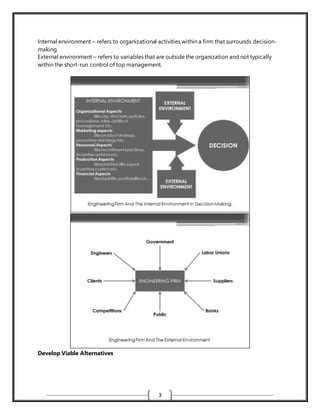
Internal environment – refers to organizational activities within a firm that surrounds decision-
making.
External environment – refers to variables that are outside the organization and not typically
within the short-run control of top management.
Develop Viable Alternatives
4
Oftentimes, problems may be solved by any of the solutions offered. The best among the
alternative solutions must be considered by management. This is made possible by using a
procedure with the following steps:
1. Prepare a list of alternative solutions.
2. Determine the viability of each solution.
3. Revise the list by striking out those which are not viable.
Make a Choice
What is Choice-Making?
Choice-making refers to the process of selecting among alternatives representing potential
solutions to a problem.
As Webber said, “…particular effort should be made to identify all significant consequences of
each choice.”
Alternatives? We can rank them from best to worst with the basis of some factors like benefit,
cost or risk.
Evaluate and Adapt Decision Results
In implementing the decision, the results expected may or may not happen.
It is, therefore, important for the manager to take note of the results and use it for future
references and decisions.
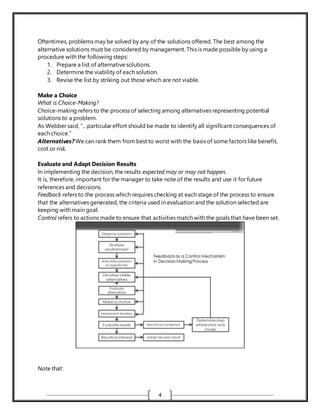
Feedback refers to the process which requires checking at each stage of the process to ensure
that the alternatives generated, the criteria used in evaluation and the solution selected are
keeping with main goal.
Control refers to actions made to ensure that activities match with the goals that have been set.
Note that:
5
We will not go back to choose another alternatives but will go back from the start and analyze
further
IV. APPROACHES IN SOLVING PROBLEMS
In decision making, the engineer manager is faced with problems which may either be
simple or complex. To provide him with some guide, he must be familiar with the following
approaches:
1. Qualitative evaluation, and
2. Quantitative evaluation
Qualitative Evaluation. This term refers to evaluation of alternatives using
intuition and subjective judgment. Stevenson states that managers tend to use the qualitative
approach when;
1. The problem is fairly simple
2. The problem is familiar
3. The cost involved are not great
4. Immediate decision are needed
An example of an evaluation using the qualitative approach is as follows;
A factory operates on three shifts with the following schedule:
First shift – 6:00 A.M. to 2:00 P.M.
Second shift – 2:00 P.M. to 10:00 P.M.
Third Shift – 10:00 P.M. to 6:00 A. M.
Each shift consists of 200 workers manning 200 machines. On September 16,
1996, the operations went smoothly until the factory manager, an industrial engineer, was
notified at 1:00 P.M. that five of the workers assigned to the second shift could not report for
work because of injuries sustained in a traffic accident while they were on their way to the
factory.
Because of time constraints, the manager made an instant decision on who
among the first shift workers would work overtime to man the five machines.
Quantitative Evaluation. This term refers to the evaluation of alternatives using
any technique in a group classified as rational and analytical.
V. QUANTITATIVE MODELS FOR DECISION MAKING
The types of quantitative techniques which may be useful in decision-making are as follows:
1. Inventory Models
2. Queuing Theory
3. Network Models
4. Forecasting
5. Regression Analysis
6. Simulation
6
7. Linear Programming
8. Sampling Theory
9. Statistical Decision Theory
Inventory Models
Inventory models consist of several types all designed to help engineer manager make decisions
regarding inventory. They are as follows.
Queuing Theory
The queuing theory is one that describes how to determine the number of service units that will
minimize both customers waiting time and cost of service.
The queuing theory is applicable to companies where waiting lines are common situation.
Examples are cars waiting for service at a car service center.
Network Models
These are models where large complex tasks are broken into smaller segments that can be
managed independently
The two most prominent network work models are:
1. The Program Evaluation Review Technique (PERT) – a technique which enables engineer
managers to schedule, monitor, and control large and complex projects by employing three
time estimates for each activity.
2. The Critical Path Method (CPM) – this is a network technique using only one time factor per
activity that enables engineer managers to schedule, monitor, and control large and complex
projects.
Forecasting
There are instance when engineer managers make decisions that will have implications in the
future. A manufacturing firm, for example, must put a capacity which is sufficient to produce the
demand requirements of customers within the next 12 months. As such, man- power and
facilities must be procured before the start of operations. To make decisions on capacity more
effective, the engineer manager must be provided with data on demand requirements for the
next 12 months.
Regression Analysis
The regression model is a forecasting method that examines the association between two or
more variables. It uses data form previous periods to predict future events.
Regression analysis may be simple or multiple depending on the number of independent
variables present. When one independent variable is involved, it is called simple regression;
when two or more independent variables are involved, it is called multiple regression
Simulation
Simulation is a model constructed to represent reality, on which conclusions about real-life
problems can be used. It is a highly sophisticated tool by means of which the decision maker
develops a mathematical model of the system under consideration
Linear Programming
Linear programming is a quantitative technique that is used to produce an optimum solution
within the bounds imposed by constraints upon the decision. Linear programming is very useful
7
as a decision-making tool when supply and demand limitations at plants, warehouse, or market
areas are constraints upon the system
Sampling Theory
Sampling theory is a quantitative technique where samples of populations are statistically
determined to be used for a number of processes such as quality control.
Sampling, in effect, is expensive but saves time and money.
Statistical Decision- Theory
Decision theory refers to the “rational way to conceptualize, analyze, and solve problems in
situation involving limited, or partial information about the decision environment.
~~End of the Handout~~

Decision Making (Engineering Management)

  • 1.
    1 Don Honorio VenturaTechnological State University Bacolor (Main), Pampanga College of Engineering and Architecture Bachelor of Science in Mechanical Engineering BSME-3C Official Handout of Group 2 for the report: DECISION MAKING Managers of all kinds and types, including the engineer manager, are primarily tasked to provide leadership in the quest for the attainment of the organization’s objectives. Many times, he will be confronted by situations where he will have to choose from among various options. The Engineer manager’s decision skills will be very crucial to his success as a professional. A major blunder on decision making may be sufficient to cause the destruction of any organization. Good decisions will providethe right environment for continuous growth and success of any organized effort. I. DECISION-MAKING AS A MANAGEMENT RESPONSIBILITY Decisions must be made at various levels in the workplace. They are also made at the various stages in the management process; someone must make a decision authorizing certain persons to appropriatesuch resources. Decision making is a responsibility of the Engineer manager. It is understandable for managers to make wrong decisions at times. The bigger issue is the manager who cannot or do not want to make decisions. Delaney concludes that these types of managers are dangerous and should be removed from their position as soon as possible Management must strive to choose a decision option as correctly as possible. The higher the management level is, the bigger and more complicateddecision-making becomes. II. WHAT IS DECISION MAKING? Decision making maybe defined as “the process of identifying and choosing alternative courses of action in a matter appropriate to the demands of the situation.” The definition indicates that the engineer manager must adapt a certain procedure designed to determine the best option available to solve certain problems. Decision are made at various management levels (i.e., top middle, and lower levels) and various management function (i.e., planning, organizing, directing, and controlling) decision making, according to Nickels and other “is the heart of all the management functions”. III. THE DECISION MAKING PROCESS Rational decision-making, according to DavidH. Holt, is a process involving the following steps: 1. Diagnose problem 2. Analyze environment 3. Articulate problem or opportunity
  • 2.
    2 4. Develop viablealternatives 5.Evaluate alternatives 6. Make a choice 7. Implement decision 8. Evaluate and adapt decision results Diagnose Problem Identify the problem  An expert once said “identification of the problem is tantamount to having the problem half-solved.”  What is a Problem? A problem exists when there is a difference between an actual situation and a desired situation. Analyze the Environment The environment where the organization is situated plays a very significant role in the success or failure of such an organization. It is, therefore, very important that an analysis of the environment be undertaken. What is the goal of the Environmental Analysis? To identify the constraint or the limitations. 2 kinds of limitations: 1. Internal Limitations (examples) 1. Limited funds availablefor the purchase of equipment. 2. Limited training on the part of employees. 3. III-designed facilities 2. External Limitations (examples) 1. Patents are controlled by other organizations. 2. A very limited market for the company’s products and services exists. 3. Strict enforcement of local zoning regulations What if it fails? The president of a new chemical manufacturing company made a decision to locate his factory in a place adjacent to a thickly populated area. Construction of the building was made with precision and was finished in a short period. When the clearance for the commencement of operation was sought from local authorities, this could not be given. It turned out that the residents opposed the operation of the firm and made sure that no clearance is given. The president decided to relocate the factory but not after much time and money has been lost. This is an example of a man making solution to a problem disregarding his environment when decisions are made. Components of the Environment The environment consists of two major concerns. 1. Internal 2. External
  • 3.
    3 Internal environment –refers to organizational activities within a firm that surrounds decision- making. External environment – refers to variables that are outside the organization and not typically within the short-run control of top management. Develop Viable Alternatives
  • 4.
    4 Oftentimes, problems maybe solved by any of the solutions offered. The best among the alternative solutions must be considered by management. This is made possible by using a procedure with the following steps: 1. Prepare a list of alternative solutions. 2. Determine the viability of each solution. 3. Revise the list by striking out those which are not viable. Make a Choice What is Choice-Making? Choice-making refers to the process of selecting among alternatives representing potential solutions to a problem. As Webber said, “…particular effort should be made to identify all significant consequences of each choice.” Alternatives? We can rank them from best to worst with the basis of some factors like benefit, cost or risk. Evaluate and Adapt Decision Results In implementing the decision, the results expected may or may not happen. It is, therefore, important for the manager to take note of the results and use it for future references and decisions. Feedback refers to the process which requires checking at each stage of the process to ensure that the alternatives generated, the criteria used in evaluation and the solution selected are keeping with main goal. Control refers to actions made to ensure that activities match with the goals that have been set. Note that:
  • 5.
    5 We will notgo back to choose another alternatives but will go back from the start and analyze further IV. APPROACHES IN SOLVING PROBLEMS In decision making, the engineer manager is faced with problems which may either be simple or complex. To provide him with some guide, he must be familiar with the following approaches: 1. Qualitative evaluation, and 2. Quantitative evaluation Qualitative Evaluation. This term refers to evaluation of alternatives using intuition and subjective judgment. Stevenson states that managers tend to use the qualitative approach when; 1. The problem is fairly simple 2. The problem is familiar 3. The cost involved are not great 4. Immediate decision are needed An example of an evaluation using the qualitative approach is as follows; A factory operates on three shifts with the following schedule: First shift – 6:00 A.M. to 2:00 P.M. Second shift – 2:00 P.M. to 10:00 P.M. Third Shift – 10:00 P.M. to 6:00 A. M. Each shift consists of 200 workers manning 200 machines. On September 16, 1996, the operations went smoothly until the factory manager, an industrial engineer, was notified at 1:00 P.M. that five of the workers assigned to the second shift could not report for work because of injuries sustained in a traffic accident while they were on their way to the factory. Because of time constraints, the manager made an instant decision on who among the first shift workers would work overtime to man the five machines. Quantitative Evaluation. This term refers to the evaluation of alternatives using any technique in a group classified as rational and analytical. V. QUANTITATIVE MODELS FOR DECISION MAKING The types of quantitative techniques which may be useful in decision-making are as follows: 1. Inventory Models 2. Queuing Theory 3. Network Models 4. Forecasting 5. Regression Analysis 6. Simulation
  • 6.
    6 7. Linear Programming 8.Sampling Theory 9. Statistical Decision Theory Inventory Models Inventory models consist of several types all designed to help engineer manager make decisions regarding inventory. They are as follows. Queuing Theory The queuing theory is one that describes how to determine the number of service units that will minimize both customers waiting time and cost of service. The queuing theory is applicable to companies where waiting lines are common situation. Examples are cars waiting for service at a car service center. Network Models These are models where large complex tasks are broken into smaller segments that can be managed independently The two most prominent network work models are: 1. The Program Evaluation Review Technique (PERT) – a technique which enables engineer managers to schedule, monitor, and control large and complex projects by employing three time estimates for each activity. 2. The Critical Path Method (CPM) – this is a network technique using only one time factor per activity that enables engineer managers to schedule, monitor, and control large and complex projects. Forecasting There are instance when engineer managers make decisions that will have implications in the future. A manufacturing firm, for example, must put a capacity which is sufficient to produce the demand requirements of customers within the next 12 months. As such, man- power and facilities must be procured before the start of operations. To make decisions on capacity more effective, the engineer manager must be provided with data on demand requirements for the next 12 months. Regression Analysis The regression model is a forecasting method that examines the association between two or more variables. It uses data form previous periods to predict future events. Regression analysis may be simple or multiple depending on the number of independent variables present. When one independent variable is involved, it is called simple regression; when two or more independent variables are involved, it is called multiple regression Simulation Simulation is a model constructed to represent reality, on which conclusions about real-life problems can be used. It is a highly sophisticated tool by means of which the decision maker develops a mathematical model of the system under consideration Linear Programming Linear programming is a quantitative technique that is used to produce an optimum solution within the bounds imposed by constraints upon the decision. Linear programming is very useful
  • 7.
    7 as a decision-makingtool when supply and demand limitations at plants, warehouse, or market areas are constraints upon the system Sampling Theory Sampling theory is a quantitative technique where samples of populations are statistically determined to be used for a number of processes such as quality control. Sampling, in effect, is expensive but saves time and money. Statistical Decision- Theory Decision theory refers to the “rational way to conceptualize, analyze, and solve problems in situation involving limited, or partial information about the decision environment. ~~End of the Handout~~