Human Resource Management   TENTH EDITON Jobs © 2003 Southwestern College Publishing. All rights reserved. PowerPoint Presentation  by Charlie Cook Chapter 6 SECTION 2 Staffing the Organization Robert L. Mathis     John H. Jackson
Learning Objectives After you have read this chapter, you should be able to: Discuss workflow analysis and business process reengineering as approaches to organizational work. Explain how changing job characteristics can be used to improve jobs. Indicate how job analysis has both legal and behavioral aspects. List and explain four job analysis methods. Identify the five steps in conducting a job analysis.
Learning Objectives (cont’d) Write a job description and the job specifications for it. Compare task-based job analysis with the competency approach of job analysis.
HR Management and Jobs Dividing Work into Jobs Work Effort directed toward producing or accomplishing results. Job A grouping of tasks, duties, and responsibilities that constitutes the total work assignment for an employee. Workflow Analysis A study of the way work (inputs, activities, and outputs) moves through an organization.
Job Issues and HR Approaches Figure 6 –1
Workflow Analysis Workflow Analysis A study of the way work (inputs, activities, and outputs) moves through an organization. Inputs People Materials Equipment Activities Tasks and Jobs Outputs Goods and Services Evaluation
Influences Affecting Jobs, People, and Related HR Policies Figure 6 –2
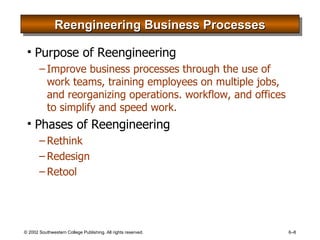
Reengineering Business Processes Purpose of Reengineering Improve business processes through the use of work teams, training employees on multiple jobs, and reorganizing operations. workflow, and offices to simplify and speed work. Phases of Reengineering Rethink Redesign Retool
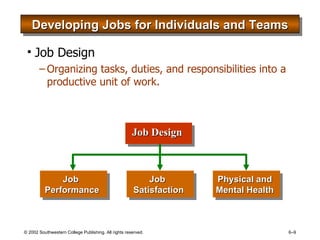
Developing Jobs for Individuals and Teams Job Design Organizing tasks, duties, and responsibilities into a productive unit of work. Job Design Job  Satisfaction Job  Performance Physical and Mental Health
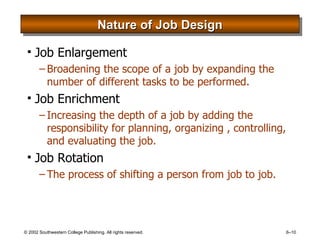
Nature of Job Design Job Enlargement Broadening the scope of a job by expanding the number of different tasks to be performed. Job Enrichment Increasing the depth of a job by adding the responsibility for planning, organizing , controlling, and evaluating the job. Job Rotation The process of shifting a person from job to job.
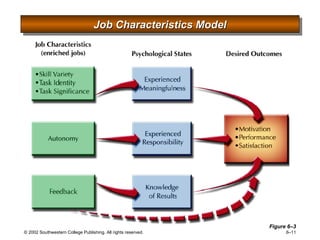
Job Characteristics Model Figure 6 –3
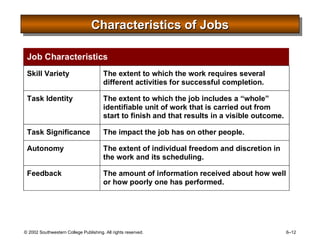
Characteristics of Jobs
Using Teams in Jobs
Shamrock Team Figure 6 –4
Team Jobs Advantages Improved productivity Increased employee involvement More widespread employee learning Greater employee ownership of problems Disadvantages Requires employees to be “group oriented” Not appropriate for most work in organizations Can be overused Difficult to measure team performance Individual compensation interferes with team concept
Alternative Work Schedules Flextime A work scheduling arrangement in which employees work a set number of hours per day but vary their starting and ending times. Compressed Work Week A work schedule in which a full week’s work is accomplished in fewer than five days.
Alternative Work Locations Telecommuting The process of going to work via electronic computing and telecommunications equipment. Temporary Locations Hoteling Virtual office Effects of Alternative Work Arrangements A shift to evaluating employees on results Greater trust, less direct supervision Lack of direct contact (visibility)
The Nature of Job Analysis Job Analysis A systematic way to gather and analyze information about the content, context, and the human requirements of jobs. Work activities and behaviors Interactions with others Performance standards Financial and budgeting impact Machines and equipment used Working conditions Supervision given and received Knowledge, skills, and abilities needed
Job Analysis in Perspective Figure 6 –5
Task-Based Job Analysis Task A distinct, identifiable work activity composed of motions Duty A larger work segment composed of several tasks that are performed by an individual Responsibilities Obligations to perform certain tasks and duties
Typical Division of HR Responsibilities: Job Analysis Figure 6 –6
Stages in the Job Analysis Process Figure 6 –7
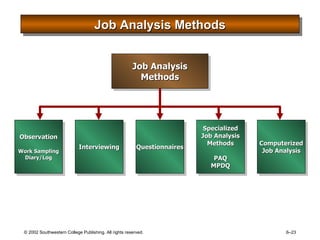
Job Analysis Methods Job Analysis Methods Questionnaires Observation Work Sampling Diary/Log Interviewing Specialized Job Analysis Methods PAQ MPDQ Computerized Job Analysis
Job Analysis and  the U.S. Department of Labor Functional Job Analysis (FJA) Goals of the organization What workers do to achieve goals Level and orientation of what workers do Performance standards Training content Dictionary of Occupational Titles Data, people, and things O*Net Online Online information from DOL job research
Typical Areas Covered in a  Job Analysis Questionnaire Figure 6 –8
Behavioral Aspects of Job Analysis Behavioral Aspects of  Job Analysis Employee Anxieties Job Inflation Managerial Straitjacket Current Incumbent Emphasis
Legal Aspects of Job Analysis Job Analysis and the Americans with Disabilities Act (ADA) Essential job functions —fundamental duties of the job that are performed regularly, require significant amounts of time, cannot be easily assigned to another employee, and are necessary to accomplish the job. Marginal job functions—duties that are part of the job but are incidental or ancillary to the purpose and nature of the job.
Determining Essential and Marginal Job Functions Figure 6 –9 Source:
Job Analysis and Wage/Hour Regulations Fair Labor Standards Act To qualify for an exemption from the overtime provisions of the act: Exempt employees can spend no more than 20% of their time on manual, routine, or clerical duties. Exempt employees must spend at least 50% of their time performing their primary duties as executive, administrative, or professional employees.
Sample Job Duty Statements  and Performance Standards Figure 6 –10
Job Descriptions and Job Specifications Job Description Identification of the tasks, duties, and responsibilities of a job Performance Standards Indicator of what the job accomplishes and how performance is measured in key areas of the job description. Job Specification The knowledge, skills, and abilities (KSAs) an individual needs to perform a job satisfactorily.
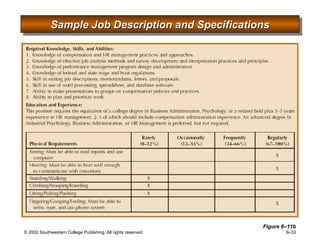
Sample Job Description and Specifications Figure 6 –11a
Sample Job Description and Specifications Figure 6 –11b
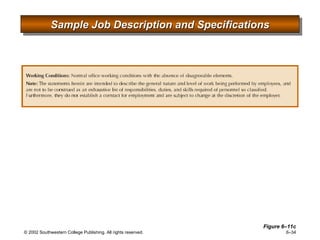
Sample Job Description and Specifications Figure 6 –11c
Job Description Components Identification Job title Reporting relationships Department Location Date of analysis General Summary Describes the job’s distinguishing responsibilities and components Essential Functions and Duties Lists major tasks, duties and responsibilities Job Specifications Knowledge, skills, and abilities Education and experience Physical requirements Disclaimer Of implied contract Signature of approvals
Competency Approach to Job Analysis Competencies Basic characteristics that can be linked to enhanced performance by individuals or teams. Reasons for using the competency approach To communicate value behaviors throughout the organization. To raise the competency levels of the organization. To emphasize the capabilities of people to enhance organizational competitive advantage.
Competency Analysis Methodology Identify future performance results areas critical to the organization. Assemble panel groups familiar with the company. Interview panel members to get examples of job behaviors. Develop detailed descriptions of competencies. Rate competencies and levels need to meet them. Standards of performance are identified and tied to jobs.

Hrm10e Chap06

  • 1.
    Human Resource Management TENTH EDITON Jobs © 2003 Southwestern College Publishing. All rights reserved. PowerPoint Presentation by Charlie Cook Chapter 6 SECTION 2 Staffing the Organization Robert L. Mathis  John H. Jackson
  • 2.
    Learning Objectives Afteryou have read this chapter, you should be able to: Discuss workflow analysis and business process reengineering as approaches to organizational work. Explain how changing job characteristics can be used to improve jobs. Indicate how job analysis has both legal and behavioral aspects. List and explain four job analysis methods. Identify the five steps in conducting a job analysis.
  • 3.
    Learning Objectives (cont’d)Write a job description and the job specifications for it. Compare task-based job analysis with the competency approach of job analysis.
  • 4.
    HR Management andJobs Dividing Work into Jobs Work Effort directed toward producing or accomplishing results. Job A grouping of tasks, duties, and responsibilities that constitutes the total work assignment for an employee. Workflow Analysis A study of the way work (inputs, activities, and outputs) moves through an organization.
  • 5.
    Job Issues andHR Approaches Figure 6 –1
  • 6.
    Workflow Analysis WorkflowAnalysis A study of the way work (inputs, activities, and outputs) moves through an organization. Inputs People Materials Equipment Activities Tasks and Jobs Outputs Goods and Services Evaluation
  • 7.
    Influences Affecting Jobs,People, and Related HR Policies Figure 6 –2
  • 8.
    Reengineering Business ProcessesPurpose of Reengineering Improve business processes through the use of work teams, training employees on multiple jobs, and reorganizing operations. workflow, and offices to simplify and speed work. Phases of Reengineering Rethink Redesign Retool
  • 9.
    Developing Jobs forIndividuals and Teams Job Design Organizing tasks, duties, and responsibilities into a productive unit of work. Job Design Job Satisfaction Job Performance Physical and Mental Health
  • 10.
    Nature of JobDesign Job Enlargement Broadening the scope of a job by expanding the number of different tasks to be performed. Job Enrichment Increasing the depth of a job by adding the responsibility for planning, organizing , controlling, and evaluating the job. Job Rotation The process of shifting a person from job to job.
  • 11.
  • 12.
  • 13.
  • 14.
  • 15.
    Team Jobs AdvantagesImproved productivity Increased employee involvement More widespread employee learning Greater employee ownership of problems Disadvantages Requires employees to be “group oriented” Not appropriate for most work in organizations Can be overused Difficult to measure team performance Individual compensation interferes with team concept
  • 16.
    Alternative Work SchedulesFlextime A work scheduling arrangement in which employees work a set number of hours per day but vary their starting and ending times. Compressed Work Week A work schedule in which a full week’s work is accomplished in fewer than five days.
  • 17.
    Alternative Work LocationsTelecommuting The process of going to work via electronic computing and telecommunications equipment. Temporary Locations Hoteling Virtual office Effects of Alternative Work Arrangements A shift to evaluating employees on results Greater trust, less direct supervision Lack of direct contact (visibility)
  • 18.
    The Nature ofJob Analysis Job Analysis A systematic way to gather and analyze information about the content, context, and the human requirements of jobs. Work activities and behaviors Interactions with others Performance standards Financial and budgeting impact Machines and equipment used Working conditions Supervision given and received Knowledge, skills, and abilities needed
  • 19.
    Job Analysis inPerspective Figure 6 –5
  • 20.
    Task-Based Job AnalysisTask A distinct, identifiable work activity composed of motions Duty A larger work segment composed of several tasks that are performed by an individual Responsibilities Obligations to perform certain tasks and duties
  • 21.
    Typical Division ofHR Responsibilities: Job Analysis Figure 6 –6
  • 22.
    Stages in theJob Analysis Process Figure 6 –7
  • 23.
    Job Analysis MethodsJob Analysis Methods Questionnaires Observation Work Sampling Diary/Log Interviewing Specialized Job Analysis Methods PAQ MPDQ Computerized Job Analysis
  • 24.
    Job Analysis and the U.S. Department of Labor Functional Job Analysis (FJA) Goals of the organization What workers do to achieve goals Level and orientation of what workers do Performance standards Training content Dictionary of Occupational Titles Data, people, and things O*Net Online Online information from DOL job research
  • 25.
    Typical Areas Coveredin a Job Analysis Questionnaire Figure 6 –8
  • 26.
    Behavioral Aspects ofJob Analysis Behavioral Aspects of Job Analysis Employee Anxieties Job Inflation Managerial Straitjacket Current Incumbent Emphasis
  • 27.
    Legal Aspects ofJob Analysis Job Analysis and the Americans with Disabilities Act (ADA) Essential job functions —fundamental duties of the job that are performed regularly, require significant amounts of time, cannot be easily assigned to another employee, and are necessary to accomplish the job. Marginal job functions—duties that are part of the job but are incidental or ancillary to the purpose and nature of the job.
  • 28.
    Determining Essential andMarginal Job Functions Figure 6 –9 Source:
  • 29.
    Job Analysis andWage/Hour Regulations Fair Labor Standards Act To qualify for an exemption from the overtime provisions of the act: Exempt employees can spend no more than 20% of their time on manual, routine, or clerical duties. Exempt employees must spend at least 50% of their time performing their primary duties as executive, administrative, or professional employees.
  • 30.
    Sample Job DutyStatements and Performance Standards Figure 6 –10
  • 31.
    Job Descriptions andJob Specifications Job Description Identification of the tasks, duties, and responsibilities of a job Performance Standards Indicator of what the job accomplishes and how performance is measured in key areas of the job description. Job Specification The knowledge, skills, and abilities (KSAs) an individual needs to perform a job satisfactorily.
  • 32.
    Sample Job Descriptionand Specifications Figure 6 –11a
  • 33.
    Sample Job Descriptionand Specifications Figure 6 –11b
  • 34.
    Sample Job Descriptionand Specifications Figure 6 –11c
  • 35.
    Job Description ComponentsIdentification Job title Reporting relationships Department Location Date of analysis General Summary Describes the job’s distinguishing responsibilities and components Essential Functions and Duties Lists major tasks, duties and responsibilities Job Specifications Knowledge, skills, and abilities Education and experience Physical requirements Disclaimer Of implied contract Signature of approvals
  • 36.
    Competency Approach toJob Analysis Competencies Basic characteristics that can be linked to enhanced performance by individuals or teams. Reasons for using the competency approach To communicate value behaviors throughout the organization. To raise the competency levels of the organization. To emphasize the capabilities of people to enhance organizational competitive advantage.
  • 37.
    Competency Analysis MethodologyIdentify future performance results areas critical to the organization. Assemble panel groups familiar with the company. Interview panel members to get examples of job behaviors. Develop detailed descriptions of competencies. Rate competencies and levels need to meet them. Standards of performance are identified and tied to jobs.