PowerPoint Presentation by Charlie Cook
The University of West Alabama
Chapter 12
Pay for Performance
and Financial
Incentives
Part Four | Compensation
Copyright © 2011 Pearson Education, Inc.
publishing as Prentice Hall
Copyright © 2011 Pearson Education, Inc. publishing as Prentice Hall 12–2
Motivation, Performance, and PayMotivation, Performance, and Pay
• IncentivesIncentives
 Financial rewards paid to workers whose production exceeds aFinancial rewards paid to workers whose production exceeds a
predetermined standard.predetermined standard.
• Frederick TaylorFrederick Taylor
 Popularized scientific management and the use of financialPopularized scientific management and the use of financial
incentives in the late 1800s.incentives in the late 1800s.
• Linking Pay and PerformanceLinking Pay and Performance
 Understanding the motivationalUnderstanding the motivational
bases of incentive plansbases of incentive plans
Types of incentivesTypes of incentives
• Financial incentivesFinancial incentives
• Non financial incentives.Non financial incentives.
Copyright © 2011 Pearson Education, Inc. publishing as Prentice Hall 12–3
Copyright © 2011 Pearson Education, Inc. publishing as Prentice Hall 12–4
The Hierarchy of NeedsThe Hierarchy of Needs
• Maslow’s Hierarchy of Needs:Maslow’s Hierarchy of Needs:
 Physiological (food, water, warmth)Physiological (food, water, warmth)
 Security (a secure income, knowing one has a job)Security (a secure income, knowing one has a job)
 Social (friendships and camaraderie)Social (friendships and camaraderie)
 Self-esteem (respect)Self-esteem (respect)
 Self-actualization (becoming a whole person)Self-actualization (becoming a whole person)
• Maslow’s prepotency process principle:Maslow’s prepotency process principle:
 People are motivated first to satisfy each lower-order needPeople are motivated first to satisfy each lower-order need
and then, in sequence, each of the higher-level needs.and then, in sequence, each of the higher-level needs.
Copyright © 2011 Pearson Education, Inc. publishing as Prentice Hall 12–5
Herzberg’s Hygiene–Motivator TheoryHerzberg’s Hygiene–Motivator Theory
• Hygienes (extrinsic job factors)Hygienes (extrinsic job factors)
 Satisfy lower-level needsSatisfy lower-level needs
 Inadequate working conditions, salary, and incentive pay canInadequate working conditions, salary, and incentive pay can
cause dissatisfaction and prevent satisfaction.cause dissatisfaction and prevent satisfaction.
• Motivators (intrinsic job factors)Motivators (intrinsic job factors)
 Satisfy higher-level needsSatisfy higher-level needs
 Job enrichment (challenging job, feedback, and recognition)Job enrichment (challenging job, feedback, and recognition)
addresses higher-level (achievement, self-actualization) needs.addresses higher-level (achievement, self-actualization) needs.
• Premise:Premise:
 The best way to motivate someone is to organize the job so thatThe best way to motivate someone is to organize the job so that
doing it provides feedback and challenge that helps satisfy thedoing it provides feedback and challenge that helps satisfy the
person’s higher-level needs.person’s higher-level needs.
Copyright © 2011 Pearson Education, Inc. publishing as Prentice Hall 12–6
Victor Vroom’s Expectancy TheoryVictor Vroom’s Expectancy Theory
• Motivation is a function of:Motivation is a function of:
 Expectancy:Expectancy: the belief that effort will lead to performance.the belief that effort will lead to performance.
 Instrumentality:Instrumentality: the connection between performance andthe connection between performance and
the appropriate reward.the appropriate reward.
 Valence:Valence: the value the person places on the reward.the value the person places on the reward.
• Motivation = (E x I x V)Motivation = (E x I x V)
 If any factor (E, I, or V) is zero, then there is no motivationIf any factor (E, I, or V) is zero, then there is no motivation
to work toward the reward.to work toward the reward.
 Employee confidence building and training, accurateEmployee confidence building and training, accurate
appraisals, and knowledge of workers’ desired rewards canappraisals, and knowledge of workers’ desired rewards can
increase employee motivation.increase employee motivation.
Copyright © 2011 Pearson Education, Inc. publishing as Prentice Hall 12–7
Behavior Modification /Behavior Modification /
Reinforcement TheoryReinforcement Theory
• B. F. Skinner’s PrinciplesB. F. Skinner’s Principles
 To understand behavior one must understandTo understand behavior one must understand
the consequences of that behavior.the consequences of that behavior.
 Behavior that leads to a positive consequence (reward)Behavior that leads to a positive consequence (reward)
tends to be repeated, while behavior that leads to a negativetends to be repeated, while behavior that leads to a negative
consequence (punishment) tends not to be repeated.consequence (punishment) tends not to be repeated.
 Behavior can be changed by providing properly scheduledBehavior can be changed by providing properly scheduled
rewards (or punishments).rewards (or punishments).
Copyright © 2011 Pearson Education, Inc. publishing as Prentice Hall 12–8
Incentive Pay TerminologyIncentive Pay Terminology
• Pay-for-Performance PlanPay-for-Performance Plan
 Ties employee’s pay to the employee’s performanceTies employee’s pay to the employee’s performance
• Variable Pay PlanVariable Pay Plan
 Is an incentive plan that ties a group or team’s pay to someIs an incentive plan that ties a group or team’s pay to some
measure of the firm’s (or the facility’s) overall profitabilitymeasure of the firm’s (or the facility’s) overall profitability
 Example: profit-sharing plansExample: profit-sharing plans
 May include incentive plans for individual employeesMay include incentive plans for individual employees
Copyright © 2011 Pearson Education, Inc. publishing as Prentice Hall 12–9
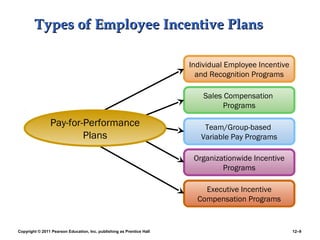
Types of Employee Incentive PlansTypes of Employee Incentive Plans
Individual Employee Incentive
and Recognition Programs
Sales Compensation
Programs
Organizationwide Incentive
Programs
Executive Incentive
Compensation Programs
Team/Group-based
Variable Pay Programs
Pay-for-Performance
Plans
Copyright © 2011 Pearson Education, Inc. publishing as Prentice Hall 12–10
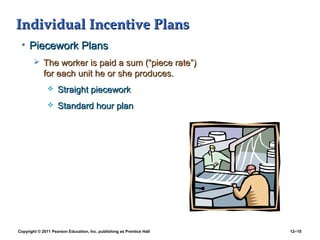
Individual Incentive PlansIndividual Incentive Plans
• Piecework PlansPiecework Plans
 The worker is paid a sum (“piece rate”)The worker is paid a sum (“piece rate”)
for each unit he or she produces.for each unit he or she produces.
 Straight pieceworkStraight piecework
 Standard hour planStandard hour plan
Advantages of pieceworkAdvantages of piecework
• Increases the efficiency of all the employees
• They do not constantly require any kind of
micromanagement
• It is very easy to calculate the dues of the
worker
• They are encouraged to think of better working
methods
• The workers set deadlines for themselves
Copyright © 2011 Pearson Education, Inc. publishing as Prentice Hall 12–11
Disadvantages of pieceworkDisadvantages of piecework
• Workers pay much more attention to quantity and
not quality
• Sometimes even more super vision is required
• Finding and fixing on a reasonable piece cost is a
rather tough task
Copyright © 2011 Pearson Education, Inc. publishing as Prentice Hall 12–12
Copyright © 2011 Pearson Education, Inc. publishing as Prentice Hall 12–13
Individual Incentive Plans (cont’d)Individual Incentive Plans (cont’d)
• Merit PayMerit Pay
 Is a permanent cumulative salary increase the firm awardsIs a permanent cumulative salary increase the firm awards
to an individual employee based on his or her individualto an individual employee based on his or her individual
performanceperformance
 Can detract from performance if awarded across the boardCan detract from performance if awarded across the board
 Becomes permanent ongoing reward for past performanceBecomes permanent ongoing reward for past performance
• Merit Pay OptionsMerit Pay Options
 Give annual lump-sum merit raises that doGive annual lump-sum merit raises that do notnot make themake the
raise part of an employee’s base salary.raise part of an employee’s base salary.
 Tie merit awards to both individual and organizationalTie merit awards to both individual and organizational
performance.performance.

Dessler hrm12e ppt_12

  • 1.
    PowerPoint Presentation byCharlie Cook The University of West Alabama Chapter 12 Pay for Performance and Financial Incentives Part Four | Compensation Copyright © 2011 Pearson Education, Inc. publishing as Prentice Hall
  • 2.
    Copyright © 2011Pearson Education, Inc. publishing as Prentice Hall 12–2 Motivation, Performance, and PayMotivation, Performance, and Pay • IncentivesIncentives  Financial rewards paid to workers whose production exceeds aFinancial rewards paid to workers whose production exceeds a predetermined standard.predetermined standard. • Frederick TaylorFrederick Taylor  Popularized scientific management and the use of financialPopularized scientific management and the use of financial incentives in the late 1800s.incentives in the late 1800s. • Linking Pay and PerformanceLinking Pay and Performance  Understanding the motivationalUnderstanding the motivational bases of incentive plansbases of incentive plans
  • 3.
    Types of incentivesTypesof incentives • Financial incentivesFinancial incentives • Non financial incentives.Non financial incentives. Copyright © 2011 Pearson Education, Inc. publishing as Prentice Hall 12–3
  • 4.
    Copyright © 2011Pearson Education, Inc. publishing as Prentice Hall 12–4 The Hierarchy of NeedsThe Hierarchy of Needs • Maslow’s Hierarchy of Needs:Maslow’s Hierarchy of Needs:  Physiological (food, water, warmth)Physiological (food, water, warmth)  Security (a secure income, knowing one has a job)Security (a secure income, knowing one has a job)  Social (friendships and camaraderie)Social (friendships and camaraderie)  Self-esteem (respect)Self-esteem (respect)  Self-actualization (becoming a whole person)Self-actualization (becoming a whole person) • Maslow’s prepotency process principle:Maslow’s prepotency process principle:  People are motivated first to satisfy each lower-order needPeople are motivated first to satisfy each lower-order need and then, in sequence, each of the higher-level needs.and then, in sequence, each of the higher-level needs.
  • 5.
    Copyright © 2011Pearson Education, Inc. publishing as Prentice Hall 12–5 Herzberg’s Hygiene–Motivator TheoryHerzberg’s Hygiene–Motivator Theory • Hygienes (extrinsic job factors)Hygienes (extrinsic job factors)  Satisfy lower-level needsSatisfy lower-level needs  Inadequate working conditions, salary, and incentive pay canInadequate working conditions, salary, and incentive pay can cause dissatisfaction and prevent satisfaction.cause dissatisfaction and prevent satisfaction. • Motivators (intrinsic job factors)Motivators (intrinsic job factors)  Satisfy higher-level needsSatisfy higher-level needs  Job enrichment (challenging job, feedback, and recognition)Job enrichment (challenging job, feedback, and recognition) addresses higher-level (achievement, self-actualization) needs.addresses higher-level (achievement, self-actualization) needs. • Premise:Premise:  The best way to motivate someone is to organize the job so thatThe best way to motivate someone is to organize the job so that doing it provides feedback and challenge that helps satisfy thedoing it provides feedback and challenge that helps satisfy the person’s higher-level needs.person’s higher-level needs.
  • 6.
    Copyright © 2011Pearson Education, Inc. publishing as Prentice Hall 12–6 Victor Vroom’s Expectancy TheoryVictor Vroom’s Expectancy Theory • Motivation is a function of:Motivation is a function of:  Expectancy:Expectancy: the belief that effort will lead to performance.the belief that effort will lead to performance.  Instrumentality:Instrumentality: the connection between performance andthe connection between performance and the appropriate reward.the appropriate reward.  Valence:Valence: the value the person places on the reward.the value the person places on the reward. • Motivation = (E x I x V)Motivation = (E x I x V)  If any factor (E, I, or V) is zero, then there is no motivationIf any factor (E, I, or V) is zero, then there is no motivation to work toward the reward.to work toward the reward.  Employee confidence building and training, accurateEmployee confidence building and training, accurate appraisals, and knowledge of workers’ desired rewards canappraisals, and knowledge of workers’ desired rewards can increase employee motivation.increase employee motivation.
  • 7.
    Copyright © 2011Pearson Education, Inc. publishing as Prentice Hall 12–7 Behavior Modification /Behavior Modification / Reinforcement TheoryReinforcement Theory • B. F. Skinner’s PrinciplesB. F. Skinner’s Principles  To understand behavior one must understandTo understand behavior one must understand the consequences of that behavior.the consequences of that behavior.  Behavior that leads to a positive consequence (reward)Behavior that leads to a positive consequence (reward) tends to be repeated, while behavior that leads to a negativetends to be repeated, while behavior that leads to a negative consequence (punishment) tends not to be repeated.consequence (punishment) tends not to be repeated.  Behavior can be changed by providing properly scheduledBehavior can be changed by providing properly scheduled rewards (or punishments).rewards (or punishments).
  • 8.
    Copyright © 2011Pearson Education, Inc. publishing as Prentice Hall 12–8 Incentive Pay TerminologyIncentive Pay Terminology • Pay-for-Performance PlanPay-for-Performance Plan  Ties employee’s pay to the employee’s performanceTies employee’s pay to the employee’s performance • Variable Pay PlanVariable Pay Plan  Is an incentive plan that ties a group or team’s pay to someIs an incentive plan that ties a group or team’s pay to some measure of the firm’s (or the facility’s) overall profitabilitymeasure of the firm’s (or the facility’s) overall profitability  Example: profit-sharing plansExample: profit-sharing plans  May include incentive plans for individual employeesMay include incentive plans for individual employees
  • 9.
    Copyright © 2011Pearson Education, Inc. publishing as Prentice Hall 12–9 Types of Employee Incentive PlansTypes of Employee Incentive Plans Individual Employee Incentive and Recognition Programs Sales Compensation Programs Organizationwide Incentive Programs Executive Incentive Compensation Programs Team/Group-based Variable Pay Programs Pay-for-Performance Plans
  • 10.
    Copyright © 2011Pearson Education, Inc. publishing as Prentice Hall 12–10 Individual Incentive PlansIndividual Incentive Plans • Piecework PlansPiecework Plans  The worker is paid a sum (“piece rate”)The worker is paid a sum (“piece rate”) for each unit he or she produces.for each unit he or she produces.  Straight pieceworkStraight piecework  Standard hour planStandard hour plan
  • 11.
    Advantages of pieceworkAdvantagesof piecework • Increases the efficiency of all the employees • They do not constantly require any kind of micromanagement • It is very easy to calculate the dues of the worker • They are encouraged to think of better working methods • The workers set deadlines for themselves Copyright © 2011 Pearson Education, Inc. publishing as Prentice Hall 12–11
  • 12.
    Disadvantages of pieceworkDisadvantagesof piecework • Workers pay much more attention to quantity and not quality • Sometimes even more super vision is required • Finding and fixing on a reasonable piece cost is a rather tough task Copyright © 2011 Pearson Education, Inc. publishing as Prentice Hall 12–12
  • 13.
    Copyright © 2011Pearson Education, Inc. publishing as Prentice Hall 12–13 Individual Incentive Plans (cont’d)Individual Incentive Plans (cont’d) • Merit PayMerit Pay  Is a permanent cumulative salary increase the firm awardsIs a permanent cumulative salary increase the firm awards to an individual employee based on his or her individualto an individual employee based on his or her individual performanceperformance  Can detract from performance if awarded across the boardCan detract from performance if awarded across the board  Becomes permanent ongoing reward for past performanceBecomes permanent ongoing reward for past performance • Merit Pay OptionsMerit Pay Options  Give annual lump-sum merit raises that doGive annual lump-sum merit raises that do notnot make themake the raise part of an employee’s base salary.raise part of an employee’s base salary.  Tie merit awards to both individual and organizationalTie merit awards to both individual and organizational performance.performance.

Editor's Notes

  • #3 Frederick Taylor popularized using financial incentives—financial rewards paid to workers whose production exceeds some predetermined standard—in the late 1800s. Compensation experts argue that managers need to have a better understanding of the motivational bases of incentive plans in order for their plans to succeed.
  • #5 Abraham Maslow made what may be the most popular observation on what motivates people in proposing that people have a hierarchy of needs that they are motivated to satisfy. Maslow’s theory has many practical implications for managers using incentive programs.
  • #6 Frederick Herzberg said the best way to motivate someone is to organize the job so that doing it provides the feedback and challenge that helps satisfy the person’s “higher-level” needs for things like accomplishment and recognition. Herzberg’s theory makes the point that relying exclusively on financial incentives is risky. The employer should also provide the recognition and challenging work that most people desire.
  • #7 Victor Vroom’s expectancy motivation theory posits that people will pursue rewards they desire when they believe that they are likely to be successful in obtaining the rewards.
  • #8 Managers apply Skinner’s principles by using behavior modification. Behavior modification means changing behavior through rewards or punishments that are contingent on performance.
  • #9 Managers often use two terms synonymously with incentive plans. Traditionally, all incentive plans are pay-for-performance plans. They all tie employees’ pay to the employees’ performance. Variable pay is more specific: It is usually an incentive plan that ties a group or team’s pay to some measure of the firm’s (or the facility’s) overall profitability.
  • #10 Managers should seek to choose the incentive plan that best suits the work that an employee does. Various incentive plans focus on either individuals, groups or teams, or organizations.
  • #11 Piecework is the oldest and still most popular individual incentive plan. Here the worker is paid a sum (called a piece rate) for each unit he or she produces. The standard hour plan is like the piece rate plan, except that, instead of getting a rate per piece, the worker gets a premium equal to the percent by which his or her performance exceeds the standard.
  • #14 Merit pay or a merit raise is a permanent salary increase the firm awards to an individual employee based on his or her individual performance. Merit pay advocates argue that awarding pay raises across the board (without regard to individual merit) may actually detract from performance, by showing employees they’ll be rewarded regardless of how they perform. The solution is not to throw out merit raises, but to design them to be more effective. Among other things, this means establishing effective appraisal procedures and ensuring that managers in fact tie merit pay awards to performance.