Human Resource Management   TENTH EDITON Changing Nature of Human Resource Management © 2003 Southwestern College Publishing. All rights reserved. Chapter 1 Robert L. Mathis     John H. Jackson PowerPoint Presentation  by Charlie Cook SECTION 1 Nature of Human Resource Management
Learning Objectives  After you have read this chapter, you should be able to: Define HR management and explain why managers and HR staff must work together. List and define the seven categories of of HR activities. Identify three challenges facing HR today. Describe the four roles of HR management. Discuss why ethical issues affect HR management.
Nature of Human Resource Management Human Resource Management The design of formal systems in an organization to ensure effective and efficient use of human talent to accomplish organizational goals. Who Is an HR Manager? In the course carrying out their duties, every operating manager is, in essence, an HR manager. HR specialists design processes and systems that operating managers help implement.
Typical Division of HR Responsibilities HR Unit Develops legal, effective interviewing techniques Trains managers in conducting selection interviews Conducts interviews and testing Sends top three applicants to managers for final review Checks references Does final interviewing and hiring for certain job classifications Managers Advise HR of job openings Decide whether to do own final interviewing Receive interview training from HR unit Do final interviewing and hiring where appropriate Review reference information  Provide feedback to HR unit on hiring/rejection decisions Figure 1 – 1
HR Activities HR Planning and Analysis Equal Employment Opportunity Staffing HR Development Compensation and Benefits Health, Safety, and Security Employee and Labor/Management Relations
HR Management Activities Figure 1 – 2
HR Management Challenges Economic and Technological Changes Shift in jobs for manufacturing and agriculture to service industries and telecommunications. Pressures of global competition causing firms to adapt by lowering costs and increasing productivity. Growth of information technology (Internet).
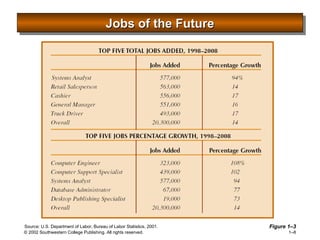
Jobs of the Future Figure 1 – 3 Source: U.S. Department of Labor, Bureau of Labor Statistics, 2001.
HR Management Challenges Workforce Availability and Quality Inadequate supply of workers with needed skills for “knowledge jobs” Education of workers in basic skills Growth in Contingent Workforce Increases in temporary workers, independent contractors, leased employees, and part-timers caused by: Need for flexibility in staffing levels Increased difficulty in firing regular employees. Reduced legal liability from contract employees
HR Management Challenges Demographics and Diversity Issues More diversity of race, gender, age, and ethnicity in the U.S. workforce Balancing Work and Family Dual-career couples Single-parent households Decline in the “traditional family” Working mothers and family/childcare Single employee “backlash” against family-oriented programs.
New Moms in the Workforce Figure 1 – 4 Source: U.S. Census Bureau, 2000.
HR Management Challenges Organizational Restructuring, Mergers, and Acquisitions “ Right-sizing” — eliminating of layers of management, closing facilities, merging with other organizations, and outplacing workers Intended results are flatter organizations, increases in productivity, quality, service and lower costs. Costs are survivor mentality, loss of employee loyalty, and turnover of valuable employees. HR managers must work toward ensuring cultural compatibility in mergers.
Different Roles for HR Management Figure 1 – 5
HR Management Roles Administrative Role Clerical and administrative support operations (e.g., payroll and benefits work) Employee Advocate Role “ Champion” for employee concerns Employee crisis management Responding to employee complaints Operational Role Identification and implementation of HR programs and policies —EEO, hiring, training, and other activities that support the organization.
How HR Spends Its Time Figure 1 – 6 Source: Adapted from “How Much Time Should Your HR staff Spend on Recruiting?” Human Resources Department Management Report, June 2000, p. 6.
Strategic Role for HR HR becomes a strategic business partner by: Focusing on developing HR programs that enhance organizational performance . Involving HR in strategic planning at the onset. Participating in decision making on mergers, acquisitions, and downsizing. Redesigning organizations and work processes Accounting and documenting the financial results of HR activities.
Overview of HR Management Roles Figure 1 –7
Ethics and HR What is Ethical Behavior? What “ought” to be done. Dimensions of decisions about ethical issues in management: Extended consequences Multiple alternatives Mixed outcomes Uncertain consequences Personal effects
Ethics and HR (cont’d) Responding to Ethical Situations  Guided by values and personal behavior “codes” that include: Does response meet all applicable laws, regulations, and government codes? Does response comply with all organizational standards of ethical behavior? Does response pass the test of professional standards for ethical behavior?
Ethical Issues in Management Most Common Forms of Unethical Conduct Lying to supervisors Employee drug use or alcohol abuse Falsification of records International Ethical Issues Gift giving and bribery Discrimination in hiring and treatment Addressing Ethical Issues Code of ethics Training managers and employees
HR Management Competencies and Careers HR Generalist A person with responsibility for performing a variety of HR activities. HR Specialist A person with in-depth knowledge and expertise in a limited area of HR. Important HR Capabilities: Knowledge of business and organization Influence and change management Specific HR knowledge and expertise

Hrm10e Chap01

  • 1.
    Human Resource Management TENTH EDITON Changing Nature of Human Resource Management © 2003 Southwestern College Publishing. All rights reserved. Chapter 1 Robert L. Mathis  John H. Jackson PowerPoint Presentation by Charlie Cook SECTION 1 Nature of Human Resource Management
  • 2.
    Learning Objectives After you have read this chapter, you should be able to: Define HR management and explain why managers and HR staff must work together. List and define the seven categories of of HR activities. Identify three challenges facing HR today. Describe the four roles of HR management. Discuss why ethical issues affect HR management.
  • 3.
    Nature of HumanResource Management Human Resource Management The design of formal systems in an organization to ensure effective and efficient use of human talent to accomplish organizational goals. Who Is an HR Manager? In the course carrying out their duties, every operating manager is, in essence, an HR manager. HR specialists design processes and systems that operating managers help implement.
  • 4.
    Typical Division ofHR Responsibilities HR Unit Develops legal, effective interviewing techniques Trains managers in conducting selection interviews Conducts interviews and testing Sends top three applicants to managers for final review Checks references Does final interviewing and hiring for certain job classifications Managers Advise HR of job openings Decide whether to do own final interviewing Receive interview training from HR unit Do final interviewing and hiring where appropriate Review reference information Provide feedback to HR unit on hiring/rejection decisions Figure 1 – 1
  • 5.
    HR Activities HRPlanning and Analysis Equal Employment Opportunity Staffing HR Development Compensation and Benefits Health, Safety, and Security Employee and Labor/Management Relations
  • 6.
  • 7.
    HR Management ChallengesEconomic and Technological Changes Shift in jobs for manufacturing and agriculture to service industries and telecommunications. Pressures of global competition causing firms to adapt by lowering costs and increasing productivity. Growth of information technology (Internet).
  • 8.
    Jobs of theFuture Figure 1 – 3 Source: U.S. Department of Labor, Bureau of Labor Statistics, 2001.
  • 9.
    HR Management ChallengesWorkforce Availability and Quality Inadequate supply of workers with needed skills for “knowledge jobs” Education of workers in basic skills Growth in Contingent Workforce Increases in temporary workers, independent contractors, leased employees, and part-timers caused by: Need for flexibility in staffing levels Increased difficulty in firing regular employees. Reduced legal liability from contract employees
  • 10.
    HR Management ChallengesDemographics and Diversity Issues More diversity of race, gender, age, and ethnicity in the U.S. workforce Balancing Work and Family Dual-career couples Single-parent households Decline in the “traditional family” Working mothers and family/childcare Single employee “backlash” against family-oriented programs.
  • 11.
    New Moms inthe Workforce Figure 1 – 4 Source: U.S. Census Bureau, 2000.
  • 12.
    HR Management ChallengesOrganizational Restructuring, Mergers, and Acquisitions “ Right-sizing” — eliminating of layers of management, closing facilities, merging with other organizations, and outplacing workers Intended results are flatter organizations, increases in productivity, quality, service and lower costs. Costs are survivor mentality, loss of employee loyalty, and turnover of valuable employees. HR managers must work toward ensuring cultural compatibility in mergers.
  • 13.
    Different Roles forHR Management Figure 1 – 5
  • 14.
    HR Management RolesAdministrative Role Clerical and administrative support operations (e.g., payroll and benefits work) Employee Advocate Role “ Champion” for employee concerns Employee crisis management Responding to employee complaints Operational Role Identification and implementation of HR programs and policies —EEO, hiring, training, and other activities that support the organization.
  • 15.
    How HR SpendsIts Time Figure 1 – 6 Source: Adapted from “How Much Time Should Your HR staff Spend on Recruiting?” Human Resources Department Management Report, June 2000, p. 6.
  • 16.
    Strategic Role forHR HR becomes a strategic business partner by: Focusing on developing HR programs that enhance organizational performance . Involving HR in strategic planning at the onset. Participating in decision making on mergers, acquisitions, and downsizing. Redesigning organizations and work processes Accounting and documenting the financial results of HR activities.
  • 17.
    Overview of HRManagement Roles Figure 1 –7
  • 18.
    Ethics and HRWhat is Ethical Behavior? What “ought” to be done. Dimensions of decisions about ethical issues in management: Extended consequences Multiple alternatives Mixed outcomes Uncertain consequences Personal effects
  • 19.
    Ethics and HR(cont’d) Responding to Ethical Situations Guided by values and personal behavior “codes” that include: Does response meet all applicable laws, regulations, and government codes? Does response comply with all organizational standards of ethical behavior? Does response pass the test of professional standards for ethical behavior?
  • 20.
    Ethical Issues inManagement Most Common Forms of Unethical Conduct Lying to supervisors Employee drug use or alcohol abuse Falsification of records International Ethical Issues Gift giving and bribery Discrimination in hiring and treatment Addressing Ethical Issues Code of ethics Training managers and employees
  • 21.
    HR Management Competenciesand Careers HR Generalist A person with responsibility for performing a variety of HR activities. HR Specialist A person with in-depth knowledge and expertise in a limited area of HR. Important HR Capabilities: Knowledge of business and organization Influence and change management Specific HR knowledge and expertise