Workers, Jobs and Job
analysis
Outlines:
-Definition of work and job.
-Definition of worker and employee.
-Approaches to understand jobs.
1 -workflow analysis
2-Reengineering
3 -Job design
4 -Job analysis
.Definition of job analysis
.Uses of job analysis
.Methods Definition of job analysis
.Who willconuct job analysis
.Sources of job analysis
. job analysis process
.Competency based job analysis
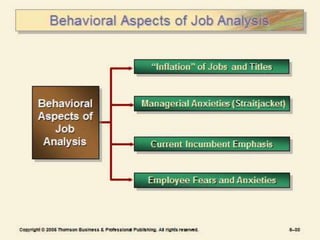
.Behavioral aspects of job analysis
.Job analysis and wages
5-Job description
6-Job specification
HR Managementand Jobs
•Dividing Work intoJobs
Work
Effort directed toward producing or
accomplishingresults.
Job
A grouping of tasks, duties, andresponsibilities that
constitutes the total workassignment for anemployee.
•Approaches to UnderstandingJobs
Workflow analysis
Re-engineering
Job design
Job analysis
Job descriptions and job specifications
EMPLOYEE
Any person who is employed for wages in any
kind of work, manual or otherwise, in or in
connection with the work of an establishment
and who gets his wages directly or indirectly
from the employer, and includes any person,-
(i)employed by through a contractor in or in
connection with the work of the establishment
(ii)engaged as an apprentice, not being an
apprentice engaged under the ApprenticesAct
or under the standing orders of the
establishment
WORKERS
Worker means a person employed
a)directly or through any agency (including a
contractor) with or without the knowledge of
the principal employer whether for
remuneration or not
b)in any manufacturing process, or in cleaning
any part of the machinery or premises used for
a manufacturing process,
c)in any other kind of work incidental to, or
connected with the manufacturing process,
or the subject of the manufacturing process
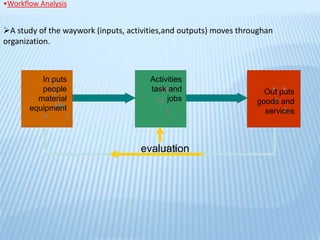
•Workflow Analysis
I
l
tils
it
tiiti
ss
s
tt
s
is
lti
A study of the waywork (inputs, activities,and outputs) moves throughan
organization.
In puts
people
material
equipment
Activities
task and
jobs
Out puts
goods and
services
evaluation
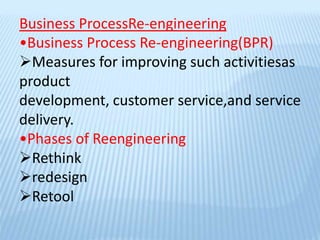
Business ProcessRe-engineering
•Business Process Re-engineering(BPR)
Measures for improving such activitiesas
product
development, customer service,and service
delivery.
•Phases of Reengineering
Rethink
redesign
Retool
Importance OfJob Design
•Job Design
Organizing tasks, duties, and
responsibilitiesinto a productive unit
ofwork.
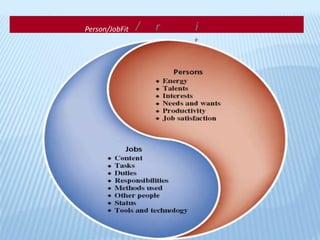
•Person/job Fit
Matching characteristics of people
withcharacteristics of jobs.
si
tiftirfr
il
tllt
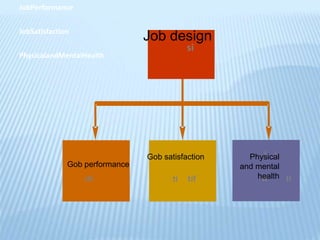
JobPerformance
JobSatisfaction
PhysicalandMentalHealth
Job design
Gob performance
Gob satisfaction Physical
and mental
health
r/ i
t
Person/JobFit
Nature ofJob Design
•Job Enlargement
Broadening the scope of ajob by
expandingthe number of differenttasks to
beperformed.
•Job Enrichment
Increasing the depth of ajob by addingthe
responsibility for planning,organizing ,
controlling, and evaluating thejob.
•Job Rotation
The process of shifting aperson from jobtojob.
Characteristics ofJobs
•Skill Variety
The extent to which thework requires
severaldifferent activities for successfulcompletion.
•Task Identity
The extent to which thejob includes a“whole”
identifiable unit ofwork that iscarried outfrom start to
finish and thatresults in avisible outcome.
•Task Significance
The impact the job hason other people.
Characteristics ofJobs
•Autonomy
The extent of individual freedomand
discretion inthe work and itsscheduling.
•Feedback
Amount of information employees
receiveabout how well or howpoorly they
haveperformed.
Using Teamsin Jobs
•Types of Teams
Special-Purpose Team
Organizational team formed to address specificproblems,
improve work processes, andenhance product andservice
quality.
Self-directed Work Team
A team composed of individuals assigneda cluster oftasks,
duties, and responsibilities tobe accomplished.
Virtual Team
Organizational team composed of individuals whoare
geographically separated but linkedby communications
technology.
Adantage
Improved productivity
Increased employed involvement
More wide spread employee learning
Greater employee ownership of problems
Disadvantage
Requires employees to be group
oriented
Not appropriate for most work in
organization
Can be over usedce
Individual compensation interferes
with team concept
Work Schedules
•GlobalWork ScheduleDifferences
The number ofwork hoursin a weekvaries from
country to country.
•WorkSchedule Alternatives
Longer daily hours(e.g., 4-day,40 hours)
•ShiftWork
Shift differentials forevening ornight shift work
•CompressedWork Week
A work schedulein whicha full week’swork is
accomplished in fewerthan five days.
Work Schedules
•Flextime
A work schedulingarrangement inwhich employees
work a setnumber of hoursper daybut vary their
starting and endingtimes.
•JobSharing
A scheduling arrangementin whichtwo employees
perform the workof one full-timejob.
Alternative WorkLocations
•Telecommuting
The process ofgoing towork via
electroniccomputing and telecommunications
equipment.
•TemporaryLocations
Office nomads
Virtual office
•Effectsof AlternativeWork Arrangements
A shift toevaluating employeeson results
Greater trust, lessdirect supervisio
Lack of directcontact (visibility)
The Natureof JobAnalysis
•JobAnalysis
A systematic wayof gatheringand analyzing
information about thecontent, context, andthe
human requirements of jobs.
Work activities andbehaviors
Interactions with others
Performance standards
Financial and budgetingimpact
Machines and equipmentused
Working conditions Supervision given andreceived
Knowledge, skills, andabilities needed
USES OFJOB ANALYSIS
•Produce job descriptionsand
specifications
•Recruitment and Selection
•Performance Standards
•Training and Development
•Compensation
•Used in training
•Help in performanceappraisal
lii
lii
r
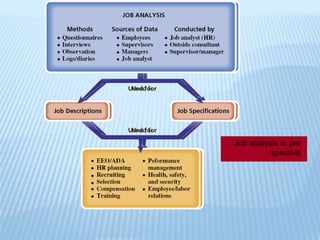
Job analysis in per
spective
Task-Based JobAnalysis
•Task
A distinct, identifiablework activitycomposed
of motions
•Duty
A larger worksegment composedof several
tasksthat are performed byan individual
•Responsibilities
Obligations to performcertain tasksand duties
Who willconduct jobanalysis?
Todecide who will conduct it.
Somecompanies prefer getting it done by their own
HR department while some hire job analysis
consultants.
Jobanalysis consultants may prove to be extremely
helpful as they offer unbiased advice, guidelines and
methods.
They don’t have any personal likes and dislikes when
it comes to analyze a job.
Competency-Based JobAnalysis
•Competencies
Individual capabilities that can belinked to enhanced
performance by individualsor teams.
Technical competencies
Behavioral competencies
•Reasons for usinga competencyapproach:
To communicate valued behaviors withinthe organization
To raise competency levels throughoutthe organization
To emphasize people’s capabilities forenhancing the
competitive advantage ofthe organization
Job Analysis Methods
•Questionnaires
•Observation
•Interviews
•Employee recording
•Combination of methods
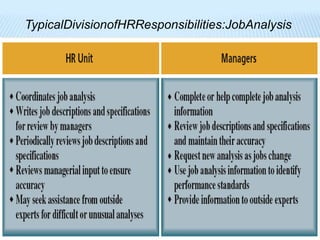
TypicalDivisionofHRResponsibilities:JobAnalysis
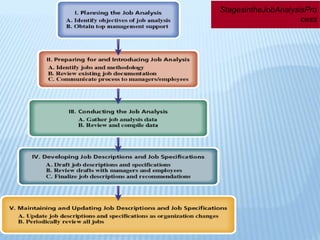
StagesintheJobAnalysisPro
cess
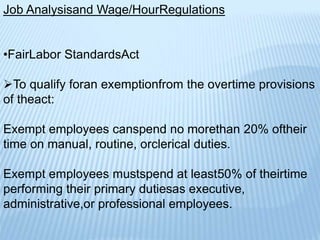
Job Analysisand Wage/HourRegulations
•FairLabor StandardsAct
To qualify foran exemptionfrom the overtime provisions
of theact:
Exempt employees canspend no morethan 20% oftheir
time on manual, routine, orclerical duties.
Exempt employees mustspend at least50% of theirtime
performing their primary dutiesas executive,
administrative,or professional employees.
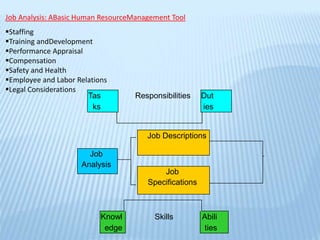
Tas
ks
Responsibilities Dut
ies
Job
Analysis
Job Descriptions
Job
Specifications
Job Analysis: ABasic Human ResourceManagement Tool
Staffing
Training andDevelopment
Performance Appraisal
Compensation
Safety and Health
Employee and Labor Relations
Legal Considerations
Knowl
edge
Skills Abili
ties
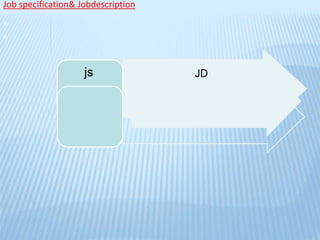
Job specification& Jobdescription
JS
JD
js JD
is a written statementof educational qualifications, specific qualities,
level of experience,physical, emotional, technical and communication
skills required to perform a job,responsibilities involved in a job and
other unusualsensory demands.
•It also includes generalhealth, mental health, intelligence, aptitude,
memory, judgment, leadership skills, emotional ability, adaptability,
flexibility,values and ethics, manners and creativity,etc.
•basic job-related data thatis useful to advertise a specific job and
attract apool of talent.
•It includes information suchas job title, job location, reporting to and of
employees,job summary, nature and objectives of a job,tasks and duties
tobe performed, working conditions, machines, toolsand equipments to
be used bya prospective worker and hazards involved in it.
Job DescriptionComponents
•Identification
Job title
Reporting relationships ØDepartment
Location
Date of analysis
•General Summary
Describes the job’s distinguishing responsibilities and components
•Essential Functions and Duties
Lists major tasks, duties and responsibilities
•Job Specifications
Knowledge, skills, andabilities
Education and experience
Physical requirements
•Disclaimer
Of implied contract
•Signature of approvals
Writing JobSpecifications
•Specifications for trainedpersonnel
Focus on traits like lengthof previous service,quality of
relevant training,and previous jobperformance.
•Specifications for untrainedpersonnel
Focus on physical traits, personality,interests, or
sensory skills thatimply some potentialfor performing or
for beingtrained to dothe job.
Writing JobSpecifications (Contd.)
• Specifications Based onJudgment
Self-created judgments (common sense)
List of competencies in Web-basedjob descriptions (e.g.,
www.jobdescription.com)
NET online
Standard Occupational Classification
•Specifications Based onStatistical Analysis
Attempts to determine statistically therelationship
between a predictoror human traitand anindicator or criterion of
jobeffectiveness.

Worker, job and job analysis

  • 1.
    Workers, Jobs andJob analysis
  • 2.
    Outlines: -Definition of workand job. -Definition of worker and employee. -Approaches to understand jobs. 1 -workflow analysis 2-Reengineering 3 -Job design 4 -Job analysis .Definition of job analysis .Uses of job analysis .Methods Definition of job analysis .Who willconuct job analysis .Sources of job analysis . job analysis process .Competency based job analysis .Behavioral aspects of job analysis .Job analysis and wages 5-Job description 6-Job specification
  • 3.
    HR Managementand Jobs •DividingWork intoJobs Work Effort directed toward producing or accomplishingresults. Job A grouping of tasks, duties, andresponsibilities that constitutes the total workassignment for anemployee. •Approaches to UnderstandingJobs Workflow analysis Re-engineering Job design Job analysis Job descriptions and job specifications
  • 4.
    EMPLOYEE Any person whois employed for wages in any kind of work, manual or otherwise, in or in connection with the work of an establishment and who gets his wages directly or indirectly from the employer, and includes any person,- (i)employed by through a contractor in or in connection with the work of the establishment (ii)engaged as an apprentice, not being an apprentice engaged under the ApprenticesAct or under the standing orders of the establishment
  • 5.
    WORKERS Worker means aperson employed a)directly or through any agency (including a contractor) with or without the knowledge of the principal employer whether for remuneration or not b)in any manufacturing process, or in cleaning any part of the machinery or premises used for a manufacturing process, c)in any other kind of work incidental to, or connected with the manufacturing process, or the subject of the manufacturing process
  • 6.
    •Workflow Analysis I l tils it tiiti ss s tt s is lti A studyof the waywork (inputs, activities,and outputs) moves throughan organization. In puts people material equipment Activities task and jobs Out puts goods and services evaluation
  • 7.
    Business ProcessRe-engineering •Business ProcessRe-engineering(BPR) Measures for improving such activitiesas product development, customer service,and service delivery. •Phases of Reengineering Rethink redesign Retool
  • 8.
    Importance OfJob Design •JobDesign Organizing tasks, duties, and responsibilitiesinto a productive unit ofwork. •Person/job Fit Matching characteristics of people withcharacteristics of jobs.
  • 9.
  • 10.
  • 11.
    Nature ofJob Design •JobEnlargement Broadening the scope of ajob by expandingthe number of differenttasks to beperformed. •Job Enrichment Increasing the depth of ajob by addingthe responsibility for planning,organizing , controlling, and evaluating thejob. •Job Rotation The process of shifting aperson from jobtojob.
  • 12.
    Characteristics ofJobs •Skill Variety Theextent to which thework requires severaldifferent activities for successfulcompletion. •Task Identity The extent to which thejob includes a“whole” identifiable unit ofwork that iscarried outfrom start to finish and thatresults in avisible outcome. •Task Significance The impact the job hason other people.
  • 13.
    Characteristics ofJobs •Autonomy The extentof individual freedomand discretion inthe work and itsscheduling. •Feedback Amount of information employees receiveabout how well or howpoorly they haveperformed.
  • 14.
    Using Teamsin Jobs •Typesof Teams Special-Purpose Team Organizational team formed to address specificproblems, improve work processes, andenhance product andservice quality. Self-directed Work Team A team composed of individuals assigneda cluster oftasks, duties, and responsibilities tobe accomplished. Virtual Team Organizational team composed of individuals whoare geographically separated but linkedby communications technology.
  • 15.
    Adantage Improved productivity Increased employedinvolvement More wide spread employee learning Greater employee ownership of problems Disadvantage Requires employees to be group oriented Not appropriate for most work in organization Can be over usedce Individual compensation interferes with team concept
  • 16.
    Work Schedules •GlobalWork ScheduleDifferences Thenumber ofwork hoursin a weekvaries from country to country. •WorkSchedule Alternatives Longer daily hours(e.g., 4-day,40 hours) •ShiftWork Shift differentials forevening ornight shift work •CompressedWork Week A work schedulein whicha full week’swork is accomplished in fewerthan five days.
  • 17.
    Work Schedules •Flextime A workschedulingarrangement inwhich employees work a setnumber of hoursper daybut vary their starting and endingtimes. •JobSharing A scheduling arrangementin whichtwo employees perform the workof one full-timejob.
  • 18.
    Alternative WorkLocations •Telecommuting The processofgoing towork via electroniccomputing and telecommunications equipment. •TemporaryLocations Office nomads Virtual office •Effectsof AlternativeWork Arrangements A shift toevaluating employeeson results Greater trust, lessdirect supervisio Lack of directcontact (visibility)
  • 19.
    The Natureof JobAnalysis •JobAnalysis Asystematic wayof gatheringand analyzing information about thecontent, context, andthe human requirements of jobs. Work activities andbehaviors Interactions with others Performance standards Financial and budgetingimpact Machines and equipmentused Working conditions Supervision given andreceived Knowledge, skills, andabilities needed
  • 20.
    USES OFJOB ANALYSIS •Producejob descriptionsand specifications •Recruitment and Selection •Performance Standards •Training and Development •Compensation •Used in training •Help in performanceappraisal
  • 21.
  • 22.
    Task-Based JobAnalysis •Task A distinct,identifiablework activitycomposed of motions •Duty A larger worksegment composedof several tasksthat are performed byan individual •Responsibilities Obligations to performcertain tasksand duties
  • 23.
    Who willconduct jobanalysis? Todecidewho will conduct it. Somecompanies prefer getting it done by their own HR department while some hire job analysis consultants. Jobanalysis consultants may prove to be extremely helpful as they offer unbiased advice, guidelines and methods. They don’t have any personal likes and dislikes when it comes to analyze a job.
  • 24.
    Competency-Based JobAnalysis •Competencies Individual capabilitiesthat can belinked to enhanced performance by individualsor teams. Technical competencies Behavioral competencies •Reasons for usinga competencyapproach: To communicate valued behaviors withinthe organization To raise competency levels throughoutthe organization To emphasize people’s capabilities forenhancing the competitive advantage ofthe organization
  • 25.
  • 26.
  • 27.
  • 29.
    Job Analysisand Wage/HourRegulations •FairLaborStandardsAct To qualify foran exemptionfrom the overtime provisions of theact: Exempt employees canspend no morethan 20% oftheir time on manual, routine, orclerical duties. Exempt employees mustspend at least50% of theirtime performing their primary dutiesas executive, administrative,or professional employees.
  • 30.
    Tas ks Responsibilities Dut ies Job Analysis Job Descriptions Job Specifications JobAnalysis: ABasic Human ResourceManagement Tool Staffing Training andDevelopment Performance Appraisal Compensation Safety and Health Employee and Labor Relations Legal Considerations Knowl edge Skills Abili ties
  • 31.
  • 32.
    is a writtenstatementof educational qualifications, specific qualities, level of experience,physical, emotional, technical and communication skills required to perform a job,responsibilities involved in a job and other unusualsensory demands. •It also includes generalhealth, mental health, intelligence, aptitude, memory, judgment, leadership skills, emotional ability, adaptability, flexibility,values and ethics, manners and creativity,etc. •basic job-related data thatis useful to advertise a specific job and attract apool of talent. •It includes information suchas job title, job location, reporting to and of employees,job summary, nature and objectives of a job,tasks and duties tobe performed, working conditions, machines, toolsand equipments to be used bya prospective worker and hazards involved in it.
  • 33.
    Job DescriptionComponents •Identification Job title Reportingrelationships ØDepartment Location Date of analysis •General Summary Describes the job’s distinguishing responsibilities and components •Essential Functions and Duties Lists major tasks, duties and responsibilities •Job Specifications Knowledge, skills, andabilities Education and experience Physical requirements •Disclaimer Of implied contract •Signature of approvals
  • 34.
    Writing JobSpecifications •Specifications fortrainedpersonnel Focus on traits like lengthof previous service,quality of relevant training,and previous jobperformance. •Specifications for untrainedpersonnel Focus on physical traits, personality,interests, or sensory skills thatimply some potentialfor performing or for beingtrained to dothe job.
  • 35.
    Writing JobSpecifications (Contd.) •Specifications Based onJudgment Self-created judgments (common sense) List of competencies in Web-basedjob descriptions (e.g., www.jobdescription.com) NET online Standard Occupational Classification •Specifications Based onStatistical Analysis Attempts to determine statistically therelationship between a predictoror human traitand anindicator or criterion of jobeffectiveness.