Job Analysis
Defined as the process of studying and collecting information
relating to the operations and responsibilities of a specific job
The main focus of Job analysis is on the Job, not on the
individual holding the job
Products – Job Description & Job Specifications
Benefits
1. Lays the foundation for human resource planning
2. Helps to indicate training needs
3. Helps to put together work groups or teams
4. Provide as a basis for recruitment
5. Provide as a basis for compensation
7. Helps to describe the physical needs of various jobs to determine the
validity of discrimination complaints
7. As a basis for coordinating safety and health concerns
8. As an input for strategic planning
Job Description
Defined as a statement that explains the job
Include:
 Job Title
 Location
 Job Summary
 Machines, Tools & Equipment to be used
 Materials to be used
 Supervision needed
 Working conditions
 Hazards
Job Specification
Defined as a statement that indicates human qualifications necessary to do the job
Include:
 Educational Qualification
 Experience
 Training
 Physical Effort
 Physical Skills
 Communication Skills
 Emotional Characteristics
 Sensory demands such as sight, smell, hearing
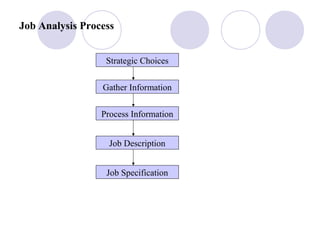
Job Analysis Process
Strategic Choices
Gather Information
Process Information
Job Description
Job Specification
Strategic Choices
Include:
1. Extent of employee involvement
 Depends upon the need of organisation & employees
 Too much employee involvement result in bias in favour of the job
 Less employee involvement creates suspicion among employees regarding
the motive of Job Analysis
2. Level of details of Job Analysis
Depends on – Nature of Job which is analysing
Purpose for which job related details are collected
Strategic Choices Cont..
3. Timing and frequency
Conducted when:
 An organisation is newly established
 A new job is created
 Change of Job due to technology change
 For introducing new remuneration plan
 To overcome the inequalities between effort and remuneration
4. Past-oriented versus Future-oriented
Exists a need because of the rapid change of technology
Strategic Choices Cont..
5. Source of Job data
Categorised as
A. Non- human sources
Include:
i. Existing job descriptions and specifications
ii. Equipment maintenance records
iii. Equipment design blueprints
iv. Films of employee working
v. Training manuals, magazines & newspapers
B. Human sources
Include:
i. Job analysts
ii. Job incumbents
iii. Supervisors
iv. Job experts
Gathering information
Involves 3 steps
Include
1. Type of data to be collected
Depends upon:
i. Enduse of information
ii. Time and budget constraints
2. Methods of data collection
Include:
i. Interview
ii. Questionnaires
iii. Checklists
iv. Technical conference
v. Diary methods
Quantitative Techniques
i. Position Analysis Questionnaire
ii. Management Position Description Questionnaire
iii. Department of Labour Procedure
iv. Functional Job Analysis
Processing Information
Refers to the analysis of the collected information through various means that
should result in Job description and Job specification
Job Design
Refers to the process of assigning tasks to the job, including interdependency of
those tasks with other jobs
Job design follows Job analysis
Involves 3 steps:
1. Specification of individual tasks
2. Specification of methods performing each task
3. Combination of tasks into specific jobs to be assigned to individuals
Job Design- Factors Affecting
Include:
1. Organisational
i. Characteristics of tasks
ii. Work flow
iii. Ergonomics
2. Environmental
i. Employee Ability and Availability
ii. Social and Cultural Expectations
2. Behavioural
i. Feedback
ii. Autonomy
iii. Whether the job helps to use job holders ability/ not
iv. Variety of jobs to be performed
Job Design - Approaches
1. Job Rotation
2. Job Engineering
3. Job Enlargement
4. Job Enrichment
5. Socio- Technical Systems
Job Design – Contemporary Issues
1. Telecommuting
Refers to the use of microcomputers, networks and communication systems to
do work from home which was traditionally done in the workplace
2. Alternative Work Pattern
Refers to Job sharing in terms of timing
3. Task Revision
Process of correcting incorrectly defined jobs
4. Knowledge work
Jobs are to be designed such that human brains do have some contribution
rather than a mere repetitive process
5. Business Process Reengineering
Process of making the Company adaptable and oriented towards continuous
change

Hrm basics

  • 1.
    Job Analysis Defined asthe process of studying and collecting information relating to the operations and responsibilities of a specific job The main focus of Job analysis is on the Job, not on the individual holding the job Products – Job Description & Job Specifications
  • 2.
    Benefits 1. Lays thefoundation for human resource planning 2. Helps to indicate training needs 3. Helps to put together work groups or teams 4. Provide as a basis for recruitment 5. Provide as a basis for compensation 7. Helps to describe the physical needs of various jobs to determine the validity of discrimination complaints 7. As a basis for coordinating safety and health concerns 8. As an input for strategic planning
  • 3.
    Job Description Defined asa statement that explains the job Include:  Job Title  Location  Job Summary  Machines, Tools & Equipment to be used  Materials to be used  Supervision needed  Working conditions  Hazards
  • 4.
    Job Specification Defined asa statement that indicates human qualifications necessary to do the job Include:  Educational Qualification  Experience  Training  Physical Effort  Physical Skills  Communication Skills  Emotional Characteristics  Sensory demands such as sight, smell, hearing
  • 5.
    Job Analysis Process StrategicChoices Gather Information Process Information Job Description Job Specification
  • 6.
    Strategic Choices Include: 1. Extentof employee involvement  Depends upon the need of organisation & employees  Too much employee involvement result in bias in favour of the job  Less employee involvement creates suspicion among employees regarding the motive of Job Analysis 2. Level of details of Job Analysis Depends on – Nature of Job which is analysing Purpose for which job related details are collected
  • 7.
    Strategic Choices Cont.. 3.Timing and frequency Conducted when:  An organisation is newly established  A new job is created  Change of Job due to technology change  For introducing new remuneration plan  To overcome the inequalities between effort and remuneration 4. Past-oriented versus Future-oriented Exists a need because of the rapid change of technology
  • 8.
    Strategic Choices Cont.. 5.Source of Job data Categorised as A. Non- human sources Include: i. Existing job descriptions and specifications ii. Equipment maintenance records iii. Equipment design blueprints iv. Films of employee working v. Training manuals, magazines & newspapers B. Human sources Include: i. Job analysts ii. Job incumbents iii. Supervisors iv. Job experts
  • 9.
    Gathering information Involves 3steps Include 1. Type of data to be collected Depends upon: i. Enduse of information ii. Time and budget constraints 2. Methods of data collection Include: i. Interview ii. Questionnaires iii. Checklists iv. Technical conference v. Diary methods Quantitative Techniques i. Position Analysis Questionnaire ii. Management Position Description Questionnaire iii. Department of Labour Procedure iv. Functional Job Analysis
  • 10.
    Processing Information Refers tothe analysis of the collected information through various means that should result in Job description and Job specification
  • 11.
    Job Design Refers tothe process of assigning tasks to the job, including interdependency of those tasks with other jobs Job design follows Job analysis Involves 3 steps: 1. Specification of individual tasks 2. Specification of methods performing each task 3. Combination of tasks into specific jobs to be assigned to individuals
  • 12.
    Job Design- FactorsAffecting Include: 1. Organisational i. Characteristics of tasks ii. Work flow iii. Ergonomics 2. Environmental i. Employee Ability and Availability ii. Social and Cultural Expectations 2. Behavioural i. Feedback ii. Autonomy iii. Whether the job helps to use job holders ability/ not iv. Variety of jobs to be performed
  • 13.
    Job Design -Approaches 1. Job Rotation 2. Job Engineering 3. Job Enlargement 4. Job Enrichment 5. Socio- Technical Systems
  • 14.
    Job Design –Contemporary Issues 1. Telecommuting Refers to the use of microcomputers, networks and communication systems to do work from home which was traditionally done in the workplace 2. Alternative Work Pattern Refers to Job sharing in terms of timing 3. Task Revision Process of correcting incorrectly defined jobs 4. Knowledge work Jobs are to be designed such that human brains do have some contribution rather than a mere repetitive process 5. Business Process Reengineering Process of making the Company adaptable and oriented towards continuous change