Human Resource Management   TENTH EDITON Employee Rights and Discipline © 2003 Southwestern College Publishing. All rights reserved. PowerPoint Presentation  by Charlie Cook Chapter 16 SECTION 5 Employee Relations and Global HR Robert L. Mathis     John H. Jackson
Learning Objectives After you have read this chapter, you should be able to: Explain the difference between statutory rights and contractual rights. Define employment-at-will and identify three exceptions to it. Describe what due process is and explain some means of alternative dispute resolution. Identify employee rights associated with access to employee records and free speech.
Learning Objectives (cont’d) Discuss issues associated with workplace monitoring, surveillance, investigations, and drug testing. List elements to consider when developing an employee handbook. Differentiate between the positive approach and the progressive approach to discipline.
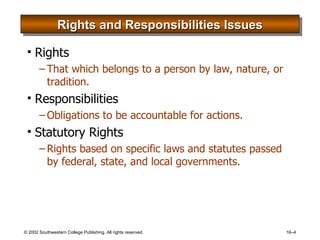
Rights and Responsibilities Issues Rights That which belongs to a person by law, nature, or tradition. Responsibilities Obligations to be accountable for actions. Statutory Rights Rights based on specific laws and statutes passed by federal, state, and local governments.
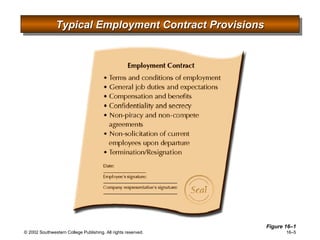
Typical Employment Contract Provisions Figure 16 –1
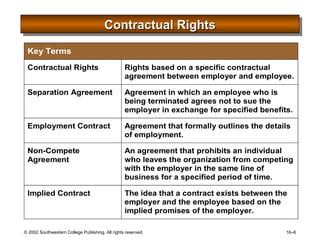
Contractual Rights
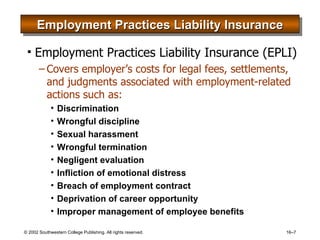
Employment Practices Liability Insurance Employment Practices Liability Insurance (EPLI) Covers employer’s costs for legal fees, settlements, and judgments associated with employment-related actions such as: Discrimination Wrongful discipline Sexual harassment Wrongful termination Negligent evaluation Infliction of emotional distress Breach of employment contract Deprivation of career opportunity Improper management of employee benefits
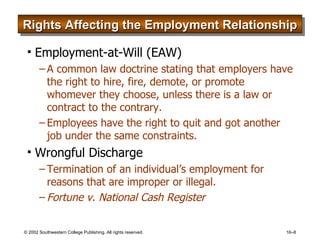
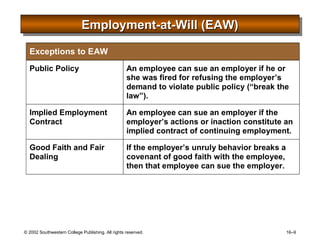
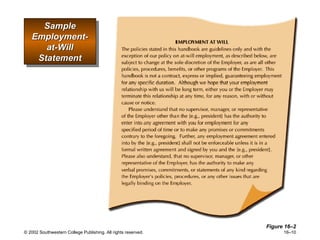
Rights Affecting the Employment Relationship Employment-at-Will (EAW) A common law doctrine stating that employers have the right to hire, fire, demote, or promote whomever they choose, unless there is a law or contract to the contrary. Employees have the right to quit and got another job under the same constraints. Wrongful Discharge Termination of an individual’s employment for reasons that are improper or illegal. Fortune v. National Cash Register
Employment-at-Will (EAW)
Sample Employment-at-Will Statement Figure 16 –2
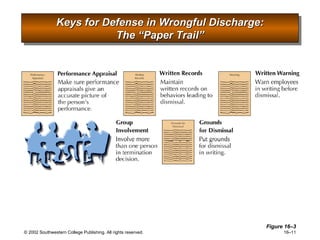
Keys for Defense in Wrongful Discharge: The “Paper Trail” Figure 16 –3
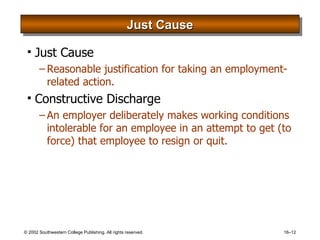
Just Cause Just Cause Reasonable justification for taking an employment-related action. Constructive Discharge An employer deliberately makes working conditions intolerable for an employee in an attempt to get (to force) that employee to resign or quit.
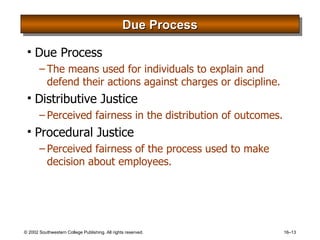
Due Process Due Process The means used for individuals to explain and defend their actions against charges or discipline. Distributive Justice Perceived fairness in the distribution of outcomes. Procedural Justice Perceived fairness of the process used to make decision about employees.
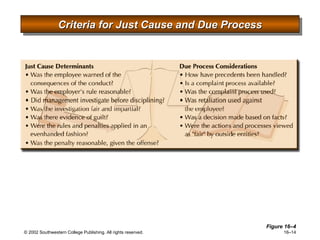
Criteria for Just Cause and Due Process Figure 16 –4
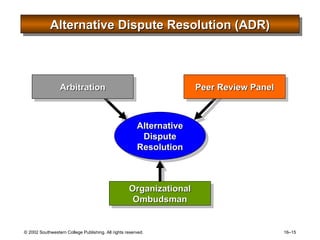
Alternative Dispute Resolution (ADR) Organizational Ombudsman Arbitration Peer Review Panel Alternative Dispute Resolution
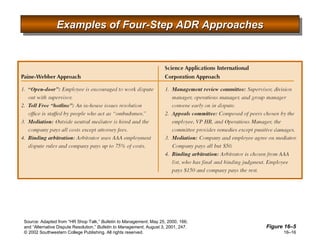
Examples of Four-Step ADR Approaches Figure 16 –5 Source: Adapted from “HR Shop Talk,”  Bulletin to Management , May 25, 2000, 166; and “Alternative Dispute Resolution,”  Bulletin to Management , August 3, 2001, 247.
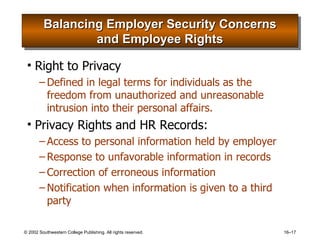
Balancing Employer Security Concerns and Employee Rights Right to Privacy Defined in legal terms for individuals as the freedom from unauthorized and unreasonable intrusion into their personal affairs. Privacy Rights and HR Records: Access to personal information held by employer Response to unfavorable information in records Correction of erroneous information Notification when information is given to a third party
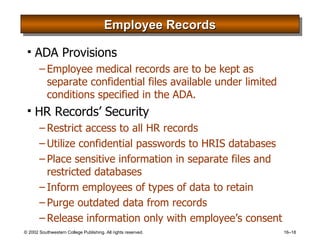
Employee Records ADA Provisions Employee medical records are to be kept as separate confidential files available under limited conditions specified in the ADA. HR Records’ Security Restrict access to all HR records Utilize confidential passwords to HRIS databases Place sensitive information in separate files and restricted databases Inform employees of types of data to retain Purge outdated data from records Release information only with employee’s consent
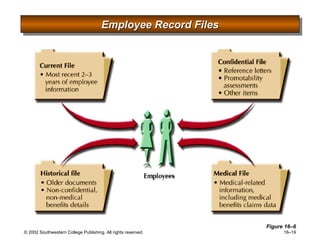
Employee Record Files Figure 16 –6
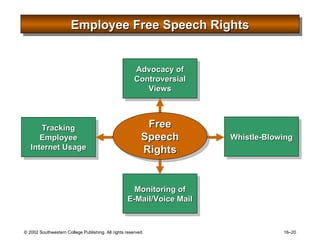
Employee Free Speech Rights Free Speech Rights Tracking Employee Internet Usage Advocacy of Controversial Views Whistle-Blowing Monitoring of E-Mail/Voice Mail
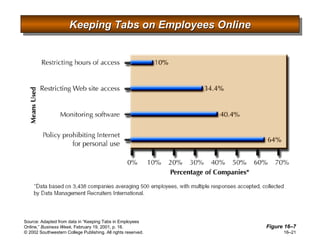
Keeping Tabs on Employees Online Figure 16 –7 Source: Adapted from data in “Keeping Tabs in Employees Online,”  Business Week,  February 19, 2001, p. 16.
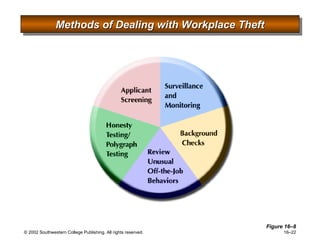
Methods of Dealing with Workplace Theft Figure 16 –8
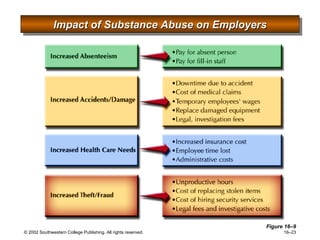
Impact of Substance Abuse on Employers Figure 16 –9
Drug Testing and Employee Rights Arguments Against Drug Testing It violates employees’ privacy rights. Drugs may not affect performance in every case. Employers may abuse the results of tests. Drug tests may be inaccurate. Test results can be misinterpreted. Types of Drug Testing Urinalysis Hair immunoassay Fit-for-duty tests for impairment
Drug Testing Conducting Drug Tests Random testing of all employee at periodic intervals Testing only in cases of probable cause Testing after accidents When to Test (Conditions) Job consequences outweigh privacy concerns Accurate test procedures are available Written consent of the employee is obtained Results are treated confidentially Employers have a complete drug program, including an EAP.
HR Policies, Procedures, and Rules Policies General guidelines that focus organizational actions. “Why we do it” Procedures Customary methods of handling activities “How we do it” Rules Specific guidelines that regulate and restrict the behavior of individuals. “The limits on what we do”
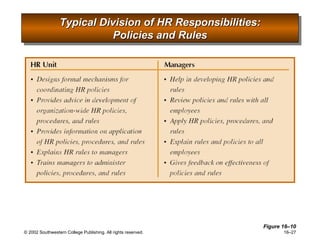
Typical Division of HR Responsibilities: Policies and Rules Figure 16 –10
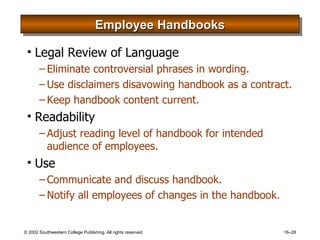
Employee Handbooks Legal Review of Language Eliminate controversial phrases in wording. Use disclaimers disavowing handbook as a contract. Keep handbook content current. Readability Adjust reading level of handbook for intended audience of employees. Use Communicate and discuss handbook. Notify all employees of changes in the handbook.
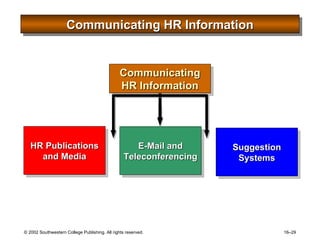
Communicating HR Information Communicating HR Information HR Publications and Media Suggestion Systems E-Mail and Teleconferencing
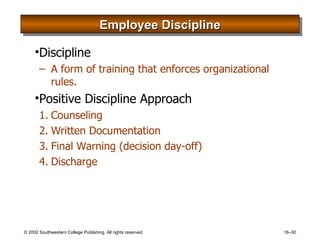
Employee Discipline Discipline A form of training that enforces organizational rules. Positive Discipline Approach Counseling Written Documentation Final Warning (decision day-off) Discharge
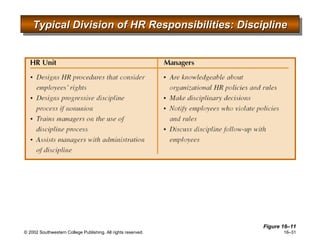
Typical Division of HR Responsibilities: Discipline Figure 16 –11
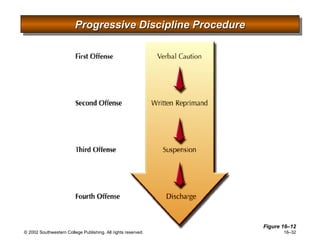
Progressive Discipline Procedure Figure 16 –12
Reasons Why Discipline Might Not Be Used Organization culture regarding discipline Lack of support by higher management Guilt Loss of friendship Time loss Fear of lawsuits
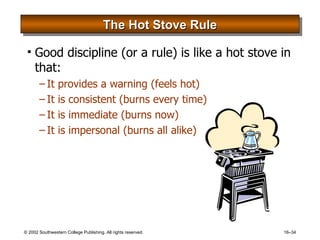
The Hot Stove Rule Good discipline (or a rule) is like a hot stove in that: It provides a warning (feels hot) It is consistent (burns every time) It is immediate (burns now) It is impersonal (burns all alike)
Discharge: The Final Disciplinary Step Handling Discharges Provide discharge warning at last disciplinary step before termination. Provide the employee with written notice of the discharge that clearly states the reason(s) for the discharge decision, do not try to “sugarcoat” the reason(s). Have an HR representative attend the termination meeting as a witness. Inform the employee of HR or benefits issues. Maintain a professional demeanor at all times.

Hrm10e Chap16

  • 1.
    Human Resource Management TENTH EDITON Employee Rights and Discipline © 2003 Southwestern College Publishing. All rights reserved. PowerPoint Presentation by Charlie Cook Chapter 16 SECTION 5 Employee Relations and Global HR Robert L. Mathis  John H. Jackson
  • 2.
    Learning Objectives Afteryou have read this chapter, you should be able to: Explain the difference between statutory rights and contractual rights. Define employment-at-will and identify three exceptions to it. Describe what due process is and explain some means of alternative dispute resolution. Identify employee rights associated with access to employee records and free speech.
  • 3.
    Learning Objectives (cont’d)Discuss issues associated with workplace monitoring, surveillance, investigations, and drug testing. List elements to consider when developing an employee handbook. Differentiate between the positive approach and the progressive approach to discipline.
  • 4.
    Rights and ResponsibilitiesIssues Rights That which belongs to a person by law, nature, or tradition. Responsibilities Obligations to be accountable for actions. Statutory Rights Rights based on specific laws and statutes passed by federal, state, and local governments.
  • 5.
    Typical Employment ContractProvisions Figure 16 –1
  • 6.
  • 7.
    Employment Practices LiabilityInsurance Employment Practices Liability Insurance (EPLI) Covers employer’s costs for legal fees, settlements, and judgments associated with employment-related actions such as: Discrimination Wrongful discipline Sexual harassment Wrongful termination Negligent evaluation Infliction of emotional distress Breach of employment contract Deprivation of career opportunity Improper management of employee benefits
  • 8.
    Rights Affecting theEmployment Relationship Employment-at-Will (EAW) A common law doctrine stating that employers have the right to hire, fire, demote, or promote whomever they choose, unless there is a law or contract to the contrary. Employees have the right to quit and got another job under the same constraints. Wrongful Discharge Termination of an individual’s employment for reasons that are improper or illegal. Fortune v. National Cash Register
  • 9.
  • 10.
  • 11.
    Keys for Defensein Wrongful Discharge: The “Paper Trail” Figure 16 –3
  • 12.
    Just Cause JustCause Reasonable justification for taking an employment-related action. Constructive Discharge An employer deliberately makes working conditions intolerable for an employee in an attempt to get (to force) that employee to resign or quit.
  • 13.
    Due Process DueProcess The means used for individuals to explain and defend their actions against charges or discipline. Distributive Justice Perceived fairness in the distribution of outcomes. Procedural Justice Perceived fairness of the process used to make decision about employees.
  • 14.
    Criteria for JustCause and Due Process Figure 16 –4
  • 15.
    Alternative Dispute Resolution(ADR) Organizational Ombudsman Arbitration Peer Review Panel Alternative Dispute Resolution
  • 16.
    Examples of Four-StepADR Approaches Figure 16 –5 Source: Adapted from “HR Shop Talk,” Bulletin to Management , May 25, 2000, 166; and “Alternative Dispute Resolution,” Bulletin to Management , August 3, 2001, 247.
  • 17.
    Balancing Employer SecurityConcerns and Employee Rights Right to Privacy Defined in legal terms for individuals as the freedom from unauthorized and unreasonable intrusion into their personal affairs. Privacy Rights and HR Records: Access to personal information held by employer Response to unfavorable information in records Correction of erroneous information Notification when information is given to a third party
  • 18.
    Employee Records ADAProvisions Employee medical records are to be kept as separate confidential files available under limited conditions specified in the ADA. HR Records’ Security Restrict access to all HR records Utilize confidential passwords to HRIS databases Place sensitive information in separate files and restricted databases Inform employees of types of data to retain Purge outdated data from records Release information only with employee’s consent
  • 19.
    Employee Record FilesFigure 16 –6
  • 20.
    Employee Free SpeechRights Free Speech Rights Tracking Employee Internet Usage Advocacy of Controversial Views Whistle-Blowing Monitoring of E-Mail/Voice Mail
  • 21.
    Keeping Tabs onEmployees Online Figure 16 –7 Source: Adapted from data in “Keeping Tabs in Employees Online,” Business Week, February 19, 2001, p. 16.
  • 22.
    Methods of Dealingwith Workplace Theft Figure 16 –8
  • 23.
    Impact of SubstanceAbuse on Employers Figure 16 –9
  • 24.
    Drug Testing andEmployee Rights Arguments Against Drug Testing It violates employees’ privacy rights. Drugs may not affect performance in every case. Employers may abuse the results of tests. Drug tests may be inaccurate. Test results can be misinterpreted. Types of Drug Testing Urinalysis Hair immunoassay Fit-for-duty tests for impairment
  • 25.
    Drug Testing ConductingDrug Tests Random testing of all employee at periodic intervals Testing only in cases of probable cause Testing after accidents When to Test (Conditions) Job consequences outweigh privacy concerns Accurate test procedures are available Written consent of the employee is obtained Results are treated confidentially Employers have a complete drug program, including an EAP.
  • 26.
    HR Policies, Procedures,and Rules Policies General guidelines that focus organizational actions. “Why we do it” Procedures Customary methods of handling activities “How we do it” Rules Specific guidelines that regulate and restrict the behavior of individuals. “The limits on what we do”
  • 27.
    Typical Division ofHR Responsibilities: Policies and Rules Figure 16 –10
  • 28.
    Employee Handbooks LegalReview of Language Eliminate controversial phrases in wording. Use disclaimers disavowing handbook as a contract. Keep handbook content current. Readability Adjust reading level of handbook for intended audience of employees. Use Communicate and discuss handbook. Notify all employees of changes in the handbook.
  • 29.
    Communicating HR InformationCommunicating HR Information HR Publications and Media Suggestion Systems E-Mail and Teleconferencing
  • 30.
    Employee Discipline DisciplineA form of training that enforces organizational rules. Positive Discipline Approach Counseling Written Documentation Final Warning (decision day-off) Discharge
  • 31.
    Typical Division ofHR Responsibilities: Discipline Figure 16 –11
  • 32.
  • 33.
    Reasons Why DisciplineMight Not Be Used Organization culture regarding discipline Lack of support by higher management Guilt Loss of friendship Time loss Fear of lawsuits
  • 34.
    The Hot StoveRule Good discipline (or a rule) is like a hot stove in that: It provides a warning (feels hot) It is consistent (burns every time) It is immediate (burns now) It is impersonal (burns all alike)
  • 35.
    Discharge: The FinalDisciplinary Step Handling Discharges Provide discharge warning at last disciplinary step before termination. Provide the employee with written notice of the discharge that clearly states the reason(s) for the discharge decision, do not try to “sugarcoat” the reason(s). Have an HR representative attend the termination meeting as a witness. Inform the employee of HR or benefits issues. Maintain a professional demeanor at all times.