Syllabus
Unit 1: INTRODUCTIONTO HUMAN RESOURCE MANAGEMENT:
Introduction-Meaning of HRM – Objectives of HRM – Importance of
HRM – Functions and Process of HRM - Duties and Responsibilities of
Human Resource Manager – Qualities of Human Resource Manager -
Recent trends in HRM.
3.
Definition of HRM
EdwinB. Flippo (1984)
Flippo describes HRM as:
"The planning, organizing, directing, and controlling of the procurement,
development, compensation,
integration, maintenance, and separation of human resources to the end that
individual, organizational, and societal objectives are accomplished."
4.
Objectives of HRM
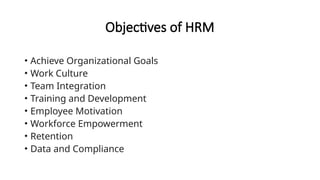
•Achieve Organizational Goals
• Work Culture
• Team Integration
• Training and Development
• Employee Motivation
• Workforce Empowerment
• Retention
• Data and Compliance
5.
Objectives of HRM
AchieveOrganizational Goals:
The HRM objectives are to fulfill organizational goals by utilizing human
resources to achieve business requirements and standards. An effective
HRM needs to accomplish the organizational goals to inflate the
profitability of an organization.
Organizational objectives include workforce handling, staff requirements
like hiring, onboarding, payroll management, social engagement, and
more. To succeed at the organizational objectives, HR requires efficient
planning and execution.
6.
Objectives of HRM
WorkCulture
When it comes to handling HRM effectively, employee and work environment are the
prior factors. Work culture plays an important role in defining HRM and business
performance.
An HR manager needs to be active while calling for strategies to foster better work
culture. Automated activities like leave approvals, reimbursement request
acknowledgement, etc. can help you.
In addition, Quick operations and empowerment to employees help in creating
positive vibes at the workplace. Developing and maintaining healthy and transparent
relations among team members and teams contribute to building a good example of
work culture.
7.
Objectives of HRM
TeamIntegration
One of the prime roles and objectives of HRM is to make sure the team coordinates
efficiently. Easy communication is the need for teams in an enterprise. An HR here
must ensure a tool that assists in making the integration easier and smooth.
8.
Objectives of HRM
Trainingand Development
With proper training and providing future opportunities, employees feel
safe and organized. Effective employment is highly dependent upon
training practices. Providing opportunities to employees is one of the
great step to ensure workforce performance management.
9.
Objectives of HRM
EmployeeMotivation:
The prime objective of the HR team is to keep things on the right path. Keep distractions and
negative vibes away. For motivating employees, it is important to give power to them. Take their
views on things. Involve them in weekly meets or decisions. Even if they are freshers, let them join.
Keep the morale always high.
Employee recognition like yearly appraisals, incentives, and bonuses based on their performance
can also help. It must be framed yearly to review the performances as well as reward the
deserving.
10.
Objectives of HRM
WorkforceEmpowerment
Workforce empowerment involves granting employees the authority,
resources, and confidence to make decisions and take actions within
their roles. Employees no more need to knock on HR’s desk for small
queries as all the minute details would be made available on HR portal.
Employees can apply for approvals and track them through their mobile
phones. Be it leave requests, generating Payslip, checking PF accounts,
remaining leaves, upcoming holidays, manager details, or anything, HR
intervention is least required. The workforce plays a pivotal role in an
organization as the business’s functioning depends on the employees’
skills.
When the objective of HRM would align with individual interests it
inflates the encouragement of employees to heights.
11.
Objectives of HRM
Retention
Toensure the retention of employees, the HR department should optimize the
functional objectives of the company in accordance to the interest of company as well
as its workforce to ensure the engagement of staff in achieving the company’s goals.
Other than employee hiring, onboarding, and training cycle, keeping the employees
retained for long is the biggest challenge the objective of the HR people. It often
occurs that employees leave the organization within 2 months of onboarding. It can be
due to ineffective training management or a rough hiring process.
Employee experience needs to be carefully attended to. Keeping your employees
retained can help maintain a good state of employee turnover. To keep it stable, the
HR manager needs to learn the best retention tips for business.
12.
Objectives of HRM
Dataand Compliance
Functional and organizational objectives also include managing company/ employee
data and managing compliance. Managing payroll compliances and keeping the
company out of any penalties or fines is a huge challenge for the Human resource
management (HRM) teams and managers.
Even a small error or miscalculation can owe you huge penalties and even may lose
respect. When committing to tasks like employment and payroll, you need to be
careful about laws and regulations. The objective here is to keep any unwanted claims
at bay for smooth functioning.
13.
Poonawalla Fincorp CTOsteps down after "ha
rassment" from HR head; read resignation ma
il sent to the company's MD
Importance of HRM
1.Talent Acquisition and Retention
HRM plays a crucial role in identifying and recruiting the right talent for
the organization. By employing effective recruitment strategies, HR
ensures that the organization has a skilled and diverse workforce.
Additionally, HR initiatives like competitive compensation, benefits, and
a supportive work environment help retain top talent, reducing
turnover and maintaining organizational stability.
16.
Importance of HRM
2.Employee Development
HRM invests in the continuous learning and development of employees by
organizing training sessions, workshops, and career development programs.
These initiatives not only enhance employees' skills but also prepare them for
future challenges, leading to improved efficiency and innovation within the
organization.
17.
Importance of HRM
3.Conflict Resolution
Workplace conflicts are inevitable, but HRM ensures they are managed effectively
through mediation and communication. By addressing grievances promptly and
fostering a culture of mutual respect, HR helps maintain a harmonious and
productive workplace environment.
4. Compliance and Legal Framework
Adherence to labor laws and regulations is a critical responsibility of HRM. By
staying updated on legal requirements, HR minimizes the risk of legal disputes and
ensures ethical practices in areas such as employment contracts, workplace safety,
and employee rights.
18.
Importance of HRM
5.Performance Management
HRM designs and implements performance appraisal systems that provide
constructive feedback and recognize employees' contributions. These systems
motivate employees to achieve their goals, align their efforts with organizational
objectives, and boost overall productivity.
6. Employee Engagement and Satisfaction
HRM promotes initiatives that foster employee engagement and job satisfaction,
such as recognition programs, team-building activities, and open communication. A
motivated and engaged workforce is more likely to contribute positively to
organizational success and reduce absenteeism and turnover rates.
19.
Importance of HRM
7.Strategic Planning
HRM aligns its strategies with the broader organizational goals, contributing to
long-term growth. This includes workforce planning, succession planning, and
identifying skill gaps to ensure that the organization remains competitive and agile.
8. Cost Efficiency
By optimizing workforce-related expenses, HRM helps control costs without
compromising quality. Efficient recruitment, proper utilization of human resources,
and minimizing turnover costs contribute to the financial health of the
organization.
21.
Functions of HRM
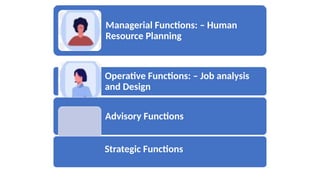
ManagerialFunctions: – Human
Resource Planning
Operative Functions: – Job analysis
and Design
Advisory Functions
Strategic Functions
22.
Functions of HRM
1.Managerial Functions: –
Human Resource Planning
Organizing
Directing
Controlling
23.
Functions of HRM
•2. Operative Functions: – Job analysis and Design
• Selection and Recruitment
• Training and Development
• Wage and Salary Administration
• Performance Appraisal
• Employee Welfare
24.
Functions of HRM
•2. Operative Functions: – Job analysis and Design
• Employee Relations
• Maintenance
• Employee Research
• Employee Record
25.
Functions of HRM
3.Advisory Functions:
• Advising Top Management
• Advising Department Heads
26.
Functions of HRM
4.Strategic Functions:
• Benchmarking the current Standing of your Human Resources
• Ensuring the business outcomes are aligned with the organizational goals
• Measuring HR contributions
27.
Managerial Functions
1. HumanResource Planning: it is a function that determines the need
for the number of employees and the types of employees for achieving
organizational goals.
Research becomes an important part of this function as the data is
collected and analyzed for current and future HR needs.
This function also helps in forecasting the changing values, attitude,
and behavior of the employees and how that would impact the
organization and the business.
28.
Managerial Functions
2. Organizing:In an organization, tasks are allocated among members, relationships
are identified and established, and activities are directed towards collectively
contributing to the achievement of the organizational goal.
3. Directing: Making the employees contribute their maximum efforts and activating
them at different levels is only possible through proper direction and motivation.
when you employees are motivated, you can tap into the employees’ full potential with
proper command.
29.
Managerial Functions
4. Controlling:After planning, organizing and directing, the actual
performance of the employees is checked and compared with the
original plans.
If the performance of the employees is deviated, it requires some
measures of control to be taken so that the employee performance is
on track with their goals.
30.
Operative Functions
1.Selection andRecruitment: It is a function that brings together a
pool of prospective candidates to the organization. The management
can select the right candidate for the job from this talent pool.
2.Job Analysis: The process of outlining the nature of a job and
specifying the candidate requirements like qualification, skills, and
work experience to perform the job is called Job analysis. Job design
aims at outlining and organizing tasks, duties, and responsibilities into
a single unit of work for the achievement of certain objectives.
31.
Operative Functions
3. Trainingand development: This HRM function enables the
employees to develop their skills and knowledge in order for
them to perform their jobs effectively. Training and
development programs help in preparing the existing
employees for higher roles and responsibilities. They also
help the new and existing employees learn more about their
job.
4. Wage and Salary Administration: HRM determines what
is to be paid for different roles and jobs. HRM helps in
deciding the compensation of the employees which include
wage administration, salary administration, bonuses,
incentives, etc.
32.
Operative Functions
5. PerformanceAppraisal: This HRM function is very important as the
HRs need to ensure that the employees’ performances are consistent.
Performance appraisal rewards the employees for their consistent
performance and reaching their objectives.
6. Employee Welfare: This is the function that looks after the overall
wellbeing of the employees by providing various benefits, facilities, and
services to the employees by the organization.
33.
Operative Functions
7. EmployeeRelations: This refers to the HRM’s interactions with the
employees represented by a union. Employees come together to attain
more voice for making decisions impacting the wage benefits, working
conditions, etc.
8. Maintenance: HR is considered to be an asset to the organization
and employee turnover is considered NOT to be good for the
organization. HRM always tries to keep and maintain their best
performing employees within the organization.
34.
Operative Functions
9. PersonnelResearch: Personnel Research is done by HRM to
understand the employees’ opinions on compensation, work conditions
and work culture, etc. The results of this research help in determining
the employee promotions, employee satisfaction, employee upskilling
and termination of the employees.
10. Personnel Record: This function involves recording, maintaining,
documenting, and retrieving employee-related data like – application
forms, employment history, working hours, compensation history,
employee attendance, employee turnover, and other employee related
data.
35.
Advisory Functions
• HRMhas expertise in managing the Human Resources of
the company and hence has the ability to advise on matters
related to the employee to the:
• 1. Advising the top Management: Personnel managers
advices the top management on formulating and evaluating
the employee programs, policies and procedures.
• 2. Advising the Department Heads: The personnel
manager advises the department heads on matters such as
staff planning, job analysis, job design, recruitment,
selection, placement, training, performance appraisal, etc.
36.
Strategic Functions ofHRM
1. Benchmarking the current Standing of your Human Resources:
understanding the current stance of your employees is very important as it
determines how to set your future goals and helps you understand the
timelines for achieving them.
2. Ensuring the business outcomes are aligned with the organizational
goals: Everyone in the organization is working towards the organizational
goals, but ensuring that the business outcomes are aligned with these goals
helps us keep track of the progress.
3. Measuring HR contributions: As the nature of HRM is more action
oriented and involves more activity, putting them in numbers is very difficult.
Strategic HRM functions help in conveying the true extent of the HR
contributions to the leadership.
Process of HRM
1.Recruitment
It is a positive process of posting job openings and attracting prospective employees to
apply for their desired job openings in an organization so that the eligible candidate can
be selected.
The recruitment process is a crucial aspect of HRM as it helps organizations to find and
hire the best candidates for open positions. The recruitment process involves several
steps, including job analysis, sourcing candidates, screening resumes, conducting initial
interviews, assessing candidate fit, making a job offer, completing joining formalities.
41.
TCS Recruitment Process
TataConsultancy Services Limited (TCS) is an Indian
multinational information technology (IT) service, consulting,
and business solutions company Headquartered in Mumbai,
Maharashtra. It is a subsidiary of the Tata Group and operates
in 46 countries.
42.
TCS Recruitment Process
TCSconducts 4 rounds to select freshers as Assistant System Engineers
in their organization.
1) Written Round
2) Technical Round
3) Managerial Round
4) HR Round
43.
TCS Recruitment Process
1.Written Round:
• The Written round consists of four sections and the total time allotted is 90 minutes. The
four sections include:
A: Quantitative Aptitude test where the numerical and the reasoning ability
sections are tested.
20 questions need to be attempted in 40 minutes. There are 2-star questions that have more
weight than normal questions and are a bit tricky.
There is a negative marking of 1/3rd for the questions other than the star.
• Important topics include Number systems, Equations, Ratio and Proportion,
Percentages, Profit and Loss, Time and Work, Time Speed Distance, Areas and
Mensuration, Averages, Permutations and Combinations, Probability, Plane geometry,
Seating Arrangements, Sets, Progressions, Functions, Series, Coding, Truth and Lie
based puzzles.
44.
TCS Recruitment Process
B:Programming Language Test:
This round consists of general questions from computer science and programming
languages. It consists of 10 to 12 questions and the time allotted is 20 minutes. It is
an MCQ round and consists of basic programming questions.
45.
TCS Recruitment Process
C:Coding Round:
This is a technical coding round. It consists of 1 to 2 questions and the time allotted
is 20 minutes.
D: E-mail writing:
There will be certain clues/words given to which you have to write an e-mail
addressing the scenario. You have to type the e-mail in the space given. The most
important thing is you have to use all the phrases given without missing even a
single one. The time allotted is 10 minutes.
46.
TCS Recruitment Process
EmailQuestion: As a member of your residential society, write an email
to the inspector of the local Police station, Mr.Agarwal, informing him
about miscreants who ride their bikes rashly every evening outside your
society. Sign the email as Shyam.
Phrases:
residential area - ride - rashly - children -
play - elderly - walk - grocery shop -
across the road - dangerous - accidents -
nuisance - action - immediately.
47.
TCS Recruitment Process
2.Technical Round:
The students who clear the written round are called for a Technical
Interview. There is no hard & fast rule for which questions will be asked
in this round, you can expect questions on any topic depending on the
panel. To clear this round, you should be clear with your basics. You
should be prepared with Data structures and Algorithms, DBMS,
Operating Systems, Networking, etc.
48.
TCS Recruitment Process
3.Managerial Round:
This round includes everything that was in the Technical round
plus it will be under pressure and a lot of cross-checking.
Doubts will be raised on your answers to check if you can
handle stress or not. Students may or may not be sent to this
round depending on the feedback of the previous round. If the
feedback of the previous round was good you may expect to
directly been sent to the HR round.
49.
TCS Recruitment Process
4.HR Round:
This is the final round of the recruitment process. The interview panel can ask you
anything related to your personality, family, education, hobbies, internships, general
knowledge, and basic HR questions like Why should I hire you? If any problem with
relocation, etc. The key here is to be confident about everything you speak.
50.
TCS Recruitment Process
ForBPS (Business Process Services)
https://www.tcs.com/careers/indi
a/tcs-bps-fresher-hiring-2024
51.
2. Selection Process
Selectionis quite a necessary process in HRM. It involves eliminating the
unsuitable candidates through the process of tests or interviews and identifying the
suitable ones, which are the best fit for the positions.
52.
3. Training
Selection isquite a necessary process in HRM. It involves eliminating the
unsuitable candidates through the process of tests or interviews and identifying the
suitable ones, which are the best fit for the positions. Eg: onboarding new
employees, leadership development programs, mentoring and coaching by senior
staff, technical skills training on new software, product knowledge training for sales
teams, compliance training on company policies, and softskills workshops on
communication and teamwork
53.
4. Performance Appraisal(Assessing performance)
There should be proper management of the work done and the future goals.
Performance appraisal refers to appraising the performance of the employees and
enhancing it. For such a management, it is necessary to encourage the employees so
as to raise their confidence levels. This can be done by providing them with fair
rewards so that they work in their optimum productivity levels.
58.
Ola CEO BhavishAggarwal’s stern message to employees
goes viral
https://www.livemint.com/companies/ola-ceo-bhavish-aggarwals-stern
-message-to-employees-goes-viral-hr-will-be-having-conversation-1173
4454868979.html
59.
5. Motivating
Motivated employeesare often more productive and better
performers than their unmotivated colleagues. They tend to
work harder and focus on completing their tasks to the best
of their abilities.
Eg: Create a positive work culture, Recognize and appreciate
employees, Provide training and development opportunities,
Give employees responsibility, etc. members for doing good
work
60.
6. Compensating
Fair salaryor remuneration plays a very important role in motivating an
employee to accomplish organisational goals. If the employees get
rewards for their best performance, they will get job satisfaction. The
rewards not just includes salaries, but it also includes incentives and
fringe benefits for doing good work
61.
7. Maintaining LabourRelations
Maintaining good labor relations in HRM involves fostering
open communication, actively addressing employee concerns, fairly
enforcing company policies, engaging in proactive conflict resolution,
and collaborating with unions (if present) to reach mutually beneficial
agreements through collective bargaining, all while ensuring
compliance with labor laws to maintain a positive working environment
for employees and the organization
62.
8. Healthy welfare& safety of employees
In Human Resource Management (HRM), "healthy welfare and safety
of employees" refers to the practices and initiatives implemented by a
company to ensure the physical and mental well-being of their
workforce, including providing a safe working environment, access to
healthcare, and measures to promote work-life balance, all aimed at
preventing accidents, illnesses, and stress while maximizing employee
productivity and satisfaction.
63.
8. Compliance tolabour laws
"Compliance to labor laws in HRM" refers to the practice of
ensuring that a company's Human Resource Management (HRM)
policies and practices fully adhere to all applicable employment laws
and regulations, including minimum wage, working hours, anti-
discrimination policies, workplace safety, and termination procedures,
to avoid legal repercussions and maintain a fair work environment.
Duties and Responsibilitiesof Human
Resource Manager
The role of human resource jobs or managers is
multidimensional in an organization because they perform
multiple roles in the organization. Fundamentally, the people
overseen by HR managers cover a range of vital human
resources that form the basis of strategic talent management
and development.
66.
Duties and Responsibilitiesof Human
Resource Manager
1. Recruitment and Staffing
Develop and implement recruitment strategies.
Manage job postings, interviews, and selection processes.
Collaborate with department heads to understand staffing needs.
2. Employee Relations
Foster a positive workplace environment.
Address employee grievances and resolve conflicts.
Implement policies to maintain workplace ethics and compliance.
67.
Duties and Responsibilitiesof Human
Resource Manager
3. Training and Development
Assess employee training needs.
Design and implement training programs.
Facilitate professional development opportunities.
4. Performance Management
Oversee performance appraisal systems.
Set clear goals and benchmarks for employee evaluations.
Provide feedback and coaching to improve productivity.
68.
Duties and Responsibilitiesof Human
Resource Manager
5. Compensation and Benefits
Design competitive compensation structures.
Manage payroll and benefits administration.
Ensure compliance with labor laws and regulations.
6. Policy Development and Compliance
Create, update, and enforce HR policies.
Ensure compliance with labor laws and company regulations.
Conduct regular audits to identify and address compliance risks.
69.
Duties and Responsibilitiesof Human
Resource Manager
7. Strategic Planning
Align HR strategies with organizational goals.
Forecast workforce requirements.
Monitor industry trends to attract and retain talent.
8. Employee Engagement
Plan and execute engagement activities and programs.
Measure employee satisfaction through surveys and feedback.
Develop strategies to improve employee retention.
70.
Duties and Responsibilitiesof Human
Resource Manager
9. Health and Safety
Ensure workplace health and safety standards.
Manage wellness programs.
Address workplace hazards and conduct safety training.
10. Administrative Duties
Maintain employee records and databases.
Generate HR reports for management.
Handle documentation for promotions, transfers, and terminations.
Qualities of HumanResource Manager
Empathy
HR managers should be able to understand and relate to employees'
needs and concerns.
Quick Decisions
He should display the ability to make quick decisions. Let’s assume that
there is a conflict between a superior and an employee in the
organization. When the HR manager tries to mediate and put an end to
the conflict, he might have to make some quick decisions. He should be
mentally alert.
73.
Qualities of HumanResource Manager
Integrity
Being the head of the personnel or human resource
department, an HR manager should display integrity. Honesty
and frankness are the hallmarks of a good human resource
manager. At no time can the employees doubt the integrity of
the personnel manager.
74.
Qualities of HumanResource Manager
Patience
He should be extremely patient and not someone who loses his temper easily.
While dealing with employees, it is important to be a good listener, especially
when an employee is voicing his concerns. And good listening skills require a lot
of patience.
Further, since employees tend to talk to the HR manager about their problems,
they can get agitated and verbally abusive. In such situations, it is imperative that
the HR manager keeps his cool and controls the situation.
75.
Qualities of HumanResource Manager
Formal Authority
He should depend on his formal authority alone. In fact, an
effective HR manager earns his informal authority of
influencing people through his interpersonal skills.
76.
Qualities of HumanResource Manager
Leadership
Good leadership skills are essential to guide the employees
towards achieving the organization’s objectives. He should
also keep people motivated and encourage them to use their
skills for the overall good of the enterprise.
77.
Qualities of HumanResource Manager
Good Communication Skills
Another essential quality of a human resource manager is
that he must possess good communication skills. In fact,
since a major part of his role involves interacting with
employees, unions, and management, being a good
communicator is a must.
78.
Qualities of HumanResource Manager
Ethical standards
HR managers should uphold high ethical standards, including
honesty, impartiality, and privacy.
79.
Qualities of HumanResource Manager
Self-Discipline
Self-discipline is one of the essential qualities of an HR
manager. It is the ability to stay focused and organised under
pressure and challenges. An HR manager who is self-disciplined
can maintain a high level of productivity, even when working
under difficult circumstances.
An HR manager must prioritise and adhere to a schedule. They
must be able to complete tasks promptly and meet deadlines.
An HR manager must have excellent time management skills.
80.
Qualities of HumanResource Manager
Strategic Thinker
The HR manager must be a strategic thinker to be successful.
They must be able to see the big picture and develop long-
term plans. They should think creatively and come up with
ingenious solutions to problems.
Recent trends inHRM
Hybrid working
Many organizations are embracing hybrid work models, where employees split their time
between working remotely and in the office. HR departments are tasked with navigating the challenges
and opportunities of hybrid work models. These include ensuring effective communication, maintaining
company culture, promoting employee engagement, and managing performance across distributed teams.
HR must also address logistical concerns such as equitable access to resources, scheduling, and compliance
with labor laws. Success requires leveraging technology, fostering inclusivity, and developing flexible
policies to support a seamless experience for all employees in the hybrid environment, while also
prioritizing employee well-being and adapting strategies to meet evolving workplace demands.
83.
Recent trends inHRM
Metaverse in HR
The metaverse is emerging as a transformative tool in HR, offering immersive and
interactive environments that redefine employee engagement, training, and
recruitment. By leveraging virtual reality (VR) and augmented reality (AR), HR
departments can create realistic onboarding experiences, conduct virtual job fairs,
and deliver engaging training sessions. The metaverse also enables team
collaboration in 3D spaces, fostering creativity and inclusivity. Additionally, it
offers innovative ways to assess skills and enhance workplace culture, bridging the
gap between physical and remote work environments. However, HR must address
challenges like data security, accessibility, and the need for digital literacy to ensure
successful implementation.
84.
Recent trends inHRM
HR Analytics
HR Analytics (or People Analytics) refers to the use of data analysis and advanced metrics
to optimize human resource functions, improve decision-making, and enhance employee
experience. By leveraging data, HR teams can gain insights into workforce trends,
performance, and engagement.
Eg: Analyzing candidate data to streamline hiring processes, predict job success, and
reduce turnover, Monitoring workforce demographics to support equitable practices,
Identifying factors contributing to employee satisfaction and predicting attrition risks, etc.,
85.
Recent trends inHRM
Focus on employee wellness programs
There is an increasing recognition of the significance of employee well-being and mental health. Current
HRM trends include initiatives such as employee assistance programs (EAPs), mental health resources,
mindfulness programs, and flexible work schedules to promote overall well-being and prevent burnout.
Analyzing data on absenteeism, healthcare claims, and employee surveys to understand stress levels,
burnout risks, and health challenges and Tailoring wellness programs based on demographic and
behavioral insights, such as offering mental health resources, fitness incentives, or flexible schedules
became very important in HRM.
86.
Recent trends inHRM
Diversity, Equity, and Inclusion (DEI)
Organizations are giving greater importance to establishing diverse, equitable, and
inclusive workplaces. HRM practices now involve diversity training, recruitment
strategies aimed at attracting diverse talent, inclusive leadership development
programs, and policies designed to address biases and discrimination.
87.
Recent trends inHRM
Agile (responsive) Performance Management
Conventional performance management systems are transitioning to agile methods
that focus on continuous feedback, goal establishment, and real-time performance
monitoring. HRM trends in this domain incorporate frequent check-ins, peer
feedback mechanisms, and agile goal-setting frameworks to enhance employee
engagement and growth.
88.
Recent trends inHRM
Upskilling and Reskilling Initiatives
The rapid pace of technological advancements has led to a heightened emphasis on
upskilling and reskilling employees. HR departments are working closely with
learning and development teams to provide training programs in areas such as
digital literacy, data analysis, problem-solving, and adaptability, ensuring that
employees are equipped for upcoming roles.
89.
Recent trends inHRM
Flexible Benefits and Total Rewards
HRM trends include offering flexible benefits packages and
total rewards programs tailored to diverse employee
preferences. This may include wellness benefits, remote work
allowances, flexible hours, career development opportunities,
and recognition programs aimed at enhancing employee
satisfaction and loyalty.