
HRM-6
Human Resource Information System(HRIS)
Prof. Wechansing Suliya
Human Resource Information System(HRIS)
Prof. Wechansing Suliya
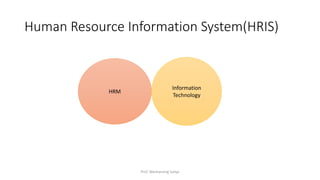
HRM
Information
Technology
Human Resource Information System(HRIS)
Prof. Wechansing Suliya
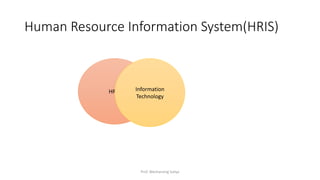
HRM Information
Technology
Human Resource Information System(HRIS)
Prof. Wechansing Suliya
HRM Information
Technology
Human Resource Information System(HRIS)
Prof. Wechansing Suliya
Human Resource
Information
System
 Definition of the Human Resource Information System (HRIS)
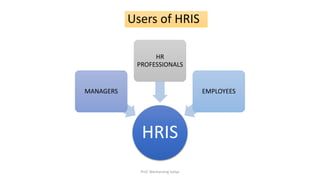
 Users of HRIS
 Modules of HR
 The HRIS System Workflows
 Available HRIS Software
 Benefits of HRIS
 Challenges Faced By Successful HRIS
What we’ll cover today
Prof. Wechansing Suliya
Starting nuggets
• What things you keep in your mind?
• Information about facts and General knowledge.
• Information about human being around you
Prof. Wechansing Suliya
History of Record Keeping
• Ancient Record Keeping
• Live todays records Keeping
• Nalanda University Record Keeping
• Printers era
Prof. Wechansing Suliya
• Acquiring, storing, manipulating, analyzing, retrieving, and
distributing applicable information regarding an organization's human
resources.
• Helps HR managers perform HR functions in a more effective and
systematic way using technology.
• Systems and processes at the intersection between HRM and IT.
• Electronic tools applications
HRIS: Definition
Prof. Wechansing Suliya
1.To make the desired information available in the right form to
the right person and at the right time.
2.To supply the desired information at a reasonable cost.
3.To use the most efficient method of processing data.
4.To provide necessary security and secrecy for important
and/or confidential information.
5.To keep the information up-to-date.
OBJECTIVES OF HRIS
Prof. Wechansing Suliya
HRIS
MANAGERS
HR
PROFESSIONALS
EMPLOYEES
Users of HRIS
Prof. Wechansing Suliya
It can be broadly classified into two processes:-
1.Data Collection
 The nature and form of data will vary from organization to organization
depending upon its objectives.
After collection of data, the irrelevant data should be filtered out and
the relevant data should be properly classified and tabulated so that it
can be used easily when needed.
FUNCTIONING OF HRIS
Prof. Wechansing Suliya
2.Data Management-It involves the following sub-system:-
• Data Management-A good data management system involves editing
the data.
• Processing Operations viz. classifying, analyzing , summarizing and
editing the data.
• Storage of data viz, indexing, coding and filing of information.
FUNCTIONING OF HRIS
Prof. Wechansing Suliya
Data collection
INPUT
Data
Management
DATA
MAINTENENCE
OUTPUT
COMPONENTS of HRIS
Prof. Wechansing Suliya
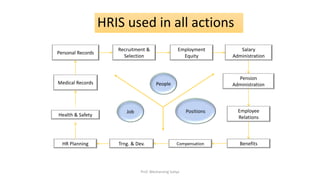
HRIS used in all actions
Personal Records
Recruitment &
Selection
Employment
Equity
Salary
Administration
Trng. & Dev. Compensation
Employee
Relations
BenefitsHR Planning
Pension
AdministrationMedical Records
Health & Safety
Job
People
Positions
Prof. Wechansing Suliya
• Recruitment
• Locate and attract applicants through advertising –resume saving
• Selection
• Getting right people for right position with the help of software allocation
• Training and Development
• Training – for current jobs-training module or video lecture
• Development – for future jobs
Using HRIS in HR Process
Prof. Wechansing Suliya
• Performance Evaluation and Management
• Evaluate employees work efficiency
• Promotions/Performance Appraisal
• Responsible for proper compensation of the deserving employees
• Employee Relations
• Build camaraderie among colleagues
Using HRIS in HR Process
Prof. Wechansing Suliya
• Record keeping of all personal data.
• Keeper of all people related data such as family members, previous company
that an employee worked with, etc.
• Compensation and Benefits
• Responsible for giving appropriate benefits and salaries to the employees in
order to maintain or increase their efficiency level
Using HRIS in HR Process
Prof. Wechansing Suliya
• Career development
• Help the employees to develop their respective career by implementing
different training and development that the employee needed
Using HRIS in HR Process
Prof. Wechansing Suliya
• Payroll Module:
• automates the pay process by gathering data on employee time and
attendance, calculating various deductions and taxes, and generating periodic
pay cheques and employee tax reports.
• Online Recruiting:
• used to garner potential candidates for available positions within an
organization.
Using HRIS in HR Modules
Prof. Wechansing Suliya
• Time and Labour Management Module:
• is designed to collate and analyze employee timekeeping information for the
purposes of organizational cost accounting.
• Training Module/Learning Management System:
• provides a system for organizations to administer and track employee
training and development efforts.
Using HRIS in HR Modules
Prof. Wechansing Suliya
• HR Management Module:
• records basic demographic data of employee - training and development,
skills, and qualifications of each employee. Advanced HR management
modules can also automate the process of application for positions by
capturing application data and entering it to a relevant database.
Using HRIS in HR Modules
Prof. Wechansing Suliya
• provides a system for organizations to administer and track employee
participation in benefits programs.
• These programs can range from programs such as health insurance
and pension schemes, stock option plans, and profit sharing.
Benefits Administration Module
Prof. Wechansing Suliya
 Abra Suite
 ABS (Atlas Business Solutions)
 CORT: HRMS
 HRSOFT
 Human Resource MicroSystems
 ORACLE- HRMS
 PEOPLESOFT
 SAP HR
 SPECTRUM HR
 VANTAGE: HRA
HRIS: Softwares
Prof. Wechansing Suliya
• Faster information process,
• Greater information accuracy,
• Improved planning and program development, and
• Enhanced employee communications (Overman,
1992).
HRIS: Benefits
Prof. Wechansing Suliya
 Lack of management commitment
 No or poorly done needs analysis
 Failure to include key people
 Failure to keep project team intact
 Politics / hidden agendas
 Failure to involve / consult significant groups
 Lack of communication
 Bad timing (time of year and duration
HRIS: Challenges
Prof. Wechansing Suliya
• http://www.smallbusinessbible.org/
• http://www.indianmba.com/
• http://en.wikipedia.org/
• http://www.human-resource-system.com/
• http://www.about.com/
HRIS: References
Prof. Wechansing Suliya

HRM 6-Human Resource Information System

  • 1.
    HRM-6 Human Resource InformationSystem(HRIS) Prof. Wechansing Suliya
  • 2.
    Human Resource InformationSystem(HRIS) Prof. Wechansing Suliya HRM Information Technology
  • 3.
    Human Resource InformationSystem(HRIS) Prof. Wechansing Suliya HRM Information Technology
  • 4.
    Human Resource InformationSystem(HRIS) Prof. Wechansing Suliya HRM Information Technology
  • 5.
    Human Resource InformationSystem(HRIS) Prof. Wechansing Suliya Human Resource Information System
  • 6.
     Definition ofthe Human Resource Information System (HRIS)  Users of HRIS  Modules of HR  The HRIS System Workflows  Available HRIS Software  Benefits of HRIS  Challenges Faced By Successful HRIS What we’ll cover today Prof. Wechansing Suliya
  • 7.
    Starting nuggets • Whatthings you keep in your mind? • Information about facts and General knowledge. • Information about human being around you Prof. Wechansing Suliya
  • 8.
    History of RecordKeeping • Ancient Record Keeping • Live todays records Keeping • Nalanda University Record Keeping • Printers era Prof. Wechansing Suliya
  • 9.
    • Acquiring, storing,manipulating, analyzing, retrieving, and distributing applicable information regarding an organization's human resources. • Helps HR managers perform HR functions in a more effective and systematic way using technology. • Systems and processes at the intersection between HRM and IT. • Electronic tools applications HRIS: Definition Prof. Wechansing Suliya
  • 10.
    1.To make thedesired information available in the right form to the right person and at the right time. 2.To supply the desired information at a reasonable cost. 3.To use the most efficient method of processing data. 4.To provide necessary security and secrecy for important and/or confidential information. 5.To keep the information up-to-date. OBJECTIVES OF HRIS Prof. Wechansing Suliya
  • 11.
  • 12.
    It can bebroadly classified into two processes:- 1.Data Collection  The nature and form of data will vary from organization to organization depending upon its objectives. After collection of data, the irrelevant data should be filtered out and the relevant data should be properly classified and tabulated so that it can be used easily when needed. FUNCTIONING OF HRIS Prof. Wechansing Suliya
  • 13.
    2.Data Management-It involvesthe following sub-system:- • Data Management-A good data management system involves editing the data. • Processing Operations viz. classifying, analyzing , summarizing and editing the data. • Storage of data viz, indexing, coding and filing of information. FUNCTIONING OF HRIS Prof. Wechansing Suliya
  • 14.
  • 15.
    HRIS used inall actions Personal Records Recruitment & Selection Employment Equity Salary Administration Trng. & Dev. Compensation Employee Relations BenefitsHR Planning Pension AdministrationMedical Records Health & Safety Job People Positions Prof. Wechansing Suliya
  • 16.
    • Recruitment • Locateand attract applicants through advertising –resume saving • Selection • Getting right people for right position with the help of software allocation • Training and Development • Training – for current jobs-training module or video lecture • Development – for future jobs Using HRIS in HR Process Prof. Wechansing Suliya
  • 17.
    • Performance Evaluationand Management • Evaluate employees work efficiency • Promotions/Performance Appraisal • Responsible for proper compensation of the deserving employees • Employee Relations • Build camaraderie among colleagues Using HRIS in HR Process Prof. Wechansing Suliya
  • 18.
    • Record keepingof all personal data. • Keeper of all people related data such as family members, previous company that an employee worked with, etc. • Compensation and Benefits • Responsible for giving appropriate benefits and salaries to the employees in order to maintain or increase their efficiency level Using HRIS in HR Process Prof. Wechansing Suliya
  • 19.
    • Career development •Help the employees to develop their respective career by implementing different training and development that the employee needed Using HRIS in HR Process Prof. Wechansing Suliya
  • 20.
    • Payroll Module: •automates the pay process by gathering data on employee time and attendance, calculating various deductions and taxes, and generating periodic pay cheques and employee tax reports. • Online Recruiting: • used to garner potential candidates for available positions within an organization. Using HRIS in HR Modules Prof. Wechansing Suliya
  • 21.
    • Time andLabour Management Module: • is designed to collate and analyze employee timekeeping information for the purposes of organizational cost accounting. • Training Module/Learning Management System: • provides a system for organizations to administer and track employee training and development efforts. Using HRIS in HR Modules Prof. Wechansing Suliya
  • 22.
    • HR ManagementModule: • records basic demographic data of employee - training and development, skills, and qualifications of each employee. Advanced HR management modules can also automate the process of application for positions by capturing application data and entering it to a relevant database. Using HRIS in HR Modules Prof. Wechansing Suliya
  • 23.
    • provides asystem for organizations to administer and track employee participation in benefits programs. • These programs can range from programs such as health insurance and pension schemes, stock option plans, and profit sharing. Benefits Administration Module Prof. Wechansing Suliya
  • 24.
     Abra Suite ABS (Atlas Business Solutions)  CORT: HRMS  HRSOFT  Human Resource MicroSystems  ORACLE- HRMS  PEOPLESOFT  SAP HR  SPECTRUM HR  VANTAGE: HRA HRIS: Softwares Prof. Wechansing Suliya
  • 25.
    • Faster informationprocess, • Greater information accuracy, • Improved planning and program development, and • Enhanced employee communications (Overman, 1992). HRIS: Benefits Prof. Wechansing Suliya
  • 26.
     Lack ofmanagement commitment  No or poorly done needs analysis  Failure to include key people  Failure to keep project team intact  Politics / hidden agendas  Failure to involve / consult significant groups  Lack of communication  Bad timing (time of year and duration HRIS: Challenges Prof. Wechansing Suliya
  • 27.
    • http://www.smallbusinessbible.org/ • http://www.indianmba.com/ •http://en.wikipedia.org/ • http://www.human-resource-system.com/ • http://www.about.com/ HRIS: References Prof. Wechansing Suliya
  • 28.