Fundamentals of Human 
Resource Management 
Eighth Edition 
DeCenzo and Robbins 
Chapter 2 
Fundamentals of HRM 
Fundamentals of Human Resource
Management Essentials 
• Management involves setting goals and 
allocating scarce resources to achieve 
them. 
• Management is the process of 
efficiently achieving the objectives of 
the organization with and through 
people. 
Fundamentals of Human Resource
Management Essentials 
• Primary Functions of Management 
– Planning – establishing goals 
– Organizing – determining what activities 
need to be done 
– Leading – assuring the right people are on 
the job and motivated 
– Controlling – monitoring activities to be 
sure goals are met 
Fundamentals of Human Resource
Why is HRM Important to an 
Organization? 
• The role of human resource managers has 
changed. HRM jobs today require a new level 
of sophistication. 
– Federal and state employment legislation has 
placed new requirements on employers. 
– Jobs have become more technical and skilled. 
– Traditional job boundaries have become blurred 
with the advent of such things as project teams 
and telecommuting. 
– Global competition has increased demands for 
productivity. 
Fundamentals of Human Resource
Why is HRM Important to an 
Organization? 
• The Strategic Nature – HRM must be 
– a strategic business partner and represent 
employees. 
– forward-thinking, support the business 
strategy, and assist the organization in 
maintaining competitive advantage. 
– concerned with the total cost of its function 
and for determining value added to the 
organization. 
Fundamentals of Human Resource
Why is HRM Important to an 
Organization? 
• HRM is the part of the organization 
concerned with the “people” dimension. 
• HRM is both a staff, or support function 
that assists line employees, and a 
function of every manager’s job. 
Fundamentals of Human Resource
Why is HRM Important to an 
Organization? 
• HRM Certification 
– Colleges and universities offer HR 
programs. 
– The Society for Human Resource 
Management and Human Resource 
Certification Institute offer professional 
certification. 
Fundamentals of Human Resource
Why is HRM Important to an 
Organization? 
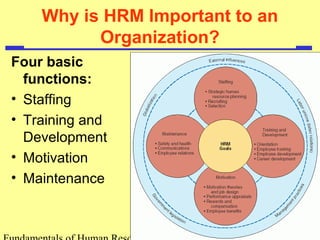
Four basic 
functions: 
• Staffing 
• Training and 
Development 
• Motivation 
• Maintenance 
Fundamentals of Human Resource
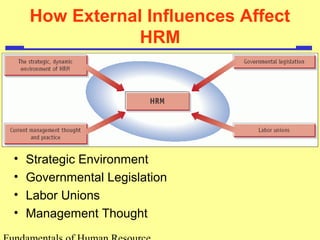
How External Influences Affect 
HRM 
• Strategic Environment 
• Governmental Legislation 
• Labor Unions 
• Management Thought 
Fundamentals of Human Resource
How External Influences Affect 
HRM 
• HRM Strategic Environment includes: 
– Globalization 
– Technology 
– Work force diversity 
– Changing skill requirements 
– Continuous improvement 
– Work process engineering 
– Decentralized work sites 
– Teams 
– Employee involvement 
– Ethics 
Fundamentals of Human Resource
Staffing Function Activities 
• Employment planning 
– ensures that staffing will contribute to the 
organization’s mission and strategy 
• Job analysis 
– determining the specific skills, knowledge 
and abilities needed to be successful in a 
particular job 
– defining the essential functions of the job 
Fundamentals of Human Resource
Staffing Function Activities 
• Recruitment 
– the process of attracting a pool of qualified 
applicants that is representative of all 
groups in the labor market 
• Selection 
– the process of assessing who will be 
successful on the job, and 
– the communication of information to assist 
job candidates in their decision to accept 
an offer 
Fundamentals of Human Resource
Goals of the Training and 
Development Function 
• Activities in HRM concerned with 
assisting employees to develop up-to-date 
skills, knowledge, and abilities 
• Orientation and socialization help 
employees to adapt 
• Four phases of training and development 
– Employee training 
– Employee development 
– Organization development 
– Career development 
Fundamentals of Human Resource
The Motivation Function 
• Activities in HRM concerned with helping 
employees exert at high energy levels. 
• Implications are: 
– Individual 
– Managerial 
– Organizational 
• Function of two factors: 
– Ability 
– Willingness 
• Respect 
Fundamentals of Human Resource
The Motivation Function 
• Managing motivation includes: 
– Job design 
– Setting performance standards 
– Establishing effective compensation and 
benefits programs 
– Understanding motivational theories 
Fundamentals of Human Resource
The Motivation Function 
• Classic Motivation Theories 
– Hierarchy of Needs –Maslow 
– Theory X – Theory Y –McGregor 
– Motivation – Hygiene – Herzberg 
– Achievement, Affiliation, and Power Motives 
– McClelland 
– Equity Theory – Adams 
– Expectancy Theory - Vroom 
Fundamentals of Human Resource
How Important is the 
Maintenance Function 
• Activities in HRM concerned with maintaining 
employees’ commitment and loyalty to the 
organization. 
– Health 
– Safety 
– Communications 
– Employee assistance programs 
• Effective communications programs provide 
for 2-way communication to ensure that 
employees are well informed and that their 
voices are heard. 
Fundamentals of Human Resource
Translating HRM Functions 
into Practice 
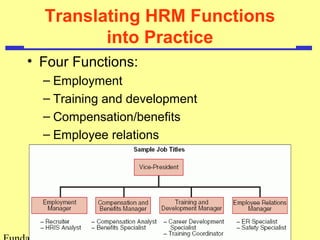
• Four Functions: 
– Employment 
– Training and development 
– Compensation/benefits 
– Employee relations 
Fundamentals of Human Resource
Translating HRM Functions 
into Practice 
• Employment - Employment specialists: 
– coordinate the staffing function 
– advertising vacancies 
– perform initial screening 
– interview 
– make job offers 
– do paperwork related to hiring 
• Training and Development – 
– help employees to maximize their potential 
– serve as internal change agents to the 
organization 
– provide counseling and career development 
Fundamentals of Human Resource
Translating HRM Functions 
into Practice 
• Compensation and Benefits – 
– establish objective and equitable pay 
systems 
– design cost-effective benefits packages 
that help attract and retain high-quality 
employees. 
– help employees to effectively utilize their 
benefits, such as by providing information 
on retirement planning. 
Fundamentals of Human Resource
Translating HRM Functions 
into Practice 
• Employee Relations – involves: 
– communications 
– fair application of policies and procedures 
– data documentation 
– coordination of activities and services that 
enhance employee commitment and 
loyalty 
– Employee relations should not be confused 
with labor relations, which refers to HRM in 
a unionized environment. 
Fundamentals of Human Resource
Translating HRM Functions 
into Practice 
• Purpose and Elements of HRM 
Communications 
– Keep employees informed of what is 
happening and knowledgeable of policies 
and procedures. 
– Convey that the organization values 
employees. 
– Build trust and openness, and reinforce 
company goals. 
Fundamentals of Human Resource
Translating HRM Functions 
into Practice 
• Effective Communication programs 
involve: 
– Top Management Commitment 
– Effective Upward Communication 
– Determining What to Communicate 
– Allowing for Feedback 
– Information Sources 
Fundamentals of Human Resource
Does HRM Really Matter? 
• Research has shown that a fully functioning 
HR department does make a difference. 
• Organizations that spend money to have 
quality HR programs perform better than 
those who don’t. 
• Practices that are part of superior HR 
services include: 
– rewarding productive work 
– creating a flexible work-friendly environment 
– properly recruiting and retaining quality workers 
– effective communications 
Fundamentals of Human Resource
HRM in an Entrepreneurial 
Enterprise 
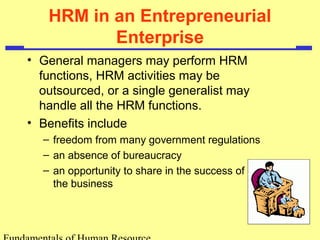
• General managers may perform HRM 
functions, HRM activities may be 
outsourced, or a single generalist may 
handle all the HRM functions. 
• Benefits include 
– freedom from many government regulations 
– an absence of bureaucracy 
– an opportunity to share in the success of 
the business 
Fundamentals of Human Resource
HRM in a Global Village 
• HRM functions are more complex when 
employees are located around the 
world. 
• Consideration must be given to such 
things as foreign language training, 
relocation and orientation processes, 
etc. 
• HRM also involves considering the 
needs of employees’ families when they 
are sent overseas. 
Fundamentals of Human Resource
HR and Corporate Ethics 
• HRM must: 
– Make sure employees know about 
corporate ethics policies 
– Train employees and supervisors on how 
to act ethically 
Fundamentals of Human Resource

Fundamentals of HRM

  • 1.
    Fundamentals of Human Resource Management Eighth Edition DeCenzo and Robbins Chapter 2 Fundamentals of HRM Fundamentals of Human Resource
  • 2.
    Management Essentials •Management involves setting goals and allocating scarce resources to achieve them. • Management is the process of efficiently achieving the objectives of the organization with and through people. Fundamentals of Human Resource
  • 3.
    Management Essentials •Primary Functions of Management – Planning – establishing goals – Organizing – determining what activities need to be done – Leading – assuring the right people are on the job and motivated – Controlling – monitoring activities to be sure goals are met Fundamentals of Human Resource
  • 4.
    Why is HRMImportant to an Organization? • The role of human resource managers has changed. HRM jobs today require a new level of sophistication. – Federal and state employment legislation has placed new requirements on employers. – Jobs have become more technical and skilled. – Traditional job boundaries have become blurred with the advent of such things as project teams and telecommuting. – Global competition has increased demands for productivity. Fundamentals of Human Resource
  • 5.
    Why is HRMImportant to an Organization? • The Strategic Nature – HRM must be – a strategic business partner and represent employees. – forward-thinking, support the business strategy, and assist the organization in maintaining competitive advantage. – concerned with the total cost of its function and for determining value added to the organization. Fundamentals of Human Resource
  • 6.
    Why is HRMImportant to an Organization? • HRM is the part of the organization concerned with the “people” dimension. • HRM is both a staff, or support function that assists line employees, and a function of every manager’s job. Fundamentals of Human Resource
  • 7.
    Why is HRMImportant to an Organization? • HRM Certification – Colleges and universities offer HR programs. – The Society for Human Resource Management and Human Resource Certification Institute offer professional certification. Fundamentals of Human Resource
  • 8.
    Why is HRMImportant to an Organization? Four basic functions: • Staffing • Training and Development • Motivation • Maintenance Fundamentals of Human Resource
  • 9.
    How External InfluencesAffect HRM • Strategic Environment • Governmental Legislation • Labor Unions • Management Thought Fundamentals of Human Resource
  • 10.
    How External InfluencesAffect HRM • HRM Strategic Environment includes: – Globalization – Technology – Work force diversity – Changing skill requirements – Continuous improvement – Work process engineering – Decentralized work sites – Teams – Employee involvement – Ethics Fundamentals of Human Resource
  • 11.
    Staffing Function Activities • Employment planning – ensures that staffing will contribute to the organization’s mission and strategy • Job analysis – determining the specific skills, knowledge and abilities needed to be successful in a particular job – defining the essential functions of the job Fundamentals of Human Resource
  • 12.
    Staffing Function Activities • Recruitment – the process of attracting a pool of qualified applicants that is representative of all groups in the labor market • Selection – the process of assessing who will be successful on the job, and – the communication of information to assist job candidates in their decision to accept an offer Fundamentals of Human Resource
  • 13.
    Goals of theTraining and Development Function • Activities in HRM concerned with assisting employees to develop up-to-date skills, knowledge, and abilities • Orientation and socialization help employees to adapt • Four phases of training and development – Employee training – Employee development – Organization development – Career development Fundamentals of Human Resource
  • 14.
    The Motivation Function • Activities in HRM concerned with helping employees exert at high energy levels. • Implications are: – Individual – Managerial – Organizational • Function of two factors: – Ability – Willingness • Respect Fundamentals of Human Resource
  • 15.
    The Motivation Function • Managing motivation includes: – Job design – Setting performance standards – Establishing effective compensation and benefits programs – Understanding motivational theories Fundamentals of Human Resource
  • 16.
    The Motivation Function • Classic Motivation Theories – Hierarchy of Needs –Maslow – Theory X – Theory Y –McGregor – Motivation – Hygiene – Herzberg – Achievement, Affiliation, and Power Motives – McClelland – Equity Theory – Adams – Expectancy Theory - Vroom Fundamentals of Human Resource
  • 17.
    How Important isthe Maintenance Function • Activities in HRM concerned with maintaining employees’ commitment and loyalty to the organization. – Health – Safety – Communications – Employee assistance programs • Effective communications programs provide for 2-way communication to ensure that employees are well informed and that their voices are heard. Fundamentals of Human Resource
  • 18.
    Translating HRM Functions into Practice • Four Functions: – Employment – Training and development – Compensation/benefits – Employee relations Fundamentals of Human Resource
  • 19.
    Translating HRM Functions into Practice • Employment - Employment specialists: – coordinate the staffing function – advertising vacancies – perform initial screening – interview – make job offers – do paperwork related to hiring • Training and Development – – help employees to maximize their potential – serve as internal change agents to the organization – provide counseling and career development Fundamentals of Human Resource
  • 20.
    Translating HRM Functions into Practice • Compensation and Benefits – – establish objective and equitable pay systems – design cost-effective benefits packages that help attract and retain high-quality employees. – help employees to effectively utilize their benefits, such as by providing information on retirement planning. Fundamentals of Human Resource
  • 21.
    Translating HRM Functions into Practice • Employee Relations – involves: – communications – fair application of policies and procedures – data documentation – coordination of activities and services that enhance employee commitment and loyalty – Employee relations should not be confused with labor relations, which refers to HRM in a unionized environment. Fundamentals of Human Resource
  • 22.
    Translating HRM Functions into Practice • Purpose and Elements of HRM Communications – Keep employees informed of what is happening and knowledgeable of policies and procedures. – Convey that the organization values employees. – Build trust and openness, and reinforce company goals. Fundamentals of Human Resource
  • 23.
    Translating HRM Functions into Practice • Effective Communication programs involve: – Top Management Commitment – Effective Upward Communication – Determining What to Communicate – Allowing for Feedback – Information Sources Fundamentals of Human Resource
  • 24.
    Does HRM ReallyMatter? • Research has shown that a fully functioning HR department does make a difference. • Organizations that spend money to have quality HR programs perform better than those who don’t. • Practices that are part of superior HR services include: – rewarding productive work – creating a flexible work-friendly environment – properly recruiting and retaining quality workers – effective communications Fundamentals of Human Resource
  • 25.
    HRM in anEntrepreneurial Enterprise • General managers may perform HRM functions, HRM activities may be outsourced, or a single generalist may handle all the HRM functions. • Benefits include – freedom from many government regulations – an absence of bureaucracy – an opportunity to share in the success of the business Fundamentals of Human Resource
  • 26.
    HRM in aGlobal Village • HRM functions are more complex when employees are located around the world. • Consideration must be given to such things as foreign language training, relocation and orientation processes, etc. • HRM also involves considering the needs of employees’ families when they are sent overseas. Fundamentals of Human Resource
  • 27.
    HR and CorporateEthics • HRM must: – Make sure employees know about corporate ethics policies – Train employees and supervisors on how to act ethically Fundamentals of Human Resource