Employees
Socialisation
BY : AARTI
Socialization:
Socialization is the process by which a person learn the values,
norms and required behaviors which permit that individual to
participate as a member of organization.
Or we can say that “ socialization is the process of adjusting of
the new member to the organization”
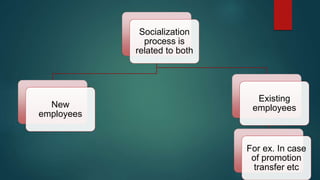
Socialization
process is
related to both
New
employees
Existing
employees
For ex. In case
of promotion
transfer etc
Benefits of socialization :
Successful socialization is beneficial not only to individual but also to the organisation
Individual may be benefitted:
1)By increased satisfaction
2) by increased performance
3) commitment toward the organisation
Organisation may be benefitted:
1) by reduction in startup cost of each employees
2) by reduction in the cost of employees turnover
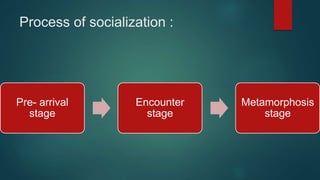
Process of socialization :
Pre- arrival
stage
Encounter
stage
Metamorphosis
stage
Pre arrival stage:
 In this stage all new recruits arrives the organisation with a set of
values, attitudes, expectations and learning.
 In other words, pre-arrival refers to all the learning that occurs
before a new member joins the organization
 For Example:
1) when a person is joining a job he/she might go and ask people
in order to obtain information about the organization.
2)An MBA graduate knows from the Professors what business is
like .
3)Employees also comes to know about the organisation and the
job during the selection process.
Encounter stage:
 Encounter Stage is the part of the stages of socialization where a
person joins or enters an organization.
Individuals discover how well their expectations match realities
within the organization. At this stage employee join or enter in the
organization and by entering they might have some:
Shocks
Expectation
Reality
In this process of adjustment,
the individual tries to replace his/her own values and norms with
those of the organisation.
If the member simply cannot reconcile to those values and norms of
the organisation then he/she quits the job.
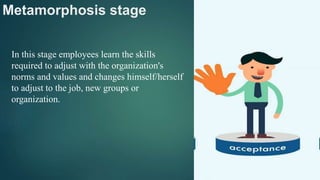
Metamorphosis stage
In this stage employees learn the skills
required to adjust with the organization's
norms and values and changes himself/herself
to adjust to the job, new groups or
organization.
Approaches to socialization:
1) Realistic job preview
2) Employee orientation or
induction program
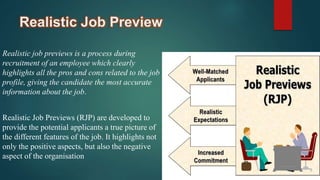
Realistic Job Preview
Realistic job previews is a process during
recruitment of an employee which clearly
highlights all the pros and cons related to the job
profile, giving the candidate the most accurate
information about the job.
Realistic Job Previews (RJP) are developed to
provide the potential applicants a true picture of
the different features of the job. It highlights not
only the positive aspects, but also the negative
aspect of the organisation
RJP Model consist 4 interrelated
mechanism
 Vaccination against unrealistic high expectation
 Self selection
 Coping effect
 Personal commitment
When to use RJP:
 When candidate can be selective about offers ( specially during the
time of low unemployment)
 When selection ratio is low ( the organization may have more job applications
then position vacant)
 When recruits are unlikely to have enough information available to them to
develop realistic expectation ( such as with entry level, complex or unique job)
 When replacement cost are very high
Induction:
“Induction is the process of receiving and
welcoming employees when they first join a
company and giving them the basic
information they need to settle down quickly
and happily and start work.”
Objective of induction:
 To smooth the preliminary stages when everything is likely to be strange
and unfamiliar to the starter
 To established a positive attitude toward the company in the mind of new
employee
 To obtain more effective output
 To reduce the employee absenteeism
Process of induction
Pre-employment phases
Primary stage
Main induction
Review of induction process
1)Pre-employment phases:
This stage refers to the period during which the new staff member has
accepted an appointment but has yet to commence. It presents an ideal
opportunity to create a positive early impression on the new staff
member
In this organization provide publication audio-visual and reference material to new recruit
1. Reference material: it include organisational chart, telephone list, terms and condition etc
2. Working document include programme learning tests, employees development manual, etc.
3. Arrangement can also be made for new employee to visit the new work place.
2)Primary stage:
 This phase start after the employee join the organization ,
induction training at this phase has two objective:
1. To orient new starter
2. To protect new starter
1) To orient new starter include provide information regarding
Surrounding: building or factory layout
Health and safety: first aid facilities, emergency procedure
Time keeping: break, working hour, and work pattern
Comfort: toilet, rest , and canteen area
2) To protect new starter in the work environment information should be provided:
Code of conduct: relationship expected between employee and client of the org.
Contract or agreement : which define relationship between employee and employer
The responsibilities of new employee to themselves and other employees in term of
health and safety.
3)Main induction:
This phase include:
 Induction into the organization: this include introduce the new employee about
the aim, objective, rules, regulation and culture of the organization.
 Induction into the job : this step ensure that the employee have the information
and particular skill to perform the new job effectively. It means they have clear
definition of their goal and standard expected.
4) Review of induction process:
After the first 3 phase it is essential for the employer to review and evaluate the
process.
 Primary Evaluation - The reaction, learning and behaviour of the inductee
and how well these match up to the objectives of the induction.
 Secondary Evaluation - The effects of the induction on the organisation in
terms of staff retention, attendance, flexibility, equal opportunities, health and
safety and customer care.
Induction programmes, as with any training, should be modified according to the
results of the evaluation.
References:
 Werner Jon M. , DeSimone Randy L. , Human Resource Development , sixth edition,
 Krishnaveni R., Human Resource Development, excel book
Employee socialisation

Employee socialisation

  • 1.
  • 2.
    Socialization: Socialization is theprocess by which a person learn the values, norms and required behaviors which permit that individual to participate as a member of organization. Or we can say that “ socialization is the process of adjusting of the new member to the organization”
  • 3.
    Socialization process is related toboth New employees Existing employees For ex. In case of promotion transfer etc
  • 4.
    Benefits of socialization: Successful socialization is beneficial not only to individual but also to the organisation Individual may be benefitted: 1)By increased satisfaction 2) by increased performance 3) commitment toward the organisation Organisation may be benefitted: 1) by reduction in startup cost of each employees 2) by reduction in the cost of employees turnover
  • 5.
    Process of socialization: Pre- arrival stage Encounter stage Metamorphosis stage
  • 6.
    Pre arrival stage: In this stage all new recruits arrives the organisation with a set of values, attitudes, expectations and learning.  In other words, pre-arrival refers to all the learning that occurs before a new member joins the organization  For Example: 1) when a person is joining a job he/she might go and ask people in order to obtain information about the organization. 2)An MBA graduate knows from the Professors what business is like . 3)Employees also comes to know about the organisation and the job during the selection process.
  • 7.
    Encounter stage:  EncounterStage is the part of the stages of socialization where a person joins or enters an organization. Individuals discover how well their expectations match realities within the organization. At this stage employee join or enter in the organization and by entering they might have some: Shocks Expectation Reality In this process of adjustment, the individual tries to replace his/her own values and norms with those of the organisation. If the member simply cannot reconcile to those values and norms of the organisation then he/she quits the job.
  • 8.
    Metamorphosis stage In thisstage employees learn the skills required to adjust with the organization's norms and values and changes himself/herself to adjust to the job, new groups or organization.
  • 10.
    Approaches to socialization: 1)Realistic job preview 2) Employee orientation or induction program
  • 11.
    Realistic Job Preview Realisticjob previews is a process during recruitment of an employee which clearly highlights all the pros and cons related to the job profile, giving the candidate the most accurate information about the job. Realistic Job Previews (RJP) are developed to provide the potential applicants a true picture of the different features of the job. It highlights not only the positive aspects, but also the negative aspect of the organisation
  • 12.
    RJP Model consist4 interrelated mechanism  Vaccination against unrealistic high expectation  Self selection  Coping effect  Personal commitment
  • 13.
    When to useRJP:  When candidate can be selective about offers ( specially during the time of low unemployment)  When selection ratio is low ( the organization may have more job applications then position vacant)  When recruits are unlikely to have enough information available to them to develop realistic expectation ( such as with entry level, complex or unique job)  When replacement cost are very high
  • 14.
    Induction: “Induction is theprocess of receiving and welcoming employees when they first join a company and giving them the basic information they need to settle down quickly and happily and start work.”
  • 15.
    Objective of induction: To smooth the preliminary stages when everything is likely to be strange and unfamiliar to the starter  To established a positive attitude toward the company in the mind of new employee  To obtain more effective output  To reduce the employee absenteeism
  • 16.
    Process of induction Pre-employmentphases Primary stage Main induction Review of induction process
  • 17.
    1)Pre-employment phases: This stagerefers to the period during which the new staff member has accepted an appointment but has yet to commence. It presents an ideal opportunity to create a positive early impression on the new staff member In this organization provide publication audio-visual and reference material to new recruit 1. Reference material: it include organisational chart, telephone list, terms and condition etc 2. Working document include programme learning tests, employees development manual, etc. 3. Arrangement can also be made for new employee to visit the new work place.
  • 18.
    2)Primary stage:  Thisphase start after the employee join the organization , induction training at this phase has two objective: 1. To orient new starter 2. To protect new starter
  • 19.
    1) To orientnew starter include provide information regarding Surrounding: building or factory layout Health and safety: first aid facilities, emergency procedure Time keeping: break, working hour, and work pattern Comfort: toilet, rest , and canteen area 2) To protect new starter in the work environment information should be provided: Code of conduct: relationship expected between employee and client of the org. Contract or agreement : which define relationship between employee and employer The responsibilities of new employee to themselves and other employees in term of health and safety.
  • 20.
    3)Main induction: This phaseinclude:  Induction into the organization: this include introduce the new employee about the aim, objective, rules, regulation and culture of the organization.  Induction into the job : this step ensure that the employee have the information and particular skill to perform the new job effectively. It means they have clear definition of their goal and standard expected.
  • 21.
    4) Review ofinduction process: After the first 3 phase it is essential for the employer to review and evaluate the process.  Primary Evaluation - The reaction, learning and behaviour of the inductee and how well these match up to the objectives of the induction.  Secondary Evaluation - The effects of the induction on the organisation in terms of staff retention, attendance, flexibility, equal opportunities, health and safety and customer care. Induction programmes, as with any training, should be modified according to the results of the evaluation.
  • 22.
    References:  Werner JonM. , DeSimone Randy L. , Human Resource Development , sixth edition,  Krishnaveni R., Human Resource Development, excel book