Risk Response Planning
Risk Management Process
Risk
Management
Planning
Risk
Identification
Qualitative
Risk
Analysis
Quantitative
Risk
Analysis
Risk
Response
Planning
Risk
Monitoring
and
Control
Risk Management Process
• Risk Response Planning
– Process of developing options, and determining
actions to reduce threats to the projects’ objectives.
– Conducted based on results of risk analysis
– Assigns risks to “risk owners”
– Applies resources and inserts activities into Risk
Management Plan.
Criteria for risk response
• Risk response must be:
– Proportional to the severity of the risk.
– Cost effective.
– Timely.
– Realistic.
– Accepted by all parties involved.
– Owned by a person or a party.
Risk response planning
Input
1. Risk
Management
Plan
2. Risk Register
Tools and Techniques
1. Strategies for
negative risk
(Threats)
2. Strategies for
positive risk
(Opportunities)
3. Contingent
strategy
Output
1. Risk Register (Update)
2. Project Management
Plan (Update)
3. Risk related
contractual
agreements
Inputs to Risk Response Planning
• Risk management plan.
– Major elements from the plan needed include roles
& responsibilities, budgets and schedule for risk
management activities, risk categories, definitions of
probability & impact, and the stakeholders’
tolerances.
Inputs to Risk Response Planning
• Risk Register-Reference will be made to:
1. List of prioritized risks. (from qualitative and
quantitative risk analysis).
2. Probabilistic analysis of the project. (from quantitative
risk analysis).
3. Probability of achieving the cost and time objectives.
4. List of potential responses. In the risk identification
process, actions may be identified that respond to
individual risks or categories of risks.
Inputs to Risk Response Planning
• 5. Risk thresholds. The level of risk that is acceptable to the
organization will influence risk response planning.
• 6. Risk owners. A list of project stakeholders able to act as
owners of risk responses. Risk owners should be involved in
developing the risk responses.
• 7. Common risk causes. Several risks may be driven by a
common cause. This situation may reveal opportunities to
mitigate two or more project risks with one generic
response.
• 8. Trends in qualitative and quantitative risk analysis
results. Trends in results can make risk response or further
analysis more or less urgent and important.
• 9. Watch list of low priority risks.
Managing Risk
• Fixed and variable cost
• Pricing strategy
• Sequential investment
• Improving information
• Financial leverage
• Insurance
• Long-term arrangements
• Strategic alliance
• Derivatives
Tools & Techniques for Response
Planning
• Strategies for negative risks (Threats)
• Strategies for positive risks (Opportunities)
• All strategies do not apply in infrastructure/Real Estate and
construction Management. These are generic strategies and
applicable to all the fields.
Strategies for negative risks (Threats)
• Risk Response Planning
– Results of risk analysis will determine the
appropriate risk response strategy.
• Avoid
• Transfer
• Mitigate
• Acceptance
Risk Response Planning
• Risk Avoidance
– Eliminates the sources of any unacceptable risks.
– which naturally involves changing the project management
plan (design, requirement, specification, practices) that
reduces the risk to an acceptable level.
• Risk avoidance is done by
– changing the project plan to eliminate the risk or the
condition that causes the risk in order to protect the
project objectives from its impact.
– Relaxing the relevant objective (extend the schedule,
reduce specification requirements, reduce scope)
– Not all risks can be avoided, but some may.
Examples of Risk Avoidance
• Add resources or time.
• Adopt a familiar approach instead of an innovative one.
• Avoid an unfamiliar subcontractor.
• Clarify requirements.
• Improve communication
• Obtain information
• Acquire expertise.
• Reduce scope to avoid high-risk activities
Risk Response Planning
• Risk Transfer
– Shifts the risk impact to another party.
– Typically involves the use of various instruments such as
insurance, performance bonds, and through the use of
specific contract types.
– A performance bond, also known as a contract bond, is
a surety bond issued by an insurance company or a
bank to guarantee satisfactory completion of a project
by a contractor.
15
Risk Response Planning
 Transfer: Risk reduction can be achieved by transfer. The
transfer can be of three types.
 In the first type, the risk can be transferred by
transferring the asset/liability itself.
 For instance, the risk emanating by holding a property
or a foreign currency security can be eliminated by
transferring the same to another.
 Subcontract
16
Risk Response Planning
 The second type of transfer involves transferring the
risk without transferring the asset/liability. The
exchange risk involved in holding a foreign currency
asset/liability can be transferred to another by
entering into a forward contract/currency swap.
Similarly, the interest rate risk can be transferred by
entering into an interest rate swap.
 The third type of transfer involves making a third
party pay for the losses without actually transferring
the risk. An insurance policy covering the third party
risk is an example.
Risk Response Planning
• Risk Mitigation
– Attempts to mitigate the risk by reducing the
probability and/or impact of the risk event.
– Activities include:
• Alternative design
• Demonstrations
• Prototypes
• Modeling and simulation
Examples of Risk mitigation
• Implementing a new course of action that will reduce the
problem, e.g. adopting less complex processes, conducting
more engineering tests, or choosing a more stable supplier.
• Changing conditions so that the probability of the risk
occurring is reduced, e.g. adding resources or time to the
schedule.
• Where it is not possible to reduce probability, a mitigation
response might address the risk impact by targeting
linkages that determine the impact severity.
Risk Response Planning
• Risk Acceptance
– A conscious decision to actively acknowledge and
accept the risk without planning to mitigate it.
– Strategy includes ensuring adequate resources
(personnel, cost, schedule) exist to address the risk
in the event it occurs.
Risk Response Planning
• There are two types of acceptance:
• Active acceptance: may include developing a
contingency plan to execute should a risk
occurs. (Not Mitigation as we are doing
nothing to reduce the probability or impact of
risk event rather we are hoping the event does
not happen. And if it happens we try to control
the damage)
• Passive acceptance: requires no action. The
project team will deal with the risk as it occurs.
Risk Response Planning
• A contingency plan is developed in advance to respond
to risks that arise during the project. Planning would
reduce the cost of an action should the risk occur.
• The most usual risk acceptance response is to establish
a contingency allowance, or reserve, including amounts
of time, money or resources to account for known risks.
2. Strategies for positive risks
(Opportunities)
Usually Not applicable in Infra/Real
Estate or construction
• Strategies for positive risks are:
– 1.Exploit
– 2.Share
– 3.enhance
Risk Response Planning
• 1. Exploit the opportunity-
• Ensure that the risk event happens by eliminating the
uncertainty to take advantage of the opportunity.
Examples: assign qualified personnel to take advantage,
Add work or change the project to make sure the
opportunity occurs
• A project could be adjusted to take advantage of a
change in technology or a new market.
Risk Response Planning
• 2. Share the risk - Allocate ownership to a third party who
has a better chance of achieving the required results.
Examples: joint ventures, partnerships. An opportunity is
shared with a partner or supplier to maximise the benefits
through use of shared resource/technology etc.
• 3. Enhance- Increase the likelihood of occurrence or the
impact of the of the event
– Improve chances for the event to happen so the
opportunity becomes more certain
– Consider how the impact can be increased and choose a
course of action that in the increased impact
Exploit Vs. Enhance
• In the enhance risk response strategy, the opportunity may or may not be
realized.
• Here, you take measures to increase the chance of the event happening,
but there will be no assurance of realizing this opportunity.
• Suppose you’re constructing a school building, and suddenly the client
tells you that if you complete the job two months earlier than planned, he
will give a monetary reward.
• Therefore, you take several measures to realize the opportunity. You
utilize fast-tracking and crashing.
• As you can see in the above example, you’re only trying to complete the
project early to gain the opportunity; i.e. you are only increasing the
probability of completing the project early; there is no guarantee you will
realize the opportunity.
• This is an example of the enhance risk response strategy.
Exploit Vs. Enhance
• Exploiting is about doing everything to make sure the event happens. In this risk
response strategy, you make sure the opportunity is realized. Here, you take the
opportunity very seriously and develop a strategy to realize it.
• Simply put, in exploit risk response strategy, you increase the chance of the event
happening to 100%.
• Suppose you are constructing a building, and suddenly the client tells you that if you
complete the project two months before the actual completion date, he will give
you some extra money.
• This is an opportunity for you and you must realize it. Therefore, you do everything
to complete the project ahead of time. You give overtime to your team members,
bring some more manpower, motivate team members by announcing rewards if
they help you complete the project ahead of time, etc.
• In the exploit risk response strategy, you are doing everything to make sure the
opportunity is realized. You do not merely try to get this opportunity; you ensure
that you get it.
All Types
Risk Response Description/example Suitable for…. risk types (these are
suggestions and not exhaustive)
Avoid The risk is avoided by changing the
project in someway to bypass the
risk.
Some political risks e.g. adverse
public opinion. maintenance
problems.
Transfer Some or all of the risk is
transferred to a third party for
example insurance.
Some strategic/commercial risks e.g.
theft, insolvency can be insured
against.
Mitigate Action is taken to reduce either
the likelihood of the risk occurring
or the impact that it will have.
The most frequently used response to
risk.
Accept The risk may be accepted perhaps
because there is a low impact or
likelihood. A contingency plan will
be identified should it occur.
Some political, legal and regulatory,
and economic/financial risks may
need to be accepted with a
contingency plan in place e.g. war and
disorder, exchange rate fluctuation.
All Types
Risk Response Description/example Suitable for…. risk types (these are
suggestions and not exhaustive)
Share An opportunity is shared with a
partner or supplier to maximise
the benefits through use of shared
resource/technology etc.
Technical/operational/infrastructure
e.g. new technology, improved
designs.
Exploit A project could be adjusted to take
advantage of a change in
technology or a new market.
Economic/financial/market e.g. new
and emerging markets, positive
changes in exchange rates or interest
rates.
Enhance Action is taken to increase the
likelihood of the opportunity
occurring or the positive impact it
could have.
Risk Statement Risk Response
Design
Inaccuracies or incomplete
information in the survey file
could lead to rework of the
design.
Mitigate: Work with Surveys to verify that
the survey file is accurate and complete.
Perform additional surveys as needed.
Environmental
Potential lawsuits may
challenge the environmental
report, delaying the start of
construction or threatening loss
of funding.
Mitigate: Address concerns of stakeholders
and public during environmental process.
Schedule additional public outreach.
Nesting birds, protected from
harassment under the Migratory
Bird Treaty Act, may delay
construction during the nesting
season.
Mitigate: Schedule contract work to avoid
the nesting season or remove nesting
habitat before starting work.
Examples in Construction
Risk Statement Risk Response
Construction
Hazardous materials encountered during
construction will require an on‐site storage
area and potential additional costs to dispose.
Accept: Ensure storage space will
be available.
Unanticipated buried man‐made objects
uncovered during construction require
removal and disposal resulting in additional
costs.
Accept: Include a Supplemental
Work item to cover this risk.
Class Exercise on Risk Response
Planning
Outputs from Risk Response
Planning
• Risk Response Planning Update
– Results of risk response planning includes documenting the
selected risk response strategy to the Risk Management Plan
and related documents.
– Ensuring resources are acquired for implementing the
selected risk response strategy for each identified risk.
• Risk Register Updates
– The risk register is updated to reflect the results of the
response planning process.
• Contractual agreements.
– Contractual agreements are prepared to specify each party’s
responsibility for specific risks, should they occur. This
include agreements for insurance, services, and other items
as appropriate in order to avoid or mitigate threats.
Risk Register Content-Update
• Update the following
– Identified risks, their description, the area of the project
affected, their causes and how they may affect project
objectives.
– Risk owners and assigned responsibilities.
– Results from the qualitative and quantitative risk
analysis processes.
– Agreed response strategies
– Specific actions to implement the response plan.
– Budget and schedule activities for responses.
Risk Register Content-Update
– Symptoms and warning signs for risks’ occurrence
– Contingency plans with triggers
– Contingency reserves.
– Fallback plan for when risk occurs and original response
is inadequate
– Residual risks expected to be remaining after the
strategy is implemented and accepted risks
– Secondary risks arising directly from implementing a
risk response
Project Risk Monitoring and Control
• Project risk monitoring and control is an exercise, where
you need to keep a track of “how your risk responses are
performing/have performed against the plan”.
• It is also a process where new risks to the projects are
managed. You must remember that risks can have
“negative and positive impacts”; however, we like
positive risk and take it for its potential benefit.
• On the other hand, we reject and dislike the negative risk
as “it could negatively influence the cost of the project or
its schedule”.
Project Risk Monitoring and Control
• The main goals to risk monitoring and control is to
ensure that “risk responses have been implemented as it
was planned and to determine if the risk responses have
been effective or some alternative responses are
required”.
• The process also determines the validity of the project
assumptions examines if the risk exposure has changed,
evolved, or declined.
Project Risk Monitoring and Control
• The inputs to the project risk monitoring and control is
the steps that have been performed before, i.e.,
development of risk management plan, qualitative and
quantitative risk assessment, determination of risk
threshold and risk tolerance levels and the risk response
plan.
• The outputs of risk monitoring and control are revised
plans, the actions taken, the change requests that have
been initiated, the updated risk response plan and the
checklist updates.
Project Risk Monitoring and Control
• The American Associate of Cost Engineers (AACE’s)
Technical Board has recommended the Total cost
management (TCM) framework for effective application
of professional and technical expertise to plan and
control resources, costs, profitability and risk.
• David T. Hulett and Michael R. Nosbisch (2012) in their
book titled Integrated Cost-Schedule Risk Analysis and
Cost Engineering define “TCM as a systematic approach
to managing cost throughout the life cycle of any
enterprise, project, facility, project, product, or service.
Project Risk Monitoring and Control
• This is accomplished through the application of cost
engineering and cost management principles, proven
methodologies and the latest technology in support of the
management process”.
• AACE’s TCM framework also define project risk monitoring
and control as a “process for controlling the investment of
resources in an asset”.
Project Risk Monitoring and Control
• The American Associate of Cost Engineers have come up
with recommended practice (RP) to quantify risk. This
RP-No. 57R-09: “Integrated Cost and Schedule Risk
Analysis Using Monte Carlo Simulation of a CPM Model”
suggest the “integration of cost estimates with the
project schedule by resource-loading and costing the
schedule’s activities”. A major contribution of this AACE
RP 57R-09 is that it includes the impact of risk event on
project cost. Hence, it can help us arrive at contingencies.
Project Risk Monitoring and Control
• In the integration process of cost estimates and project
schedule, the probabilities and the impact of risk events
are specified and linked to the activities. Therefore, it’s a
complex process to begin with, but it can ripe huge
rewards, if implemented properly.
• These integrated systems can be developed using
Primavera or MSP. Further, these software’s use the
advanced computational models like Monte Carlo
simulations to estimate the impacts of schedule risk on
cost risk to be calculated”.
Study of Risk management from
Lender/Financier Point of view in
Projects
AND Financial Risk Management
Identifying and managing project
finance risks
• Project finance is a form of secured lending
• Lenders extend credit, to a newly-formed or
existing project company whose core assets at
the time of financing is nothing but a
collection of contracts, licenses and ambitious
plans; hence it is important to have prudent
risk analysis and allocation.
Identifying and managing project
finance risks
• Therefore, the key objectives of the various
commercial parties and their advisers when
negotiating a project finance transaction
include:
– Identifying each material risk associated with the
design, construction, development and operation
of the project.
– Determining which participant is best able to bear
each such risk and the mechanic for it to do so.
Identifying and managing project
finance risks
• Failing to identify a major risk or requiring the wrong party to
assume or control a particular risk can result in:
– Delays in the project’s construction and operation
schedule.
– The need to revise transaction documents at additional
cost to the parties.
– The project company being unable to repay the lenders.
i.e. loss to the financier.
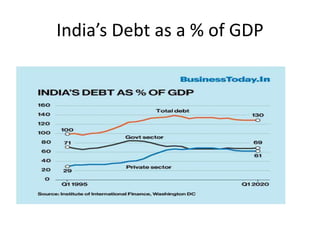
India’s Debt as a % of GDP
Debt Financing by Non-Financial
Firms in India
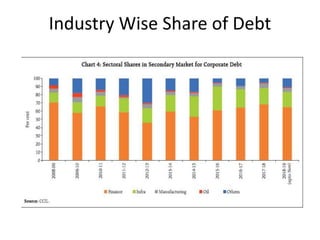
Industry Wise Share of Debt
NPA
• Total bank credit amounted to Rs 100.4 lakh crore, up 6.3 per cent
(year-on-year), according to the latest figures released by the Reserve
Bank of India.
• Non Performing Assets (NPAs) of Public Sector Banks (PSBs) stood
at ₹7.27 lakh crore as on September 30, 2019.
• Scheduled commercial banks and select financial institutions have
reported frauds to the tune of ₹1,13,374 crore in the first half of the
current financial year 2019.
• Gross NPAs of PSBs, as per RBI data on global operations, rose
from ₹2,79,016 crore as on March 31, 2015, to ₹6,84,732 crore as on
March 31, 2017 and ₹8,95,601 crore as on March 31, 2018.
• Government's strategy of recognition, resolution, recapitalisation and
reforms, have helped it decline by ₹1,68,305 crore to ₹7,27,296 crore
as on September 30, 2019.
• But Covid will now deteriorate the situation.
Key Data
• 30,42,230 crore is our Budget expenditure
proposed
• 24.23 lakh crore is expected revenue from
direct and indirect taxes
• Deficit Target of 3.3% of GDP, as on March
2020, appx. 200 Lakh crore. So 3.3% is 7 lakh
crore
• MCAP is appx. 160 lakh crore
Factors determine project risk
• Nature of the project
– Though project financing techniques are used in a number
of core sectors, including energy, infrastructure, oil and gas
and mining, the technical details of projects differ hugely
even within a sector.
Factors determine project risk
• Nature of the project
– For example, contrast the different technologies used by,
and regulation applicable to, nuclear and wind power
projects, or hospitals and transportation projects.
However, there are also significant areas of commonality
within and across sectors; most projects require
governmental approvals or licenses, rights to use a variety
of other assets, ranging from real property (particularly in
the extraction industries) to intellectual property, with the
complexity of a project from a technical perspective being
a key risk consideration.
Factors determine project risk
• Location of the project
– A project located in a
– less economically developed country, perhaps one with unreliable infrastructure
(including inadequate utilities, transportation options and social factors),
– an untested legal regime (raising questions over, amongst other things, the
enforceability of law) or
– an unstable political climate (potentially undermining the reliability of core host
government agreements and relationships, including the concession agreement,
other consents and taxation arrangements (Retrospective modification made
by Indian Government in Vodafone case), or Closure of plants in Bihar
(Locomotive plant Alstom and GE)
– a combination of all of these, will likely pose greater risks than a project located
in a more economically developed country.
Typical Project Financing Risk
• Construction risk
– In a project financing, the primary, and typically sole,
source of income for the repayment of the debt provided
by the lenders is the revenue generated by the project.
– The result is that, until the project is constructed and, at
least partly, operational, the project company will likely
not be able to repay the lenders. Ensuring the proper and
timely construction of the project is therefore an
absolutely fundamental consideration for all of the parties.
Typical Project Financing Risk
• Operational risk
– Once the project is constructed it must be
operated and maintained in such a manner that
the project company can comply with its
obligations under the other project documents.
Typical Project Financing Risk
• Supply risk
– Many projects rely on raw materials or commodities
for the project to work. For example, a coal or natural
gas fired power plant requires access and rights to an
uninterrupted supply of coal or natural gas. The prices
of these commodities can be volatile and their
availability for the life of the project is not assured.
The project participants can mitigate these risks by:
• Executing a long term supply agreement.
• Selecting a qualified supplier
Typical Project Financing Risk
• Off-take risk
– An important consideration for the parties is whether the
project will generate the expected revenues or, at least,
sufficient revenues to service the debt and pay the project
company’s expenses (and, preferably, to generate a return
for the project sponsor). In addition, the parties must
consider how any revenue shortfalls will be addressed. To
ensure the project generates the level of revenues that the
project participants forecasted for the success of the
project, financier may Enter into hedge agreements.
• (These agreements may allow the project company to receive
payment from a third party if certain conditions apply)
Typical Project Financing Risk
• Repayment risk
– The lenders will want to minimise the risk of nonpayment
by the project company generally. This can occur if the
project company generates insufficient revenues (whether
due to offtake risk or other cause), has obligations to third
parties that take precedence over the payments to the
lenders or is otherwise prevented from making the
necessary payments to the lenders (First Service right). To
help ensure that the lenders receive the payments to which
they are entitled when and in the amounts due, the parties
can use insurance cover or other hedge tools.
Typical Project Financing Risk
• Political risk
– Some of the main risks a project located in a less
economically developed country faces are political
risks (also known as country risks), which includes
war or civil disturbance, exchange controls or
other types of currency transfer limitations.
Typical Project Financing Risk
• Authorizations risk
– Certain projects depend on the obtaining and the continued
availability of governmental approvals, permits or licenses to
construct or operate the project. These include:
• Environmental permits.
• Drilling permits.
• In the case of a foreign investor, permits to own property, employ
emigrant labour or operate the project.
• Approvals to import goods into the country or to transfer funds out of
the country.
• In some cases, it may take months or years before a permit
is issued or renewed.
Typical Project Financing Risk
• Dispute resolution risk
– In international project finance transactions, the
parties must determine the law that should
govern their transactions (to the extent they have
a choice) and whether any disputes that arise
under the documents will be resolved through
arbitration or judicial means.
Typical Project Financing Risk
• Social Risk
– Infrastructure projects generally have an important
impact on local communities and quality of life, in
particularly delivery of essential services like water
and electricity or land intensive projects like toll roads.
– Project impact of society, consumers and civil society
generally, can result in resistance from local interest
groups that can delay project implementation,
increase the cost of implementation and undermine
project viability.
Typical Project Financing Risk
• Interest Rate Risk
• Interest may be charged at a fixed rate, or a floating rate.
• Project finance debt tends to be fixed rate. This helps provide a
foreseeable, or at least somewhat stable, repayment profile over
time to reduce fluctuations in the cost of infrastructure services.
• If lenders are unable to provide fixed rate debt and no project
participant is willing to bear the risk, hedging or some other
arrangements may need to be implemented to manage the risk that
interest rates increase to a point that debt service becomes
unaffordable to the project.
• The tension between local and foreign currency debt is often a
question of balancing fixed rate debt with foreign exchange rate risk
or local currency debt subject to interest rate risk.
Typical Project Financing Risk
• Currency risk
– If the project output agreement (for example, the power
purchase agreement or the gas transportation agreement)
is in a currency different from the loan, the project
participants must also consider currency devaluations and
currency inconvertibility. The primary risks are:
• Interference in the ability to convert the local currency into foreign
currency (generally US dollars).
• Transference of the foreign currency out of the country.
• The way parties can mitigate this risk is Currency
Derivatives.
Financial Risk Management Through
Derivatives
• Financial derivative: a financial instrument/contract
whose value is a function of another (“underlying”)
financial instrument or asset such as currency,
commodity, stocks, interest rates and indexes.
• Financial engineering: the creation and use of
financial derivatives to aid in the management of risk.
PURPOSES OF DERIVATIVES
• Speculative
– Highly risky
– Highly leveraged
– Very volatile
• Hedging
– Combine with other securities
– Hedge (minimize) risk
• Arbitrage
HEDGING
• “Hedge”: Take a position that offsets a risk
• By hedging, one changes the risk inherent in
owning the underlying asset
Types
 Based on Nature of Contract
 Forwards and Futures
 Options
 Swaps
 Based on Underlying Asset
 Currency
 Interest rate
 Commodities
 Stock
 Index
 Based on Market Mechanism
 OTC
 Exchange traded
Types
Forward Future Option Swap
Currency Currency Currency Currency
Interest Rate Interest Rate Interest Rate Interest Rate
Commodities Commodities Commodities Commodities
Stocks Stocks Stocks Stocks
Indexes Indexes Indexes Indexes
Market Type OTC Exchange
Traded
Exchange
Trade
OTC
Introduction to Forward Contract
• A forward contract is an agreement to buy or
sell an asset on a specified date for a
specified price.
• One of the parties to the contract assumes a
long position and agrees to buy the underlying
asset on a certain specified future date for a
certain specified price.
Introduction to Forward Contract
• The other party assumes a short position and
agrees to sell the asset on the same date for
the same price.
• Other contract details like delivery date, price
and quantity are negotiated bilaterally by the
parties to the contract. The forward contracts
are normally traded outside the exchanges.
EXAMPLE-Forward
• Contract can be settled in two ways-
– Delivery of oil and make full payment. (Generally
used by hedger)
– Settle the contract by only seeking price
difference. (used by Speculator)
– The buyer of the contract has to pay a price for
this contract. It does not come for free.
– Who can be the counter party?
Salient features of forward contracts
• They are bilateral contracts and hence
exposed to counter–party risk. Each contract
is custom designed, and hence is unique in
terms of contract size, expiration date and
the asset type and quality.
• The contract price is generally not available in
public domain.
Salient features of forward contracts
• On the expiration date, the contract has to be
settled by delivery of the asset.
• If the party wishes to reverse the contract, it
has to compulsorily go to the same counter
party, which often results in high prices being
charged.
Limitations of forward markets
• Lack of centralization of trading,
• liquidity, and
• Counter party risk
Purchase of Raw Material from
International Market
• Let us say that For an ongoing project some of the raw
material is going to be imported.
• Material Quantity Needed=100 Tons
• Price=$20000 per Ton (as on Today)
• So the total expected cost=$2000000 ($ 20 Million)
• As on today assuming the current rate is 72, the cost in
Indian currency is going to be
=72X2000000=14,4000000 Crore.
• The delivery of the material will be received 3 months
from Now.
• What is the risk to your company and how can the
company overcome the risk.
Purchase of Raw Material from
International Market
• Risk is Deprecation of Indian Rupee or
appreciation of Dollar.
• Overcome by risk sharing
• Overcome by billing in domestic currency
• Overcome by use of derivatives
• Lets see
– Forward contract.
– Future Contact
Forward contract
Go in the forward market and buy a contract for
Rupee/Dollar expiry in three months time.
Since you are going to make payment in dollar
three months from now.
you are agreeing to buy dollar from a party in
forward market at 72/- per dollar, but the delivery
of dollar will be given to you after three months.
You have to pay a small price for this contact, but
the entire risk is taken by the other party.
Question-Forward
• An Indian construction Company has acquired
a contract in US, for which they will receive
$8,00,000 by the end of December 2020.
• The construction contract is profitable
considering the current exchange rate is 72/-
per USD.
• What is The risk to Indian Party?
• How can they overcome it?
FUTURES CONTRACTS
• Obligation; agree to a future transaction
• Traded on organized exchanges
• Standardized
• Daily settlement (marking to market)
– Reduces default risk
• Margins
– Initial margin
– Maintenance margin
– Margin call
• Exchange clearinghouse
EXCHANGES VS. OTC
Exchanges
• Advantages
– Clearinghouse
– Liquidity
– Standardization
• Disadvantages
– Lack of flexibility
– Regulation
– Trading costs
– Public
OTC Markets
• Disadvantages
– Credit risk
– Low liquidity
– Non-standardization
• Advantages
– Flexible
– Less regulation
– Lower regulatory costs
– Private
TYPES OF CONTRACTS
• Agricultural commodities
– Wheat, corn, soybeans
– Farmer (supplier) can lock in sales price before harvest
(short futures)
– Consumer (user) can lock in purchase price (long
futures)
• Other commodities
– Metals, petroleum
• Financial assets
– FX, stock market indices, interest rates
Hedging with Futures
• To enter into a futures contract a trader needs
to pay a deposit (called an initial margin) first.
Then his position will be tracked on a daily
basis so much so that whenever his account
makes a loss for the day, the trader would
receive a margin call (also known as variation
margin), i.e. requiring him to pay up the
losses.
Future contract-Earlier Problem
Future is a formal market unlike the forward market
and the contracts are offered by stock exchange rather
than individuals.
The contract term and conditions are also fix and the
price and expiry is also decided by stock exchange.
The contract price also may be different to began with
but converges towards the spot price towards the end
of the end of expiry. The price during the period
changes as per the market conditions.
Since you are going to make payment in dollar three
months from now.
Future contract-Earlier Problem
Future is a formal market unlike the forward market
and the contracts are offered by stock exchange rather
than individuals.
The contract term and conditions are also fix and the
price and expiry is also decided by stock exchange.
The contract price also may be different to began with
but converges towards the spot price towards the end
of the end of expiry. The price during the period
changes as per the market conditions.
Conti….
• Our requirement in terms of dollars after three
months is $ 20 Million. (I have to pay)
• What is the Risk: Rupee Depreciation
• Current/Spot rate=72/- per dollar
• At stock exchange one contract is $ 1 Million, rate 72/-
per dollar and expiry 3 months from now.
• So, we (buy) 20 contracts (The value of the contacts=$1
Million X 20 X 72=14.4 Crore).
• Stock Exchange will ask me to deposit 10% of this in
the margin account. 10% of 14.4 Crore=1.4 Crore
• Now we wait for three months.
• Payment of 20 Million Dollar
to be made on 20th Sept.
2020.
• Spot Rate=72/-
• So if I make this payment
today=72 X 20 Million=14.4
Crore
• But I will wait till 20th Sept.
2020
• On 20th Sept. 2020 the rate
becomes 76/- So my payment
is= 76 X 20 Million=15.2
Crores
• Loss of 80 Lacs.
• Strategy to Hedge (Forwards
or Future)
• I go for Future.
• Risk is Deprecation of Rupee
• SO the strategy is to buy
future contracts.
• How many contracts=20
contracts
• Profit of 80 Lacs
• Payment of 20 Million Dollar
to be made on 20th Sept.
2020.
• Spot Rate=72/-
• So if I make this payment
today=72 X 20 Million=14.4
Crore
• But I will wait till 20th Sept.
2020
• On 20th Sept. 2020 the rate
becomes 68/- So my payment
is= 68 X 20 Million=13.6
Crores
• Profit of 80 Lacs.
• Strategy to Hedge (Forwards
or Future)
• I go for Future.
• Risk is Deprecation of Rupee
• SO the strategy is to buy
future contracts.
• How many contracts=20
contracts
• Loss of 80 Million
Spot Rate Initial
Margin
Account
Balance
Profit
28/6 72/- 1.4 Crore
29/6 72.30/- 1.46
Crore
6 Lacs 0.30*20
*1Millio
n
30/6
1/7
2/7
20/9 76/- 80 Million 4*20*1
Take Profit of 80 Million in Future Contract.
In spot Market buy dollars at 76/ (So loss of 4/- per dollar) and make payment of
20 Million.
So the loss is offset by the gain.
Spot Rate Initial
Margin
Account
Balance
Profit/Loss
28/6 72/- 1.4 Crore
20/9 68/- -80 Million 4*20*1
Take Profit of 80 Million in Future Contract.
In spot Market buy dollars at 76/ (So loss of 4/- per dollar) and make payment of
20 Million.
So the loss is offset by the gain.
Conti….
• Let us say after three months the dollar rate has
become=70.
• We buy dollars from the spot market at 70 and
make the payment. Our saving is Rs. 2 per dollar
as initially we were thinking that we will get
dollars for 72/-
• But……, We lose in future contract as we bought a
contact at 72/- and now on expiry the contract
value is 70/-.
• The loss is offset by gain.
Conti….
• Let us say after three months the dollar rate has
become=75.
• We buy dollars from the spot market at 75 and
make the payment. Our loss is Rs. 3 per dollar as
initially we were thinking that we will get dollars
for 72/-
• But……, We gain in future contract as we bought a
contact at 72/- and now on expiry the contract
value is 75/-.
• The loss is offset by gain.

Risk response planning.pptx

  • 1.
  • 2.
  • 3.
    Risk Management Process •Risk Response Planning – Process of developing options, and determining actions to reduce threats to the projects’ objectives. – Conducted based on results of risk analysis – Assigns risks to “risk owners” – Applies resources and inserts activities into Risk Management Plan.
  • 4.
    Criteria for riskresponse • Risk response must be: – Proportional to the severity of the risk. – Cost effective. – Timely. – Realistic. – Accepted by all parties involved. – Owned by a person or a party.
  • 5.
    Risk response planning Input 1.Risk Management Plan 2. Risk Register Tools and Techniques 1. Strategies for negative risk (Threats) 2. Strategies for positive risk (Opportunities) 3. Contingent strategy Output 1. Risk Register (Update) 2. Project Management Plan (Update) 3. Risk related contractual agreements
  • 6.
    Inputs to RiskResponse Planning • Risk management plan. – Major elements from the plan needed include roles & responsibilities, budgets and schedule for risk management activities, risk categories, definitions of probability & impact, and the stakeholders’ tolerances.
  • 7.
    Inputs to RiskResponse Planning • Risk Register-Reference will be made to: 1. List of prioritized risks. (from qualitative and quantitative risk analysis). 2. Probabilistic analysis of the project. (from quantitative risk analysis). 3. Probability of achieving the cost and time objectives. 4. List of potential responses. In the risk identification process, actions may be identified that respond to individual risks or categories of risks.
  • 8.
    Inputs to RiskResponse Planning • 5. Risk thresholds. The level of risk that is acceptable to the organization will influence risk response planning. • 6. Risk owners. A list of project stakeholders able to act as owners of risk responses. Risk owners should be involved in developing the risk responses. • 7. Common risk causes. Several risks may be driven by a common cause. This situation may reveal opportunities to mitigate two or more project risks with one generic response. • 8. Trends in qualitative and quantitative risk analysis results. Trends in results can make risk response or further analysis more or less urgent and important. • 9. Watch list of low priority risks.
  • 9.
    Managing Risk • Fixedand variable cost • Pricing strategy • Sequential investment • Improving information • Financial leverage • Insurance • Long-term arrangements • Strategic alliance • Derivatives
  • 10.
    Tools & Techniquesfor Response Planning • Strategies for negative risks (Threats) • Strategies for positive risks (Opportunities) • All strategies do not apply in infrastructure/Real Estate and construction Management. These are generic strategies and applicable to all the fields.
  • 11.
    Strategies for negativerisks (Threats) • Risk Response Planning – Results of risk analysis will determine the appropriate risk response strategy. • Avoid • Transfer • Mitigate • Acceptance
  • 12.
    Risk Response Planning •Risk Avoidance – Eliminates the sources of any unacceptable risks. – which naturally involves changing the project management plan (design, requirement, specification, practices) that reduces the risk to an acceptable level. • Risk avoidance is done by – changing the project plan to eliminate the risk or the condition that causes the risk in order to protect the project objectives from its impact. – Relaxing the relevant objective (extend the schedule, reduce specification requirements, reduce scope) – Not all risks can be avoided, but some may.
  • 13.
    Examples of RiskAvoidance • Add resources or time. • Adopt a familiar approach instead of an innovative one. • Avoid an unfamiliar subcontractor. • Clarify requirements. • Improve communication • Obtain information • Acquire expertise. • Reduce scope to avoid high-risk activities
  • 14.
    Risk Response Planning •Risk Transfer – Shifts the risk impact to another party. – Typically involves the use of various instruments such as insurance, performance bonds, and through the use of specific contract types. – A performance bond, also known as a contract bond, is a surety bond issued by an insurance company or a bank to guarantee satisfactory completion of a project by a contractor.
  • 15.
    15 Risk Response Planning Transfer: Risk reduction can be achieved by transfer. The transfer can be of three types.  In the first type, the risk can be transferred by transferring the asset/liability itself.  For instance, the risk emanating by holding a property or a foreign currency security can be eliminated by transferring the same to another.  Subcontract
  • 16.
    16 Risk Response Planning The second type of transfer involves transferring the risk without transferring the asset/liability. The exchange risk involved in holding a foreign currency asset/liability can be transferred to another by entering into a forward contract/currency swap. Similarly, the interest rate risk can be transferred by entering into an interest rate swap.  The third type of transfer involves making a third party pay for the losses without actually transferring the risk. An insurance policy covering the third party risk is an example.
  • 17.
    Risk Response Planning •Risk Mitigation – Attempts to mitigate the risk by reducing the probability and/or impact of the risk event. – Activities include: • Alternative design • Demonstrations • Prototypes • Modeling and simulation
  • 18.
    Examples of Riskmitigation • Implementing a new course of action that will reduce the problem, e.g. adopting less complex processes, conducting more engineering tests, or choosing a more stable supplier. • Changing conditions so that the probability of the risk occurring is reduced, e.g. adding resources or time to the schedule. • Where it is not possible to reduce probability, a mitigation response might address the risk impact by targeting linkages that determine the impact severity.
  • 19.
    Risk Response Planning •Risk Acceptance – A conscious decision to actively acknowledge and accept the risk without planning to mitigate it. – Strategy includes ensuring adequate resources (personnel, cost, schedule) exist to address the risk in the event it occurs.
  • 20.
    Risk Response Planning •There are two types of acceptance: • Active acceptance: may include developing a contingency plan to execute should a risk occurs. (Not Mitigation as we are doing nothing to reduce the probability or impact of risk event rather we are hoping the event does not happen. And if it happens we try to control the damage) • Passive acceptance: requires no action. The project team will deal with the risk as it occurs.
  • 21.
    Risk Response Planning •A contingency plan is developed in advance to respond to risks that arise during the project. Planning would reduce the cost of an action should the risk occur. • The most usual risk acceptance response is to establish a contingency allowance, or reserve, including amounts of time, money or resources to account for known risks.
  • 22.
    2. Strategies forpositive risks (Opportunities) Usually Not applicable in Infra/Real Estate or construction • Strategies for positive risks are: – 1.Exploit – 2.Share – 3.enhance
  • 23.
    Risk Response Planning •1. Exploit the opportunity- • Ensure that the risk event happens by eliminating the uncertainty to take advantage of the opportunity. Examples: assign qualified personnel to take advantage, Add work or change the project to make sure the opportunity occurs • A project could be adjusted to take advantage of a change in technology or a new market.
  • 24.
    Risk Response Planning •2. Share the risk - Allocate ownership to a third party who has a better chance of achieving the required results. Examples: joint ventures, partnerships. An opportunity is shared with a partner or supplier to maximise the benefits through use of shared resource/technology etc. • 3. Enhance- Increase the likelihood of occurrence or the impact of the of the event – Improve chances for the event to happen so the opportunity becomes more certain – Consider how the impact can be increased and choose a course of action that in the increased impact
  • 25.
    Exploit Vs. Enhance •In the enhance risk response strategy, the opportunity may or may not be realized. • Here, you take measures to increase the chance of the event happening, but there will be no assurance of realizing this opportunity. • Suppose you’re constructing a school building, and suddenly the client tells you that if you complete the job two months earlier than planned, he will give a monetary reward. • Therefore, you take several measures to realize the opportunity. You utilize fast-tracking and crashing. • As you can see in the above example, you’re only trying to complete the project early to gain the opportunity; i.e. you are only increasing the probability of completing the project early; there is no guarantee you will realize the opportunity. • This is an example of the enhance risk response strategy.
  • 26.
    Exploit Vs. Enhance •Exploiting is about doing everything to make sure the event happens. In this risk response strategy, you make sure the opportunity is realized. Here, you take the opportunity very seriously and develop a strategy to realize it. • Simply put, in exploit risk response strategy, you increase the chance of the event happening to 100%. • Suppose you are constructing a building, and suddenly the client tells you that if you complete the project two months before the actual completion date, he will give you some extra money. • This is an opportunity for you and you must realize it. Therefore, you do everything to complete the project ahead of time. You give overtime to your team members, bring some more manpower, motivate team members by announcing rewards if they help you complete the project ahead of time, etc. • In the exploit risk response strategy, you are doing everything to make sure the opportunity is realized. You do not merely try to get this opportunity; you ensure that you get it.
  • 27.
    All Types Risk ResponseDescription/example Suitable for…. risk types (these are suggestions and not exhaustive) Avoid The risk is avoided by changing the project in someway to bypass the risk. Some political risks e.g. adverse public opinion. maintenance problems. Transfer Some or all of the risk is transferred to a third party for example insurance. Some strategic/commercial risks e.g. theft, insolvency can be insured against. Mitigate Action is taken to reduce either the likelihood of the risk occurring or the impact that it will have. The most frequently used response to risk. Accept The risk may be accepted perhaps because there is a low impact or likelihood. A contingency plan will be identified should it occur. Some political, legal and regulatory, and economic/financial risks may need to be accepted with a contingency plan in place e.g. war and disorder, exchange rate fluctuation.
  • 28.
    All Types Risk ResponseDescription/example Suitable for…. risk types (these are suggestions and not exhaustive) Share An opportunity is shared with a partner or supplier to maximise the benefits through use of shared resource/technology etc. Technical/operational/infrastructure e.g. new technology, improved designs. Exploit A project could be adjusted to take advantage of a change in technology or a new market. Economic/financial/market e.g. new and emerging markets, positive changes in exchange rates or interest rates. Enhance Action is taken to increase the likelihood of the opportunity occurring or the positive impact it could have.
  • 29.
    Risk Statement RiskResponse Design Inaccuracies or incomplete information in the survey file could lead to rework of the design. Mitigate: Work with Surveys to verify that the survey file is accurate and complete. Perform additional surveys as needed. Environmental Potential lawsuits may challenge the environmental report, delaying the start of construction or threatening loss of funding. Mitigate: Address concerns of stakeholders and public during environmental process. Schedule additional public outreach. Nesting birds, protected from harassment under the Migratory Bird Treaty Act, may delay construction during the nesting season. Mitigate: Schedule contract work to avoid the nesting season or remove nesting habitat before starting work. Examples in Construction
  • 30.
    Risk Statement RiskResponse Construction Hazardous materials encountered during construction will require an on‐site storage area and potential additional costs to dispose. Accept: Ensure storage space will be available. Unanticipated buried man‐made objects uncovered during construction require removal and disposal resulting in additional costs. Accept: Include a Supplemental Work item to cover this risk.
  • 31.
    Class Exercise onRisk Response Planning
  • 32.
    Outputs from RiskResponse Planning • Risk Response Planning Update – Results of risk response planning includes documenting the selected risk response strategy to the Risk Management Plan and related documents. – Ensuring resources are acquired for implementing the selected risk response strategy for each identified risk. • Risk Register Updates – The risk register is updated to reflect the results of the response planning process. • Contractual agreements. – Contractual agreements are prepared to specify each party’s responsibility for specific risks, should they occur. This include agreements for insurance, services, and other items as appropriate in order to avoid or mitigate threats.
  • 33.
    Risk Register Content-Update •Update the following – Identified risks, their description, the area of the project affected, their causes and how they may affect project objectives. – Risk owners and assigned responsibilities. – Results from the qualitative and quantitative risk analysis processes. – Agreed response strategies – Specific actions to implement the response plan. – Budget and schedule activities for responses.
  • 34.
    Risk Register Content-Update –Symptoms and warning signs for risks’ occurrence – Contingency plans with triggers – Contingency reserves. – Fallback plan for when risk occurs and original response is inadequate – Residual risks expected to be remaining after the strategy is implemented and accepted risks – Secondary risks arising directly from implementing a risk response
  • 35.
    Project Risk Monitoringand Control • Project risk monitoring and control is an exercise, where you need to keep a track of “how your risk responses are performing/have performed against the plan”. • It is also a process where new risks to the projects are managed. You must remember that risks can have “negative and positive impacts”; however, we like positive risk and take it for its potential benefit. • On the other hand, we reject and dislike the negative risk as “it could negatively influence the cost of the project or its schedule”.
  • 36.
    Project Risk Monitoringand Control • The main goals to risk monitoring and control is to ensure that “risk responses have been implemented as it was planned and to determine if the risk responses have been effective or some alternative responses are required”. • The process also determines the validity of the project assumptions examines if the risk exposure has changed, evolved, or declined.
  • 37.
    Project Risk Monitoringand Control • The inputs to the project risk monitoring and control is the steps that have been performed before, i.e., development of risk management plan, qualitative and quantitative risk assessment, determination of risk threshold and risk tolerance levels and the risk response plan. • The outputs of risk monitoring and control are revised plans, the actions taken, the change requests that have been initiated, the updated risk response plan and the checklist updates.
  • 38.
    Project Risk Monitoringand Control • The American Associate of Cost Engineers (AACE’s) Technical Board has recommended the Total cost management (TCM) framework for effective application of professional and technical expertise to plan and control resources, costs, profitability and risk. • David T. Hulett and Michael R. Nosbisch (2012) in their book titled Integrated Cost-Schedule Risk Analysis and Cost Engineering define “TCM as a systematic approach to managing cost throughout the life cycle of any enterprise, project, facility, project, product, or service.
  • 39.
    Project Risk Monitoringand Control • This is accomplished through the application of cost engineering and cost management principles, proven methodologies and the latest technology in support of the management process”. • AACE’s TCM framework also define project risk monitoring and control as a “process for controlling the investment of resources in an asset”.
  • 40.
    Project Risk Monitoringand Control • The American Associate of Cost Engineers have come up with recommended practice (RP) to quantify risk. This RP-No. 57R-09: “Integrated Cost and Schedule Risk Analysis Using Monte Carlo Simulation of a CPM Model” suggest the “integration of cost estimates with the project schedule by resource-loading and costing the schedule’s activities”. A major contribution of this AACE RP 57R-09 is that it includes the impact of risk event on project cost. Hence, it can help us arrive at contingencies.
  • 41.
    Project Risk Monitoringand Control • In the integration process of cost estimates and project schedule, the probabilities and the impact of risk events are specified and linked to the activities. Therefore, it’s a complex process to begin with, but it can ripe huge rewards, if implemented properly. • These integrated systems can be developed using Primavera or MSP. Further, these software’s use the advanced computational models like Monte Carlo simulations to estimate the impacts of schedule risk on cost risk to be calculated”.
  • 42.
    Study of Riskmanagement from Lender/Financier Point of view in Projects AND Financial Risk Management
  • 43.
    Identifying and managingproject finance risks • Project finance is a form of secured lending • Lenders extend credit, to a newly-formed or existing project company whose core assets at the time of financing is nothing but a collection of contracts, licenses and ambitious plans; hence it is important to have prudent risk analysis and allocation.
  • 44.
    Identifying and managingproject finance risks • Therefore, the key objectives of the various commercial parties and their advisers when negotiating a project finance transaction include: – Identifying each material risk associated with the design, construction, development and operation of the project. – Determining which participant is best able to bear each such risk and the mechanic for it to do so.
  • 45.
    Identifying and managingproject finance risks • Failing to identify a major risk or requiring the wrong party to assume or control a particular risk can result in: – Delays in the project’s construction and operation schedule. – The need to revise transaction documents at additional cost to the parties. – The project company being unable to repay the lenders. i.e. loss to the financier.
  • 46.
  • 47.
    Debt Financing byNon-Financial Firms in India
  • 48.
  • 53.
    NPA • Total bankcredit amounted to Rs 100.4 lakh crore, up 6.3 per cent (year-on-year), according to the latest figures released by the Reserve Bank of India. • Non Performing Assets (NPAs) of Public Sector Banks (PSBs) stood at ₹7.27 lakh crore as on September 30, 2019. • Scheduled commercial banks and select financial institutions have reported frauds to the tune of ₹1,13,374 crore in the first half of the current financial year 2019. • Gross NPAs of PSBs, as per RBI data on global operations, rose from ₹2,79,016 crore as on March 31, 2015, to ₹6,84,732 crore as on March 31, 2017 and ₹8,95,601 crore as on March 31, 2018. • Government's strategy of recognition, resolution, recapitalisation and reforms, have helped it decline by ₹1,68,305 crore to ₹7,27,296 crore as on September 30, 2019. • But Covid will now deteriorate the situation.
  • 54.
    Key Data • 30,42,230crore is our Budget expenditure proposed • 24.23 lakh crore is expected revenue from direct and indirect taxes • Deficit Target of 3.3% of GDP, as on March 2020, appx. 200 Lakh crore. So 3.3% is 7 lakh crore • MCAP is appx. 160 lakh crore
  • 55.
    Factors determine projectrisk • Nature of the project – Though project financing techniques are used in a number of core sectors, including energy, infrastructure, oil and gas and mining, the technical details of projects differ hugely even within a sector.
  • 56.
    Factors determine projectrisk • Nature of the project – For example, contrast the different technologies used by, and regulation applicable to, nuclear and wind power projects, or hospitals and transportation projects. However, there are also significant areas of commonality within and across sectors; most projects require governmental approvals or licenses, rights to use a variety of other assets, ranging from real property (particularly in the extraction industries) to intellectual property, with the complexity of a project from a technical perspective being a key risk consideration.
  • 57.
    Factors determine projectrisk • Location of the project – A project located in a – less economically developed country, perhaps one with unreliable infrastructure (including inadequate utilities, transportation options and social factors), – an untested legal regime (raising questions over, amongst other things, the enforceability of law) or – an unstable political climate (potentially undermining the reliability of core host government agreements and relationships, including the concession agreement, other consents and taxation arrangements (Retrospective modification made by Indian Government in Vodafone case), or Closure of plants in Bihar (Locomotive plant Alstom and GE) – a combination of all of these, will likely pose greater risks than a project located in a more economically developed country.
  • 58.
    Typical Project FinancingRisk • Construction risk – In a project financing, the primary, and typically sole, source of income for the repayment of the debt provided by the lenders is the revenue generated by the project. – The result is that, until the project is constructed and, at least partly, operational, the project company will likely not be able to repay the lenders. Ensuring the proper and timely construction of the project is therefore an absolutely fundamental consideration for all of the parties.
  • 59.
    Typical Project FinancingRisk • Operational risk – Once the project is constructed it must be operated and maintained in such a manner that the project company can comply with its obligations under the other project documents.
  • 60.
    Typical Project FinancingRisk • Supply risk – Many projects rely on raw materials or commodities for the project to work. For example, a coal or natural gas fired power plant requires access and rights to an uninterrupted supply of coal or natural gas. The prices of these commodities can be volatile and their availability for the life of the project is not assured. The project participants can mitigate these risks by: • Executing a long term supply agreement. • Selecting a qualified supplier
  • 61.
    Typical Project FinancingRisk • Off-take risk – An important consideration for the parties is whether the project will generate the expected revenues or, at least, sufficient revenues to service the debt and pay the project company’s expenses (and, preferably, to generate a return for the project sponsor). In addition, the parties must consider how any revenue shortfalls will be addressed. To ensure the project generates the level of revenues that the project participants forecasted for the success of the project, financier may Enter into hedge agreements. • (These agreements may allow the project company to receive payment from a third party if certain conditions apply)
  • 62.
    Typical Project FinancingRisk • Repayment risk – The lenders will want to minimise the risk of nonpayment by the project company generally. This can occur if the project company generates insufficient revenues (whether due to offtake risk or other cause), has obligations to third parties that take precedence over the payments to the lenders or is otherwise prevented from making the necessary payments to the lenders (First Service right). To help ensure that the lenders receive the payments to which they are entitled when and in the amounts due, the parties can use insurance cover or other hedge tools.
  • 63.
    Typical Project FinancingRisk • Political risk – Some of the main risks a project located in a less economically developed country faces are political risks (also known as country risks), which includes war or civil disturbance, exchange controls or other types of currency transfer limitations.
  • 64.
    Typical Project FinancingRisk • Authorizations risk – Certain projects depend on the obtaining and the continued availability of governmental approvals, permits or licenses to construct or operate the project. These include: • Environmental permits. • Drilling permits. • In the case of a foreign investor, permits to own property, employ emigrant labour or operate the project. • Approvals to import goods into the country or to transfer funds out of the country. • In some cases, it may take months or years before a permit is issued or renewed.
  • 65.
    Typical Project FinancingRisk • Dispute resolution risk – In international project finance transactions, the parties must determine the law that should govern their transactions (to the extent they have a choice) and whether any disputes that arise under the documents will be resolved through arbitration or judicial means.
  • 66.
    Typical Project FinancingRisk • Social Risk – Infrastructure projects generally have an important impact on local communities and quality of life, in particularly delivery of essential services like water and electricity or land intensive projects like toll roads. – Project impact of society, consumers and civil society generally, can result in resistance from local interest groups that can delay project implementation, increase the cost of implementation and undermine project viability.
  • 67.
    Typical Project FinancingRisk • Interest Rate Risk • Interest may be charged at a fixed rate, or a floating rate. • Project finance debt tends to be fixed rate. This helps provide a foreseeable, or at least somewhat stable, repayment profile over time to reduce fluctuations in the cost of infrastructure services. • If lenders are unable to provide fixed rate debt and no project participant is willing to bear the risk, hedging or some other arrangements may need to be implemented to manage the risk that interest rates increase to a point that debt service becomes unaffordable to the project. • The tension between local and foreign currency debt is often a question of balancing fixed rate debt with foreign exchange rate risk or local currency debt subject to interest rate risk.
  • 68.
    Typical Project FinancingRisk • Currency risk – If the project output agreement (for example, the power purchase agreement or the gas transportation agreement) is in a currency different from the loan, the project participants must also consider currency devaluations and currency inconvertibility. The primary risks are: • Interference in the ability to convert the local currency into foreign currency (generally US dollars). • Transference of the foreign currency out of the country. • The way parties can mitigate this risk is Currency Derivatives.
  • 69.
    Financial Risk ManagementThrough Derivatives • Financial derivative: a financial instrument/contract whose value is a function of another (“underlying”) financial instrument or asset such as currency, commodity, stocks, interest rates and indexes. • Financial engineering: the creation and use of financial derivatives to aid in the management of risk.
  • 70.
    PURPOSES OF DERIVATIVES •Speculative – Highly risky – Highly leveraged – Very volatile • Hedging – Combine with other securities – Hedge (minimize) risk • Arbitrage
  • 71.
    HEDGING • “Hedge”: Takea position that offsets a risk • By hedging, one changes the risk inherent in owning the underlying asset
  • 72.
    Types  Based onNature of Contract  Forwards and Futures  Options  Swaps  Based on Underlying Asset  Currency  Interest rate  Commodities  Stock  Index  Based on Market Mechanism  OTC  Exchange traded
  • 73.
    Types Forward Future OptionSwap Currency Currency Currency Currency Interest Rate Interest Rate Interest Rate Interest Rate Commodities Commodities Commodities Commodities Stocks Stocks Stocks Stocks Indexes Indexes Indexes Indexes Market Type OTC Exchange Traded Exchange Trade OTC
  • 74.
    Introduction to ForwardContract • A forward contract is an agreement to buy or sell an asset on a specified date for a specified price. • One of the parties to the contract assumes a long position and agrees to buy the underlying asset on a certain specified future date for a certain specified price.
  • 75.
    Introduction to ForwardContract • The other party assumes a short position and agrees to sell the asset on the same date for the same price. • Other contract details like delivery date, price and quantity are negotiated bilaterally by the parties to the contract. The forward contracts are normally traded outside the exchanges.
  • 76.
    EXAMPLE-Forward • Contract canbe settled in two ways- – Delivery of oil and make full payment. (Generally used by hedger) – Settle the contract by only seeking price difference. (used by Speculator) – The buyer of the contract has to pay a price for this contract. It does not come for free. – Who can be the counter party?
  • 77.
    Salient features offorward contracts • They are bilateral contracts and hence exposed to counter–party risk. Each contract is custom designed, and hence is unique in terms of contract size, expiration date and the asset type and quality. • The contract price is generally not available in public domain.
  • 78.
    Salient features offorward contracts • On the expiration date, the contract has to be settled by delivery of the asset. • If the party wishes to reverse the contract, it has to compulsorily go to the same counter party, which often results in high prices being charged.
  • 79.
    Limitations of forwardmarkets • Lack of centralization of trading, • liquidity, and • Counter party risk
  • 80.
    Purchase of RawMaterial from International Market • Let us say that For an ongoing project some of the raw material is going to be imported. • Material Quantity Needed=100 Tons • Price=$20000 per Ton (as on Today) • So the total expected cost=$2000000 ($ 20 Million) • As on today assuming the current rate is 72, the cost in Indian currency is going to be =72X2000000=14,4000000 Crore. • The delivery of the material will be received 3 months from Now. • What is the risk to your company and how can the company overcome the risk.
  • 81.
    Purchase of RawMaterial from International Market • Risk is Deprecation of Indian Rupee or appreciation of Dollar. • Overcome by risk sharing • Overcome by billing in domestic currency • Overcome by use of derivatives • Lets see – Forward contract. – Future Contact
  • 82.
    Forward contract Go inthe forward market and buy a contract for Rupee/Dollar expiry in three months time. Since you are going to make payment in dollar three months from now. you are agreeing to buy dollar from a party in forward market at 72/- per dollar, but the delivery of dollar will be given to you after three months. You have to pay a small price for this contact, but the entire risk is taken by the other party.
  • 83.
    Question-Forward • An Indianconstruction Company has acquired a contract in US, for which they will receive $8,00,000 by the end of December 2020. • The construction contract is profitable considering the current exchange rate is 72/- per USD. • What is The risk to Indian Party? • How can they overcome it?
  • 84.
    FUTURES CONTRACTS • Obligation;agree to a future transaction • Traded on organized exchanges • Standardized • Daily settlement (marking to market) – Reduces default risk • Margins – Initial margin – Maintenance margin – Margin call • Exchange clearinghouse
  • 85.
    EXCHANGES VS. OTC Exchanges •Advantages – Clearinghouse – Liquidity – Standardization • Disadvantages – Lack of flexibility – Regulation – Trading costs – Public OTC Markets • Disadvantages – Credit risk – Low liquidity – Non-standardization • Advantages – Flexible – Less regulation – Lower regulatory costs – Private
  • 86.
    TYPES OF CONTRACTS •Agricultural commodities – Wheat, corn, soybeans – Farmer (supplier) can lock in sales price before harvest (short futures) – Consumer (user) can lock in purchase price (long futures) • Other commodities – Metals, petroleum • Financial assets – FX, stock market indices, interest rates
  • 87.
    Hedging with Futures •To enter into a futures contract a trader needs to pay a deposit (called an initial margin) first. Then his position will be tracked on a daily basis so much so that whenever his account makes a loss for the day, the trader would receive a margin call (also known as variation margin), i.e. requiring him to pay up the losses.
  • 88.
    Future contract-Earlier Problem Futureis a formal market unlike the forward market and the contracts are offered by stock exchange rather than individuals. The contract term and conditions are also fix and the price and expiry is also decided by stock exchange. The contract price also may be different to began with but converges towards the spot price towards the end of the end of expiry. The price during the period changes as per the market conditions. Since you are going to make payment in dollar three months from now.
  • 89.
    Future contract-Earlier Problem Futureis a formal market unlike the forward market and the contracts are offered by stock exchange rather than individuals. The contract term and conditions are also fix and the price and expiry is also decided by stock exchange. The contract price also may be different to began with but converges towards the spot price towards the end of the end of expiry. The price during the period changes as per the market conditions.
  • 90.
    Conti…. • Our requirementin terms of dollars after three months is $ 20 Million. (I have to pay) • What is the Risk: Rupee Depreciation • Current/Spot rate=72/- per dollar • At stock exchange one contract is $ 1 Million, rate 72/- per dollar and expiry 3 months from now. • So, we (buy) 20 contracts (The value of the contacts=$1 Million X 20 X 72=14.4 Crore). • Stock Exchange will ask me to deposit 10% of this in the margin account. 10% of 14.4 Crore=1.4 Crore • Now we wait for three months.
  • 91.
    • Payment of20 Million Dollar to be made on 20th Sept. 2020. • Spot Rate=72/- • So if I make this payment today=72 X 20 Million=14.4 Crore • But I will wait till 20th Sept. 2020 • On 20th Sept. 2020 the rate becomes 76/- So my payment is= 76 X 20 Million=15.2 Crores • Loss of 80 Lacs. • Strategy to Hedge (Forwards or Future) • I go for Future. • Risk is Deprecation of Rupee • SO the strategy is to buy future contracts. • How many contracts=20 contracts • Profit of 80 Lacs
  • 92.
    • Payment of20 Million Dollar to be made on 20th Sept. 2020. • Spot Rate=72/- • So if I make this payment today=72 X 20 Million=14.4 Crore • But I will wait till 20th Sept. 2020 • On 20th Sept. 2020 the rate becomes 68/- So my payment is= 68 X 20 Million=13.6 Crores • Profit of 80 Lacs. • Strategy to Hedge (Forwards or Future) • I go for Future. • Risk is Deprecation of Rupee • SO the strategy is to buy future contracts. • How many contracts=20 contracts • Loss of 80 Million
  • 93.
    Spot Rate Initial Margin Account Balance Profit 28/672/- 1.4 Crore 29/6 72.30/- 1.46 Crore 6 Lacs 0.30*20 *1Millio n 30/6 1/7 2/7 20/9 76/- 80 Million 4*20*1 Take Profit of 80 Million in Future Contract. In spot Market buy dollars at 76/ (So loss of 4/- per dollar) and make payment of 20 Million. So the loss is offset by the gain.
  • 94.
    Spot Rate Initial Margin Account Balance Profit/Loss 28/672/- 1.4 Crore 20/9 68/- -80 Million 4*20*1 Take Profit of 80 Million in Future Contract. In spot Market buy dollars at 76/ (So loss of 4/- per dollar) and make payment of 20 Million. So the loss is offset by the gain.
  • 95.
    Conti…. • Let ussay after three months the dollar rate has become=70. • We buy dollars from the spot market at 70 and make the payment. Our saving is Rs. 2 per dollar as initially we were thinking that we will get dollars for 72/- • But……, We lose in future contract as we bought a contact at 72/- and now on expiry the contract value is 70/-. • The loss is offset by gain.
  • 96.
    Conti…. • Let ussay after three months the dollar rate has become=75. • We buy dollars from the spot market at 75 and make the payment. Our loss is Rs. 3 per dollar as initially we were thinking that we will get dollars for 72/- • But……, We gain in future contract as we bought a contact at 72/- and now on expiry the contract value is 75/-. • The loss is offset by gain.