Blended Learning:Incorporating Blended Learning to Fortify the Effectiveness of Training and DevelopmentClemson UniversityHRD 847Dr. Eileen NewmarkVivian I. Williams-Covington
IntroductionHello, I am Vivian Williams-CovingtonThe ISD process that I have chosen to discuss is; Blended Learning.The topic of my major paper is: Incorporating Blended Learning to Fortify the Effectiveness of Training and Development.My reason for choosing this process is because in my current employment, we are experiencing a major design process deficiency in training.   Therefore,  due to travel restrictions, training budgets and limited availability of trainers,  incorporating Blended Learning could be the fix to our current design process predicament.Instructional Design Process- HRD 847
What is Blended Learning?Blended learning, (BL) combines onlinedelivery of educational content with the best features of classroom interaction and live instructionto personalize learning, allow thoughtful reflection, and differentiate instruction from student tostudent across a diverse group of learners..Instructional Design Process-HRD 847
Blended Learning Defined cont…Blended learning is the use of the most effective trainingsolutions, applied in a coordinated manner, to achieve learningobjectives that will attain the desired business goals.Instructional Design Process- HRD 847
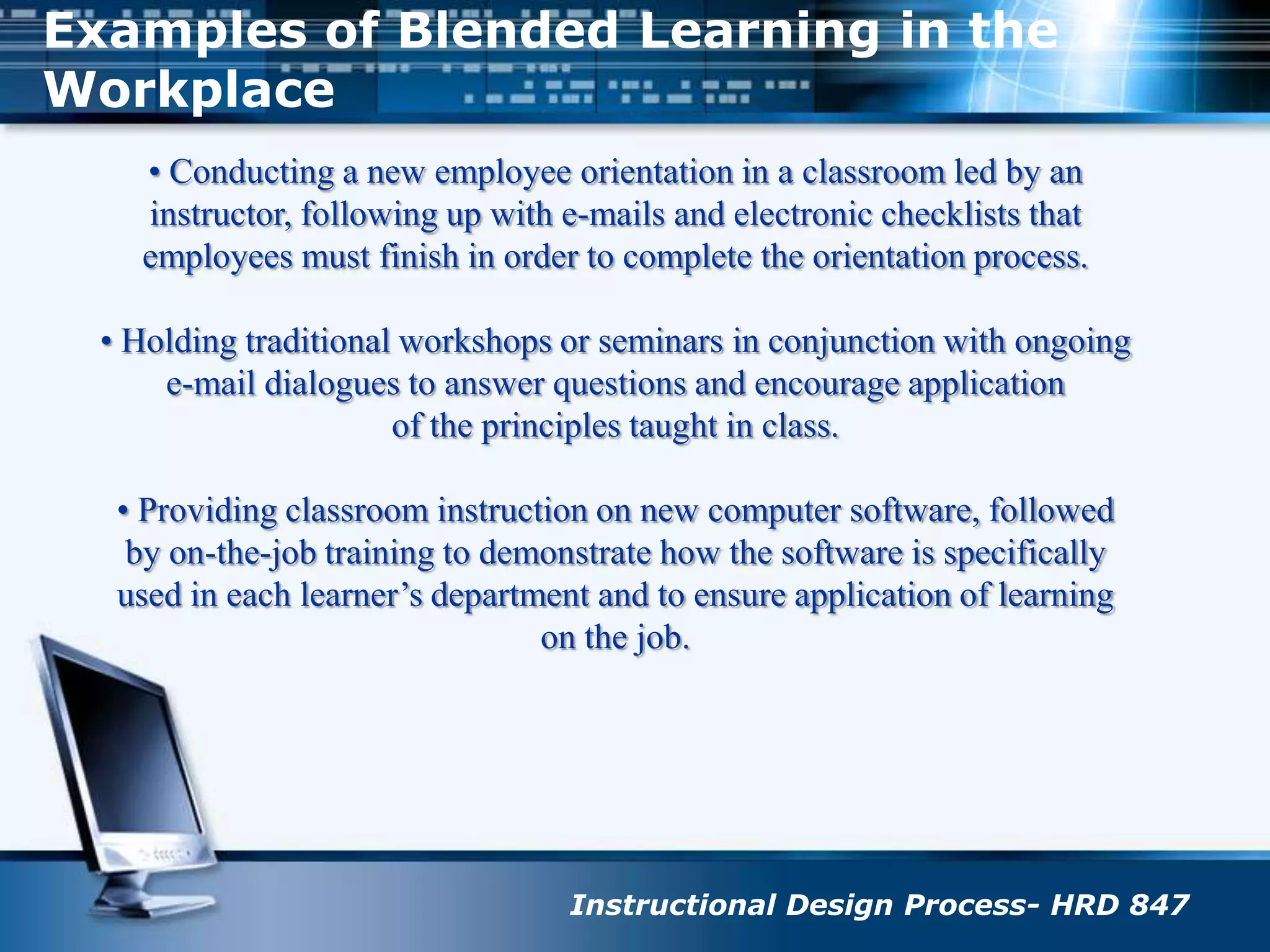
Examples of Blended Learning in the Workplace• Conducting a new employee orientation in a classroom led by aninstructor, following up with e-mails and electronic checklists thatemployees must finish in order to complete the orientation process.• Holding traditional workshops or seminars in conjunction with ongoinge-mail dialogues to answer questions and encourage applicationof the principles taught in class.• Providing classroom instruction on new computer software, followedby on-the-job training to demonstrate how the software is specificallyused in each learner’s department and to ensure application of learningon the job.Instructional Design Process- HRD 847
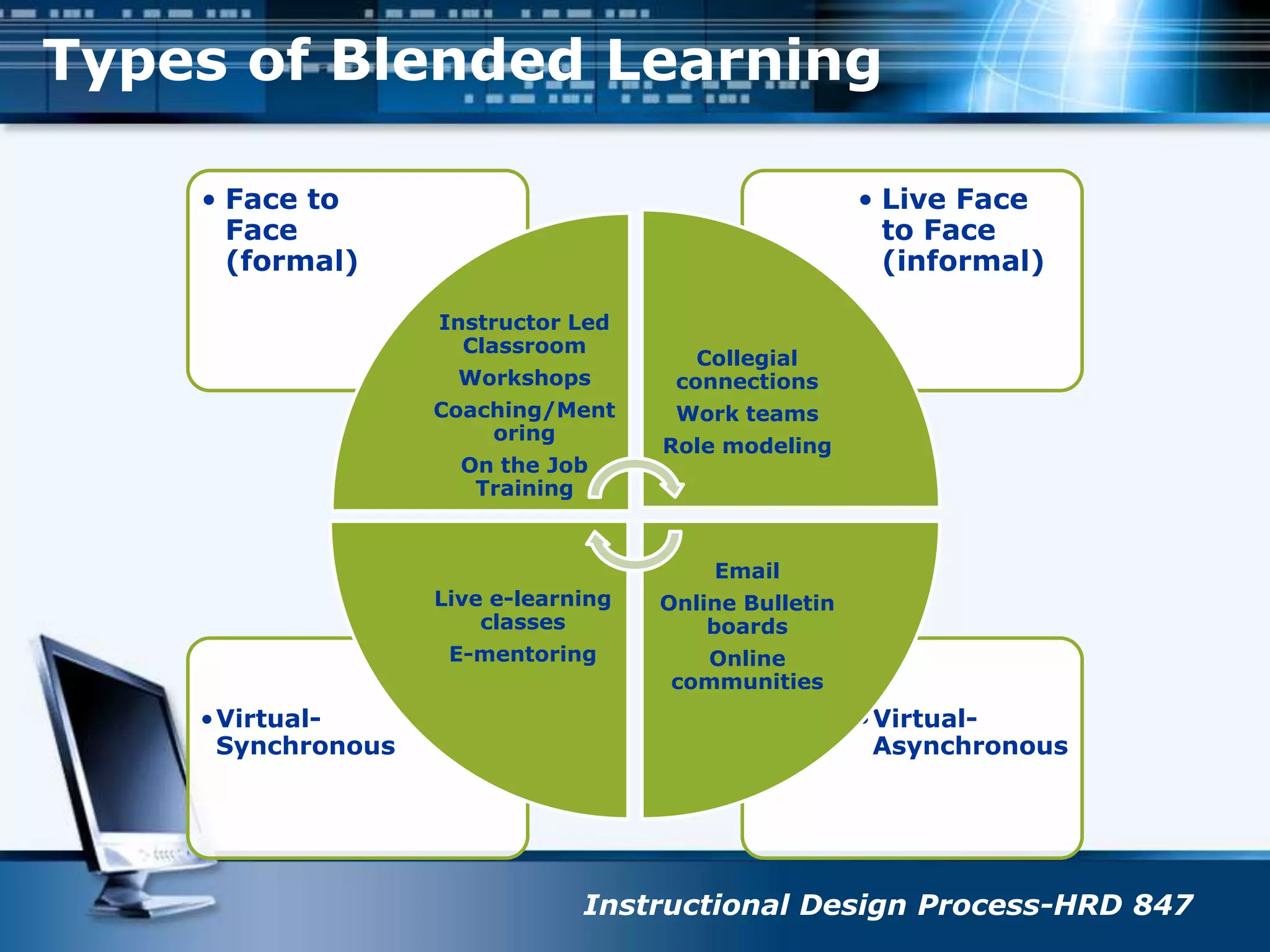
Types of Blended Learning Instructional Design Process-HRD 847
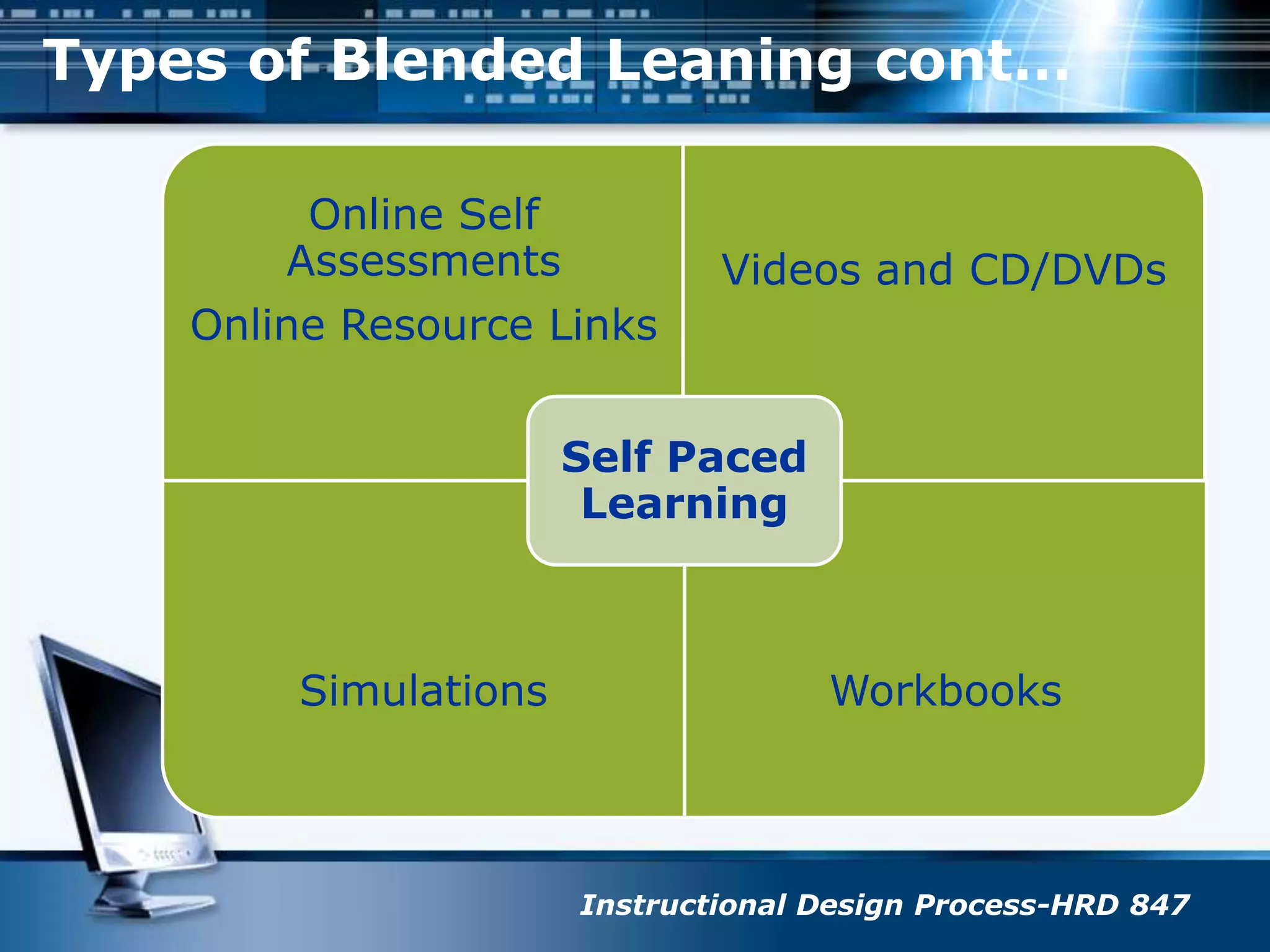
Types of Blended Leaning cont…Instructional Design Process-HRD 847
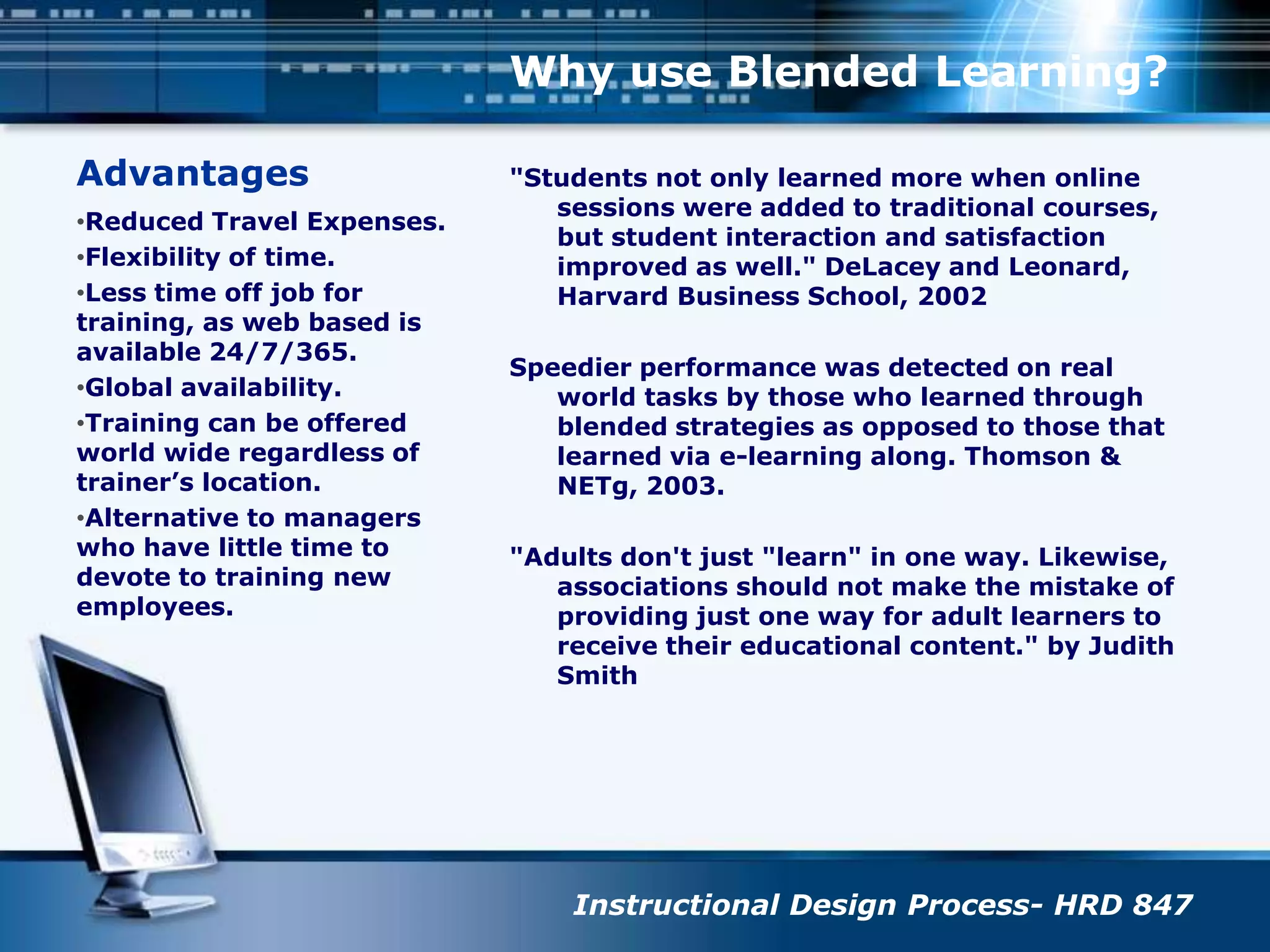
AdvantagesWhy use Blended Learning?"Students not only learned more when online sessions were added to traditional courses, but student interaction and satisfaction improved as well." DeLacey and Leonard, Harvard Business School, 2002Speedier performance was detected on real world tasks by those who learned through blended strategies as opposed to those that learned via e-learning along. Thomson & NETg, 2003."Adults don't just "learn" in one way. Likewise, associations should not make the mistake of providing just one way for adult learners to receive their educational content." by Judith Smith Reduced Travel Expenses.
Flexibility of time.
Less time off job for training, as web based is available 24/7/365.
Global availability.
Training can be offered world wide regardless of trainer’s location.

Hrd 847 presentation

  • 1.
    Blended Learning:Incorporating BlendedLearning to Fortify the Effectiveness of Training and DevelopmentClemson UniversityHRD 847Dr. Eileen NewmarkVivian I. Williams-Covington
  • 2.
    IntroductionHello, I amVivian Williams-CovingtonThe ISD process that I have chosen to discuss is; Blended Learning.The topic of my major paper is: Incorporating Blended Learning to Fortify the Effectiveness of Training and Development.My reason for choosing this process is because in my current employment, we are experiencing a major design process deficiency in training. Therefore, due to travel restrictions, training budgets and limited availability of trainers, incorporating Blended Learning could be the fix to our current design process predicament.Instructional Design Process- HRD 847
  • 3.
    What is BlendedLearning?Blended learning, (BL) combines onlinedelivery of educational content with the best features of classroom interaction and live instructionto personalize learning, allow thoughtful reflection, and differentiate instruction from student tostudent across a diverse group of learners..Instructional Design Process-HRD 847
  • 4.
    Blended Learning Definedcont…Blended learning is the use of the most effective trainingsolutions, applied in a coordinated manner, to achieve learningobjectives that will attain the desired business goals.Instructional Design Process- HRD 847
  • 5.
    Examples of BlendedLearning in the Workplace• Conducting a new employee orientation in a classroom led by aninstructor, following up with e-mails and electronic checklists thatemployees must finish in order to complete the orientation process.• Holding traditional workshops or seminars in conjunction with ongoinge-mail dialogues to answer questions and encourage applicationof the principles taught in class.• Providing classroom instruction on new computer software, followedby on-the-job training to demonstrate how the software is specificallyused in each learner’s department and to ensure application of learningon the job.Instructional Design Process- HRD 847
  • 6.
    Types of BlendedLearning Instructional Design Process-HRD 847
  • 7.
    Types of BlendedLeaning cont…Instructional Design Process-HRD 847
  • 8.
    AdvantagesWhy use BlendedLearning?"Students not only learned more when online sessions were added to traditional courses, but student interaction and satisfaction improved as well." DeLacey and Leonard, Harvard Business School, 2002Speedier performance was detected on real world tasks by those who learned through blended strategies as opposed to those that learned via e-learning along. Thomson & NETg, 2003."Adults don't just "learn" in one way. Likewise, associations should not make the mistake of providing just one way for adult learners to receive their educational content." by Judith Smith Reduced Travel Expenses.
  • 9.
  • 10.
    Less time offjob for training, as web based is available 24/7/365.
  • 11.
  • 12.
    Training can beoffered world wide regardless of trainer’s location.
  • 13.
    Alternative to managerswho have little time to devote to training new employees.Instructional Design Process- HRD 847
  • 14.
    Framework to Creatinga Design Process in Blended LearningWhat do you want your trainees to know when they have completed the Blended Learning course?What types of learning activities will you design that integrate face-to-face and online components?What means will you use to access these integrated learning activities?How will information and communication technologies be used to support blended learning?Instructional Design Process-HRD 847
  • 15.
    Future Training Possibilitiesfor Blended LearningBlended learning, combining the best elements of online and face-to-face education, is likely to emerge as the predominant teaching model of the future.Instructional Design Process-HRD 847
  • 16.
  • 17.
    Harriman, G. (2004).E-Resources. Retrieved February 22, 2011, from Gary Harriman: www.garyharriman/blendedlearningKim, B. S. (2003, February). Blended Learning: The Here and Now. Retrieved March 3, 2011, from ASTD.com: www.astd.comReed, H. S. (2001). A White Paper: Achieving Success in Blended Learning. ASTD State of Industry Report , 1-11.Vaughan, R. G. (2008). Blended Learning in Higher Education. San Francisco : Josey Bass.