Welcome to PH601
Philosophy of Religion
An Orientation of a Hybrid Course
What is an orientation and
why do I need it?
 Hybrid courses are new and promising but
different!
 Theories of Equivalence and Intersubjectivity in the
design of this course.
 Keep up the communication!
 Got your technology in check?
 What you can expect and what’s expected of you.
 Overview of technology tools in this course.
What is a
hybrid course?
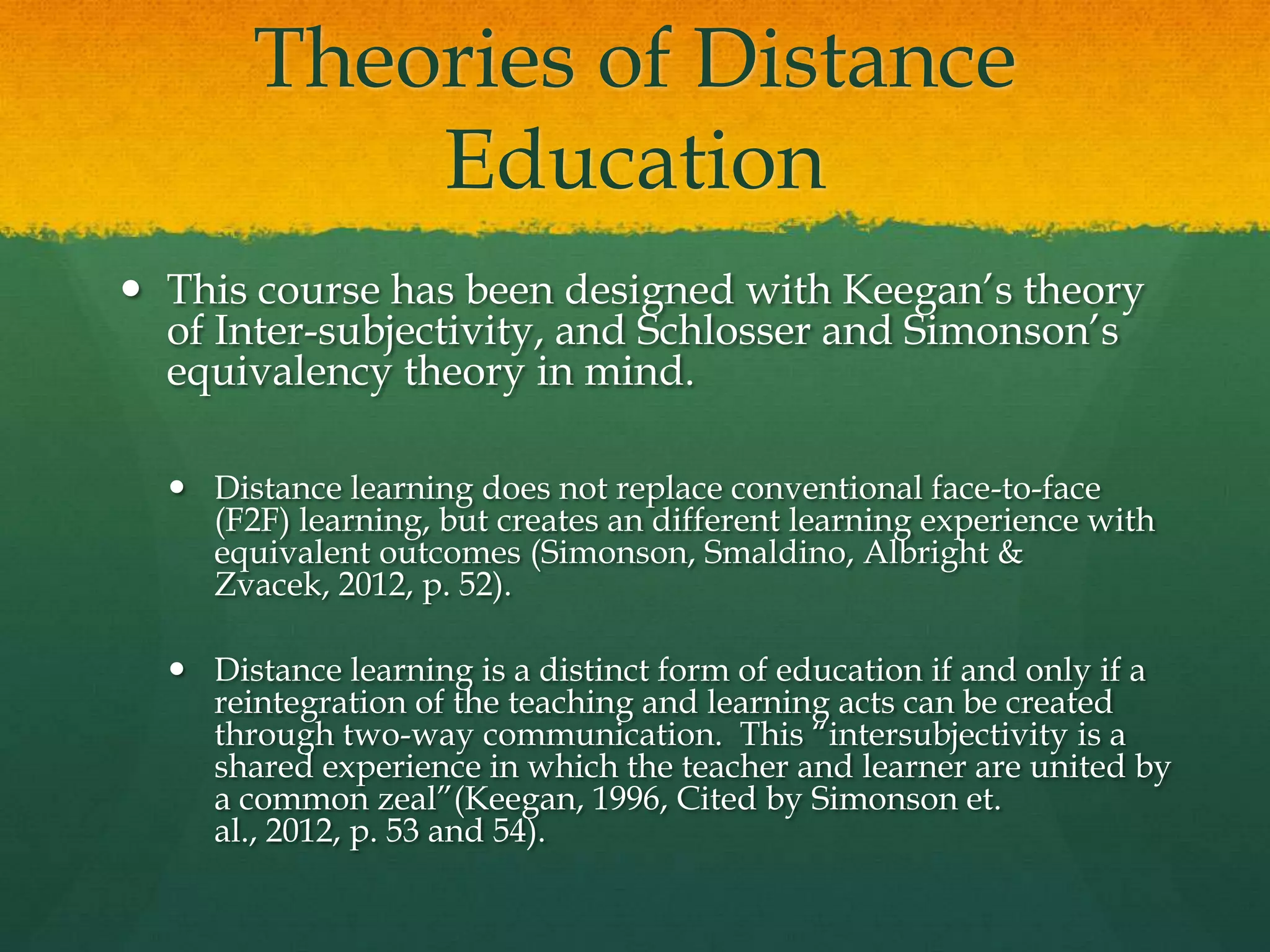
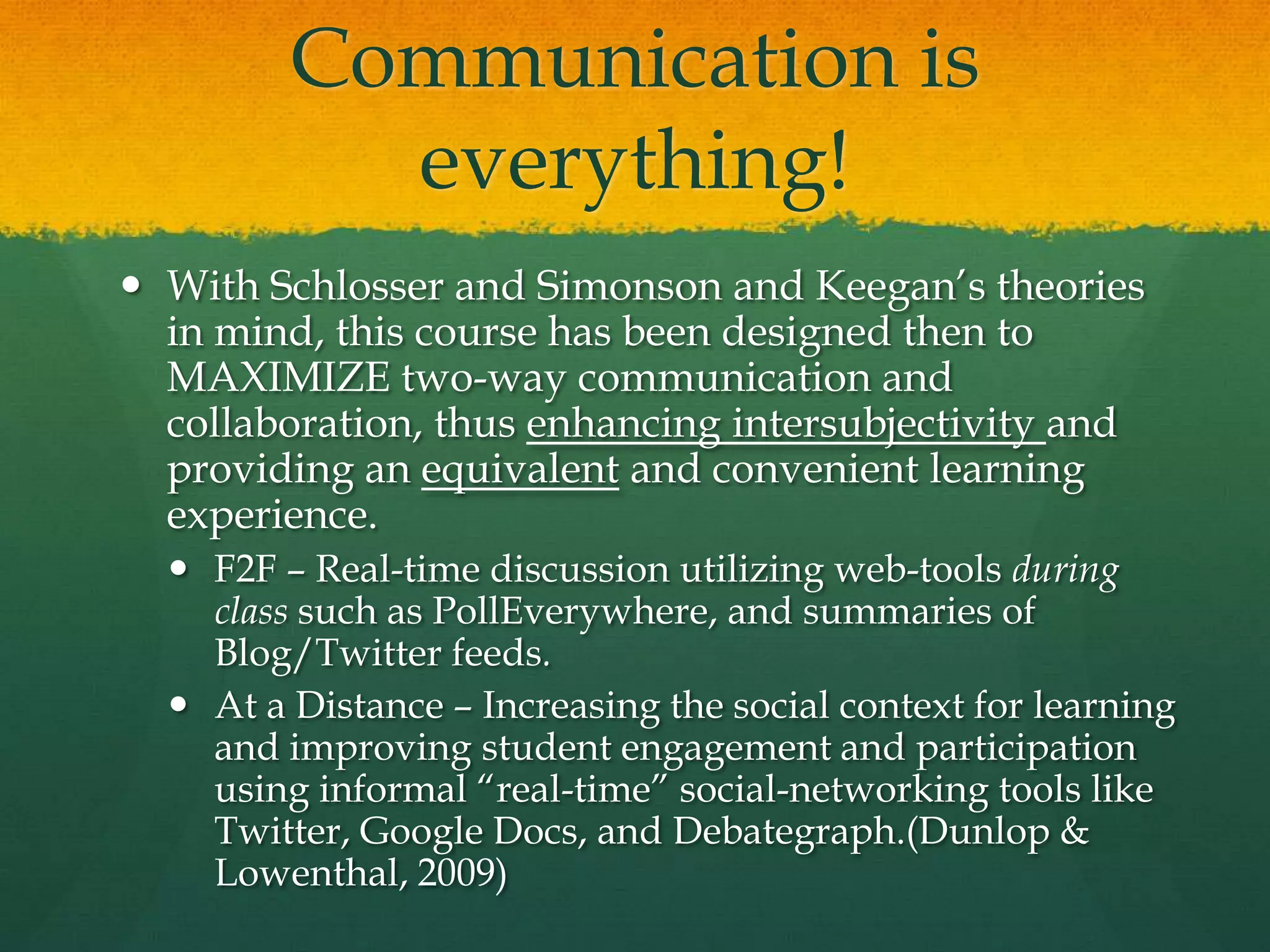
Using a blended-learning model
students study at their own pace
outside of the classroom, engage
in collaborative research and
conversation using Web 2.0 tools,
and then convene in the
conventional classroom to present
findings, carry on discussion, and
learn at a deeper level.
By maintaining the two-way
conversation necessary for
intersubjectivity in education
(Keegan 1996), while reducing the
number of class meetings,
students benefit from increased
access and convenience while
maintaining a high level of
educational rigor. (Simonson, et.
al., 2012).
The Blended-Learning Model
A recent study conducted by the Department of Education has
concluded that students generally perform better in a blended-learning
program than in a pure face-to-face environment.
Department of Education Study on Blended Learning
Theories of Distance
Education
 This course has been designed with Keegan’s theory
of Inter-subjectivity, and Schlosser and Simonson’s
equivalency theory in mind.
 Distance learning does not replace conventional face-to-face
(F2F) learning, but creates an different learning experience with
equivalent outcomes (Simonson, Smaldino, Albright &
Zvacek, 2012, p. 52).
 Distance learning is a distinct form of education if and only if a
reintegration of the teaching and learning acts can be created
through two-way communication. This ―intersubjectivity is a
shared experience in which the teacher and learner are united by
a common zeal‖(Keegan, 1996, Cited by Simonson et.
al., 2012, p. 53 and 54).
Communication is
everything!
 With Schlosser and Simonson and Keegan’s theories
in mind, this course has been designed then to
MAXIMIZE two-way communication and
collaboration, thus enhancing intersubjectivity and
providing an equivalent and convenient learning
experience.
 F2F – Real-time discussion utilizing web-tools during
class such as PollEverywhere, and summaries of
Blog/Twitter feeds.
 At a Distance – Increasing the social context for learning
and improving student engagement and participation
using informal ―real-time‖ social-networking tools like
Twitter, Google Docs, and Debategraph.(Dunlop &
Lowenthal, 2009)
Minimum Technology
Requirements
 High-speed Internet access
 Computer with ability to run multiple applications at once
 Software
 Browser-Firefox or Chrome
 Adobe Reader
 Productivity suite (such as Microsoft Office, although Google
Docs are sufficient).
 Accounts set-up for all required web-technology tools.
 Mobile devices (smartphones, tablets), are not required by
helpful and will improve the level of communication and
therefore the entire distance-learning experience.
Expectations (Simonson et. al., 2012)
What can I expect?
 More flexibility in schedule
(p. 221)
 Active-learning
 Well-structured instruction
with clear responsibilities (p.
222)
 Scaffolded collaborative
learning experiences (p. 224)
 Relevant information and
discussion (p. 221)
What is expected of
me?
 Assume the primary responsibility
for learning (p. 225).
 Stay disciplined—balance your on-
task time for class with other
responsibilities (p. 229)
 Participate--be online on a regular
basis and contribute both formally
and informally (p. 230)
 Choose your own learning
preferences and follow them.
 Plan to spend about 8-12 hours
outside of class, and in addition to
the 3 hour F2F component. (p. 233)
Technology Overview
At the conclusion of this slideshare you will be directed back to the
Blackboard interface where you may explore some of the Web-based
tools we will be using as part of our course. Please peruse the
descriptions, rationale for use, and tutorials provided to become familiar
with these collaboration and communication tools. You may also want
to begin the process of registering for accounts on sites that require this.
APA references
 Dunlap J. & , Lowenthal, P. (2009, December 22). Horton
Hears a Tweet. EDUCAUSE Review Online. Retrieved
from http://www.educause.edu/ero/article/horton-
hears-tweet
 Means, B., Toyama, Y., Murphy, R., Bakia, M., &
Jones, K. (2010). Evaluation of evidence-based practices
in online learning: A meta-analysis and review of online
learning studies.
 Simonson, M., Smaldino, S., Albright, M., & Zvacek, S.
(2012). Teaching and Learning at a Distance. Boston, MA:
Allyn & Bacon

PH601 Hybrid-course Orientation Introduction

  • 1.
    Welcome to PH601 Philosophyof Religion An Orientation of a Hybrid Course
  • 2.
    What is anorientation and why do I need it?  Hybrid courses are new and promising but different!  Theories of Equivalence and Intersubjectivity in the design of this course.  Keep up the communication!  Got your technology in check?  What you can expect and what’s expected of you.  Overview of technology tools in this course.
  • 3.
    What is a hybridcourse? Using a blended-learning model students study at their own pace outside of the classroom, engage in collaborative research and conversation using Web 2.0 tools, and then convene in the conventional classroom to present findings, carry on discussion, and learn at a deeper level. By maintaining the two-way conversation necessary for intersubjectivity in education (Keegan 1996), while reducing the number of class meetings, students benefit from increased access and convenience while maintaining a high level of educational rigor. (Simonson, et. al., 2012).
  • 4.
    The Blended-Learning Model Arecent study conducted by the Department of Education has concluded that students generally perform better in a blended-learning program than in a pure face-to-face environment. Department of Education Study on Blended Learning
  • 5.
    Theories of Distance Education This course has been designed with Keegan’s theory of Inter-subjectivity, and Schlosser and Simonson’s equivalency theory in mind.  Distance learning does not replace conventional face-to-face (F2F) learning, but creates an different learning experience with equivalent outcomes (Simonson, Smaldino, Albright & Zvacek, 2012, p. 52).  Distance learning is a distinct form of education if and only if a reintegration of the teaching and learning acts can be created through two-way communication. This ―intersubjectivity is a shared experience in which the teacher and learner are united by a common zeal‖(Keegan, 1996, Cited by Simonson et. al., 2012, p. 53 and 54).
  • 6.
    Communication is everything!  WithSchlosser and Simonson and Keegan’s theories in mind, this course has been designed then to MAXIMIZE two-way communication and collaboration, thus enhancing intersubjectivity and providing an equivalent and convenient learning experience.  F2F – Real-time discussion utilizing web-tools during class such as PollEverywhere, and summaries of Blog/Twitter feeds.  At a Distance – Increasing the social context for learning and improving student engagement and participation using informal ―real-time‖ social-networking tools like Twitter, Google Docs, and Debategraph.(Dunlop & Lowenthal, 2009)
  • 7.
    Minimum Technology Requirements  High-speedInternet access  Computer with ability to run multiple applications at once  Software  Browser-Firefox or Chrome  Adobe Reader  Productivity suite (such as Microsoft Office, although Google Docs are sufficient).  Accounts set-up for all required web-technology tools.  Mobile devices (smartphones, tablets), are not required by helpful and will improve the level of communication and therefore the entire distance-learning experience.
  • 8.
    Expectations (Simonson et.al., 2012) What can I expect?  More flexibility in schedule (p. 221)  Active-learning  Well-structured instruction with clear responsibilities (p. 222)  Scaffolded collaborative learning experiences (p. 224)  Relevant information and discussion (p. 221) What is expected of me?  Assume the primary responsibility for learning (p. 225).  Stay disciplined—balance your on- task time for class with other responsibilities (p. 229)  Participate--be online on a regular basis and contribute both formally and informally (p. 230)  Choose your own learning preferences and follow them.  Plan to spend about 8-12 hours outside of class, and in addition to the 3 hour F2F component. (p. 233)
  • 9.
    Technology Overview At theconclusion of this slideshare you will be directed back to the Blackboard interface where you may explore some of the Web-based tools we will be using as part of our course. Please peruse the descriptions, rationale for use, and tutorials provided to become familiar with these collaboration and communication tools. You may also want to begin the process of registering for accounts on sites that require this.
  • 10.
    APA references  DunlapJ. & , Lowenthal, P. (2009, December 22). Horton Hears a Tweet. EDUCAUSE Review Online. Retrieved from http://www.educause.edu/ero/article/horton- hears-tweet  Means, B., Toyama, Y., Murphy, R., Bakia, M., & Jones, K. (2010). Evaluation of evidence-based practices in online learning: A meta-analysis and review of online learning studies.  Simonson, M., Smaldino, S., Albright, M., & Zvacek, S. (2012). Teaching and Learning at a Distance. Boston, MA: Allyn & Bacon