HR for HR
Prof.Dr.Aung Tun Thet
Adding Value and
Delivering Results
• “Our progress as a nation can be no swifter
than our progress in education.
• The human mind is our fundamental
resource.”
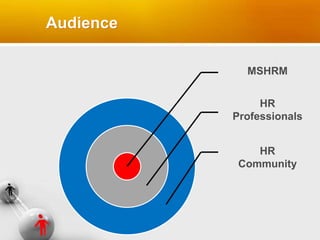
Audience
HR
Community
HR
Professionals
MSHRM
Messages
1. Role and function of HR in
organizations
2. HR in HR practices
Four roles or deliverables for HR
1. Management of Strategic HR
2. Firm infrastructure
3. Employee contribution
4. Transformation and Change
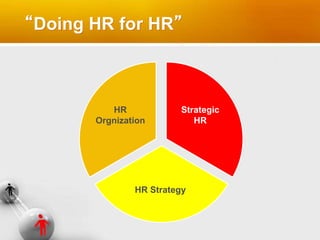
“Doing HR for HR”
New way of thinking and doing
HR
 Cobbler’s unshod children
 Design systems; give advice;
help others
 Do not apply HR principles to
themselves
“Doing HR for HR”
Strategic
HR
HR Strategy
HR
Orgnization
Three Issues
 Related
 Focus on business success
Strategic HR:
Turning Business Strategies Into
HR Priorities
Strategic Challenge
 Moving from business strategy to
HR Plan to HR practices
Strategic Planning
1. Strategic Formulation
2. Strategic Implementation
Strategy Formulation without
Implementation: Unfulfilled Promises
Three purposes of Strategy
1.Future direction for business - vision,
mission
2.Allocate resources
3.Commitment
Strategy Implementation
 Follows formulation
 Organizational practices aligned with
business strategy
Strategic HR and Fulfilment of Strategic
Promises: Defining Capabilities
 “Organizational Capability” -
processes and capabilities to make
strategy happen
 Capabilities - important link between
formulation and implementation
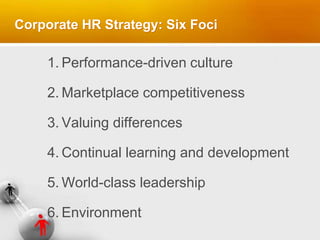
Corporate HR Strategy: Six Foci
1. Performance-driven culture
2. Marketplace competitiveness
3. Valuing differences
4. Continual learning and development
5. World-class leadership
6. Environment
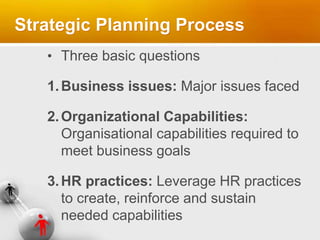
Strategic Planning Process
• Three basic questions
1.Business issues: Major issues faced
2.Organizational Capabilities:
Organisational capabilities required to
meet business goals
3.HR practices: Leverage HR practices
to create, reinforce and sustain
needed capabilities
HR Strategy:
Shaping HR Function
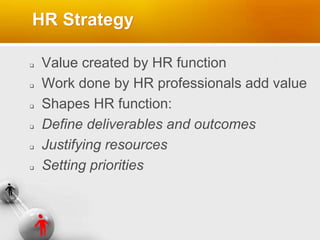
HR Strategy
 Value created by HR function
 Work done by HR professionals add value
 Shapes HR function:
 Define deliverables and outcomes
 Justifying resources
 Setting priorities
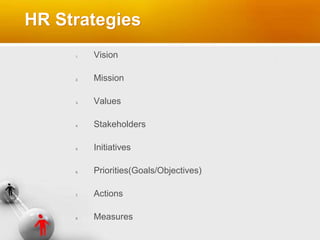
HR Strategies
1. Vision
2. Mission
3. Values
4. Stakeholders
5. Initiatives
6. Priorities(Goals/Objectives)
7. Actions
8. Measures
HR Vision Statement
 Ensure improved business performance
and competitive advantage
 Enabe managers to build, develop and
manage employees
 Products and services add value and
build organisational capability
HR Strategic Architecture:
Future Situation
Management Capability
 Customer-focused
 Strategic and results oriented
 Change agents
 Intelligent risk-takers
Management Capability
 People builders
 Team players
 Continual learners
 Respected
Employee Commitment
Access to resources to meet needs
Contribute to organizational outcomes
Take initiatives
Employee Commitment
Contributions recognized and shared
Compensation and benefits competitive
Safe work environment provided
Organizational Effectiveness
Fulfils mission, strategies and goals
Processes tied to strategies and
performance
Processes flexible and adaptable
Organizational Effectiveness
Capacity for change
Resources leveraged across organisation
Work teams used effectively
HR information system interactive
Administrative Efficiency
100% fulfillment of commitments
Effective and timely delivery of HR services
No ‘non-value added services or duplication
Continuous improvement of processes
Compliance with policy, laws and
regulations
HR Strategic Architecture:
Strategic Direction
Guiding Principles
Core values
Partnering
HR processes add value
Fast, flexible and cost effective delivery
Maintain priorities
Continuous learning opportunities
People
Right people, right jobs
Aligned workforce
Communications
Teaming for results
People
Diverse workforce
Continuous learning
Recognition/Reward
Performance Management
Process
Results-driven
Facts-based and documented
Infrastructure
Centres of Expertise
External Influences
Globalization
Rapid technological change
Demanding customer requirements
Innovation
External Influences
Sourcing talent
Partnering
Competition
HR Organization: Organization
Diagnosis to build HR
infrastructure
HR Organization
Road Map
Four-step process
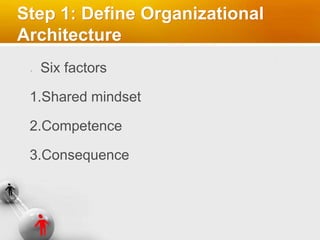
Step 1: Define Organizational
Architecture
Six factors
1.Shared mindset
2.Competence
3.Consequence
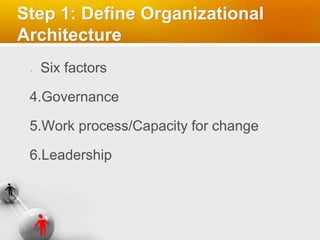
Step 1: Define Organizational
Architecture
Six factors
4.Governance
5.Work process/Capacity for change
6.Leadership
Step 2: Assessment Process
Probing strengths and weaknesses of
HR organisation
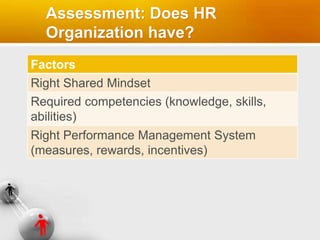
Assessment: Does HR
Organization have?
Factors
Right Shared Mindset
Required competencies (knowledge, skills,
abilities)
Right Performance Management System
(measures, rewards, incentives)
Assessment: Does HR
Organization have?
Factors
Right organisational structure, communication
and policies
Ability to improve, learn and change
Right Leadership
Step 3: Provide Leadership in Improvement
Practices
Shared Mindset
Clear vision and mission
Common identity
Step 3: Provide Leadership in Improvement
Practices
Competence
Four:
1.Knowledge of business
2.Delivery of HR
3.Management of Change
4.Personal credibility
Competencies
Three options:
1.Buy
2.Build
3.Borrow
Buying Competencies
Talent from outside
Targeted
Not wholesale outsourcing
Building Competencies
Upgrading skills and knowledge of current HR
professionals
Training and Development
Formal training
Job assignments
Career mobility
Task Force assignments
Borrowing Competencies
Outsourcing
Joint Venture
Partnership
Alliance
Consequences
Standards and measures of HR
professionals
Performance Management Systems
Performance Management
System (PMS)
HR professionals their worst enemies
Design and advocate company’s
PMS
Do not apply in HR Departments
Performance Management System
(PMS)
Three goals
Set standards for expectations from HR professionals
1. Behavioural - what HR professional should do
2. Outcomes - what HR professionals accomplish
3. Understandable, Controllable, Significant, Shared
Commitment
Performance Management System
(PMS)
• Rewards contingent on meeting standards
• Financial and non-financial
Performance Management System
(PMS)
Collect and share feedback on results
Self-monitoring
Timely, Helpful, Candid Performance
Reviews
Governance
Organization structure for delivering HR
Communication - HR agendas, goals, activities,
results
Fair and equitable administration of policies
Model for how to treat staff
Restructuring work, communication, marketing of
ideas
Work Process/Capacity for
Change
Speed, agility and responsiveness
Taking risks
Understanding processes for making
change quickly
Trailblazers imbedded in policies and
procedures
HR Leadership
Report to CEO
Create and transform organisational
culture
Top-quality
Many hats
“Leader-Managers”
Step 4: Set Priorities
Focus attention on few critical issues
Criteria:
Impact
Implementability
Differences among Strategic
HR, HR Strategy and HR
Organization
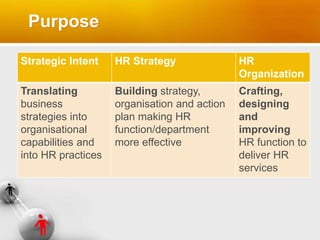
Purpose
Strategic Intent HR Strategy HR
Organization
Translating
business
strategies into
organisational
capabilities and
into HR practices
Building strategy,
organisation and action
plan making HR
function/department
more effective
Crafting,
designing
and
improving
HR function to
deliver HR
services
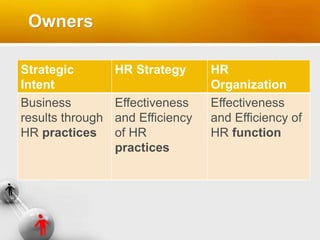
Owners
Strategic
Intent
HR Strategy HR
Organization
Business
results through
HR practices
Effectiveness
and Efficiency
of HR
practices
Effectiveness
and Efficiency of
HR function
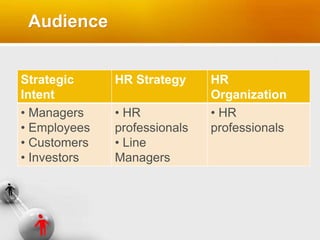
Audience
Strategic
Intent
HR Strategy HR
Organization
• Managers
• Employees
• Customers
• Investors
• HR
professionals
• Line
Managers
• HR
professionals
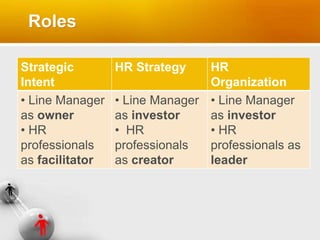
Roles
Strategic
Intent
HR Strategy HR
Organization
• Line Manager
as owner
• HR
professionals
as facilitator
• Line Manager
as investor
• HR
professionals
as creator
• Line Manager
as investor
• HR
professionals as
leader
Summary: HR for HR
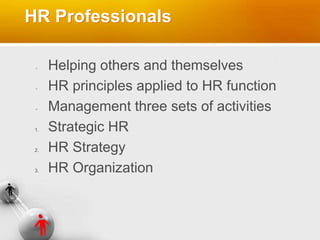
HR Professionals
Helping others and themselves
HR principles applied to HR function
Management three sets of activities
1. Strategic HR
2. HR Strategy
3. HR Organization
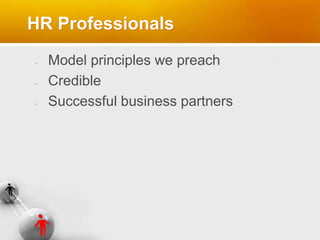
HR Professionals
Model principles we preach
Credible
Successful business partners
Human Resources
• Like natural resources
• Buried deep
• Not lying on surface
• Have to look
HR for HR
HR for HR

HR for HR