Sage HRMS I White Paper


Aligning HR Goals and Corporate Objectives
for Greater Return on Employee Investment
Sage HRMS

Table of Contents

Introduction................................................................................................................... 1


Strategic Alignment Defined...................................................................................... 1


Recruiting and Hiring................................................................................................... 2
	        Planning for future workforce needs......................................................... 3
	        Online recruiting and social media............................................................ 3


Employee Retention and Development.................................................................... 4
	      Employee surveys.......................................................................................... 4
	      Skills development........................................................................................ 5
	      Internal promotions and lateral transfers................................................ 5


Compensation............................................................................................................... 6
	     Analyzing current compensation............................................................... 6
	     Paying for performance................................................................................ 6


Technology can help with HR alignment.................................................................. 7


Conclusion..................................................................................................................... 7


About Sage HRMS......................................................................................................... 8
Introduction                                                                                                Sage HRMS
A company is only as good as its workforce. A company does not generate ideas, does not
give service, and by itself is neither efficient nor productive. People make all of those things
happen. In that sense, employees are the most important component in the quest to improve
business results. It makes sense to treat employee-related expenses as an investment in the
workforce. Like any other investment, this critical company investment must yield a healthy
return. At Sage, we call that the Return On Employee Investment™ or ROEI™.

These are not easy times for HR managers. Like other executives, they must do more with            Accurate and timely
less. A viable approach to the consequences of an economic downturn is tighter “strategic          employee information
alignment” of HR processes to the company’s overall competitive strategy. One way that HR          is crucial to driving
managers might adapt to doing more with less is to develop initiatives that designate HR as a      operational efficiency.
strategic partner to revenue-generating business units and to the executive team.


Strategic Alignment Defined
The function of an HR system is to minimize the risks of an organization’s human capital and
maximize the organization’s ROEI. How well HR managers perform this function is not so
easy to quantify. Relative to other business units, HR departments cannot readily point to
costs and revenues as a measure of effectiveness. This is a problem for HR managers. No
department in a company, even in good times, is exempt from cost/benefit scrutiny. The goal
of strategic alignment is to create efficiencies and to enable HR managers to better explain
their contribution to the company’s bottom line, using HR metrics as appropriate.                  Information should
                                                                                                   be actively pushed.
In broad terms, HR processes should be used to align business units and individual
employees with the strategic goals identified by senior management. For example,
management needs clear, direct, and constant communication with employees to implement
strategies. HR is in a unique position to communicate those strategies. This is true in
a strategic sense, in an example like a compensation system that rewards significant
contributions. It can also be true on a day-to-day basis, in that employees typically use
HR’s electronic interface to keep track of work hours, performance reviews, and more. This
electronic interface can be used to communicate, reinforce, and measure the progress toward
the company’s strategic goals.

Of course, making this alignment requires an understanding of the company’s strategies. As
a first step, HR managers should study their company and its industry. They should have a
working knowledge of the company’s financials and be able to answer basic questions. What
are the trends in our industry? What is my company’s value proposition to the marketplace?
What types of employees contribute to my organization’s growth? What positions are the most
difficult to fill? What drives employee and customer satisfaction?

From this base of knowledge, HR managers can then modify traditional HR processes—
recruiting and hiring, employee retention and development, and compensation—to implement
the strategies developed by senior management. In other words, if a core function of HR is
to make a “rigorous and accurate assessment of talent,” strategic alignment is a means of
performing this function more effectively.


                                                                                                                             1
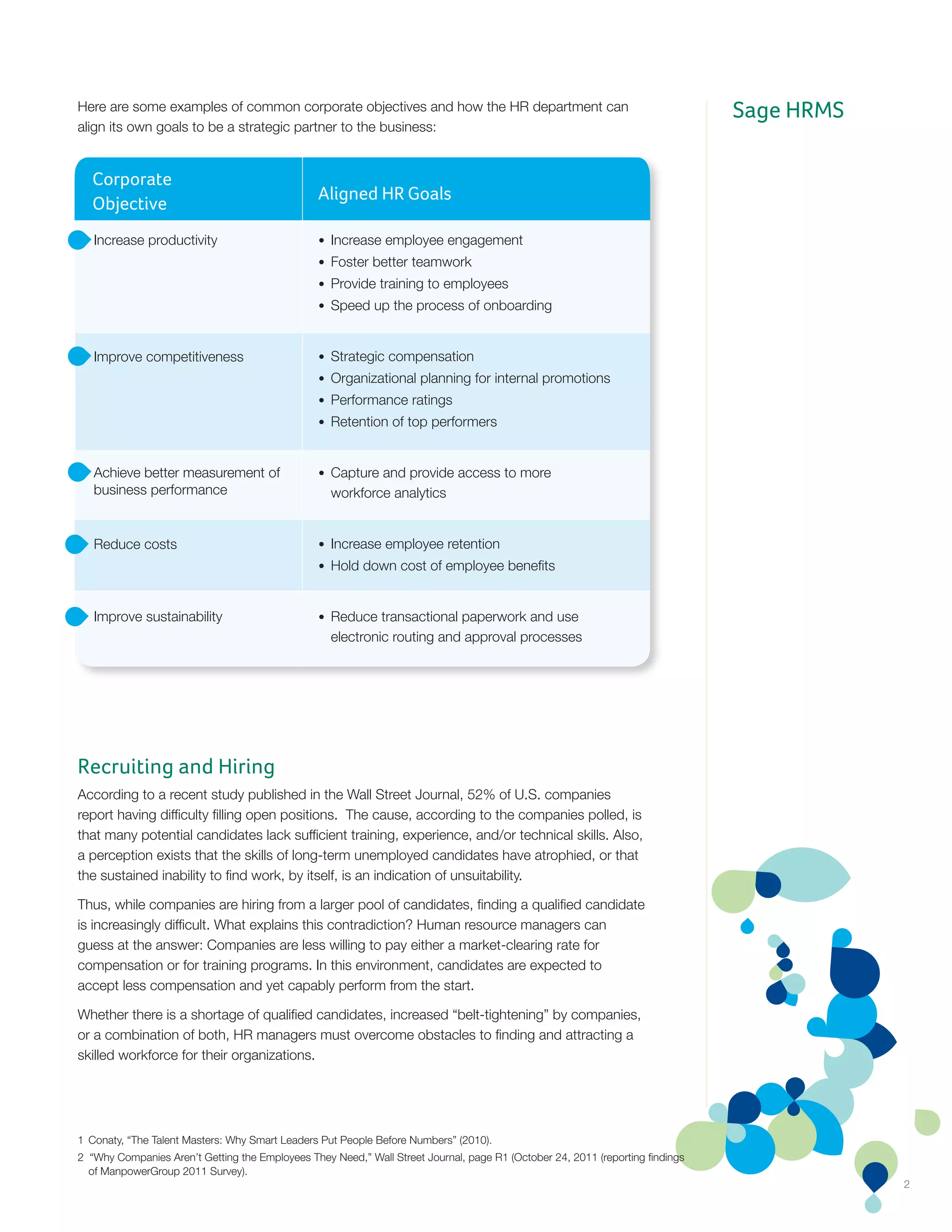
Here are some examples of common corporate objectives and how the HR department can                                               Sage HRMS
align its own goals to be a strategic partner to the business:


   Corporate
                                                 Aligned HR Goals
   Objective
   Increase productivity                         •	 Increase employee engagement
                                                 •	 Foster better teamwork
                                                 •	 Provide training to employees
                                                 •	 Speed up the process of onboarding


   Improve competitiveness                       •	 Strategic compensation
                                                 •	 Organizational planning for internal promotions
                                                 •	 Performance ratings
                                                 •	 Retention of top performers


   Achieve better measurement of                 •	 Capture and provide access to more
   business performance                            workforce analytics


   Reduce costs                                  •	 Increase employee retention
                                                 •	 Hold down cost of employee benefits


   Improve sustainability                        •	 Reduce transactional paperwork and use
                                                   electronic routing and approval processes


Recruiting and Hiring
According to a recent study published in the Wall Street Journal, 52% of U.S. companies
report having difficulty filling open positions. The cause, according to the companies polled, is
that many potential candidates lack sufficient training, experience, and/or technical skills. Also,
a perception exists that the skills of long-term unemployed candidates have atrophied, or that
the sustained inability to find work, by itself, is an indication of unsuitability.

Thus, while companies are hiring from a larger pool of candidates, finding a qualified candidate
is increasingly difficult. What explains this contradiction? Human resource managers can
guess at the answer: Companies are less willing to pay either a market-clearing rate for
compensation or for training programs. In this environment, candidates are expected to
accept less compensation and yet capably perform from the start.

Whether there is a shortage of qualified candidates, increased “belt-tightening” by companies,
or a combination of both, HR managers must overcome obstacles to finding and attracting a
skilled workforce for their organizations.


1	 Conaty, “The Talent Masters: Why Smart Leaders Put People Before Numbers” (2010).
2 “Why Companies Aren’t Getting the Employees They Need,” Wall Street Journal, page R1 (October 24, 2011 (reporting findings 		
	 of ManpowerGroup 2011 Survey).
                                                                                                                                              2
Planning for future workforce needs                                                                                               Sage HRMS
To start aligning recruiting efforts with longer term corporate objectives, you’ll need to be proactive.
Before a need to fill a position arises, reach out for input from various business units to identify the best
sources of potential recruits. Business managers should be able to provide this information based on
their experience and their industry knowledge. Past experience with current and former employees
may provide the most useful information. Where did we obtain our best performers? Conversely, which
new hires looked good on paper but ultimately proved unqualified?

This information may indicate that the best hires learned about open positions at the company through
a particular source or medium, such as a trade publication. Identifying these sources may allow your
company to target its talent marketing in a way that will create efficiencies.

For positions that are difficult to fill, another initiative might involve developing ongoing relationships
with the best sources of talent. If a particular trade school, for example, can readily provide talented
candidates, HR managers should be on a first-name basis with the appropriate school officials. The
company might consider investing time and money, if available, to increase awareness of the company
among the students. This might run the gamut from participating in workshops, providing “guest
lecturers,” or even working with faculty on a sustained basis to ensure that the curriculum will enable
students to become employees that meet the company’s expectations.

As a part of a recruitment initiative, business managers might also identify specific individuals they
would like to hire. In making this “wish list,” HR managers should determine whether there is a
corresponding interest on the part of the talent in question. This is a simple conversation (initiated by
HR or by a person who knows the individual)—“if a position comes open, would you be interested?”
Very often such individuals will be employed by a competitor and/or located elsewhere. Thus, potential
obstacles such as noncompetes and unease about relocation might be identified in advance. Making
these efforts should reduce the time needed to fill a position that opens in the future. The broader point
is that HR should identify and cultivate talent in anticipation of needs.


Online recruiting and social media
Any recruitment initiative should also include an online component. Most companies advertise open
positions and collect resumes, applications, and cover letters online. Also, 80% of U.S. companies
indicate that they have increased their use social media, such as LinkedIn, for recruitment. These
are basic tools already familiar to most HR managers, who naturally excel at networking and
communicating with people and, as a result, have been early adopters of using social media for
business purposes.

A stronger web initiative would also include HR working with sales, marketing, and IT to take a stake
ownership of the company’s online reputation, to further the employer brand. Potential customers can
use the web to research your company’s reputation for quality, service, social responsibility, and other
factors that may be important to growth. By the same means, potential candidates can research your
company’s reputation for these and other qualities, such as employee satisfaction and diversity. How
your company presents itself on its website may determine whether qualified candidates respond to
open positions. Online recruitment efforts might include links to employee testimonials about their own
satisfaction and their appreciation for the company’s commitment to specified values.


1	 Wall Street Journal Report, page R7 (citing as source “Jobsite Survey of U.S. human-resource and recruiting professionals”).
                                                                                                                                              3
Protecting this employer brand reputation requires periodic surveys of company-related information.          Sage HRMS
More precisely, what does a search of the company’s name, through Google, Yahoo, and other search
engines, recover? Negative information about the company, such as customer complaints or bad
press, can be brought to the attention of marketing or the business unit involved. Negative information
regarding employment with the company—from candidates and former or current employees—is
within HR’s responsibility to address. In addition to resolving the underlying problem, if possible, it is
also important to dilute and/or rebut negative information with positive information about the company.

In this situation, social media policies can be a part of the strategic HR plan. These policies are
another example of a function that can be both managerial with respect to the day-to-day actions of
employees but also can impact the organization at a higher level


Employee Retention and Development
Employee retention and development is another area in which HR can strategically align itself
with the company’s business objectives. The consequences of high employee turnover are
clear. Most immediate is the disruption to operations and employee productivity caused by
departing employees, particularly key talent. Employees can walk out of the door with know-
how, client relationships, and the skills needed to operate the affected business unit. There are
also significant costs associated with high turnover. These include not only the costs of finding
a replacement, but also the sunken costs of training and development that leave with the
departing employee.


Employee surveys
The first step to improving employee retention and development is to gather information. Employee
surveys should be conducted to determine what aspects of the job are satisfactory and which are
causing employees stress.

The survey might include questions such as:

	   •	 What is the most difficult part of your job?

	   •	 How can the company improve its products/services or create efficiencies?

	   •	 How can the company improve your work environment?

	   •	 What training provided by the company have you found useful?

	   •	 What training provided by the company have you found not useful?

	   •	 Are you satisfied with your level of compensation?

	 •	 Are you satisfied with the development and promotion opportunities provided by
		 the company?

	 •	 Are you regularly informed of development and promotion opportunities provided 		
		 by the company?

	   •	 What aspects of the company’s operations make you proud to be an employee?


                                                                                                                         4
Questions should be tailored to fit particular business units. If appropriate, a guarantee that the               Sage HRMS
responses will be kept confidential may promote accuracy. The responses should yield useful
information that will allow HR, working with the particular business unit, to resolve problems or to
identify successes that might be duplicated in other business units. The fact that the company cares
enough to regularly gather such information may, in itself, boost morale.

An employee development survey initiative should yield several benefits:

	    •	 Ideas for how to improve retention rates and reduce costs.

	    •	 Insight into what drives retention rates.

	    •	 Satisfaction statistics that be can promoted to attract new recruits.


Skills development
Training is a critical area of talent management that helps ensure your employees have the right set
of skills to do their jobs today—and in the future. Several of the survey questions are intended to
gather information regarding employee development as well as opportunities for promotion. Like
compensation, the opportunity to learn new skills may be an important factor in employee satisfaction
and, thus, retention.

To strategically align employee training programs with corporate objectives, it’s important to find out
what types of positions will be most important to the organization in the future and what skills are
required to fill those positions. Do these critical positions require certifications? If so, what training will
be needed to get employees certified and maintain those certifications. Finally, consider other types of
training that may be necessary for the company to succeed—for example, training that complies with
laws about worker harassment, leadership training for managers, or training to help teams work more
effectively together.


Internal promotions and lateral transfers
Very often, employees who want to expand their skill set will need the ability to switch departments.
The extent to which such moves are encouraged should be discussed between HR and the affected
business units. Another consideration is that some positions may require regular transitions to improve
performance. Some positions require creativity. Other positions are particularly stressful. If HR can
identify these positions, it should consider whether internal “turnover” for these positions is desirable.

In addition to improving employee morale, an increased focus on employee development and internal
promotion removes many of the uncertainties described above. An employee is a known quantity. A
history of satisfactory performance should, with few exceptions, trump the risk taken by bringing a
new employee into the company. Internal promotion should also reduce the costs associated with
filling a position. To this end, internal training programs can be used to identify talent for possible
promotion.


                                                                                                                              5
Compensation                                                                                                 Sage HRMS
Compensation is typically the largest expense for any business. Not surprisingly, compensation
is an inviting target for senior managers tasked with reducing costs. Often, this means that
compensation rates are held in check, with reductions-in-force and/or attrition generating
cost savings. For HR managers engaged in recruitment and retention efforts, the inability to
offer higher compensation can be a significant limiting factor. There are two steps that that HR
managers can take to better align compensation with the company’s competitive strategy.


Analyzing current compensation
To begin, HR managers should collect and analyze market information related to compensation. The
goal is to determine where the company falls in relation to competitors and other companies hiring for
similar positions. Some of this information is publicly available. Alternatively, third-party firms can be
retained to collect this information.

An analysis of marketwide compensation can be useful for several purposes. Namely, by keeping
senior executives informed of current market rates, it will result in more informed decisions with
respect to compensation. A comparative analysis indicating salaries in the company’s recruiting areas,
for example, may explain recruitment and retention rates. Such information can also enable senior
executives to better analyze the company’s cost structure relative to its competitors. Moreover, to the
extent that the company is able to pay above-market rates, this can be communicated to employees
to improve morale by pushing back against the common misperception among employees that they
are “underpaid.”


Paying for performance
A second important alignment strategy is to fix compensation to performance. Pay for performance,
at some level, underscores the company’s strategic goals to employees. Communication is key. The
employee must know, in advance, what metrics will be used to measure performance. For example,
in addition to a base compensation per hour, employees might receive additional compensation for
units produced, miles driven, profits achieved, and so on. This can be done at the individual level or
on a business unit basis. Pay for performance may be particularly important for the retention of top
performers.


                                                                                                                         6
Technology Can Help With HR Alignment                                                                  Sage HRMS
HR-related technology such as Human Resource Management Systems (HRMS) and talent
management solutions were traditionally thought of as cost reduction tools, saving time and
automating routine administration to raise productivity within the HR department itself. An HRMS
certainly does deliver that result. But when viewed as part of an investment in a competitive
workforce, it can do much more.

Through employee self-service, training, development, compensation, and benefits management,
HRMS and talent management solutions can provide the tools to help keep employees engaged
and satisfied. These systems also deliver the analytics to help managers and executives examine
trends, support business decisions, and plan for future organizational changes.

Investing in an HRMS solution, integrated with performance management, learning and training,
tools for decision support, self-service portals, and more, is an investment in the most important
asset of the organization: its employees. And the return on the investment in employees can change
a struggling company into a winning company.


Conclusion
Because HR departments are being asked to do more with less, it’s important that HR managers
identify the best areas to focus their resources in order to make the biggest impact for the
organization. Well-aligned, strategic HR initiatives should improve important metrics such as number
of open positions, cost-per-hire, turnover rates, employee satisfaction, and so on.

In today’s tough business environment, all HR initiatives should be designed to:

	   •	 Support overall corporate objectives regarding both costs and results.

	   •	 Yield a positive Return on Employee Investment.

In addition to well-designed employee programs and benefits, HR technology such as HRMS and
talent management solutions can help organizations achieve a better ROEI and more closely align
HR processes with corporate goals. By supporting the objectives of the organization, HR will make
a direct impact on the competitiveness and success of the company and become a strategic
partner to the executive team, as well as other business units.


                                                                                                                   7
About Sage HRMS
 An industry-leading, customizable HRMS solution, Sage HRMS helps
 companies optimize their HR business processes as well as maximize their
 Return On Employee Investment (ROEI)™. Developed by HR professionals
 for HR professionals, Sage HRMS delivers a tightly integrated set of
 comprehensive features and functionality that increases efficiency and
 improves productivity at every level in the organization.

 With Sage HRMS, you can successfully meet and respond to the HR
 management challenges you face every day in the areas of payroll, benefits,
 employee self-service, attendance, recruiting, training, workforce analytics,
 and more. By automating and streamlining your day-to-day HR business
 processes using Sage HRMS, you and your staff are freed up to spend more
 time and energy on the business asset that is most vital to your company—
 your employees.

 A global $2.2 billion software company with over 30 years of experience and
 over 6 million customers, Sage has provided HRMS solutions longer than
 any other company in North America. By choosing Sage, you not only get
 productivity-boosting HR and payroll software solutions, you get the support
 of an award-winning customer service team and access to many other
 business tools and resources that make your work life easier.


 To learn more, please call us at 800-424-9392, or visit
 our website at: www.SageHRMS.com


Sage
888 Executive Center Dr. W., Suite 300 | St. Petersburg, FL 33702 | www.SageHRMS.com


©2012 Sage Software, Inc. All rights reserved. Sage, the Sage logos, and the Sage product and service
names mentioned herein are registered trademarks or trademarks of Sage Software, Inc., or its affiliated
entities. All other trademarks are the property of their respective owners. 			                 01/12

Aligning HR Goals & Corporate Objectives for Greater ROEI

  • 1.
    Sage HRMS IWhite Paper Aligning HR Goals and Corporate Objectives for Greater Return on Employee Investment
  • 2.
    Sage HRMS Table ofContents Introduction................................................................................................................... 1 Strategic Alignment Defined...................................................................................... 1 Recruiting and Hiring................................................................................................... 2 Planning for future workforce needs......................................................... 3 Online recruiting and social media............................................................ 3 Employee Retention and Development.................................................................... 4 Employee surveys.......................................................................................... 4 Skills development........................................................................................ 5 Internal promotions and lateral transfers................................................ 5 Compensation............................................................................................................... 6 Analyzing current compensation............................................................... 6 Paying for performance................................................................................ 6 Technology can help with HR alignment.................................................................. 7 Conclusion..................................................................................................................... 7 About Sage HRMS......................................................................................................... 8
  • 3.
    Introduction Sage HRMS A company is only as good as its workforce. A company does not generate ideas, does not give service, and by itself is neither efficient nor productive. People make all of those things happen. In that sense, employees are the most important component in the quest to improve business results. It makes sense to treat employee-related expenses as an investment in the workforce. Like any other investment, this critical company investment must yield a healthy return. At Sage, we call that the Return On Employee Investment™ or ROEI™. These are not easy times for HR managers. Like other executives, they must do more with Accurate and timely less. A viable approach to the consequences of an economic downturn is tighter “strategic employee information alignment” of HR processes to the company’s overall competitive strategy. One way that HR is crucial to driving managers might adapt to doing more with less is to develop initiatives that designate HR as a operational efficiency. strategic partner to revenue-generating business units and to the executive team. Strategic Alignment Defined The function of an HR system is to minimize the risks of an organization’s human capital and maximize the organization’s ROEI. How well HR managers perform this function is not so easy to quantify. Relative to other business units, HR departments cannot readily point to costs and revenues as a measure of effectiveness. This is a problem for HR managers. No department in a company, even in good times, is exempt from cost/benefit scrutiny. The goal of strategic alignment is to create efficiencies and to enable HR managers to better explain their contribution to the company’s bottom line, using HR metrics as appropriate. Information should be actively pushed. In broad terms, HR processes should be used to align business units and individual employees with the strategic goals identified by senior management. For example, management needs clear, direct, and constant communication with employees to implement strategies. HR is in a unique position to communicate those strategies. This is true in a strategic sense, in an example like a compensation system that rewards significant contributions. It can also be true on a day-to-day basis, in that employees typically use HR’s electronic interface to keep track of work hours, performance reviews, and more. This electronic interface can be used to communicate, reinforce, and measure the progress toward the company’s strategic goals. Of course, making this alignment requires an understanding of the company’s strategies. As a first step, HR managers should study their company and its industry. They should have a working knowledge of the company’s financials and be able to answer basic questions. What are the trends in our industry? What is my company’s value proposition to the marketplace? What types of employees contribute to my organization’s growth? What positions are the most difficult to fill? What drives employee and customer satisfaction? From this base of knowledge, HR managers can then modify traditional HR processes— recruiting and hiring, employee retention and development, and compensation—to implement the strategies developed by senior management. In other words, if a core function of HR is to make a “rigorous and accurate assessment of talent,” strategic alignment is a means of performing this function more effectively. 1
  • 4.
    Here are someexamples of common corporate objectives and how the HR department can Sage HRMS align its own goals to be a strategic partner to the business: Corporate Aligned HR Goals Objective Increase productivity • Increase employee engagement • Foster better teamwork • Provide training to employees • Speed up the process of onboarding Improve competitiveness • Strategic compensation • Organizational planning for internal promotions • Performance ratings • Retention of top performers Achieve better measurement of • Capture and provide access to more business performance workforce analytics Reduce costs • Increase employee retention • Hold down cost of employee benefits Improve sustainability • Reduce transactional paperwork and use electronic routing and approval processes Recruiting and Hiring According to a recent study published in the Wall Street Journal, 52% of U.S. companies report having difficulty filling open positions. The cause, according to the companies polled, is that many potential candidates lack sufficient training, experience, and/or technical skills. Also, a perception exists that the skills of long-term unemployed candidates have atrophied, or that the sustained inability to find work, by itself, is an indication of unsuitability. Thus, while companies are hiring from a larger pool of candidates, finding a qualified candidate is increasingly difficult. What explains this contradiction? Human resource managers can guess at the answer: Companies are less willing to pay either a market-clearing rate for compensation or for training programs. In this environment, candidates are expected to accept less compensation and yet capably perform from the start. Whether there is a shortage of qualified candidates, increased “belt-tightening” by companies, or a combination of both, HR managers must overcome obstacles to finding and attracting a skilled workforce for their organizations. 1 Conaty, “The Talent Masters: Why Smart Leaders Put People Before Numbers” (2010). 2 “Why Companies Aren’t Getting the Employees They Need,” Wall Street Journal, page R1 (October 24, 2011 (reporting findings of ManpowerGroup 2011 Survey). 2
  • 5.
    Planning for futureworkforce needs Sage HRMS To start aligning recruiting efforts with longer term corporate objectives, you’ll need to be proactive. Before a need to fill a position arises, reach out for input from various business units to identify the best sources of potential recruits. Business managers should be able to provide this information based on their experience and their industry knowledge. Past experience with current and former employees may provide the most useful information. Where did we obtain our best performers? Conversely, which new hires looked good on paper but ultimately proved unqualified? This information may indicate that the best hires learned about open positions at the company through a particular source or medium, such as a trade publication. Identifying these sources may allow your company to target its talent marketing in a way that will create efficiencies. For positions that are difficult to fill, another initiative might involve developing ongoing relationships with the best sources of talent. If a particular trade school, for example, can readily provide talented candidates, HR managers should be on a first-name basis with the appropriate school officials. The company might consider investing time and money, if available, to increase awareness of the company among the students. This might run the gamut from participating in workshops, providing “guest lecturers,” or even working with faculty on a sustained basis to ensure that the curriculum will enable students to become employees that meet the company’s expectations. As a part of a recruitment initiative, business managers might also identify specific individuals they would like to hire. In making this “wish list,” HR managers should determine whether there is a corresponding interest on the part of the talent in question. This is a simple conversation (initiated by HR or by a person who knows the individual)—“if a position comes open, would you be interested?” Very often such individuals will be employed by a competitor and/or located elsewhere. Thus, potential obstacles such as noncompetes and unease about relocation might be identified in advance. Making these efforts should reduce the time needed to fill a position that opens in the future. The broader point is that HR should identify and cultivate talent in anticipation of needs. Online recruiting and social media Any recruitment initiative should also include an online component. Most companies advertise open positions and collect resumes, applications, and cover letters online. Also, 80% of U.S. companies indicate that they have increased their use social media, such as LinkedIn, for recruitment. These are basic tools already familiar to most HR managers, who naturally excel at networking and communicating with people and, as a result, have been early adopters of using social media for business purposes. A stronger web initiative would also include HR working with sales, marketing, and IT to take a stake ownership of the company’s online reputation, to further the employer brand. Potential customers can use the web to research your company’s reputation for quality, service, social responsibility, and other factors that may be important to growth. By the same means, potential candidates can research your company’s reputation for these and other qualities, such as employee satisfaction and diversity. How your company presents itself on its website may determine whether qualified candidates respond to open positions. Online recruitment efforts might include links to employee testimonials about their own satisfaction and their appreciation for the company’s commitment to specified values. 1 Wall Street Journal Report, page R7 (citing as source “Jobsite Survey of U.S. human-resource and recruiting professionals”). 3
  • 6.
    Protecting this employerbrand reputation requires periodic surveys of company-related information. Sage HRMS More precisely, what does a search of the company’s name, through Google, Yahoo, and other search engines, recover? Negative information about the company, such as customer complaints or bad press, can be brought to the attention of marketing or the business unit involved. Negative information regarding employment with the company—from candidates and former or current employees—is within HR’s responsibility to address. In addition to resolving the underlying problem, if possible, it is also important to dilute and/or rebut negative information with positive information about the company. In this situation, social media policies can be a part of the strategic HR plan. These policies are another example of a function that can be both managerial with respect to the day-to-day actions of employees but also can impact the organization at a higher level Employee Retention and Development Employee retention and development is another area in which HR can strategically align itself with the company’s business objectives. The consequences of high employee turnover are clear. Most immediate is the disruption to operations and employee productivity caused by departing employees, particularly key talent. Employees can walk out of the door with know- how, client relationships, and the skills needed to operate the affected business unit. There are also significant costs associated with high turnover. These include not only the costs of finding a replacement, but also the sunken costs of training and development that leave with the departing employee. Employee surveys The first step to improving employee retention and development is to gather information. Employee surveys should be conducted to determine what aspects of the job are satisfactory and which are causing employees stress. The survey might include questions such as: • What is the most difficult part of your job? • How can the company improve its products/services or create efficiencies? • How can the company improve your work environment? • What training provided by the company have you found useful? • What training provided by the company have you found not useful? • Are you satisfied with your level of compensation? • Are you satisfied with the development and promotion opportunities provided by the company? • Are you regularly informed of development and promotion opportunities provided by the company? • What aspects of the company’s operations make you proud to be an employee? 4
  • 7.
    Questions should betailored to fit particular business units. If appropriate, a guarantee that the Sage HRMS responses will be kept confidential may promote accuracy. The responses should yield useful information that will allow HR, working with the particular business unit, to resolve problems or to identify successes that might be duplicated in other business units. The fact that the company cares enough to regularly gather such information may, in itself, boost morale. An employee development survey initiative should yield several benefits: • Ideas for how to improve retention rates and reduce costs. • Insight into what drives retention rates. • Satisfaction statistics that be can promoted to attract new recruits. Skills development Training is a critical area of talent management that helps ensure your employees have the right set of skills to do their jobs today—and in the future. Several of the survey questions are intended to gather information regarding employee development as well as opportunities for promotion. Like compensation, the opportunity to learn new skills may be an important factor in employee satisfaction and, thus, retention. To strategically align employee training programs with corporate objectives, it’s important to find out what types of positions will be most important to the organization in the future and what skills are required to fill those positions. Do these critical positions require certifications? If so, what training will be needed to get employees certified and maintain those certifications. Finally, consider other types of training that may be necessary for the company to succeed—for example, training that complies with laws about worker harassment, leadership training for managers, or training to help teams work more effectively together. Internal promotions and lateral transfers Very often, employees who want to expand their skill set will need the ability to switch departments. The extent to which such moves are encouraged should be discussed between HR and the affected business units. Another consideration is that some positions may require regular transitions to improve performance. Some positions require creativity. Other positions are particularly stressful. If HR can identify these positions, it should consider whether internal “turnover” for these positions is desirable. In addition to improving employee morale, an increased focus on employee development and internal promotion removes many of the uncertainties described above. An employee is a known quantity. A history of satisfactory performance should, with few exceptions, trump the risk taken by bringing a new employee into the company. Internal promotion should also reduce the costs associated with filling a position. To this end, internal training programs can be used to identify talent for possible promotion. 5
  • 8.
    Compensation Sage HRMS Compensation is typically the largest expense for any business. Not surprisingly, compensation is an inviting target for senior managers tasked with reducing costs. Often, this means that compensation rates are held in check, with reductions-in-force and/or attrition generating cost savings. For HR managers engaged in recruitment and retention efforts, the inability to offer higher compensation can be a significant limiting factor. There are two steps that that HR managers can take to better align compensation with the company’s competitive strategy. Analyzing current compensation To begin, HR managers should collect and analyze market information related to compensation. The goal is to determine where the company falls in relation to competitors and other companies hiring for similar positions. Some of this information is publicly available. Alternatively, third-party firms can be retained to collect this information. An analysis of marketwide compensation can be useful for several purposes. Namely, by keeping senior executives informed of current market rates, it will result in more informed decisions with respect to compensation. A comparative analysis indicating salaries in the company’s recruiting areas, for example, may explain recruitment and retention rates. Such information can also enable senior executives to better analyze the company’s cost structure relative to its competitors. Moreover, to the extent that the company is able to pay above-market rates, this can be communicated to employees to improve morale by pushing back against the common misperception among employees that they are “underpaid.” Paying for performance A second important alignment strategy is to fix compensation to performance. Pay for performance, at some level, underscores the company’s strategic goals to employees. Communication is key. The employee must know, in advance, what metrics will be used to measure performance. For example, in addition to a base compensation per hour, employees might receive additional compensation for units produced, miles driven, profits achieved, and so on. This can be done at the individual level or on a business unit basis. Pay for performance may be particularly important for the retention of top performers. 6
  • 9.
    Technology Can HelpWith HR Alignment Sage HRMS HR-related technology such as Human Resource Management Systems (HRMS) and talent management solutions were traditionally thought of as cost reduction tools, saving time and automating routine administration to raise productivity within the HR department itself. An HRMS certainly does deliver that result. But when viewed as part of an investment in a competitive workforce, it can do much more. Through employee self-service, training, development, compensation, and benefits management, HRMS and talent management solutions can provide the tools to help keep employees engaged and satisfied. These systems also deliver the analytics to help managers and executives examine trends, support business decisions, and plan for future organizational changes. Investing in an HRMS solution, integrated with performance management, learning and training, tools for decision support, self-service portals, and more, is an investment in the most important asset of the organization: its employees. And the return on the investment in employees can change a struggling company into a winning company. Conclusion Because HR departments are being asked to do more with less, it’s important that HR managers identify the best areas to focus their resources in order to make the biggest impact for the organization. Well-aligned, strategic HR initiatives should improve important metrics such as number of open positions, cost-per-hire, turnover rates, employee satisfaction, and so on. In today’s tough business environment, all HR initiatives should be designed to: • Support overall corporate objectives regarding both costs and results. • Yield a positive Return on Employee Investment. In addition to well-designed employee programs and benefits, HR technology such as HRMS and talent management solutions can help organizations achieve a better ROEI and more closely align HR processes with corporate goals. By supporting the objectives of the organization, HR will make a direct impact on the competitiveness and success of the company and become a strategic partner to the executive team, as well as other business units. 7
  • 10.
    About Sage HRMS An industry-leading, customizable HRMS solution, Sage HRMS helps companies optimize their HR business processes as well as maximize their Return On Employee Investment (ROEI)™. Developed by HR professionals for HR professionals, Sage HRMS delivers a tightly integrated set of comprehensive features and functionality that increases efficiency and improves productivity at every level in the organization. With Sage HRMS, you can successfully meet and respond to the HR management challenges you face every day in the areas of payroll, benefits, employee self-service, attendance, recruiting, training, workforce analytics, and more. By automating and streamlining your day-to-day HR business processes using Sage HRMS, you and your staff are freed up to spend more time and energy on the business asset that is most vital to your company— your employees. A global $2.2 billion software company with over 30 years of experience and over 6 million customers, Sage has provided HRMS solutions longer than any other company in North America. By choosing Sage, you not only get productivity-boosting HR and payroll software solutions, you get the support of an award-winning customer service team and access to many other business tools and resources that make your work life easier. To learn more, please call us at 800-424-9392, or visit our website at: www.SageHRMS.com Sage 888 Executive Center Dr. W., Suite 300 | St. Petersburg, FL 33702 | www.SageHRMS.com ©2012 Sage Software, Inc. All rights reserved. Sage, the Sage logos, and the Sage product and service names mentioned herein are registered trademarks or trademarks of Sage Software, Inc., or its affiliated entities. All other trademarks are the property of their respective owners. 01/12