Promoting Entrepreneurship 
Prof.Dr.Aung Tun Thet
• “The best way to predict the future is to create 
it.” 
• 
• Winners never quit 
• Quitters never win
Opportunities 
• Emerging in many sectors 

• Potential to transform Myanmar 
• Young people strike out on their own - 
self-employed 
• ‘Domino effect’
• Business people “satisfy needs” 
• Entrepreneurs “create needs”
Government 
• Promote entrepreneurship 
• Newer approaches 
• Proactive policies
Entrepreneur 
• Creator 
• Destroyer
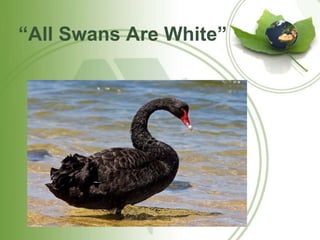
“All Swans Are White”
Entrepreneur 
• Innovator implements change 
• Five manifestations: 
1. Introduction of new/improved good 
2. Introduction of new method of production 
3. Opening of new market 
4. Exploitation of new source of supply 
5. Carrying out new organization
Entrepreneurs 
• See world differently 
• Envision future better than others 
• Seize opportunities that go unnoticed 
• Perceive and accept risks differently 
• Exceptional mind-set
Blue Ocean Strategy
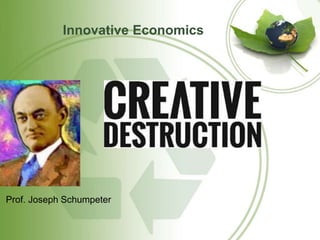
Innovative Economics 
Prof. Joseph Schumpeter
Promoting Entrepreneurship 
Policy Challenges
Promoting 
Entrepreneurship 
• Route to development 
• Involved in micro and small enterprises 
(MSE)
Entrepreneurs 
• “Persons who are ingenious and creative 
in finding ways that add to their own 
wealth, power, and prestige”. 
• Resource and process where individuals 
utilize opportunities in market through 
creation of new business firms
Entrepreneurship 
• Innovation, risk-taking and arbitrage 
• Self- employment 
• Business ownership 
• New start-ups
Entrepreneurship 
• Crucial factor in development and well-being of 
societies 
• Results 
• Lower unemployment rates 
• Adopt innovation 
• Structural changes in economy 
• New competition
Entrepreneurship 
• Distinction between motivations 
• “Necessity” entrepreneurs 
• “Opportunity” entrepreneurs
Entrepreneurship 
matter for Development 
• Structural transformation from low-income, 
traditional economy to modern economy 
• Creating new firms outside household 
• Absorbing surplus labour from traditional sector 
• Providing innovative intermediate inputs to final-goods 
producing firms
Entrepreneurship 
matter for Development 
• Greater specialization in manufacturing 
• Raising productivity and employment in both 
modern and traditional sectors 
• Employment growth substantial 
• Contribution to female empowerment
Being Entrepreneurs 
• Non-pecuniary returns 
• Independence 
• Positive change in lifestyle 
• Sense of achievement 
• Higher levels of job satisfaction
Designing Policies 
• Complicated 
• Three questions: 
1. Should entrepreneurship be supported? 
2. Can entrepreneurship be supported? 
3. What is the most effective means of support?
Government 
• Cannot raise supply or quantity of 
entrepreneurship 
• Influence allocation of entrepreneurial ability 
• “Get the institutions right” 
• Protection of property rights 
• Well-functioning legal system 
• Maintain macroeconomic and political stability 
• Competitive tax rates
“Entrepreneurial 
Economy” 
• Creativity and innovation flourish 
• Liberalized private-sector economy 
• Knowledge, policies focused on formation and 
function of regional clusters and linkages with 
rest of economy
Government 
• Limitations in dealing with growing number of 
global challenges: 
• Climate change 
• Insecurity 
• Violent conflict and terrorism 
• Migration 
• Vulnerability to financial and economic shocks
Social Entrepreneurship
Social Entrepreneurship 
• Contributions to improve welfare of 
communities 
• Socially-oriented entrepreneurial activities 
• Spectrum of entrepreneurship
Social Entrepreneurship 
• Tied with creating social value 
• Not personal profit 
• Passion of social mission + 
• Business-like discipline, innovation, and 
determination
Characteristics 
• Addressing critical social problems 
• Dedication in improving well-being of society
Social Entrepreneurs 
• Individuals with innovative solutions to society’s 
most pressing social problems 
• Visionaries 
• Realists
Definition 
• Mission-driven individual 
• Uses entrepreneurial behaviours to deliver 
social value to less privileged 
• Entrepreneurially oriented 
• Financially independent, self-sufficient, or 
sustainable
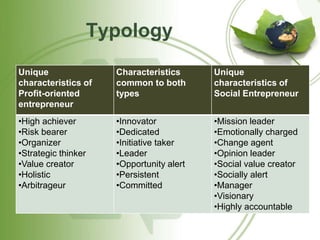
Typology 
Unique 
characteristics of 
Profit-oriented 
entrepreneur 
Characteristics 
common to both 
types 
Unique 
characteristics of 
Social Entrepreneur 
•High achiever 
•Risk bearer 
•Organizer 
•Strategic thinker 
•Value creator 
•Holistic 
•Arbitrageur 
•Innovator 
•Dedicated 
•Initiative taker 
•Leader 
•Opportunity alert 
•Persistent 
•Committed 
•Mission leader 
•Emotionally charged 
•Change agent 
•Opinion leader 
•Social value creator 
•Socially alert 
•Manager 
•Visionary 
•Highly accountable
Boundaries of Social 
Entrepreneurship 
• Distinction between social entrepreneurship 
and other non-entrepreneurial, mission-driven 
initiatives 
• Do not extend to philanthropists, social 
activists, environmentalists, companies with 
foundations, socially responsible organizations 
• Needed and valued but not social 
entrepreneurs
Social Entrepreneurs 
• Operate within boundaries of two 
business strategies: 
1. Non-profit with earned income 
strategies 
• Hybrid social and commercial 
entrepreneurial activity to achieve self-sufficiency 
• Organization both social and commercial 
• Revenues and profits generated improve 
delivery of social values
Social Entrepreneurs 
2. For-profit with mission-driven strategies 
• Social-purpose business 
• Performing social and commercial entrepreneurial 
activities simultaneously to achieve sustainability 
• Organization both social and commercial 
• Financially independent 
• Founders and investors benefit from personal monetary 
gain
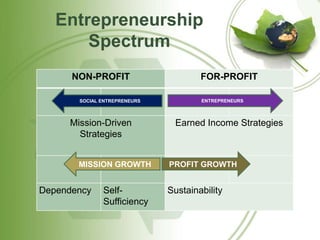
Entrepreneurship 
Spectrum 
NON-PROFIT FOR-PROFIT 
SOCIAL ENTREPRENEURS ENTREPRENEURS 
Mission-Driven 
Strategies 
Earned Income Strategies 
Dependency Self- 
Sufficiency 
Sustainability 
MISSION GROWTH 
PROFIT GROWTH
Social Entrepreneurship 
• Flourished significantly at practical level 
• Social Innovations
• “ You have to accept whatever comes, 
and 
• the only important thing is that you meet it 
with the best you have to give. ”
THANK YOU!

Promoting Entrepreneurship

  • 1.
  • 3.
    • “The bestway to predict the future is to create it.” • • Winners never quit • Quitters never win
  • 4.
    Opportunities • Emergingin many sectors • Potential to transform Myanmar • Young people strike out on their own - self-employed • ‘Domino effect’
  • 5.
    • Business people“satisfy needs” • Entrepreneurs “create needs”
  • 6.
    Government • Promoteentrepreneurship • Newer approaches • Proactive policies
  • 7.
  • 8.
  • 9.
    Entrepreneur • Innovatorimplements change • Five manifestations: 1. Introduction of new/improved good 2. Introduction of new method of production 3. Opening of new market 4. Exploitation of new source of supply 5. Carrying out new organization
  • 10.
    Entrepreneurs • Seeworld differently • Envision future better than others • Seize opportunities that go unnoticed • Perceive and accept risks differently • Exceptional mind-set
  • 11.
  • 12.
    Innovative Economics Prof.Joseph Schumpeter
  • 13.
  • 14.
    Promoting Entrepreneurship •Route to development • Involved in micro and small enterprises (MSE)
  • 15.
    Entrepreneurs • “Personswho are ingenious and creative in finding ways that add to their own wealth, power, and prestige”. • Resource and process where individuals utilize opportunities in market through creation of new business firms
  • 16.
    Entrepreneurship • Innovation,risk-taking and arbitrage • Self- employment • Business ownership • New start-ups
  • 17.
    Entrepreneurship • Crucialfactor in development and well-being of societies • Results • Lower unemployment rates • Adopt innovation • Structural changes in economy • New competition
  • 18.
    Entrepreneurship • Distinctionbetween motivations • “Necessity” entrepreneurs • “Opportunity” entrepreneurs
  • 19.
    Entrepreneurship matter forDevelopment • Structural transformation from low-income, traditional economy to modern economy • Creating new firms outside household • Absorbing surplus labour from traditional sector • Providing innovative intermediate inputs to final-goods producing firms
  • 20.
    Entrepreneurship matter forDevelopment • Greater specialization in manufacturing • Raising productivity and employment in both modern and traditional sectors • Employment growth substantial • Contribution to female empowerment
  • 21.
    Being Entrepreneurs •Non-pecuniary returns • Independence • Positive change in lifestyle • Sense of achievement • Higher levels of job satisfaction
  • 22.
    Designing Policies •Complicated • Three questions: 1. Should entrepreneurship be supported? 2. Can entrepreneurship be supported? 3. What is the most effective means of support?
  • 23.
    Government • Cannotraise supply or quantity of entrepreneurship • Influence allocation of entrepreneurial ability • “Get the institutions right” • Protection of property rights • Well-functioning legal system • Maintain macroeconomic and political stability • Competitive tax rates
  • 24.
    “Entrepreneurial Economy” •Creativity and innovation flourish • Liberalized private-sector economy • Knowledge, policies focused on formation and function of regional clusters and linkages with rest of economy
  • 25.
    Government • Limitationsin dealing with growing number of global challenges: • Climate change • Insecurity • Violent conflict and terrorism • Migration • Vulnerability to financial and economic shocks
  • 26.
  • 27.
    Social Entrepreneurship •Contributions to improve welfare of communities • Socially-oriented entrepreneurial activities • Spectrum of entrepreneurship
  • 28.
    Social Entrepreneurship •Tied with creating social value • Not personal profit • Passion of social mission + • Business-like discipline, innovation, and determination
  • 29.
    Characteristics • Addressingcritical social problems • Dedication in improving well-being of society
  • 30.
    Social Entrepreneurs •Individuals with innovative solutions to society’s most pressing social problems • Visionaries • Realists
  • 31.
    Definition • Mission-drivenindividual • Uses entrepreneurial behaviours to deliver social value to less privileged • Entrepreneurially oriented • Financially independent, self-sufficient, or sustainable
  • 32.
    Typology Unique characteristicsof Profit-oriented entrepreneur Characteristics common to both types Unique characteristics of Social Entrepreneur •High achiever •Risk bearer •Organizer •Strategic thinker •Value creator •Holistic •Arbitrageur •Innovator •Dedicated •Initiative taker •Leader •Opportunity alert •Persistent •Committed •Mission leader •Emotionally charged •Change agent •Opinion leader •Social value creator •Socially alert •Manager •Visionary •Highly accountable
  • 33.
    Boundaries of Social Entrepreneurship • Distinction between social entrepreneurship and other non-entrepreneurial, mission-driven initiatives • Do not extend to philanthropists, social activists, environmentalists, companies with foundations, socially responsible organizations • Needed and valued but not social entrepreneurs
  • 34.
    Social Entrepreneurs •Operate within boundaries of two business strategies: 1. Non-profit with earned income strategies • Hybrid social and commercial entrepreneurial activity to achieve self-sufficiency • Organization both social and commercial • Revenues and profits generated improve delivery of social values
  • 35.
    Social Entrepreneurs 2.For-profit with mission-driven strategies • Social-purpose business • Performing social and commercial entrepreneurial activities simultaneously to achieve sustainability • Organization both social and commercial • Financially independent • Founders and investors benefit from personal monetary gain
  • 36.
    Entrepreneurship Spectrum NON-PROFITFOR-PROFIT SOCIAL ENTREPRENEURS ENTREPRENEURS Mission-Driven Strategies Earned Income Strategies Dependency Self- Sufficiency Sustainability MISSION GROWTH PROFIT GROWTH
  • 37.
    Social Entrepreneurship •Flourished significantly at practical level • Social Innovations
  • 38.
    • “ Youhave to accept whatever comes, and • the only important thing is that you meet it with the best you have to give. ”
  • 40.