Developing and executing an effective Human Resources strategyby Toronto Training and HR September 2011
3-4 Introduction to Toronto Training and 		HR	5-6	Questions to ask7-8	Questions to answer9-11	Organizational succession	12-13	Achieving a fit14-16	The use of playscripts17-18	Putting a strategy in place19-21	High-value strategies22-28	Typical HR strategy-public sector29-36	Typical HR strategy-private sector37-40	Strategy execution41-42Implementing strategy43-44	Drill45-50	Case studies	51-52	Conclusion and questionsContentsPage 2
Page 3Introduction
Page 4Introduction to Toronto Training and HRToronto Training and HRis a specialist training and human resources consultancy headed by Timothy Holden 10 years in banking10 years in training and human resourcesFreelance practitioner since 2006The core services provided by Toronto Training and HR are:Training course design
Training course delivery-  Reducing costsSaving time
Improving employee engagement & morale
Services for job seekersPage 5Questions to ask
Page 6Questions to askSTRESS TESTWho is your primary customer?How do your core values prioritize shareholders, employees and customers?What critical performance variables are you tracking?What strategic boundaries have you set?How are you generating creative tension?How committed are your employees to helping each other?What strategic uncertainties keep you awake at night?
Page 7Questions to answer
Page 8Questions to answerWhat is our capacity building plan?What is our succession plan strategy?What is our change management model to ensure our organization is able to stay fluid and dynamic?What is our process to ensure we are using the right measures to evaluate operational efficiency, knowledge management, transfer of learning and organizational capacity?What is our organizational learning strategy?
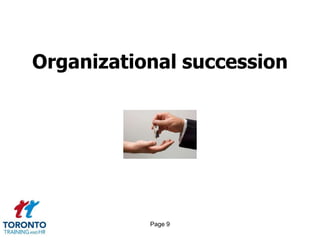
Page 9Organizational succession
Page 10Organizational succession 1 of 2DEFINING GLOBAL TO SPECIFIC SUCCESS BEHAVIOURSOrganizational development philosophyOperational managementDefine each critical position with competenciesDeconstruct the competencies into the behaviours and skills to help achieve the competencies definedFor each competency determine the key performance behavioursDetermine the standard for each key performance behaviour
Page 11Organizational succession 2 of 2ALIGNING SUCCESSION PLANNING WITH CAREER PLANNINGConduct an operational and human capital auditIdentify gapsCreate a recruiting planDevise a hiring planOn-boardingCareer development path
Page 12Achieving a fit
Page 13Achieving a fitFIT TYPESPerson-job fitPerson-group fitPerson-organization fit
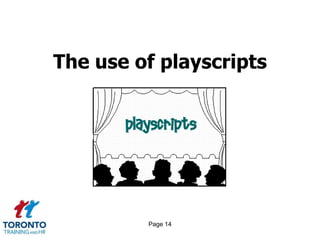
Page 14The use of playscripts
Page 15The use of playscripts 1 of 2Corporate playscriptBusiness playscript
Page 16The use of playscripts 2 of 2DEVELOPING YOUR PLAYSCRIPTWrite your current corporate and business playscriptsRewrite your playscriptFuture-proof your playscript
Page 17Putting a strategy in place
Page 18Putting a strategy in placeState your intentTry again-this time in contextSet your measuresDefine the tasks implied by your intentDefine the boundaries
Page 19High-value strategies
Page 20High-value strategies 1 of 2WHY STRATEGIES FAILThe highest value new ideas are the least understood and least acceptedGifted, creative and strategic thinkers often poorly communicate the new paradigmWhen the new strategy is articulated from on high, even if it is communicated clearly, it is often proclaimed as “doctrine” without any provision for feedback
Page 21High-value strategies 2 of 2ACHIEVING EFFECTIVE IMPLEMENTATIONClearly explain the reason why a new strategy is required, the rationale underlying the new strategy, and the perceived risks in its implementationEncourage questions and feedbackGo slow to go fastSeek to understand your strategic idea before trying to implement it
Page 22Typical HR strategy-public sector
Page 23Typical HR strategy-public sector 1 of 6 YEAR ONE KEY ELEMENTSCommunicationDiversityEmployee and Trade Union RelationsEmployee Development and MotivationHealth, Safety and WelfareOrganizational DevelopmentPerformance ManagementRecruitment and RetentionRemunerationWorkforce Data
Page 24Typical HR strategy-public sector 2 of 6 YEAR ONE AIMS AND KEY OUTCOME MEASURESCommunicationDiversityEmployee and Trade Union RelationsEmployee Development and MotivationHealth, Safety and WelfareOrganizational DevelopmentPerformance ManagementRecruitment and RetentionRemunerationWorkforce Data
Page 25Typical HR strategy-public sector 3 of 6 UNDERLYING CORE PRINCIPLESA proactive approach to learning and taking advantage of all opportunities to spread good practice across the HR function, the wider organization and local community. The utilization of website and intranet for communication both externally and internally in addition to paper based systems. 
Page 26Typical HR strategy-public sector 4 of 6 UNDERLYING CORE PRINCIPLESA commitment to the highest possible standards of confidentiality, professional conduct and competency.A commitment to a ‘quality’ proactive approach and philosophy of ‘continuous improvement’ both individually and for the function.The promotion of employment practices that remove discrimination and support consistency of application across the organization.
Page 27Typical HR strategy-public sector 5 of 6 YEAR TWODeveloping leadershipDeveloping workforce skills and capacityOrganizational developmentResourcing: recruitment, retention and diversityPay and rewardsService and local priorities
Page 28Typical HR strategy-public sector 6 of 6 YEAR THREECommunication Employee developmentOrganizational developmentPerformance management
Page 29Typical HR strategy-private sector
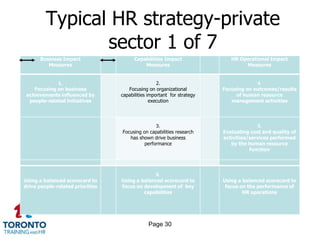
Page 30Typical HR strategy-private sector 1 of 7 YEAR ONE KEY ELEMENTSCommunicationDiversityEmployee and Trade Union RelationsEmployee Development and MotivationHealth, Safety and Welfareorganizational DevelopmentPerformance ManagementRecruitment and RetentionRemunerationWorkforce Data
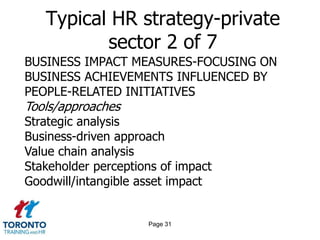
Page 31Typical HR strategy-private sector 2 of 7 BUSINESS IMPACT MEASURES-FOCUSING ON BUSINESS ACHIEVEMENTS INFLUENCED BY PEOPLE-RELATED INITIATIVESTools/approachesStrategic analysisBusiness-driven approachValue chain analysisStakeholder perceptions of impactGoodwill/intangible asset impact
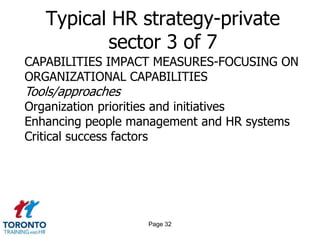
Page 32Typical HR strategy-private sector 3 of 7 CAPABILITIES IMPACT MEASURES-FOCUSING ON ORGANIZATIONAL CAPABILITIESTools/approachesOrganization priorities and initiativesEnhancing people management and HR systemsCritical success factors
Page 33Typical HR strategy-private sector 4 of 7 CAPABILITIES IMPACT MEASURES-FOCUSING ON INITIATIVES THAT HAVE SHOWN TO DRIVE BUSINESS PERFORMANCE Tools/approachesResearch initiatives and surveys
Page 34Typical HR strategy-private sector 5 of 7 HR OPERATIONAL IMPACT MEASURES-FOCUSING ON OUTCOMES/RESULTS OF HRM ACTIVITIESTools/approachesEffectivenessCost/effectivenessSix Sigma measuresReturn on knowledgeHR dashboard
Page 35Typical HR strategy-private sector 6 of 7 HR OPERATIONAL IMPACT MEASURES-EVALUATING COST & QUALITY OF ACTIVITIES/SERVICES PERFORMED BY THE HR FUNCTION & VENDOR MGTTools/approachesCustomer-user satisfactionEfficiencyOverall costs of the HR function
Page 37Typical HR strategy-private sector 7 of 7 USING A BALANCED SCORECARDTools/approachesThe approach is simple and compellingThemes used as a prescriptive framework to guide thinking-strategic skills/competencies, leadership, culture and strategic awareness, strategic alignment and strategic integration/learningHR programs/functions, high performance practices and measures are defined for each category
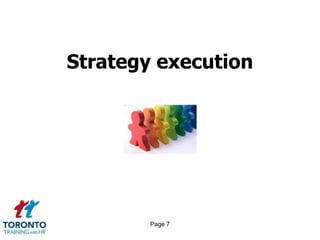
Page 7Strategy execution
Page 38Strategy execution 1 of 3WHAT PREVENTS SUCCESSFUL EXECUTION?DisengagementDisconnection
Page 39Strategy execution 2 of 3Leaders need to define and communicate a common mental model for the strategy, presenting it as a shared picture that means the same thing to everyone-this can be difficult for four reasons:Words are inadequate conveyors of meaningManagers have to receive and send strategic information at the same timeIndividual contributors must see the common mental model and have their managers translate it into what they’ll have to do (and do differently)People need to practice the new skills and behaviours necessary to execute strategy in way that is safe
Page 40Strategy execution 3 of 3POINTS TO BEAR IN MINDTo be engaged, people want to solve their strategic puzzlesThey must be linked in a process that spells out the roles of leaders, managers, and individual contributors in executing that strategy
Page 41Implementing strategy
Page 42Implementing strategyGet the big pictureUncover and collaborateElicit genuine buy-inBuild trust firstFocus on process
Page 43Drill
Page 44Drill
Page 45Case study A
Page 46Case study A
Page 47Case study B
Page 48Case study B
Page 49Case study C
Page 50Case study C

Developing and executing an effective HR strategy September 2011

  • 1.
    Developing and executingan effective Human Resources strategyby Toronto Training and HR September 2011
  • 2.
    3-4 Introduction toToronto Training and HR 5-6 Questions to ask7-8 Questions to answer9-11 Organizational succession 12-13 Achieving a fit14-16 The use of playscripts17-18 Putting a strategy in place19-21 High-value strategies22-28 Typical HR strategy-public sector29-36 Typical HR strategy-private sector37-40 Strategy execution41-42Implementing strategy43-44 Drill45-50 Case studies 51-52 Conclusion and questionsContentsPage 2
  • 3.
  • 4.
    Page 4Introduction toToronto Training and HRToronto Training and HRis a specialist training and human resources consultancy headed by Timothy Holden 10 years in banking10 years in training and human resourcesFreelance practitioner since 2006The core services provided by Toronto Training and HR are:Training course design
  • 5.
    Training course delivery- Reducing costsSaving time
  • 6.
  • 7.
    Services for jobseekersPage 5Questions to ask
  • 8.
    Page 6Questions toaskSTRESS TESTWho is your primary customer?How do your core values prioritize shareholders, employees and customers?What critical performance variables are you tracking?What strategic boundaries have you set?How are you generating creative tension?How committed are your employees to helping each other?What strategic uncertainties keep you awake at night?
  • 9.
  • 10.
    Page 8Questions toanswerWhat is our capacity building plan?What is our succession plan strategy?What is our change management model to ensure our organization is able to stay fluid and dynamic?What is our process to ensure we are using the right measures to evaluate operational efficiency, knowledge management, transfer of learning and organizational capacity?What is our organizational learning strategy?
  • 11.
  • 12.
    Page 10Organizational succession1 of 2DEFINING GLOBAL TO SPECIFIC SUCCESS BEHAVIOURSOrganizational development philosophyOperational managementDefine each critical position with competenciesDeconstruct the competencies into the behaviours and skills to help achieve the competencies definedFor each competency determine the key performance behavioursDetermine the standard for each key performance behaviour
  • 13.
    Page 11Organizational succession2 of 2ALIGNING SUCCESSION PLANNING WITH CAREER PLANNINGConduct an operational and human capital auditIdentify gapsCreate a recruiting planDevise a hiring planOn-boardingCareer development path
  • 14.
  • 15.
    Page 13Achieving afitFIT TYPESPerson-job fitPerson-group fitPerson-organization fit
  • 16.
    Page 14The useof playscripts
  • 17.
    Page 15The useof playscripts 1 of 2Corporate playscriptBusiness playscript
  • 18.
    Page 16The useof playscripts 2 of 2DEVELOPING YOUR PLAYSCRIPTWrite your current corporate and business playscriptsRewrite your playscriptFuture-proof your playscript
  • 19.
    Page 17Putting astrategy in place
  • 20.
    Page 18Putting astrategy in placeState your intentTry again-this time in contextSet your measuresDefine the tasks implied by your intentDefine the boundaries
  • 21.
  • 22.
    Page 20High-value strategies1 of 2WHY STRATEGIES FAILThe highest value new ideas are the least understood and least acceptedGifted, creative and strategic thinkers often poorly communicate the new paradigmWhen the new strategy is articulated from on high, even if it is communicated clearly, it is often proclaimed as “doctrine” without any provision for feedback
  • 23.
    Page 21High-value strategies2 of 2ACHIEVING EFFECTIVE IMPLEMENTATIONClearly explain the reason why a new strategy is required, the rationale underlying the new strategy, and the perceived risks in its implementationEncourage questions and feedbackGo slow to go fastSeek to understand your strategic idea before trying to implement it
  • 24.
    Page 22Typical HRstrategy-public sector
  • 25.
    Page 23Typical HRstrategy-public sector 1 of 6 YEAR ONE KEY ELEMENTSCommunicationDiversityEmployee and Trade Union RelationsEmployee Development and MotivationHealth, Safety and WelfareOrganizational DevelopmentPerformance ManagementRecruitment and RetentionRemunerationWorkforce Data
  • 26.
    Page 24Typical HRstrategy-public sector 2 of 6 YEAR ONE AIMS AND KEY OUTCOME MEASURESCommunicationDiversityEmployee and Trade Union RelationsEmployee Development and MotivationHealth, Safety and WelfareOrganizational DevelopmentPerformance ManagementRecruitment and RetentionRemunerationWorkforce Data
  • 27.
    Page 25Typical HRstrategy-public sector 3 of 6 UNDERLYING CORE PRINCIPLESA proactive approach to learning and taking advantage of all opportunities to spread good practice across the HR function, the wider organization and local community. The utilization of website and intranet for communication both externally and internally in addition to paper based systems. 
  • 28.
    Page 26Typical HRstrategy-public sector 4 of 6 UNDERLYING CORE PRINCIPLESA commitment to the highest possible standards of confidentiality, professional conduct and competency.A commitment to a ‘quality’ proactive approach and philosophy of ‘continuous improvement’ both individually and for the function.The promotion of employment practices that remove discrimination and support consistency of application across the organization.
  • 29.
    Page 27Typical HRstrategy-public sector 5 of 6 YEAR TWODeveloping leadershipDeveloping workforce skills and capacityOrganizational developmentResourcing: recruitment, retention and diversityPay and rewardsService and local priorities
  • 30.
    Page 28Typical HRstrategy-public sector 6 of 6 YEAR THREECommunication Employee developmentOrganizational developmentPerformance management
  • 31.
    Page 29Typical HRstrategy-private sector
  • 32.
    Page 30Typical HRstrategy-private sector 1 of 7 YEAR ONE KEY ELEMENTSCommunicationDiversityEmployee and Trade Union RelationsEmployee Development and MotivationHealth, Safety and Welfareorganizational DevelopmentPerformance ManagementRecruitment and RetentionRemunerationWorkforce Data
  • 33.
    Page 31Typical HRstrategy-private sector 2 of 7 BUSINESS IMPACT MEASURES-FOCUSING ON BUSINESS ACHIEVEMENTS INFLUENCED BY PEOPLE-RELATED INITIATIVESTools/approachesStrategic analysisBusiness-driven approachValue chain analysisStakeholder perceptions of impactGoodwill/intangible asset impact
  • 34.
    Page 32Typical HRstrategy-private sector 3 of 7 CAPABILITIES IMPACT MEASURES-FOCUSING ON ORGANIZATIONAL CAPABILITIESTools/approachesOrganization priorities and initiativesEnhancing people management and HR systemsCritical success factors
  • 35.
    Page 33Typical HRstrategy-private sector 4 of 7 CAPABILITIES IMPACT MEASURES-FOCUSING ON INITIATIVES THAT HAVE SHOWN TO DRIVE BUSINESS PERFORMANCE Tools/approachesResearch initiatives and surveys
  • 36.
    Page 34Typical HRstrategy-private sector 5 of 7 HR OPERATIONAL IMPACT MEASURES-FOCUSING ON OUTCOMES/RESULTS OF HRM ACTIVITIESTools/approachesEffectivenessCost/effectivenessSix Sigma measuresReturn on knowledgeHR dashboard
  • 37.
    Page 35Typical HRstrategy-private sector 6 of 7 HR OPERATIONAL IMPACT MEASURES-EVALUATING COST & QUALITY OF ACTIVITIES/SERVICES PERFORMED BY THE HR FUNCTION & VENDOR MGTTools/approachesCustomer-user satisfactionEfficiencyOverall costs of the HR function
  • 38.
    Page 37Typical HRstrategy-private sector 7 of 7 USING A BALANCED SCORECARDTools/approachesThe approach is simple and compellingThemes used as a prescriptive framework to guide thinking-strategic skills/competencies, leadership, culture and strategic awareness, strategic alignment and strategic integration/learningHR programs/functions, high performance practices and measures are defined for each category
  • 39.
  • 40.
    Page 38Strategy execution1 of 3WHAT PREVENTS SUCCESSFUL EXECUTION?DisengagementDisconnection
  • 41.
    Page 39Strategy execution2 of 3Leaders need to define and communicate a common mental model for the strategy, presenting it as a shared picture that means the same thing to everyone-this can be difficult for four reasons:Words are inadequate conveyors of meaningManagers have to receive and send strategic information at the same timeIndividual contributors must see the common mental model and have their managers translate it into what they’ll have to do (and do differently)People need to practice the new skills and behaviours necessary to execute strategy in way that is safe
  • 42.
    Page 40Strategy execution3 of 3POINTS TO BEAR IN MINDTo be engaged, people want to solve their strategic puzzlesThey must be linked in a process that spells out the roles of leaders, managers, and individual contributors in executing that strategy
  • 43.
  • 44.
    Page 42Implementing strategyGetthe big pictureUncover and collaborateElicit genuine buy-inBuild trust firstFocus on process
  • 45.
  • 46.
  • 47.
  • 48.
  • 49.
  • 50.
  • 51.
  • 52.