HRVALUE
PROPOSITION
@visueelhr
-edition
“
”
Intro
“
”
1
Business
Model
Canvas
Pages
5 – 9
2
HR Business
Model
Canvas
Pages
10 – 20
3
Value
Proposition
Canvas
Pages
21 – 28
4
HR Value
Proposition
Canvas
Pages
29 – 36
Table Of Contents
MODEL
BUSINESS
CANVAS
1
@visueelhr
“
“
”
”
Definition
Alexander Osterwalder
Key partners – describes the network of suppliers and
partners that make the business model work
The 9 Building Blocks
Key activities – describes the most important things a
company must do to make its business model work
Key resources – describes the most important assets
required to make a business model work
Value proposition – describes the bundle of products and
services that create value for a specific customer segment
Customer relationships – describes the types of
relationships a company establishes with specific
customer segments
Channels – describes how a company communicates with
and reaches its customer segments to deliver a value
proposition
The 9 Building Blocks
Customer segments – defines the different groups of
people or organisations an enterprise aims to reach and
serve
Revenue streams – represents the cash a company
generates from each customer segment
Cost structure – describes all costs incurred to operate a
business model
Customer
relationships
Key activities
Customer
segments
Key partners
Value proposition
Cost structure Revenue stream
Key resources Channels
Business Model Canvas
MODEL
BUSINESS
CANVAS
2H
R @visueelhr
“
“
”
”
Definition
HR Business Model Canvas – Value proposition
Value proposition – the collection
of products and services a business
offers to meet the needs of its
customers. Applied to HR, HR offers
the deployment of the right people
at the right place in the right time.
HR Business Model Canvas – Key activities
Key activities – the most important
activities in executing a company’s
value proposition. Applied to HR, HR
conducts activities related to input,
throughput and output of people.
HR Business Model Canvas – Key resources
Key resources – the resources that
are necessary to create value for the
customer. Applied to HR, HR has
technology, administrators and
advisors at its disposal. Also high-
potential employees are important.
HR Business Model Canvas – Key partners
Key partners – in order to optimize
operations and reduce risks of a
business model, organization
usually cultivate buyer-supplier
relationships so they can focus on
their core activity. Applied to HR,
key activities can be outsourced or
purchased by Business Process
Outsourcing, a Shared Service
Centre, Interim Services or head
hunters. Also relationships with
legislators and regulators are
important.
HR Business Model Canvas – Customer relationships
Customer relationships – to ensure
the survival and success of any
businesses, companies must
identify the type of relationship
they want to create with their
customer segments. Applied to HR,
customer relationships are built and
maintained through meetings, self-
service and personal advice.
HR Business Model Canvas – Channels
Channels – a company can deliver
its value proposition to its targeted
customers through different
channels. Applied to HR, HR is
delivering the right people in the
right place in the right time through
an HR portal, a staff shop, advisor
and telephone and (e-)mail.
HR Business Model Canvas – Customer segments
Customer segments – to build an
effective business model, a
company must identify which
customers it tries to serve. Applied
to HR, HR is serving the board of
directors, management and (future)
employees. In addition, (external)
customers and investors are seen as
a customer segment.
HR Business Model Canvas – Revenue streams
Revenue streams – the way a
company makes income from each
customer segment. Applied to HR,
HR gets a budget at its disposal to
ensure the deployment of the right
people at the right place at the right
time.
HR Business Model Canvas – Cost structure
Cost structure – this describes the
most important monetary
consequences while operating
under different business models.
Applied to HR, HR has staffing,
technology and office costs.
VALUEPROPOSITION
CANVAS
3
@visueelhr
“
”
Intro
Product leadership – the focus is on development,
innovation, design, time-to-market, high margins in a
short timeframe.
Value disciplines
Operational excellence – the focus is on efficiency,
streaming operations, Supply Chain Management, no-
frills, volume counts.
Customer intimacy – focus is on CRM, deliver products
and services on time and above customer expectations,
lifetime value concepts, reliability, being close to the
customer.
Model Treacy and Wiersema
Product
leadership
Customer
intimacy
Operational
excellence
Value
proposition
Definition
Alexander Osterwalder
”
“
Products and services – describes the bundle of products
and services offered to the selected customer segment
The 6 Building Blocks
Gain creators – describes how the bundle of products and
services create customer gains
Pain relievers – describes how the bundle of products and
services alleviate customer pains
Value proposition:
Customer job(s) – describes what a specific customer
segment is trying to get done
Pains – describes negative emotions, undesired costs and
situations, and risks that customers experience or could
experience before, during, and after getting the job done
The 6 Building Blocks
Gains – describes the benefits customers expect, desire or
would be surprised by
Customer segments:
Value Proposition Canvas
Gains
Pains
Customer
segments
Customer job(s)
Value
proposition
Gain creators
Pain relieversProducts and
services
Fit
CANVAS
PROPOSITION
VALUE 4H
R @visueelhr
“
Definition
”
HR VP Canvas – Products and services
Products and services – describes the bundle
of products and services offered to the
selected customer segment. Applied to HR, HR
manages workforce in a flexible, open
organisation with an eye for changes at such a
motivational and on the organisation
customized method (value discipline) that the
workforce is as much as possible equipped
with skills with which they can give their work
shape and content without frequent
interference by management. Reputation and
relationship with investors and customers are
strengthened indirectly.
HR VP Canvas – Gain creators
Gain creators – describes how the bundle of
products and services create customer gains.
Applied to HR, HR delivers a contribution to an
organisation by:
• organizing the presence of talent, individual
responsibility, the right people in the right
place and a structure that's right;
• to recruit the right people, to train them in the
right way, develop and reward them, to
communicate with them in the right way so
that there is confidence and involvement at
the strategic direction;
• leadership development;
• offer of HR analytics to management;
• to act as a coach and facilitator of
management/employee.
HR VP Canvas – Pain relievers
Pain relievers – describes how the bundle of
products and services alleviate customer pains.
Applied to HR, HR delivers a contribution to an
organisation by :
• the conduct of a payroll and HR
administration and generate (management)
information;
• supporting the management and
employees at reorganization, redeployment
and firing;
• to have specialist knowledge of laws and
regulations and to inform management and
workforce about laws and regulations;
• to ensure the welfare and safety of
employees;
• adhering to good employment principles.
HR VP Canvas – Customer job(s)
Customer job(s) – describes what a specific
customer segment is trying to get done.
Applied to the (internal) customers of HR, they
try to get the following done:
• management deploys, stimulates and
develops workforce in order to achieve
strategy and objectives;
• an employee is committed in order to
achieve organisational goals and individual
goals and aspirations;
• an investor tries to increase the value of an
organisation by increasing revenue,
reputation and credibility;
• a customer acquires a product or service
and is trying to build a relationship.
HR VP Canvas – Gains
Gains – describes the benefits customers
expect, desire or would be surprised by.
Applied to the (internal) clients of HR, expects
or wishes :
• management to have the right workforce at
the right time and in the right place;
• an employee and management to have
reliable and relevant information;
• an employee meaningful and interesting
work, live up to ambitions, influence and
that promotion and higher pay are
provided;
• an investor confidence in the future;
• a customer to have a good relationship.
HR VP Canvas – Pains
Pains – describes negative emotions,
undesired costs and situations, and risks that
customers (could) experience. Applied to the
(internal) customers of HR :
• employee/manager experience large
administrative burden;
• manager struggles with the question of
how to address reorganisation and
downsizing;
• unawareness of laws and regulations by
employee/manager;
• manager has inadequate view on potential,
ambition and performance of workforce;
• manager has no availability of employees;
• fear of investor that organisation comes
negative in the news (strike);
• no customer empathy.
Inspired by
Business Model Generatie –
Alexander Osterwalder
The Discipline of Market
Leaders – Treacy en Wiersema
Value Proposition Design –
Alexander Osterwalder
Inspired by
The HR Value Proposition –
Dave Ulrich
A Freehand Drawing Search
Engine – Pictofigo
Slidedocs – Nancy Duarte

HR Value Proposition

  • 1.
  • 2.
  • 3.
  • 4.
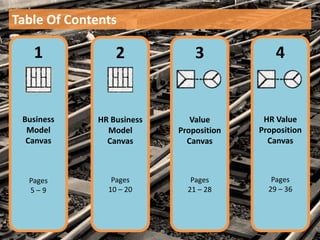
    1 Business Model Canvas Pages 5 – 9 2 HRBusiness Model Canvas Pages 10 – 20 3 Value Proposition Canvas Pages 21 – 28 4 HR Value Proposition Canvas Pages 29 – 36 Table Of Contents
  • 5.
  • 6.
  • 7.
    Key partners –describes the network of suppliers and partners that make the business model work The 9 Building Blocks Key activities – describes the most important things a company must do to make its business model work Key resources – describes the most important assets required to make a business model work Value proposition – describes the bundle of products and services that create value for a specific customer segment Customer relationships – describes the types of relationships a company establishes with specific customer segments
  • 8.
    Channels – describeshow a company communicates with and reaches its customer segments to deliver a value proposition The 9 Building Blocks Customer segments – defines the different groups of people or organisations an enterprise aims to reach and serve Revenue streams – represents the cash a company generates from each customer segment Cost structure – describes all costs incurred to operate a business model
  • 9.
    Customer relationships Key activities Customer segments Key partners Valueproposition Cost structure Revenue stream Key resources Channels Business Model Canvas
  • 10.
  • 11.
  • 12.
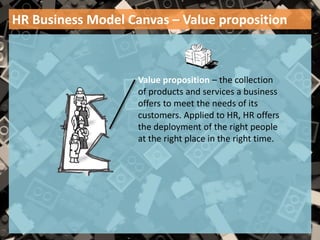
    HR Business ModelCanvas – Value proposition Value proposition – the collection of products and services a business offers to meet the needs of its customers. Applied to HR, HR offers the deployment of the right people at the right place in the right time.
  • 13.
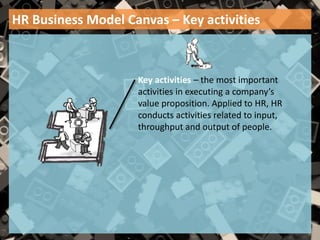
    HR Business ModelCanvas – Key activities Key activities – the most important activities in executing a company’s value proposition. Applied to HR, HR conducts activities related to input, throughput and output of people.
  • 14.
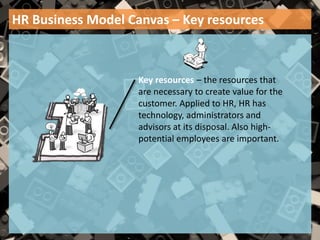
    HR Business ModelCanvas – Key resources Key resources – the resources that are necessary to create value for the customer. Applied to HR, HR has technology, administrators and advisors at its disposal. Also high- potential employees are important.
  • 15.
    HR Business ModelCanvas – Key partners Key partners – in order to optimize operations and reduce risks of a business model, organization usually cultivate buyer-supplier relationships so they can focus on their core activity. Applied to HR, key activities can be outsourced or purchased by Business Process Outsourcing, a Shared Service Centre, Interim Services or head hunters. Also relationships with legislators and regulators are important.
  • 16.
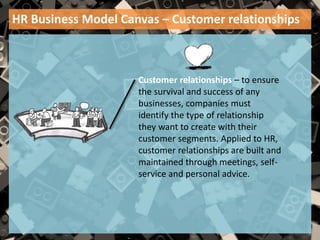
    HR Business ModelCanvas – Customer relationships Customer relationships – to ensure the survival and success of any businesses, companies must identify the type of relationship they want to create with their customer segments. Applied to HR, customer relationships are built and maintained through meetings, self- service and personal advice.
  • 17.
    HR Business ModelCanvas – Channels Channels – a company can deliver its value proposition to its targeted customers through different channels. Applied to HR, HR is delivering the right people in the right place in the right time through an HR portal, a staff shop, advisor and telephone and (e-)mail.
  • 18.
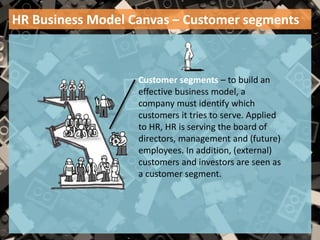
    HR Business ModelCanvas – Customer segments Customer segments – to build an effective business model, a company must identify which customers it tries to serve. Applied to HR, HR is serving the board of directors, management and (future) employees. In addition, (external) customers and investors are seen as a customer segment.
  • 19.
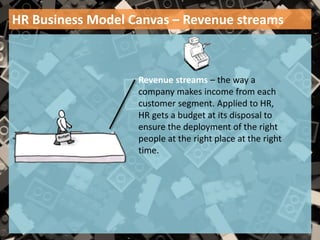
    HR Business ModelCanvas – Revenue streams Revenue streams – the way a company makes income from each customer segment. Applied to HR, HR gets a budget at its disposal to ensure the deployment of the right people at the right place at the right time.
  • 20.
    HR Business ModelCanvas – Cost structure Cost structure – this describes the most important monetary consequences while operating under different business models. Applied to HR, HR has staffing, technology and office costs.
  • 21.
  • 22.
  • 23.
    Product leadership –the focus is on development, innovation, design, time-to-market, high margins in a short timeframe. Value disciplines Operational excellence – the focus is on efficiency, streaming operations, Supply Chain Management, no- frills, volume counts. Customer intimacy – focus is on CRM, deliver products and services on time and above customer expectations, lifetime value concepts, reliability, being close to the customer.
  • 24.
    Model Treacy andWiersema Product leadership Customer intimacy Operational excellence Value proposition
  • 25.
  • 26.
    Products and services– describes the bundle of products and services offered to the selected customer segment The 6 Building Blocks Gain creators – describes how the bundle of products and services create customer gains Pain relievers – describes how the bundle of products and services alleviate customer pains Value proposition:
  • 27.
    Customer job(s) –describes what a specific customer segment is trying to get done Pains – describes negative emotions, undesired costs and situations, and risks that customers experience or could experience before, during, and after getting the job done The 6 Building Blocks Gains – describes the benefits customers expect, desire or would be surprised by Customer segments:
  • 28.
    Value Proposition Canvas Gains Pains Customer segments Customerjob(s) Value proposition Gain creators Pain relieversProducts and services Fit
  • 29.
  • 30.
  • 31.
    HR VP Canvas– Products and services Products and services – describes the bundle of products and services offered to the selected customer segment. Applied to HR, HR manages workforce in a flexible, open organisation with an eye for changes at such a motivational and on the organisation customized method (value discipline) that the workforce is as much as possible equipped with skills with which they can give their work shape and content without frequent interference by management. Reputation and relationship with investors and customers are strengthened indirectly.
  • 32.
    HR VP Canvas– Gain creators Gain creators – describes how the bundle of products and services create customer gains. Applied to HR, HR delivers a contribution to an organisation by: • organizing the presence of talent, individual responsibility, the right people in the right place and a structure that's right; • to recruit the right people, to train them in the right way, develop and reward them, to communicate with them in the right way so that there is confidence and involvement at the strategic direction; • leadership development; • offer of HR analytics to management; • to act as a coach and facilitator of management/employee.
  • 33.
    HR VP Canvas– Pain relievers Pain relievers – describes how the bundle of products and services alleviate customer pains. Applied to HR, HR delivers a contribution to an organisation by : • the conduct of a payroll and HR administration and generate (management) information; • supporting the management and employees at reorganization, redeployment and firing; • to have specialist knowledge of laws and regulations and to inform management and workforce about laws and regulations; • to ensure the welfare and safety of employees; • adhering to good employment principles.
  • 34.
    HR VP Canvas– Customer job(s) Customer job(s) – describes what a specific customer segment is trying to get done. Applied to the (internal) customers of HR, they try to get the following done: • management deploys, stimulates and develops workforce in order to achieve strategy and objectives; • an employee is committed in order to achieve organisational goals and individual goals and aspirations; • an investor tries to increase the value of an organisation by increasing revenue, reputation and credibility; • a customer acquires a product or service and is trying to build a relationship.
  • 35.
    HR VP Canvas– Gains Gains – describes the benefits customers expect, desire or would be surprised by. Applied to the (internal) clients of HR, expects or wishes : • management to have the right workforce at the right time and in the right place; • an employee and management to have reliable and relevant information; • an employee meaningful and interesting work, live up to ambitions, influence and that promotion and higher pay are provided; • an investor confidence in the future; • a customer to have a good relationship.
  • 36.
    HR VP Canvas– Pains Pains – describes negative emotions, undesired costs and situations, and risks that customers (could) experience. Applied to the (internal) customers of HR : • employee/manager experience large administrative burden; • manager struggles with the question of how to address reorganisation and downsizing; • unawareness of laws and regulations by employee/manager; • manager has inadequate view on potential, ambition and performance of workforce; • manager has no availability of employees; • fear of investor that organisation comes negative in the news (strike); • no customer empathy.
  • 37.
    Inspired by Business ModelGeneratie – Alexander Osterwalder The Discipline of Market Leaders – Treacy en Wiersema Value Proposition Design – Alexander Osterwalder
  • 38.
    Inspired by The HRValue Proposition – Dave Ulrich A Freehand Drawing Search Engine – Pictofigo Slidedocs – Nancy Duarte