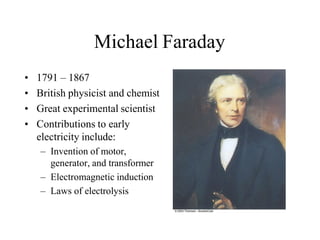
Michael Faraday
• 1791 – 1867
• British physicist and chemist
• Great experimental scientist
• Contributions to early
electricity include:
– Invention of motor,
generator, and transformer
– Electromagnetic induction
– Laws of electrolysis
Generator Effect: EM Induction
A changing magnetic flux induces an EMF.
Magnet moves in a stationary coil.
+
-
EM Induction
The magnet is pushed into the coil.
What is the direction of the induced current?
+
-
B
Michael
Faraday
(1791 - 1867)
d
dt
 = -
N
Faraday’s Law of Induction
induced
dt
 N
dext

number of
loops
Emf that drives the
induced current
(nonconservative)
Faraday’s Law
How quickly you change
the number of external field
lines through one loop.
Opposes the change
in magnetic flux
Lenz’s law: the induced current in a
loop is in the direction that creates a
magnetic field that opposes the change
in magnetic flux through the area
enclosed by the loop
FLUX Magnetic FLUX
d  B dA
d  BcosdA
The amount of FLOW
perpendicular to a surface!
  B dA
The flux depends on the
magnitude of the B field, the area,
A, it intersects and the angle
between them. Changes in B, A
or θproduce a change in the
magnetic flux.
Magnetic Flux
Maximum
Flux
 = 0
Maximum
Flux
 = 180
Minimum
Flux
 = 90
Magnetic Flux: B  BAcos
B
Maxwell’s Equations
Gauss's law electric:

Faraday's law:
Ampere-Maxwell law
S
S
εo
EdA 
q
Gauss's law in (magnetic): BdA  0
E
d
dt
Eds  
dB
Bds  μo I μo
dt
d
dt
 = -
N
Faraday’s Law of Induction
dt dt open

closed
  Eds  
dB
 
d
 BdA
The emf induced in a closed loop is directly proportional to the
time rate of change of the magnetic flux through the loop. The
electric field is path dependent – E is NOT conservative.
Why does the Ring Jump?
Lenz’s Law!
Great Demo: Jumping Ring
The magnetic force on each bit of ring is radially inward and upward, at
angle  above the radial line. The radially inward components tend to
squeeze the ring but all cancel out as forces. The upward components add:
F  ILB  dF  IdsBsin  F  IBsin ds
F  I2 rBsin up
EM Induction
The induced EMF produces a a current that produces a magnetic field
that opposes the original changing magnetic field.
To find the direction of the induced current:
1. Determine the flux change: Increasing? Decreasing?
2. The induced B field will be opposite. Find that.
3. Find the current with the RHR to produce the induced B field.
A conducting loop is
halfway into a magnetic
field. Suppose the magnetic
field begins to increase
rapidly in strength. What
happens to the loop?
1. The loop is pushed upward, toward the top of the page.
2. The loop is pushed downward, toward the bottom of the page.
3. The loop is pulled to the left, into the magnetic field.
4. The loop is pushed to the right, out of the magnetic field.
5. The tension is the wires increases but the loop does not move.
A conducting loop is
halfway into a magnetic
field. Suppose the magnetic
field begins to increase
rapidly in strength. What
happens to the loop?
1. The loop is pushed upward, toward the top of the page.
2. The loop is pushed downward, toward the bottom of the page.
3. The loop is pulled to the left, into the magnetic field.
4. The loop is pushed to the right, out of the magnetic field.
5. The tension is the wires increases but the loop does not move.
Faraday’s Law of Induction
The emf induced in a closed loop is directly
proportional to the time rate of change of the
magnetic flux through the loop.
open
dt

closed
  Eds  
dB
   BdA
How many ways can the flux change?
dt
 =-N
d =-N
d(ABcos)
dt
Sound Reproduction: B Changes
 =-N
d
=-N
d(ABcos)
dt dt
Angle Changes: Generators
 =-N
d
=-N
d(ABcos)
dt dt
 =-N
d
=-N
d(ABcos)
dt dt
Area Changes: Motional EMF
The Hall Effect
When a current carrying conductor is placed in a magnetic field, the
magnetic force causes a separation of charge in the conductor which
produces a charge separation and voltage, VH, in a direction that is
perpendicular to both the current and the magnetic field.
This Hall voltage produces an E field that opposes the Hall
Effect and tries to push the electrons back up. Eventually,
balance is reached. By measuring the voltage you can use a
hall probe to measure the magnetic field.
VH  qE  qvd B
• A motional emf is the emf
induced in a conductor
moving through a constant
magnetic field. The Hall
Effect induces an emf.
• The electrons in the
conductor experience a
force,
that is directed along ℓ
• The charges accumulate at
both ends of the conductor
until they are in equilibrium
with regard to the electric
and magnetic forces.
F  qvB
F  qvB  qE  q(l )
E  vB
 = Blv
Forces on a Sliding Conducting Bar
• The applied force to the right must balance the
magnetic force to keep the bar moving at constant
speed. The force does work on the bar.
• The magnetic force on the induced current in the
wire is opposite the motion of the bar.
Fapp  FB
B
F  I B 

( ) B  (
vLB
) B
R R
v 2
B2
R
Fapp  FB 
Sliding Conducting Bar Circuit
I 
ε

B v
R R
• A bar moving through a uniform field and the
equivalent circuit diagram
• Assume the bar has zero resistance and the stationary
part of the circuit has a resistance R
• The induced current obeys Ohms Law
 = Blv
εMotional Emf  = Blv
I 
ε

B v
R R
v 2
B2
R
Fapp  FB 
Geomagnetic Induction and Thrust
The forces generated by this
"electrodynamic" tether can be used to
pull or push a spacecraft to act as a brake
or a booster or to generate voltage.
Calculate the motional emf
induces alonga 20 km long
conductor moving at the
orbital speed of 7.8 km/s
perpendicular to the Earth’s
0.5 microT magnetic field.
 = Blv
Tethered Satellite Experiment
Cool Problem! Incline Generator!
Eddy Currents
Current loops in moving currents create drag
due to magnetic damping.
Eddy currents
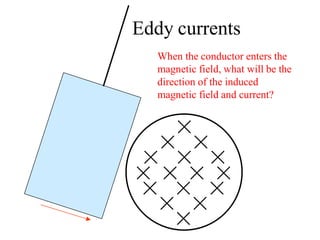
When the conductor enters the
magnetic field, what will be the
direction of the induced
magnetic field and current?
Eddy currents
What will be the direction of
the magnetic force on the
current in the conductor?
Eddy currents
F
What will be the direction of
the magnetic force on the
current in the conductor?
The force
slows the
conductor.
Eddy Currents
• To reduce energy loses by
the eddy currents, the
conducting parts can
– Be built up in thin layers
separated by a
nonconducting material
– Have slots cut in the
conducting plate
• Both prevent large current
loops and increase the
efficiency of the device
 =-N
(ABcos)
t
open
dt

closed
  Eds  
dB
   BdA
Area of Coil Changes
Eddy Currents & National
Security!!
Traffic Light Triggering
A traffic light sensor uses an inductance loop in the
road. When a car sits on top of the loop, the
inductance is changed due to eddy currents in the
steel in the car. The sensor constantly tests the
inductance of the loop in the road, and when the
inductance rises, it knows there is a car waiting!
Traffic Loops
AC Generators
dt dt
  NABsint
For a coil with N turns, area A, turning at angular
speed  the induced EMF is:
 = -N
d
 -N
d BAcos   -N
d BAcost
dt
(: rad/s)
Generator Problem
The 500 turn square coil has sides of
length 10.0 cm and is in a uniform 1.25 T
magnetic field. Initially the coil is
perpendicular to the field and then it is
turned 90 degrees as shown in 0.05s.
a) Does the magnetic flux through the coil
increase or decrease during the ¼ turn?
b) What is the average EMF induced?
c) At what time is the EMF maximum?
What is the maximum EMF?
d) What is the frequency of the ac
generated?
AC VS DC Generators
In an AC electric generator, or
alternator, the flux through the
loops of wire (wound on the
armature) changes, and therefore
according to Faraday's law there
will be an emf induced in the
loops of wire.
In a DC generator the direction
of the induced current in the
loops must be changed every
one-half turn of the generator
shaft. This is done with split
rings on the rotating armature
contacting the stationary
"brushes" which are in turn
connected to the wires coming
out of the generator.
Motors & Generators
Magnetic Force on
Moving Charges in
Loop: Motor Effect
Magnetic Field
Changing through
Loop: Generator Effect
Motor Effect Generator Effect
Sources of Electrical Power
Solar doesn’t use a EM induction!!
Power Production
Coal, Nuclear, Oil or Gas:
It all comes down to making
HOT WATER & STEAM
to turn a turbine!
Wind & Tidal Turbines
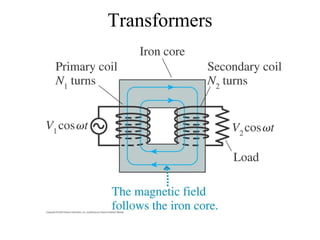
Transformers
PP  PS  ISVS  IPVP
VS

IP

NS
VP IS NP
Voltage and Current Change but Energy & Power DO NOT!
EM Inductance:Transformers
S
S P
P
V
N
N
V  S P
S
NP
N
I  I
o
B  μ
N
I  I 
1
N
Step UP
Step Down
NS  NP
NS  NP
“Step” refers to VOLTAGE:
Transformers
S
S P
NP
N
V  V
Step Down
Decrease Voltage
Increase Current
Step UP
Increase Voltage
Decrease Current
NP
S P
S
I  I
N
Transformers and Auto Ignition
Converting 12V to 40,000V
Power Transmission
Step up Voltage Step Down Current to reduce Power loss.
S
S P
NP
N
V  V
NP
S P
S
I  I
N
Transformers
(Modern transmission grids use AC voltages up to 765,000 volts.)
The Power Grid
Typical power plant can generate MegaWatts of Energy.
US consumption of electricity is 90 Quadrillion BTUs/year.
1 quad = 1015 Btu = 2.931 x 10¹¹ kW-hrs
Hetch Hetchy: 2 billion kW-hrs per year
Wind in CA: 4.5 million kW-hrs per year
In The Future….
Long Distance AC Power Transmission
may not be needed!!!
Advantages of AC Transmission
• Alternating Current can be transformed to ‘step’ the voltage up or down
with transformers.
• Power is transmitted at great distances at HIGH voltages and LOW
currents and then stepped down to low voltages for use in homes (240V)
and industry (440V).
• Convert AC to DC with a rectifier in appliances.
AC is more efficient for
Transmission & Distribution of
electrical power than DC!
War of Currents 1880’s
Thomas Edison, American
inventor and businessman,
pushed for the development of
a DC power network.
George Westinghouse,
American entrepreneur
and engineer, backed
financially the
development of a
practical AC power
network.
Nikola Tesla, Serbian
inventor, physicist,
and electro-
mechanical engineer,
was instrumental in
developing AC
networks.

Faraday’s Law.pdf

  • 1.
    Michael Faraday • 1791– 1867 • British physicist and chemist • Great experimental scientist • Contributions to early electricity include: – Invention of motor, generator, and transformer – Electromagnetic induction – Laws of electrolysis
  • 2.
    Generator Effect: EMInduction A changing magnetic flux induces an EMF. Magnet moves in a stationary coil. + -
  • 3.
    EM Induction The magnetis pushed into the coil. What is the direction of the induced current? + - B
  • 4.
    Michael Faraday (1791 - 1867) d dt = - N Faraday’s Law of Induction
  • 5.
    induced dt  N dext  number of loops Emfthat drives the induced current (nonconservative) Faraday’s Law How quickly you change the number of external field lines through one loop. Opposes the change in magnetic flux Lenz’s law: the induced current in a loop is in the direction that creates a magnetic field that opposes the change in magnetic flux through the area enclosed by the loop
  • 6.
    FLUX Magnetic FLUX d B dA d  BcosdA The amount of FLOW perpendicular to a surface!   B dA The flux depends on the magnitude of the B field, the area, A, it intersects and the angle between them. Changes in B, A or θproduce a change in the magnetic flux.
  • 7.
    Magnetic Flux Maximum Flux  =0 Maximum Flux  = 180 Minimum Flux  = 90 Magnetic Flux: B  BAcos B
  • 8.
    Maxwell’s Equations Gauss's lawelectric:  Faraday's law: Ampere-Maxwell law S S εo EdA  q Gauss's law in (magnetic): BdA  0 E d dt Eds   dB Bds  μo I μo dt
  • 9.
    d dt  = - N Faraday’sLaw of Induction dt dt open  closed   Eds   dB   d  BdA The emf induced in a closed loop is directly proportional to the time rate of change of the magnetic flux through the loop. The electric field is path dependent – E is NOT conservative.
  • 10.
    Why does theRing Jump? Lenz’s Law!
  • 11.
    Great Demo: JumpingRing The magnetic force on each bit of ring is radially inward and upward, at angle  above the radial line. The radially inward components tend to squeeze the ring but all cancel out as forces. The upward components add: F  ILB  dF  IdsBsin  F  IBsin ds F  I2 rBsin up
  • 12.
    EM Induction The inducedEMF produces a a current that produces a magnetic field that opposes the original changing magnetic field. To find the direction of the induced current: 1. Determine the flux change: Increasing? Decreasing? 2. The induced B field will be opposite. Find that. 3. Find the current with the RHR to produce the induced B field.
  • 13.
    A conducting loopis halfway into a magnetic field. Suppose the magnetic field begins to increase rapidly in strength. What happens to the loop? 1. The loop is pushed upward, toward the top of the page. 2. The loop is pushed downward, toward the bottom of the page. 3. The loop is pulled to the left, into the magnetic field. 4. The loop is pushed to the right, out of the magnetic field. 5. The tension is the wires increases but the loop does not move.
  • 14.
    A conducting loopis halfway into a magnetic field. Suppose the magnetic field begins to increase rapidly in strength. What happens to the loop? 1. The loop is pushed upward, toward the top of the page. 2. The loop is pushed downward, toward the bottom of the page. 3. The loop is pulled to the left, into the magnetic field. 4. The loop is pushed to the right, out of the magnetic field. 5. The tension is the wires increases but the loop does not move.
  • 15.
    Faraday’s Law ofInduction The emf induced in a closed loop is directly proportional to the time rate of change of the magnetic flux through the loop. open dt  closed   Eds   dB    BdA How many ways can the flux change? dt  =-N d =-N d(ABcos) dt
  • 16.
    Sound Reproduction: BChanges  =-N d =-N d(ABcos) dt dt
  • 17.
    Angle Changes: Generators =-N d =-N d(ABcos) dt dt
  • 18.
  • 19.
    The Hall Effect Whena current carrying conductor is placed in a magnetic field, the magnetic force causes a separation of charge in the conductor which produces a charge separation and voltage, VH, in a direction that is perpendicular to both the current and the magnetic field. This Hall voltage produces an E field that opposes the Hall Effect and tries to push the electrons back up. Eventually, balance is reached. By measuring the voltage you can use a hall probe to measure the magnetic field. VH  qE  qvd B
  • 20.
    • A motionalemf is the emf induced in a conductor moving through a constant magnetic field. The Hall Effect induces an emf. • The electrons in the conductor experience a force, that is directed along ℓ • The charges accumulate at both ends of the conductor until they are in equilibrium with regard to the electric and magnetic forces. F  qvB F  qvB  qE  q(l ) E  vB  = Blv
  • 21.
    Forces on aSliding Conducting Bar • The applied force to the right must balance the magnetic force to keep the bar moving at constant speed. The force does work on the bar. • The magnetic force on the induced current in the wire is opposite the motion of the bar. Fapp  FB B F  I B   ( ) B  ( vLB ) B R R v 2 B2 R Fapp  FB 
  • 22.
    Sliding Conducting BarCircuit I  ε  B v R R • A bar moving through a uniform field and the equivalent circuit diagram • Assume the bar has zero resistance and the stationary part of the circuit has a resistance R • The induced current obeys Ohms Law  = Blv
  • 23.
    εMotional Emf = Blv I  ε  B v R R v 2 B2 R Fapp  FB 
  • 24.
    Geomagnetic Induction andThrust The forces generated by this "electrodynamic" tether can be used to pull or push a spacecraft to act as a brake or a booster or to generate voltage.
  • 25.
    Calculate the motionalemf induces alonga 20 km long conductor moving at the orbital speed of 7.8 km/s perpendicular to the Earth’s 0.5 microT magnetic field.  = Blv Tethered Satellite Experiment
  • 26.
  • 27.
    Eddy Currents Current loopsin moving currents create drag due to magnetic damping.
  • 28.
    Eddy currents When theconductor enters the magnetic field, what will be the direction of the induced magnetic field and current?
  • 29.
    Eddy currents What willbe the direction of the magnetic force on the current in the conductor?
  • 30.
    Eddy currents F What willbe the direction of the magnetic force on the current in the conductor? The force slows the conductor.
  • 31.
    Eddy Currents • Toreduce energy loses by the eddy currents, the conducting parts can – Be built up in thin layers separated by a nonconducting material – Have slots cut in the conducting plate • Both prevent large current loops and increase the efficiency of the device
  • 33.
     =-N (ABcos) t open dt  closed  Eds   dB    BdA Area of Coil Changes
  • 34.
    Eddy Currents &National Security!!
  • 35.
    Traffic Light Triggering Atraffic light sensor uses an inductance loop in the road. When a car sits on top of the loop, the inductance is changed due to eddy currents in the steel in the car. The sensor constantly tests the inductance of the loop in the road, and when the inductance rises, it knows there is a car waiting!
  • 36.
  • 37.
    AC Generators dt dt  NABsint For a coil with N turns, area A, turning at angular speed  the induced EMF is:  = -N d  -N d BAcos   -N d BAcost dt (: rad/s)
  • 38.
    Generator Problem The 500turn square coil has sides of length 10.0 cm and is in a uniform 1.25 T magnetic field. Initially the coil is perpendicular to the field and then it is turned 90 degrees as shown in 0.05s. a) Does the magnetic flux through the coil increase or decrease during the ¼ turn? b) What is the average EMF induced? c) At what time is the EMF maximum? What is the maximum EMF? d) What is the frequency of the ac generated?
  • 39.
    AC VS DCGenerators In an AC electric generator, or alternator, the flux through the loops of wire (wound on the armature) changes, and therefore according to Faraday's law there will be an emf induced in the loops of wire. In a DC generator the direction of the induced current in the loops must be changed every one-half turn of the generator shaft. This is done with split rings on the rotating armature contacting the stationary "brushes" which are in turn connected to the wires coming out of the generator.
  • 40.
    Motors & Generators MagneticForce on Moving Charges in Loop: Motor Effect Magnetic Field Changing through Loop: Generator Effect Motor Effect Generator Effect
  • 41.
    Sources of ElectricalPower Solar doesn’t use a EM induction!!
  • 42.
    Power Production Coal, Nuclear,Oil or Gas: It all comes down to making HOT WATER & STEAM to turn a turbine!
  • 43.
    Wind & TidalTurbines
  • 44.
  • 45.
    PP  PS ISVS  IPVP VS  IP  NS VP IS NP Voltage and Current Change but Energy & Power DO NOT! EM Inductance:Transformers S S P P V N N V  S P S NP N I  I o B  μ N I  I  1 N Step UP Step Down NS  NP NS  NP “Step” refers to VOLTAGE:
  • 46.
    Transformers S S P NP N V V Step Down Decrease Voltage Increase Current Step UP Increase Voltage Decrease Current NP S P S I  I N
  • 47.
    Transformers and AutoIgnition Converting 12V to 40,000V
  • 48.
    Power Transmission Step upVoltage Step Down Current to reduce Power loss. S S P NP N V  V NP S P S I  I N Transformers (Modern transmission grids use AC voltages up to 765,000 volts.)
  • 49.
    The Power Grid Typicalpower plant can generate MegaWatts of Energy. US consumption of electricity is 90 Quadrillion BTUs/year. 1 quad = 1015 Btu = 2.931 x 10¹¹ kW-hrs Hetch Hetchy: 2 billion kW-hrs per year Wind in CA: 4.5 million kW-hrs per year
  • 50.
    In The Future…. LongDistance AC Power Transmission may not be needed!!!
  • 51.
    Advantages of ACTransmission • Alternating Current can be transformed to ‘step’ the voltage up or down with transformers. • Power is transmitted at great distances at HIGH voltages and LOW currents and then stepped down to low voltages for use in homes (240V) and industry (440V). • Convert AC to DC with a rectifier in appliances. AC is more efficient for Transmission & Distribution of electrical power than DC!
  • 52.
    War of Currents1880’s Thomas Edison, American inventor and businessman, pushed for the development of a DC power network. George Westinghouse, American entrepreneur and engineer, backed financially the development of a practical AC power network. Nikola Tesla, Serbian inventor, physicist, and electro- mechanical engineer, was instrumental in developing AC networks.