Chapter 22
Electromagnetic
Induction
22.1 Induced Emf and Induced Current
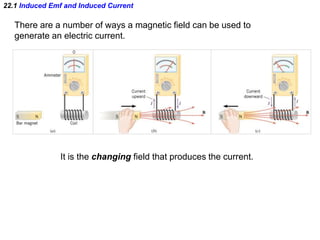
There are a number of ways a magnetic field can be used to
generate an electric current.
It is the changing field that produces the current.
22.1 Induced Emf and Induced Current
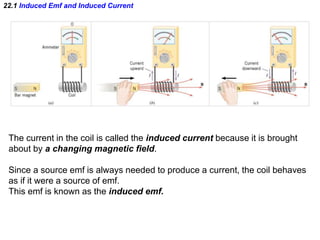
The current in the coil is called the induced current because it is brought
about by a changing magnetic field.
Since a source emf is always needed to produce a current, the coil behaves
as if it were a source of emf.
This emf is known as the induced emf.
22.1 Induced Emf and Induced Current
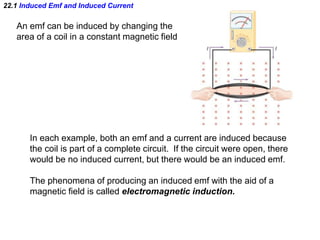
An emf can be induced by changing the
area of a coil in a constant magnetic field
In each example, both an emf and a current are induced because
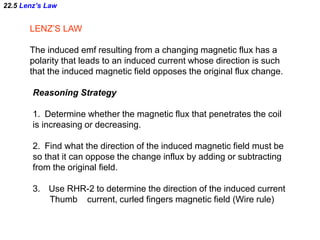
the coil is part of a complete circuit. If the circuit were open, there
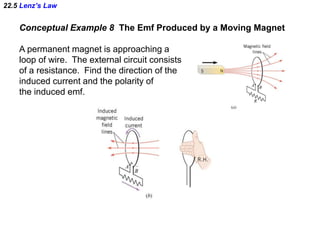
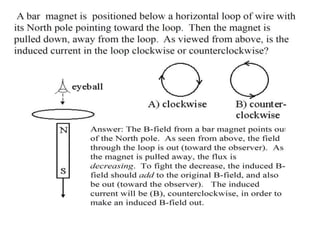
would be no induced current, but there would be an induced emf.
The phenomena of producing an induced emf with the aid of a
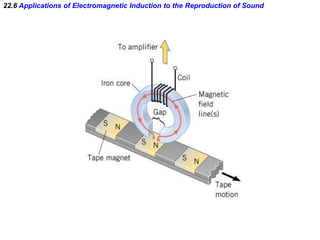
magnetic field is called electromagnetic induction.
22.2 Motional Emf
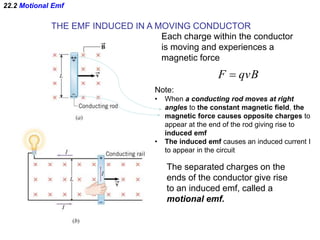
THE EMF INDUCED IN A MOVING CONDUCTOR
Each charge within the conductor
is moving and experiences a
magnetic force
qvBF 
The separated charges on the
ends of the conductor give rise
to an induced emf, called a
motional emf.
Note:
• When a conducting rod moves at right
angles to the constant magnetic field, the
magnetic force causes opposite charges to
appear at the end of the rod giving rise to
induced emf
• The induced emf causes an induced current I
to appear in the circuit
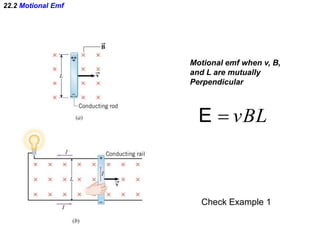
22.2 Motional Emf
vBLE
Motional emf when v, B,
and L are mutually
Perpendicular
Check Example 1
22.2 Motional Emf
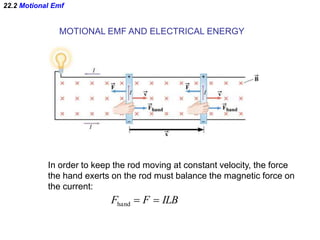
MOTIONAL EMF AND ELECTRICAL ENERGY
In order to keep the rod moving at constant velocity, the force
the hand exerts on the rod must balance the magnetic force on
the current:
ILBFF hand
22.2 Motional Emf
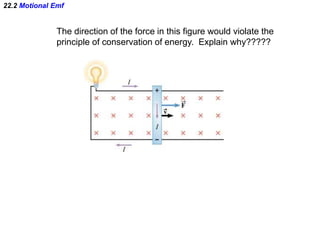
The direction of the force in this figure would violate the
principle of conservation of energy. Explain why?????
22.2 Motional Emf
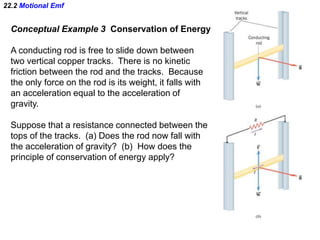
Conceptual Example 3 Conservation of Energy
A conducting rod is free to slide down between
two vertical copper tracks. There is no kinetic
friction between the rod and the tracks. Because
the only force on the rod is its weight, it falls with
an acceleration equal to the acceleration of
gravity.
Suppose that a resistance connected between the
tops of the tracks. (a) Does the rod now fall with
the acceleration of gravity? (b) How does the
principle of conservation of energy apply?
22.3 Magnetic Flux
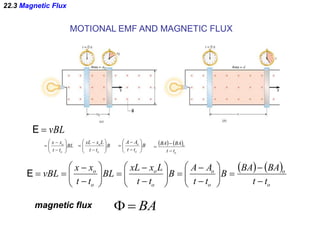
MOTIONAL EMF AND MAGNETIC FLUX
   
o
o
o
o
o
o
o
o
tt
BABA
B
tt
AA
B
tt
LxxL
BL
tt
xx
vBL


























E
magnetic flux BA
vBLE
BL
tt
xx
o
o








 B
tt
LxxL
o
o








 B
tt
AA
o
o








    
o
o
tt
BABA



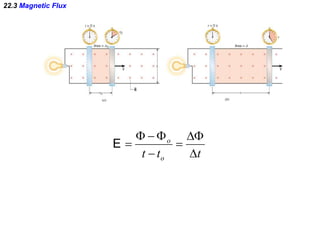
22.3 Magnetic Flux
ttt o
o





E
22.3 Magnetic Flux
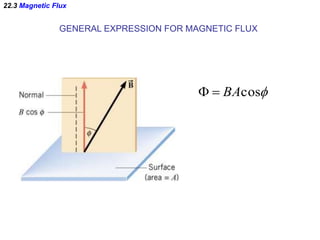
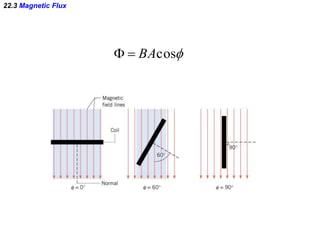
GENERAL EXPRESSION FOR MAGNETIC FLUX
cosBA
22.3 Magnetic Flux
cosBA
22.3 Magnetic Flux
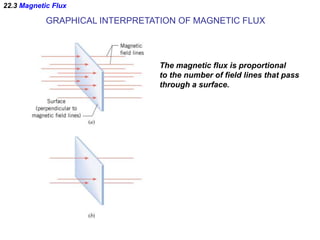
GRAPHICAL INTERPRETATION OF MAGNETIC FLUX
The magnetic flux is proportional
to the number of field lines that pass
through a surface.
22.4 Faraday’s Law of Electromagnetic Induction
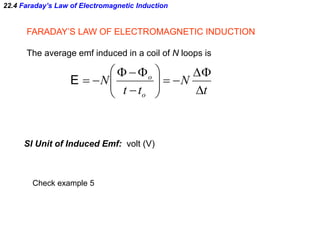
FARADAY’S LAW OF ELECTROMAGNETIC INDUCTION
The average emf induced in a coil of N loops is
t
N
tt
N
o
o










E
SI Unit of Induced Emf: volt (V)
Check example 5
22.4 Faraday’s Law of Electromagnetic Induction
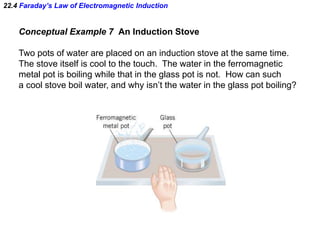
Conceptual Example 7 An Induction Stove
Two pots of water are placed on an induction stove at the same time.
The stove itself is cool to the touch. The water in the ferromagnetic
metal pot is boiling while that in the glass pot is not. How can such
a cool stove boil water, and why isn’t the water in the glass pot boiling?
22.5 Lenz’s Law
LENZ’S LAW
The induced emf resulting from a changing magnetic flux has a
polarity that leads to an induced current whose direction is such
that the induced magnetic field opposes the original flux change.
Reasoning Strategy
1. Determine whether the magnetic flux that penetrates the coil
is increasing or decreasing.
2. Find what the direction of the induced magnetic field must be
so that it can oppose the change influx by adding or subtracting
from the original field.
3. Use RHR-2 to determine the direction of the induced current
Thumb current, curled fingers magnetic field (Wire rule)
22.5 Lenz’s Law
Conceptual Example 8 The Emf Produced by a Moving Magnet
A permanent magnet is approaching a
loop of wire. The external circuit consists
of a resistance. Find the direction of the
induced current and the polarity of
the induced emf.
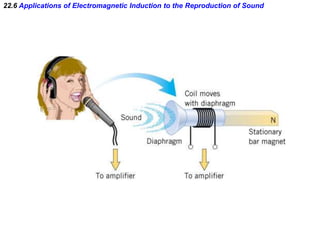
22.6 Applications of Electromagnetic Induction to the Reproduction of Sound
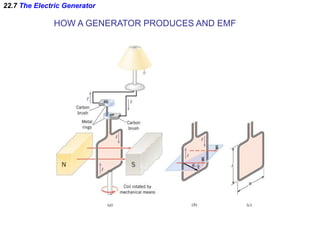
22.7 The Electric Generator
HOW A GENERATOR PRODUCES AND EMF
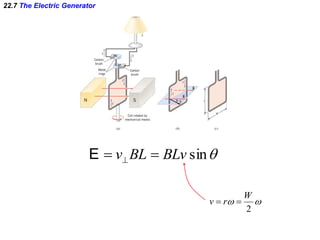
22.7 The Electric Generator
sinBLvBLv  E

2
W
rv 
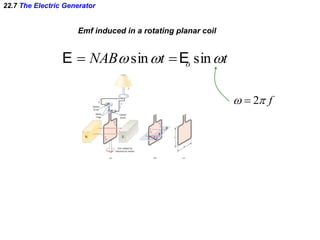
22.7 The Electric Generator
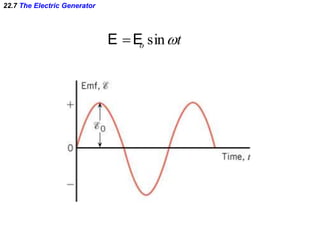
ttNAB o  sinsin EE 
f 2
Emf induced in a rotating planar coil
22.7 The Electric Generator
to sinEE 
22.7 The Electric Generator
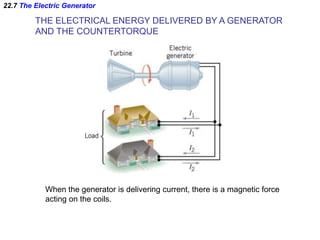
THE ELECTRICAL ENERGY DELIVERED BY A GENERATOR
AND THE COUNTERTORQUE
When the generator is delivering current, there is a magnetic force
acting on the coils.
22.7 The Electric Generator
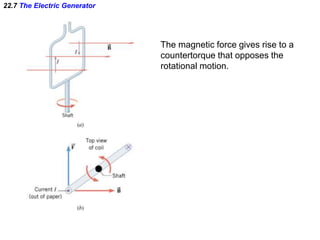
The magnetic force gives rise to a
countertorque that opposes the
rotational motion.
22.7 The Electric Generator
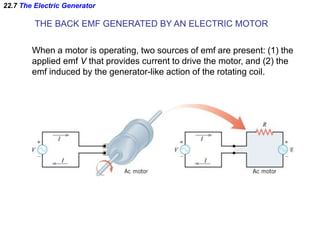
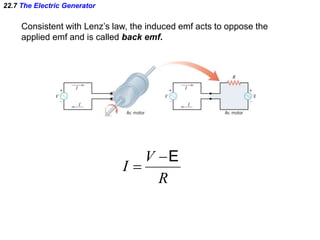
THE BACK EMF GENERATED BY AN ELECTRIC MOTOR
When a motor is operating, two sources of emf are present: (1) the
applied emf V that provides current to drive the motor, and (2) the
emf induced by the generator-like action of the rotating coil.
22.7 The Electric Generator
R
V
I
E

Consistent with Lenz’s law, the induced emf acts to oppose the
applied emf and is called back emf.
22.7 The Electric Generator
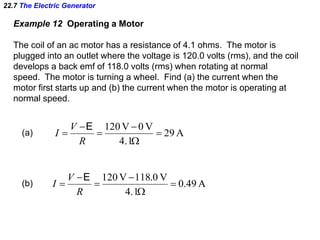
Example 12 Operating a Motor
The coil of an ac motor has a resistance of 4.1 ohms. The motor is
plugged into an outlet where the voltage is 120.0 volts (rms), and the coil
develops a back emf of 118.0 volts (rms) when rotating at normal
speed. The motor is turning a wheel. Find (a) the current when the
motor first starts up and (b) the current when the motor is operating at
normal speed.
A29
4.1
V0V120






R
V
I
E
(a)
A49.0
4.1
V0.118V120






R
V
I
E
(b)
22.8 Mutual Inductance and Self Inductance
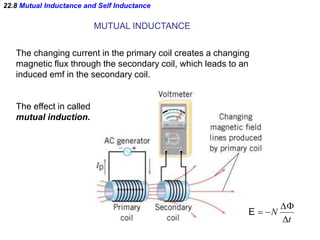
MUTUAL INDUCTANCE
The changing current in the primary coil creates a changing
magnetic flux through the secondary coil, which leads to an
induced emf in the secondary coil.
The effect in called
mutual induction.
t
N


E
22.8 Mutual Inductance and Self Inductance
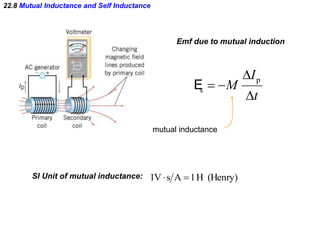
Emf due to mutual induction
t
I
M



p
sE
mutual inductance
SI Unit of mutual inductance: (Henry)H1As1V 
22.8 Mutual Inductance and Self Inductance
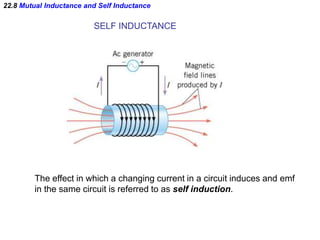
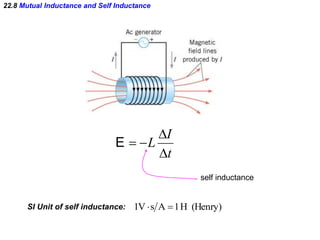
SELF INDUCTANCE
The effect in which a changing current in a circuit induces and emf
in the same circuit is referred to as self induction.
22.8 Mutual Inductance and Self Inductance
SI Unit of self inductance: (Henry)H1As1V 
t
I
L


E
self inductance
22.8 Mutual Inductance and Self Inductance
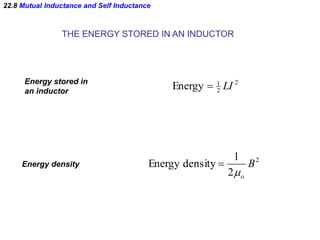
THE ENERGY STORED IN AN INDUCTOR
Energy stored in
an inductor
Energy density
2
2
1
Energy LI
2
2
1
densityEnergy B
o

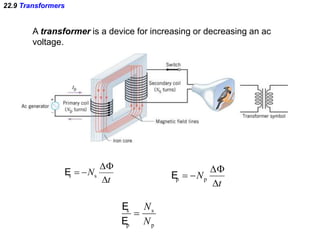
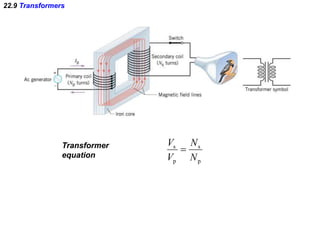
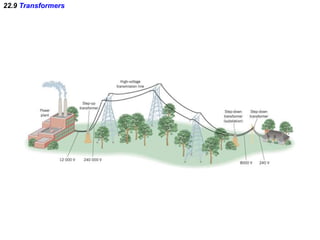
22.9 Transformers
A transformer is a device for increasing or decreasing an ac
voltage.
t
N


 ssE
t
N


 ppE
p
s
p
s
N
N

E
E
22.9 Transformers
p
s
p
s
N
N
V
V
Transformer
equation
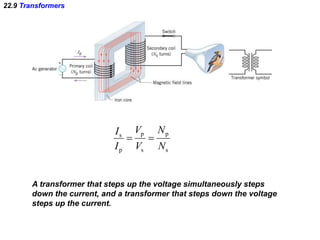
22.9 Transformers
s
p
s
p
p
s
N
N
V
V
I
I

A transformer that steps up the voltage simultaneously steps
down the current, and a transformer that steps down the voltage
steps up the current.
22.9 Transformers

electromagnetic induction

  • 1.
  • 2.
    22.1 Induced Emfand Induced Current There are a number of ways a magnetic field can be used to generate an electric current. It is the changing field that produces the current.
  • 3.
    22.1 Induced Emfand Induced Current The current in the coil is called the induced current because it is brought about by a changing magnetic field. Since a source emf is always needed to produce a current, the coil behaves as if it were a source of emf. This emf is known as the induced emf.
  • 4.
    22.1 Induced Emfand Induced Current An emf can be induced by changing the area of a coil in a constant magnetic field In each example, both an emf and a current are induced because the coil is part of a complete circuit. If the circuit were open, there would be no induced current, but there would be an induced emf. The phenomena of producing an induced emf with the aid of a magnetic field is called electromagnetic induction.
  • 5.
    22.2 Motional Emf THEEMF INDUCED IN A MOVING CONDUCTOR Each charge within the conductor is moving and experiences a magnetic force qvBF  The separated charges on the ends of the conductor give rise to an induced emf, called a motional emf. Note: • When a conducting rod moves at right angles to the constant magnetic field, the magnetic force causes opposite charges to appear at the end of the rod giving rise to induced emf • The induced emf causes an induced current I to appear in the circuit
  • 6.
    22.2 Motional Emf vBLE Motionalemf when v, B, and L are mutually Perpendicular Check Example 1
  • 7.
    22.2 Motional Emf MOTIONALEMF AND ELECTRICAL ENERGY In order to keep the rod moving at constant velocity, the force the hand exerts on the rod must balance the magnetic force on the current: ILBFF hand
  • 8.
    22.2 Motional Emf Thedirection of the force in this figure would violate the principle of conservation of energy. Explain why?????
  • 9.
    22.2 Motional Emf ConceptualExample 3 Conservation of Energy A conducting rod is free to slide down between two vertical copper tracks. There is no kinetic friction between the rod and the tracks. Because the only force on the rod is its weight, it falls with an acceleration equal to the acceleration of gravity. Suppose that a resistance connected between the tops of the tracks. (a) Does the rod now fall with the acceleration of gravity? (b) How does the principle of conservation of energy apply?
  • 10.
    22.3 Magnetic Flux MOTIONALEMF AND MAGNETIC FLUX     o o o o o o o o tt BABA B tt AA B tt LxxL BL tt xx vBL                           E magnetic flux BA vBLE BL tt xx o o          B tt LxxL o o          B tt AA o o              o o tt BABA   
  • 11.
    22.3 Magnetic Flux ttto o      E
  • 12.
    22.3 Magnetic Flux GENERALEXPRESSION FOR MAGNETIC FLUX cosBA
  • 13.
  • 14.
    22.3 Magnetic Flux GRAPHICALINTERPRETATION OF MAGNETIC FLUX The magnetic flux is proportional to the number of field lines that pass through a surface.
  • 15.
    22.4 Faraday’s Lawof Electromagnetic Induction FARADAY’S LAW OF ELECTROMAGNETIC INDUCTION The average emf induced in a coil of N loops is t N tt N o o           E SI Unit of Induced Emf: volt (V) Check example 5
  • 16.
    22.4 Faraday’s Lawof Electromagnetic Induction Conceptual Example 7 An Induction Stove Two pots of water are placed on an induction stove at the same time. The stove itself is cool to the touch. The water in the ferromagnetic metal pot is boiling while that in the glass pot is not. How can such a cool stove boil water, and why isn’t the water in the glass pot boiling?
  • 17.
    22.5 Lenz’s Law LENZ’SLAW The induced emf resulting from a changing magnetic flux has a polarity that leads to an induced current whose direction is such that the induced magnetic field opposes the original flux change. Reasoning Strategy 1. Determine whether the magnetic flux that penetrates the coil is increasing or decreasing. 2. Find what the direction of the induced magnetic field must be so that it can oppose the change influx by adding or subtracting from the original field. 3. Use RHR-2 to determine the direction of the induced current Thumb current, curled fingers magnetic field (Wire rule)
  • 18.
    22.5 Lenz’s Law ConceptualExample 8 The Emf Produced by a Moving Magnet A permanent magnet is approaching a loop of wire. The external circuit consists of a resistance. Find the direction of the induced current and the polarity of the induced emf.
  • 20.
    22.6 Applications ofElectromagnetic Induction to the Reproduction of Sound
  • 21.
    22.6 Applications ofElectromagnetic Induction to the Reproduction of Sound
  • 22.
    22.7 The ElectricGenerator HOW A GENERATOR PRODUCES AND EMF
  • 23.
    22.7 The ElectricGenerator sinBLvBLv  E  2 W rv 
  • 24.
    22.7 The ElectricGenerator ttNAB o  sinsin EE  f 2 Emf induced in a rotating planar coil
  • 25.
    22.7 The ElectricGenerator to sinEE 
  • 26.
    22.7 The ElectricGenerator THE ELECTRICAL ENERGY DELIVERED BY A GENERATOR AND THE COUNTERTORQUE When the generator is delivering current, there is a magnetic force acting on the coils.
  • 27.
    22.7 The ElectricGenerator The magnetic force gives rise to a countertorque that opposes the rotational motion.
  • 28.
    22.7 The ElectricGenerator THE BACK EMF GENERATED BY AN ELECTRIC MOTOR When a motor is operating, two sources of emf are present: (1) the applied emf V that provides current to drive the motor, and (2) the emf induced by the generator-like action of the rotating coil.
  • 29.
    22.7 The ElectricGenerator R V I E  Consistent with Lenz’s law, the induced emf acts to oppose the applied emf and is called back emf.
  • 30.
    22.7 The ElectricGenerator Example 12 Operating a Motor The coil of an ac motor has a resistance of 4.1 ohms. The motor is plugged into an outlet where the voltage is 120.0 volts (rms), and the coil develops a back emf of 118.0 volts (rms) when rotating at normal speed. The motor is turning a wheel. Find (a) the current when the motor first starts up and (b) the current when the motor is operating at normal speed. A29 4.1 V0V120       R V I E (a) A49.0 4.1 V0.118V120       R V I E (b)
  • 31.
    22.8 Mutual Inductanceand Self Inductance MUTUAL INDUCTANCE The changing current in the primary coil creates a changing magnetic flux through the secondary coil, which leads to an induced emf in the secondary coil. The effect in called mutual induction. t N   E
  • 32.
    22.8 Mutual Inductanceand Self Inductance Emf due to mutual induction t I M    p sE mutual inductance SI Unit of mutual inductance: (Henry)H1As1V 
  • 33.
    22.8 Mutual Inductanceand Self Inductance SELF INDUCTANCE The effect in which a changing current in a circuit induces and emf in the same circuit is referred to as self induction.
  • 34.
    22.8 Mutual Inductanceand Self Inductance SI Unit of self inductance: (Henry)H1As1V  t I L   E self inductance
  • 35.
    22.8 Mutual Inductanceand Self Inductance THE ENERGY STORED IN AN INDUCTOR Energy stored in an inductor Energy density 2 2 1 Energy LI 2 2 1 densityEnergy B o 
  • 36.
    22.9 Transformers A transformeris a device for increasing or decreasing an ac voltage. t N    ssE t N    ppE p s p s N N  E E
  • 37.
  • 38.
    22.9 Transformers s p s p p s N N V V I I  A transformerthat steps up the voltage simultaneously steps down the current, and a transformer that steps down the voltage steps up the current.
  • 39.