CV (Curriculum Vitae)
• A CV is an in-depth document that can be laid out over two or more pages
• It contains a high level of detail about your achievements, a great deal more than just a
career biography.
• The CV covers your education as well as any other accomplishments like publications,
awards, honors etc.
• The document tends to be organized chronologically and should make it easy to get an
overview of an individual’s full working career.
• A CV is static and doesn’t change for different positions, the difference would be in the
cover letter.
Resume
• A resume, is a concise document typically not longer than one page as the intended the
reader will not dwell on your document for very long.
• The goal of a resume is to make an individual stand out from the competition.
• The job seeker should adapt the resume to every position they apply for.
• It is in the applicant’s interest to change the resume from one job application to another
and to tailor it to the needs of the specific post.
• A resume doesn’t have to be ordered chronologically, doesn’t have to cover your whole
career like and is a highly customizable document.
Differences
• As stated, three major differences between CVs and resumes .
• length,
• the purpose &
• the layout.
• A resume is a brief summary of your skills and experience over one or two pages, A CV is more detailed and
can stretch well beyond two pages.
• The resume will be tailored to each position whereas the CV will stay put and any changes will be in the
cover letter.
• Resume Used when applying for a position in industry, non-profit, and public sector. CV Used when
applying for positions in academia, fellowships and grants.
• A CV has a clear chronological order listing the whole career of the individual whereas a resume’s
information can be shuffled around to best suit the applicant.
• The main difference between a resume and a CV is-
• A CV is intended to be a full record of your career
history
• A resume is a brief, targeted list of skills and
achievements.
Let’s revise
CV – long, covers your entire career, static
Resume – short, no particular format rule, highly customizable.
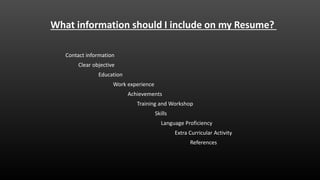
What information should I include on my Resume?
Work experience
Education
Clear objective
Contact information
Achievements
Skills
References
Language Proficiency
Extra Curricular Activity
Training and Workshop
Personal details
• It may sound obvious, but you’d be surprised how many people
forget to include their name, email, contact phone number and
address.
• To avoid any awkward moments, make sure these are clearly presented at
the top of your Resume.
• “Resume” is an unnecessary title – your name is not.
Personal statement/Objective
• As it’s the first thing that’s shown on your Resume
• A statement is an essential part of standing out from the crowd.
• It explains who you are, what you’re offering, and what you’re looking for.
• Aim to prove why you’re suitable in one short and succinct paragraph.
• Private information is different from personal information and should not be
included on your resume.
 Don't list your age, race, sex, political preferences, religious affiliations,
marital status, Social Security number, driver's license number, test scores on
your resume, advises the University of Minnesota.
Private Information
Work experience:
This section should include all of your relevant
work experience, listed with the most recent
first. Include your job title, the name of the
organization, time in post, and your key
responsibilities.
Education:
Your educational experience and achievements should
be listed here, along with dates, the type of qualification
and/or the grade you achieved – although the specific
parts of education that you include in your Resume will
depend on your individual situation. For example, if you
have more educational achievements than work
experience, placing an emphasis on this section is a good
idea.
Achievements:
This is your chance to show how your previous experience has
given you the skills needed to make you a suitable candidate. List
all of your relevant skills and achievements (backing them up
with examples), and make it clear how you would apply these to
the new role.
Skills
The usual ones to mention are languages (good conversational
French, basic Spanish), computing (e.g. "good working knowledge
of MS Access and Excel, plus basic web page design skills" and
driving ("full current clean driving license").
If you are a mature candidate or have lots of relevant skills to
offer, a skills-based CV may work for you.
References
Many employers don’t check references at the application stage so unless the
vacancy specifically requests referees it's fine to omit this section completely if
you are running short of space or to say "References are available on request."
Normally two referees are sufficient: one academic (perhaps your tutor or a
project supervisor) and one from an employer (perhaps your last part-time or
summer job).
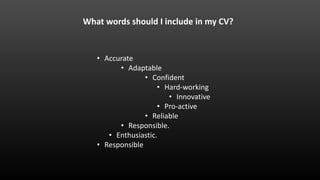
• Accurate
• Adaptable
• Confident
• Hard-working
• Innovative
• Pro-active
• Reliable
• Responsible.
• Enthusiastic.
• Responsible
What words should I include in my CV?
• Excellent communication skills
• Goal driven
• Flexible
• Motivated
• Multi-tasked
• Independent
• Detail oriented
• Self-motivated
What should I leave out?
When it comes to your CV, there are
certain words and phrases you should
try to avoid and they mostly consist
of overused clichés.
Not only could using them risk mildly
irritating the person in charge of hiring,
you could also end up blending into a sea
of similar candidates.
Here are just a few of the worst CV words:
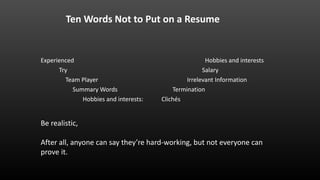
Ten Words Not to Put on a Resume
Experienced
Try
Team Player
Summary Words
Hobbies and interests:
Hobbies and interests
Salary
Irrelevant Information
Termination
Clichés
Be realistic,
After all, anyone can say they’re hard-working, but not everyone can
prove it.
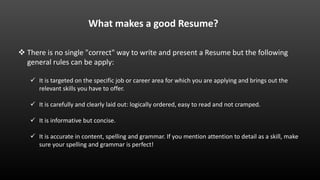
 There is no single "correct" way to write and present a Resume but the following
general rules can be apply:
 It is targeted on the specific job or career area for which you are applying and brings out the
relevant skills you have to offer.
 It is carefully and clearly laid out: logically ordered, easy to read and not cramped.
 It is informative but concise.
 It is accurate in content, spelling and grammar. If you mention attention to detail as a skill, make
sure your spelling and grammar is perfect!
What makes a good Resume?
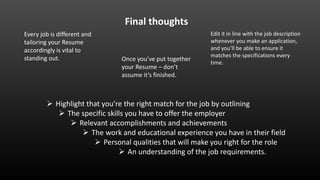
 Highlight that you’re the right match for the job by outlining
 The specific skills you have to offer the employer
 Relevant accomplishments and achievements
 The work and educational experience you have in their field
 Personal qualities that will make you right for the role
 An understanding of the job requirements.
Final thoughts
Once you’ve put together
your Resume – don’t
assume it’s finished.
Every job is different and
tailoring your Resume
accordingly is vital to
standing out.
Edit it in line with the job description
whenever you make an application,
and you’ll be able to ensure it
matches the specifications every
time.
Resume and CV (Presentation)

Resume and CV (Presentation)

  • 2.
    CV (Curriculum Vitae) •A CV is an in-depth document that can be laid out over two or more pages • It contains a high level of detail about your achievements, a great deal more than just a career biography. • The CV covers your education as well as any other accomplishments like publications, awards, honors etc. • The document tends to be organized chronologically and should make it easy to get an overview of an individual’s full working career. • A CV is static and doesn’t change for different positions, the difference would be in the cover letter.
  • 3.
    Resume • A resume,is a concise document typically not longer than one page as the intended the reader will not dwell on your document for very long. • The goal of a resume is to make an individual stand out from the competition. • The job seeker should adapt the resume to every position they apply for. • It is in the applicant’s interest to change the resume from one job application to another and to tailor it to the needs of the specific post. • A resume doesn’t have to be ordered chronologically, doesn’t have to cover your whole career like and is a highly customizable document.
  • 4.
    Differences • As stated,three major differences between CVs and resumes . • length, • the purpose & • the layout. • A resume is a brief summary of your skills and experience over one or two pages, A CV is more detailed and can stretch well beyond two pages. • The resume will be tailored to each position whereas the CV will stay put and any changes will be in the cover letter. • Resume Used when applying for a position in industry, non-profit, and public sector. CV Used when applying for positions in academia, fellowships and grants. • A CV has a clear chronological order listing the whole career of the individual whereas a resume’s information can be shuffled around to best suit the applicant.
  • 5.
    • The maindifference between a resume and a CV is- • A CV is intended to be a full record of your career history • A resume is a brief, targeted list of skills and achievements. Let’s revise CV – long, covers your entire career, static Resume – short, no particular format rule, highly customizable.
  • 7.
    What information shouldI include on my Resume? Work experience Education Clear objective Contact information Achievements Skills References Language Proficiency Extra Curricular Activity Training and Workshop
  • 8.
    Personal details • Itmay sound obvious, but you’d be surprised how many people forget to include their name, email, contact phone number and address. • To avoid any awkward moments, make sure these are clearly presented at the top of your Resume. • “Resume” is an unnecessary title – your name is not.
  • 9.
    Personal statement/Objective • Asit’s the first thing that’s shown on your Resume • A statement is an essential part of standing out from the crowd. • It explains who you are, what you’re offering, and what you’re looking for. • Aim to prove why you’re suitable in one short and succinct paragraph.
  • 10.
    • Private informationis different from personal information and should not be included on your resume.  Don't list your age, race, sex, political preferences, religious affiliations, marital status, Social Security number, driver's license number, test scores on your resume, advises the University of Minnesota. Private Information
  • 11.
    Work experience: This sectionshould include all of your relevant work experience, listed with the most recent first. Include your job title, the name of the organization, time in post, and your key responsibilities. Education: Your educational experience and achievements should be listed here, along with dates, the type of qualification and/or the grade you achieved – although the specific parts of education that you include in your Resume will depend on your individual situation. For example, if you have more educational achievements than work experience, placing an emphasis on this section is a good idea.
  • 12.
    Achievements: This is yourchance to show how your previous experience has given you the skills needed to make you a suitable candidate. List all of your relevant skills and achievements (backing them up with examples), and make it clear how you would apply these to the new role. Skills The usual ones to mention are languages (good conversational French, basic Spanish), computing (e.g. "good working knowledge of MS Access and Excel, plus basic web page design skills" and driving ("full current clean driving license"). If you are a mature candidate or have lots of relevant skills to offer, a skills-based CV may work for you.
  • 13.
    References Many employers don’tcheck references at the application stage so unless the vacancy specifically requests referees it's fine to omit this section completely if you are running short of space or to say "References are available on request." Normally two referees are sufficient: one academic (perhaps your tutor or a project supervisor) and one from an employer (perhaps your last part-time or summer job).
  • 14.
    • Accurate • Adaptable •Confident • Hard-working • Innovative • Pro-active • Reliable • Responsible. • Enthusiastic. • Responsible What words should I include in my CV?
  • 15.
    • Excellent communicationskills • Goal driven • Flexible • Motivated • Multi-tasked • Independent • Detail oriented • Self-motivated What should I leave out? When it comes to your CV, there are certain words and phrases you should try to avoid and they mostly consist of overused clichés. Not only could using them risk mildly irritating the person in charge of hiring, you could also end up blending into a sea of similar candidates. Here are just a few of the worst CV words:
  • 16.
    Ten Words Notto Put on a Resume Experienced Try Team Player Summary Words Hobbies and interests: Hobbies and interests Salary Irrelevant Information Termination Clichés Be realistic, After all, anyone can say they’re hard-working, but not everyone can prove it.
  • 17.
     There isno single "correct" way to write and present a Resume but the following general rules can be apply:  It is targeted on the specific job or career area for which you are applying and brings out the relevant skills you have to offer.  It is carefully and clearly laid out: logically ordered, easy to read and not cramped.  It is informative but concise.  It is accurate in content, spelling and grammar. If you mention attention to detail as a skill, make sure your spelling and grammar is perfect! What makes a good Resume?
  • 18.
     Highlight thatyou’re the right match for the job by outlining  The specific skills you have to offer the employer  Relevant accomplishments and achievements  The work and educational experience you have in their field  Personal qualities that will make you right for the role  An understanding of the job requirements. Final thoughts Once you’ve put together your Resume – don’t assume it’s finished. Every job is different and tailoring your Resume accordingly is vital to standing out. Edit it in line with the job description whenever you make an application, and you’ll be able to ensure it matches the specifications every time.