Work-based Experience Session ? –  Putting together your C.V.
Tips on writing a good CV DO!!!  use positive language -  when describing your work achievements use power "doing" words like "launched", "managed" and "improved". Quote figures if possible to back up your claims.  use good quality paper -  first impressions count!  use a word processor on a computer -  typed or written CVs won't impress   include other skills that might be useful to an employer -  driving, languages, IT skills etc
Tips on writing a good CV DON’T!!! lie -  employers have ways of checking what you put is true, and may sack you if they take you on and find out you've lied to them  include a photo unless requested
Your winning CV should be: easy to read with space between each section  no more than two pages long -  only senior executives with a lot of experience should have longer CVs. You may wonder how to fit everything into 2 pages but you can free up space by leaving certain things out or by being brief about others that are less important. For example, it's not necessary to put 'CV' or 'Curriculum Vitae' at the top.
What should I definitely include? Start with your personal details; your name, address and contact details. It's up to you whether you include your age, marital status and nationality - it's not essential. Your personal profile Underneath your personal details, your 'Personal Profile' outlines your: skills and qualities
Tailoring your CV to the job Your CV shouldn't be your life story but should be tailored for the job you're applying for, focusing on the parts that are important.  Look at the job advert or the person specification and think about what the job involves, and what the employer is asking for.  Take some time to find out about the main activities of the employer.
Work background and achievements. It should only be a few lines but must spark the reader's interest.  For example, if the job involves working with people, you could say you're a good team-worker and an effective communicator.  Be brief - you can highlight examples of your skills in later sections
Education and work experience This part of your CV depends on your background and the type of job you're applying for.  Some jobs require experience, while for others your qualifications are more important.  If you've been working for a while, put your employment history first; if you're younger and don't have much work experience, focus on your education and training.
Employment history Start with your present or most recent job and work backwards, using bullet points. Include: each employer  the dates you worked for them  the job title  your main duties
Employment history Employers want to see how your experience will be useful to them, so be brief about jobs that are totally different from the one you're applying for.  Relevant jobs should be listed in more detail, showing not only your main duties and responsibilities but giving examples of the skills you used and what you achieved. This is the information the employer uses when deciding whether to interview you or not.  Your employment history shows your experience and suitability for the job. Include useful information but leave out anything that's not relevant.
Employment history Relate your skills and experience to the job description and what the employer is looking for.  Also include any relevant temporary or unpaid work.  Avoid unexplained gaps in your employment history, as employers may think you have something to hide! You can provide reasons for them further on where necessary
Employment history Education and training Start with your most recent study and go back to the qualifications you got at school. Using bullet points or a table include: the university, college or school you went to  the dates the qualifications were awarded and any grades  any other courses, if they're relevant.
Hobbies and interests Some employers like to read about your interests, as it can give them an idea of your strengths and what you'd be like to work alongside.  It should be relevant in some way to the job. For example, if you're involved in any clubs or societies this can show that you enjoy meeting new people.  People often put on their CV that they enjoy cooking or reading, but these activities are too general and widespread to be of interest to an employer.
Additional information If you need to add anything else that's relevant, such as a gap in your employment history for travel or family reasons, you could include a further section titled 'Additional Information' after your interests to explain this
References Finally, you should state that references are available if required, although you don't need to include referees' contact details on the CV.  At least one referee should be work-related; or if you haven't worked for a while, some other responsible person who has known you for quite a while.
How should it be presented? Print your CV on white A4 paper, using just one style and font. It should be concise and easy to read.  Check it for spelling and grammar mistakes. You can use a computer spelling and grammar check but it's also good idea to get it checked by somebody else. A common mistake is to use bold type everywhere. It's good for section headings such as 'Employment History' or 'Education' but many people use it to highlight dates and previous employers' names - this draws the reader's eye away from what's important.
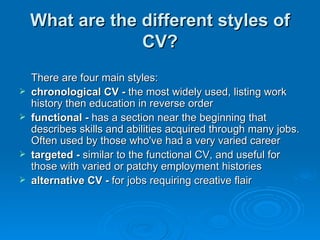
What are the different styles of CV? There are four main styles: chronological CV -  the most widely used, listing work history then education in reverse order  functional -  has a section near the beginning that describes skills and abilities acquired through many jobs. Often used by those who've had a very varied career  targeted -  similar to the functional CV, and useful for those with varied or patchy employment histories   alternative CV -  for jobs requiring creative flair
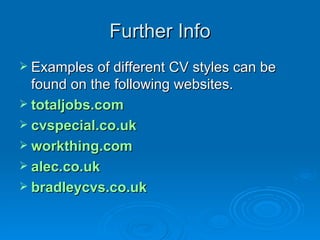
Further Info Examples of different CV styles can be found on the following websites. totaljobs.com   cvspecial.co.uk   workthing.com   alec.co.uk   bradleycvs.co.uk

Cv writing

  • 1.
    Work-based Experience Session? – Putting together your C.V.
  • 2.
    Tips on writinga good CV DO!!! use positive language - when describing your work achievements use power "doing" words like "launched", "managed" and "improved". Quote figures if possible to back up your claims. use good quality paper - first impressions count! use a word processor on a computer - typed or written CVs won't impress include other skills that might be useful to an employer - driving, languages, IT skills etc
  • 3.
    Tips on writinga good CV DON’T!!! lie - employers have ways of checking what you put is true, and may sack you if they take you on and find out you've lied to them include a photo unless requested
  • 4.
    Your winning CVshould be: easy to read with space between each section no more than two pages long - only senior executives with a lot of experience should have longer CVs. You may wonder how to fit everything into 2 pages but you can free up space by leaving certain things out or by being brief about others that are less important. For example, it's not necessary to put 'CV' or 'Curriculum Vitae' at the top.
  • 5.
    What should Idefinitely include? Start with your personal details; your name, address and contact details. It's up to you whether you include your age, marital status and nationality - it's not essential. Your personal profile Underneath your personal details, your 'Personal Profile' outlines your: skills and qualities
  • 6.
    Tailoring your CVto the job Your CV shouldn't be your life story but should be tailored for the job you're applying for, focusing on the parts that are important. Look at the job advert or the person specification and think about what the job involves, and what the employer is asking for. Take some time to find out about the main activities of the employer.
  • 7.
    Work background andachievements. It should only be a few lines but must spark the reader's interest. For example, if the job involves working with people, you could say you're a good team-worker and an effective communicator. Be brief - you can highlight examples of your skills in later sections
  • 8.
    Education and workexperience This part of your CV depends on your background and the type of job you're applying for. Some jobs require experience, while for others your qualifications are more important. If you've been working for a while, put your employment history first; if you're younger and don't have much work experience, focus on your education and training.
  • 9.
    Employment history Startwith your present or most recent job and work backwards, using bullet points. Include: each employer the dates you worked for them the job title your main duties
  • 10.
    Employment history Employerswant to see how your experience will be useful to them, so be brief about jobs that are totally different from the one you're applying for. Relevant jobs should be listed in more detail, showing not only your main duties and responsibilities but giving examples of the skills you used and what you achieved. This is the information the employer uses when deciding whether to interview you or not. Your employment history shows your experience and suitability for the job. Include useful information but leave out anything that's not relevant.
  • 11.
    Employment history Relateyour skills and experience to the job description and what the employer is looking for. Also include any relevant temporary or unpaid work. Avoid unexplained gaps in your employment history, as employers may think you have something to hide! You can provide reasons for them further on where necessary
  • 12.
    Employment history Educationand training Start with your most recent study and go back to the qualifications you got at school. Using bullet points or a table include: the university, college or school you went to the dates the qualifications were awarded and any grades any other courses, if they're relevant.
  • 13.
    Hobbies and interestsSome employers like to read about your interests, as it can give them an idea of your strengths and what you'd be like to work alongside. It should be relevant in some way to the job. For example, if you're involved in any clubs or societies this can show that you enjoy meeting new people. People often put on their CV that they enjoy cooking or reading, but these activities are too general and widespread to be of interest to an employer.
  • 14.
    Additional information Ifyou need to add anything else that's relevant, such as a gap in your employment history for travel or family reasons, you could include a further section titled 'Additional Information' after your interests to explain this
  • 15.
    References Finally, youshould state that references are available if required, although you don't need to include referees' contact details on the CV. At least one referee should be work-related; or if you haven't worked for a while, some other responsible person who has known you for quite a while.
  • 16.
    How should itbe presented? Print your CV on white A4 paper, using just one style and font. It should be concise and easy to read. Check it for spelling and grammar mistakes. You can use a computer spelling and grammar check but it's also good idea to get it checked by somebody else. A common mistake is to use bold type everywhere. It's good for section headings such as 'Employment History' or 'Education' but many people use it to highlight dates and previous employers' names - this draws the reader's eye away from what's important.
  • 17.
    What are thedifferent styles of CV? There are four main styles: chronological CV - the most widely used, listing work history then education in reverse order functional - has a section near the beginning that describes skills and abilities acquired through many jobs. Often used by those who've had a very varied career targeted - similar to the functional CV, and useful for those with varied or patchy employment histories alternative CV - for jobs requiring creative flair
  • 18.
    Further Info Examplesof different CV styles can be found on the following websites. totaljobs.com cvspecial.co.uk workthing.com alec.co.uk bradleycvs.co.uk