
How to write a successful 
teaching CV 
Protocol Education’s guide to CV writing 
November 2014
Writing a Protocol Education CV 
When it comes to CVs, we’ve 
seen a few in our time – both 
good and bad! 
Your CV is a vital tool for 
securing an interview, so we 
want to help you make as good 
an impression as possible with a 
potential school. 
2
Writing a CV – Tips and Tricks 
We asked headteachers, 
deputy heads and our own 
consultants what they like 
to see on CVs. 
Take a look at some of their 
dos and don’ts: 
• Show your impact on children's learning 
with specific examples 
• No need to say that you like children or 
enjoy being with children 
• Don’t have unexplained gaps in employment 
• Highlight your skills from volunteering, 
community work and other organisations, as 
initiative is important in any setting 
• Make sure you mention your leadership 
skills if you’ve had this experience 
• If you are looking for a leadership role, 
create a clear narrative of career journey 
which shows 3-5 years in each job 
• Avoid using teaching quotes or clichés 
• No need to include your photo 
3
Writing a CV – Key Points 
1. Know your audience 
2. Duties vs achievements 
3. SPaG 
4. Keep it snappy 
5. Stay up to date 
4 
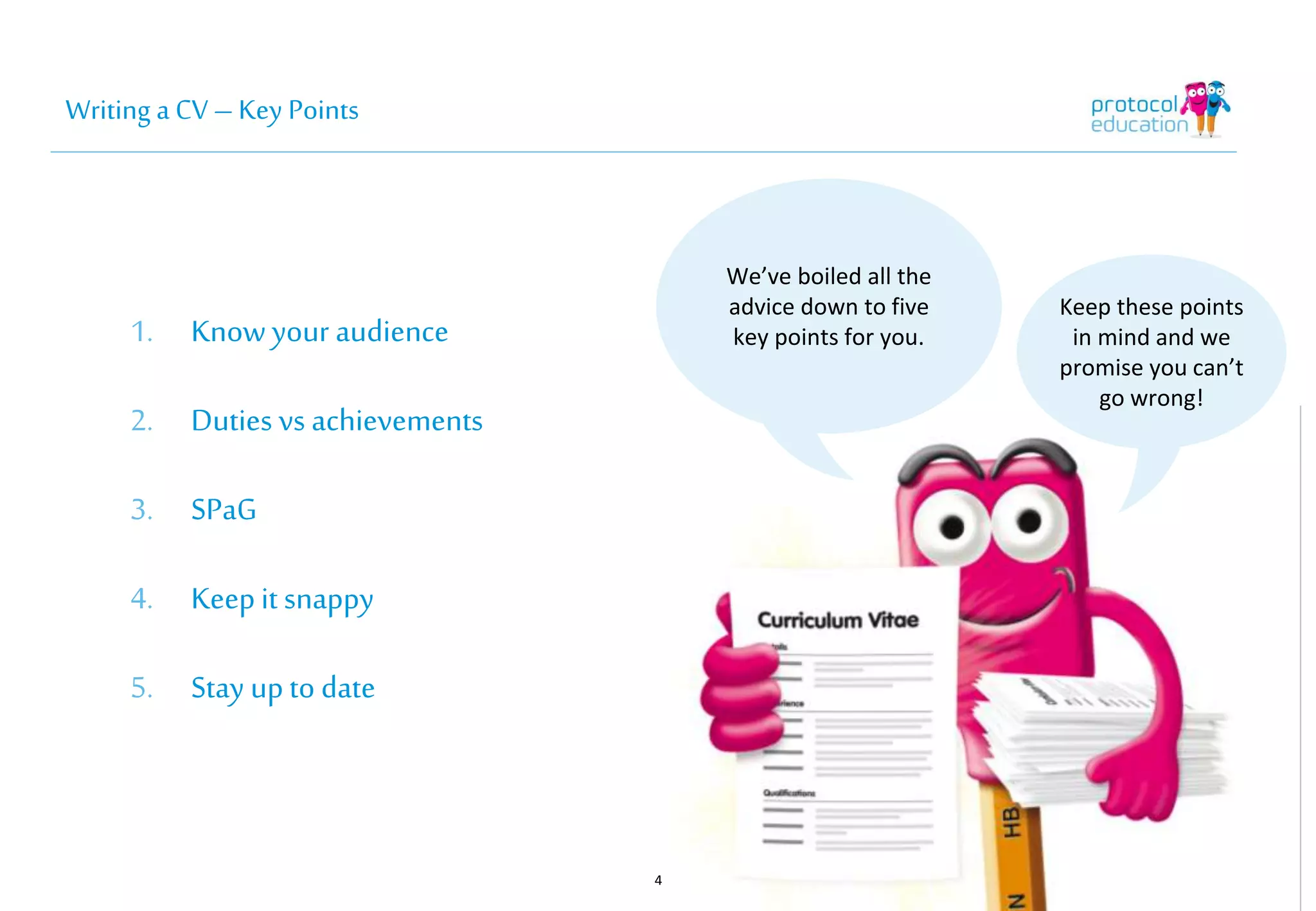
We’ve boiled all the 
advice down to five 
key points for you. 
Keep these points 
in mind and we 
promise you can’t 
go wrong!
Writing a CV – Key Points 
You don’t need to be a 
mind reader, but it 
helps... 
1. Know your audience 
Put yourselves in the shoes of a busy 
headteacher. What things will they 
be looking for on a CV? 
Some things that might interest a 
headteacher: 
- Ofsted experience 
- Exam group experience and success 
- Monitoring, assessing and 
reporting on pupil attainment 
5
Writing a CV – Key Points 
2. Duties vs achievements 
Just listing your previous responsibilities 
might not be enough to make your CV 
stand out. 
Use specific past accomplishments to 
show what you can contribute to a 
school: 
OK: Taught Year 6 class 
Better: Improved Year 6 Sats results 
Best: Increased Year 6 Sats numeracy 
attainment levels by 20% 
6 
It can be tough to 
see your own 
strengths 
sometimes... 
Speak to one of our 
consultants for help 
with finding your 
highlights.
Writing a CV – Key Points 
3. SPaG (Spelling and 
Grammar) 
Check, check and check again. Give your 
CV to a friend to read, and don’t rely solely 
on spellcheckers – they don’t catch 
everything! 
After all, this sentence looks fine to a 
spellchecker: 
“I taut very affectively in my previous 
roll...” 
7 
A new set of eyes on 
your CV always helps!
Writing a CV – Key Points 
4. Keep it snappy 
Your CV might only have a few 
moments to impress, so don’t hide 
your best points. 
- Keep it to two A4 pages 
- Use an easy-to-read typeface 
- Make sure you have a logical 
structure with clear headings 
8 
Make it count! 
There’ll be time to 
explore things in more 
detail once you get to the 
interview.
Writing a CV – Key Points 
5. Stay up to date 
Make sure your CV reflects who you 
are right now, not six months ago. 
Keep track of professional 
development courses and new 
classroom achievements, and use 
the latest terminology. 
9 
If you are missing key 
skills or experience, one 
of our professional 
development courses 
could be the answer. 
Take a look at our 
website to see 
what’s on offer in a 
branch near you.
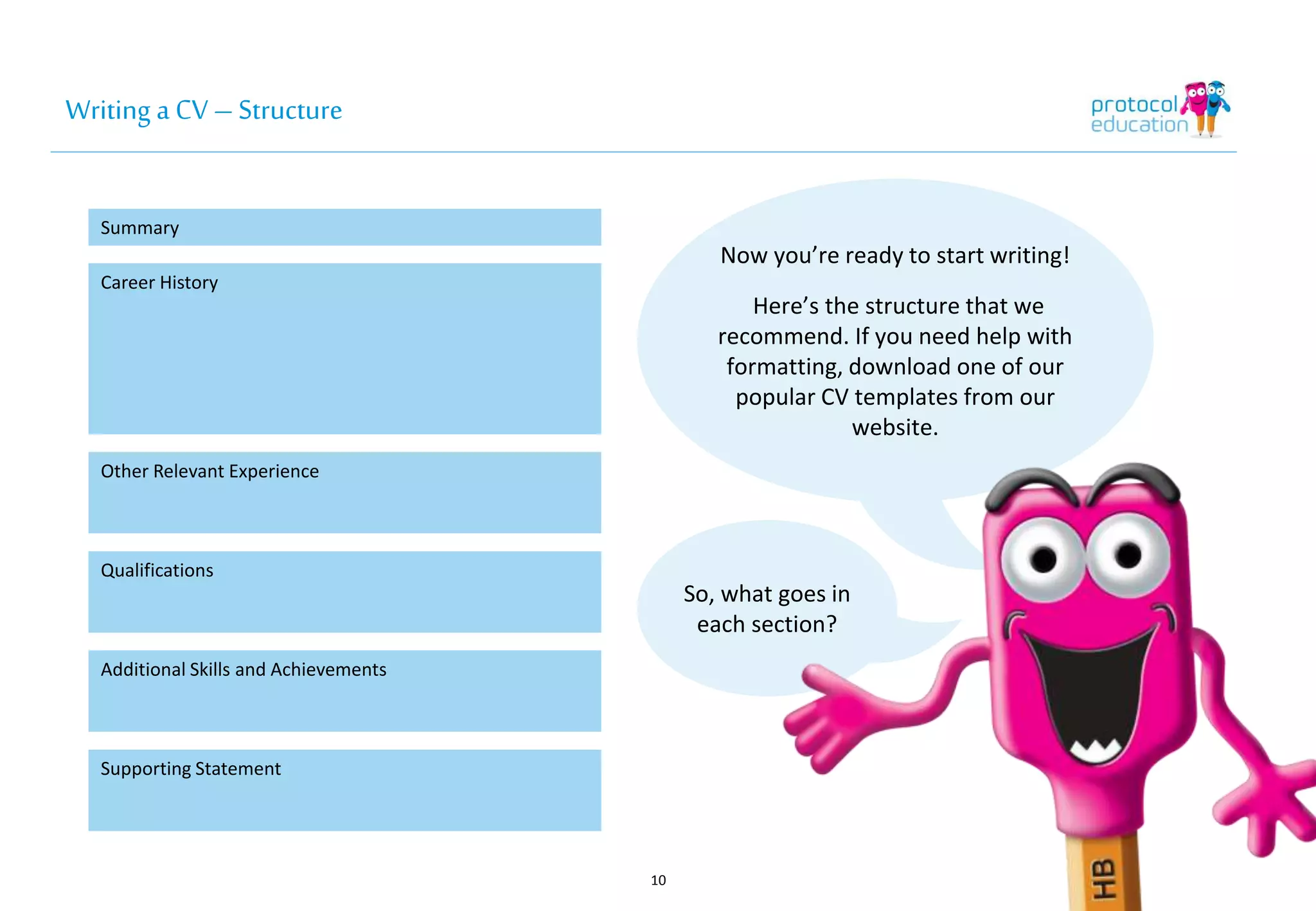
Now you’re ready to start writing! 
Here’s the structure that we 
recommend. If you need help with 
formatting, download one of our 
popular CV templates from our 
website. 
Writing a CV – Structure 
10 
Summary 
Career History 
Other Relevant Experience 
Qualifications 
Additional Skills and Achievements 
Supporting Statement 
So, what goes in 
each section?
Writing a CV – Structure 
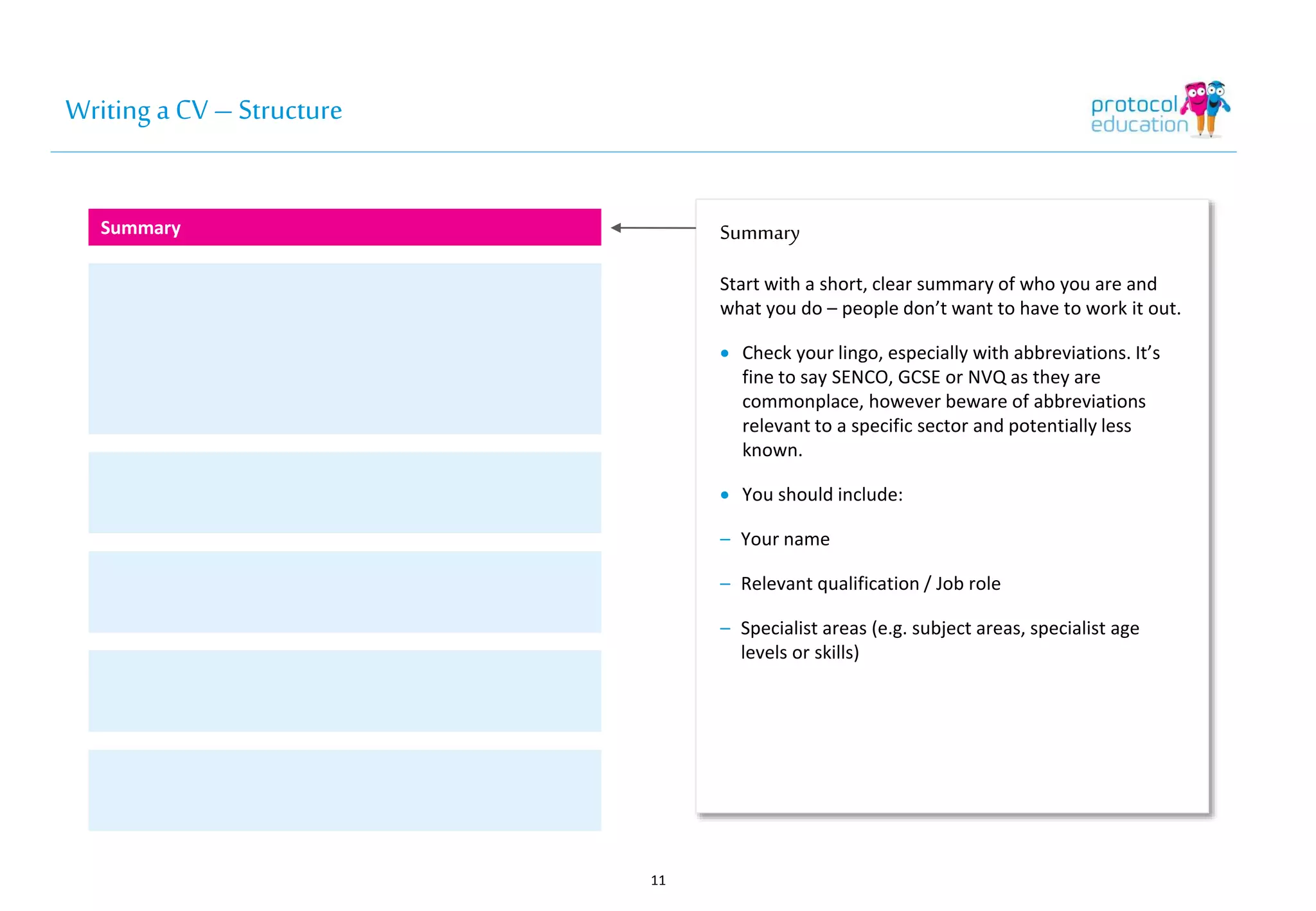
Summary 
Start with a short, clear summary of who you are and 
what you do – people don’t want to have to work it out. 
 Check your lingo, especially with abbreviations. It’s 
fine to say SENCO, GCSE or NVQ as they are 
commonplace, however beware of abbreviations 
relevant to a specific sector and potentially less 
known. 
 You should include: 
– Your name 
– Relevant qualification / Job role 
– Specialist areas (e.g. subject areas, specialist age 
levels or skills) 
11 
Summary
Writing a CV – Structure 
Career History 
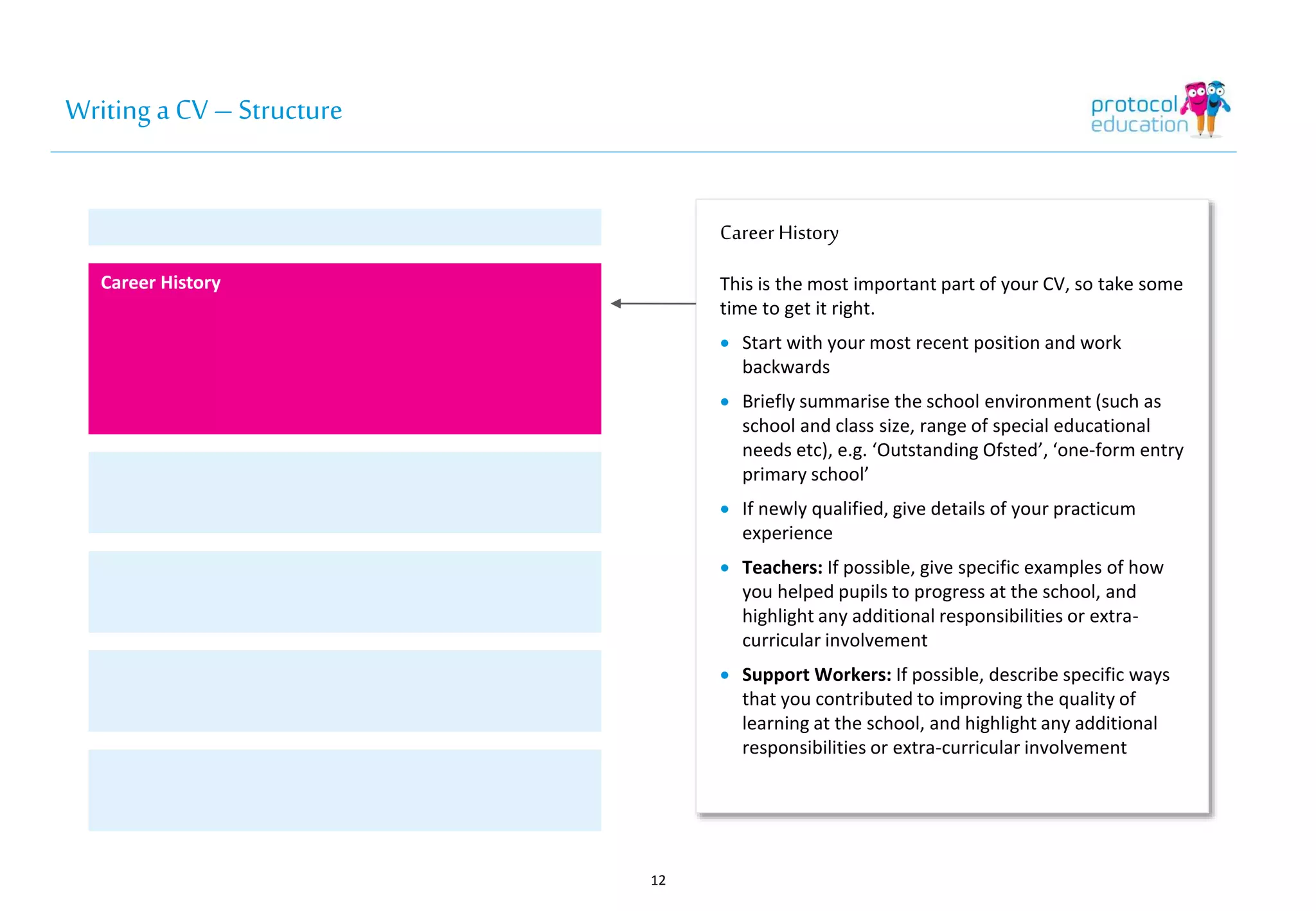
This is the most important part of your CV, so take some 
time to get it right. 
 Start with your most recent position and work 
backwards 
 Briefly summarise the school environment (such as 
school and class size, range of special educational 
needs etc), e.g. ‘Outstanding Ofsted’, ‘one-form entry 
primary school’ 
 If newly qualified, give details of your practicum 
experience 
 Teachers: If possible, give specific examples of how 
you helped pupils to progress at the school, and 
highlight any additional responsibilities or extra-curricular 
involvement 
 Support Workers: If possible, describe specific ways 
that you contributed to improving the quality of 
learning at the school, and highlight any additional 
responsibilities or extra-curricular involvement 
12 
Career History
Writing a CV – Structure 
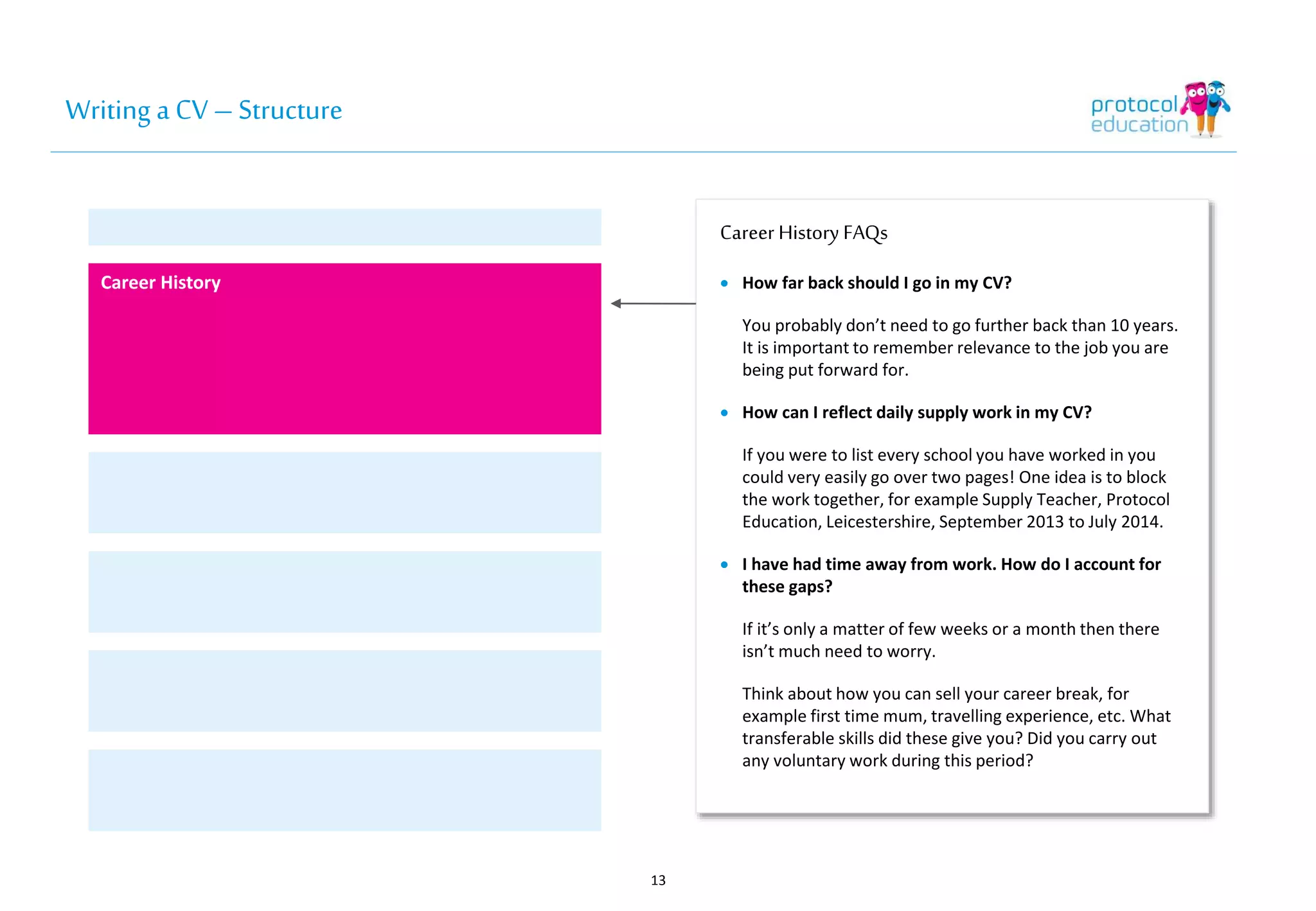
Career History FAQs 
 How far back should I go in my CV? 
You probably don’t need to go further back than 10 years. 
It is important to remember relevance to the job you are 
being put forward for. 
 How can I reflect daily supply work in my CV? 
If you were to list every school you have worked in you 
could very easily go over two pages! One idea is to block 
the work together, for example Supply Teacher, Protocol 
Education, Leicestershire, September 2013 to July 2014. 
 I have had time away from work. How do I account for 
these gaps? 
If it’s only a matter of few weeks or a month then there 
isn’t much need to worry. 
Think about how you can sell your career break, for 
example first time mum, travelling experience, etc. What 
transferable skills did these give you? Did you carry out 
any voluntary work during this period? 
13 
Career History
Writing a CV – Structure 
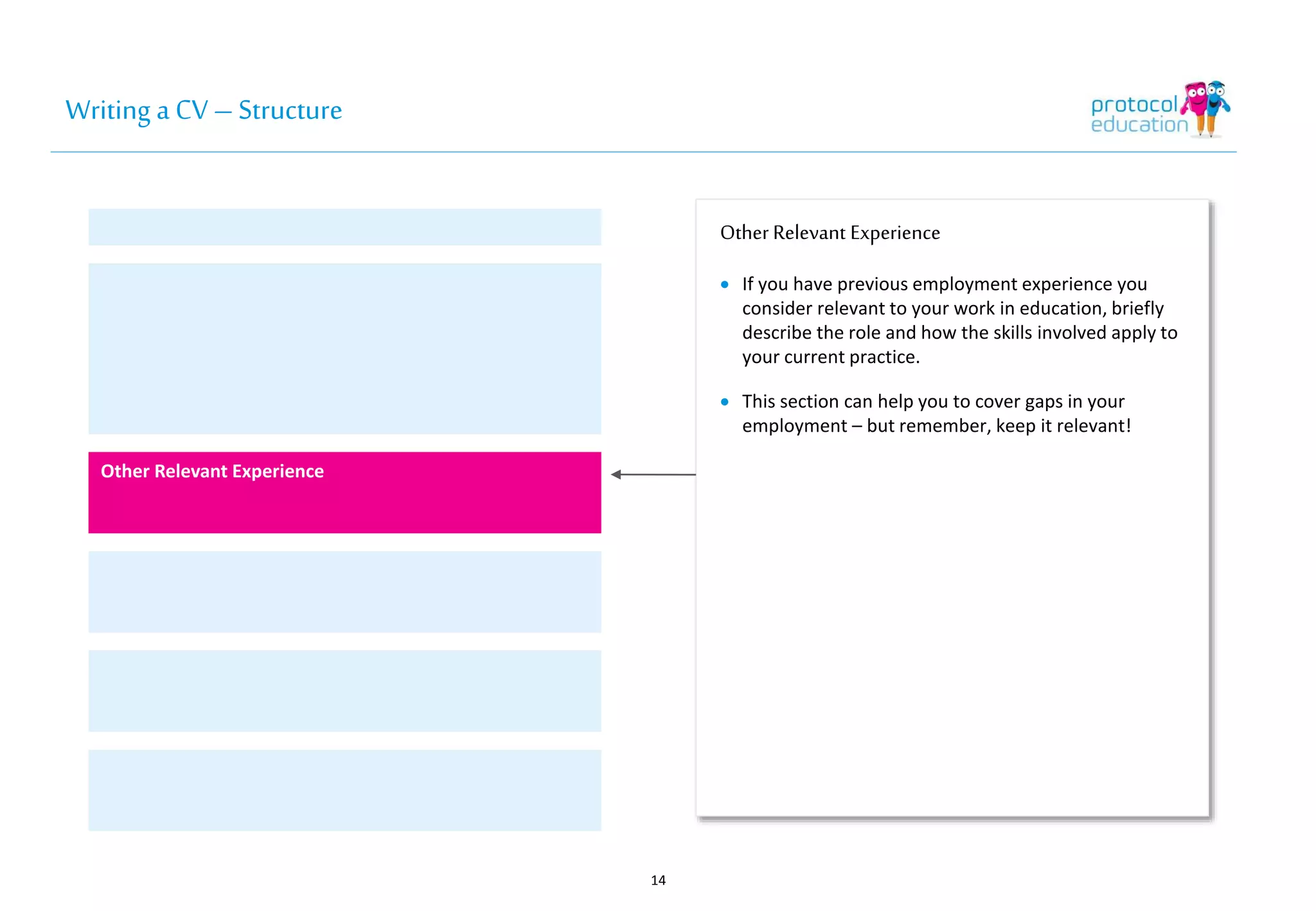
Other Relevant Experience 
 If you have previous employment experience you 
consider relevant to your work in education, briefly 
describe the role and how the skills involved apply to 
your current practice. 
 This section can help you to cover gaps in your 
employment – but remember, keep it relevant! 
14 
Other Relevant Experience
Writing a CV – Structure 
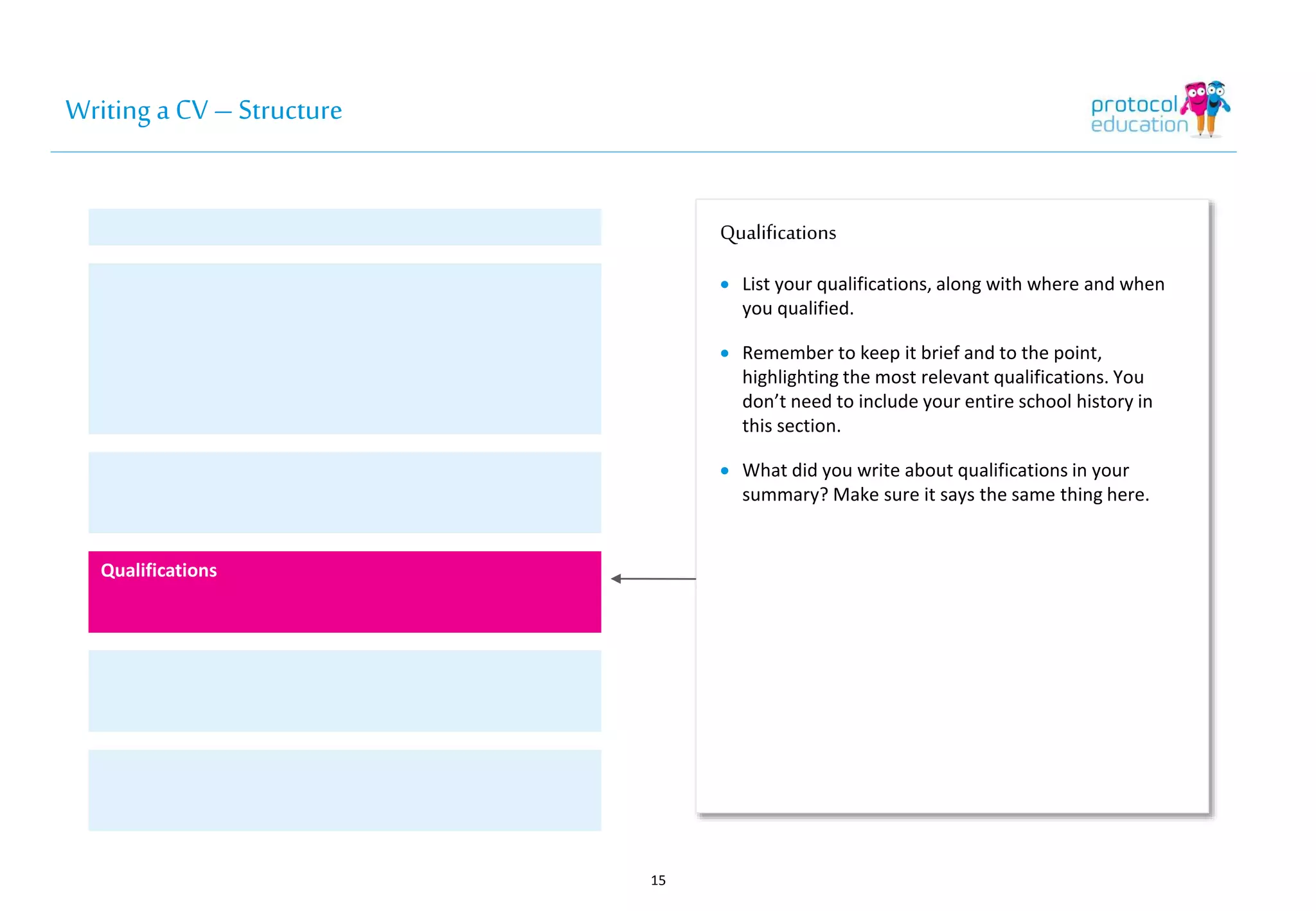
Qualifications 
 List your qualifications, along with where and when 
you qualified. 
 Remember to keep it brief and to the point, 
highlighting the most relevant qualifications. You 
don’t need to include your entire school history in 
this section. 
 What did you write about qualifications in your 
summary? Make sure it says the same thing here. 
15 
Qualifications
Writing a CV – Structure 
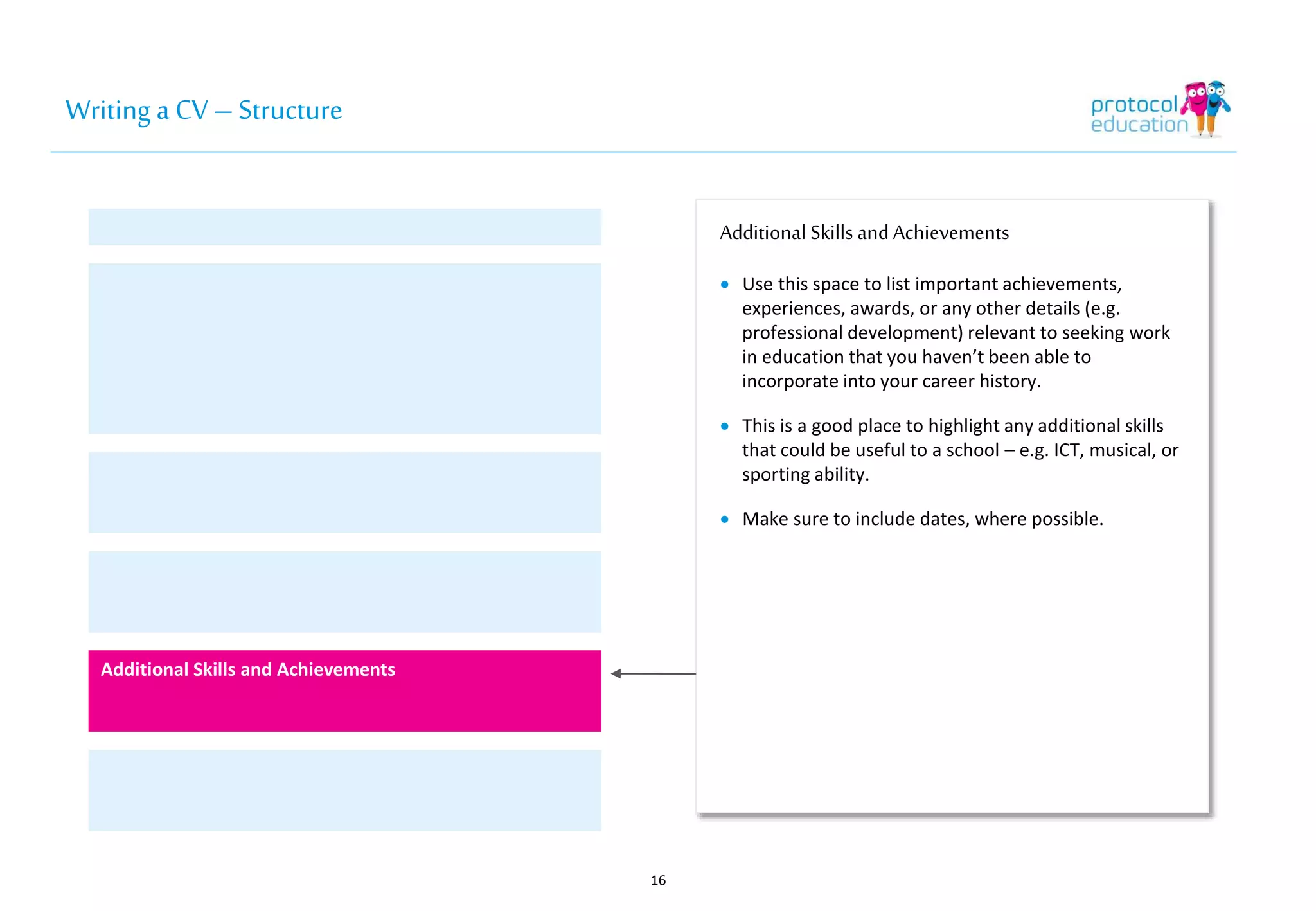
Additional Skills and Achievements 
 Use this space to list important achievements, 
experiences, awards, or any other details (e.g. 
professional development) relevant to seeking work 
in education that you haven’t been able to 
incorporate into your career history. 
 This is a good place to highlight any additional skills 
that could be useful to a school – e.g. ICT, musical, or 
sporting ability. 
 Make sure to include dates, where possible. 
16 
Additional Skills and Achievements
Writing a CV – Structure 
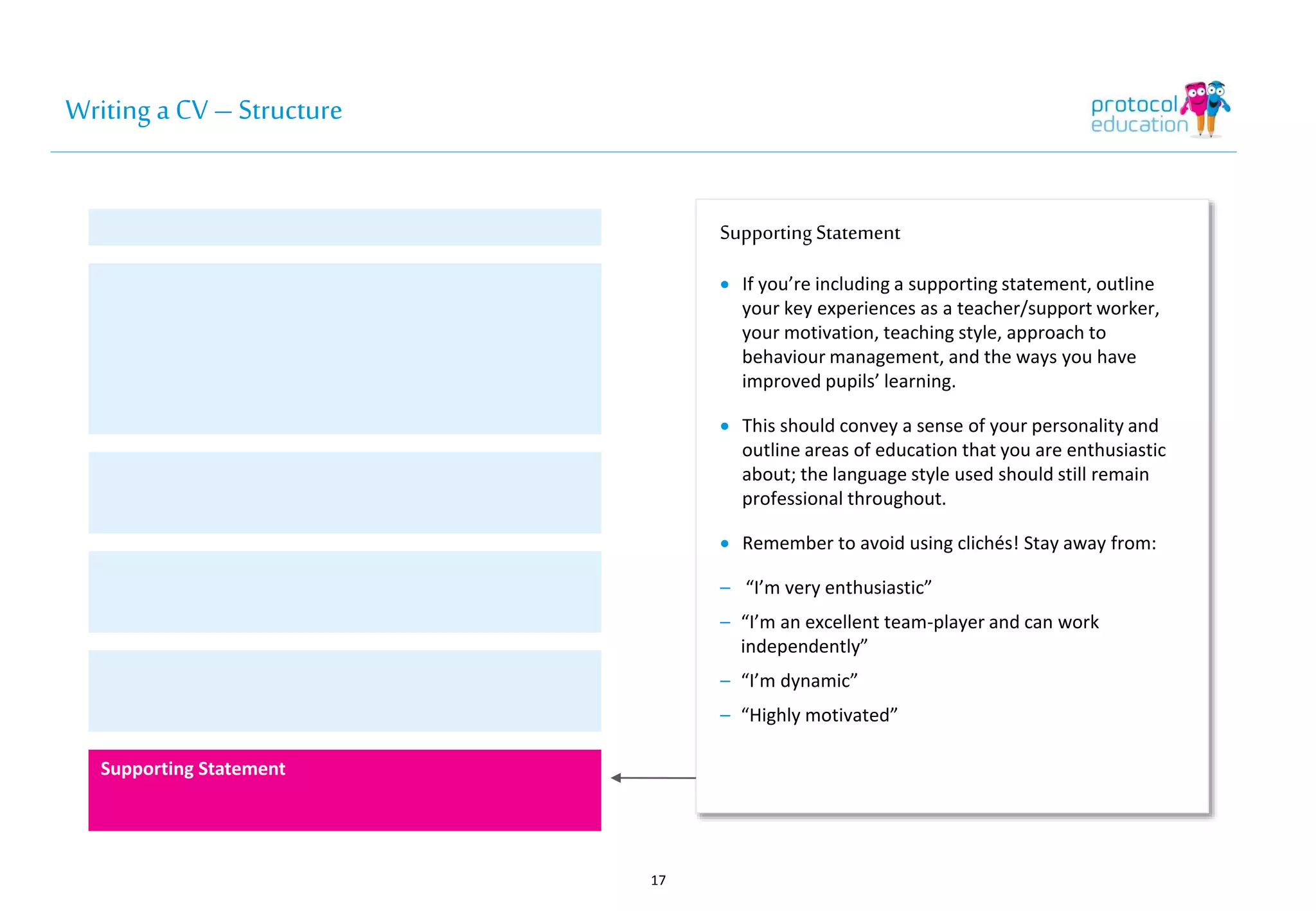
Supporting Statement 
 If you’re including a supporting statement, outline 
your key experiences as a teacher/support worker, 
your motivation, teaching style, approach to 
behaviour management, and the ways you have 
improved pupils’ learning. 
 This should convey a sense of your personality and 
outline areas of education that you are enthusiastic 
about; the language style used should still remain 
professional throughout. 
 Remember to avoid using clichés! Stay away from: 
– “I’m very enthusiastic” 
– “I’m an excellent team-player and can work 
independently” 
– “I’m dynamic” 
– “Highly motivated” 
17 
Supporting Statement
What do I do next? 
Well done! You should now have the 
18 
beginnings of a fantastic CV. 
Remember our five key points: 
 Have you kept it relevant to your audience? 
 Have you used specific examples of 
accomplishments? 
 Has it been checked thoroughly? 
 Have you kept it to two pages? Is it easy to read? 
 Is it up to date? E.g CPD, SEN skills, etc. 
Once you’ve checked all the above, 
send it to your consultant or upload it 
to your Candidate Lounge account. 
Now you’re ready to land that 
interview!
How to Write a Successful Teaching CV

How to Write a Successful Teaching CV

  • 1.
    How to writea successful teaching CV Protocol Education’s guide to CV writing November 2014
  • 2.
    Writing a ProtocolEducation CV When it comes to CVs, we’ve seen a few in our time – both good and bad! Your CV is a vital tool for securing an interview, so we want to help you make as good an impression as possible with a potential school. 2
  • 3.
    Writing a CV– Tips and Tricks We asked headteachers, deputy heads and our own consultants what they like to see on CVs. Take a look at some of their dos and don’ts: • Show your impact on children's learning with specific examples • No need to say that you like children or enjoy being with children • Don’t have unexplained gaps in employment • Highlight your skills from volunteering, community work and other organisations, as initiative is important in any setting • Make sure you mention your leadership skills if you’ve had this experience • If you are looking for a leadership role, create a clear narrative of career journey which shows 3-5 years in each job • Avoid using teaching quotes or clichés • No need to include your photo 3
  • 4.
    Writing a CV– Key Points 1. Know your audience 2. Duties vs achievements 3. SPaG 4. Keep it snappy 5. Stay up to date 4 We’ve boiled all the advice down to five key points for you. Keep these points in mind and we promise you can’t go wrong!
  • 5.
    Writing a CV– Key Points You don’t need to be a mind reader, but it helps... 1. Know your audience Put yourselves in the shoes of a busy headteacher. What things will they be looking for on a CV? Some things that might interest a headteacher: - Ofsted experience - Exam group experience and success - Monitoring, assessing and reporting on pupil attainment 5
  • 6.
    Writing a CV– Key Points 2. Duties vs achievements Just listing your previous responsibilities might not be enough to make your CV stand out. Use specific past accomplishments to show what you can contribute to a school: OK: Taught Year 6 class Better: Improved Year 6 Sats results Best: Increased Year 6 Sats numeracy attainment levels by 20% 6 It can be tough to see your own strengths sometimes... Speak to one of our consultants for help with finding your highlights.
  • 7.
    Writing a CV– Key Points 3. SPaG (Spelling and Grammar) Check, check and check again. Give your CV to a friend to read, and don’t rely solely on spellcheckers – they don’t catch everything! After all, this sentence looks fine to a spellchecker: “I taut very affectively in my previous roll...” 7 A new set of eyes on your CV always helps!
  • 8.
    Writing a CV– Key Points 4. Keep it snappy Your CV might only have a few moments to impress, so don’t hide your best points. - Keep it to two A4 pages - Use an easy-to-read typeface - Make sure you have a logical structure with clear headings 8 Make it count! There’ll be time to explore things in more detail once you get to the interview.
  • 9.
    Writing a CV– Key Points 5. Stay up to date Make sure your CV reflects who you are right now, not six months ago. Keep track of professional development courses and new classroom achievements, and use the latest terminology. 9 If you are missing key skills or experience, one of our professional development courses could be the answer. Take a look at our website to see what’s on offer in a branch near you.
  • 10.
    Now you’re readyto start writing! Here’s the structure that we recommend. If you need help with formatting, download one of our popular CV templates from our website. Writing a CV – Structure 10 Summary Career History Other Relevant Experience Qualifications Additional Skills and Achievements Supporting Statement So, what goes in each section?
  • 11.
    Writing a CV– Structure Summary Start with a short, clear summary of who you are and what you do – people don’t want to have to work it out.  Check your lingo, especially with abbreviations. It’s fine to say SENCO, GCSE or NVQ as they are commonplace, however beware of abbreviations relevant to a specific sector and potentially less known.  You should include: – Your name – Relevant qualification / Job role – Specialist areas (e.g. subject areas, specialist age levels or skills) 11 Summary
  • 12.
    Writing a CV– Structure Career History This is the most important part of your CV, so take some time to get it right.  Start with your most recent position and work backwards  Briefly summarise the school environment (such as school and class size, range of special educational needs etc), e.g. ‘Outstanding Ofsted’, ‘one-form entry primary school’  If newly qualified, give details of your practicum experience  Teachers: If possible, give specific examples of how you helped pupils to progress at the school, and highlight any additional responsibilities or extra-curricular involvement  Support Workers: If possible, describe specific ways that you contributed to improving the quality of learning at the school, and highlight any additional responsibilities or extra-curricular involvement 12 Career History
  • 13.
    Writing a CV– Structure Career History FAQs  How far back should I go in my CV? You probably don’t need to go further back than 10 years. It is important to remember relevance to the job you are being put forward for.  How can I reflect daily supply work in my CV? If you were to list every school you have worked in you could very easily go over two pages! One idea is to block the work together, for example Supply Teacher, Protocol Education, Leicestershire, September 2013 to July 2014.  I have had time away from work. How do I account for these gaps? If it’s only a matter of few weeks or a month then there isn’t much need to worry. Think about how you can sell your career break, for example first time mum, travelling experience, etc. What transferable skills did these give you? Did you carry out any voluntary work during this period? 13 Career History
  • 14.
    Writing a CV– Structure Other Relevant Experience  If you have previous employment experience you consider relevant to your work in education, briefly describe the role and how the skills involved apply to your current practice.  This section can help you to cover gaps in your employment – but remember, keep it relevant! 14 Other Relevant Experience
  • 15.
    Writing a CV– Structure Qualifications  List your qualifications, along with where and when you qualified.  Remember to keep it brief and to the point, highlighting the most relevant qualifications. You don’t need to include your entire school history in this section.  What did you write about qualifications in your summary? Make sure it says the same thing here. 15 Qualifications
  • 16.
    Writing a CV– Structure Additional Skills and Achievements  Use this space to list important achievements, experiences, awards, or any other details (e.g. professional development) relevant to seeking work in education that you haven’t been able to incorporate into your career history.  This is a good place to highlight any additional skills that could be useful to a school – e.g. ICT, musical, or sporting ability.  Make sure to include dates, where possible. 16 Additional Skills and Achievements
  • 17.
    Writing a CV– Structure Supporting Statement  If you’re including a supporting statement, outline your key experiences as a teacher/support worker, your motivation, teaching style, approach to behaviour management, and the ways you have improved pupils’ learning.  This should convey a sense of your personality and outline areas of education that you are enthusiastic about; the language style used should still remain professional throughout.  Remember to avoid using clichés! Stay away from: – “I’m very enthusiastic” – “I’m an excellent team-player and can work independently” – “I’m dynamic” – “Highly motivated” 17 Supporting Statement
  • 18.
    What do Ido next? Well done! You should now have the 18 beginnings of a fantastic CV. Remember our five key points:  Have you kept it relevant to your audience?  Have you used specific examples of accomplishments?  Has it been checked thoroughly?  Have you kept it to two pages? Is it easy to read?  Is it up to date? E.g CPD, SEN skills, etc. Once you’ve checked all the above, send it to your consultant or upload it to your Candidate Lounge account. Now you’re ready to land that interview!