How To Write A CV
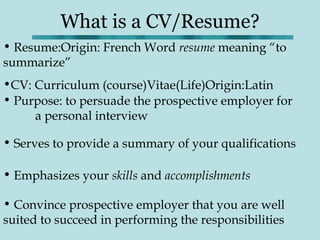
What is a CV/Resume?
• Resume:Origin: French Word resume meaning “to
summarize”
•CV: Curriculum (course)Vitae(Life)Origin:Latin
• Purpose: to persuade the prospective employer for
     a personal interview

• Serves to provide a summary of your qualifications

• Emphasizes your skills and accomplishments

• Convince prospective employer that you are well
suited to succeed in performing the responsibilities
Difference between CV and
            Resume
• CV is longer (2 or more pages) and more
  detailed synopsis of your background and
  skills.
• CV includes a summary of your educational
  and academic backgrounds as well as
  teaching and research experience,
  publications, presentations, awards,
  honors, affiliations and other details
Before You Start
             DO…                                   DO NOT…
•   Be brief, clear and concise
•                                           •   Use the pronoun “I”
    Stress your accomplishments and
    skills, as well as experience           •   Use a font size smaller than 10
•   Be neat and organized; direct the       •   Include personal information such as
    reader’s eye with format                    marital status, health, age, place of
•   Use bold type to emphasize certain          birth, etc
    elements; use italics sparingly, only   •   State salary requirements
    to highlight                            •   Use nicknames
•   Be consistent on format and tenses      •   Include a photograph
•   Concentrate on positives                •   Include any information that you
•   Use action words to describe your           cannot supply documentation or
    accomplishments                             explain
•   Proofread carefully
•   Use high quality matching paper
Heading

• Initial section of your CV details
  – Who you are
     • Do not use nicknames
  – How the employer can reach you
     • Name, address, phone number, email (professional)
     • Current and Permanent if applicable
Career Objective
• Some Do, Some Don’t
  – Some choose to exclude from cv and state in cover letter

• A clear Statement of Your Intentions
  – Some employers like to see a clear goal or purpose
  – Taylor to the job, examples:
     • To obtain a position as a management trainee
     • To secure a full time teaching position at the school/university level.
Education
• Content and format
•   Schools you have attended, including universities, community colleges, technical
    schools, etc.
•   Location of school(s)
•   Date of graduation, actual or anticipated
•   Degree(s) earned or pursued
•   Grade Point Average (GPA) / Division

• Placement
     – Recently graduated students place it after objective
     – Graduated a year or more, place after experience
Experience
• Experience relevant to your objective
    – Full or part-time employment, internships, practicum
    – Also be sure to list volunteer work, community committee work.
This section includes….
• Company or organization and location (city, state)
• Position title
• Dates of employment or involvement
• Descriptions of responsibilities, duties, achievements, etc.

• Important to use action words
   – Good descriptions are vital to convey your experience
   – Keep your tense consistent; present tense if you are currently active
     in the experience and past tense for all other past
     experiences
   – Use the action word list provided for ideas
Skills
• Summary of special skills
  – Computer skills, language skills, customer service,
    leadership
  – Be Specific! Example:
      • Proficient in writing and speaking English
        Skilled in the use of MS Word, MS Excel, MS
        Access
Achievements/Activities/
               Honors/ Awards

• Emphasize significant outside of work
•   Awards, grants, prizes, and special honors
•   Memberships in professional clubs and organization
•   Volunteer activities
•   Hobbies (optional)
References

• Choose two to three people (Past
  supervisors or employers)
   – Name
   – Designation
   – Contact information

• Not usually sent with CV and
  cover letter unless specified
• Can write at end “References
  Available Upon Request”
A few things to remember...

• There is really no ONE right way to write a
  resume or CV—everyone is unique. There is room
  to “be yourself.”
• Proofread your CV very carefully for grammar,
  punctuation, and spelling. You do not want ANY
  mistakes in your CV. Have someone review your
  CV for mistakes and use spell check!
• Get feedback from other people. Make sure that
  your resume looks good, is easy to understand, and
  says what you want it to say!
Three Types of Resumes
• Chronological
• Functional
• Hybrid
The Chronological CV
• A chronological CV focuses on
  presenting the candidate's experience
  on an employer by employer basis,
  with the posts being listed in reverse
  chronological order.
• It also contains details of education
  and qualifications, together with
  hobbies.
• This is the most common type of CV.
How to structure a
         chronological CV
• A chronological CV typically uses the
  following structure:
• Personal details (i.e. name and contact
  details)
• Personal profile or career objectives. This
  should not exceed 5 lines.
• Employment in reverse chronological order.
• Key qualifications
• Professional memberships
• Hobbies and personal interests
Advantages/Disadvantages
• Particularly useful for those applying within
  the same industry as it will demonstrate your
  career progression.
• It is the favourite format for most employers,
  who simply want to get a feel for your career
  to date.


• If you have gaps in your employment which
  you would rather not discuss, a chronological
  CV will make them more obvious.
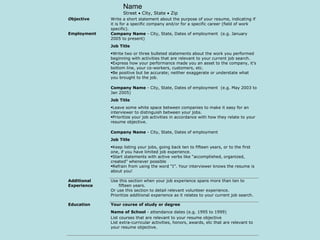
Name
                   Street • City, State • Zip
Objective    Write a short statement about the purpose of your resume, indicating if
             it is for a specific company and/or for a specific career (field of work
             specific).
Employment   Company Name - City, State, Dates of employment (e.g. January
             2005 to present)
             Job Title
             •Write two or three bulleted statements about the work you performed
             beginning with activities that are relevant to your current job search.
             •Express how your performance made you an asset to the company, it’s
             bottom line, your co-workers, customers, etc.
             •Be positive but be accurate; neither exaggerate or understate what
             you brought to the job.

             Company Name - City, State, Dates of employment (e.g. May 2003 to
             Jan 2005)
             Job Title
             •Leave some white space between companies to make it easy for an
             interviewer to distinguish between your jobs.
             •Prioritize your job activities in accordance with how they relate to your
             resume objective.

             Company Name - City, State, Dates of employment
             Job Title
             •Keep listing your jobs, going back ten to fifteen years, or to the first
             one, if you have limited job experience.
             •Start statements with active verbs like “accomplished, organized,
             created” whenever possible
             •Refrain from using the word “I”. Your interviewer knows the resume is
             about you!

Additional   Use this section when your job experience spans more than ten to
Experience       fifteen years.
             Or use this section to detail relevant volunteer experience.
             Prioritize additional experience as it relates to your current job search.

Education    Your course of study or degree
             Name of School - attendance dates (e.g. 1995 to 1999)
             List courses that are relevant to your resume objective
             List extra-curricular activities, honors, awards, etc that are relevant to
             your resume objective.
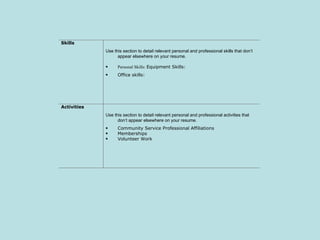
Skills
             Use this section to detail relevant personal and professional skills that don’t
                   appear elsewhere on your resume.

             •     Personal Skills: Equipment Skills:
             •     Office skills:


Activities
             Use this section to detail relevant personal and professional activities that
                   don’t appear elsewhere on your resume.
             •     Community Service Professional Affiliations
             •     Memberships
             •     Volunteer Work
21
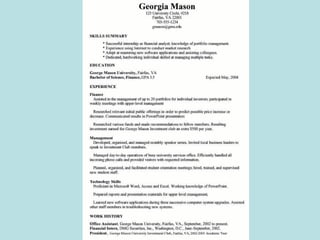
The Functional CV
• Unlike a chronological CV, a functional CV
  places the emphasis on your skills and
  expertise rather than the chronology of you
  employment to date.
• A functional CV typically starts with a personal
  profile which highlights the achievements,
  skills and personal qualities that you possess.
  This is then followed by a succession of
  sections, each relating to a different skill or
  ability. These should be ordered in decreasing
  order of importance.
Functional headings that are
             commonly used.
•   Administration
•   Advertising
•   Communication
•   Consulting
•   Counseling
•   Customer service
•   Designing
•   Editing
•   Education
•   Journalism
•   Human Resources
•   Research
•   Publishing
•   Writing
Advantages of Functional CV
• If you have changed jobs frequently, if your
  experience is a mish-mash of seemingly unrelated
  posts or if you have several career gaps, a
  functional CV will help place the emphasis on
  what you have to offer as a whole rather than on
  the chronology.
• If you are changing industry, a functional CV will
  help the recruiter focus on your transferable skills.
• If you are a more mature applicant, a functional
  CV will take the spotlight away from your age.
Disadvantages of Functional CV
• If you do not have much work experience,
  you may struggle to highlight
  achievements in a separate section.
• A functional CV will not enable you to
  highlight consistent career progression. If
  you wish to convey career progression,
  you should adopt a chronological format.
26
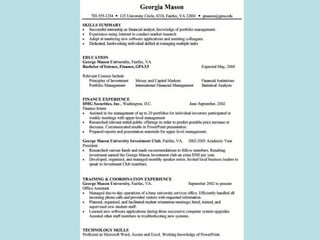
The Hybrid CV
• A hybrid CV follows both the chronological and functional
  format, which makes the CV slightly longer than normal.
• Advantages
• Perfect format if you have a strong career progression with
  many achievements.
• Enables you to sell your strengths as well as your
  experience.
• Disadvantages
• Lengthier than a functional or chronological CV
• Failing to get the attention with the right profile at the start
  of the CV may result in the whole CV remaining unread.
• Not suitable for those with little experience or
  achievements.
• Not suitable for those with employment gaps
28
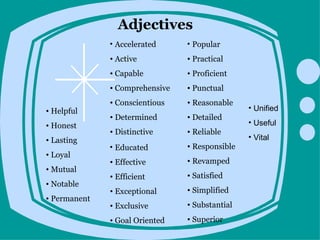
Adjectives
              • Accelerated     • Popular
              • Active          • Practical
              • Capable         • Proficient
              • Comprehensive   • Punctual
              • Conscientious   • Reasonable
• Helpful                                       • Unified
              • Determined      • Detailed
• Honest                                        • Useful
              • Distinctive     • Reliable
• Lasting                                       • Vital
              • Educated        • Responsible
• Loyal
              • Effective       • Revamped
• Mutual
              • Efficient       • Satisfied
• Notable
              • Exceptional     • Simplified
• Permanent
              • Exclusive       • Substantial
              • Goal Oriented   • Superior
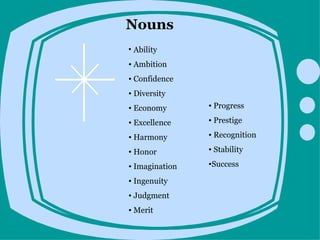
Nouns
• Ability
• Ambition
• Confidence
• Diversity
• Economy       • Progress

• Excellence    • Prestige

• Harmony       • Recognition

• Honor         • Stability

• Imagination   •Success

• Ingenuity
• Judgment
• Merit
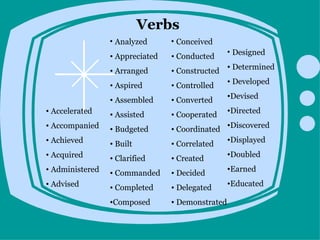
Verbs
                 • Analyzed      • Conceived
                                                  • Designed
                 • Appreciated   • Conducted
                 • Arranged      • Constructed • Determined
                 • Aspired       • Controlled  • Developed

                 • Assembled     • Converted      •Devised
• Accelerated                                     •Directed
                 • Assisted      • Cooperated
• Accompanied    • Budgeted      • Coordinated •Discovered
• Achieved       • Built         • Correlated  •Displayed
• Acquired       • Clarified     • Created        •Doubled
• Administered                                    •Earned
                 • Commanded     • Decided
• Advised        • Completed     • Delegated      •Educated

                 •Composed       • Demonstrated
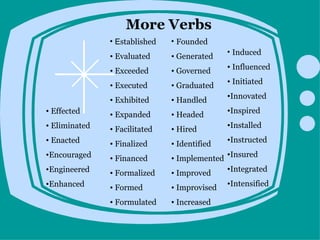
More Verbs
               • Established   • Founded
                                              • Induced
               • Evaluated     • Generated
                                              • Influenced
               • Exceeded      • Governed
               • Executed      • Graduated    • Initiated

               • Exhibited     • Handled      •Innovated
• Effected                                    •Inspired
               • Expanded      • Headed
• Eliminated                                  •Installed
               • Facilitated   • Hired
• Enacted      • Finalized     • Identified   •Instructed
•Encouraged    • Financed      • Implemented •Insured
•Engineered                                  •Integrated
               • Formalized    • Improved
•Enhanced      • Formed        • Improvised   •Intensified

               • Formulated    • Increased
Even MORE Verbs
                • Licensed     • Organized
                                                • Revised
                • Located      • Participated
                                                • Served
                • Maintained   • Perfected
                • Managed      • Piloted        • Serviced

                • Marketed     • Pioneered      • Streamlined
• Interpreted                                   • Structured
                • Mastered     • Planned
• Invented                                      • Succeeded
                • Monitored    • Prepared
• Justified     • Motivated    • Produced       • Supervised
• Keyed         • Negotiated   • Provided       • Trained
• Keynoted      • Negotiated   • Recommended • Unified
•Launched       • Obtained     • Reconciled  • Verified

                • Operated     • Reorganized
Closing Remarks

• Remember that resume building and fine tuning is
  an art not a science


• There are countless ways to design and layout a
  resume/ CV

cv writing

  • 1.
  • 3.
    What is aCV/Resume? • Resume:Origin: French Word resume meaning “to summarize” •CV: Curriculum (course)Vitae(Life)Origin:Latin • Purpose: to persuade the prospective employer for a personal interview • Serves to provide a summary of your qualifications • Emphasizes your skills and accomplishments • Convince prospective employer that you are well suited to succeed in performing the responsibilities
  • 4.
    Difference between CVand Resume • CV is longer (2 or more pages) and more detailed synopsis of your background and skills. • CV includes a summary of your educational and academic backgrounds as well as teaching and research experience, publications, presentations, awards, honors, affiliations and other details
  • 5.
    Before You Start DO… DO NOT… • Be brief, clear and concise • • Use the pronoun “I” Stress your accomplishments and skills, as well as experience • Use a font size smaller than 10 • Be neat and organized; direct the • Include personal information such as reader’s eye with format marital status, health, age, place of • Use bold type to emphasize certain birth, etc elements; use italics sparingly, only • State salary requirements to highlight • Use nicknames • Be consistent on format and tenses • Include a photograph • Concentrate on positives • Include any information that you • Use action words to describe your cannot supply documentation or accomplishments explain • Proofread carefully • Use high quality matching paper
  • 7.
    Heading • Initial sectionof your CV details – Who you are • Do not use nicknames – How the employer can reach you • Name, address, phone number, email (professional) • Current and Permanent if applicable
  • 8.
    Career Objective • SomeDo, Some Don’t – Some choose to exclude from cv and state in cover letter • A clear Statement of Your Intentions – Some employers like to see a clear goal or purpose – Taylor to the job, examples: • To obtain a position as a management trainee • To secure a full time teaching position at the school/university level.
  • 9.
    Education • Content andformat • Schools you have attended, including universities, community colleges, technical schools, etc. • Location of school(s) • Date of graduation, actual or anticipated • Degree(s) earned or pursued • Grade Point Average (GPA) / Division • Placement – Recently graduated students place it after objective – Graduated a year or more, place after experience
  • 10.
    Experience • Experience relevantto your objective – Full or part-time employment, internships, practicum – Also be sure to list volunteer work, community committee work. This section includes…. • Company or organization and location (city, state) • Position title • Dates of employment or involvement • Descriptions of responsibilities, duties, achievements, etc. • Important to use action words – Good descriptions are vital to convey your experience – Keep your tense consistent; present tense if you are currently active in the experience and past tense for all other past experiences – Use the action word list provided for ideas
  • 11.
    Skills • Summary ofspecial skills – Computer skills, language skills, customer service, leadership – Be Specific! Example: • Proficient in writing and speaking English Skilled in the use of MS Word, MS Excel, MS Access
  • 12.
    Achievements/Activities/ Honors/ Awards • Emphasize significant outside of work • Awards, grants, prizes, and special honors • Memberships in professional clubs and organization • Volunteer activities • Hobbies (optional)
  • 13.
    References • Choose twoto three people (Past supervisors or employers) – Name – Designation – Contact information • Not usually sent with CV and cover letter unless specified • Can write at end “References Available Upon Request”
  • 14.
    A few thingsto remember... • There is really no ONE right way to write a resume or CV—everyone is unique. There is room to “be yourself.” • Proofread your CV very carefully for grammar, punctuation, and spelling. You do not want ANY mistakes in your CV. Have someone review your CV for mistakes and use spell check! • Get feedback from other people. Make sure that your resume looks good, is easy to understand, and says what you want it to say!
  • 15.
    Three Types ofResumes • Chronological • Functional • Hybrid
  • 16.
    The Chronological CV •A chronological CV focuses on presenting the candidate's experience on an employer by employer basis, with the posts being listed in reverse chronological order. • It also contains details of education and qualifications, together with hobbies. • This is the most common type of CV.
  • 17.
    How to structurea chronological CV • A chronological CV typically uses the following structure: • Personal details (i.e. name and contact details) • Personal profile or career objectives. This should not exceed 5 lines. • Employment in reverse chronological order. • Key qualifications • Professional memberships • Hobbies and personal interests
  • 18.
    Advantages/Disadvantages • Particularly usefulfor those applying within the same industry as it will demonstrate your career progression. • It is the favourite format for most employers, who simply want to get a feel for your career to date. • If you have gaps in your employment which you would rather not discuss, a chronological CV will make them more obvious.
  • 19.
    Name Street • City, State • Zip Objective Write a short statement about the purpose of your resume, indicating if it is for a specific company and/or for a specific career (field of work specific). Employment Company Name - City, State, Dates of employment (e.g. January 2005 to present) Job Title •Write two or three bulleted statements about the work you performed beginning with activities that are relevant to your current job search. •Express how your performance made you an asset to the company, it’s bottom line, your co-workers, customers, etc. •Be positive but be accurate; neither exaggerate or understate what you brought to the job. Company Name - City, State, Dates of employment (e.g. May 2003 to Jan 2005) Job Title •Leave some white space between companies to make it easy for an interviewer to distinguish between your jobs. •Prioritize your job activities in accordance with how they relate to your resume objective. Company Name - City, State, Dates of employment Job Title •Keep listing your jobs, going back ten to fifteen years, or to the first one, if you have limited job experience. •Start statements with active verbs like “accomplished, organized, created” whenever possible •Refrain from using the word “I”. Your interviewer knows the resume is about you! Additional Use this section when your job experience spans more than ten to Experience fifteen years. Or use this section to detail relevant volunteer experience. Prioritize additional experience as it relates to your current job search. Education Your course of study or degree Name of School - attendance dates (e.g. 1995 to 1999) List courses that are relevant to your resume objective List extra-curricular activities, honors, awards, etc that are relevant to your resume objective.
  • 20.
    Skills Use this section to detail relevant personal and professional skills that don’t appear elsewhere on your resume. • Personal Skills: Equipment Skills: • Office skills: Activities Use this section to detail relevant personal and professional activities that don’t appear elsewhere on your resume. • Community Service Professional Affiliations • Memberships • Volunteer Work
  • 21.
  • 22.
    The Functional CV •Unlike a chronological CV, a functional CV places the emphasis on your skills and expertise rather than the chronology of you employment to date. • A functional CV typically starts with a personal profile which highlights the achievements, skills and personal qualities that you possess. This is then followed by a succession of sections, each relating to a different skill or ability. These should be ordered in decreasing order of importance.
  • 23.
    Functional headings thatare commonly used. • Administration • Advertising • Communication • Consulting • Counseling • Customer service • Designing • Editing • Education • Journalism • Human Resources • Research • Publishing • Writing
  • 24.
    Advantages of FunctionalCV • If you have changed jobs frequently, if your experience is a mish-mash of seemingly unrelated posts or if you have several career gaps, a functional CV will help place the emphasis on what you have to offer as a whole rather than on the chronology. • If you are changing industry, a functional CV will help the recruiter focus on your transferable skills. • If you are a more mature applicant, a functional CV will take the spotlight away from your age.
  • 25.
    Disadvantages of FunctionalCV • If you do not have much work experience, you may struggle to highlight achievements in a separate section. • A functional CV will not enable you to highlight consistent career progression. If you wish to convey career progression, you should adopt a chronological format.
  • 26.
  • 27.
    The Hybrid CV •A hybrid CV follows both the chronological and functional format, which makes the CV slightly longer than normal. • Advantages • Perfect format if you have a strong career progression with many achievements. • Enables you to sell your strengths as well as your experience. • Disadvantages • Lengthier than a functional or chronological CV • Failing to get the attention with the right profile at the start of the CV may result in the whole CV remaining unread. • Not suitable for those with little experience or achievements. • Not suitable for those with employment gaps
  • 28.
  • 30.
    Adjectives • Accelerated • Popular • Active • Practical • Capable • Proficient • Comprehensive • Punctual • Conscientious • Reasonable • Helpful • Unified • Determined • Detailed • Honest • Useful • Distinctive • Reliable • Lasting • Vital • Educated • Responsible • Loyal • Effective • Revamped • Mutual • Efficient • Satisfied • Notable • Exceptional • Simplified • Permanent • Exclusive • Substantial • Goal Oriented • Superior
  • 31.
    Nouns • Ability • Ambition •Confidence • Diversity • Economy • Progress • Excellence • Prestige • Harmony • Recognition • Honor • Stability • Imagination •Success • Ingenuity • Judgment • Merit
  • 32.
    Verbs • Analyzed • Conceived • Designed • Appreciated • Conducted • Arranged • Constructed • Determined • Aspired • Controlled • Developed • Assembled • Converted •Devised • Accelerated •Directed • Assisted • Cooperated • Accompanied • Budgeted • Coordinated •Discovered • Achieved • Built • Correlated •Displayed • Acquired • Clarified • Created •Doubled • Administered •Earned • Commanded • Decided • Advised • Completed • Delegated •Educated •Composed • Demonstrated
  • 33.
    More Verbs • Established • Founded • Induced • Evaluated • Generated • Influenced • Exceeded • Governed • Executed • Graduated • Initiated • Exhibited • Handled •Innovated • Effected •Inspired • Expanded • Headed • Eliminated •Installed • Facilitated • Hired • Enacted • Finalized • Identified •Instructed •Encouraged • Financed • Implemented •Insured •Engineered •Integrated • Formalized • Improved •Enhanced • Formed • Improvised •Intensified • Formulated • Increased
  • 34.
    Even MORE Verbs • Licensed • Organized • Revised • Located • Participated • Served • Maintained • Perfected • Managed • Piloted • Serviced • Marketed • Pioneered • Streamlined • Interpreted • Structured • Mastered • Planned • Invented • Succeeded • Monitored • Prepared • Justified • Motivated • Produced • Supervised • Keyed • Negotiated • Provided • Trained • Keynoted • Negotiated • Recommended • Unified •Launched • Obtained • Reconciled • Verified • Operated • Reorganized
  • 35.
    Closing Remarks • Rememberthat resume building and fine tuning is an art not a science • There are countless ways to design and layout a resume/ CV