HOW TO WRITE A
RESUME / CV
WHAT IS A RESUME?
A resume is a one page summary of
your skills, education, and experience.
The resume acts much like an
advertisement for a company trying to
sell something. The resume is your
advertisement.
INTERCHANGABLE TERMINOLOGY
 Curriculum Vitae
"a brief biographical
résumé of one's career
and training, as
prepared by a person
applying for a job.“
More common term in the
UK
 Résumé
"a brief written account of
personal, educational,
and professional
qualifications and
experience, as that
prepared by an
applicant for a job."
More common term in the
USA
WHY DO I NEED A CV?
 Many employers will ask for one
 Think of your CV as a brochure designed to
promote you
 Take some time and effort and create a really
great CV - it will be worth the effort
 In an application form you are limited in what
you can say about yourself - you can only answer
the questions that are asked
 In your CV, you are in control. Take advantage of
this and show yourself in the best possible light
YOUR CV IS A WORK-IN-PROGRESS
 Keep a master CV,
which is updated
cumulatively as you
progress in your
career:
 add to it only when
you have new
experience or
achievements to
record
 delete from it only as
older items appear
less significant in the
light of new
experience
 Each time you apply
for a job, make a copy
of your master CV:
 edit the copy to reflect
the specific
requirements of the
job you are applying
for
 keep careful records
of what was
submitted for which
vacancies
WHAT SHOULD I PUT IN MY CV?
The past
 how have you spent your life so far?
 what have you achieved?
The present
 what are you currently doing?
 what have you learnt from what you have done in the past?
The Future
 where do you want to end up?
 how do you plan to get there?
 It is good to have a career goal. It indicates that you are
 ambitious and are taking your career seriously.
 Your goal should be ambitious but achievable.
 You should be knowledgeable about what your goal
entails, and be prepared to discuss it at interview.
 You should have a realistic plan for achieving your goal
 The job for which you are applying should be part of that plan.
THE PAST
How have you spent your life so far?
 schools and colleges attended (with dates)
 qualifications attained (with dates and grades)
 employers and job titles (with dates)
 student/vacation work (with dates)
What have you achieved?
 Do you have any sporting achievements?
 Do you play a musical instrument? Do you play in a band or
orchestra?
 Are/were you a member of any student clubs societies?
 Have you undertaken any voluntary work?
 Have you ever won any prizes or awards?
 Have you taken a leadership role or position of responsibility
with respect
 to any of the above?
SKILLS
Subject or industry specific skills:
 For an IT professional you might list the
programming languages that you
 have used - indicating your level of experience in
each.
 If you are a school teacher you might list the subjects
and levels at which you have taught.
Generic or transferable skills:
 Can you write well?
 Can you communicate effectively on the telephone?
 Can you fit in to their team?
 Are you reliable?
 Can you be trusted with money?
 Do you have any leadership ability?
HOW SHOULD I ORGANISE MY CV?
Use bullet point - or short paragraphs - within each of these
sections.
 Personal Details - simple, factual information.
 Career Goal - this section is optional but if you decide to
include it, be prepared to discuss it at interview.
 Educational History - bullet point your progress (with
dates)
 Employment History - bullet point your progress (with
dates)
 Skills and achievements - say when & how you have
demonstrated these
 Referees - make sure you ask their permission first
 Leisure Activities - this section should be kept fairly short
unless you have something very interesting to say.
 Within each section, put more recent items above older
ones
THE PERSON READING YOUR CV IS
BUSY
 ... so use structure, layout and formatting to help him.
 Keep the structure, formatting and layout simple,
logical and consistent.
 Use layout such as white space, indentation and
bullet lists:
 to emphasise important information such as dates
 to enable the reader to scan quickly to the information he is
interested in.
 Keep the text of each item brief but self contained.
 Your CV should normally be no longer than two sides.
 Do not use a font that is smaller than 11 point Times
New Roman (or equivalent) - 12 point is even better.
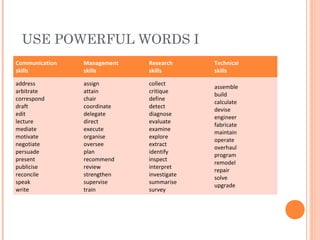
USE POWERFUL WORDS I
Communication
skills
Management
skills
Research
skills
Technical
skills
address
arbitrate
correspond
draft
edit
lecture
mediate
motivate
negotiate
persuade
present
publicise
reconcile
speak
write
assign
attain
chair
coordinate
delegate
direct
execute
organise
oversee
plan
recommend
review
strengthen
supervise
train
collect
critique
define
detect
diagnose
evaluate
examine
explore
extract
identify
inspect
interpret
investigate
summarise
survey
assemble
build
calculate
devise
engineer
fabricate
maintain
operate
overhaul
program
remodel
repair
solve
upgrade
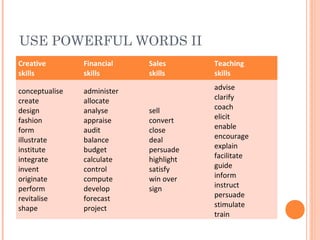
USE POWERFUL WORDS II
Creative
skills
Financial
skills
Sales
skills
Teaching
skills
conceptualise
create
design
fashion
form
illustrate
institute
integrate
invent
originate
perform
revitalise
shape
administer
allocate
analyse
appraise
audit
balance
budget
calculate
control
compute
develop
forecast
project
sell
convert
close
deal
persuade
highlight
satisfy
win over
sign
advise
clarify
coach
elicit
enable
encourage
explain
facilitate
guide
inform
instruct
persuade
stimulate
train
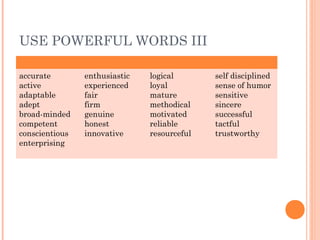
USE POWERFUL WORDS III
accurate
active
adaptable
adept
broad-minded
competent
conscientious
enterprising
enthusiastic
experienced
fair
firm
genuine
honest
innovative
logical
loyal
mature
methodical
motivated
reliable
resourceful
self disciplined
sense of humor
sensitive
sincere
successful
tactful
trustworthy
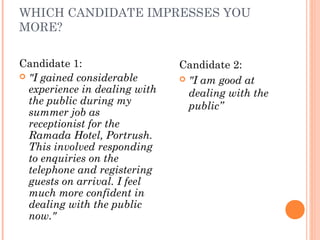
WHICH CANDIDATE IMPRESSES YOU
MORE?
Candidate 1:
 "I gained considerable
experience in dealing with
the public during my
summer job as
receptionist for the
Ramada Hotel, Portrush.
This involved responding
to enquiries on the
telephone and registering
guests on arrival. I feel
much more confident in
dealing with the public
now."
Candidate 2:
 "I am good at
dealing with the
public”
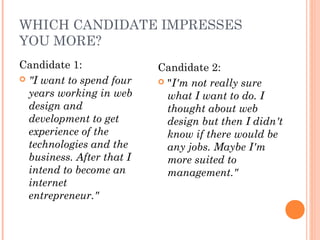
WHICH CANDIDATE IMPRESSES
YOU MORE?
Candidate 1:
 "I want to spend four
years working in web
design and
development to get
experience of the
technologies and the
business. After that I
intend to become an
internet
entrepreneur."
Candidate 2:
 "I'm not really sure
what I want to do. I
thought about web
design but then I didn't
know if there would be
any jobs. Maybe I'm
more suited to
management."
GOOD LUCK!

How to write a resume

  • 1.
    HOW TO WRITEA RESUME / CV
  • 2.
    WHAT IS ARESUME? A resume is a one page summary of your skills, education, and experience. The resume acts much like an advertisement for a company trying to sell something. The resume is your advertisement.
  • 3.
    INTERCHANGABLE TERMINOLOGY  CurriculumVitae "a brief biographical résumé of one's career and training, as prepared by a person applying for a job.“ More common term in the UK  Résumé "a brief written account of personal, educational, and professional qualifications and experience, as that prepared by an applicant for a job." More common term in the USA
  • 4.
    WHY DO INEED A CV?  Many employers will ask for one  Think of your CV as a brochure designed to promote you  Take some time and effort and create a really great CV - it will be worth the effort  In an application form you are limited in what you can say about yourself - you can only answer the questions that are asked  In your CV, you are in control. Take advantage of this and show yourself in the best possible light
  • 5.
    YOUR CV ISA WORK-IN-PROGRESS  Keep a master CV, which is updated cumulatively as you progress in your career:  add to it only when you have new experience or achievements to record  delete from it only as older items appear less significant in the light of new experience  Each time you apply for a job, make a copy of your master CV:  edit the copy to reflect the specific requirements of the job you are applying for  keep careful records of what was submitted for which vacancies
  • 6.
    WHAT SHOULD IPUT IN MY CV? The past  how have you spent your life so far?  what have you achieved? The present  what are you currently doing?  what have you learnt from what you have done in the past? The Future  where do you want to end up?  how do you plan to get there?  It is good to have a career goal. It indicates that you are  ambitious and are taking your career seriously.  Your goal should be ambitious but achievable.  You should be knowledgeable about what your goal entails, and be prepared to discuss it at interview.  You should have a realistic plan for achieving your goal  The job for which you are applying should be part of that plan.
  • 7.
    THE PAST How haveyou spent your life so far?  schools and colleges attended (with dates)  qualifications attained (with dates and grades)  employers and job titles (with dates)  student/vacation work (with dates) What have you achieved?  Do you have any sporting achievements?  Do you play a musical instrument? Do you play in a band or orchestra?  Are/were you a member of any student clubs societies?  Have you undertaken any voluntary work?  Have you ever won any prizes or awards?  Have you taken a leadership role or position of responsibility with respect  to any of the above?
  • 8.
    SKILLS Subject or industryspecific skills:  For an IT professional you might list the programming languages that you  have used - indicating your level of experience in each.  If you are a school teacher you might list the subjects and levels at which you have taught. Generic or transferable skills:  Can you write well?  Can you communicate effectively on the telephone?  Can you fit in to their team?  Are you reliable?  Can you be trusted with money?  Do you have any leadership ability?
  • 9.
    HOW SHOULD IORGANISE MY CV? Use bullet point - or short paragraphs - within each of these sections.  Personal Details - simple, factual information.  Career Goal - this section is optional but if you decide to include it, be prepared to discuss it at interview.  Educational History - bullet point your progress (with dates)  Employment History - bullet point your progress (with dates)  Skills and achievements - say when & how you have demonstrated these  Referees - make sure you ask their permission first  Leisure Activities - this section should be kept fairly short unless you have something very interesting to say.  Within each section, put more recent items above older ones
  • 10.
    THE PERSON READINGYOUR CV IS BUSY  ... so use structure, layout and formatting to help him.  Keep the structure, formatting and layout simple, logical and consistent.  Use layout such as white space, indentation and bullet lists:  to emphasise important information such as dates  to enable the reader to scan quickly to the information he is interested in.  Keep the text of each item brief but self contained.  Your CV should normally be no longer than two sides.  Do not use a font that is smaller than 11 point Times New Roman (or equivalent) - 12 point is even better.
  • 11.
    USE POWERFUL WORDSI Communication skills Management skills Research skills Technical skills address arbitrate correspond draft edit lecture mediate motivate negotiate persuade present publicise reconcile speak write assign attain chair coordinate delegate direct execute organise oversee plan recommend review strengthen supervise train collect critique define detect diagnose evaluate examine explore extract identify inspect interpret investigate summarise survey assemble build calculate devise engineer fabricate maintain operate overhaul program remodel repair solve upgrade
  • 12.
    USE POWERFUL WORDSII Creative skills Financial skills Sales skills Teaching skills conceptualise create design fashion form illustrate institute integrate invent originate perform revitalise shape administer allocate analyse appraise audit balance budget calculate control compute develop forecast project sell convert close deal persuade highlight satisfy win over sign advise clarify coach elicit enable encourage explain facilitate guide inform instruct persuade stimulate train
  • 13.
    USE POWERFUL WORDSIII accurate active adaptable adept broad-minded competent conscientious enterprising enthusiastic experienced fair firm genuine honest innovative logical loyal mature methodical motivated reliable resourceful self disciplined sense of humor sensitive sincere successful tactful trustworthy
  • 14.
    WHICH CANDIDATE IMPRESSESYOU MORE? Candidate 1:  "I gained considerable experience in dealing with the public during my summer job as receptionist for the Ramada Hotel, Portrush. This involved responding to enquiries on the telephone and registering guests on arrival. I feel much more confident in dealing with the public now." Candidate 2:  "I am good at dealing with the public”
  • 15.
    WHICH CANDIDATE IMPRESSES YOUMORE? Candidate 1:  "I want to spend four years working in web design and development to get experience of the technologies and the business. After that I intend to become an internet entrepreneur." Candidate 2:  "I'm not really sure what I want to do. I thought about web design but then I didn't know if there would be any jobs. Maybe I'm more suited to management."
  • 16.