
CV Tips
Content
• Types of CV
• CV VS Resume
• How to create an attractive
CV
• MUST and MUST NOTs
Types of CV
Chronological CV
•

The chronological or performance CV is the most
traditional and widely used format.

•

This type of CV basically outlines:
your work and
educational history

and is ideal if you have stayed in the same career for most
of your working life, steadily working your way up.
use the chronological CV in the following
situations
•

If you have steadily progressed in one chosen field and are
looking for promotion or better conditions.

•

If you have no gaps in your work history.

•

If you want to highlight where you have worked rather than
what you have achieved.

•

If you are staying in the same industry.
Functional CV
•

This type of CV focuses on and highlights the skills
and achievements that you have gained throughout
your whole working career irrespective of where and
when you acquired them.

•

This is useful if you do have gaps in your working
career or if want to change career completely.
Use the functional CV in the following
instances:
•

If you want to change career fields.

•

If you have gaps in your work history due to bringing up
children, illness or any other reason.

•

If you have little experience due to just starting out or just
finishing college or university.

•

If you want to show a prospective employer that you
possess the correct skills for the job even though you do
not have experience in that field.
CV
•

•

•

a CV is a fairly detailed
overview of your life’s
accomplishments,
especially those most
relevant to the realm of
academia
A typical CV for someone
in the beginning stages of
his or her graduate school
career
might only be two or three
pages in length

Resume
•

•

•
•

a general and concise
introduction of your experiences
and skills as they relate to a
particular career or position that
you are aiming to acquire.
may have to be altered for each
position that you are applying
for so as to emphasize those
skills and experiences most
relevant to the work.
Resumes are usually no more
than one page in length.
They are often accompanied
by cover letters
How to create an attractive CV
• CV creation is the first step in order to
start looking for a job
• Using samples from internet is a total
mistake as it doesn’t guarantee a good
CV
What is the mistake?
• Use of the same CV for every position-
WRONG
• The employ want to know WHY should select
you and not somebody else!
Which is the structure?
•

Name and Contact Information:
contact information for your current institution or place of employment
may work best, unless you do not want your colleagues to know that
you are job-hunting.
• Areas of Interest:
a listing of your varied academic interests.
•

Education:
a list of your degrees earned or in progress, institutions, and years of
graduation. You may also include the titles of your dissertation or
thesis here.
For a recent graduate without working experience,this section will be
over the working experience and for canditates with bigger
experience vice versa
•

Grants, Honors and Awards:
a list of grants received, honors bestowed upon you for your
work, and awards you may have received for teaching or
service.
•
Publications and Presentations:
a list of your published articles and books, as well
presentations given at conferences. If there are many of
both, you might consider having one section for
publications and another for presentations
I write ONLY the one that are relevant to this position
•

Employment and Experience:
this section may include separate lists of teaching
experiences, laboratory experiences, field experiences,
volunteer work, leadership, or other relevant experiences.
•

Scholarly or Professional Memberships:
a listing of the professional organizations of which you are a
member. If you have held an office or position in a particular
organization, you can either say so here or leave this
information for the experience section.

•

References:
a list of persons who write letters of recommendations for you,
which includes their contact information.
MUST and MUST NOT in the CV
MUST
What a company want to see in my CV
•Skills (Can I do my job?)
•Achievements ( through references)
•Development (How I developed in the working or
education field?)
•Personality (What can I contribute to the team?)
•

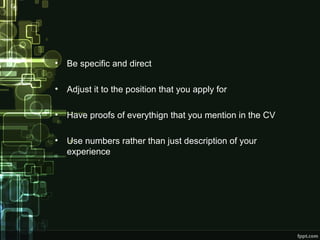
Be specific and direct

•

Adjust it to the position that you apply for

•

Have proofs of everythign that you mention in the CV

•

Use numbers rather than just description of your
experience
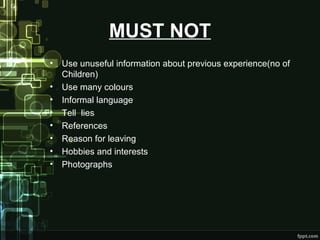
MUST NOT
•
•
•
•
•
•
•
•

Use unuseful information about previous experience(no of
Children)
Use many colours
Informal language
Tell lies
References
Reason for leaving
Hobbies and interests
Photographs
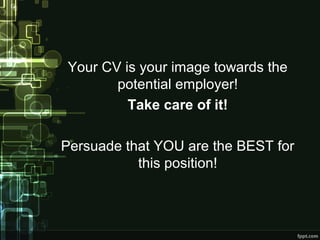
Your CV is your image towards the
potential employer!
Take care of it!
Persuade that YOU are the BEST for
this position!
Cv's

Cv's

  • 1.
  • 2.
    Content • Types ofCV • CV VS Resume • How to create an attractive CV • MUST and MUST NOTs
  • 3.
  • 4.
    Chronological CV • The chronologicalor performance CV is the most traditional and widely used format. • This type of CV basically outlines: your work and educational history and is ideal if you have stayed in the same career for most of your working life, steadily working your way up.
  • 5.
    use the chronologicalCV in the following situations • If you have steadily progressed in one chosen field and are looking for promotion or better conditions. • If you have no gaps in your work history. • If you want to highlight where you have worked rather than what you have achieved. • If you are staying in the same industry.
  • 6.
    Functional CV • This typeof CV focuses on and highlights the skills and achievements that you have gained throughout your whole working career irrespective of where and when you acquired them. • This is useful if you do have gaps in your working career or if want to change career completely.
  • 7.
    Use the functionalCV in the following instances: • If you want to change career fields. • If you have gaps in your work history due to bringing up children, illness or any other reason. • If you have little experience due to just starting out or just finishing college or university. • If you want to show a prospective employer that you possess the correct skills for the job even though you do not have experience in that field.
  • 8.
    CV • • • a CV isa fairly detailed overview of your life’s accomplishments, especially those most relevant to the realm of academia A typical CV for someone in the beginning stages of his or her graduate school career might only be two or three pages in length Resume • • • • a general and concise introduction of your experiences and skills as they relate to a particular career or position that you are aiming to acquire. may have to be altered for each position that you are applying for so as to emphasize those skills and experiences most relevant to the work. Resumes are usually no more than one page in length. They are often accompanied by cover letters
  • 9.
    How to createan attractive CV
  • 10.
    • CV creationis the first step in order to start looking for a job • Using samples from internet is a total mistake as it doesn’t guarantee a good CV
  • 11.
    What is themistake? • Use of the same CV for every position- WRONG • The employ want to know WHY should select you and not somebody else!
  • 12.
    Which is thestructure? • Name and Contact Information: contact information for your current institution or place of employment may work best, unless you do not want your colleagues to know that you are job-hunting. • Areas of Interest: a listing of your varied academic interests. • Education: a list of your degrees earned or in progress, institutions, and years of graduation. You may also include the titles of your dissertation or thesis here. For a recent graduate without working experience,this section will be over the working experience and for canditates with bigger experience vice versa
  • 13.
    • Grants, Honors andAwards: a list of grants received, honors bestowed upon you for your work, and awards you may have received for teaching or service. • Publications and Presentations: a list of your published articles and books, as well presentations given at conferences. If there are many of both, you might consider having one section for publications and another for presentations I write ONLY the one that are relevant to this position • Employment and Experience: this section may include separate lists of teaching experiences, laboratory experiences, field experiences, volunteer work, leadership, or other relevant experiences.
  • 14.
    • Scholarly or ProfessionalMemberships: a listing of the professional organizations of which you are a member. If you have held an office or position in a particular organization, you can either say so here or leave this information for the experience section. • References: a list of persons who write letters of recommendations for you, which includes their contact information.
  • 15.
    MUST and MUSTNOT in the CV
  • 16.
    MUST What a companywant to see in my CV •Skills (Can I do my job?) •Achievements ( through references) •Development (How I developed in the working or education field?) •Personality (What can I contribute to the team?)
  • 17.
    • Be specific anddirect • Adjust it to the position that you apply for • Have proofs of everythign that you mention in the CV • Use numbers rather than just description of your experience
  • 18.
    MUST NOT • • • • • • • • Use unusefulinformation about previous experience(no of Children) Use many colours Informal language Tell lies References Reason for leaving Hobbies and interests Photographs
  • 19.
    Your CV isyour image towards the potential employer! Take care of it! Persuade that YOU are the BEST for this position!