Article Structure and Scientific
Writing
Amr Albanna, MD, MSc
Content
• Manuscripts structure.
• Interpretation of evidence.
• Scientific Writing: Logical Fallacies.
• Research misconduct.
Manuscript
Structure
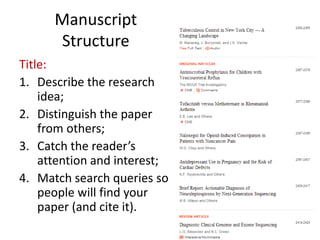
Title:
1. Describe the research
idea;
2. Distinguish the paper
from others;
3. Catch the reader’s
attention and interest;
4. Match search queries so
people will find your
paper (and cite it).
Manuscript Structure
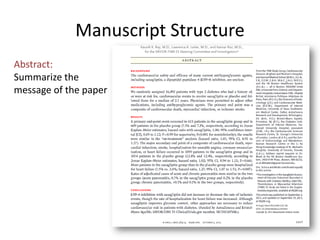
Abstract:
Summarize the
message of the paper
Manuscript Structure
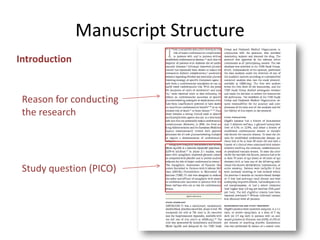
Reason for conducting
the research
Study question (PICO)
Introduction
Manuscript Structure
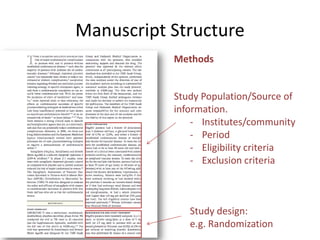
Methods
Study Population/Source of
information.
- Institutes/community
- Period
- Eligibility criteria
- Exclusion criteria
Study design:
e.g. Randomization
Manuscript Structure
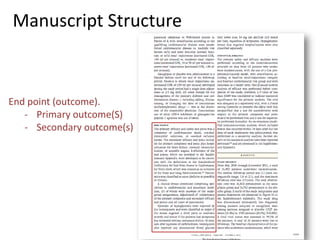
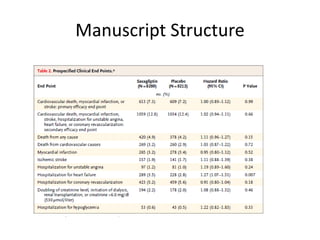
End point (outcome).
- Primary outcome(S)
- Secondary outcome(s)
Manuscript Structure
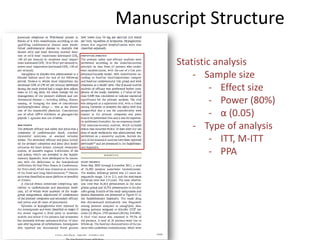
Statistic analysis
- Sample size
- Effect size
- Power (80%)
- α (0.05)
- Type of analysis
- ITT, M-ITT
- PPA
Manuscript Structure
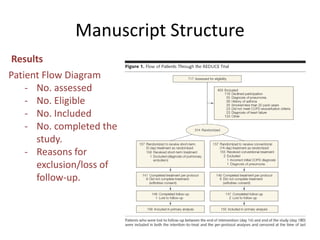
Patient Flow Diagram
- No. assessed
- No. Eligible
- No. Included
- No. completed the
study.
- Reasons for
exclusion/loss of
follow-up.
Results
Manuscript Structure
• Results
– Primary outcomes.
– Secondary outcomes.
– Safety.
• Discussion
– Findings that answer study questions.
– Difference from what has been published.
– Limitations.
– Clinical implications.
– Conclusion.
Manuscript Structure
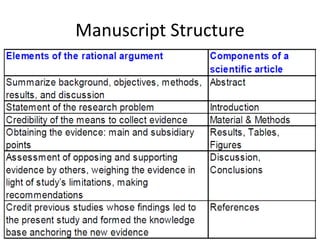
Interpreting the Evidence
• Target your study question.
– Results that answer your primary study question
(primary objective) provide evidence.
– Results that answer secondary questions are
hypothesis generating.
– Results from analyses that were not specifies at
the planning stage (post-hoc analyses) explain
findings of the primary objective.
Interpreting the Evidence
• Findings should be interpreted in light of prior
work by others, both in terms of favourable and
unfavourable arguments.
• Acknowledge the limitations of your study before
considering its implications.
• The credit should be given to the studies that
formed the knowledge on which the present
study rests.
Interpreting the Evidence
• Present your study results to experts for
appropriate interpretation.
Scientific Writing
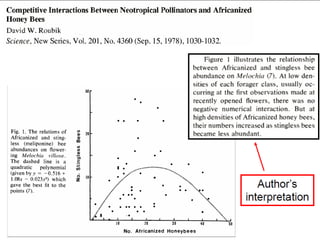
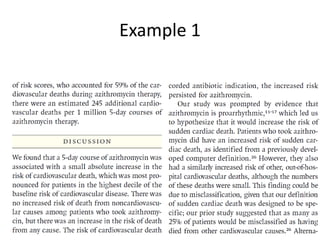
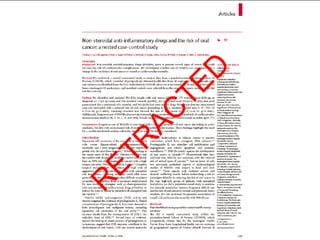
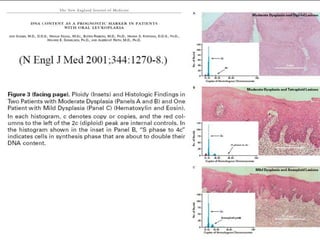
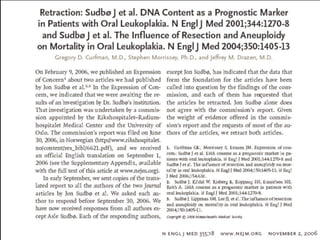
Example 1
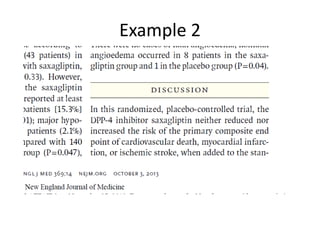
Example 2
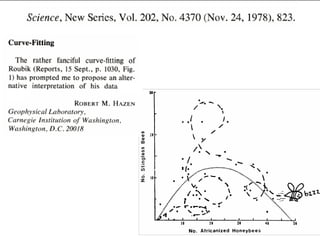
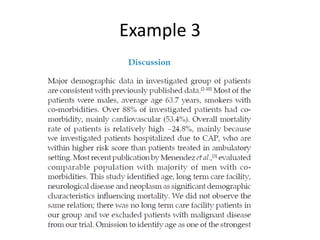
Example 3
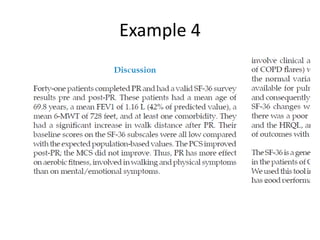
Example 4
Scientific Writing
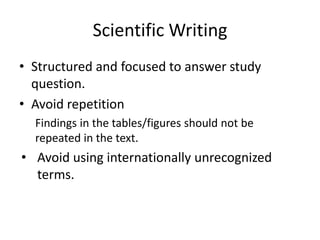
• Structured and focused to answer study
question.
• Avoid repetition
Findings in the tables/figures should not be
repeated in the text.
• Avoid using internationally unrecognized
terms.
Scientific Writing
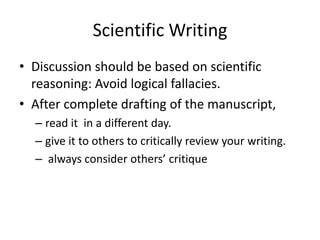
• Discussion should be based on scientific
reasoning: Avoid logical fallacies.
• After complete drafting of the manuscript,
– read it in a different day.
– give it to others to critically review your writing.
– always consider others’ critique
Logical Fallacies
• Flaws in reasoning that lead to illogical
statements.
• Attempt to manipulate audience/readers by
appealing to their emotions instead of their
intellects (i.e. their hearts rather than their
brain).
Logical Fallacies
• Hasty Generalization
– Draw conclusions from inadequate evidence (e.g.
valid questionnaire because it has been prepared
by highly expert physicians).
– Stereotyping: Claim about all members of ethnic,
religious, or racial group (e.g. previously published
results are not reliable because it was conducted
in country X).
Logical Fallacies
• False analogy
– Draw a comparison in which the differences
outweigh the similarities or the similarities are
irrelevant.
– E.g. pooling results from different studies is like
mixing fruits with vegetables.
Logical Fallacies
• Circular Reasoning
– Try to offer proof using another version of the
same argument.
– E.g. Herbal medications are dangerous because
they are unsafe (unsafe is a synonym for
dangerous).
– E.g. Herbal medications are dangerous; otherwise,
patients taking herbal medicine would not get side
effects.
Logical Fallacies
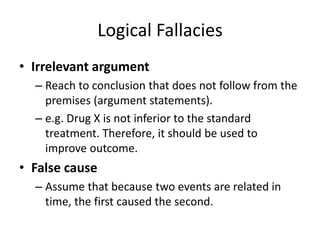
• Irrelevant argument
– Reach to conclusion that does not follow from the
premises (argument statements).
– e.g. Drug X is not inferior to the standard
treatment. Therefore, it should be used to
improve outcome.
• False cause
– Assume that because two events are related in
time, the first caused the second.
Logical Fallacies
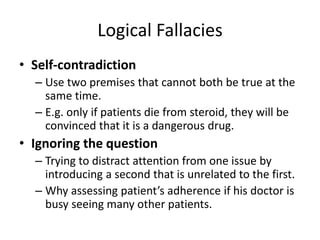
• Self-contradiction
– Use two premises that cannot both be true at the
same time.
– E.g. only if patients die from steroid, they will be
convinced that it is a dangerous drug.
• Ignoring the question
– Trying to distract attention from one issue by
introducing a second that is unrelated to the first.
– Why assessing patient’s adherence if his doctor is
busy seeing many other patients.
Logical Fallacies
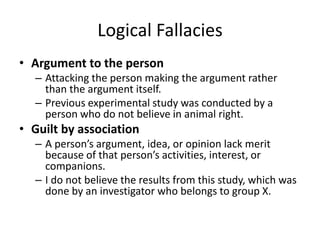
• Argument to the person
– Attacking the person making the argument rather
than the argument itself.
– Previous experimental study was conducted by a
person who do not believe in animal right.
• Guilt by association
– A person’s argument, idea, or opinion lack merit
because of that person’s activities, interest, or
companions.
– I do not believe the results from this study, which was
done by an investigator who belongs to group X.
Logical Fallacies
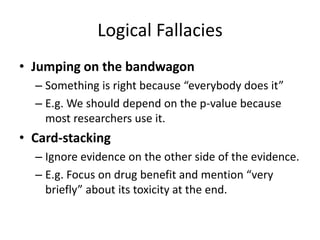
• Jumping on the bandwagon
– Something is right because “everybody does it”
– E.g. We should depend on the p-value because
most researchers use it.
• Card-stacking
– Ignore evidence on the other side of the evidence.
– E.g. Focus on drug benefit and mention “very
briefly” about its toxicity at the end.
Logical Fallacies
• The either-or fallacy
– Offer only two alternatives when more exist.
– E.g. either you take statin or you develop
myocardial infarction.
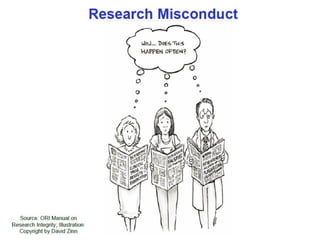
Research Misconduct
“Research misconduct means fabrication, falsification, or plagiarism in
proposing, performing, or reviewing research, or in reporting research
results.”
“Fabrication is making up data or results and recording or reporting them.”
“Falsification is manipulating research materials, equipment, or processes, or
changing or omitting data or results such that the research is not accurately
represented in the research record.”
“Plagiarism is the appropriation of another person's ideas, processes, results,
or words without giving appropriate credit.”
“Research misconduct does not include honest error or differences of
opinion.”
Office of Research Integrity, DHHS, US
Case Summary - Scott E. Monte
[[Federal Register: January 23, 2008 (Volume 73, Number 15)] [Notices] [Page 3973] From the Federal Register
Online via GPO Access
[wais.access.gpo.gov] [DOCID:fr23ja08-52] DEPARTMENT OF HEALTH AND HUMAN SERVICES Office of the Secretary
Findings of Scientific Misconduct ACTION: Notice. SUMMARY: Notice is hereby given that the Office of Research
Integrity (ORI) and the Assistant Secretary for Health have taken final action in the following case:
Scott E. Monte, Huntington Memorial Hospital, Pasadena, CA: Based on the findings of an investigation conducted
by Huntington Memorial Hospital (HMH) and information obtained by the Office of Research Integrity (ORI) during
its oversight review, the U.S. Public Health Service (PHS) found that Scott E. Monte, L.V.N., former Clinical Research
Associate, HMH, engaged in scientific misconduct by knowingly and intentionally falsifying and fabricating clinical
research records in HMH cancer prevention and treatment protocols supported by National Cancer Institute (NCI),
National Institutes of Health (NIH), awards U10 CA69651, U10 CA12027, U10 CA32012, and U10 CA86004.
Specifically, Mr. Monte knowingly and intentionally:
(1) Entered falsified and fabricated laboratory data or physical examination results on five (5) research protocol case
report forms (CRFs);
(2) Falsified a gynecological examination report in a physician's progress note and entered the falsified document in
the patient's research chart; and
(3) Fabricated progress notes for four patients and a case report form for one of these patients.
ORI has implemented the following administrative actions for a period of three (3) years, beginning on January 7,
2008:
(1) Mr. Monte is debarred from any contracting or subcontracting with any agency of the United States Government
and from eligibility or involvement in nonprocurement programs of the United States Government pursuant to HHS'
implementation of the OMB Guidelines to Agencies on Governmentwide Debarment and Suspension at 2 CFR Part
376; and
(2) Mr. Monte is prohibited from serving in any advisory capacity to PHS, including but not limited to service on any
PHS advisory committee, board, and/or peer review committee, or as a consultant.
FOR FURTHER INFORMATION CONTACT:
Director, Division of Investigative Oversight
Office of Research Integrity
1101 Wootton Parkway, Suite 750
Rockville, MD 20852
(240) 453-8800

Article structure & scientific writing

  • 1.
    Article Structure andScientific Writing Amr Albanna, MD, MSc
  • 2.
    Content • Manuscripts structure. •Interpretation of evidence. • Scientific Writing: Logical Fallacies. • Research misconduct.
  • 3.
    Manuscript Structure Title: 1. Describe theresearch idea; 2. Distinguish the paper from others; 3. Catch the reader’s attention and interest; 4. Match search queries so people will find your paper (and cite it).
  • 4.
  • 5.
    Manuscript Structure Reason forconducting the research Study question (PICO) Introduction
  • 6.
    Manuscript Structure Methods Study Population/Sourceof information. - Institutes/community - Period - Eligibility criteria - Exclusion criteria Study design: e.g. Randomization
  • 7.
    Manuscript Structure End point(outcome). - Primary outcome(S) - Secondary outcome(s)
  • 8.
    Manuscript Structure Statistic analysis -Sample size - Effect size - Power (80%) - α (0.05) - Type of analysis - ITT, M-ITT - PPA
  • 9.
    Manuscript Structure Patient FlowDiagram - No. assessed - No. Eligible - No. Included - No. completed the study. - Reasons for exclusion/loss of follow-up. Results
  • 10.
  • 11.
    Manuscript Structure • Results –Primary outcomes. – Secondary outcomes. – Safety. • Discussion – Findings that answer study questions. – Difference from what has been published. – Limitations. – Clinical implications. – Conclusion.
  • 12.
  • 13.
    Interpreting the Evidence •Target your study question. – Results that answer your primary study question (primary objective) provide evidence. – Results that answer secondary questions are hypothesis generating. – Results from analyses that were not specifies at the planning stage (post-hoc analyses) explain findings of the primary objective.
  • 14.
    Interpreting the Evidence •Findings should be interpreted in light of prior work by others, both in terms of favourable and unfavourable arguments. • Acknowledge the limitations of your study before considering its implications. • The credit should be given to the studies that formed the knowledge on which the present study rests.
  • 15.
    Interpreting the Evidence •Present your study results to experts for appropriate interpretation.
  • 18.
  • 19.
  • 20.
  • 21.
  • 22.
  • 23.
    Scientific Writing • Structuredand focused to answer study question. • Avoid repetition Findings in the tables/figures should not be repeated in the text. • Avoid using internationally unrecognized terms.
  • 24.
    Scientific Writing • Discussionshould be based on scientific reasoning: Avoid logical fallacies. • After complete drafting of the manuscript, – read it in a different day. – give it to others to critically review your writing. – always consider others’ critique
  • 25.
    Logical Fallacies • Flawsin reasoning that lead to illogical statements. • Attempt to manipulate audience/readers by appealing to their emotions instead of their intellects (i.e. their hearts rather than their brain).
  • 26.
    Logical Fallacies • HastyGeneralization – Draw conclusions from inadequate evidence (e.g. valid questionnaire because it has been prepared by highly expert physicians). – Stereotyping: Claim about all members of ethnic, religious, or racial group (e.g. previously published results are not reliable because it was conducted in country X).
  • 27.
    Logical Fallacies • Falseanalogy – Draw a comparison in which the differences outweigh the similarities or the similarities are irrelevant. – E.g. pooling results from different studies is like mixing fruits with vegetables.
  • 28.
    Logical Fallacies • CircularReasoning – Try to offer proof using another version of the same argument. – E.g. Herbal medications are dangerous because they are unsafe (unsafe is a synonym for dangerous). – E.g. Herbal medications are dangerous; otherwise, patients taking herbal medicine would not get side effects.
  • 29.
    Logical Fallacies • Irrelevantargument – Reach to conclusion that does not follow from the premises (argument statements). – e.g. Drug X is not inferior to the standard treatment. Therefore, it should be used to improve outcome. • False cause – Assume that because two events are related in time, the first caused the second.
  • 30.
    Logical Fallacies • Self-contradiction –Use two premises that cannot both be true at the same time. – E.g. only if patients die from steroid, they will be convinced that it is a dangerous drug. • Ignoring the question – Trying to distract attention from one issue by introducing a second that is unrelated to the first. – Why assessing patient’s adherence if his doctor is busy seeing many other patients.
  • 31.
    Logical Fallacies • Argumentto the person – Attacking the person making the argument rather than the argument itself. – Previous experimental study was conducted by a person who do not believe in animal right. • Guilt by association – A person’s argument, idea, or opinion lack merit because of that person’s activities, interest, or companions. – I do not believe the results from this study, which was done by an investigator who belongs to group X.
  • 32.
    Logical Fallacies • Jumpingon the bandwagon – Something is right because “everybody does it” – E.g. We should depend on the p-value because most researchers use it. • Card-stacking – Ignore evidence on the other side of the evidence. – E.g. Focus on drug benefit and mention “very briefly” about its toxicity at the end.
  • 33.
    Logical Fallacies • Theeither-or fallacy – Offer only two alternatives when more exist. – E.g. either you take statin or you develop myocardial infarction.
  • 35.
    Research Misconduct “Research misconductmeans fabrication, falsification, or plagiarism in proposing, performing, or reviewing research, or in reporting research results.” “Fabrication is making up data or results and recording or reporting them.” “Falsification is manipulating research materials, equipment, or processes, or changing or omitting data or results such that the research is not accurately represented in the research record.” “Plagiarism is the appropriation of another person's ideas, processes, results, or words without giving appropriate credit.” “Research misconduct does not include honest error or differences of opinion.” Office of Research Integrity, DHHS, US
  • 40.
    Case Summary -Scott E. Monte [[Federal Register: January 23, 2008 (Volume 73, Number 15)] [Notices] [Page 3973] From the Federal Register Online via GPO Access [wais.access.gpo.gov] [DOCID:fr23ja08-52] DEPARTMENT OF HEALTH AND HUMAN SERVICES Office of the Secretary Findings of Scientific Misconduct ACTION: Notice. SUMMARY: Notice is hereby given that the Office of Research Integrity (ORI) and the Assistant Secretary for Health have taken final action in the following case: Scott E. Monte, Huntington Memorial Hospital, Pasadena, CA: Based on the findings of an investigation conducted by Huntington Memorial Hospital (HMH) and information obtained by the Office of Research Integrity (ORI) during its oversight review, the U.S. Public Health Service (PHS) found that Scott E. Monte, L.V.N., former Clinical Research Associate, HMH, engaged in scientific misconduct by knowingly and intentionally falsifying and fabricating clinical research records in HMH cancer prevention and treatment protocols supported by National Cancer Institute (NCI), National Institutes of Health (NIH), awards U10 CA69651, U10 CA12027, U10 CA32012, and U10 CA86004. Specifically, Mr. Monte knowingly and intentionally: (1) Entered falsified and fabricated laboratory data or physical examination results on five (5) research protocol case report forms (CRFs); (2) Falsified a gynecological examination report in a physician's progress note and entered the falsified document in the patient's research chart; and (3) Fabricated progress notes for four patients and a case report form for one of these patients. ORI has implemented the following administrative actions for a period of three (3) years, beginning on January 7, 2008: (1) Mr. Monte is debarred from any contracting or subcontracting with any agency of the United States Government and from eligibility or involvement in nonprocurement programs of the United States Government pursuant to HHS' implementation of the OMB Guidelines to Agencies on Governmentwide Debarment and Suspension at 2 CFR Part 376; and (2) Mr. Monte is prohibited from serving in any advisory capacity to PHS, including but not limited to service on any PHS advisory committee, board, and/or peer review committee, or as a consultant. FOR FURTHER INFORMATION CONTACT: Director, Division of Investigative Oversight Office of Research Integrity 1101 Wootton Parkway, Suite 750 Rockville, MD 20852 (240) 453-8800