1
HEAT TREATMENT OF
PRESSURE VESSELS
2
HEAT TREATMENT
MECHANICAL PROPERTIES OF METALS &
ALLOYS DEPEND ON
 CHEMISTRY (ALLOYING ELEMENTS)
&
 HEAT TREATMENT
3
WHAT IS HEAT TREATMENT?
• MATERIALS TREATED BYAPPLICATION OF
HEAT - NORMALLY DONE IN SOLID STATE
• HEATING BY VARIOUS SOURCES
– HEATING IN A FURNACE – Oil, Gas, Electrical
– HEATING OUT SIDE WITH ELECTRIC HEATING
COILS ARROUND THE JOB – Local Heat treatment
– PASSING HOT AIR INSIDE A CLOSSED VESSEL –
Internal firing
4
HEAT TREATMENT
• HEAT TEATMENT PARAMETERS
– RATE OF HEATING
– SOAKING TEMP.
– SOAKING TIME
– COOLING RATE
– COOLING MEDIA
5
WHY HT REQUIRED ?
• TO BRING THE PROPERTIES TO THE
DESIRED RANGE
–Strength, UTS, YS & Elongation
–Toughness
–Hardness
• CARRIED OUT IN
–FABRICATION INDUSTRIES- Fabricated Components
–STEEL PLANTS – Plates, Pipes, Tubes, Sections
– FOUNDRY SHOPS - Castings
– FORGING SHOPS – Forged Components
6
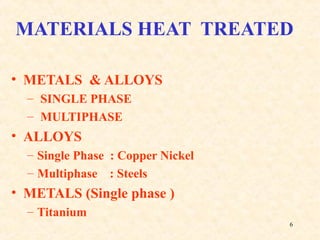
MATERIALS HEAT TREATED
• METALS & ALLOYS
– SINGLE PHASE
– MULTIPHASE
• ALLOYS
– Single Phase : Copper Nickel
– Multiphase : Steels
• METALS (Single phase )
– Titanium
7
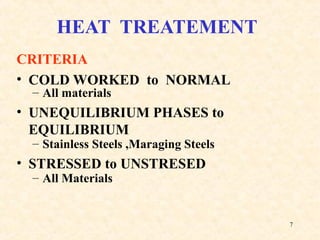
HEAT TREATEMENT
CRITERIA
• COLD WORKED to NORMAL
– All materials
• UNEQUILIBRIUM PHASES to
EQUILIBRIUM
– Stainless Steels ,Maraging Steels
• STRESSED to UNSTRESED
– All Materials
8
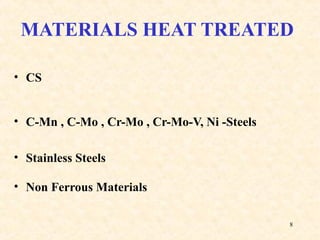
MATERIALS HEAT TREATED
• CS
• C-Mn , C-Mo , Cr-Mo , Cr-Mo-V, Ni -Steels
• Stainless Steels
• Non Ferrous Materials
9
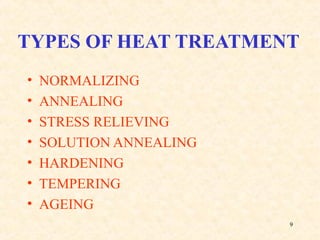
TYPES OF HEAT TREATMENT
• NORMALIZING
• ANNEALING
• STRESS RELIEVING
• SOLUTION ANNEALING
• HARDENING
• TEMPERING
• AGEING
10
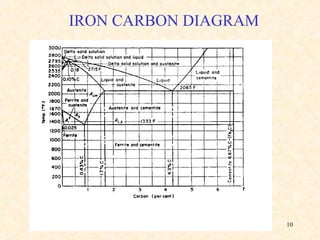
IRON CARBON DIAGRAM
11
NORMALIZING
• The steel is heated to 40° C above the upper
critical temperature followed by cooling in the
still air.
To achieve
• Uniform structure
• Change in Mechanical properties,
– UTS, YS & Elongation
– Hardness
– Impact properties
• Refined grains
12
ANNEALING
• Steel is heated 10 to 50°C above the upper
critical temperature and held for the desired
length of time followed by very slow cooling
within the furnace
To achieve:
• Softness & better ductility
• Stresses free material – Stress generated due to
mechanical working / previous HT
• Uniform property through out the material
13
SOLUTION ANNEALING
• Austenitic Stainless steels is heated to above
1050°C and held for the desired time followed
by fast cooling to room temperature within few
minutes by quenching / blowing the air.
Solution annealing is done on stainless steel and
non ferrous alloys
• To soften the material
• To remove carbide precipitation formed at grain
boundaries during manufacturing process ( SS )
• To improve Corrosion Resistance
14
AGEING
The Material is heated to a certain temperature,
and held for the desired time; followed by
quenching or cooling in air
Ageing is done on materials susceptible for
ageing characteristics : Maraging Steels
• Normally increases strength
• Improves Toughness
15
AGEING
Maraging Steels
M250
• Temperature : 485° C
• Normally 3 Hrs 15 mts
• Heating Rate : 200 C per hr per inch thick
• Cooling Rate : Cool in Air / Quench in water
16
STRESS RELIEVING
The steel is heated to a temperature below close to the
lower critical temperature with a specific rate of
heating. It is held at the temperature for a desired
length of time, followed by cooling with a specific
rate up to certain temperature.
There is no change in grain structure.
Stress relieving is done Fabricated Components of
CS & LAS:
• To reduce Internal Stresses
• To soften the steel partially
• To soften HAZ
17
STRESS RELIEVING
C-Mn , C-Mo , Cr-Mo (< 2% Cr)
• C - Mn Steels , C - Mo Steels, Cr-Mo Steels
– SA 515Gr 70 , SA204GrA, SA387GR11,CL1
• Temperature : 593° C Min
– Normally 600 - 640° C, 650-690° C
• Time : 15 minutes min ( 1 hr / inch thick)
• Heating Rate : 200° C per hr per inch thick
• Cooling Rate : 260° C per hr per inch thick
18
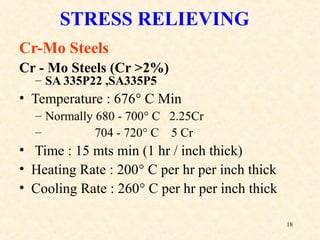
Cr-Mo Steels
Cr - Mo Steels (Cr >2%)
– SA 335P22 ,SA335P5
• Temperature : 676° C Min
– Normally 680 - 700° C 2.25Cr
– 704 - 720° C 5 Cr
• Time : 15 mts min (1 hr / inch thick)
• Heating Rate : 200° C per hr per inch thick
• Cooling Rate : 260° C per hr per inch thick
STRESS RELIEVING
19
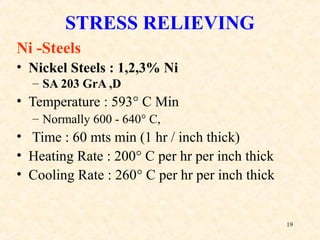
Ni -Steels
• Nickel Steels : 1,2,3% Ni
– SA 203 GrA ,D
• Temperature : 593° C Min
– Normally 600 - 640° C,
• Time : 60 mts min (1 hr / inch thick)
• Heating Rate : 200° C per hr per inch thick
• Cooling Rate : 260° C per hr per inch thick
STRESS RELIEVING
20
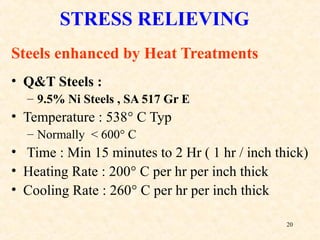
Steels enhanced by Heat Treatments
• Q&T Steels :
– 9.5% Ni Steels , SA 517 Gr E
• Temperature : 538° C Typ
– Normally < 600° C
• Time : Min 15 minutes to 2 Hr ( 1 hr / inch thick)
• Heating Rate : 200° C per hr per inch thick
• Cooling Rate : 260° C per hr per inch thick
STRESS RELIEVING
21
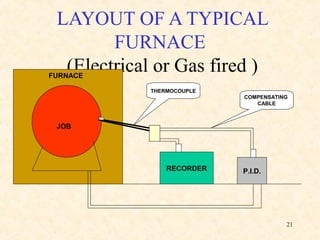
LAYOUT OF A TYPICAL
FURNACE
(Electrical or Gas fired )
RECORDER P.I.D.
FURNACE
JOB
COMPENSATING
CABLE
THERMOCOUPLE
22
THERMOCOUPLES
• PRINCIPLE OF A THERMOCOUPLE
• THERMOCOUPLE MATERIAL
• TYPES OF THERMOCOUPLE BEING
USED IN HED POWAI / HZW
23
PRINCIPLE OF
THERMOCOUPLE
The basic principle of thermoelectric
thermometry is that a thermocouple develops
an emf which is a function of the difference in
temperature of its measuring junction &
reference junction. If the temperature of
reference junction is known, the temperature
of the measuring junction can be determined
by measuring the emf generated in the circuit.
24
THERMOCOUPLE MATERIAL
REQUIREMENT
1. High coefficient of thermal emf.
2. Continuously increasing relation of emf to temperature over
a long range.
3. Freedom from phase changes or other phenomenon giving
rise to discontinuity in temperature emf relationships.
4. Resistance to oxidation, corrosion and contamination.
5. Homogeneity and reproducibility to fit an establish
temperature & emf relationship.
SPEED OF RESPONSE MAY BE IMPROVED AND
RADIATION & CONDUCTION ERRORS MAY BE REDUCED
BY THE USE OF SMALL DIAMETER THERMOCOUPLES.
25
TYPES OF THERMOCOUPLE
BEING USED IN HZW
K type :
Material : Chromel + Alumel
Nickel based ( 10 %Cr ) + ( 2 % Al )
Properties : Non-Magnetic + Magnetic
In this type of thermocouple, the wires are
joined at one end only to form a point-type
temperature sensor. Instrumentation converts
the millivolt signal to related temperature.
26
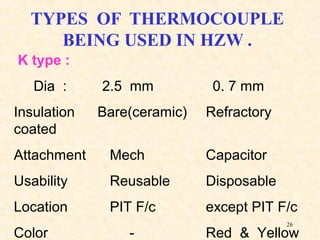
TYPES OF THERMOCOUPLE
BEING USED IN HZW .
K type :
Dia : 2.5 mm 0. 7 mm
Insulation Bare(ceramic) Refractory
coated
Attachment Mech Capacitor
Usability Reusable Disposable
Location PIT F/c except PIT F/c
Color - Red & Yellow
27
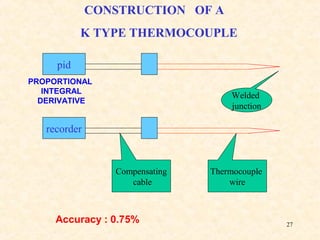
recorder
pid
Compensating
cable
Thermocouple
wire
Welded
junction
CONSTRUCTION OF A
K TYPE THERMOCOUPLE
Accuracy : 0.75%
PROPORTIONAL
INTEGRAL
DERIVATIVE
28
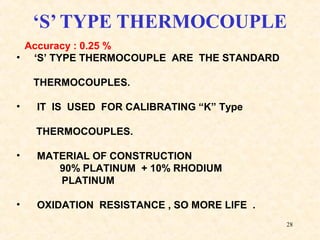
‘S’ TYPE THERMOCOUPLE
• ‘S’ TYPE THERMOCOUPLE ARE THE STANDARD
THERMOCOUPLES.
• IT IS USED FOR CALIBRATING “K” Type
THERMOCOUPLES.
• MATERIAL OF CONSTRUCTION
90% PLATINUM + 10% RHODIUM
PLATINUM
• OXIDATION RESISTANCE , SO MORE LIFE .
Accuracy : 0.25 %
29
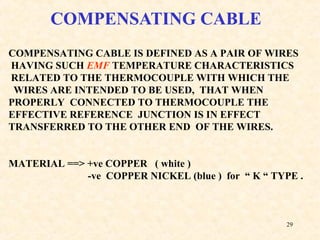
COMPENSATING CABLE
COMPENSATING CABLE IS DEFINED AS A PAIR OF WIRES
HAVING SUCH EMF TEMPERATURE CHARACTERISTICS
RELATED TO THE THERMOCOUPLE WITH WHICH THE
WIRES ARE INTENDED TO BE USED, THAT WHEN
PROPERLY CONNECTED TO THERMOCOUPLE THE
EFFECTIVE REFERENCE JUNCTION IS IN EFFECT
TRANSFERRED TO THE OTHER END OF THE WIRES.
MATERIAL ==> +ve COPPER ( white )
-ve COPPER NICKEL (blue ) for “ K “ TYPE .
30
P.I.D.
PID = PROPORTIONAL INTEGRAL DERIVATIVE
• PID FUNCTIONS BOTH AS PROGRAMMER AND
CONTROLLER
• PID CONTROLLER CAN BE ZONE WISE
• PROGRAMME IS MADE IN SEGMENTS AS PER
DIFFERENT STAGES OF HEAT TREATMENT
• DIGITAL DISPLAY IS AVAILABLE FOR PROGRAMME
TEMPERATURE AND FURNACE TEMEPERATURE
• TYPICAL OR REPETITIVE HEAT TREATMENT CYCLE
CAN BE STORED IN PID(PROGRAMMER)
31
RECORDER
TYPES OF RECORDER
•PAPERLESS -- WITH COLOUR DISPLAY SCREEN ,HARD DISC AND FLOPPY
DRIVE. NOT USED IN HED HZW.
•WITH PAPER -- CURRENTLY BEING USED IN HZW.
•24 CHANNEL -- CURRENTLY BEING USED IN PFS( CHINO MAKE-- model no.I003
/Graph ET 001).
•12 CHANNEL -- CURRENTLY BEING USED IN MFS1 AND HFS1
( CHINO MAKE -- model no. EH100 / Graph ET 201).
COMPENSATING CABLES ARE CONNECTED BEHIND THE RECORDER SCREEN IN
CHANNELS.
•X-AXIS IS FOR TEMPERATURE (RANGE = 0 TO 1200’C)
•Y-AXIS IS FOR GRAPH SPEED.
•VARIOUS SPEED OF GRAPHS ARE 12.5, 25, 50, 100 MM / HOUR
• GENERALLY KEEP 25 MM / HOUR.
32
GRAPH PAPER
• GRAPH PAPERS ARE USED FOR PLOTTING THE
FURNACE /JOB TEMPERATURE VIA THERMOCOUPLE.
THEY ARE FITTED ON THE RECORDER.
• GRAPH PAPER RECOMMENDED ON RECORDER ONLY
TO BE USED
• GRAPH PAPER FOR MFS1 AND HFS1 FURNACE
==> ET 201 CHINO MAKE, JAPAN
GRAPH PAPER FOR PFS FURNACE
==> ET 001 CHINO MAKE, JAPAN
• THE LENGTH OF ONE BUNDLE OF GRAPH PAPER IS
GENERALLY 2000 MM.
• DOTTING TYPE RECORDER INK (CHINO MAKE, JAPAN)
IS USED IN RECORDER FOR PLOTTING OF GRAPH.
USUALLY , 6 COLOURS ARE FILLED FOR PLOTTING.
33
PROCEDURE FOR EMPTY FURNACE
CALIBRATION
Calibration of PIDS ( indicator & controller )
1. Connect the millivolt source to the temperature
indicator or controller by a compensating
cable. Care should be taken to clean the wires and
terminals thoroughly before connections are
made.
2. The millivolt output for various temperature
ranging from 00
C to 10000
C in steps of 500
C is fed
to the indicator / controller.
3. After the millivolt value / temperature reading
displayed is steady, the reading of
indicator/controller shall be noted.
34
PROCEDURE FOR EMPTY FURNACE
CALIBRATION
Calibration of recorder
1. Connect the millivolt source to the recorder by a
compensating cable. Care should be taken to
clean the wires and terminals thoroughly before
the connections are made.
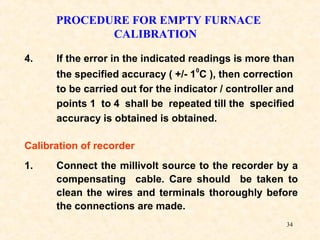
4. If the error in the indicated readings is more than
the specified accuracy ( +/- 1
0
C ), then correction
to be carried out for the indicator / controller and
points 1 to 4 shall be repeated till the specified
accuracy is obtained is obtained.
35
PROCEDURE FOR EMPTY FURNACE
CALIBRATION
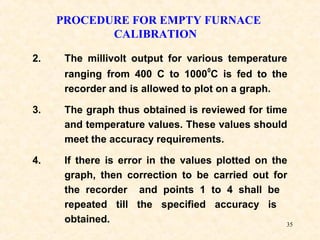
2. The millivolt output for various temperature
ranging from 400 C to 1000
0
C is fed to the
recorder and is allowed to plot on a graph.
3. The graph thus obtained is reviewed for time
and temperature values. These values should
meet the accuracy requirements.
4. If there is error in the values plotted on the
graph, then correction to be carried out for
the recorder and points 1 to 4 shall be
repeated till the specified accuracy is
obtained.
36
PROCEDURE FOR EMPTY FURNACE
CALIBRATION
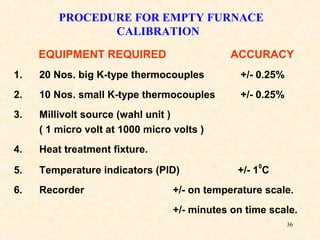
EQUIPMENT REQUIRED ACCURACY
1. 20 Nos. big K-type thermocouples +/- 0.25%
2. 10 Nos. small K-type thermocouples +/- 0.25%
3. Millivolt source (wahl unit )
( 1 micro volt at 1000 micro volts )
4. Heat treatment fixture.
5. Temperature indicators (PID) +/- 1
0
C
6. Recorder +/- on temperature scale.
+/- minutes on time scale.
37
PIT FURNACE CALIBRATION PROCEDURE
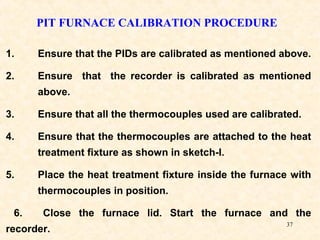
1. Ensure that the PIDs are calibrated as mentioned above.
2. Ensure that the recorder is calibrated as mentioned
above.
3. Ensure that all the thermocouples used are calibrated.
4. Ensure that the thermocouples are attached to the heat
treatment fixture as shown in sketch-I.
5. Place the heat treatment fixture inside the furnace with
thermocouples in position.
6. Close the furnace lid. Start the furnace and the
recorder.
38
7. Set the temperature of controller to 400
0
C.
8. After reaching the set temperature, it is allowed to
stabilize for half an hour.
9. Measure and record the temperature indicated by
each of the 20 thermocouples. The temperature is to
be read through WAHL UNIT.
10. Three sets of readings are to be taken for each
thermocouples at an interval of 10 minutes.
11. Also record the readings indicated by each of the
thermocouples at an interval of 10 minutes.
PIT FURNACE CALIBRATION PROCEDURE
39
PIT FURNACE CALIBRATION PROCEDURE
12. The temperature is then raised in steps of 50 C up to
1000
0
C. ( I. e. 400
0
C, 450
0
C, …….., 950
0
C, 1000
0
C. ) The
measured temperature is stabilized for 30 minutes.
PID reading are also to be recorded along with this.
13. The allowed temperature variation with respect to the
set temperature is +/- 5
0
C up to 800
0
C and +/- 10
0
C
above 800
0
C.
14. This is allowed to plot on the graph and thus
obtained for time and temperature values.
15. Calibration of furnace is valid for 1 year.
40
STANDARD OPERATING
PRACTICES FOR LOCAL
STRESS RELIEVING
41
LOCAL STRESS RELIEVING
When• Local SR to be done only when furnace SR not feasible
• Only when certain weld joints on components to be heat
treated
HOW
• Done by Electrical heating coil
• DETAILS ON ENSURING PWHT TEMP. IN WELDMENT AREA
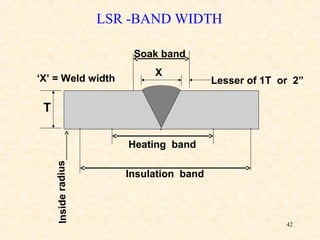
• Soaking band(SB) = Widest weld width ‘x’+ ’t’ or 2 inches
whichever is less from edge of weld
• Heating band width (HB)
• Induction stress level
• Through thickness criteria
• SB + 4√ rt where r = Inside radius, t = thickness
• Insulation band width (IB)
• Axial gradient
• HB + 4√ rt
42
LSR -BAND WIDTH
‘X’ = Weld width
X
T
Soak band
Insulation band
Heating band
Insideradius
Lesser of 1T or 2”
43
LOCAL STRESS RELIEVING SET UP
1. Provide multitonne roller on one end of vessel during
LSR of circular seam when job is horizontal.
2. If both ends are open during LSR, provide insulation
from inside. If not possible , prevent airflow so that
temperature on inside surface do not drop down.
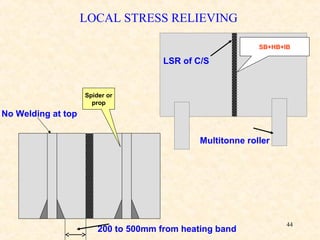
3. Spider/prop shall be provided in such a way that upper
portion of spider / prop is not welded with inside
surface to allow contraction/expansion of shell surface.
4. Spider/prop shall be between 200- 500mm from heating
zone.
5. Temporary attachments, provided for holding insulation,
shall be within soak band only.
6. Minimum two thermocouples shall be provided from
inside, when accessible.
44
LOCAL STRESS RELIEVING
No Welding at top
Multitonne roller
200 to 500mm from heating band
LSR of C/S
SB+HB+IB
Spider or
prop
45
GOOD ENGG. PRACTICES
FOR FURNACE CHARGES
& L S R
46
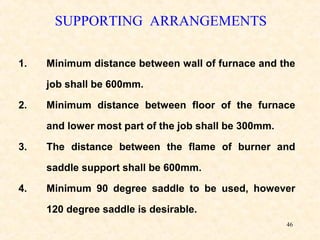
SUPPORTING ARRANGEMENTS
1. Minimum distance between wall of furnace and the
job shall be 600mm.
2. Minimum distance between floor of the furnace
and lower most part of the job shall be 300mm.
3. The distance between the flame of burner and
saddle support shall be 600mm.
4. Minimum 90 degree saddle to be used, however
120 degree saddle is desirable.
47
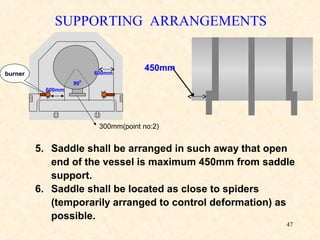
600mm
90
0
600mm
SUPPORTING ARRANGEMENTS
450mm
5. Saddle shall be arranged in such away that open
end of the vessel is maximum 450mm from saddle
support.
6. Saddle shall be located as close to spiders
(temporarily arranged to control deformation) as
possible.
burner
300mm(point no:2)
48
SUPPORTING ARRANGEMENTS
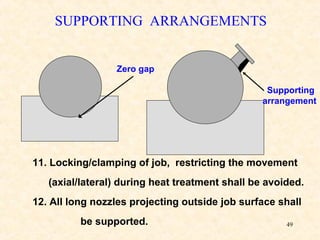
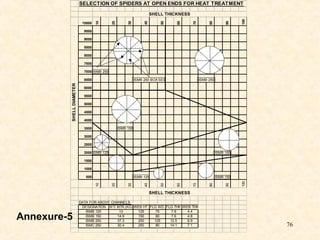
7. Spiders shall be provided as per annexure-5
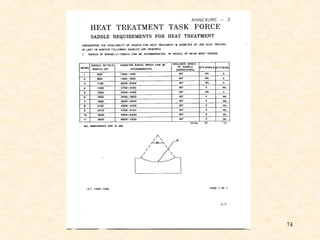
8 Saddle supports shall be selected as per annexure.-3
9. Spiders or vertical prop shall be provided at open
ends, center and below man way/nozzles above 24”
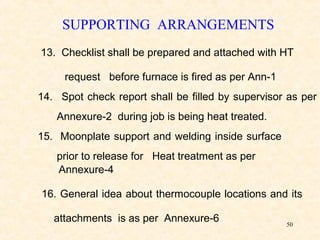
10. Avoid gap between saddle support and job surface
49
Zero gap
Supporting
arrangement
SUPPORTING ARRANGEMENTS
11. Locking/clamping of job, restricting the movement
(axial/lateral) during heat treatment shall be avoided.
12. All long nozzles projecting outside job surface shall
be supported.
50
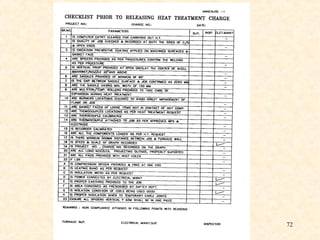
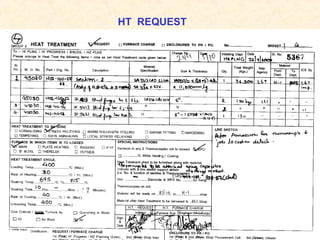
13. Checklist shall be prepared and attached with HT
request before furnace is fired as per Ann-1
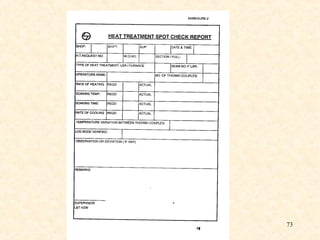
14. Spot check report shall be filled by supervisor as per
Annexure-2 during job is being heat treated.
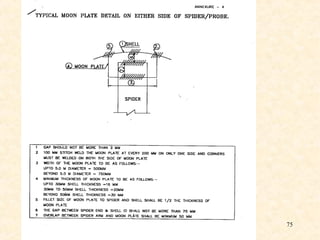
15. Moonplate support and welding inside surface
prior to release for Heat treatment as per
Annexure-4
16. General idea about thermocouple locations and its
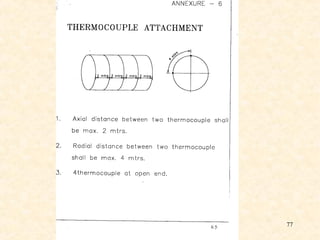
attachments is as per Annexure-6
SUPPORTING ARRANGEMENTS
51
GENERAL
1. Blocking the flame of the burner is not desirable
2. Burner shall have blue flame and not yellow
3. Flame shall not directly impinge on job
4. All burners shall be fired at a time
5. Keep all job nozzles open during heat treatment
6. Above “24” nozzles / manways shall be located
towards bottom
52
GENERAL
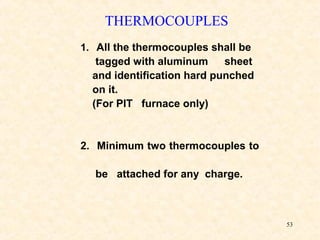
Temp. support
Furnace floor
Gasket machined surface
7. Deoxidization agent shall be applied on all
machined and gasket faces
8. Gasket / machined face of loose assemblies
shall not be touching any object.
53
THERMOCOUPLES
1. All the thermocouples shall be
tagged with aluminum sheet
and identification hard punched
on it.
(For PIT furnace only)
2. Minimum two thermocouples to
be attached for any charge.
54
3. Minimum 8 thermocouples to be used for a charge in
HFS- I furnace if the job occupies all 8 zones
4. Maximum distance between two thermocouples for a
sample job is as shown in annexure- 6
5. PTC shall have separate thermocouple
THERMOCOUPLES
55
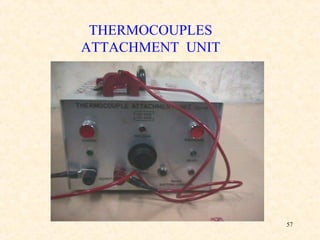
1. Use only TAU-90 capacitor Discharge Welding
machine for thermocouple connection
2. Use WPS:999-154 R0 for attachment of
thermocouple for cs/alloy steel material
3. Only trained person by welding engineering shall
attach thermocouple
4. A list of qualified person shall be by Welding
Eng.
THERMOCOUPLES
ATTACHMENTS
56
5. Clean surface prior to attachment.
6. Two wire of thermocouple shall be attached one
after another.
7. Gap between two wire of a thermocouple shall be
max. 3.0mm
8. Only calibrated thermocouple shall be used.
Calibration shall be by QA.
9. After PWHT, thermocouple area shall be ground
and DP shall be carried out.
THERMOCOUPLES
ATTACHMENTS
57
THERMOCOUPLES
ATTACHMENT UNIT
58
SPECIAL NOTE
IF THE TEMPERATURE OF HEAT TREATMENT
EXCEEEDS 650-DEGREE CENTIGRADE, THE
MATERIAL AND SIZE OF SPIDERS AND SUPPORTS
TO BE DECIDED BY PLANNING AND APPROVED BY
DESIGN.
59
CODE EXTRACTS
•FURNACE PWHT
• L S R
60
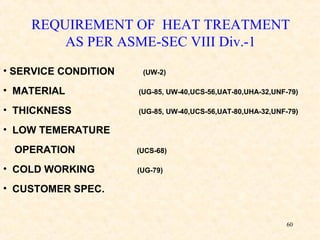
REQUIREMENT OF HEAT TREATMENT
AS PER ASME-SEC VIII Div.-1
• SERVICE CONDITION (UW-2)
• MATERIAL (UG-85, UW-40,UCS-56,UAT-80,UHA-32,UNF-79)
• THICKNESS (UG-85, UW-40,UCS-56,UAT-80,UHA-32,UNF-79)
• LOW TEMERATURE
OPERATION (UCS-68)
• COLD WORKING (UG-79)
• CUSTOMER SPEC.
61
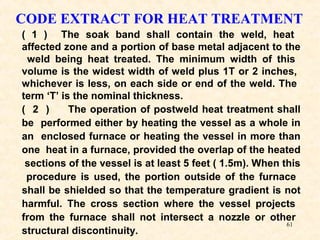
CODE EXTRACT FOR HEAT TREATMENT
( 1 ) The soak band shall contain the weld, heat
affected zone and a portion of base metal adjacent to the
weld being heat treated. The minimum width of this
volume is the widest width of weld plus 1T or 2 inches,
whichever is less, on each side or end of the weld. The
term ‘T’ is the nominal thickness.
( 2 ) The operation of postweld heat treatment shall
be performed either by heating the vessel as a whole in
an enclosed furnace or heating the vessel in more than
one heat in a furnace, provided the overlap of the heated
sections of the vessel is at least 5 feet ( 1.5m). When this
procedure is used, the portion outside of the furnace
shall be shielded so that the temperature gradient is not
harmful. The cross section where the vessel projects
from the furnace shall not intersect a nozzle or other
structural discontinuity.
62
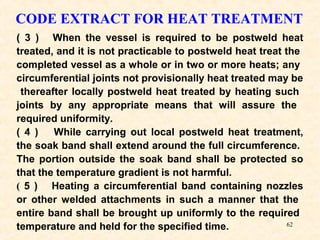
CODE EXTRACT FOR HEAT TREATMENT
( 3 ) When the vessel is required to be postweld heat
treated, and it is not practicable to postweld heat treat the
completed vessel as a whole or in two or more heats; any
circumferential joints not provisionally heat treated may be
thereafter locally postweld heat treated by heating such
joints by any appropriate means that will assure the
required uniformity.
( 4 ) While carrying out local postweld heat treatment,
the soak band shall extend around the full circumference.
The portion outside the soak band shall be protected so
that the temperature gradient is not harmful.
( 5 ) Heating a circumferential band containing nozzles
or other welded attachments in such a manner that the
entire band shall be brought up uniformly to the required
temperature and held for the specified time.
63
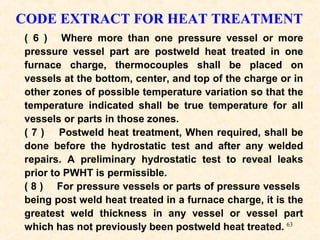
CODE EXTRACT FOR HEAT TREATMENT
( 6 ) Where more than one pressure vessel or more
pressure vessel part are postweld heat treated in one
furnace charge, thermocouples shall be placed on
vessels at the bottom, center, and top of the charge or in
other zones of possible temperature variation so that the
temperature indicated shall be true temperature for all
vessels or parts in those zones.
( 7 ) Postweld heat treatment, When required, shall be
done before the hydrostatic test and after any welded
repairs. A preliminary hydrostatic test to reveal leaks
prior to PWHT is permissible.
( 8 ) For pressure vessels or parts of pressure vessels
being post weld heat treated in a furnace charge, it is the
greatest weld thickness in any vessel or vessel part
which has not previously been postweld heat treated.
64
CODE EXTRACT FOR HEAT TREATMENT
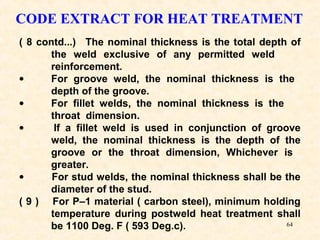
( 8 contd...) The nominal thickness is the total depth of
the weld exclusive of any permitted weld
reinforcement.
• For groove weld, the nominal thickness is the
depth of the groove.
• For fillet welds, the nominal thickness is the
throat dimension.
• If a fillet weld is used in conjunction of groove
weld, the nominal thickness is the depth of the
groove or the throat dimension, Whichever is
greater.
• For stud welds, the nominal thickness shall be the
diameter of the stud.
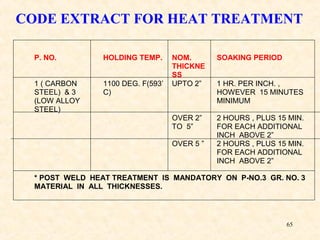
( 9 ) For P–1 material ( carbon steel), minimum holding
temperature during postweld heat treatment shall
be 1100 Deg. F ( 593 Deg.c).
65
CODE EXTRACT FOR HEAT TREATMENT
P. NO. HOLDING TEMP. NOM.
THICKNE
SS
SOAKING PERIOD
1 ( CARBON
STEEL) & 3
(LOW ALLOY
STEEL)
1100 DEG. F(593’
C)
UPTO 2” 1 HR. PER INCH. ,
HOWEVER 15 MINUTES
MINIMUM
OVER 2”
TO 5”
2 HOURS , PLUS 15 MIN.
FOR EACH ADDITIONAL
INCH ABOVE 2”
OVER 5 ” 2 HOURS , PLUS 15 MIN.
FOR EACH ADDITIONAL
INCH ABOVE 2”
* POST WELD HEAT TREATMENT IS MANDATORY ON P-NO.3 GR. NO. 3
MATERIAL IN ALL THICKNESSES.
66
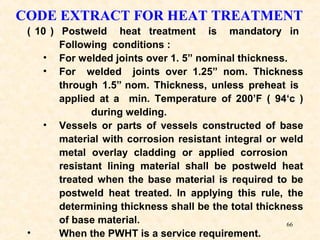
( 10 ) Postweld heat treatment is mandatory in
Following conditions :
• For welded joints over 1. 5” nominal thickness.
• For welded joints over 1.25” nom. Thickness
through 1.5” nom. Thickness, unless preheat is
applied at a min. Temperature of 200’F ( 94‘c )
during welding.
• Vessels or parts of vessels constructed of base
material with corrosion resistant integral or weld
metal overlay cladding or applied corrosion
resistant lining material shall be postweld heat
treated when the base material is required to be
postweld heat treated. In applying this rule, the
determining thickness shall be the total thickness
of base material.
• When the PWHT is a service requirement.
CODE EXTRACT FOR HEAT TREATMENT
67
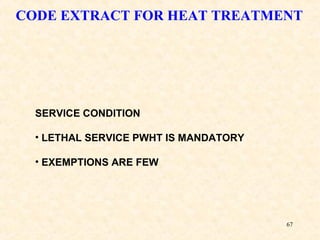
SERVICE CONDITION
• LETHAL SERVICE PWHT IS MANDATORY
• EXEMPTIONS ARE FEW
CODE EXTRACT FOR HEAT TREATMENT
68
CODE EXTRACT FOR HEAT TREATMENT
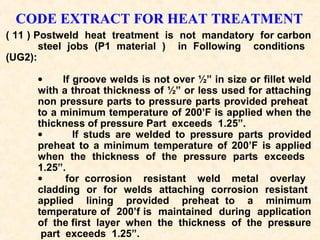
( 11 ) Postweld heat treatment is not mandatory for carbon
steel jobs (P1 material ) in Following conditions
(UG2):
• If groove welds is not over ½” in size or fillet weld
with a throat thickness of ½” or less used for attaching
non pressure parts to pressure parts provided preheat
to a minimum temperature of 200’F is applied when the
thickness of pressure Part exceeds 1.25”.
• If studs are welded to pressure parts provided
preheat to a minimum temperature of 200’F is applied
when the thickness of the pressure parts exceeds
1.25”.
• for corrosion resistant weld metal overlay
cladding or for welds attaching corrosion resistant
applied lining provided preheat to a minimum
temperature of 200’f is maintained during application
of the first layer when the thickness of the pressure
part exceeds 1.25”.
69
CODE EXTRACT FOR HEAT TREATMENT
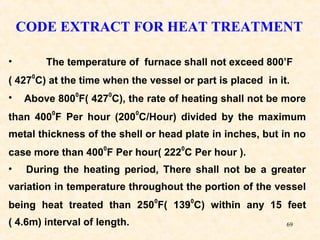
• The temperature of furnace shall not exceed 800’F
( 427
0
C) at the time when the vessel or part is placed in it.
• Above 800
0
F( 427
0
C), the rate of heating shall not be more
than 400
0
F Per hour (200
0
C/Hour) divided by the maximum
metal thickness of the shell or head plate in inches, but in no
case more than 400
0
F Per hour( 222
0
C Per hour ).
• During the heating period, There shall not be a greater
variation in temperature throughout the portion of the vessel
being heat treated than 250
0
F( 139
0
C) within any 15 feet
( 4.6m) interval of length.
70
CODE EXTRACT FOR HEAT TREATMENT
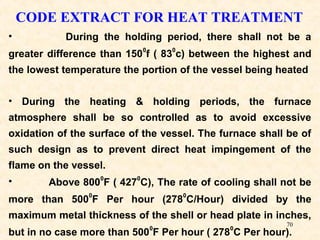
• During the holding period, there shall not be a
greater difference than 150
0
f ( 83
0
c) between the highest and
the lowest temperature the portion of the vessel being heated
• During the heating & holding periods, the furnace
atmosphere shall be so controlled as to avoid excessive
oxidation of the surface of the vessel. The furnace shall be of
such design as to prevent direct heat impingement of the
flame on the vessel.
• Above 800
0
F ( 427
0
C), The rate of cooling shall not be
more than 500
0
F Per hour (278
0
C/Hour) divided by the
maximum metal thickness of the shell or head plate in inches,
but in no case more than 500
0
F Per hour ( 278
0
C Per hour).
71
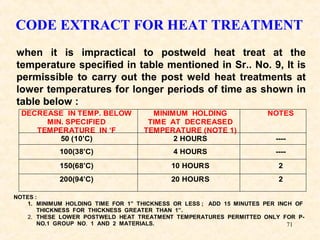
when it is impractical to postweld heat treat at the
temperature specified in table mentioned in Sr.. No. 9, It is
permissible to carry out the post weld heat treatments at
lower temperatures for longer periods of time as shown in
table below :
CODE EXTRACT FOR HEAT TREATMENT
DECREASE IN TEMP. BELOW
MIN. SPECIFIED
TEMPERATURE IN ‘F
MINIMUM HOLDING
TIME AT DECREASED
TEMPERATURE (NOTE 1)
NOTES
50 (10’C) 2 HOURS ----
100(38’C) 4 HOURS ----
150(68’C) 10 HOURS 2
200(94’C) 20 HOURS 2
NOTES :
1. MINIMUM HOLDING TIME FOR 1” THICKNESS OR LESS ; ADD 15 MINUTES PER INCH OF
THICKNESS FOR THICKNESS GREATER THAN 1”.
2. THESE LOWER POSTWELD HEAT TREATMENT TEMPERATURES PERMITTED ONLY FOR P-
NO.1 GROUP NO. 1 AND 2 MATERIALS.
72
73
74
75
76
SELECTION OF SPIDERS AT OPEN ENDS FOR HEAT TREATMENT
10000
10
20
30
40
50
60
70
80
90
100
9500
9000
8500
8000
7500
7000 ISMB 250
6500 ISMB 250 BOX SEC ISMB 250
6000
5500
5000
4500
4000
3500 ISMB 150
3000
2500
2000 ISMB 125 ISMB 150
1500
1000
500 ISMB 125 ISMB 150
10
20
30
40
50
60
70
80
90
100
DATA FOR ABOVE CHANNELS:
WEB HT FLG WD FLG THK WEB THK
SHELLDIAMETER
WT/ MTR.(KG)
13
SHELL THICKNESS
ISMB 125 75
ISMB 250
14.9
37.3
SHELL THICKNESS
ISMC 250
DESIGNATION
30.4
125
150
250
250
ISMB 150 80
125
80
7.6
7.6
12.5
14.1
4.4
4.8
6.9
7.1
Annexure-5
77
78
HT REQUEST
79
HT CHARGE

Pwht1

  • 1.
  • 2.
    2 HEAT TREATMENT MECHANICAL PROPERTIESOF METALS & ALLOYS DEPEND ON  CHEMISTRY (ALLOYING ELEMENTS) &  HEAT TREATMENT
  • 3.
    3 WHAT IS HEATTREATMENT? • MATERIALS TREATED BYAPPLICATION OF HEAT - NORMALLY DONE IN SOLID STATE • HEATING BY VARIOUS SOURCES – HEATING IN A FURNACE – Oil, Gas, Electrical – HEATING OUT SIDE WITH ELECTRIC HEATING COILS ARROUND THE JOB – Local Heat treatment – PASSING HOT AIR INSIDE A CLOSSED VESSEL – Internal firing
  • 4.
    4 HEAT TREATMENT • HEATTEATMENT PARAMETERS – RATE OF HEATING – SOAKING TEMP. – SOAKING TIME – COOLING RATE – COOLING MEDIA
  • 5.
    5 WHY HT REQUIRED? • TO BRING THE PROPERTIES TO THE DESIRED RANGE –Strength, UTS, YS & Elongation –Toughness –Hardness • CARRIED OUT IN –FABRICATION INDUSTRIES- Fabricated Components –STEEL PLANTS – Plates, Pipes, Tubes, Sections – FOUNDRY SHOPS - Castings – FORGING SHOPS – Forged Components
  • 6.
    6 MATERIALS HEAT TREATED •METALS & ALLOYS – SINGLE PHASE – MULTIPHASE • ALLOYS – Single Phase : Copper Nickel – Multiphase : Steels • METALS (Single phase ) – Titanium
  • 7.
    7 HEAT TREATEMENT CRITERIA • COLDWORKED to NORMAL – All materials • UNEQUILIBRIUM PHASES to EQUILIBRIUM – Stainless Steels ,Maraging Steels • STRESSED to UNSTRESED – All Materials
  • 8.
    8 MATERIALS HEAT TREATED •CS • C-Mn , C-Mo , Cr-Mo , Cr-Mo-V, Ni -Steels • Stainless Steels • Non Ferrous Materials
  • 9.
    9 TYPES OF HEATTREATMENT • NORMALIZING • ANNEALING • STRESS RELIEVING • SOLUTION ANNEALING • HARDENING • TEMPERING • AGEING
  • 10.
  • 11.
    11 NORMALIZING • The steelis heated to 40° C above the upper critical temperature followed by cooling in the still air. To achieve • Uniform structure • Change in Mechanical properties, – UTS, YS & Elongation – Hardness – Impact properties • Refined grains
  • 12.
    12 ANNEALING • Steel isheated 10 to 50°C above the upper critical temperature and held for the desired length of time followed by very slow cooling within the furnace To achieve: • Softness & better ductility • Stresses free material – Stress generated due to mechanical working / previous HT • Uniform property through out the material
  • 13.
    13 SOLUTION ANNEALING • AusteniticStainless steels is heated to above 1050°C and held for the desired time followed by fast cooling to room temperature within few minutes by quenching / blowing the air. Solution annealing is done on stainless steel and non ferrous alloys • To soften the material • To remove carbide precipitation formed at grain boundaries during manufacturing process ( SS ) • To improve Corrosion Resistance
  • 14.
    14 AGEING The Material isheated to a certain temperature, and held for the desired time; followed by quenching or cooling in air Ageing is done on materials susceptible for ageing characteristics : Maraging Steels • Normally increases strength • Improves Toughness
  • 15.
    15 AGEING Maraging Steels M250 • Temperature: 485° C • Normally 3 Hrs 15 mts • Heating Rate : 200 C per hr per inch thick • Cooling Rate : Cool in Air / Quench in water
  • 16.
    16 STRESS RELIEVING The steelis heated to a temperature below close to the lower critical temperature with a specific rate of heating. It is held at the temperature for a desired length of time, followed by cooling with a specific rate up to certain temperature. There is no change in grain structure. Stress relieving is done Fabricated Components of CS & LAS: • To reduce Internal Stresses • To soften the steel partially • To soften HAZ
  • 17.
    17 STRESS RELIEVING C-Mn ,C-Mo , Cr-Mo (< 2% Cr) • C - Mn Steels , C - Mo Steels, Cr-Mo Steels – SA 515Gr 70 , SA204GrA, SA387GR11,CL1 • Temperature : 593° C Min – Normally 600 - 640° C, 650-690° C • Time : 15 minutes min ( 1 hr / inch thick) • Heating Rate : 200° C per hr per inch thick • Cooling Rate : 260° C per hr per inch thick
  • 18.
    18 Cr-Mo Steels Cr -Mo Steels (Cr >2%) – SA 335P22 ,SA335P5 • Temperature : 676° C Min – Normally 680 - 700° C 2.25Cr – 704 - 720° C 5 Cr • Time : 15 mts min (1 hr / inch thick) • Heating Rate : 200° C per hr per inch thick • Cooling Rate : 260° C per hr per inch thick STRESS RELIEVING
  • 19.
    19 Ni -Steels • NickelSteels : 1,2,3% Ni – SA 203 GrA ,D • Temperature : 593° C Min – Normally 600 - 640° C, • Time : 60 mts min (1 hr / inch thick) • Heating Rate : 200° C per hr per inch thick • Cooling Rate : 260° C per hr per inch thick STRESS RELIEVING
  • 20.
    20 Steels enhanced byHeat Treatments • Q&T Steels : – 9.5% Ni Steels , SA 517 Gr E • Temperature : 538° C Typ – Normally < 600° C • Time : Min 15 minutes to 2 Hr ( 1 hr / inch thick) • Heating Rate : 200° C per hr per inch thick • Cooling Rate : 260° C per hr per inch thick STRESS RELIEVING
  • 21.
    21 LAYOUT OF ATYPICAL FURNACE (Electrical or Gas fired ) RECORDER P.I.D. FURNACE JOB COMPENSATING CABLE THERMOCOUPLE
  • 22.
    22 THERMOCOUPLES • PRINCIPLE OFA THERMOCOUPLE • THERMOCOUPLE MATERIAL • TYPES OF THERMOCOUPLE BEING USED IN HED POWAI / HZW
  • 23.
    23 PRINCIPLE OF THERMOCOUPLE The basicprinciple of thermoelectric thermometry is that a thermocouple develops an emf which is a function of the difference in temperature of its measuring junction & reference junction. If the temperature of reference junction is known, the temperature of the measuring junction can be determined by measuring the emf generated in the circuit.
  • 24.
    24 THERMOCOUPLE MATERIAL REQUIREMENT 1. Highcoefficient of thermal emf. 2. Continuously increasing relation of emf to temperature over a long range. 3. Freedom from phase changes or other phenomenon giving rise to discontinuity in temperature emf relationships. 4. Resistance to oxidation, corrosion and contamination. 5. Homogeneity and reproducibility to fit an establish temperature & emf relationship. SPEED OF RESPONSE MAY BE IMPROVED AND RADIATION & CONDUCTION ERRORS MAY BE REDUCED BY THE USE OF SMALL DIAMETER THERMOCOUPLES.
  • 25.
    25 TYPES OF THERMOCOUPLE BEINGUSED IN HZW K type : Material : Chromel + Alumel Nickel based ( 10 %Cr ) + ( 2 % Al ) Properties : Non-Magnetic + Magnetic In this type of thermocouple, the wires are joined at one end only to form a point-type temperature sensor. Instrumentation converts the millivolt signal to related temperature.
  • 26.
    26 TYPES OF THERMOCOUPLE BEINGUSED IN HZW . K type : Dia : 2.5 mm 0. 7 mm Insulation Bare(ceramic) Refractory coated Attachment Mech Capacitor Usability Reusable Disposable Location PIT F/c except PIT F/c Color - Red & Yellow
  • 27.
    27 recorder pid Compensating cable Thermocouple wire Welded junction CONSTRUCTION OF A KTYPE THERMOCOUPLE Accuracy : 0.75% PROPORTIONAL INTEGRAL DERIVATIVE
  • 28.
    28 ‘S’ TYPE THERMOCOUPLE •‘S’ TYPE THERMOCOUPLE ARE THE STANDARD THERMOCOUPLES. • IT IS USED FOR CALIBRATING “K” Type THERMOCOUPLES. • MATERIAL OF CONSTRUCTION 90% PLATINUM + 10% RHODIUM PLATINUM • OXIDATION RESISTANCE , SO MORE LIFE . Accuracy : 0.25 %
  • 29.
    29 COMPENSATING CABLE COMPENSATING CABLEIS DEFINED AS A PAIR OF WIRES HAVING SUCH EMF TEMPERATURE CHARACTERISTICS RELATED TO THE THERMOCOUPLE WITH WHICH THE WIRES ARE INTENDED TO BE USED, THAT WHEN PROPERLY CONNECTED TO THERMOCOUPLE THE EFFECTIVE REFERENCE JUNCTION IS IN EFFECT TRANSFERRED TO THE OTHER END OF THE WIRES. MATERIAL ==> +ve COPPER ( white ) -ve COPPER NICKEL (blue ) for “ K “ TYPE .
  • 30.
    30 P.I.D. PID = PROPORTIONALINTEGRAL DERIVATIVE • PID FUNCTIONS BOTH AS PROGRAMMER AND CONTROLLER • PID CONTROLLER CAN BE ZONE WISE • PROGRAMME IS MADE IN SEGMENTS AS PER DIFFERENT STAGES OF HEAT TREATMENT • DIGITAL DISPLAY IS AVAILABLE FOR PROGRAMME TEMPERATURE AND FURNACE TEMEPERATURE • TYPICAL OR REPETITIVE HEAT TREATMENT CYCLE CAN BE STORED IN PID(PROGRAMMER)
  • 31.
    31 RECORDER TYPES OF RECORDER •PAPERLESS-- WITH COLOUR DISPLAY SCREEN ,HARD DISC AND FLOPPY DRIVE. NOT USED IN HED HZW. •WITH PAPER -- CURRENTLY BEING USED IN HZW. •24 CHANNEL -- CURRENTLY BEING USED IN PFS( CHINO MAKE-- model no.I003 /Graph ET 001). •12 CHANNEL -- CURRENTLY BEING USED IN MFS1 AND HFS1 ( CHINO MAKE -- model no. EH100 / Graph ET 201). COMPENSATING CABLES ARE CONNECTED BEHIND THE RECORDER SCREEN IN CHANNELS. •X-AXIS IS FOR TEMPERATURE (RANGE = 0 TO 1200’C) •Y-AXIS IS FOR GRAPH SPEED. •VARIOUS SPEED OF GRAPHS ARE 12.5, 25, 50, 100 MM / HOUR • GENERALLY KEEP 25 MM / HOUR.
  • 32.
    32 GRAPH PAPER • GRAPHPAPERS ARE USED FOR PLOTTING THE FURNACE /JOB TEMPERATURE VIA THERMOCOUPLE. THEY ARE FITTED ON THE RECORDER. • GRAPH PAPER RECOMMENDED ON RECORDER ONLY TO BE USED • GRAPH PAPER FOR MFS1 AND HFS1 FURNACE ==> ET 201 CHINO MAKE, JAPAN GRAPH PAPER FOR PFS FURNACE ==> ET 001 CHINO MAKE, JAPAN • THE LENGTH OF ONE BUNDLE OF GRAPH PAPER IS GENERALLY 2000 MM. • DOTTING TYPE RECORDER INK (CHINO MAKE, JAPAN) IS USED IN RECORDER FOR PLOTTING OF GRAPH. USUALLY , 6 COLOURS ARE FILLED FOR PLOTTING.
  • 33.
    33 PROCEDURE FOR EMPTYFURNACE CALIBRATION Calibration of PIDS ( indicator & controller ) 1. Connect the millivolt source to the temperature indicator or controller by a compensating cable. Care should be taken to clean the wires and terminals thoroughly before connections are made. 2. The millivolt output for various temperature ranging from 00 C to 10000 C in steps of 500 C is fed to the indicator / controller. 3. After the millivolt value / temperature reading displayed is steady, the reading of indicator/controller shall be noted.
  • 34.
    34 PROCEDURE FOR EMPTYFURNACE CALIBRATION Calibration of recorder 1. Connect the millivolt source to the recorder by a compensating cable. Care should be taken to clean the wires and terminals thoroughly before the connections are made. 4. If the error in the indicated readings is more than the specified accuracy ( +/- 1 0 C ), then correction to be carried out for the indicator / controller and points 1 to 4 shall be repeated till the specified accuracy is obtained is obtained.
  • 35.
    35 PROCEDURE FOR EMPTYFURNACE CALIBRATION 2. The millivolt output for various temperature ranging from 400 C to 1000 0 C is fed to the recorder and is allowed to plot on a graph. 3. The graph thus obtained is reviewed for time and temperature values. These values should meet the accuracy requirements. 4. If there is error in the values plotted on the graph, then correction to be carried out for the recorder and points 1 to 4 shall be repeated till the specified accuracy is obtained.
  • 36.
    36 PROCEDURE FOR EMPTYFURNACE CALIBRATION EQUIPMENT REQUIRED ACCURACY 1. 20 Nos. big K-type thermocouples +/- 0.25% 2. 10 Nos. small K-type thermocouples +/- 0.25% 3. Millivolt source (wahl unit ) ( 1 micro volt at 1000 micro volts ) 4. Heat treatment fixture. 5. Temperature indicators (PID) +/- 1 0 C 6. Recorder +/- on temperature scale. +/- minutes on time scale.
  • 37.
    37 PIT FURNACE CALIBRATIONPROCEDURE 1. Ensure that the PIDs are calibrated as mentioned above. 2. Ensure that the recorder is calibrated as mentioned above. 3. Ensure that all the thermocouples used are calibrated. 4. Ensure that the thermocouples are attached to the heat treatment fixture as shown in sketch-I. 5. Place the heat treatment fixture inside the furnace with thermocouples in position. 6. Close the furnace lid. Start the furnace and the recorder.
  • 38.
    38 7. Set thetemperature of controller to 400 0 C. 8. After reaching the set temperature, it is allowed to stabilize for half an hour. 9. Measure and record the temperature indicated by each of the 20 thermocouples. The temperature is to be read through WAHL UNIT. 10. Three sets of readings are to be taken for each thermocouples at an interval of 10 minutes. 11. Also record the readings indicated by each of the thermocouples at an interval of 10 minutes. PIT FURNACE CALIBRATION PROCEDURE
  • 39.
    39 PIT FURNACE CALIBRATIONPROCEDURE 12. The temperature is then raised in steps of 50 C up to 1000 0 C. ( I. e. 400 0 C, 450 0 C, …….., 950 0 C, 1000 0 C. ) The measured temperature is stabilized for 30 minutes. PID reading are also to be recorded along with this. 13. The allowed temperature variation with respect to the set temperature is +/- 5 0 C up to 800 0 C and +/- 10 0 C above 800 0 C. 14. This is allowed to plot on the graph and thus obtained for time and temperature values. 15. Calibration of furnace is valid for 1 year.
  • 40.
  • 41.
    41 LOCAL STRESS RELIEVING When•Local SR to be done only when furnace SR not feasible • Only when certain weld joints on components to be heat treated HOW • Done by Electrical heating coil • DETAILS ON ENSURING PWHT TEMP. IN WELDMENT AREA • Soaking band(SB) = Widest weld width ‘x’+ ’t’ or 2 inches whichever is less from edge of weld • Heating band width (HB) • Induction stress level • Through thickness criteria • SB + 4√ rt where r = Inside radius, t = thickness • Insulation band width (IB) • Axial gradient • HB + 4√ rt
  • 42.
    42 LSR -BAND WIDTH ‘X’= Weld width X T Soak band Insulation band Heating band Insideradius Lesser of 1T or 2”
  • 43.
    43 LOCAL STRESS RELIEVINGSET UP 1. Provide multitonne roller on one end of vessel during LSR of circular seam when job is horizontal. 2. If both ends are open during LSR, provide insulation from inside. If not possible , prevent airflow so that temperature on inside surface do not drop down. 3. Spider/prop shall be provided in such a way that upper portion of spider / prop is not welded with inside surface to allow contraction/expansion of shell surface. 4. Spider/prop shall be between 200- 500mm from heating zone. 5. Temporary attachments, provided for holding insulation, shall be within soak band only. 6. Minimum two thermocouples shall be provided from inside, when accessible.
  • 44.
    44 LOCAL STRESS RELIEVING NoWelding at top Multitonne roller 200 to 500mm from heating band LSR of C/S SB+HB+IB Spider or prop
  • 45.
    45 GOOD ENGG. PRACTICES FORFURNACE CHARGES & L S R
  • 46.
    46 SUPPORTING ARRANGEMENTS 1. Minimumdistance between wall of furnace and the job shall be 600mm. 2. Minimum distance between floor of the furnace and lower most part of the job shall be 300mm. 3. The distance between the flame of burner and saddle support shall be 600mm. 4. Minimum 90 degree saddle to be used, however 120 degree saddle is desirable.
  • 47.
    47 600mm 90 0 600mm SUPPORTING ARRANGEMENTS 450mm 5. Saddleshall be arranged in such away that open end of the vessel is maximum 450mm from saddle support. 6. Saddle shall be located as close to spiders (temporarily arranged to control deformation) as possible. burner 300mm(point no:2)
  • 48.
    48 SUPPORTING ARRANGEMENTS 7. Spidersshall be provided as per annexure-5 8 Saddle supports shall be selected as per annexure.-3 9. Spiders or vertical prop shall be provided at open ends, center and below man way/nozzles above 24” 10. Avoid gap between saddle support and job surface
  • 49.
    49 Zero gap Supporting arrangement SUPPORTING ARRANGEMENTS 11.Locking/clamping of job, restricting the movement (axial/lateral) during heat treatment shall be avoided. 12. All long nozzles projecting outside job surface shall be supported.
  • 50.
    50 13. Checklist shallbe prepared and attached with HT request before furnace is fired as per Ann-1 14. Spot check report shall be filled by supervisor as per Annexure-2 during job is being heat treated. 15. Moonplate support and welding inside surface prior to release for Heat treatment as per Annexure-4 16. General idea about thermocouple locations and its attachments is as per Annexure-6 SUPPORTING ARRANGEMENTS
  • 51.
    51 GENERAL 1. Blocking theflame of the burner is not desirable 2. Burner shall have blue flame and not yellow 3. Flame shall not directly impinge on job 4. All burners shall be fired at a time 5. Keep all job nozzles open during heat treatment 6. Above “24” nozzles / manways shall be located towards bottom
  • 52.
    52 GENERAL Temp. support Furnace floor Gasketmachined surface 7. Deoxidization agent shall be applied on all machined and gasket faces 8. Gasket / machined face of loose assemblies shall not be touching any object.
  • 53.
    53 THERMOCOUPLES 1. All thethermocouples shall be tagged with aluminum sheet and identification hard punched on it. (For PIT furnace only) 2. Minimum two thermocouples to be attached for any charge.
  • 54.
    54 3. Minimum 8thermocouples to be used for a charge in HFS- I furnace if the job occupies all 8 zones 4. Maximum distance between two thermocouples for a sample job is as shown in annexure- 6 5. PTC shall have separate thermocouple THERMOCOUPLES
  • 55.
    55 1. Use onlyTAU-90 capacitor Discharge Welding machine for thermocouple connection 2. Use WPS:999-154 R0 for attachment of thermocouple for cs/alloy steel material 3. Only trained person by welding engineering shall attach thermocouple 4. A list of qualified person shall be by Welding Eng. THERMOCOUPLES ATTACHMENTS
  • 56.
    56 5. Clean surfaceprior to attachment. 6. Two wire of thermocouple shall be attached one after another. 7. Gap between two wire of a thermocouple shall be max. 3.0mm 8. Only calibrated thermocouple shall be used. Calibration shall be by QA. 9. After PWHT, thermocouple area shall be ground and DP shall be carried out. THERMOCOUPLES ATTACHMENTS
  • 57.
  • 58.
    58 SPECIAL NOTE IF THETEMPERATURE OF HEAT TREATMENT EXCEEEDS 650-DEGREE CENTIGRADE, THE MATERIAL AND SIZE OF SPIDERS AND SUPPORTS TO BE DECIDED BY PLANNING AND APPROVED BY DESIGN.
  • 59.
  • 60.
    60 REQUIREMENT OF HEATTREATMENT AS PER ASME-SEC VIII Div.-1 • SERVICE CONDITION (UW-2) • MATERIAL (UG-85, UW-40,UCS-56,UAT-80,UHA-32,UNF-79) • THICKNESS (UG-85, UW-40,UCS-56,UAT-80,UHA-32,UNF-79) • LOW TEMERATURE OPERATION (UCS-68) • COLD WORKING (UG-79) • CUSTOMER SPEC.
  • 61.
    61 CODE EXTRACT FORHEAT TREATMENT ( 1 ) The soak band shall contain the weld, heat affected zone and a portion of base metal adjacent to the weld being heat treated. The minimum width of this volume is the widest width of weld plus 1T or 2 inches, whichever is less, on each side or end of the weld. The term ‘T’ is the nominal thickness. ( 2 ) The operation of postweld heat treatment shall be performed either by heating the vessel as a whole in an enclosed furnace or heating the vessel in more than one heat in a furnace, provided the overlap of the heated sections of the vessel is at least 5 feet ( 1.5m). When this procedure is used, the portion outside of the furnace shall be shielded so that the temperature gradient is not harmful. The cross section where the vessel projects from the furnace shall not intersect a nozzle or other structural discontinuity.
  • 62.
    62 CODE EXTRACT FORHEAT TREATMENT ( 3 ) When the vessel is required to be postweld heat treated, and it is not practicable to postweld heat treat the completed vessel as a whole or in two or more heats; any circumferential joints not provisionally heat treated may be thereafter locally postweld heat treated by heating such joints by any appropriate means that will assure the required uniformity. ( 4 ) While carrying out local postweld heat treatment, the soak band shall extend around the full circumference. The portion outside the soak band shall be protected so that the temperature gradient is not harmful. ( 5 ) Heating a circumferential band containing nozzles or other welded attachments in such a manner that the entire band shall be brought up uniformly to the required temperature and held for the specified time.
  • 63.
    63 CODE EXTRACT FORHEAT TREATMENT ( 6 ) Where more than one pressure vessel or more pressure vessel part are postweld heat treated in one furnace charge, thermocouples shall be placed on vessels at the bottom, center, and top of the charge or in other zones of possible temperature variation so that the temperature indicated shall be true temperature for all vessels or parts in those zones. ( 7 ) Postweld heat treatment, When required, shall be done before the hydrostatic test and after any welded repairs. A preliminary hydrostatic test to reveal leaks prior to PWHT is permissible. ( 8 ) For pressure vessels or parts of pressure vessels being post weld heat treated in a furnace charge, it is the greatest weld thickness in any vessel or vessel part which has not previously been postweld heat treated.
  • 64.
    64 CODE EXTRACT FORHEAT TREATMENT ( 8 contd...) The nominal thickness is the total depth of the weld exclusive of any permitted weld reinforcement. • For groove weld, the nominal thickness is the depth of the groove. • For fillet welds, the nominal thickness is the throat dimension. • If a fillet weld is used in conjunction of groove weld, the nominal thickness is the depth of the groove or the throat dimension, Whichever is greater. • For stud welds, the nominal thickness shall be the diameter of the stud. ( 9 ) For P–1 material ( carbon steel), minimum holding temperature during postweld heat treatment shall be 1100 Deg. F ( 593 Deg.c).
  • 65.
    65 CODE EXTRACT FORHEAT TREATMENT P. NO. HOLDING TEMP. NOM. THICKNE SS SOAKING PERIOD 1 ( CARBON STEEL) & 3 (LOW ALLOY STEEL) 1100 DEG. F(593’ C) UPTO 2” 1 HR. PER INCH. , HOWEVER 15 MINUTES MINIMUM OVER 2” TO 5” 2 HOURS , PLUS 15 MIN. FOR EACH ADDITIONAL INCH ABOVE 2” OVER 5 ” 2 HOURS , PLUS 15 MIN. FOR EACH ADDITIONAL INCH ABOVE 2” * POST WELD HEAT TREATMENT IS MANDATORY ON P-NO.3 GR. NO. 3 MATERIAL IN ALL THICKNESSES.
  • 66.
    66 ( 10 )Postweld heat treatment is mandatory in Following conditions : • For welded joints over 1. 5” nominal thickness. • For welded joints over 1.25” nom. Thickness through 1.5” nom. Thickness, unless preheat is applied at a min. Temperature of 200’F ( 94‘c ) during welding. • Vessels or parts of vessels constructed of base material with corrosion resistant integral or weld metal overlay cladding or applied corrosion resistant lining material shall be postweld heat treated when the base material is required to be postweld heat treated. In applying this rule, the determining thickness shall be the total thickness of base material. • When the PWHT is a service requirement. CODE EXTRACT FOR HEAT TREATMENT
  • 67.
    67 SERVICE CONDITION • LETHALSERVICE PWHT IS MANDATORY • EXEMPTIONS ARE FEW CODE EXTRACT FOR HEAT TREATMENT
  • 68.
    68 CODE EXTRACT FORHEAT TREATMENT ( 11 ) Postweld heat treatment is not mandatory for carbon steel jobs (P1 material ) in Following conditions (UG2): • If groove welds is not over ½” in size or fillet weld with a throat thickness of ½” or less used for attaching non pressure parts to pressure parts provided preheat to a minimum temperature of 200’F is applied when the thickness of pressure Part exceeds 1.25”. • If studs are welded to pressure parts provided preheat to a minimum temperature of 200’F is applied when the thickness of the pressure parts exceeds 1.25”. • for corrosion resistant weld metal overlay cladding or for welds attaching corrosion resistant applied lining provided preheat to a minimum temperature of 200’f is maintained during application of the first layer when the thickness of the pressure part exceeds 1.25”.
  • 69.
    69 CODE EXTRACT FORHEAT TREATMENT • The temperature of furnace shall not exceed 800’F ( 427 0 C) at the time when the vessel or part is placed in it. • Above 800 0 F( 427 0 C), the rate of heating shall not be more than 400 0 F Per hour (200 0 C/Hour) divided by the maximum metal thickness of the shell or head plate in inches, but in no case more than 400 0 F Per hour( 222 0 C Per hour ). • During the heating period, There shall not be a greater variation in temperature throughout the portion of the vessel being heat treated than 250 0 F( 139 0 C) within any 15 feet ( 4.6m) interval of length.
  • 70.
    70 CODE EXTRACT FORHEAT TREATMENT • During the holding period, there shall not be a greater difference than 150 0 f ( 83 0 c) between the highest and the lowest temperature the portion of the vessel being heated • During the heating & holding periods, the furnace atmosphere shall be so controlled as to avoid excessive oxidation of the surface of the vessel. The furnace shall be of such design as to prevent direct heat impingement of the flame on the vessel. • Above 800 0 F ( 427 0 C), The rate of cooling shall not be more than 500 0 F Per hour (278 0 C/Hour) divided by the maximum metal thickness of the shell or head plate in inches, but in no case more than 500 0 F Per hour ( 278 0 C Per hour).
  • 71.
    71 when it isimpractical to postweld heat treat at the temperature specified in table mentioned in Sr.. No. 9, It is permissible to carry out the post weld heat treatments at lower temperatures for longer periods of time as shown in table below : CODE EXTRACT FOR HEAT TREATMENT DECREASE IN TEMP. BELOW MIN. SPECIFIED TEMPERATURE IN ‘F MINIMUM HOLDING TIME AT DECREASED TEMPERATURE (NOTE 1) NOTES 50 (10’C) 2 HOURS ---- 100(38’C) 4 HOURS ---- 150(68’C) 10 HOURS 2 200(94’C) 20 HOURS 2 NOTES : 1. MINIMUM HOLDING TIME FOR 1” THICKNESS OR LESS ; ADD 15 MINUTES PER INCH OF THICKNESS FOR THICKNESS GREATER THAN 1”. 2. THESE LOWER POSTWELD HEAT TREATMENT TEMPERATURES PERMITTED ONLY FOR P- NO.1 GROUP NO. 1 AND 2 MATERIALS.
  • 72.
  • 73.
  • 74.
  • 75.
  • 76.
    76 SELECTION OF SPIDERSAT OPEN ENDS FOR HEAT TREATMENT 10000 10 20 30 40 50 60 70 80 90 100 9500 9000 8500 8000 7500 7000 ISMB 250 6500 ISMB 250 BOX SEC ISMB 250 6000 5500 5000 4500 4000 3500 ISMB 150 3000 2500 2000 ISMB 125 ISMB 150 1500 1000 500 ISMB 125 ISMB 150 10 20 30 40 50 60 70 80 90 100 DATA FOR ABOVE CHANNELS: WEB HT FLG WD FLG THK WEB THK SHELLDIAMETER WT/ MTR.(KG) 13 SHELL THICKNESS ISMB 125 75 ISMB 250 14.9 37.3 SHELL THICKNESS ISMC 250 DESIGNATION 30.4 125 150 250 250 ISMB 150 80 125 80 7.6 7.6 12.5 14.1 4.4 4.8 6.9 7.1 Annexure-5
  • 77.
  • 78.
  • 79.