


How to Overcome
NAC Limitations
Why a Software-Defined
Perimeter delivers
better network security
for today’s enterprises
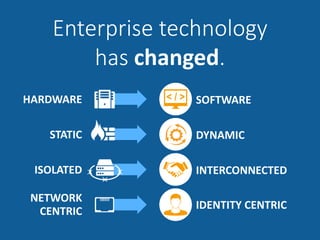
Enterprise technology
has changed.
DYNAMICSTATIC
IDENTITY CENTRIC
NETWORK
CENTRIC
SOFTWAREHARDWARE
INTERCONNECTEDISOLATED
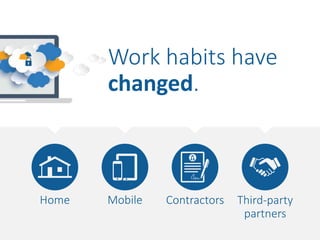
Work habits have
changed.
Home Mobile Contractors Third-party
partners
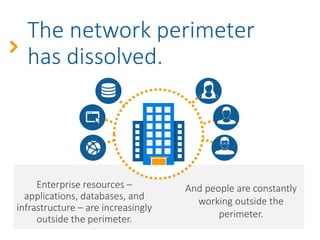
The network perimeter
has dissolved.
Enterprise resources –
applications, databases, and
infrastructure – are increasingly
outside the perimeter.
And people are constantly
working outside the
perimeter.
Network security
must change
to keep up with enterprise
technology and work
habits.
There’s a fundamental
shift in network security
happening right now.
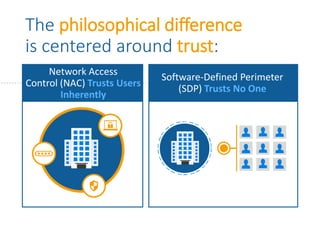
The philosophical difference
is centered around trust:
Network Access
Control (NAC) Trusts Users
Inherently
Software-Defined Perimeter
(SDP) Trusts No One
Do you trust
users completely?
NAC solutions are designed to work inside
the perimeter, a trust-based model...
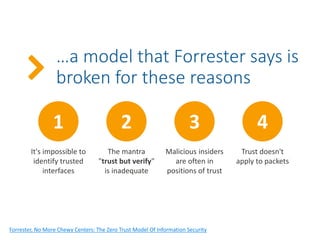
It's impossible to
identify trusted
interfaces
1
The mantra
"trust but verify"
is inadequate
2
Malicious insiders
are often in
positions of trust
3
Trust doesn't
apply to packets
4
…a model that Forrester says is
broken for these reasons
Read: Forrester, No More Chewy Centers: The Zero Trust
Model Of Information Security
Or are no users
trusted?
Abolishing the idea of a trusted network
inside (or outside) the corporate perimeter.
Instead opting for a Software-Defined
Perimeter where…
…there is zero trust.
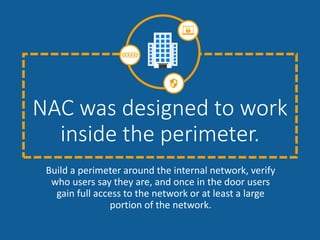
NAC was designed to work
inside the perimeter.
Build a perimeter around the internal network, verify
who users say they are, and once in the door users
gain full access to the network or at least a large
portion of the network.
In this changing world,
NAC falls short
For SEVEN reasons
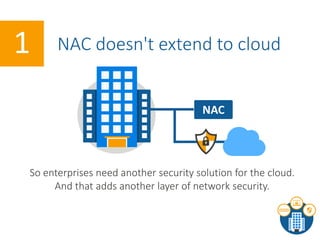
NAC doesn't extend to cloud1
So enterprises need another security solution for the cloud.
And that adds another layer of network security.
NAC
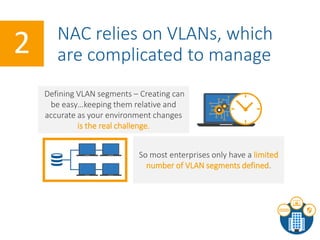
NAC relies on VLANs, which
are complicated to manage2
Defining VLAN segments – Creating can
be easy…keeping them relative and
accurate as your environment changes
is the real challenge.
So most enterprises only have a limited
number of VLAN segments defined.
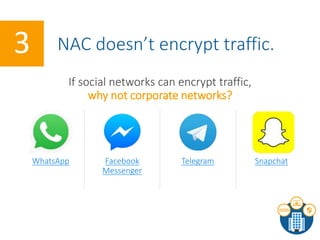
NAC doesn’t encrypt traffic.3
If social networks can encrypt traffic,
why not corporate networks?
WhatsApp SnapchatFacebook
Messenger
Telegram
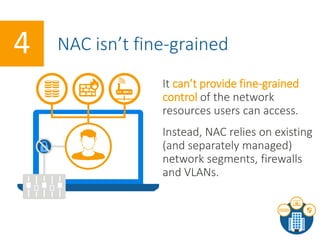
NAC isn’t fine-grained4
It can’t provide fine-grained
control of the network
resources users can access.
Instead, NAC relies on existing
(and separately managed)
network segments, firewalls
and VLANs.
– requiring yet another set of policies to
manage.
NAC’s remote user
support is non-existent5
Remote users need
yet another solution
– like a VPN
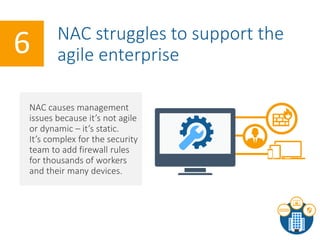
NAC struggles to support the
agile enterprise6
NAC causes management
issues because it’s not agile
or dynamic – it’s static.
It’s complex for the security
team to add firewall rules
for thousands of workers
and their many devices.
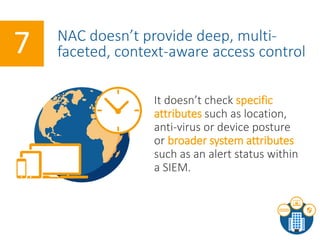
It doesn’t check specific
attributes such as location,
anti-virus or device posture
or broader system attributes
such as an alert status within
a SIEM.
NAC doesn’t provide deep, multi-
faceted, context-aware access control7
A Software-Defined Perimeter
eliminates these limitations
A Software-Defined Perimeter is a
new network security model that
dynamically creates 1:1 network
connections between users and
the data they access.
Read: Why a Software-Defined Perimeter
A Software-
Defined
Perimeter has
MAIN BENEFITS
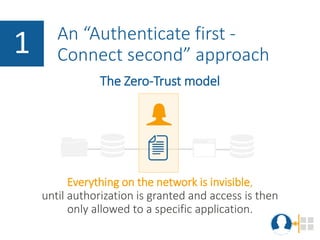
The Zero-Trust model
1 An “Authenticate first -
Connect second” approach
Everything on the network is invisible,
until authorization is granted and access is then
only allowed to a specific application.
for policy compliance.
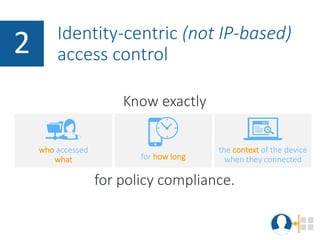
2 Identity-centric (not IP-based)
access control
Know exactly
who accessed
what for how long
the context of the device
when they connected
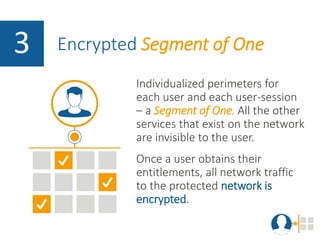
3 Encrypted Segment of One
Individualized perimeters for
each user and each user-session
– a Segment of One. All the other
services that exist on the network
are invisible to the user.
Once a user obtains their
entitlements, all network traffic
to the protected network is
encrypted.
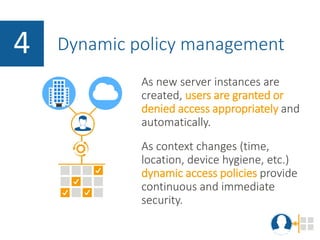
As new server instances are
created, users are granted or
denied access appropriately and
automatically.
As context changes (time,
location, device hygiene, etc.)
dynamic access policies provide
continuous and immediate
security.
4 Dynamic policy management
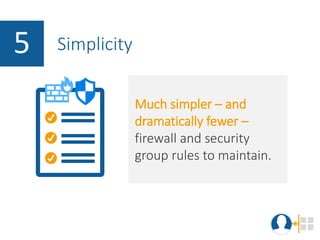
5 Simplicity
Much simpler – and
dramatically fewer –
firewall and security
group rules to maintain.
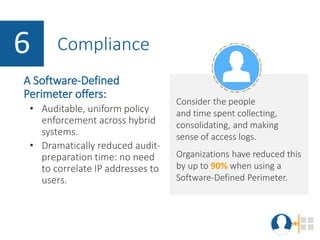
Consider the people
and time spent collecting,
consolidating, and making
sense of access logs.
Organizations have reduced this
by up to 90% when using a
Software-Defined Perimeter.
A Software-Defined
Perimeter offers:
• Auditable, uniform policy
enforcement across hybrid
systems.
• Dramatically reduced audit-
preparation time: no need
to correlate IP addresses to
users.
6 Compliance
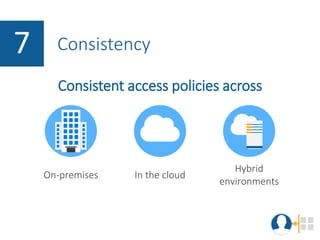
Consistent access policies across
7 Consistency
On-premises In the cloud
Hybrid
environments
Would you like to know more?
Watch the video
SDP to prevent malicious
insiders, over-privileged
users and compromised
third-party access
Get a demo
Let us show you how an
SDP can work for your
organization
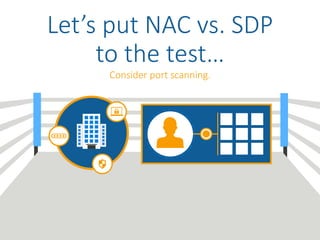
Let’s put NAC vs. SDP
to the test…
Consider port scanning.
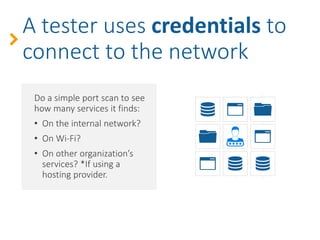
A tester uses credentials to
connect to the network
Do a simple port scan to see
how many services it finds:
• On the internal network?
• On Wi-Fi?
• On other organization’s
services? *If using a
hosting provider.
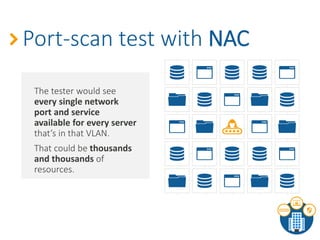
The tester would see
every single network
port and service
available for every server
that’s in that VLAN.
That could be thousands
and thousands of
resources.
Port-scan test with NAC
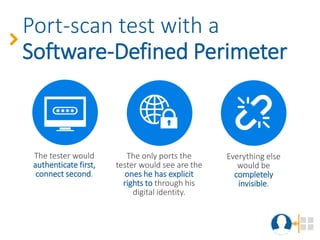
Port-scan test with a
Software-Defined Perimeter
The tester would
authenticate first,
connect second.
The only ports the
tester would see are the
ones he has explicit
rights to through his
digital identity.
Everything else
would be
completely
invisible.
(we’ll need to get techie for a bit)
Here’s why
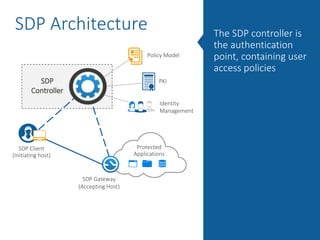
SDP Architecture
37
Protected
Applications
SDP
Controller
SDP Gateway
(Accepting Host)
SDP Client
(Initiating host)
PKI
Identity
Management
Policy Model
The SDP controller is
the authentication
point, containing user
access policies
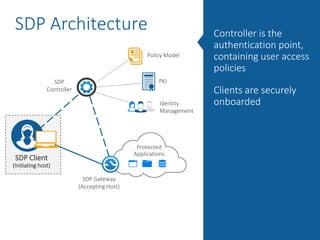
SDP Architecture
Protected
Applications
SDP
Controller
SDP Gateway
(Accepting Host)
SDP Client
(Initiating host)
PKI
Identity
Management
Policy Model
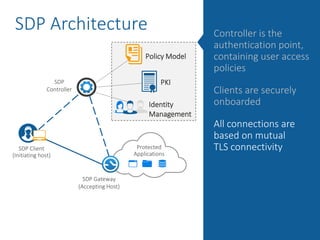
Controller is the
authentication point,
containing user access
policies
Clients are securely
onboarded
SDP Architecture
39
Protected
Applications
SDP
Controller
SDP Gateway
(Accepting Host)
SDP Client
(Initiating host)
PKI
Identity
Management
Policy Model
Controller is the
authentication point,
containing user access
policies
Clients are securely
onboarded
All connections are
based on mutual
TLS connectivity
SDP Architecture
40
Protected
Applications
SDP
Controller
SDP Gateway
(Accepting Host)
SDP Client
(Initiating host)
PKI
Identity
Management
Policy Model
Controller is the
authentication point,
containing user access
policies
Clients are securely
onboarded
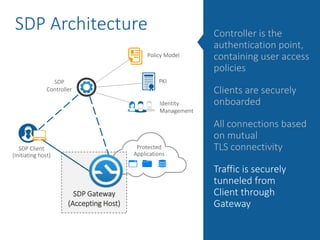
All connections based
on mutual
TLS connectivity
Traffic is securely
tunneled from
Client through
Gateway
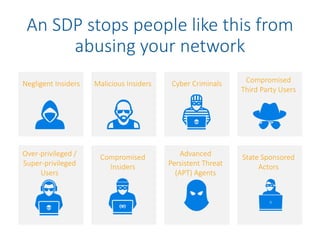
An SDP stops people like this from
abusing your network
Negligent Insiders Malicious Insiders
Compromised
Insiders
Cyber Criminals
Advanced
Persistent Threat
(APT) Agents
State Sponsored
Actors
Compromised
Third Party Users
Over-privileged /
Super-privileged
Users
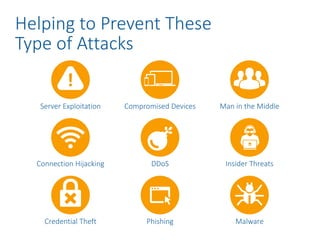
Helping to Prevent These
Type of Attacks
Server Exploitation
Credential Theft
Connection Hijacking
Compromised Devices
Phishing
DDoS Insider Threats
Malware
Man in the Middle
Software-Defined
Perimeter sounds great…
But what if a NAC is already in place?
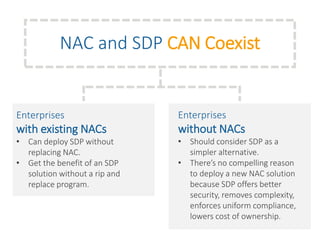
NAC and SDP CAN Coexist
Enterprises
with existing NACs
• Can deploy SDP without
replacing NAC.
• Get the benefit of an SDP
solution without a rip and
replace program.
Enterprises
without NACs
• Should consider SDP as a
simpler alternative.
• There’s no compelling reason
to deploy a new NAC solution
because SDP offers better
security, removes complexity,
enforces uniform compliance,
lowers cost of ownership.
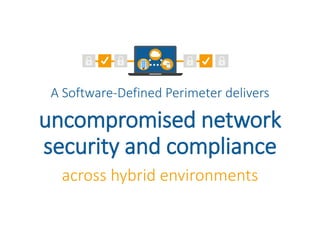
uncompromised network
security and compliance
A Software-Defined Perimeter delivers
across hybrid environments
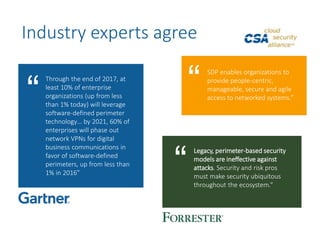
Industry experts agree
Legacy, perimeter-based security
models are ineffective against
attacks. Security and risk pros
must make security ubiquitous
throughout the ecosystem.”
“
Through the end of 2017, at
least 10% of enterprise
organizations (up from less
than 1% today) will leverage
software-defined perimeter
technology… by 2021, 60% of
enterprises will phase out
network VPNs for digital
business communications in
favor of software-defined
perimeters, up from less than
1% in 2016”
SDP enables organizations to
provide people-centric,
manageable, secure and agile
access to networked systems.”
“
“
Cryptzone delivers the
market leading
Software-Defined
Perimeter:
AppGate
Learn more about
AppGate
Network Access Control
vs. Software-Defined
Perimeter – or both?
WEBINAR
The Zero Trust Model of
Information Security
WHITEPAPER
Forrester Report
No More Chewy
Centers:
AppGate
VIDEO
Network Security is
Changing
See How AppGate
Works
FREE TRIAL | START NOW
Email: info@cryptzone.com
Twitter: @Cryptzone
LinkedIn:
linkedin.com/company/cryptzone
GET IN TOUCH
Get access to a 15-day free
trial on AWS marketplace.
Want to know
more?
www.cryptzone.com

How to Overcome Network Access Control Limitations for Better Network Security

  • 1.
    How to Overcome NACLimitations Why a Software-Defined Perimeter delivers better network security for today’s enterprises
  • 2.
    Enterprise technology has changed. DYNAMICSTATIC IDENTITYCENTRIC NETWORK CENTRIC SOFTWAREHARDWARE INTERCONNECTEDISOLATED
  • 3.
    Work habits have changed. HomeMobile Contractors Third-party partners
  • 4.
    The network perimeter hasdissolved. Enterprise resources – applications, databases, and infrastructure – are increasingly outside the perimeter. And people are constantly working outside the perimeter.
  • 5.
    Network security must change tokeep up with enterprise technology and work habits.
  • 6.
    There’s a fundamental shiftin network security happening right now.
  • 7.
    The philosophical difference iscentered around trust: Network Access Control (NAC) Trusts Users Inherently Software-Defined Perimeter (SDP) Trusts No One
  • 8.
    Do you trust userscompletely? NAC solutions are designed to work inside the perimeter, a trust-based model...
  • 9.
    It's impossible to identifytrusted interfaces 1 The mantra "trust but verify" is inadequate 2 Malicious insiders are often in positions of trust 3 Trust doesn't apply to packets 4 …a model that Forrester says is broken for these reasons Read: Forrester, No More Chewy Centers: The Zero Trust Model Of Information Security
  • 10.
    Or are nousers trusted? Abolishing the idea of a trusted network inside (or outside) the corporate perimeter. Instead opting for a Software-Defined Perimeter where…
  • 11.
  • 12.
    NAC was designedto work inside the perimeter. Build a perimeter around the internal network, verify who users say they are, and once in the door users gain full access to the network or at least a large portion of the network.
  • 13.
    In this changingworld, NAC falls short For SEVEN reasons
  • 14.
    NAC doesn't extendto cloud1 So enterprises need another security solution for the cloud. And that adds another layer of network security. NAC
  • 15.
    NAC relies onVLANs, which are complicated to manage2 Defining VLAN segments – Creating can be easy…keeping them relative and accurate as your environment changes is the real challenge. So most enterprises only have a limited number of VLAN segments defined.
  • 16.
    NAC doesn’t encrypttraffic.3 If social networks can encrypt traffic, why not corporate networks? WhatsApp SnapchatFacebook Messenger Telegram
  • 17.
    NAC isn’t fine-grained4 Itcan’t provide fine-grained control of the network resources users can access. Instead, NAC relies on existing (and separately managed) network segments, firewalls and VLANs.
  • 18.
    – requiring yetanother set of policies to manage. NAC’s remote user support is non-existent5 Remote users need yet another solution – like a VPN
  • 19.
    NAC struggles tosupport the agile enterprise6 NAC causes management issues because it’s not agile or dynamic – it’s static. It’s complex for the security team to add firewall rules for thousands of workers and their many devices.
  • 20.
    It doesn’t checkspecific attributes such as location, anti-virus or device posture or broader system attributes such as an alert status within a SIEM. NAC doesn’t provide deep, multi- faceted, context-aware access control7
  • 21.
  • 22.
    A Software-Defined Perimeteris a new network security model that dynamically creates 1:1 network connections between users and the data they access. Read: Why a Software-Defined Perimeter
  • 23.
  • 24.
    The Zero-Trust model 1An “Authenticate first - Connect second” approach Everything on the network is invisible, until authorization is granted and access is then only allowed to a specific application.
  • 25.
    for policy compliance. 2Identity-centric (not IP-based) access control Know exactly who accessed what for how long the context of the device when they connected
  • 26.
    3 Encrypted Segmentof One Individualized perimeters for each user and each user-session – a Segment of One. All the other services that exist on the network are invisible to the user. Once a user obtains their entitlements, all network traffic to the protected network is encrypted.
  • 27.
    As new serverinstances are created, users are granted or denied access appropriately and automatically. As context changes (time, location, device hygiene, etc.) dynamic access policies provide continuous and immediate security. 4 Dynamic policy management
  • 28.
    5 Simplicity Much simpler– and dramatically fewer – firewall and security group rules to maintain.
  • 29.
    Consider the people andtime spent collecting, consolidating, and making sense of access logs. Organizations have reduced this by up to 90% when using a Software-Defined Perimeter. A Software-Defined Perimeter offers: • Auditable, uniform policy enforcement across hybrid systems. • Dramatically reduced audit- preparation time: no need to correlate IP addresses to users. 6 Compliance
  • 30.
    Consistent access policiesacross 7 Consistency On-premises In the cloud Hybrid environments
  • 31.
    Would you liketo know more? Watch the video SDP to prevent malicious insiders, over-privileged users and compromised third-party access Get a demo Let us show you how an SDP can work for your organization
  • 32.
    Let’s put NACvs. SDP to the test… Consider port scanning.
  • 33.
    A tester usescredentials to connect to the network Do a simple port scan to see how many services it finds: • On the internal network? • On Wi-Fi? • On other organization’s services? *If using a hosting provider.
  • 34.
    The tester wouldsee every single network port and service available for every server that’s in that VLAN. That could be thousands and thousands of resources. Port-scan test with NAC
  • 35.
    Port-scan test witha Software-Defined Perimeter The tester would authenticate first, connect second. The only ports the tester would see are the ones he has explicit rights to through his digital identity. Everything else would be completely invisible.
  • 36.
    (we’ll need toget techie for a bit) Here’s why
  • 37.
    SDP Architecture 37 Protected Applications SDP Controller SDP Gateway (AcceptingHost) SDP Client (Initiating host) PKI Identity Management Policy Model The SDP controller is the authentication point, containing user access policies
  • 38.
    SDP Architecture Protected Applications SDP Controller SDP Gateway (AcceptingHost) SDP Client (Initiating host) PKI Identity Management Policy Model Controller is the authentication point, containing user access policies Clients are securely onboarded
  • 39.
    SDP Architecture 39 Protected Applications SDP Controller SDP Gateway (AcceptingHost) SDP Client (Initiating host) PKI Identity Management Policy Model Controller is the authentication point, containing user access policies Clients are securely onboarded All connections are based on mutual TLS connectivity
  • 40.
    SDP Architecture 40 Protected Applications SDP Controller SDP Gateway (AcceptingHost) SDP Client (Initiating host) PKI Identity Management Policy Model Controller is the authentication point, containing user access policies Clients are securely onboarded All connections based on mutual TLS connectivity Traffic is securely tunneled from Client through Gateway
  • 41.
    An SDP stopspeople like this from abusing your network Negligent Insiders Malicious Insiders Compromised Insiders Cyber Criminals Advanced Persistent Threat (APT) Agents State Sponsored Actors Compromised Third Party Users Over-privileged / Super-privileged Users
  • 42.
    Helping to PreventThese Type of Attacks Server Exploitation Credential Theft Connection Hijacking Compromised Devices Phishing DDoS Insider Threats Malware Man in the Middle
  • 43.
    Software-Defined Perimeter sounds great… Butwhat if a NAC is already in place?
  • 44.
    NAC and SDPCAN Coexist Enterprises with existing NACs • Can deploy SDP without replacing NAC. • Get the benefit of an SDP solution without a rip and replace program. Enterprises without NACs • Should consider SDP as a simpler alternative. • There’s no compelling reason to deploy a new NAC solution because SDP offers better security, removes complexity, enforces uniform compliance, lowers cost of ownership.
  • 45.
    uncompromised network security andcompliance A Software-Defined Perimeter delivers across hybrid environments
  • 46.
    Industry experts agree Legacy,perimeter-based security models are ineffective against attacks. Security and risk pros must make security ubiquitous throughout the ecosystem.” “ Through the end of 2017, at least 10% of enterprise organizations (up from less than 1% today) will leverage software-defined perimeter technology… by 2021, 60% of enterprises will phase out network VPNs for digital business communications in favor of software-defined perimeters, up from less than 1% in 2016” SDP enables organizations to provide people-centric, manageable, secure and agile access to networked systems.” “ “
  • 47.
    Cryptzone delivers the marketleading Software-Defined Perimeter: AppGate
  • 48.
    Learn more about AppGate NetworkAccess Control vs. Software-Defined Perimeter – or both? WEBINAR The Zero Trust Model of Information Security WHITEPAPER Forrester Report No More Chewy Centers: AppGate VIDEO Network Security is Changing See How AppGate Works
  • 49.
    FREE TRIAL |START NOW Email: info@cryptzone.com Twitter: @Cryptzone LinkedIn: linkedin.com/company/cryptzone GET IN TOUCH Get access to a 15-day free trial on AWS marketplace. Want to know more? www.cryptzone.com