BeyondCorp: Google Security For Everyone Else
Rocky Mountain InfoSec - May 10th 2017
Ivan Dwyer | @fortyfivan
The BeyondCorp story begins with Operation Aurora
Operation Aurora
➔ In 2009, a highly sophisticated APT originating from China targeted a number of large
US-based Enterprises, including Google, with the goal of accessing source code repositories
➔ The typical fear-driven response by most companies affected was to beef up their network
perimeter security by adding more firewalls and VPNs
➔ Google recognized that these traditional methods were no longer effective on their own, and
began a new initiative to redesign their security architecture from the ground up
The network perimeter is not an effective way to determine trust
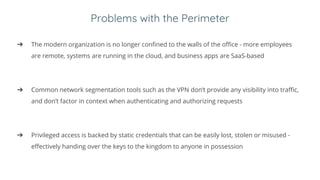
Problems with the Perimeter
➔ The modern organization is no longer confined to the walls of the office - more employees
are remote, systems are running in the cloud, and business apps are SaaS-based
➔ Common network segmentation tools such as the VPN don’t provide any visibility into traffic,
and don’t factor in context when authenticating and authorizing requests
➔ Privileged access is backed by static credentials that can be easily lost, stolen or misused -
effectively handing over the keys to the kingdom to anyone in possession
Google got it right with BeyondCorp
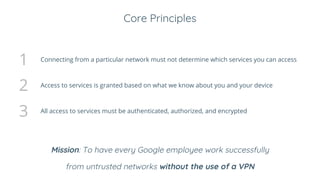
Core Principles
1 Connecting from a particular network must not determine which services you can access
2 Access to services is granted based on what we know about you and your device
3 All access to services must be authenticated, authorized, and encrypted
Mission: To have every Google employee work successfully
from untrusted networks without the use of a VPN
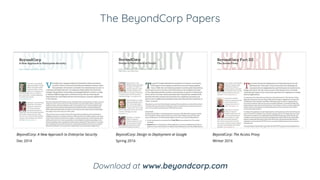
The BeyondCorp Papers
BeyondCorp: A New Approach to Enterprise Security
Dec 2014
BeyondCorp: Design to Deployment at Google
Spring 2016
BeyondCorp: The Access Proxy
Winter 2016
Download at www.beyondcorp.com
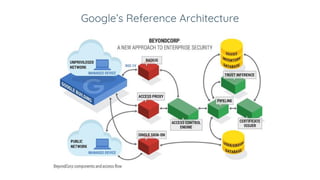
Google’s Reference Architecture
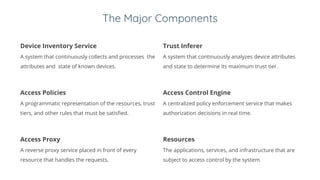
The Major Components
Device Inventory Service
A system that continuously collects and processes the
attributes and state of known devices.
Trust Inferer
A system that continuously analyzes device attributes
and state to determine its maximum trust tier.
Access Policies
A programmatic representation of the resources, trust
tiers, and other rules that must be satisfied.
Access Control Engine
A centralized policy enforcement service that makes
authorization decisions in real time.
Access Proxy
A reverse proxy service placed in front of every
resource that handles the requests.
Resources
The applications, services, and infrastructure that are
subject to access control by the system.
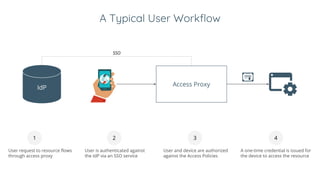
A Typical User Workflow
Access Proxy
IdP
User request to resource flows
through access proxy
User is authenticated against
the IdP via an SSO service
SSO
User and device are authorized
against the Access Policies
A one-time credential is issued for
the device to access the resource
1 2 3 4
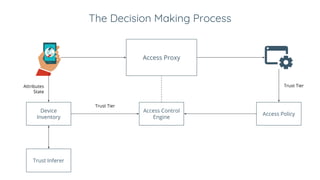
The Decision Making Process
Device
Inventory
Attributes
State
Trust Tier
Access Control
Engine
Access Proxy
Access Policy
Trust Tier
Trust Inferer
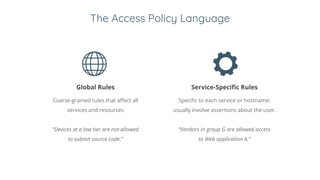
The Access Policy Language
Global Rules Service-Specific Rules
Coarse-grained rules that affect all
services and resources
“Devices at a low tier are not allowed
to submit source code.”
Specific to each service or hostname;
usually involve assertions about the user.
“Vendors in group G are allowed access
to Web application A.”
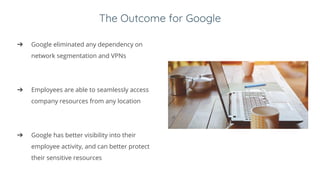
The Outcome for Google
➔ Google eliminated any dependency on
network segmentation and VPNs
➔ Employees are able to seamlessly access
company resources from any location
➔ Google has better visibility into their
employee activity, and can better protect
their sensitive resources
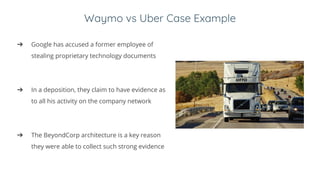
Waymo vs Uber Case Example
➔ Google has accused a former employee of
stealing proprietary technology documents
➔ In a deposition, they claim to have evidence as
to all his activity on the company network
➔ The BeyondCorp architecture is a key reason
they were able to collect such strong evidence
Zero Trust Enables BeyondCorp for Everyone Else
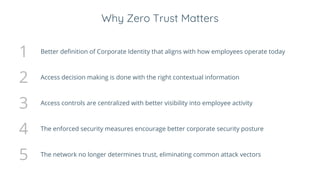
Why Zero Trust Matters
1 Better definition of Corporate Identity that aligns with how employees operate today
2 Access decision making is done with the right contextual information
3 Access controls are centralized with better visibility into employee activity
4 The enforced security measures encourage better corporate security posture
5 The network no longer determines trust, eliminating common attack vectors
Zero Trust introduces a new definition of Corporate Identity
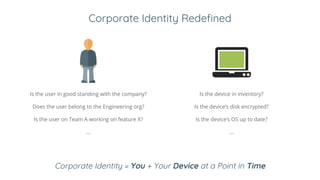
Corporate Identity Redefined
Is the user in good standing with the company?
Does the user belong to the Engineering org?
Is the user on Team A working on feature X?
...
Is the device in inventory?
Is the device’s disk encrypted?
Is the device’s OS up to date?
...
Corporate Identity = You + Your Device at a Point in Time
Decision making is done with the right contextual information
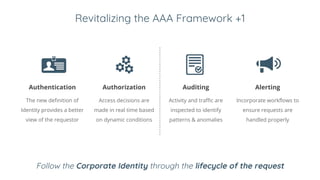
Revitalizing the AAA Framework +1
Authentication Authorization Auditing Alerting
The new definition of
Identity provides a better
view of the requestor
Access decisions are
made in real time based
on dynamic conditions
Activity and traffic are
inspected to identify
patterns & anomalies
Incorporate workflows to
ensure requests are
handled properly
Follow the Corporate Identity through the lifecycle of the request
Access controls are centralized with visibility into employee activity
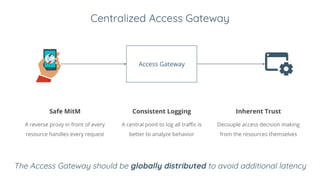
Centralized Access Gateway
Access Gateway
Safe MitM Consistent Logging Inherent Trust
A reverse proxy in front of every
resource handles every request
A central point to log all traffic is
better to analyze behavior
Decouple access decision making
from the resources themselves
The Access Gateway should be globally distributed to avoid additional latency
Enforced security measures encourage better corporate security posture
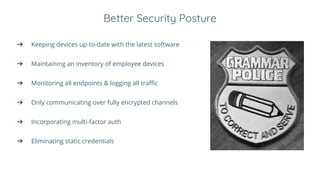
Better Security Posture
➔ Keeping devices up-to-date with the latest software
➔ Maintaining an inventory of employee devices
➔ Monitoring all endpoints & logging all traffic
➔ Only communicating over fully encrypted channels
➔ Incorporating multi-factor auth
➔ Eliminating static credentials
Eliminating static credentials solves for the most common attack vector
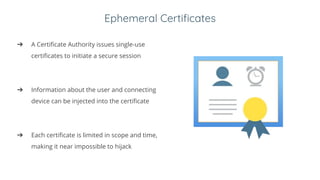
Ephemeral Certificates
➔ A Certificate Authority issues single-use
certificates to initiate a secure session
➔ Information about the user and connecting
device can be injected into the certificate
➔ Each certificate is limited in scope and time,
making it near impossible to hijack
Achieving a Zero Trust Architecture
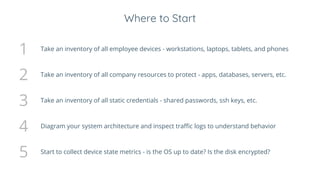
Where to Start
1 Take an inventory of all employee devices - workstations, laptops, tablets, and phones
2 Take an inventory of all company resources to protect - apps, databases, servers, etc.
3 Take an inventory of all static credentials - shared passwords, ssh keys, etc.
4 Diagram your system architecture and inspect traffic logs to understand behavior
5 Start to collect device state metrics - is the OS up to date? Is the disk encrypted?
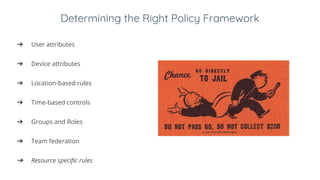
Determining the Right Policy Framework
➔ User attributes
➔ Device attributes
➔ Location-based rules
➔ Time-based controls
➔ Groups and Roles
➔ Team federation
➔ Resource specific rules
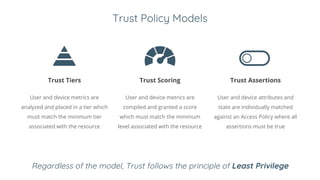
Trust Policy Models
Trust Tiers Trust Scoring Trust Assertions
User and device metrics are
analyzed and placed in a tier which
must match the minimum tier
associated with the resource
User and device metrics are
compiled and granted a score
which must match the minimum
level associated with the resource
User and device attributes and
state are individually matched
against an Access Policy where all
assertions must be true
Regardless of the model, Trust follows the principle of Least Privilege
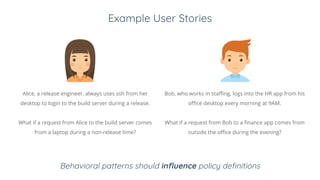
Example User Stories
Behavioral patterns should influence policy definitions
Alice, a release engineer, always uses ssh from her
desktop to login to the build server during a release.
What if a request from Alice to the build server comes
from a laptop during a non-release time?
Bob, who works in staffing, logs into the HR app from his
office desktop every morning at 9AM.
What if a request from Bob to a finance app comes from
outside the office during the evening?
Access Gateway Vendor Solutions
The Access Gateway is the central component that ties the system together
Companies Who Have Implemented Zero Trust
Some Questions to Ask
➔ How will all the components integrate with each other?
➔ How to balance coarse-grained policies with fine-grained policies?
➔ What’s the best way to incorporate additional workflows for specific resources?
➔ What role does Identity Governance play? Can the IdP exist in the cloud?
➔ How to support legacy protocols and specifications consistently? Should you?
➔ How to track and monitor all the devices the employees use?
➔ How does this impact compliance? Where will it help?
Potential Market Effects
➔ A new category of Cloud Native solution providers are emerging that are disrupting the
legacy security companies who focus primarily on strengthening perimeter security
➔ Defined market categories such as IAM and PAM will converge into a single Access
Management category that works across privileged and nonprivileged users
➔ The Identity Provider space is about to heat up as cloud-based alternatives to Active
Directory start to break through into the enterprise market
➔ The VPN market is going to be significantly impacted as more companies shift towards a Zero
Trust model that places less (or no) emphasis on network protection as a security measure
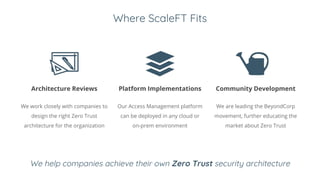
Where ScaleFT Fits
We help companies achieve their own Zero Trust security architecture
Architecture Reviews Platform Implementations Community Development
We work closely with companies to
design the right Zero Trust
architecture for the organization
Our Access Management platform
can be deployed in any cloud or
on-prem environment
We are leading the BeyondCorp
movement, further educating the
market about Zero Trust
THANKS!!
Get in touch: ivan.dwyer@scaleft.com | @fortyfivan
www.scaleft.com
www.beyondcorp.com

BeyondCorp - Google Security for Everyone Else

  • 1.
    BeyondCorp: Google SecurityFor Everyone Else Rocky Mountain InfoSec - May 10th 2017 Ivan Dwyer | @fortyfivan
  • 2.
    The BeyondCorp storybegins with Operation Aurora
  • 3.
    Operation Aurora ➔ In2009, a highly sophisticated APT originating from China targeted a number of large US-based Enterprises, including Google, with the goal of accessing source code repositories ➔ The typical fear-driven response by most companies affected was to beef up their network perimeter security by adding more firewalls and VPNs ➔ Google recognized that these traditional methods were no longer effective on their own, and began a new initiative to redesign their security architecture from the ground up
  • 4.
    The network perimeteris not an effective way to determine trust
  • 5.
    Problems with thePerimeter ➔ The modern organization is no longer confined to the walls of the office - more employees are remote, systems are running in the cloud, and business apps are SaaS-based ➔ Common network segmentation tools such as the VPN don’t provide any visibility into traffic, and don’t factor in context when authenticating and authorizing requests ➔ Privileged access is backed by static credentials that can be easily lost, stolen or misused - effectively handing over the keys to the kingdom to anyone in possession
  • 6.
    Google got itright with BeyondCorp
  • 7.
    Core Principles 1 Connectingfrom a particular network must not determine which services you can access 2 Access to services is granted based on what we know about you and your device 3 All access to services must be authenticated, authorized, and encrypted Mission: To have every Google employee work successfully from untrusted networks without the use of a VPN
  • 8.
    The BeyondCorp Papers BeyondCorp:A New Approach to Enterprise Security Dec 2014 BeyondCorp: Design to Deployment at Google Spring 2016 BeyondCorp: The Access Proxy Winter 2016 Download at www.beyondcorp.com
  • 9.
  • 10.
    The Major Components DeviceInventory Service A system that continuously collects and processes the attributes and state of known devices. Trust Inferer A system that continuously analyzes device attributes and state to determine its maximum trust tier. Access Policies A programmatic representation of the resources, trust tiers, and other rules that must be satisfied. Access Control Engine A centralized policy enforcement service that makes authorization decisions in real time. Access Proxy A reverse proxy service placed in front of every resource that handles the requests. Resources The applications, services, and infrastructure that are subject to access control by the system.
  • 11.
    A Typical UserWorkflow Access Proxy IdP User request to resource flows through access proxy User is authenticated against the IdP via an SSO service SSO User and device are authorized against the Access Policies A one-time credential is issued for the device to access the resource 1 2 3 4
  • 12.
    The Decision MakingProcess Device Inventory Attributes State Trust Tier Access Control Engine Access Proxy Access Policy Trust Tier Trust Inferer
  • 13.
    The Access PolicyLanguage Global Rules Service-Specific Rules Coarse-grained rules that affect all services and resources “Devices at a low tier are not allowed to submit source code.” Specific to each service or hostname; usually involve assertions about the user. “Vendors in group G are allowed access to Web application A.”
  • 14.
    The Outcome forGoogle ➔ Google eliminated any dependency on network segmentation and VPNs ➔ Employees are able to seamlessly access company resources from any location ➔ Google has better visibility into their employee activity, and can better protect their sensitive resources
  • 15.
    Waymo vs UberCase Example ➔ Google has accused a former employee of stealing proprietary technology documents ➔ In a deposition, they claim to have evidence as to all his activity on the company network ➔ The BeyondCorp architecture is a key reason they were able to collect such strong evidence
  • 16.
    Zero Trust EnablesBeyondCorp for Everyone Else
  • 17.
    Why Zero TrustMatters 1 Better definition of Corporate Identity that aligns with how employees operate today 2 Access decision making is done with the right contextual information 3 Access controls are centralized with better visibility into employee activity 4 The enforced security measures encourage better corporate security posture 5 The network no longer determines trust, eliminating common attack vectors
  • 18.
    Zero Trust introducesa new definition of Corporate Identity
  • 19.
    Corporate Identity Redefined Isthe user in good standing with the company? Does the user belong to the Engineering org? Is the user on Team A working on feature X? ... Is the device in inventory? Is the device’s disk encrypted? Is the device’s OS up to date? ... Corporate Identity = You + Your Device at a Point in Time
  • 20.
    Decision making isdone with the right contextual information
  • 21.
    Revitalizing the AAAFramework +1 Authentication Authorization Auditing Alerting The new definition of Identity provides a better view of the requestor Access decisions are made in real time based on dynamic conditions Activity and traffic are inspected to identify patterns & anomalies Incorporate workflows to ensure requests are handled properly Follow the Corporate Identity through the lifecycle of the request
  • 22.
    Access controls arecentralized with visibility into employee activity
  • 23.
    Centralized Access Gateway AccessGateway Safe MitM Consistent Logging Inherent Trust A reverse proxy in front of every resource handles every request A central point to log all traffic is better to analyze behavior Decouple access decision making from the resources themselves The Access Gateway should be globally distributed to avoid additional latency
  • 24.
    Enforced security measuresencourage better corporate security posture
  • 25.
    Better Security Posture ➔Keeping devices up-to-date with the latest software ➔ Maintaining an inventory of employee devices ➔ Monitoring all endpoints & logging all traffic ➔ Only communicating over fully encrypted channels ➔ Incorporating multi-factor auth ➔ Eliminating static credentials
  • 26.
    Eliminating static credentialssolves for the most common attack vector
  • 27.
    Ephemeral Certificates ➔ ACertificate Authority issues single-use certificates to initiate a secure session ➔ Information about the user and connecting device can be injected into the certificate ➔ Each certificate is limited in scope and time, making it near impossible to hijack
  • 28.
    Achieving a ZeroTrust Architecture
  • 29.
    Where to Start 1Take an inventory of all employee devices - workstations, laptops, tablets, and phones 2 Take an inventory of all company resources to protect - apps, databases, servers, etc. 3 Take an inventory of all static credentials - shared passwords, ssh keys, etc. 4 Diagram your system architecture and inspect traffic logs to understand behavior 5 Start to collect device state metrics - is the OS up to date? Is the disk encrypted?
  • 30.
    Determining the RightPolicy Framework ➔ User attributes ➔ Device attributes ➔ Location-based rules ➔ Time-based controls ➔ Groups and Roles ➔ Team federation ➔ Resource specific rules
  • 31.
    Trust Policy Models TrustTiers Trust Scoring Trust Assertions User and device metrics are analyzed and placed in a tier which must match the minimum tier associated with the resource User and device metrics are compiled and granted a score which must match the minimum level associated with the resource User and device attributes and state are individually matched against an Access Policy where all assertions must be true Regardless of the model, Trust follows the principle of Least Privilege
  • 32.
    Example User Stories Behavioralpatterns should influence policy definitions Alice, a release engineer, always uses ssh from her desktop to login to the build server during a release. What if a request from Alice to the build server comes from a laptop during a non-release time? Bob, who works in staffing, logs into the HR app from his office desktop every morning at 9AM. What if a request from Bob to a finance app comes from outside the office during the evening?
  • 33.
    Access Gateway VendorSolutions The Access Gateway is the central component that ties the system together
  • 34.
    Companies Who HaveImplemented Zero Trust
  • 35.
    Some Questions toAsk ➔ How will all the components integrate with each other? ➔ How to balance coarse-grained policies with fine-grained policies? ➔ What’s the best way to incorporate additional workflows for specific resources? ➔ What role does Identity Governance play? Can the IdP exist in the cloud? ➔ How to support legacy protocols and specifications consistently? Should you? ➔ How to track and monitor all the devices the employees use? ➔ How does this impact compliance? Where will it help?
  • 36.
    Potential Market Effects ➔A new category of Cloud Native solution providers are emerging that are disrupting the legacy security companies who focus primarily on strengthening perimeter security ➔ Defined market categories such as IAM and PAM will converge into a single Access Management category that works across privileged and nonprivileged users ➔ The Identity Provider space is about to heat up as cloud-based alternatives to Active Directory start to break through into the enterprise market ➔ The VPN market is going to be significantly impacted as more companies shift towards a Zero Trust model that places less (or no) emphasis on network protection as a security measure
  • 37.
    Where ScaleFT Fits Wehelp companies achieve their own Zero Trust security architecture Architecture Reviews Platform Implementations Community Development We work closely with companies to design the right Zero Trust architecture for the organization Our Access Management platform can be deployed in any cloud or on-prem environment We are leading the BeyondCorp movement, further educating the market about Zero Trust
  • 38.
    THANKS!! Get in touch:ivan.dwyer@scaleft.com | @fortyfivan www.scaleft.com www.beyondcorp.com