FDA INSPECTION READINESS
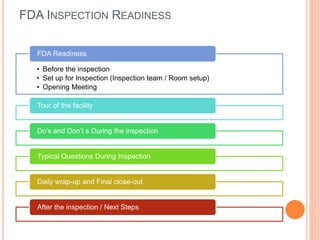
• Before the inspection
• Set up for Inspection (Inspection team / Room setup)
• Opening Meeting
FDA Readiness
Tour of the facility
Do’s and Don’t s During the inspection
Typical Questions During Inspection
Daily wrap-up and Final close-out
After the inspection / Next Steps
FDA INSPECTION READINESS
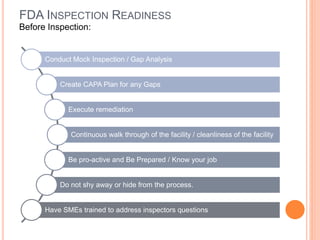
Before Inspection:
Conduct Mock Inspection / Gap Analysis
Create CAPA Plan for any Gaps
Execute remediation
Continuous walk through of the facility / cleanliness of the facility
Be pro-active and Be Prepared / Know your job
Do not shy away or hide from the process.
Have SMEs trained to address inspectors questions
FDA INSPECTION READINESS
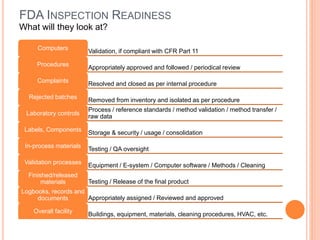
What will they look at?
Validation, if compliant with CFR Part 11
Computers
Appropriately approved and followed / periodical review
Procedures
Resolved and closed as per internal procedure
Complaints
Removed from inventory and isolated as per procedure
Rejected batches
Process / reference standards / method validation / method transfer /
raw data
Laboratory controls
Storage & security / usage / consolidation
Labels, Components
Testing / QA oversight
In-process materials
Equipment / E-system / Computer software / Methods / Cleaning
Validation processes
Testing / Release of the final product
Finished/released
materials
Appropriately assigned / Reviewed and approved
Logbooks, records and
documents
Buildings, equipment, materials, cleaning procedures, HVAC, etc.
Overall facility
FDA INSPECTION READINESS
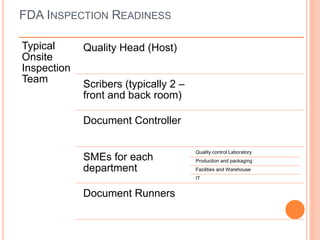
Typical
Onsite
Inspection
Team
Quality Head (Host)
Scribers (typically 2 –
front and back room)
Document Controller
SMEs for each
department
Quality control Laboratory
Production and packaging
Facilities and Warehouse
IT
Document Runners
FDA INSPECTION READINESS
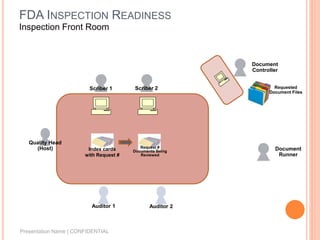
Inspection Front Room
Presentation Name | CONFIDENTIAL
Scriber 1 Scriber 2
Quality Head
(Host)
Auditor 1 Auditor 2
Document
Controller
Requested
Document Files
Index cards
with Request #
Request #
Documents Being
Reviewed
Document
Runner
FDA INSPECTION READINESS
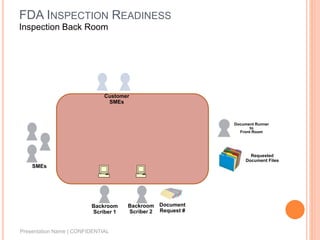
Inspection Back Room
Presentation Name | CONFIDENTIAL
Document Runner
to
Front Room
SMEs
Requested
Document Files
Document
Request #
Backroom
Scriber 1
Backroom
Scriber 2
Customer
SMEs
FDA INSPECTION READINESS
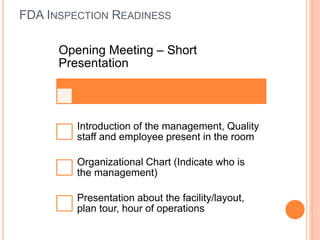
Opening Meeting – Short
Presentation
Introduction of the management, Quality
staff and employee present in the room
Organizational Chart (Indicate who is
the management)
Presentation about the facility/layout,
plan tour, hour of operations
FDA INSPECTION READINESS
Managing the inspection…
• Control documents provided to the inspector
• Keep log of requests and their status… Mark
“Confidential” and “Copy” to all copied
documents provided
• Review the requested record before sending
into the room for the investigator. Check that
the record is the one asked for.
• Send only the record and not the entire file.
• Check for any missing signatures or entries
or missing pages
FACILITY TOUR DURING INSPECTION
• Identify key QA and respective department
SMEs to escort Inspectors
• Escort the inspectors at all times
• Tour – flow the material and production
process
• Incoming materials / warehouse (raw
materials, packaging material)
• Quarantine / Approve material area
• Production (manufacturing to finish goods
area)
• QC Lab
Tour of the facility with Inspectors
FACILITY TOUR DURING INSPECTION
• Restrict conversations in common areas and/or to the area
only being toured
• Be prepared to show to which process or relevent SOP for
the work performed in the area.
• Questions –
• Address only if the available information is accurate
• Ensure you understand the questions before answering.
• Take note of the questions asked or document requested
• Take note of any document reviewed by the inspectors
• Take note of any employees interviewed during the
walkthrough
• Always be truthful, if information not available or not known,
it’s okay to say “I don’t know, let me find out”
Tour of the facility with Tour of the facility with
Inspectors (continues)
HANDLING FDA INSPECTION - DO'S
Do’s Be confident
Be well dressed and neat.
Be presentable
Be decent and polite
Be courteous and professional at all times
Correct all errors/miscommunications as
soon as possible
HANDLING FDA INSPECTION - DO'S
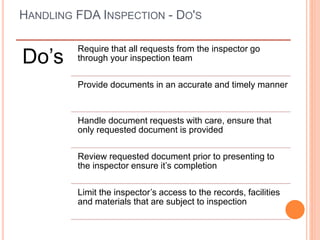
Do’s
Require that all requests from the inspector go
through your inspection team
Provide documents in an accurate and timely manner
Handle document requests with care, ensure that
only requested document is provided
Review requested document prior to presenting to
the inspector ensure it’s completion
Limit the inspector’s access to the records, facilities
and materials that are subject to inspection
HANDLING FDA INSPECTION - DO'S
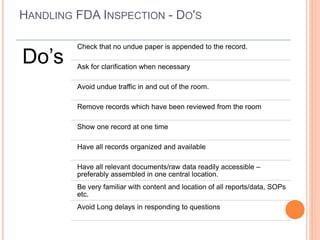
Do’s
Check that no undue paper is appended to the record.
Ask for clarification when necessary
Avoid undue traffic in and out of the room.
Remove records which have been reviewed from the room
Show one record at one time
Have all records organized and available
Have all relevant documents/raw data readily accessible –
preferably assembled in one central location.
Be very familiar with content and location of all reports/data, SOPs
etc.
Avoid Long delays in responding to questions
HANDLING FDA INSPECTION - DO'S
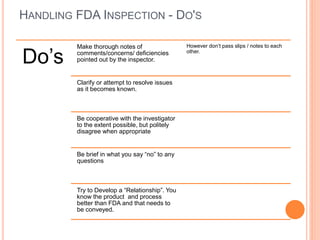
Do’s
Make thorough notes of
comments/concerns/ deficiencies
pointed out by the inspector.
However don’t pass slips / notes to each
other.
Clarify or attempt to resolve issues
as it becomes known.
Be cooperative with the investigator
to the extent possible, but politely
disagree when appropriate
Be brief in what you say “no” to any
questions
Try to Develop a “Relationship”. You
know the product and process
better than FDA and that needs to
be conveyed.
HANDLING FDA INSPECTION - DO'S
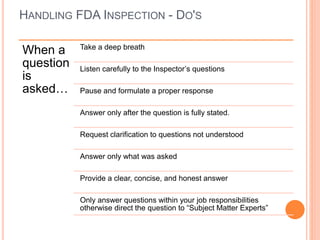
When a
question
is
asked…
Take a deep breath
Listen carefully to the Inspector’s questions
Pause and formulate a proper response
Answer only after the question is fully stated.
Request clarification to questions not understood
Answer only what was asked
Provide a clear, concise, and honest answer
Only answer questions within your job responsibilities
otherwise direct the question to “Subject Matter Experts”
HANDLING FDA INSPECTION - DO'S
When a
question
is
asked…
Speak slowly and clearly-one word at a time
Keep unnecessary conversation to a
minimum
Answer briefly to the question only
Answer only if you are sure.
Communicate clearly and effectively
Focus on positives
HANDLING FDA INSPECTION - DO'S
 DO’s
 Assume a friendly, cooperative attitude - but do
not overdo it.
 Avoid creating an adversary relationship. Project
an attitude of confidence and professionalism.
 If management is seen as "uncooperative," the
investigator may well become suspicious and
more zealous.
 Review pertinent plant policies e.g., policies
pertaining to cameras, recorders, wearing apparel,
and safety equipment during the opening interview
Presentation Name | CONFIDENTIAL
HANDLING FDA INSPECTION - DO'S
 DO’s
 Acknowledge and document areas that you know need
development.
 If the inspector is ‘digging’ or asking the same basic
question, provide more information as answers may not be
complete.
 Talk about what is and not what might be or should be.
 If a problem has surfaced, point out where GMP and quality
system controls have worked and how improvements have
been made.
 Often, it is appropriate to include a plan for corrective action.
 Inspectors wants to see that management is taking these
issues seriously.
Presentation Name | CONFIDENTIAL
HANDLING FDA INSPECTION – DON’TS
 DON’Ts
 Do not try to “Snow” the inspector, wrong information is
worse than no information.
 Don’t try to control the conversation
 Don’t try to lead the inspection
 Don’t try to change the agenda
 Avoid language using typically, normally, generally, and
usually, as possible
 Guess, lie, deny the obvious, or make misleading
statements
 Engage in unconstructive argument. (Avoid win/lose or
legalistic confrontations.)
Presentation Name | CONFIDENTIAL
HANDLING FDA INSPECTION – DON’TS
 DON’Ts
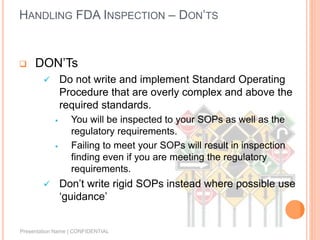
 Do not write and implement Standard Operating
Procedure that are overly complex and above the
required standards.
 You will be inspected to your SOPs as well as the
regulatory requirements.
 Failing to meet your SOPs will result in inspection
finding even if you are meeting the regulatory
requirements.
 Don’t write rigid SOPs instead where possible use
‘guidance’
Presentation Name | CONFIDENTIAL
HANDLING FDA INSPECTION – DON’TS
 DON’Ts
 Don’t try any distraction techniques
 Speak unless spoken to or questions asked
 Attempt to answer “What if?” questions or
hypothetical questions
 Become argumentative or, worse, hostile or make
threatening remarks.
 Engage in arguments with peers in the presence
of inspectors
Presentation Name | CONFIDENTIAL
HANDLING FDA INSPECTION – DON’TS
 DON’Ts
 Don’ts Allow inspectors to go through your files on their
own. Ask them what they want and provide it for them.
 Refuse appropriate requests from inspectors, but try to
narrow the scope of the request when possible
 Do not try to hinder the progress of the Auditor by time
consuming idle conversations, lengthy presentations or
non-relevant alternate agendas
 Don’t waste inspector’s time
 Do not challenge the auditor’s understanding of the
requirements and regulations.
Presentation Name | CONFIDENTIAL
HANDLING FDA INSPECTION – DON’TS
 DON’Ts
 Ask questions to the auditor
 Show off your knowledge.
 Defend your answer by giving reference of
guideline or book
 Get aggressive or be ‘clever’
 Joke with the investigator
 Say that something is impossible or couldn’t
happen. (This is a red flag that challenges the
inspector to find a way it could happen.)
 Chat in places the auditor may be i.e. toilets,
corridors etc.
Presentation Name | CONFIDENTIAL
HANDLING FDA INSPECTION – DON’TS
 DON’Ts
 Correct other people in front of the Inspector
 Do not initial/sign any error in front of the
inspectors
 Interrupt someone else’s answer
 Interrupt the Inspector’s comments and
explanations
 Provide your opinions
 Answer for someone else
Presentation Name | CONFIDENTIAL
HANDLING FDA INSPECTION – DON’TS
 DON’Ts
 Don’t have food in the lab
 Have clutter in your work area
 Quote what the SOP says, unless you’re 200%
certain you know what you’re talking about
 Be intimidated or defensive
 Don’t leave documents out on your desk.
Presentation Name | CONFIDENTIAL
HANDLING FDA INSPECTION – DON’TS
 DON’Ts
 Leave inspectors alone while they are in your plant
 Tell inspectors that records are unavailable. You can say that
you cannot locate the record
 Tell inspectors they are being unreasonable (even when
they are)
 Ask questions such as, “Where does it say we have to do
that?” Their response will likely be “Where does it say that
you don’t?”
 Do not answer questions which lie outside the authority of
the Inspector (sales data, personnel information relating to
salaries, performance reviews, etc)
Presentation Name | CONFIDENTIAL
HANDLING FDA INSPECTION – DON’TS
 DON’Ts
 When reviewing Records
 Point out errors
 Correct errors during the review
 Comment or “apologize” for the quality of the data
 Comment on plans to improve recordkeeping
practices, unless criticized by the Investigator
Presentation Name | CONFIDENTIAL
HANDLING FDA INSPECTION – DON’TS
 Choose your responses correctly “To be
really honest with you ………..” OR “To
tell you the truth ………”
 Unofficially…
 Off the record…
Presentation Name | CONFIDENTIAL
HANDLING FDA INSPECTION – DON’TS
 Be wary of the “Long silence technique”
 Auditor asks you a question
 You answer
 Auditor listens
 Auditor maintains a long silence (purposely)
 You become anxious to break the silence
 You add more to the answers (mostly unwanted!)
 Auditor got enough to grill you!
 Don’t be over anxious to break the silence, answer only to the
point, not a word more
Presentation Name | CONFIDENTIAL
TYPICAL QUESTIONS DURING INSPECTION…
 Question to expect…
 Quality Policy – What it is and how is it applied in the facility
quality system?
 Job responsibility – how do you know what to do on your job?
 Deviations, Investigations, OOS, Complaints – How many in a
quarter or past two years and how do you manage them?
Relevant SOPs.
 Supplier Quality or How vendors are qualified and audited?
 Management Review, Frequency? Agenda? Participants?
 Training – How are employees trained for their job
responsibilities and process for requalifications?
 Laboratory – Instrument qualification, validation and/or
calibration, test method validation
 Data Integrity Policy – how data is secured and ensure accuracy
of it?
Presentation Name | CONFIDENTIAL
MANAGING THE INSPECTION – DAILY WRAP UP
 Daily Wrap up:
 Regroup and try to address the concerns /
comments for the day
 Ask the inspector if there are any open issues for
that day or any concerns not address during the
day
 Confirm they are done with the topic
 Confirm next day start time
 Collect request of documents that they would like
to review next day, so all can be available first
thing next day
Presentation Name | CONFIDENTIAL
MANAGING THE INSPECTION – FINAL CLOSE OUT
 Final Close-out:
 Request a closing meeting – Even it no issues found
 Confirm the date / time with the inspector and invite
management
 This is not the time to argue with the inspector
 Ask questions as needed for any calification of any issues
found or clear understanding of any concerns presented
 Request for final report or list of observation/findings from
the inspectors
 Find out response deadline and next steps…
Presentation Name | CONFIDENTIAL
AFTER INSPECTION / NEXT STEPS
 After Inspection Steps:
 Regroup with internal respective SMEs, and the
management
 Clearly understand any findings or concerns raised by the
inspectors at the close-out
 Initiate discussion on drafting constructive response with
clear timeline and plan for any corrective actions needed
 Submit the response within allowed deadline. Do not wait for
last minute submission.
 Goal is continuous improvement
Presentation Name | CONFIDENTIAL
Be prepared to MANAGE the inspection –
Establish roles and responsibilities before the
inspection – Have the necessary resources to
accommodate the number of inspectors
Presentation Name | CONFIDENTIAL
36
QUESTIONS ?
| CONFIDENTIAL

FDA Inspection Readiness.pptx

  • 1.
  • 2.
    FDA INSPECTION READINESS •Before the inspection • Set up for Inspection (Inspection team / Room setup) • Opening Meeting FDA Readiness Tour of the facility Do’s and Don’t s During the inspection Typical Questions During Inspection Daily wrap-up and Final close-out After the inspection / Next Steps
  • 3.
    FDA INSPECTION READINESS BeforeInspection: Conduct Mock Inspection / Gap Analysis Create CAPA Plan for any Gaps Execute remediation Continuous walk through of the facility / cleanliness of the facility Be pro-active and Be Prepared / Know your job Do not shy away or hide from the process. Have SMEs trained to address inspectors questions
  • 4.
    FDA INSPECTION READINESS Whatwill they look at? Validation, if compliant with CFR Part 11 Computers Appropriately approved and followed / periodical review Procedures Resolved and closed as per internal procedure Complaints Removed from inventory and isolated as per procedure Rejected batches Process / reference standards / method validation / method transfer / raw data Laboratory controls Storage & security / usage / consolidation Labels, Components Testing / QA oversight In-process materials Equipment / E-system / Computer software / Methods / Cleaning Validation processes Testing / Release of the final product Finished/released materials Appropriately assigned / Reviewed and approved Logbooks, records and documents Buildings, equipment, materials, cleaning procedures, HVAC, etc. Overall facility
  • 5.
    FDA INSPECTION READINESS Typical Onsite Inspection Team QualityHead (Host) Scribers (typically 2 – front and back room) Document Controller SMEs for each department Quality control Laboratory Production and packaging Facilities and Warehouse IT Document Runners
  • 6.
    FDA INSPECTION READINESS InspectionFront Room Presentation Name | CONFIDENTIAL Scriber 1 Scriber 2 Quality Head (Host) Auditor 1 Auditor 2 Document Controller Requested Document Files Index cards with Request # Request # Documents Being Reviewed Document Runner
  • 7.
    FDA INSPECTION READINESS InspectionBack Room Presentation Name | CONFIDENTIAL Document Runner to Front Room SMEs Requested Document Files Document Request # Backroom Scriber 1 Backroom Scriber 2 Customer SMEs
  • 8.
    FDA INSPECTION READINESS OpeningMeeting – Short Presentation Introduction of the management, Quality staff and employee present in the room Organizational Chart (Indicate who is the management) Presentation about the facility/layout, plan tour, hour of operations
  • 9.
    FDA INSPECTION READINESS Managingthe inspection… • Control documents provided to the inspector • Keep log of requests and their status… Mark “Confidential” and “Copy” to all copied documents provided • Review the requested record before sending into the room for the investigator. Check that the record is the one asked for. • Send only the record and not the entire file. • Check for any missing signatures or entries or missing pages
  • 10.
    FACILITY TOUR DURINGINSPECTION • Identify key QA and respective department SMEs to escort Inspectors • Escort the inspectors at all times • Tour – flow the material and production process • Incoming materials / warehouse (raw materials, packaging material) • Quarantine / Approve material area • Production (manufacturing to finish goods area) • QC Lab Tour of the facility with Inspectors
  • 11.
    FACILITY TOUR DURINGINSPECTION • Restrict conversations in common areas and/or to the area only being toured • Be prepared to show to which process or relevent SOP for the work performed in the area. • Questions – • Address only if the available information is accurate • Ensure you understand the questions before answering. • Take note of the questions asked or document requested • Take note of any document reviewed by the inspectors • Take note of any employees interviewed during the walkthrough • Always be truthful, if information not available or not known, it’s okay to say “I don’t know, let me find out” Tour of the facility with Tour of the facility with Inspectors (continues)
  • 12.
    HANDLING FDA INSPECTION- DO'S Do’s Be confident Be well dressed and neat. Be presentable Be decent and polite Be courteous and professional at all times Correct all errors/miscommunications as soon as possible
  • 13.
    HANDLING FDA INSPECTION- DO'S Do’s Require that all requests from the inspector go through your inspection team Provide documents in an accurate and timely manner Handle document requests with care, ensure that only requested document is provided Review requested document prior to presenting to the inspector ensure it’s completion Limit the inspector’s access to the records, facilities and materials that are subject to inspection
  • 14.
    HANDLING FDA INSPECTION- DO'S Do’s Check that no undue paper is appended to the record. Ask for clarification when necessary Avoid undue traffic in and out of the room. Remove records which have been reviewed from the room Show one record at one time Have all records organized and available Have all relevant documents/raw data readily accessible – preferably assembled in one central location. Be very familiar with content and location of all reports/data, SOPs etc. Avoid Long delays in responding to questions
  • 15.
    HANDLING FDA INSPECTION- DO'S Do’s Make thorough notes of comments/concerns/ deficiencies pointed out by the inspector. However don’t pass slips / notes to each other. Clarify or attempt to resolve issues as it becomes known. Be cooperative with the investigator to the extent possible, but politely disagree when appropriate Be brief in what you say “no” to any questions Try to Develop a “Relationship”. You know the product and process better than FDA and that needs to be conveyed.
  • 16.
    HANDLING FDA INSPECTION- DO'S When a question is asked… Take a deep breath Listen carefully to the Inspector’s questions Pause and formulate a proper response Answer only after the question is fully stated. Request clarification to questions not understood Answer only what was asked Provide a clear, concise, and honest answer Only answer questions within your job responsibilities otherwise direct the question to “Subject Matter Experts”
  • 17.
    HANDLING FDA INSPECTION- DO'S When a question is asked… Speak slowly and clearly-one word at a time Keep unnecessary conversation to a minimum Answer briefly to the question only Answer only if you are sure. Communicate clearly and effectively Focus on positives
  • 18.
    HANDLING FDA INSPECTION- DO'S  DO’s  Assume a friendly, cooperative attitude - but do not overdo it.  Avoid creating an adversary relationship. Project an attitude of confidence and professionalism.  If management is seen as "uncooperative," the investigator may well become suspicious and more zealous.  Review pertinent plant policies e.g., policies pertaining to cameras, recorders, wearing apparel, and safety equipment during the opening interview Presentation Name | CONFIDENTIAL
  • 19.
    HANDLING FDA INSPECTION- DO'S  DO’s  Acknowledge and document areas that you know need development.  If the inspector is ‘digging’ or asking the same basic question, provide more information as answers may not be complete.  Talk about what is and not what might be or should be.  If a problem has surfaced, point out where GMP and quality system controls have worked and how improvements have been made.  Often, it is appropriate to include a plan for corrective action.  Inspectors wants to see that management is taking these issues seriously. Presentation Name | CONFIDENTIAL
  • 20.
    HANDLING FDA INSPECTION– DON’TS  DON’Ts  Do not try to “Snow” the inspector, wrong information is worse than no information.  Don’t try to control the conversation  Don’t try to lead the inspection  Don’t try to change the agenda  Avoid language using typically, normally, generally, and usually, as possible  Guess, lie, deny the obvious, or make misleading statements  Engage in unconstructive argument. (Avoid win/lose or legalistic confrontations.) Presentation Name | CONFIDENTIAL
  • 21.
    HANDLING FDA INSPECTION– DON’TS  DON’Ts  Do not write and implement Standard Operating Procedure that are overly complex and above the required standards.  You will be inspected to your SOPs as well as the regulatory requirements.  Failing to meet your SOPs will result in inspection finding even if you are meeting the regulatory requirements.  Don’t write rigid SOPs instead where possible use ‘guidance’ Presentation Name | CONFIDENTIAL

  • 22.
    HANDLING FDA INSPECTION– DON’TS  DON’Ts  Don’t try any distraction techniques  Speak unless spoken to or questions asked  Attempt to answer “What if?” questions or hypothetical questions  Become argumentative or, worse, hostile or make threatening remarks.  Engage in arguments with peers in the presence of inspectors Presentation Name | CONFIDENTIAL
  • 23.
    HANDLING FDA INSPECTION– DON’TS  DON’Ts  Don’ts Allow inspectors to go through your files on their own. Ask them what they want and provide it for them.  Refuse appropriate requests from inspectors, but try to narrow the scope of the request when possible  Do not try to hinder the progress of the Auditor by time consuming idle conversations, lengthy presentations or non-relevant alternate agendas  Don’t waste inspector’s time  Do not challenge the auditor’s understanding of the requirements and regulations. Presentation Name | CONFIDENTIAL
  • 24.
    HANDLING FDA INSPECTION– DON’TS  DON’Ts  Ask questions to the auditor  Show off your knowledge.  Defend your answer by giving reference of guideline or book  Get aggressive or be ‘clever’  Joke with the investigator  Say that something is impossible or couldn’t happen. (This is a red flag that challenges the inspector to find a way it could happen.)  Chat in places the auditor may be i.e. toilets, corridors etc. Presentation Name | CONFIDENTIAL
  • 25.
    HANDLING FDA INSPECTION– DON’TS  DON’Ts  Correct other people in front of the Inspector  Do not initial/sign any error in front of the inspectors  Interrupt someone else’s answer  Interrupt the Inspector’s comments and explanations  Provide your opinions  Answer for someone else Presentation Name | CONFIDENTIAL
  • 26.
    HANDLING FDA INSPECTION– DON’TS  DON’Ts  Don’t have food in the lab  Have clutter in your work area  Quote what the SOP says, unless you’re 200% certain you know what you’re talking about  Be intimidated or defensive  Don’t leave documents out on your desk. Presentation Name | CONFIDENTIAL
  • 27.
    HANDLING FDA INSPECTION– DON’TS  DON’Ts  Leave inspectors alone while they are in your plant  Tell inspectors that records are unavailable. You can say that you cannot locate the record  Tell inspectors they are being unreasonable (even when they are)  Ask questions such as, “Where does it say we have to do that?” Their response will likely be “Where does it say that you don’t?”  Do not answer questions which lie outside the authority of the Inspector (sales data, personnel information relating to salaries, performance reviews, etc) Presentation Name | CONFIDENTIAL
  • 28.
    HANDLING FDA INSPECTION– DON’TS  DON’Ts  When reviewing Records  Point out errors  Correct errors during the review  Comment or “apologize” for the quality of the data  Comment on plans to improve recordkeeping practices, unless criticized by the Investigator Presentation Name | CONFIDENTIAL
  • 29.
    HANDLING FDA INSPECTION– DON’TS  Choose your responses correctly “To be really honest with you ………..” OR “To tell you the truth ………”  Unofficially…  Off the record… Presentation Name | CONFIDENTIAL
  • 30.
    HANDLING FDA INSPECTION– DON’TS  Be wary of the “Long silence technique”  Auditor asks you a question  You answer  Auditor listens  Auditor maintains a long silence (purposely)  You become anxious to break the silence  You add more to the answers (mostly unwanted!)  Auditor got enough to grill you!  Don’t be over anxious to break the silence, answer only to the point, not a word more Presentation Name | CONFIDENTIAL
  • 31.
    TYPICAL QUESTIONS DURINGINSPECTION…  Question to expect…  Quality Policy – What it is and how is it applied in the facility quality system?  Job responsibility – how do you know what to do on your job?  Deviations, Investigations, OOS, Complaints – How many in a quarter or past two years and how do you manage them? Relevant SOPs.  Supplier Quality or How vendors are qualified and audited?  Management Review, Frequency? Agenda? Participants?  Training – How are employees trained for their job responsibilities and process for requalifications?  Laboratory – Instrument qualification, validation and/or calibration, test method validation  Data Integrity Policy – how data is secured and ensure accuracy of it? Presentation Name | CONFIDENTIAL
  • 32.
    MANAGING THE INSPECTION– DAILY WRAP UP  Daily Wrap up:  Regroup and try to address the concerns / comments for the day  Ask the inspector if there are any open issues for that day or any concerns not address during the day  Confirm they are done with the topic  Confirm next day start time  Collect request of documents that they would like to review next day, so all can be available first thing next day Presentation Name | CONFIDENTIAL
  • 33.
    MANAGING THE INSPECTION– FINAL CLOSE OUT  Final Close-out:  Request a closing meeting – Even it no issues found  Confirm the date / time with the inspector and invite management  This is not the time to argue with the inspector  Ask questions as needed for any calification of any issues found or clear understanding of any concerns presented  Request for final report or list of observation/findings from the inspectors  Find out response deadline and next steps… Presentation Name | CONFIDENTIAL
  • 34.
    AFTER INSPECTION /NEXT STEPS  After Inspection Steps:  Regroup with internal respective SMEs, and the management  Clearly understand any findings or concerns raised by the inspectors at the close-out  Initiate discussion on drafting constructive response with clear timeline and plan for any corrective actions needed  Submit the response within allowed deadline. Do not wait for last minute submission.  Goal is continuous improvement Presentation Name | CONFIDENTIAL
  • 35.
    Be prepared toMANAGE the inspection – Establish roles and responsibilities before the inspection – Have the necessary resources to accommodate the number of inspectors Presentation Name | CONFIDENTIAL
  • 36.
  • 37.