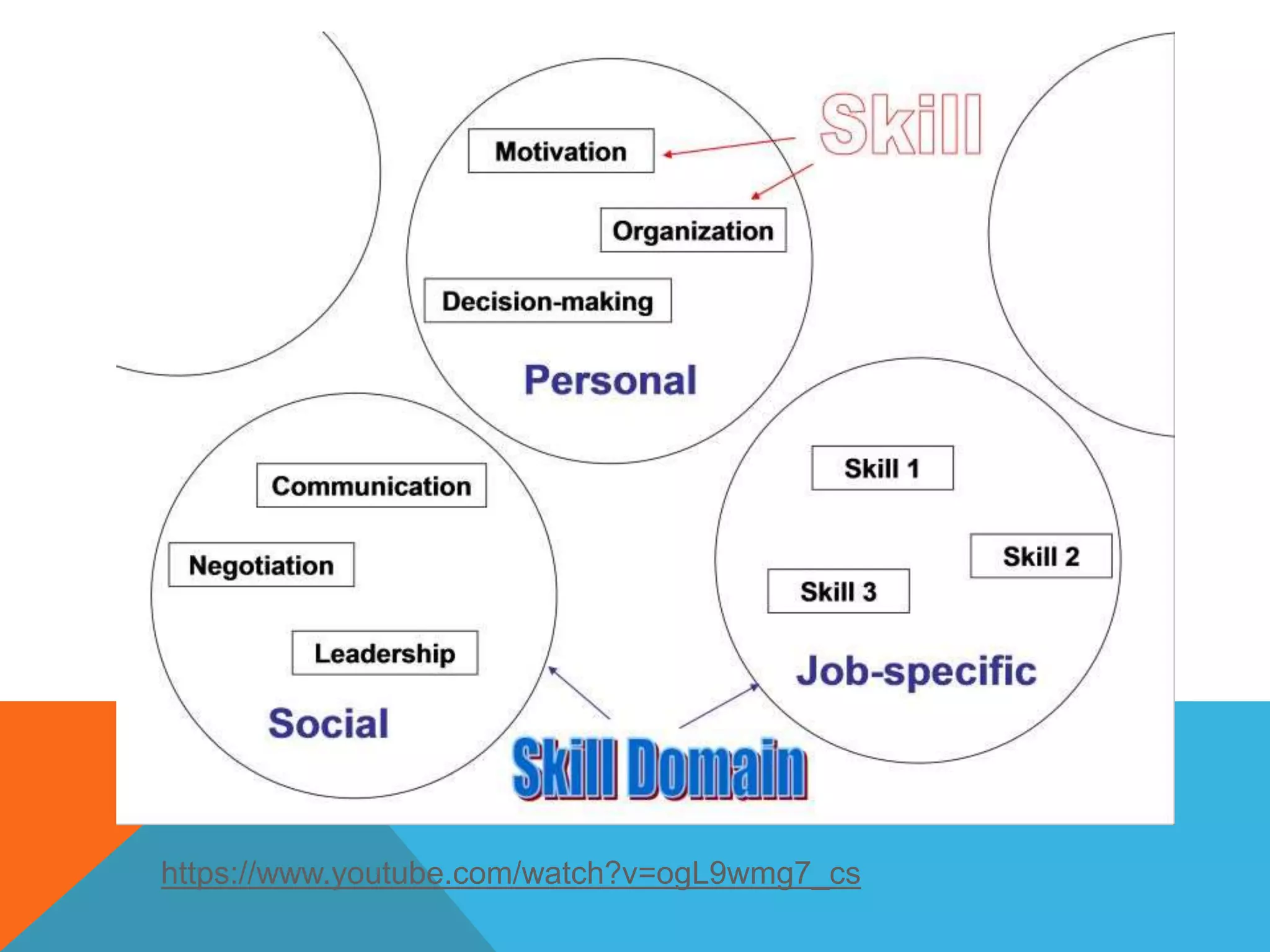
https://www.youtube.com/watch?v=ogL9wmg7_cs
SKILL & HUMAN SKILL
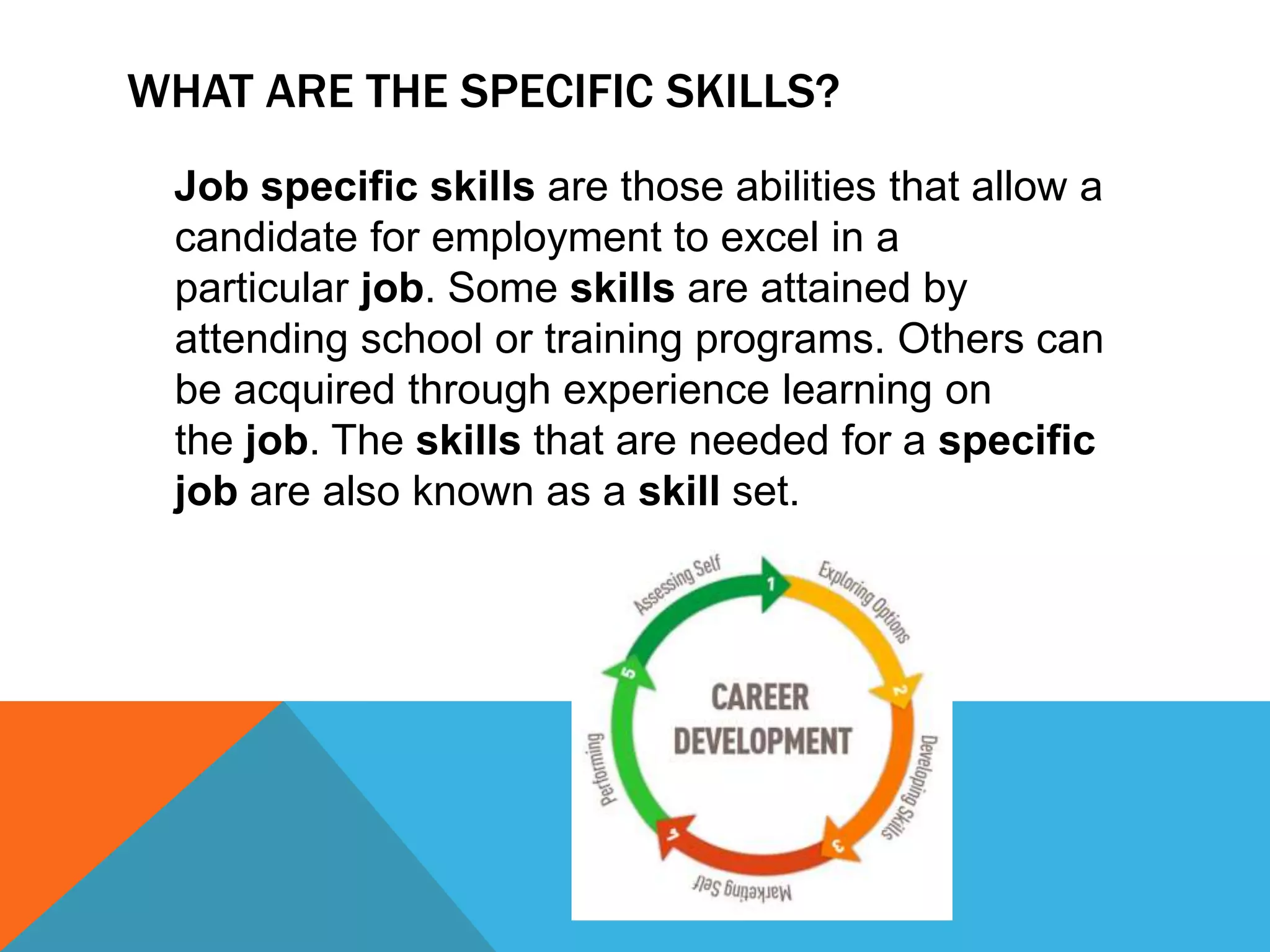
WHAT ARE THE SPECIFIC SKILLS?
Job specific skills are those abilities that allow a
candidate for employment to excel in a
particular job. Some skills are attained by
attending school or training programs. Others can
be acquired through experience learning on
the job. The skills that are needed for a specific
job are also known as a skill set.
WHAT ARE THE DIFFERENT SKILLS?
Generally speaking, there are eight skills that employers want
you to have, no matter what industry you're working in:
Communication.
Teamwork.
Problem solving.
Initiative and enterprise.
Planning and organizing.
Self-management.
Learning.
Technology.
SKILL LIST
Hard Skills List
Word Processing
Computer Programming
Heavy Machinery Operation
Spanish Fluency
Advanced Bookkeeping
Schedule Management
Systems Analysis
Automotive Repair
Environmental Cleanup
Mathematics
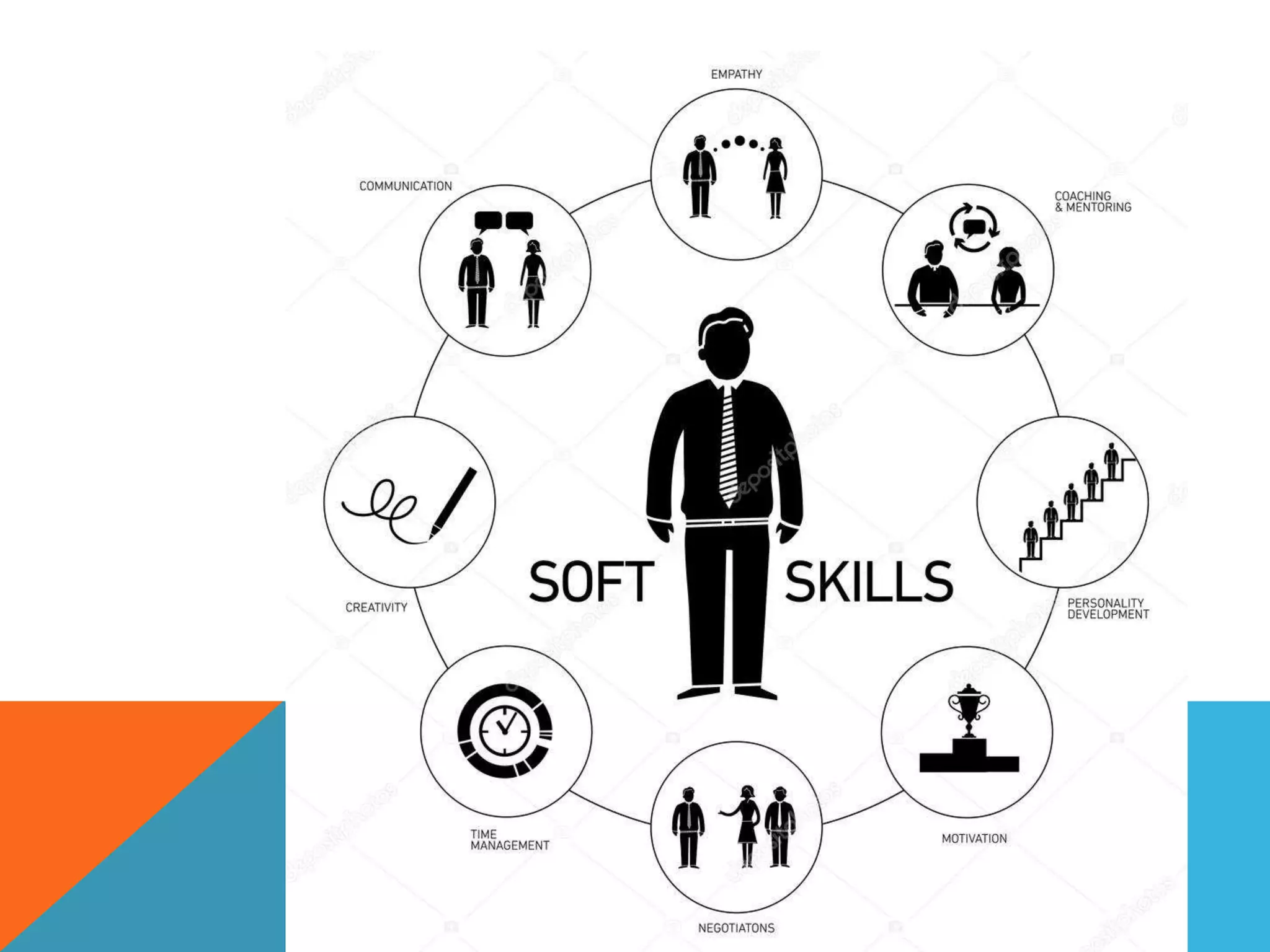
Soft Skills List
Problem Solving
Adaptability
Collaboration
Strong Work Ethic
Time Management
Critical Thinking
Self-Confidence
Handling Pressure
Leadership
Creativity
WHAT ARE SOME EXAMPLES OF
PROFESSIONAL SKILLS?
List of some soft skills to include on a resume. See examples of how to
describe them.
Communication.
Ability to Work Under Pressure.
Decision Making.
Time Management.
Self-motivation.
Conflict Resolution.
Leadership.
Adaptability.
WHAT ARE SOME EXAMPLES OF SKILLS?
Job Skills Examples
Ability to work under pressure.
Accuracy.
Adaptability.
Advising people.
Analyzing data.
Analyzing problems.
Assembling equipment.
Attention to detail.
WHAT ARE SOME PERSONAL SKILLS?
Top Qualities and Skills Employers are Looking For
Communication Skills. ...
Honesty. ...
Technical Competency. ...
Work Ethic. ...
Flexibility. ...
Determination and Persistence. ...
Ability to Work in Harmony with Co-Workers. ...
Eager and Willing to Add to Their Knowledge Base and Skills.
WHAT ARE THE KEY SKILLS?
Key skills are employability skills that you need for
the world of work – and they're pretty important for
life as well! By developing employability skills,
you'll improve your chances of getting a job and
thriving in your career.
WHAT ARE SOME EXAMPLES OF TECHNICAL SKILLS?
Job Searching. Technical skills are the abilities
and knowledge needed to perform specific tasks.
They are practical, and often relate to mechanical,
IT, mathematical, or scientific tasks.
Some examples include knowledge of
programming languages, mechanical equipment, or
tools.
WHAT DO TECHNICAL SKILLS INCLUDE?
Technical skills are abilities an individual acquires
through practice and learning. For example, an
individual who possesses a particular proficiency or
skill set, such as excellent computer coding skills,
is a qualifying candidate for a computer or
technology company.
TAKING THE PROFESSIONAL SKILLS TESTS
Professional skills tests are for aspiring teachers who have submitted an Initial
Teacher Training (ITT) application, in the process of obtaining Qualified
Teacher Status (QTS).
The tests are computerised, though some elements are delivered via audio
headset. You can take the tests up to three times in any 24-month period -
your first attempt is free, but you'll incur a charge for any subsequent resits.
Testing takes place at registered Learndirect centres across the UK and Europe.
You can take the test at any available centre, and broadening the range of
your search means you're more likely to find a time slot that suits you.
Career Pathways and Options
The GPPS Career Pathways and Options workshops offer
graduate students and postdoctoral fellows support and
resources for exploring the versatile career options open to
graduates, discovering and communicating their skills and
expertise, and planning for the future. We offer training and
support tailored to a variety of career paths: the
professoriate, academic administration and staff, business,
entrepreneurship, non-profits, and government.
Knowledge Transfer Strategies
The GPPS Knowledge Transfer Strategies workshops help
graduate students and postdoctoral fellows develop the skills
and knowledge they need to perform effective research and
analysis and to ensure that their research secures funding
and has an impact, whether that’s through teaching,
community engagement, scholarly or popular publication, or
online. We offer resources and workshops on performing and
managing research, applying for scholarships and fellowships,
completing your major graduate degree requirements with the
most success and the minimum level of stress, and translating
your research to students, academic audiences, and the wider
world.
Transferable Professional Skills
The GPPS Transferable Professional Skills
workshops offer intensive or exploratory
workshops on skills which are applicable within the
academic world and its job market, but which are
also highly desirable within the non-academic and
alternative academic job markets. These
workshops focus on skills which may be used to
enhance your research but which may
simultaneously enrich your work in other contexts
and be emphasized with great results on a résumé
as well as on a CV.
Writing Success
The GPPS Writing Success Workshops help you advance
through the writing-based milestones of a graduate degree
and the steps that come after, whether those steps lead to
an academic book contract or a career outside of
academia. Learn tricks and access supports as you work
through dissertation roadblocks, and learn tips for research
organization that will help you in completing your
dissertation and other projects.
Getting Connected On Campus and Beyond
The GPPS Program overall aims to connect you
with people, organizations and resources that will
help you develop your professional plans and goals
and strategically meet those goals. These
workshops will help get you connected, as will this
list of links, groups and resources on campus and
beyond.
The seven essential employability skills
Employability skills are the skills, qualities and attitudes that employers say are
essential for their workplace.
1. Positive attitude
Having a positive attitude is like showing up to your team’s game ready to give
it your best, excited and ready to go even if the chances of winning are low and
it’s going to be hard work.
2. Communication
You have good communication skills if you can listen well, you don’t swear at
work or have a bad attitude, you can ask for what you want clearly and you’re
not afraid to ask if you don’t understand something.
3. Teamwork
Teamwork is just like when you’re playing netball or performing in your band.
You help each other to get what you want, you make sure you do your part, you
get on with everyone and you respect your coach or manager.
4. Self-management
When you manage yourself you are in control of what you do and say in
a way that doesn’t harm yourself or others. You turn up to school or work
on time, in the right clothes and ready to start, and people can rely on
you.
5. Willingness to learn
Willingness to learn is showing that you’re happy to learn new things
and what you need to know to do your job. It also means that when, for
example, your coach says that you need to work on your passes, or your
kapa haka teacher says you need to improve your poi actions, you don’t
get too upset, but take it calmly and try hard to do better.
6. Thinking skills (problem solving and decision making)
Using thinking skills means that if you see a problem, you don’t wait for
someone else, you find a way to fix it. When you make a decision, such
as what to do when you leave school, you think carefully about all your
choices and ask for advice.
7. Resilience
Maybe you’ve worked really hard on that NCEA project and got a Not
Achieved and feel like giving up? Or your family moves to a new town,
away from your friends? Resilience is accepting that life does get hard at
times and does change. It’s about being able to change, ask for help and
keep going.
How do I get these skills?
You will have many of these skills already. The good news is that
these skills can be learned in daily life.
You can develop employability skills by:
doing work experience or volunteer work
playing sport or doing music and performing arts
helping your family
taking part in a hobby or interest
taking part in school activities such as debating, or the Young
Enterprise Scheme
taking part in community activities such as environmental causes or
fundraising
working steadily at school.
Skill Development Policy
Prepared By
N.M. Shamim Hasan
mshasan2009@gmail.com

Professional skill

  • 2.
  • 3.
  • 4.
    WHAT ARE THESPECIFIC SKILLS? Job specific skills are those abilities that allow a candidate for employment to excel in a particular job. Some skills are attained by attending school or training programs. Others can be acquired through experience learning on the job. The skills that are needed for a specific job are also known as a skill set.
  • 5.
    WHAT ARE THEDIFFERENT SKILLS? Generally speaking, there are eight skills that employers want you to have, no matter what industry you're working in: Communication. Teamwork. Problem solving. Initiative and enterprise. Planning and organizing. Self-management. Learning. Technology.
  • 6.
    SKILL LIST Hard SkillsList Word Processing Computer Programming Heavy Machinery Operation Spanish Fluency Advanced Bookkeeping Schedule Management Systems Analysis Automotive Repair Environmental Cleanup Mathematics Soft Skills List Problem Solving Adaptability Collaboration Strong Work Ethic Time Management Critical Thinking Self-Confidence Handling Pressure Leadership Creativity
  • 7.
    WHAT ARE SOMEEXAMPLES OF PROFESSIONAL SKILLS? List of some soft skills to include on a resume. See examples of how to describe them. Communication. Ability to Work Under Pressure. Decision Making. Time Management. Self-motivation. Conflict Resolution. Leadership. Adaptability.
  • 8.
    WHAT ARE SOMEEXAMPLES OF SKILLS? Job Skills Examples Ability to work under pressure. Accuracy. Adaptability. Advising people. Analyzing data. Analyzing problems. Assembling equipment. Attention to detail.
  • 9.
    WHAT ARE SOMEPERSONAL SKILLS? Top Qualities and Skills Employers are Looking For Communication Skills. ... Honesty. ... Technical Competency. ... Work Ethic. ... Flexibility. ... Determination and Persistence. ... Ability to Work in Harmony with Co-Workers. ... Eager and Willing to Add to Their Knowledge Base and Skills.
  • 10.
    WHAT ARE THEKEY SKILLS? Key skills are employability skills that you need for the world of work – and they're pretty important for life as well! By developing employability skills, you'll improve your chances of getting a job and thriving in your career.
  • 11.
    WHAT ARE SOMEEXAMPLES OF TECHNICAL SKILLS? Job Searching. Technical skills are the abilities and knowledge needed to perform specific tasks. They are practical, and often relate to mechanical, IT, mathematical, or scientific tasks. Some examples include knowledge of programming languages, mechanical equipment, or tools.
  • 12.
    WHAT DO TECHNICALSKILLS INCLUDE? Technical skills are abilities an individual acquires through practice and learning. For example, an individual who possesses a particular proficiency or skill set, such as excellent computer coding skills, is a qualifying candidate for a computer or technology company.
  • 13.
    TAKING THE PROFESSIONALSKILLS TESTS Professional skills tests are for aspiring teachers who have submitted an Initial Teacher Training (ITT) application, in the process of obtaining Qualified Teacher Status (QTS). The tests are computerised, though some elements are delivered via audio headset. You can take the tests up to three times in any 24-month period - your first attempt is free, but you'll incur a charge for any subsequent resits. Testing takes place at registered Learndirect centres across the UK and Europe. You can take the test at any available centre, and broadening the range of your search means you're more likely to find a time slot that suits you.
  • 14.
    Career Pathways andOptions The GPPS Career Pathways and Options workshops offer graduate students and postdoctoral fellows support and resources for exploring the versatile career options open to graduates, discovering and communicating their skills and expertise, and planning for the future. We offer training and support tailored to a variety of career paths: the professoriate, academic administration and staff, business, entrepreneurship, non-profits, and government.
  • 15.
    Knowledge Transfer Strategies TheGPPS Knowledge Transfer Strategies workshops help graduate students and postdoctoral fellows develop the skills and knowledge they need to perform effective research and analysis and to ensure that their research secures funding and has an impact, whether that’s through teaching, community engagement, scholarly or popular publication, or online. We offer resources and workshops on performing and managing research, applying for scholarships and fellowships, completing your major graduate degree requirements with the most success and the minimum level of stress, and translating your research to students, academic audiences, and the wider world.
  • 16.
    Transferable Professional Skills TheGPPS Transferable Professional Skills workshops offer intensive or exploratory workshops on skills which are applicable within the academic world and its job market, but which are also highly desirable within the non-academic and alternative academic job markets. These workshops focus on skills which may be used to enhance your research but which may simultaneously enrich your work in other contexts and be emphasized with great results on a résumé as well as on a CV.
  • 17.
    Writing Success The GPPSWriting Success Workshops help you advance through the writing-based milestones of a graduate degree and the steps that come after, whether those steps lead to an academic book contract or a career outside of academia. Learn tricks and access supports as you work through dissertation roadblocks, and learn tips for research organization that will help you in completing your dissertation and other projects.
  • 18.
    Getting Connected OnCampus and Beyond The GPPS Program overall aims to connect you with people, organizations and resources that will help you develop your professional plans and goals and strategically meet those goals. These workshops will help get you connected, as will this list of links, groups and resources on campus and beyond.
  • 20.
    The seven essentialemployability skills Employability skills are the skills, qualities and attitudes that employers say are essential for their workplace. 1. Positive attitude Having a positive attitude is like showing up to your team’s game ready to give it your best, excited and ready to go even if the chances of winning are low and it’s going to be hard work. 2. Communication You have good communication skills if you can listen well, you don’t swear at work or have a bad attitude, you can ask for what you want clearly and you’re not afraid to ask if you don’t understand something. 3. Teamwork Teamwork is just like when you’re playing netball or performing in your band. You help each other to get what you want, you make sure you do your part, you get on with everyone and you respect your coach or manager.
  • 21.
    4. Self-management When youmanage yourself you are in control of what you do and say in a way that doesn’t harm yourself or others. You turn up to school or work on time, in the right clothes and ready to start, and people can rely on you. 5. Willingness to learn Willingness to learn is showing that you’re happy to learn new things and what you need to know to do your job. It also means that when, for example, your coach says that you need to work on your passes, or your kapa haka teacher says you need to improve your poi actions, you don’t get too upset, but take it calmly and try hard to do better. 6. Thinking skills (problem solving and decision making) Using thinking skills means that if you see a problem, you don’t wait for someone else, you find a way to fix it. When you make a decision, such as what to do when you leave school, you think carefully about all your choices and ask for advice. 7. Resilience Maybe you’ve worked really hard on that NCEA project and got a Not Achieved and feel like giving up? Or your family moves to a new town, away from your friends? Resilience is accepting that life does get hard at times and does change. It’s about being able to change, ask for help and keep going.
  • 22.
    How do Iget these skills? You will have many of these skills already. The good news is that these skills can be learned in daily life. You can develop employability skills by: doing work experience or volunteer work playing sport or doing music and performing arts helping your family taking part in a hobby or interest taking part in school activities such as debating, or the Young Enterprise Scheme taking part in community activities such as environmental causes or fundraising working steadily at school.
  • 30.
    Skill Development Policy PreparedBy N.M. Shamim Hasan mshasan2009@gmail.com