

Accurately estimating the effort and time needed to
develop e-Learning is one of the most challenging tasks
that developers must face.
Each project will be unique and this uniqueness will
often create uncertainty.
This information has been compiled to give a general
idea of how much time a project might take to develop
based on complexity of interactivity.
How long does it take to
develop 1 hour of e-Learning?
Rapid
Development,
Simple
Projects
Average
Typical
Project
Advanced,
Complex,
More Media
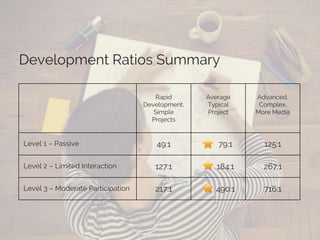
Level 1 – Passive 49:1 79:1 125:1
Level 2 – Limited Interaction 127:1 184:1 267:1
Level 3 – Moderate Participation 217:1 490:1 716:1
Development Ratios Summary
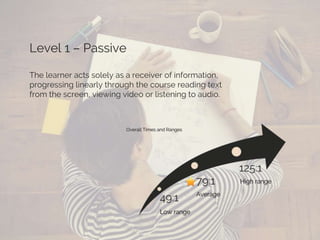
Level 1 – Passive
The learner acts solely as a receiver of information,
progressing linearly through the course reading text
from the screen, viewing video or listening to audio.
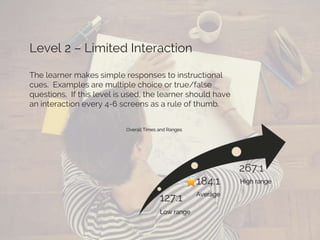
Level 2 – Limited Interaction
The learner makes simple responses to instructional
cues. Examples are multiple choice or true/false
questions. If this level is used, the learner should have
an interaction every 4-6 screens as a rule of thumb.
Level 3 – Moderate Participation
The learner makes a variety of responses using varied
techniques in response to instructional cues. Examples
are assembling a model or diagram from available parts,
drag-and-drop, or answering multiple-choice questions
about realistic scenarios.
the
knowledge
project
http://theknowledgeproject.com.au
Source: Chapman, B. (2010). How Long Does it Take
to Create Learning? [Research Study] Published by
Chapman Alliance LLC. www.chapmanalliance.com

How Long Does it Take to Develop 1 Hour of e-Learning?

  • 1.
    Accurately estimating theeffort and time needed to develop e-Learning is one of the most challenging tasks that developers must face. Each project will be unique and this uniqueness will often create uncertainty. This information has been compiled to give a general idea of how much time a project might take to develop based on complexity of interactivity. How long does it take to develop 1 hour of e-Learning?
  • 2.
    Rapid Development, Simple Projects Average Typical Project Advanced, Complex, More Media Level 1– Passive 49:1 79:1 125:1 Level 2 – Limited Interaction 127:1 184:1 267:1 Level 3 – Moderate Participation 217:1 490:1 716:1 Development Ratios Summary
  • 3.
    Level 1 –Passive The learner acts solely as a receiver of information, progressing linearly through the course reading text from the screen, viewing video or listening to audio.
  • 4.
    Level 2 –Limited Interaction The learner makes simple responses to instructional cues. Examples are multiple choice or true/false questions. If this level is used, the learner should have an interaction every 4-6 screens as a rule of thumb.
  • 5.
    Level 3 –Moderate Participation The learner makes a variety of responses using varied techniques in response to instructional cues. Examples are assembling a model or diagram from available parts, drag-and-drop, or answering multiple-choice questions about realistic scenarios.
  • 6.
    the knowledge project http://theknowledgeproject.com.au Source: Chapman, B.(2010). How Long Does it Take to Create Learning? [Research Study] Published by Chapman Alliance LLC. www.chapmanalliance.com