FACILITATORTRAINING PROGRAM
MarchellaChristian | University of Phoenix
Professor Danene Mims- CUR/532
Synchronous 3-Day Model
This is a training program for distance learning facilitator trainees
without previous experience in distance education.
(mdy2.tistory.com)
Introduction:
Hi my name is MarchellaChristian! I will be the host of this 3 day training that is
design for participants that do not have experience in distance education.This training
will empower you to become effective distance learning facilitators. If you need to contact me
feel free to contact via:
marchellac@email.phoenix.edu (University of Phoenix)
wrightmarchella@yahoo.com (Personal)
770-885-6296 (EST)
(soft9000.com)
(safelifting.wikispaces.com)
PART 1-Vital Information in the FacilitatorTraining
Training program audience:
Novice with no experience in the traditional
classroom environment; knowledge about
adult learning theories, assessment course
design, evaluation and basic instructional skills.
Current skill set:
Participants is proficient using computer, for email,
Word processing and printing.
(my-ecoach.com)
Current experiences:
The participants has some teaching experience, but not online.
Current knowledge:
They are high school graduates and some are college graduates with
Bachelors' and Masters Degrees.
(www.paralegalalliance.com)
Training Programs Goals
 Develop competent online facilitators
 Provide instruction on how to become effective within the learning community
 Establish Online Presence
 Communicate effectively within the online community
 Time management
(4teens11.blogspot.com)
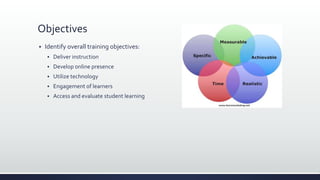
Objectives
 Identify overall training objectives:
 Deliver instruction
 Develop online presence
 Utilize technology
 Engagement of learners
 Access and evaluate student learning
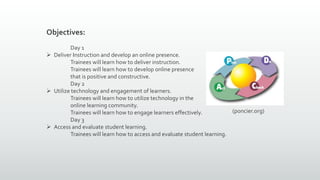
Objectives:
Day 1
 Deliver Instruction and develop an online presence.
Trainees will learn how to deliver instruction.
Trainees will learn how to develop online presence
that is positive and constructive.
Day 2
 Utilize technology and engagement of learners.
Trainees will learn how to utilize technology in the
online learning community.
Trainees will learn how to engage learners effectively.
Day 3
 Access and evaluate student learning.
Trainees will learn how to access and evaluate student learning.
(poncier.org)
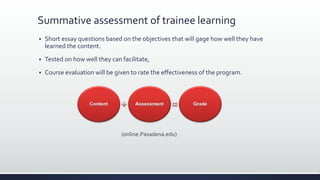
Summative assessment of trainee learning
 Short essay questions based on the objectives that will gage how well they have
learned the content.
 Tested on how well they can facilitate,
 Course evaluation will be given to rate the effectiveness of the program.
(online.Pasadena.edu)
Part II-Facilitator Skills and Instructional Materials
Training Materials-
Skills needed to create effective distance learning:
 Accessibility
 Mobility
 Interactivity
 Measurement
 Communication
(www.remansodepaz.es)
strategies
Accessibility-The most important key is that content must be accessible for everyone.
It is determined by what platform is being used to deliver the training.The easier it is
to access the content the more effective the training program will be.
Mobility-the material should be accessed from any device. For effective mobile-friendly
Training content it should be presented in short segments;
Straightforward topics that create challenges for learners (Cournoyer, 2012).
Interactivity-Is to use elements to keep the learners engaged, and action
from the learner is require. Include questions that promote a sense
of community among learners (Cournoyer, 2012).
Measurement-This is to monitor and track the performance of the program by
using real—time data using analytics. It is to identify the success
of the content and areas that needs clarification or improvement.
Communication is vital and a connection between students and instructor.
This is an avenue used to encourage and motivate students as well as
give constructive feedback with positive reinforcement.
(Monsieurdoh.tistory.com)
Phases of Development
Visitor –One who may posted assignments or use email for assignment completion
Novice-One that has no teaching or student experience online; has used technology
to communicate and supplement face to face teaching
Apprentice-Faculty that has taught online for one or two terms.This stage gives an
understanding of the online environment and the skills that is required to
teach online.
Insider-Faculty that has taught more then two semesters and more than one course
online.This stage the faculty is comfortable working online, proficient with
course management technology and a basic understanding of the skills that
is required for online teaching. And has designed one or more online courses.
Master-Faculty has taught multiple terms online; has designed several courses online;
expert with technology and integrated it into their teaching. In this stage they
are very comfortable in their role as an online facilitator; called to be mentors
and support for new online faculty.
(2012books.lardbucket.org)
Theories of Distance Learning
“Theory help us bear our ignorance of facts (G. Santayana-The Sense of Beauty)”
Transformation
Framing
Emergence
Transactional Distance
Multimodality
Theories of Distance Learning continue:
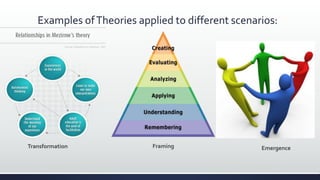
 Transformation is considered the hallmark of learning in which a change in understanding
occurs that transforms cognition from an initial state to a modified state (Haythornthwaite & Andrews, 2011)
 Framing is a concept that turns our attention to the complex knowledge, past experience, mindset,
and mental construct of the scope and borders of an endeavor, that characterizes what we, or our learners
bring into the learning experience (Haythornthwaite & Andrews, 2011).
 Emergence is the way learning and knowledge construction are happening continuously from the
Interplay of elements in the environment we operate in the meaning, interpretation and actions that
Individually and collectively add to the communal frame. It also promote attention to the way learning
encompasses many aspects of personal, professional, social and societal growth (Haythornthwaite & Andrews, 2011).
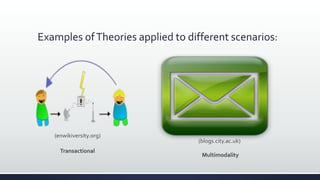
 Transactional Distance Learning consists of three variables that operate in relation to the degree of
transactional distance between the teachers and learners: dialogue, program structure and learner
autonomy (Haythornthwaite & Andrews, 2011).
 Multimodality is a theory of e-learning of contemporary communication which is highly relevant because most
e-learning communication is via computer interface and they are multimodal in nature (Haythornwaite & Andrews, 2011).
Examples ofTheories applied to different scenarios:
Transformation Framing Emergence
Examples ofTheories applied to different scenarios:
(enwikiversity.org)
(blogs.city.ac.uk)
Transactional
Multimodality
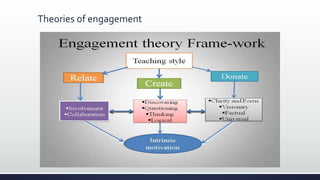
Theories of engagement
The underlying basis of The Engagement Theory is that students should be meaningfully involved in
their learning through interactive and worthwhile tasks.
Although the use of technology is not imperative, it is found that technology can promote engagement
that is difficult to achieve otherwise (Kearsley & Shneiderman, 1998).
The EngagementTheory Promotes:
1) working collaboratively
2) project based learning
3) have an authentic focus
(www.redesigmarketing.com)
Theories of engagement
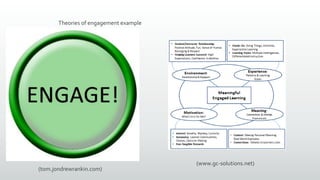
Theories of engagement example
(tom.jondrewrankin.com)
(www.gc-solutions.net)
Part III-Management andTechnologyTools
 Mentoring program for faculty:
 Goals and objectives of the mentoring program
 Identification criteria
 The performance status of the mentor current standing
 Experience with distance education
(manuelgross.bligoo.com)
Mentoring Goals :
 Improve instructor performance
 Enhance student satisfaction
 Identify professional development needs
 Aid accreditation
 Assessment needs
Objectives:
Formative:
preterm and weekly checklists
phone and email dialogue
Summative:
summary review instructor’s
progress after end of term
(www.eoi.es)
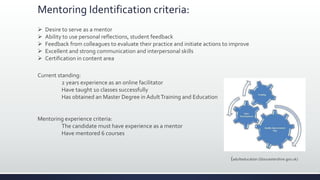
Mentoring Identification criteria:
 Desire to serve as a mentor
 Ability to use personal reflections, student feedback
 Feedback from colleagues to evaluate their practice and initiate actions to improve
 Excellent and strong communication and interpersonal skills
 Certification in content area
Current standing:
2 years experience as an online facilitator
Have taught 10 classes successfully
Has obtained an Master Degree in AdultTraining and Education
Mentoring experience criteria:
The candidate must have experience as a mentor
Have mentored 6 courses
(adulteducation.Gloucestershire.gov.uk)
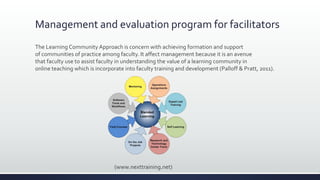
Management and evaluation program for facilitators
The Learning Community Approach is concern with achieving formation and support
of communities of practice among faculty. It affect management because it is an avenue
that faculty use to assist faculty in understanding the value of a learning community in
online teaching which is incorporate into faculty training and development (Palloff & Pratt, 2011).
(www.nexttraining.net)
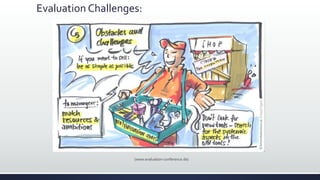
Evaluation Challenges:
(www.evaluation-conference.de)
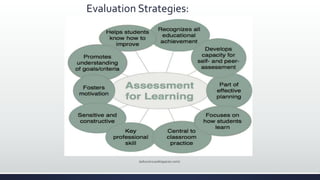
Evaluation Strategies:
(educon21wikispaces.com)
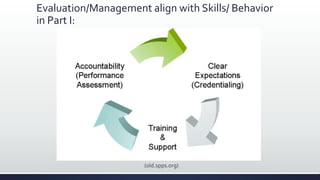
Evaluation/Management align with Skills/ Behavior
in Part I:
(old.spps.org)
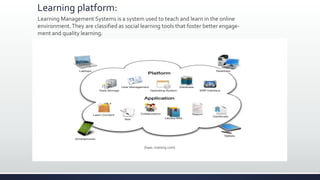
Learning platform:
Learning Management Systems is a system used to teach and learn in the online
environment.They are classified as social learning tools that foster better engage-
ment and quality learning.
(haas.-training.com)
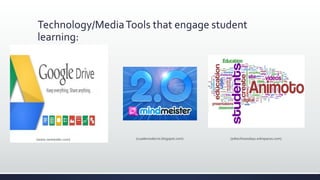
Technology/MediaTools that engage student
learning:
(www.nextwider.com) (edtechtuesdays.wikispaces.com)(cuademodecris.blogspot.com)
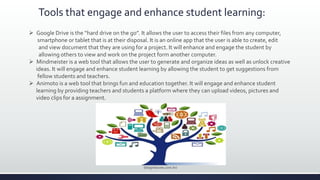
Tools that engage and enhance student learning:
 Google Drive is the “hard drive on the go”. It allows the user to access their files from any computer,
smartphone or tablet that is at their disposal. It is an online app that the user is able to create, edit
and view document that they are using for a project. It will enhance and engage the student by
allowing others to view and work on the project form another computer.
 Mindmeister is a web tool that allows the user to generate and organize ideas as well as unlock creative
ideas. It will engage and enhance student learning by allowing the student to get suggestions from
fellow students and teachers.
 Animoto is a web tool that brings fun and education together. It will engage and enhance student
learning by providing teachers and students a platform where they can upload videos, pictures and
video clips for a assignment.
(blogrelacoes.com.br)
Part IV-Issues and Classroom Management
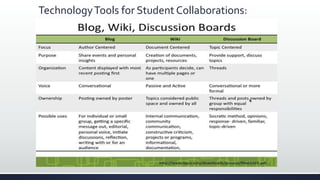
TechnologyTools for Student Collaborations:
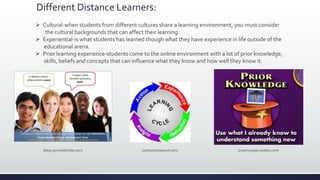
Different Distance Learners:
 Cultural-when students from different cultures share a learning environment, you must consider
the cultural backgrounds that can affect their learning.
 Experiential-is what students has learned though what they have experience in life outside of the
educational arena.
 Prior learning experience-students come to the online environment with a lot of prior knowledge,
skills, beliefs and concepts that can influence what they know and how well they know it.
(blog.commlabindia.com) (acktionoutbound.com) (coachvargas.weebly.com)
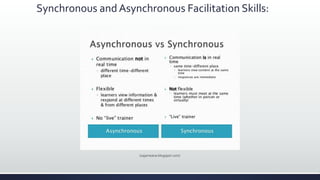
Synchronous and Asynchronous Facilitation Skills:
(sajameana.blogspot.com)
Technology and Classroom management issues
and resolutions:
 Website has technical difficulties on PC-Solution is to have a backup plan. Another computer, laptop or iPad
to do the assignment or answer discussion questions.
 If not able to post assignment within the LMS. Reach out to facilitator in the private chatroom and inform
him/her about the situation and call tech support and get a reference number.
 If a file is lost or deleted-check the Recycle Bin and if it is there click to restore. It is not there then do a seach
and type in the file name within the network; this should locate the file.
 Learner feedback-
 Message-Solution is to give positive and constructive feedback to encourage learner within
within the discussion forum. If you need to give a suggestion or pointer use the private chatroom.
 Comments-Solution is to use comments that will help the learner as well as motivate the learner.
 Audio-Solution is to be polite if using audio and respectful.
Challenging behaviors
 Cyber-bullying-Solution is to set expectations in regards to appropriate participation and online
behaviors.
 Inappropriate posts-Solution is to stay involved, monitor course discussions and content during
the week.When issues arises deal with them quickly.
 Lack of participation or engagement-Solution is to reach out to learner by phone, email or private
forum. Give encouragement and be supportive.
References:
Cournoyer, B. (2012) FiveTips for Effective Distance Learning. Retrieved from: http://www.clomedia.com/
Haythornthwaite, C. & Andrews, R. (2011). E-LearningTheory and Practice, 1e. Los Angeles,Ca. Sage
Kearsley, G. & Shneiderman, B. (1998). EngagementTheory: A Framework forTechnology-Based
Teaching and Learning. EducationalTechnology , v38 n5, p20-23
Palloff, R. M., & Pratt, K. (2011). The Excellent Online Instructor. Strategies for Professional Development.
John Wiley & Sons

Facilitator training program

  • 1.
    FACILITATORTRAINING PROGRAM MarchellaChristian |University of Phoenix Professor Danene Mims- CUR/532
  • 2.
    Synchronous 3-Day Model Thisis a training program for distance learning facilitator trainees without previous experience in distance education. (mdy2.tistory.com)
  • 3.
    Introduction: Hi my nameis MarchellaChristian! I will be the host of this 3 day training that is design for participants that do not have experience in distance education.This training will empower you to become effective distance learning facilitators. If you need to contact me feel free to contact via: marchellac@email.phoenix.edu (University of Phoenix) wrightmarchella@yahoo.com (Personal) 770-885-6296 (EST) (soft9000.com) (safelifting.wikispaces.com)
  • 4.
    PART 1-Vital Informationin the FacilitatorTraining Training program audience: Novice with no experience in the traditional classroom environment; knowledge about adult learning theories, assessment course design, evaluation and basic instructional skills. Current skill set: Participants is proficient using computer, for email, Word processing and printing. (my-ecoach.com)
  • 5.
    Current experiences: The participantshas some teaching experience, but not online. Current knowledge: They are high school graduates and some are college graduates with Bachelors' and Masters Degrees. (www.paralegalalliance.com)
  • 6.
    Training Programs Goals Develop competent online facilitators  Provide instruction on how to become effective within the learning community  Establish Online Presence  Communicate effectively within the online community  Time management (4teens11.blogspot.com)
  • 7.
    Objectives  Identify overalltraining objectives:  Deliver instruction  Develop online presence  Utilize technology  Engagement of learners  Access and evaluate student learning
  • 8.
    Objectives: Day 1  DeliverInstruction and develop an online presence. Trainees will learn how to deliver instruction. Trainees will learn how to develop online presence that is positive and constructive. Day 2  Utilize technology and engagement of learners. Trainees will learn how to utilize technology in the online learning community. Trainees will learn how to engage learners effectively. Day 3  Access and evaluate student learning. Trainees will learn how to access and evaluate student learning. (poncier.org)
  • 9.
    Summative assessment oftrainee learning  Short essay questions based on the objectives that will gage how well they have learned the content.  Tested on how well they can facilitate,  Course evaluation will be given to rate the effectiveness of the program. (online.Pasadena.edu)
  • 10.
    Part II-Facilitator Skillsand Instructional Materials Training Materials- Skills needed to create effective distance learning:  Accessibility  Mobility  Interactivity  Measurement  Communication (www.remansodepaz.es)
  • 11.
    strategies Accessibility-The most importantkey is that content must be accessible for everyone. It is determined by what platform is being used to deliver the training.The easier it is to access the content the more effective the training program will be. Mobility-the material should be accessed from any device. For effective mobile-friendly Training content it should be presented in short segments; Straightforward topics that create challenges for learners (Cournoyer, 2012). Interactivity-Is to use elements to keep the learners engaged, and action from the learner is require. Include questions that promote a sense of community among learners (Cournoyer, 2012). Measurement-This is to monitor and track the performance of the program by using real—time data using analytics. It is to identify the success of the content and areas that needs clarification or improvement. Communication is vital and a connection between students and instructor. This is an avenue used to encourage and motivate students as well as give constructive feedback with positive reinforcement. (Monsieurdoh.tistory.com)
  • 12.
    Phases of Development Visitor–One who may posted assignments or use email for assignment completion Novice-One that has no teaching or student experience online; has used technology to communicate and supplement face to face teaching Apprentice-Faculty that has taught online for one or two terms.This stage gives an understanding of the online environment and the skills that is required to teach online. Insider-Faculty that has taught more then two semesters and more than one course online.This stage the faculty is comfortable working online, proficient with course management technology and a basic understanding of the skills that is required for online teaching. And has designed one or more online courses. Master-Faculty has taught multiple terms online; has designed several courses online; expert with technology and integrated it into their teaching. In this stage they are very comfortable in their role as an online facilitator; called to be mentors and support for new online faculty. (2012books.lardbucket.org)
  • 13.
    Theories of DistanceLearning “Theory help us bear our ignorance of facts (G. Santayana-The Sense of Beauty)” Transformation Framing Emergence Transactional Distance Multimodality
  • 14.
    Theories of DistanceLearning continue:  Transformation is considered the hallmark of learning in which a change in understanding occurs that transforms cognition from an initial state to a modified state (Haythornthwaite & Andrews, 2011)  Framing is a concept that turns our attention to the complex knowledge, past experience, mindset, and mental construct of the scope and borders of an endeavor, that characterizes what we, or our learners bring into the learning experience (Haythornthwaite & Andrews, 2011).  Emergence is the way learning and knowledge construction are happening continuously from the Interplay of elements in the environment we operate in the meaning, interpretation and actions that Individually and collectively add to the communal frame. It also promote attention to the way learning encompasses many aspects of personal, professional, social and societal growth (Haythornthwaite & Andrews, 2011).  Transactional Distance Learning consists of three variables that operate in relation to the degree of transactional distance between the teachers and learners: dialogue, program structure and learner autonomy (Haythornthwaite & Andrews, 2011).  Multimodality is a theory of e-learning of contemporary communication which is highly relevant because most e-learning communication is via computer interface and they are multimodal in nature (Haythornwaite & Andrews, 2011).
  • 15.
    Examples ofTheories appliedto different scenarios: Transformation Framing Emergence
  • 16.
    Examples ofTheories appliedto different scenarios: (enwikiversity.org) (blogs.city.ac.uk) Transactional Multimodality
  • 17.
    Theories of engagement Theunderlying basis of The Engagement Theory is that students should be meaningfully involved in their learning through interactive and worthwhile tasks. Although the use of technology is not imperative, it is found that technology can promote engagement that is difficult to achieve otherwise (Kearsley & Shneiderman, 1998). The EngagementTheory Promotes: 1) working collaboratively 2) project based learning 3) have an authentic focus (www.redesigmarketing.com)
  • 18.
  • 19.
    Theories of engagementexample (tom.jondrewrankin.com) (www.gc-solutions.net)
  • 20.
    Part III-Management andTechnologyTools Mentoring program for faculty:  Goals and objectives of the mentoring program  Identification criteria  The performance status of the mentor current standing  Experience with distance education (manuelgross.bligoo.com)
  • 21.
    Mentoring Goals : Improve instructor performance  Enhance student satisfaction  Identify professional development needs  Aid accreditation  Assessment needs Objectives: Formative: preterm and weekly checklists phone and email dialogue Summative: summary review instructor’s progress after end of term (www.eoi.es)
  • 22.
    Mentoring Identification criteria: Desire to serve as a mentor  Ability to use personal reflections, student feedback  Feedback from colleagues to evaluate their practice and initiate actions to improve  Excellent and strong communication and interpersonal skills  Certification in content area Current standing: 2 years experience as an online facilitator Have taught 10 classes successfully Has obtained an Master Degree in AdultTraining and Education Mentoring experience criteria: The candidate must have experience as a mentor Have mentored 6 courses (adulteducation.Gloucestershire.gov.uk)
  • 23.
    Management and evaluationprogram for facilitators The Learning Community Approach is concern with achieving formation and support of communities of practice among faculty. It affect management because it is an avenue that faculty use to assist faculty in understanding the value of a learning community in online teaching which is incorporate into faculty training and development (Palloff & Pratt, 2011). (www.nexttraining.net)
  • 24.
  • 25.
  • 26.
    Evaluation/Management align withSkills/ Behavior in Part I: (old.spps.org)
  • 27.
    Learning platform: Learning ManagementSystems is a system used to teach and learn in the online environment.They are classified as social learning tools that foster better engage- ment and quality learning. (haas.-training.com)
  • 28.
    Technology/MediaTools that engagestudent learning: (www.nextwider.com) (edtechtuesdays.wikispaces.com)(cuademodecris.blogspot.com)
  • 29.
    Tools that engageand enhance student learning:  Google Drive is the “hard drive on the go”. It allows the user to access their files from any computer, smartphone or tablet that is at their disposal. It is an online app that the user is able to create, edit and view document that they are using for a project. It will enhance and engage the student by allowing others to view and work on the project form another computer.  Mindmeister is a web tool that allows the user to generate and organize ideas as well as unlock creative ideas. It will engage and enhance student learning by allowing the student to get suggestions from fellow students and teachers.  Animoto is a web tool that brings fun and education together. It will engage and enhance student learning by providing teachers and students a platform where they can upload videos, pictures and video clips for a assignment. (blogrelacoes.com.br)
  • 30.
    Part IV-Issues andClassroom Management
  • 31.
  • 32.
    Different Distance Learners: Cultural-when students from different cultures share a learning environment, you must consider the cultural backgrounds that can affect their learning.  Experiential-is what students has learned though what they have experience in life outside of the educational arena.  Prior learning experience-students come to the online environment with a lot of prior knowledge, skills, beliefs and concepts that can influence what they know and how well they know it. (blog.commlabindia.com) (acktionoutbound.com) (coachvargas.weebly.com)
  • 33.
    Synchronous and AsynchronousFacilitation Skills: (sajameana.blogspot.com)
  • 34.
    Technology and Classroommanagement issues and resolutions:  Website has technical difficulties on PC-Solution is to have a backup plan. Another computer, laptop or iPad to do the assignment or answer discussion questions.  If not able to post assignment within the LMS. Reach out to facilitator in the private chatroom and inform him/her about the situation and call tech support and get a reference number.  If a file is lost or deleted-check the Recycle Bin and if it is there click to restore. It is not there then do a seach and type in the file name within the network; this should locate the file.  Learner feedback-  Message-Solution is to give positive and constructive feedback to encourage learner within within the discussion forum. If you need to give a suggestion or pointer use the private chatroom.  Comments-Solution is to use comments that will help the learner as well as motivate the learner.  Audio-Solution is to be polite if using audio and respectful. Challenging behaviors  Cyber-bullying-Solution is to set expectations in regards to appropriate participation and online behaviors.  Inappropriate posts-Solution is to stay involved, monitor course discussions and content during the week.When issues arises deal with them quickly.  Lack of participation or engagement-Solution is to reach out to learner by phone, email or private forum. Give encouragement and be supportive.
  • 35.
    References: Cournoyer, B. (2012)FiveTips for Effective Distance Learning. Retrieved from: http://www.clomedia.com/ Haythornthwaite, C. & Andrews, R. (2011). E-LearningTheory and Practice, 1e. Los Angeles,Ca. Sage Kearsley, G. & Shneiderman, B. (1998). EngagementTheory: A Framework forTechnology-Based Teaching and Learning. EducationalTechnology , v38 n5, p20-23 Palloff, R. M., & Pratt, K. (2011). The Excellent Online Instructor. Strategies for Professional Development. John Wiley & Sons

Editor's Notes

  • #7 May require more than one slide