How Long Does it Take to Create
Learning?
A Chapman Alliance, Research Study
By Bryan Chapman, Chief Learning Strategist
bryan@chapmanalliance.com
www.chapmanalliance.com
Abstract: Several years ago, I published some learning development metrics from several
different studies that included ratios for how long it takes to create different types of
learning. The information has been widely used and appears frequently throughout the
Blogosphere. Recently, we have been receiving many requests to update this data, so
Chapman Alliance created a survey to collect usable metrics that will help you benchmark
your own learning development times. This time, all of the results were collected from a
single audience (249 completed surveys) across several learning formats including instructor
–led training (ILT), Level 1 e-Learning (Basic), Level 2 e-learning (Interactive), Level 3 e-
learning (Advanced), and information about blended learning. The results are contained in
this deck.
Now, the good news… You are welcome to share this research with anyone you’d like.
Because we feel that this information is so important to the industry, we have released it
under Creative Commons, meaning that you can share the whole deck or pull-out
slides/charts and add them to your presentations, white papers, conference presentations,
etc. The only restrictions are (1) you must ALWAYS list the source of information as
“Chapman Alliance” and (2) you are NOT allowed to sell the results without written
permission from Chapman Alliance. That’s it. Enjoy!
Source Citation: Chapman, B. (2010). How Long Does it Take to Create Learning? [Research
Study]. Published by Chapman Alliance LLC. www.chapmanalliance.com
Survey Demographics
Thanks to all of you who took time to complete the survey!
If you would like to participate in future research surveys from Chapman Alliance, please join our list at
www.chapmanalliance.com/join-our-mailing-list
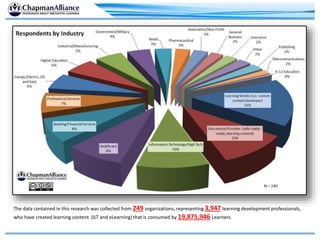
The data contained in this research was collected from 249 organizations, representing 3,947 learning development professionals,
who have created learning content (ILT and eLearning) that is consumed by 19,875,946 Learners.
Instructor-Led Training (ILT)
Development Benchmark
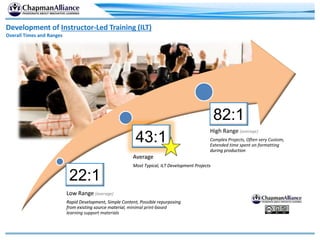
Low Range (average)
Rapid Development, Simple Content, Possible repurposing
from existing source material
Average
Most Typical, ILT Development Projects
High Range (average)
Complex Projects, Often very Custom,
Extended time spent on formatting
during production
Development of Instructor-Led Training (ILT)
Overall Times and Ranges
Low Range (average)
Rapid Development, Simple Content, Possible repurposing
from existing source material, minimal print-based
learning support materials
Average
Most Typical, ILT Development Projects
High Range (average)
Complex Projects, Often very Custom,
Extended time spent on formatting
during production
Development of Instructor-Led Training (ILT)
Overall Times and Ranges
43:1
82:1
22:1
Development of Instructor-Led Training (ILT)
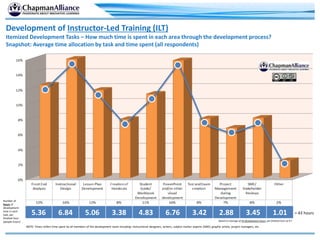
Itemized Development Tasks – How much time is spent in each area through the development process?
Snapshot: Average time allocation by task and time spent (all respondents)
Number of
hours of
development
time in each
task, per
finished hour
(people hours)
5.36 6.84 5.06 3.38 4.83 6.76 3.42 2.88 3.45 1.01
Based on average of 43 development hours, per finished hour of ILT
= 43 hours
NOTE: Times reflect time spent by all members of the development team including: instructional designers, writers, subject matter experts (SME), graphic artists, project managers, etc.
Development of Instructor-Led Training (ILT)
How much are organizations spending, on average, per-finished-hour, to create instructor-led training (internally)?
$5,934
We asked respondents:
List (if known) your
average, internal cost for
creating 1 finished hour
of ILT.
The cost shown is the average
Development of Instructor-Led Training (ILT)
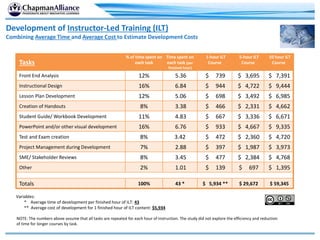
Combining Average Time and Average Cost to Estimate Development Costs
NOTE: The numbers above assume that all tasks are repeated for each hour of instruction. The study did not explore the efficiency and reduction
of time for longer courses by task.
Tasks
% of time spent on
each task
Time spent on
each task (per
finished hour)
1-hour ILT
Course
5-hour ILT
Course
10 hour ILT
Course
Front End Analysis 12% 5.36 $ 739 $ 3,695 $ 7,391
Instructional Design 16% 6.84 $ 944 $ 4,722 $ 9,444
Lesson Plan Development 12% 5.06 $ 698 $ 3,492 $ 6,985
Creation of Handouts 8% 3.38 $ 466 $ 2,331 $ 4,662
Student Guide/ Workbook Development 11% 4.83 $ 667 $ 3,336 $ 6,671
PowerPoint and/or other visual development 16% 6.76 $ 933 $ 4,667 $ 9,335
Test and Exam creation 8% 3.42 $ 472 $ 2,360 $ 4,720
Project Management during Development 7% 2.88 $ 397 $ 1,987 $ 3,973
SME/ Stakeholder Reviews 8% 3.45 $ 477 $ 2,384 $ 4,768
Other 2% 1.01 $ 139 $ 697 $ 1,395
Totals 100% 43 * $ 5,934 ** $ 29,672 $ 59,345
Variables:
* Average time of development per finished hour of ILT: 43
** Average cost of development for 1 finished hour of ILT content: $5,934
Level 1 - eLearning
Development Benchmark
Development of Level 1 - eLearning
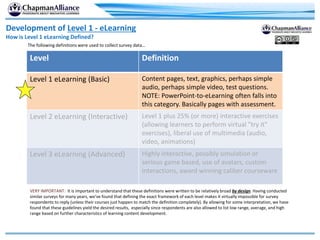
How is Level 1 eLearning Defined?
Level Definition
Level 1 eLearning (Basic) Content pages, text, graphics, perhaps simple
audio, perhaps simple video, test questions.
NOTE: PowerPoint-to-eLearning often falls into
this category. Basically pages with assessment.
Level 2 eLearning (Interactive) Level 1 plus 25% (or more) interactive exercises
(allowing learners to perform virtual "try it"
exercises), liberal use of multimedia (audio,
video, animations)
Level 3 eLearning (Advanced) Highly interactive, possibly simulation or
serious game based, use of avatars, custom
interactions, award winning caliber courseware
The following definitions were used to collect survey data…
VERY IMPORTANT: It is important to understand that these definitions were written to be relatively broad by design. Having conducted
similar surveys for many years, we’ve found that defining the exact framework of each level makes it virtually impossible for survey
respondents to reply (unless their courses just happen to match the definition completely). By allowing for some interpretation, we have
found that these guidelines yield the desired results, especially since respondents are also allowed to list low range, average, and high
range based on further characteristics of learning content development.
Development of Level 1 - eLearning
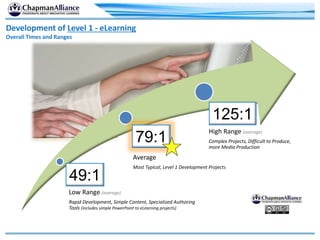
Overall Times and Ranges
Low Range (average)
Rapid Development, Simple Content, Specialized Authoring
Tools (includes simple PowerPoint to eLearning projects)
Average
Most Typical, Level 1 Development Projects
High Range (average)
Complex Projects, Difficult to Produce,
more Media Production
79:1
125:1
49:1
Development of Level 1 eLearning
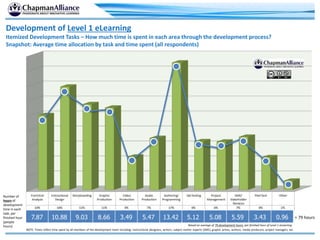
Itemized Development Tasks – How much time is spent in each area through the development process?
Snapshot: Average time allocation by task and time spent (all respondents)
Number of
hours of
development
time in each
task, per
finished hour
(people
hours) Based on average of 79 development hours, per finished hour of Level 1 eLearning
= 79 hours7.87 10.88 9.03 8.66 3.49 5.47 13.42 5.12 5.08 5.59 3.43 0.96
NOTE: Times reflect time spent by all members of the development team including: instructional designers, writers, subject matter experts (SME), graphic artists, authors, media producers, project managers, etc.
Development of Level 1 eLearning
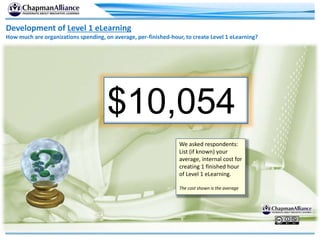
How much are organizations spending, on average, per-finished-hour, to create Level 1 eLearning?
$10,054
We asked respondents:
List (if known) your
average, internal cost for
creating 1 finished hour
of Level 1 eLearning.
The cost shown is the average
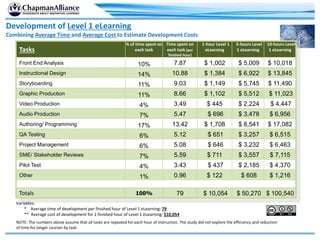
Tasks
% of time spent on
each task
Time spent on
each task (per
finished hour)
1-hour Level 1
eLearning
5-hours Level
1 eLearning
10-hours Level
1 eLearning
Front End Analysis 10% 7.87 $ 1,002 $ 5,009 $ 10,018
Instructional Design 14% 10.88 $ 1,384 $ 6,922 $ 13,845
Storyboarding 11% 9.03 $ 1,149 $ 5,745 $ 11,490
Graphic Production 11% 8.66 $ 1,102 $ 5,512 $ 11,023
Video Production 4% 3.49 $ 445 $ 2,224 $ 4,447
Audio Production 7% 5.47 $ 696 $ 3,478 $ 6,956
Authoring/ Programming 17% 13.42 $ 1,708 $ 8,541 $ 17,082
QA Testing 6% 5.12 $ 651 $ 3,257 $ 6,515
Project Management 6% 5.08 $ 646 $ 3,232 $ 6,463
SME/ Stakeholder Reviews 7% 5.59 $ 711 $ 3,557 $ 7,115
Pilot Test 4% 3.43 $ 437 $ 2,185 $ 4,370
Other 1% 0.96 $ 122 $ 608 $ 1,216
Totals 100% 79 $ 10,054 $ 50,270 $ 100,540
Development of Level 1 eLearning
Combining Average Time and Average Cost to Estimate Development Costs
NOTE: The numbers above assume that all tasks are repeated for each hour of instruction. The study did not explore the efficiency and reduction
of time for longer courses by task.
Variables:
* Average time of development per finished hour of Level 1 eLearning: 79
** Average cost of development for 1 finished hour of Level 1 eLearning: $10,054
Level 2 - eLearning
Development Benchmark
Development of Level 2 - eLearning
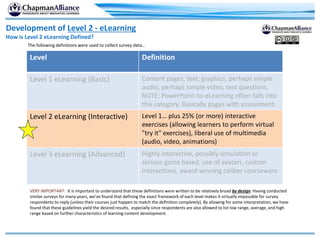
How is Level 2 eLearning Defined?
Level Definition
Level 1 eLearning (Basic) Content pages, text, graphics, perhaps simple
audio, perhaps simple video, test questions.
NOTE: PowerPoint-to-eLearning often falls into
this category. Basically pages with assessment.
Level 2 eLearning (Interactive) Level 1… plus 25% (or more) interactive
exercises (allowing learners to perform virtual
"try it" exercises), liberal use of multimedia
(audio, video, animations)
Level 3 eLearning (Advanced) Highly interactive, possibly simulation or
serious game based, use of avatars, custom
interactions, award winning caliber courseware
The following definitions were used to collect survey data…
VERY IMPORTANT: It is important to understand that these definitions were written to be relatively broad by design. Having conducted
similar surveys for many years, we’ve found that defining the exact framework of each level makes it virtually impossible for survey
respondents to reply (unless their courses just happen to match the definition completely). By allowing for some interpretation, we have
found that these guidelines yield the desired results, especially since respondents are also allowed to list low range, average, and high
range based on further characteristics of learning content development.
Development of Level 2 - eLearning
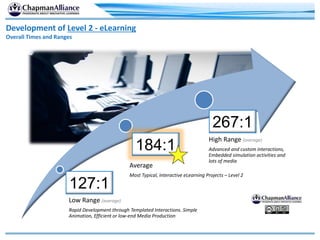
Overall Times and Ranges
Low Range (average)
Rapid Development through Templated Interactions. Simple
Animation, Efficient or low-end Media Production
Average
Most Typical, Interactive eLearning Projects – Level 2
High Range (average)
Advanced and custom interactions,
Embedded simulation activities and
lots of media
184:1
267:1
127:1
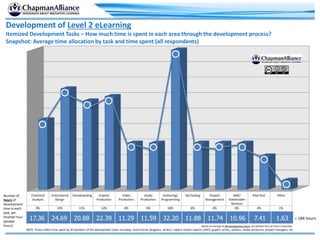
Development of Level 2 eLearning
Itemized Development Tasks – How much time is spent in each area through the development process?
Snapshot: Average time allocation by task and time spent (all respondents)
17.36 24.69 20.88 22.39 11.29 11.59 32.20 11.88 11.74 10.96 7.41 1.63
Based on average of 184 development hours, per finished hour of Level 2 eLearning
= 184 hours
Number of
hours of
development
time in each
task, per
finished hour
(people
hours)
NOTE: Times reflect time spent by all members of the development team including: instructional designers, writers, subject matter experts (SME), graphic artists, authors, media producers, project managers, etc.
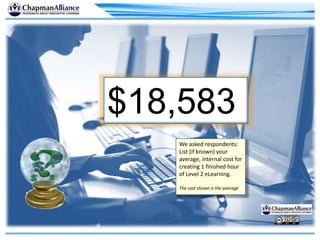
$18,583
We asked respondents:
List (if known) your
average, internal cost for
creating 1 finished hour
of Level 2 eLearning.
The cost shown is the average
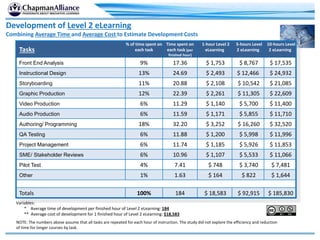
Tasks
% of time spent on
each task
Time spent on
each task (per
finished hour)
1-hour Level 2
eLearning
5-hours Level
2 eLearning
10-hours Level
2 eLearning
Front End Analysis 9% 17.36 $ 1,753 $ 8,767 $ 17,535
Instructional Design 13% 24.69 $ 2,493 $ 12,466 $ 24,932
Storyboarding 11% 20.88 $ 2,108 $ 10,542 $ 21,085
Graphic Production 12% 22.39 $ 2,261 $ 11,305 $ 22,609
Video Production 6% 11.29 $ 1,140 $ 5,700 $ 11,400
Audio Production 6% 11.59 $ 1,171 $ 5,855 $ 11,710
Authoring/ Programming 18% 32.20 $ 3,252 $ 16,260 $ 32,520
QA Testing 6% 11.88 $ 1,200 $ 5,998 $ 11,996
Project Management 6% 11.74 $ 1,185 $ 5,926 $ 11,853
SME/ Stakeholder Reviews 6% 10.96 $ 1,107 $ 5,533 $ 11,066
Pilot Test 4% 7.41 $ 748 $ 3,740 $ 7,481
Other 1% 1.63 $ 164 $ 822 $ 1,644
Totals 100% 184 $ 18,583 $ 92,915 $ 185,830
Development of Level 2 eLearning
Combining Average Time and Average Cost to Estimate Development Costs
NOTE: The numbers above assume that all tasks are repeated for each hour of instruction. The study did not explore the efficiency and reduction
of time for longer courses by task.
Variables:
* Average time of development per finished hour of Level 2 eLearning: 184
** Average cost of development for 1 finished hour of Level 2 eLearning: $18,583
Level 3 - eLearning
Development Benchmark
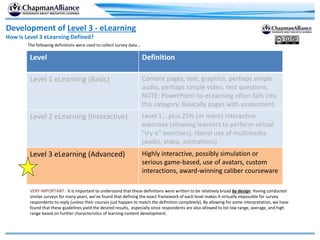
Development of Level 3 - eLearning
How is Level 3 eLearning Defined?
Level Definition
Level 1 eLearning (Basic) Content pages, text, graphics, perhaps simple
audio, perhaps simple video, test questions.
NOTE: PowerPoint-to-eLearning often falls into
this category. Basically pages with assessment.
Level 2 eLearning (Interactive) Level 1… plus 25% (or more) interactive
exercises (allowing learners to perform virtual
"try it" exercises), liberal use of multimedia
(audio, video, animations)
Level 3 eLearning (Advanced) Highly interactive, possibly simulation or
serious game-based, use of avatars, custom
interactions, award-winning caliber courseware
The following definitions were used to collect survey data…
VERY IMPORTANT: It is important to understand that these definitions were written to be relatively broad by design. Having conducted
similar surveys for many years, we’ve found that defining the exact framework of each level makes it virtually impossible for survey
respondents to reply (unless their courses just happen to match the definition completely). By allowing for some interpretation, we have
found that these guidelines yield the desired results, especially since respondents are also allowed to list low range, average, and high
range based on further characteristics of learning content development.
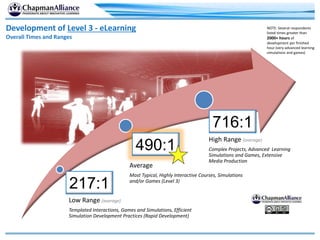
Development of Level 3 - eLearning
Overall Times and Ranges
Low Range (average)
Templated Interactions, Games and Simulations, Efficient
Simulation Development Practices (Rapid Development)
Average
Most Typical, Highly Interactive Courses, Simulations
and/or Games (Level 3)
High Range (average)
Complex Projects, Advanced Learning
Simulations and Games, Extensive
Media Production
490:1
716:1
217:1
NOTE: Several respondents
listed times greater than
2000+ hours of
development per finished
hour (very advanced learning
simulations and games)
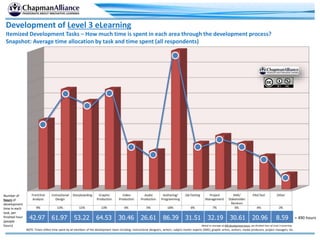
Development of Level 3 eLearning
Itemized Development Tasks – How much time is spent in each area through the development process?
Snapshot: Average time allocation by task and time spent (all respondents)
42.97 61.97 53.22 64.53 30.46 26.61 86.39 31.51 32.19 30.61 20.96 8.59
Based on average of 490 development hours, per finished hour of Level 3 eLearning
= 490 hours
Number of
hours of
development
time in each
task, per
finished hour
(people
hours)
NOTE: Times reflect time spent by all members of the development team including: instructional designers, writers, subject matter experts (SME), graphic artists, authors, media producers, project managers, etc.
Development of Level 3 eLearning
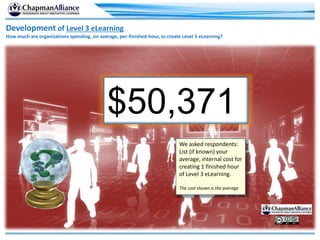
How much are organizations spending, on average, per-finished-hour, to create Level 3 eLearning?
$50,371
We asked respondents:
List (if known) your
average, internal cost for
creating 1 finished hour
of Level 3 eLearning.
The cost shown is the average
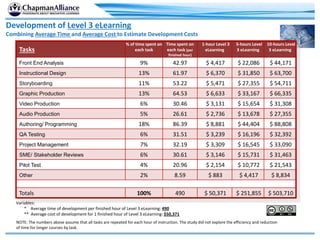
Tasks
% of time spent on
each task
Time spent on
each task (per
finished hour)
1-hour Level 3
eLearning
5-hours Level
3 eLearning
10-hours Level
3 eLearning
Front End Analysis 9% 42.97 $ 4,417 $ 22,086 $ 44,171
Instructional Design 13% 61.97 $ 6,370 $ 31,850 $ 63,700
Storyboarding 11% 53.22 $ 5,471 $ 27,355 $ 54,711
Graphic Production 13% 64.53 $ 6,633 $ 33,167 $ 66,335
Video Production 6% 30.46 $ 3,131 $ 15,654 $ 31,308
Audio Production 5% 26.61 $ 2,736 $ 13,678 $ 27,355
Authoring/ Programming 18% 86.39 $ 8,881 $ 44,404 $ 88,808
QA Testing 6% 31.51 $ 3,239 $ 16,196 $ 32,392
Project Management 7% 32.19 $ 3,309 $ 16,545 $ 33,090
SME/ Stakeholder Reviews 6% 30.61 $ 3,146 $ 15,731 $ 31,463
Pilot Test 4% 20.96 $ 2,154 $ 10,772 $ 21,543
Other 2% 8.59 $ 883 $ 4,417 $ 8,834
Totals 100% 490 $ 50,371 $ 251,855 $ 503,710
Development of Level 3 eLearning
Combining Average Time and Average Cost to Estimate Development Costs
NOTE: The numbers above assume that all tasks are repeated for each hour of instruction. The study did not explore the efficiency and reduction
of time for longer courses by task.
Variables:
* Average time of development per finished hour of Level 3 eLearning: 490
** Average cost of development for 1 finished hour of Level 3 eLearning: $50,371
Comparison Charts
Development Ratios and Costs
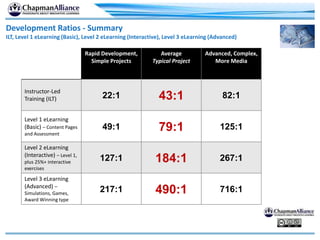
Development Ratios - Summary
ILT, Level 1 eLearning (Basic), Level 2 eLearning (Interactive), Level 3 eLearning (Advanced)
Rapid Development,
Simple Projects
Average
Typical Project
Advanced, Complex,
More Media
Instructor-Led
Training (ILT) 22:1 43:1 82:1
Level 1 eLearning
(Basic) – Content Pages
and Assessment
49:1 79:1 125:1
Level 2 eLearning
(Interactive) – Level 1,
plus 25%+ interactive
exercises
127:1 184:1 267:1
Level 3 eLearning
(Advanced) –
Simulations, Games,
Award Winning type
217:1 490:1 716:1
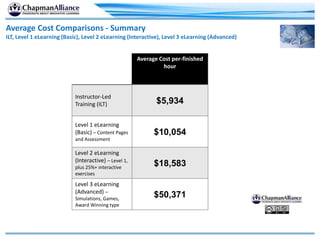
Average Cost Comparisons - Summary
ILT, Level 1 eLearning (Basic), Level 2 eLearning (Interactive), Level 3 eLearning (Advanced)
Average Cost per-finished
hour
Instructor-Led
Training (ILT) $5,934
Level 1 eLearning
(Basic) – Content Pages
and Assessment
$10,054
Level 2 eLearning
(Interactive) – Level 1,
plus 25%+ interactive
exercises
$18,583
Level 3 eLearning
(Advanced) –
Simulations, Games,
Award Winning type
$50,371
Blended Learning
Benchmark of Blended Learning Components
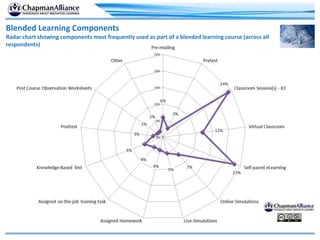
Blended Learning Components
Radar chart showing components most frequently used as part of a blended learning course (across all
respondents)
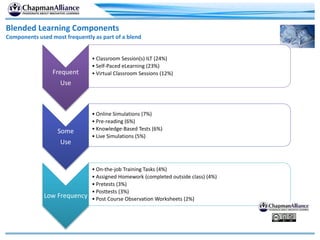
Blended Learning Components
Components used most frequently as part of a blend
Frequent
Use
• Classroom Session(s) ILT (24%)
• Self-Paced eLearning (23%)
• Virtual Classroom Sessions (12%)
Some
Use
• Online Simulations (7%)
• Pre-reading (6%)
• Knowledge-Based Tests (6%)
• Live Simulations (5%)
Low Frequency
• On-the-job Training Tasks (4%)
• Assigned Homework (completed outside class) (4%)
• Pretests (3%)
• Posttests (3%)
• Post Course Observation Worksheets (2%)
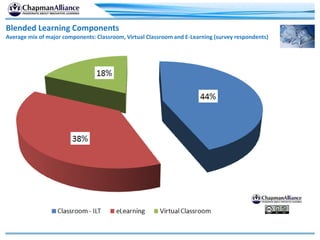
Blended Learning Components
Average mix of major components: Classroom, Virtual Classroom and E-Learning (survey respondents)
Blended Learning
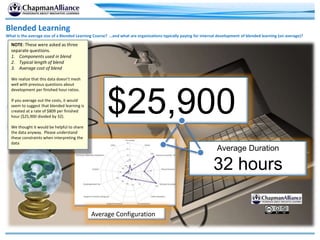
What is the average size of a Blended Learning Course? …and what are organizations typically paying for internal development of blended learning (on average)?
$25,900
Average Duration
32 hours
Average Configuration
NOTE: These were asked as three
separate questions.
1. Components used in blend
2. Typical length of blend
3. Average cost of blend
We realize that this data doesn’t mesh
well with previous questions about
development per finished hour ratios.
If you average out the costs, it would
seem to suggest that blended learning is
created at a rate of $809 per finished
hour ($25,900 divided by 32).
We thought it would be helpful to share
the data anyway. Please understand
these constraints when interpreting the
data
About the Author
Bryan Chapman is Chief Learning Strategist at Chapman Alliance; a provider of research-
centric consulting solutions that assist organizations in defining, operating and
optimizing their strategic learning initiatives. As a veteran in the industry, he has over 20
years experience and has worked with such organizations as American Express, Shell,
Kodak, Sprint, Sharp Electronics, Honda, IBM, Microsoft, Avon, UNICEF, American Red
Cross, The Food and Drug Administration, U.S. State Department, and many others; to
help them optimize learning efficiency through the use of innovative learning
techniques and technologies. Click here for a full bio.
Please feel free to contact me if you need some assistance…
• working through learning management system (LMS) or any other learning
technology selection project
• finding and applying learning industry research; custom research projects
• optimizing or establishing your learning governance approach
• exploring best practices for rapid learning development
• learning strategy “jam sessions” (available as a 2-hour block, full-day onsite, or
as a workshop)
• Click here for more available services
Contact information:
Bryan Chapman
Chief Learning Strategist
Chapman Alliance
(801) 568-7011
bryan@chapmanalliance.com
www.chapmanalliance.com
Learning Development Times - Benchmark

Learning Development Times - Benchmark

  • 1.
    How Long Doesit Take to Create Learning? A Chapman Alliance, Research Study By Bryan Chapman, Chief Learning Strategist bryan@chapmanalliance.com www.chapmanalliance.com Abstract: Several years ago, I published some learning development metrics from several different studies that included ratios for how long it takes to create different types of learning. The information has been widely used and appears frequently throughout the Blogosphere. Recently, we have been receiving many requests to update this data, so Chapman Alliance created a survey to collect usable metrics that will help you benchmark your own learning development times. This time, all of the results were collected from a single audience (249 completed surveys) across several learning formats including instructor –led training (ILT), Level 1 e-Learning (Basic), Level 2 e-learning (Interactive), Level 3 e- learning (Advanced), and information about blended learning. The results are contained in this deck. Now, the good news… You are welcome to share this research with anyone you’d like. Because we feel that this information is so important to the industry, we have released it under Creative Commons, meaning that you can share the whole deck or pull-out slides/charts and add them to your presentations, white papers, conference presentations, etc. The only restrictions are (1) you must ALWAYS list the source of information as “Chapman Alliance” and (2) you are NOT allowed to sell the results without written permission from Chapman Alliance. That’s it. Enjoy! Source Citation: Chapman, B. (2010). How Long Does it Take to Create Learning? [Research Study]. Published by Chapman Alliance LLC. www.chapmanalliance.com
  • 2.
    Survey Demographics Thanks toall of you who took time to complete the survey! If you would like to participate in future research surveys from Chapman Alliance, please join our list at www.chapmanalliance.com/join-our-mailing-list
  • 3.
    The data containedin this research was collected from 249 organizations, representing 3,947 learning development professionals, who have created learning content (ILT and eLearning) that is consumed by 19,875,946 Learners.
  • 4.
  • 5.
    Low Range (average) RapidDevelopment, Simple Content, Possible repurposing from existing source material Average Most Typical, ILT Development Projects High Range (average) Complex Projects, Often very Custom, Extended time spent on formatting during production Development of Instructor-Led Training (ILT) Overall Times and Ranges Low Range (average) Rapid Development, Simple Content, Possible repurposing from existing source material, minimal print-based learning support materials Average Most Typical, ILT Development Projects High Range (average) Complex Projects, Often very Custom, Extended time spent on formatting during production Development of Instructor-Led Training (ILT) Overall Times and Ranges 43:1 82:1 22:1
  • 6.
    Development of Instructor-LedTraining (ILT) Itemized Development Tasks – How much time is spent in each area through the development process? Snapshot: Average time allocation by task and time spent (all respondents) Number of hours of development time in each task, per finished hour (people hours) 5.36 6.84 5.06 3.38 4.83 6.76 3.42 2.88 3.45 1.01 Based on average of 43 development hours, per finished hour of ILT = 43 hours NOTE: Times reflect time spent by all members of the development team including: instructional designers, writers, subject matter experts (SME), graphic artists, project managers, etc.
  • 7.
    Development of Instructor-LedTraining (ILT) How much are organizations spending, on average, per-finished-hour, to create instructor-led training (internally)? $5,934 We asked respondents: List (if known) your average, internal cost for creating 1 finished hour of ILT. The cost shown is the average
  • 8.
    Development of Instructor-LedTraining (ILT) Combining Average Time and Average Cost to Estimate Development Costs NOTE: The numbers above assume that all tasks are repeated for each hour of instruction. The study did not explore the efficiency and reduction of time for longer courses by task. Tasks % of time spent on each task Time spent on each task (per finished hour) 1-hour ILT Course 5-hour ILT Course 10 hour ILT Course Front End Analysis 12% 5.36 $ 739 $ 3,695 $ 7,391 Instructional Design 16% 6.84 $ 944 $ 4,722 $ 9,444 Lesson Plan Development 12% 5.06 $ 698 $ 3,492 $ 6,985 Creation of Handouts 8% 3.38 $ 466 $ 2,331 $ 4,662 Student Guide/ Workbook Development 11% 4.83 $ 667 $ 3,336 $ 6,671 PowerPoint and/or other visual development 16% 6.76 $ 933 $ 4,667 $ 9,335 Test and Exam creation 8% 3.42 $ 472 $ 2,360 $ 4,720 Project Management during Development 7% 2.88 $ 397 $ 1,987 $ 3,973 SME/ Stakeholder Reviews 8% 3.45 $ 477 $ 2,384 $ 4,768 Other 2% 1.01 $ 139 $ 697 $ 1,395 Totals 100% 43 * $ 5,934 ** $ 29,672 $ 59,345 Variables: * Average time of development per finished hour of ILT: 43 ** Average cost of development for 1 finished hour of ILT content: $5,934
  • 9.
    Level 1 -eLearning Development Benchmark
  • 10.
    Development of Level1 - eLearning How is Level 1 eLearning Defined? Level Definition Level 1 eLearning (Basic) Content pages, text, graphics, perhaps simple audio, perhaps simple video, test questions. NOTE: PowerPoint-to-eLearning often falls into this category. Basically pages with assessment. Level 2 eLearning (Interactive) Level 1 plus 25% (or more) interactive exercises (allowing learners to perform virtual "try it" exercises), liberal use of multimedia (audio, video, animations) Level 3 eLearning (Advanced) Highly interactive, possibly simulation or serious game based, use of avatars, custom interactions, award winning caliber courseware The following definitions were used to collect survey data… VERY IMPORTANT: It is important to understand that these definitions were written to be relatively broad by design. Having conducted similar surveys for many years, we’ve found that defining the exact framework of each level makes it virtually impossible for survey respondents to reply (unless their courses just happen to match the definition completely). By allowing for some interpretation, we have found that these guidelines yield the desired results, especially since respondents are also allowed to list low range, average, and high range based on further characteristics of learning content development.
  • 11.
    Development of Level1 - eLearning Overall Times and Ranges Low Range (average) Rapid Development, Simple Content, Specialized Authoring Tools (includes simple PowerPoint to eLearning projects) Average Most Typical, Level 1 Development Projects High Range (average) Complex Projects, Difficult to Produce, more Media Production 79:1 125:1 49:1
  • 12.
    Development of Level1 eLearning Itemized Development Tasks – How much time is spent in each area through the development process? Snapshot: Average time allocation by task and time spent (all respondents) Number of hours of development time in each task, per finished hour (people hours) Based on average of 79 development hours, per finished hour of Level 1 eLearning = 79 hours7.87 10.88 9.03 8.66 3.49 5.47 13.42 5.12 5.08 5.59 3.43 0.96 NOTE: Times reflect time spent by all members of the development team including: instructional designers, writers, subject matter experts (SME), graphic artists, authors, media producers, project managers, etc.
  • 13.
    Development of Level1 eLearning How much are organizations spending, on average, per-finished-hour, to create Level 1 eLearning? $10,054 We asked respondents: List (if known) your average, internal cost for creating 1 finished hour of Level 1 eLearning. The cost shown is the average
  • 14.
    Tasks % of timespent on each task Time spent on each task (per finished hour) 1-hour Level 1 eLearning 5-hours Level 1 eLearning 10-hours Level 1 eLearning Front End Analysis 10% 7.87 $ 1,002 $ 5,009 $ 10,018 Instructional Design 14% 10.88 $ 1,384 $ 6,922 $ 13,845 Storyboarding 11% 9.03 $ 1,149 $ 5,745 $ 11,490 Graphic Production 11% 8.66 $ 1,102 $ 5,512 $ 11,023 Video Production 4% 3.49 $ 445 $ 2,224 $ 4,447 Audio Production 7% 5.47 $ 696 $ 3,478 $ 6,956 Authoring/ Programming 17% 13.42 $ 1,708 $ 8,541 $ 17,082 QA Testing 6% 5.12 $ 651 $ 3,257 $ 6,515 Project Management 6% 5.08 $ 646 $ 3,232 $ 6,463 SME/ Stakeholder Reviews 7% 5.59 $ 711 $ 3,557 $ 7,115 Pilot Test 4% 3.43 $ 437 $ 2,185 $ 4,370 Other 1% 0.96 $ 122 $ 608 $ 1,216 Totals 100% 79 $ 10,054 $ 50,270 $ 100,540 Development of Level 1 eLearning Combining Average Time and Average Cost to Estimate Development Costs NOTE: The numbers above assume that all tasks are repeated for each hour of instruction. The study did not explore the efficiency and reduction of time for longer courses by task. Variables: * Average time of development per finished hour of Level 1 eLearning: 79 ** Average cost of development for 1 finished hour of Level 1 eLearning: $10,054
  • 15.
    Level 2 -eLearning Development Benchmark
  • 16.
    Development of Level2 - eLearning How is Level 2 eLearning Defined? Level Definition Level 1 eLearning (Basic) Content pages, text, graphics, perhaps simple audio, perhaps simple video, test questions. NOTE: PowerPoint-to-eLearning often falls into this category. Basically pages with assessment. Level 2 eLearning (Interactive) Level 1… plus 25% (or more) interactive exercises (allowing learners to perform virtual "try it" exercises), liberal use of multimedia (audio, video, animations) Level 3 eLearning (Advanced) Highly interactive, possibly simulation or serious game based, use of avatars, custom interactions, award winning caliber courseware The following definitions were used to collect survey data… VERY IMPORTANT: It is important to understand that these definitions were written to be relatively broad by design. Having conducted similar surveys for many years, we’ve found that defining the exact framework of each level makes it virtually impossible for survey respondents to reply (unless their courses just happen to match the definition completely). By allowing for some interpretation, we have found that these guidelines yield the desired results, especially since respondents are also allowed to list low range, average, and high range based on further characteristics of learning content development.
  • 17.
    Development of Level2 - eLearning Overall Times and Ranges Low Range (average) Rapid Development through Templated Interactions. Simple Animation, Efficient or low-end Media Production Average Most Typical, Interactive eLearning Projects – Level 2 High Range (average) Advanced and custom interactions, Embedded simulation activities and lots of media 184:1 267:1 127:1
  • 18.
    Development of Level2 eLearning Itemized Development Tasks – How much time is spent in each area through the development process? Snapshot: Average time allocation by task and time spent (all respondents) 17.36 24.69 20.88 22.39 11.29 11.59 32.20 11.88 11.74 10.96 7.41 1.63 Based on average of 184 development hours, per finished hour of Level 2 eLearning = 184 hours Number of hours of development time in each task, per finished hour (people hours) NOTE: Times reflect time spent by all members of the development team including: instructional designers, writers, subject matter experts (SME), graphic artists, authors, media producers, project managers, etc.
  • 19.
    $18,583 We asked respondents: List(if known) your average, internal cost for creating 1 finished hour of Level 2 eLearning. The cost shown is the average
  • 20.
    Tasks % of timespent on each task Time spent on each task (per finished hour) 1-hour Level 2 eLearning 5-hours Level 2 eLearning 10-hours Level 2 eLearning Front End Analysis 9% 17.36 $ 1,753 $ 8,767 $ 17,535 Instructional Design 13% 24.69 $ 2,493 $ 12,466 $ 24,932 Storyboarding 11% 20.88 $ 2,108 $ 10,542 $ 21,085 Graphic Production 12% 22.39 $ 2,261 $ 11,305 $ 22,609 Video Production 6% 11.29 $ 1,140 $ 5,700 $ 11,400 Audio Production 6% 11.59 $ 1,171 $ 5,855 $ 11,710 Authoring/ Programming 18% 32.20 $ 3,252 $ 16,260 $ 32,520 QA Testing 6% 11.88 $ 1,200 $ 5,998 $ 11,996 Project Management 6% 11.74 $ 1,185 $ 5,926 $ 11,853 SME/ Stakeholder Reviews 6% 10.96 $ 1,107 $ 5,533 $ 11,066 Pilot Test 4% 7.41 $ 748 $ 3,740 $ 7,481 Other 1% 1.63 $ 164 $ 822 $ 1,644 Totals 100% 184 $ 18,583 $ 92,915 $ 185,830 Development of Level 2 eLearning Combining Average Time and Average Cost to Estimate Development Costs NOTE: The numbers above assume that all tasks are repeated for each hour of instruction. The study did not explore the efficiency and reduction of time for longer courses by task. Variables: * Average time of development per finished hour of Level 2 eLearning: 184 ** Average cost of development for 1 finished hour of Level 2 eLearning: $18,583
  • 21.
    Level 3 -eLearning Development Benchmark
  • 22.
    Development of Level3 - eLearning How is Level 3 eLearning Defined? Level Definition Level 1 eLearning (Basic) Content pages, text, graphics, perhaps simple audio, perhaps simple video, test questions. NOTE: PowerPoint-to-eLearning often falls into this category. Basically pages with assessment. Level 2 eLearning (Interactive) Level 1… plus 25% (or more) interactive exercises (allowing learners to perform virtual "try it" exercises), liberal use of multimedia (audio, video, animations) Level 3 eLearning (Advanced) Highly interactive, possibly simulation or serious game-based, use of avatars, custom interactions, award-winning caliber courseware The following definitions were used to collect survey data… VERY IMPORTANT: It is important to understand that these definitions were written to be relatively broad by design. Having conducted similar surveys for many years, we’ve found that defining the exact framework of each level makes it virtually impossible for survey respondents to reply (unless their courses just happen to match the definition completely). By allowing for some interpretation, we have found that these guidelines yield the desired results, especially since respondents are also allowed to list low range, average, and high range based on further characteristics of learning content development.
  • 23.
    Development of Level3 - eLearning Overall Times and Ranges Low Range (average) Templated Interactions, Games and Simulations, Efficient Simulation Development Practices (Rapid Development) Average Most Typical, Highly Interactive Courses, Simulations and/or Games (Level 3) High Range (average) Complex Projects, Advanced Learning Simulations and Games, Extensive Media Production 490:1 716:1 217:1 NOTE: Several respondents listed times greater than 2000+ hours of development per finished hour (very advanced learning simulations and games)
  • 24.
    Development of Level3 eLearning Itemized Development Tasks – How much time is spent in each area through the development process? Snapshot: Average time allocation by task and time spent (all respondents) 42.97 61.97 53.22 64.53 30.46 26.61 86.39 31.51 32.19 30.61 20.96 8.59 Based on average of 490 development hours, per finished hour of Level 3 eLearning = 490 hours Number of hours of development time in each task, per finished hour (people hours) NOTE: Times reflect time spent by all members of the development team including: instructional designers, writers, subject matter experts (SME), graphic artists, authors, media producers, project managers, etc.
  • 25.
    Development of Level3 eLearning How much are organizations spending, on average, per-finished-hour, to create Level 3 eLearning? $50,371 We asked respondents: List (if known) your average, internal cost for creating 1 finished hour of Level 3 eLearning. The cost shown is the average
  • 26.
    Tasks % of timespent on each task Time spent on each task (per finished hour) 1-hour Level 3 eLearning 5-hours Level 3 eLearning 10-hours Level 3 eLearning Front End Analysis 9% 42.97 $ 4,417 $ 22,086 $ 44,171 Instructional Design 13% 61.97 $ 6,370 $ 31,850 $ 63,700 Storyboarding 11% 53.22 $ 5,471 $ 27,355 $ 54,711 Graphic Production 13% 64.53 $ 6,633 $ 33,167 $ 66,335 Video Production 6% 30.46 $ 3,131 $ 15,654 $ 31,308 Audio Production 5% 26.61 $ 2,736 $ 13,678 $ 27,355 Authoring/ Programming 18% 86.39 $ 8,881 $ 44,404 $ 88,808 QA Testing 6% 31.51 $ 3,239 $ 16,196 $ 32,392 Project Management 7% 32.19 $ 3,309 $ 16,545 $ 33,090 SME/ Stakeholder Reviews 6% 30.61 $ 3,146 $ 15,731 $ 31,463 Pilot Test 4% 20.96 $ 2,154 $ 10,772 $ 21,543 Other 2% 8.59 $ 883 $ 4,417 $ 8,834 Totals 100% 490 $ 50,371 $ 251,855 $ 503,710 Development of Level 3 eLearning Combining Average Time and Average Cost to Estimate Development Costs NOTE: The numbers above assume that all tasks are repeated for each hour of instruction. The study did not explore the efficiency and reduction of time for longer courses by task. Variables: * Average time of development per finished hour of Level 3 eLearning: 490 ** Average cost of development for 1 finished hour of Level 3 eLearning: $50,371
  • 27.
  • 28.
    Development Ratios -Summary ILT, Level 1 eLearning (Basic), Level 2 eLearning (Interactive), Level 3 eLearning (Advanced) Rapid Development, Simple Projects Average Typical Project Advanced, Complex, More Media Instructor-Led Training (ILT) 22:1 43:1 82:1 Level 1 eLearning (Basic) – Content Pages and Assessment 49:1 79:1 125:1 Level 2 eLearning (Interactive) – Level 1, plus 25%+ interactive exercises 127:1 184:1 267:1 Level 3 eLearning (Advanced) – Simulations, Games, Award Winning type 217:1 490:1 716:1
  • 29.
    Average Cost Comparisons- Summary ILT, Level 1 eLearning (Basic), Level 2 eLearning (Interactive), Level 3 eLearning (Advanced) Average Cost per-finished hour Instructor-Led Training (ILT) $5,934 Level 1 eLearning (Basic) – Content Pages and Assessment $10,054 Level 2 eLearning (Interactive) – Level 1, plus 25%+ interactive exercises $18,583 Level 3 eLearning (Advanced) – Simulations, Games, Award Winning type $50,371
  • 30.
    Blended Learning Benchmark ofBlended Learning Components
  • 31.
    Blended Learning Components Radarchart showing components most frequently used as part of a blended learning course (across all respondents)
  • 32.
    Blended Learning Components Componentsused most frequently as part of a blend Frequent Use • Classroom Session(s) ILT (24%) • Self-Paced eLearning (23%) • Virtual Classroom Sessions (12%) Some Use • Online Simulations (7%) • Pre-reading (6%) • Knowledge-Based Tests (6%) • Live Simulations (5%) Low Frequency • On-the-job Training Tasks (4%) • Assigned Homework (completed outside class) (4%) • Pretests (3%) • Posttests (3%) • Post Course Observation Worksheets (2%)
  • 33.
    Blended Learning Components Averagemix of major components: Classroom, Virtual Classroom and E-Learning (survey respondents)
  • 34.
    Blended Learning What isthe average size of a Blended Learning Course? …and what are organizations typically paying for internal development of blended learning (on average)? $25,900 Average Duration 32 hours Average Configuration NOTE: These were asked as three separate questions. 1. Components used in blend 2. Typical length of blend 3. Average cost of blend We realize that this data doesn’t mesh well with previous questions about development per finished hour ratios. If you average out the costs, it would seem to suggest that blended learning is created at a rate of $809 per finished hour ($25,900 divided by 32). We thought it would be helpful to share the data anyway. Please understand these constraints when interpreting the data
  • 35.
    About the Author BryanChapman is Chief Learning Strategist at Chapman Alliance; a provider of research- centric consulting solutions that assist organizations in defining, operating and optimizing their strategic learning initiatives. As a veteran in the industry, he has over 20 years experience and has worked with such organizations as American Express, Shell, Kodak, Sprint, Sharp Electronics, Honda, IBM, Microsoft, Avon, UNICEF, American Red Cross, The Food and Drug Administration, U.S. State Department, and many others; to help them optimize learning efficiency through the use of innovative learning techniques and technologies. Click here for a full bio. Please feel free to contact me if you need some assistance… • working through learning management system (LMS) or any other learning technology selection project • finding and applying learning industry research; custom research projects • optimizing or establishing your learning governance approach • exploring best practices for rapid learning development • learning strategy “jam sessions” (available as a 2-hour block, full-day onsite, or as a workshop) • Click here for more available services Contact information: Bryan Chapman Chief Learning Strategist Chapman Alliance (801) 568-7011 bryan@chapmanalliance.com www.chapmanalliance.com