DETERMINING HOURS OF DESIGN AND DEVELOPMENT
Overview
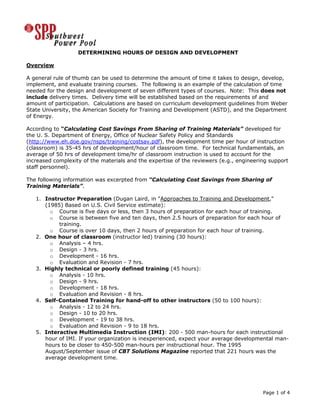
A general rule of thumb can be used to determine the amount of time it takes to design, develop,
implement, and evaluate training courses. The following is an example of the calculation of time
needed for the design and development of seven different types of courses. Note: This does not
include delivery times. Delivery time will be established based on the requirements of and
amount of participation. Calculations are based on curriculum development guidelines from Weber
State University, the American Society for Training and Development (ASTD), and the Department
of Energy.
According to “Calculating Cost Savings From Sharing of Training Materials” developed for
the U. S. Department of Energy, Office of Nuclear Safety Policy and Standards
(http://www.eh.doe.gov/nsps/training/costsav.pdf), the development time per hour of instruction
(classroom) is 35-45 hrs of development/hour of classroom time. For technical fundamentals, an
average of 50 hrs of development time/hr of classroom instruction is used to account for the
increased complexity of the materials and the expertise of the reviewers (e.g., engineering support
staff personnel).
The following information was excerpted from “Calculating Cost Savings from Sharing of
Training Materials”.
1. Instructor Preparation (Dugan Laird, in "Approaches to Training and Development,"
(1985) Based on U.S. Civil Service estimate):
o Course is five days or less, then 3 hours of preparation for each hour of training.
o Course is between five and ten days, then 2.5 hours of preparation for each hour of
training.
o Course is over 10 days, then 2 hours of preparation for each hour of training.
2. One hour of classroom (instructor led) training (30 hours):
o Analysis – 4 hrs.
o Design - 3 hrs.
o Development - 16 hrs.
o Evaluation and Revision - 7 hrs.
3. Highly technical or poorly defined training (45 hours):
o Analysis - 10 hrs.
o Design - 9 hrs.
o Development - 18 hrs.
o Evaluation and Revision - 8 hrs.
4. Self-Contained Training for hand-off to other instructors (50 to 100 hours):
o Analysis - 12 to 24 hrs.
o Design - 10 to 20 hrs.
o Development - 19 to 38 hrs.
o Evaluation and Revision - 9 to 18 hrs.
5. Interactive Multimedia Instruction (IMI): 200 - 500 man-hours for each instructional
hour of IMI. If your organization is inexperienced, expect your average developmental manhours to be closer to 450-500 man-hours per instructional hour. The 1995
August/September issue of CBT Solutions Magazine reported that 221 hours was the
average development time.

Page 1 of 4
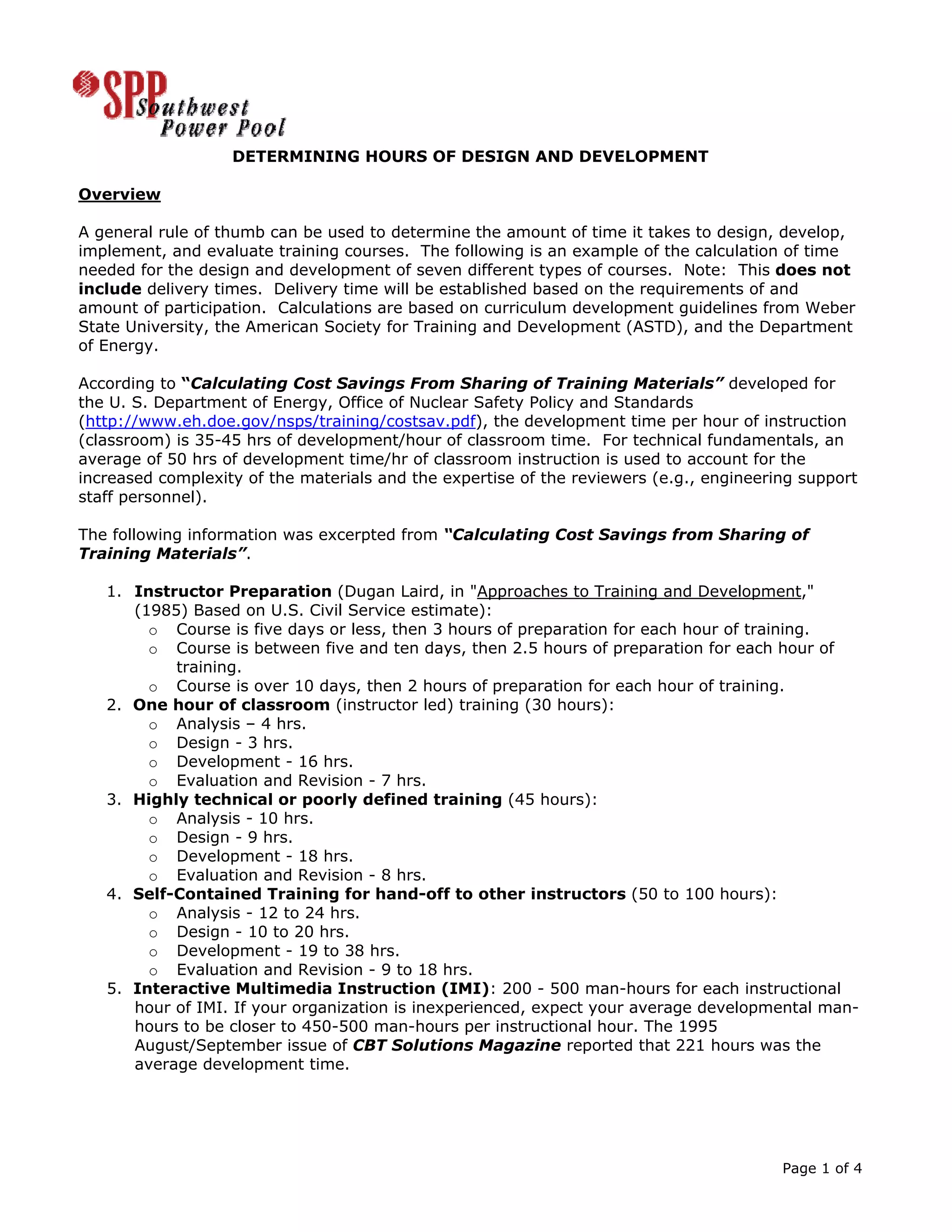
Based on information from several resources, SPP developed a list of various types of learning
experiences with varying levels of complexity and the time required to develop an 8-hour session
for each type. The following assumes that the trainer is an expert in the subject matter being
delivered. If this is not the case, the design and development times could increase.
1. Information-Only Courses (e.g., presentations)
For every hour of informational training, it is necessary to spend approximately eight hours of
development for each hour of the class. Because it is information only, it does not require a
complicated development process. A complexity factor of “1” should be used if the course is
informational and the evaluation is a simple objective assessment (e.g., Multiple Choice).
In this instance, an 8-hour information-only course with an objective assessment will require:
8 hours (course length) x 8 hours (development time) x 1 (complexity factor) = 64
hrs
So for a one-day, information-only class with objective assessments, it will take approximately
1.5 uninterrupted weeks to design and develop content and assessments. This does not include
delivery time.
2. Activity-Based Courses (e.g., workbooks/worksheets, tabletop exercises)
For every hour of activity-based training, it is necessary to spend approximately eight hours of
development for each hour of the class. Because it is activity-based, it requires a more
complicated development process. A complexity factor of “2” should be used if the course is
activity-based and the evaluation is a simple objective assessment (e.g., Multiple Choice) or a
written problem-based assessment.
In this instance, an 8-hour activity-based course with an objective assessment will require:
8 hrs (course length) x 8 hrs (development time) x 2 (complexity factor) = 128 hrs
So for a one-day, activity-based class with objective assessments, it will take approximately 3
uninterrupted weeks to design and develop content and assessments. This does not include
delivery time.
3. Scenario-Based Courses (this might include the use of a simulator)
For every hour of hands-on, performance-based training, it is necessary to spend approximately
eight hours of development for each hour of the class. Because it is performance-based, it also
requires additional time for developing performance-based assessments. A complexity factor of
“3” should be used if the course and evaluation are hands-on. If a simulator is used, this will
require additional time and coordination.
In this instance, an 8-hour performance-base course with performance-based assessments will
require:
8 hrs (course length) x 8 hrs (development time) x 3 (complexity factor) = 192 hrs
So for a one-day, hands-on class with performance-based assessments, it will take
approximately 5 uninterrupted weeks to design and develop content and assessments. This
does not include delivery time.

Page 2 of 4
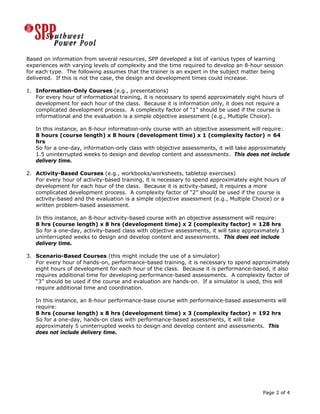
4. Simulator-based- an 8 hour performance-based, scenario-based course with performancebased assessments will require: For every hour of simulator-based training, it is necessary to
spend approximately eight hours of development for each hour of the class. Because it is
performance-based and involves the integration of simulator use, it requires additional time for
developing performance-based assessments. A complexity factor of “4” should be used since
the course and evaluation are hands-on and performance-based.
8 hrs (course length) x 8 hrs (development time) x 4 (complexity factor) = 256 hrs
So for a one-day, hands-on, simulator-based class with performance-based assessments, it will
take approximately 6.5 uninterrupted weeks to design and develop content and assessments.
This does not include delivery time.
5. Vendor-Provided Courses
If any of these courses are offered by a vendor, it reduces the amount of time required of the
training staff. A good rule of thumb for vendor-provided training is to use the following:
8 hrs (course length) x 0.5 (complexity factor) = 4 hrs
So for a one-day, vendor-provided class, it will take approximately ½ day of a training staff
member. This does not include delivery time.
6. Vendor-Partner Courses
If any of these courses are offered by a vendor and training staff are asked to partner with the
vendor in the design and development process, it reduces the amount of time required of the
training staff, but still requires more than a course that is solely vendor-provided. A good rule
of thumb for training developed in partnership with a vendor is:
8 hrs (course length) x 1.5 (complexity factor) = 12 hrs
So for a one-day, vendor-partner class, it will take approximately 1.5 days of a training staff
member. This does not include delivery time.
7. Online Courses (courses created using FLASH, CAPTIVATE, or other MACROMEDIA
products that are animated and interactive)
Due to the nature of these courses, the design and development calculations are different than
those above.
For a one-hour, online, interactive course, the following metrics apply:
40 hours research and development of data for course
40 hours script writing
40 hours Flash animation development
40 hours Captivate development and editing
8 hours audio recording
168 Total Hours or approximately 4 weeks of design and development time
So for a one-hour, online, interactive course, it will take approximately four weeks to
design and develop content and assessments. This assumes that the developer will
have experience using the available tools.

Page 3 of 4
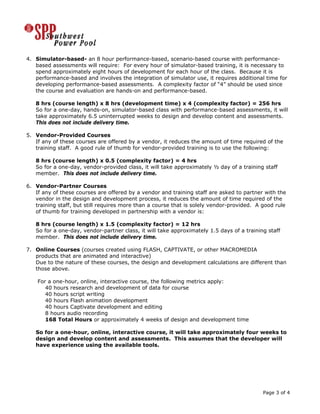
Website Resources
“Calculating Cost Savings From Sharing of Training Materials”
http://www.eh.doe.gov/nsps/training/costsav.pdf
This is an excellent site titled “Estimating Training Development Time and Costs”. This site
has an Excel spreadsheet with a rough cost estimator.
http://www.nwlink.com/~donclark/hrd/costs.html
Another excellent site titled “Knowledge, Performance, Training and Learning” contains
1. Instructional System Development Manual - A complete guide to analysis, design, development,
implementation (delivery), & evaluation.
2. ISD Concept Map - A visual guide to the learning design process.
http://www.nwlink.com/~donclark/hrd.html
This site has information regarding job tasks analysis that you might also find helpful:
“Instructional System Design: Analysis Phase”.
http://www.nwlink.com/~donclark/hrd/sat2.html#traincost
Approaches to Training and Development by Dugan Laird is another reference that you might
find helpful- link to Amazon: http://www.amazon.com/Approaches-Training-Development-DuganLaird/dp/0201044986

Page 4 of 4

Design & development hours

  • 1.
    DETERMINING HOURS OFDESIGN AND DEVELOPMENT Overview A general rule of thumb can be used to determine the amount of time it takes to design, develop, implement, and evaluate training courses. The following is an example of the calculation of time needed for the design and development of seven different types of courses. Note: This does not include delivery times. Delivery time will be established based on the requirements of and amount of participation. Calculations are based on curriculum development guidelines from Weber State University, the American Society for Training and Development (ASTD), and the Department of Energy. According to “Calculating Cost Savings From Sharing of Training Materials” developed for the U. S. Department of Energy, Office of Nuclear Safety Policy and Standards (http://www.eh.doe.gov/nsps/training/costsav.pdf), the development time per hour of instruction (classroom) is 35-45 hrs of development/hour of classroom time. For technical fundamentals, an average of 50 hrs of development time/hr of classroom instruction is used to account for the increased complexity of the materials and the expertise of the reviewers (e.g., engineering support staff personnel). The following information was excerpted from “Calculating Cost Savings from Sharing of Training Materials”. 1. Instructor Preparation (Dugan Laird, in "Approaches to Training and Development," (1985) Based on U.S. Civil Service estimate): o Course is five days or less, then 3 hours of preparation for each hour of training. o Course is between five and ten days, then 2.5 hours of preparation for each hour of training. o Course is over 10 days, then 2 hours of preparation for each hour of training. 2. One hour of classroom (instructor led) training (30 hours): o Analysis – 4 hrs. o Design - 3 hrs. o Development - 16 hrs. o Evaluation and Revision - 7 hrs. 3. Highly technical or poorly defined training (45 hours): o Analysis - 10 hrs. o Design - 9 hrs. o Development - 18 hrs. o Evaluation and Revision - 8 hrs. 4. Self-Contained Training for hand-off to other instructors (50 to 100 hours): o Analysis - 12 to 24 hrs. o Design - 10 to 20 hrs. o Development - 19 to 38 hrs. o Evaluation and Revision - 9 to 18 hrs. 5. Interactive Multimedia Instruction (IMI): 200 - 500 man-hours for each instructional hour of IMI. If your organization is inexperienced, expect your average developmental manhours to be closer to 450-500 man-hours per instructional hour. The 1995 August/September issue of CBT Solutions Magazine reported that 221 hours was the average development time. Page 1 of 4
  • 2.
    Based on informationfrom several resources, SPP developed a list of various types of learning experiences with varying levels of complexity and the time required to develop an 8-hour session for each type. The following assumes that the trainer is an expert in the subject matter being delivered. If this is not the case, the design and development times could increase. 1. Information-Only Courses (e.g., presentations) For every hour of informational training, it is necessary to spend approximately eight hours of development for each hour of the class. Because it is information only, it does not require a complicated development process. A complexity factor of “1” should be used if the course is informational and the evaluation is a simple objective assessment (e.g., Multiple Choice). In this instance, an 8-hour information-only course with an objective assessment will require: 8 hours (course length) x 8 hours (development time) x 1 (complexity factor) = 64 hrs So for a one-day, information-only class with objective assessments, it will take approximately 1.5 uninterrupted weeks to design and develop content and assessments. This does not include delivery time. 2. Activity-Based Courses (e.g., workbooks/worksheets, tabletop exercises) For every hour of activity-based training, it is necessary to spend approximately eight hours of development for each hour of the class. Because it is activity-based, it requires a more complicated development process. A complexity factor of “2” should be used if the course is activity-based and the evaluation is a simple objective assessment (e.g., Multiple Choice) or a written problem-based assessment. In this instance, an 8-hour activity-based course with an objective assessment will require: 8 hrs (course length) x 8 hrs (development time) x 2 (complexity factor) = 128 hrs So for a one-day, activity-based class with objective assessments, it will take approximately 3 uninterrupted weeks to design and develop content and assessments. This does not include delivery time. 3. Scenario-Based Courses (this might include the use of a simulator) For every hour of hands-on, performance-based training, it is necessary to spend approximately eight hours of development for each hour of the class. Because it is performance-based, it also requires additional time for developing performance-based assessments. A complexity factor of “3” should be used if the course and evaluation are hands-on. If a simulator is used, this will require additional time and coordination. In this instance, an 8-hour performance-base course with performance-based assessments will require: 8 hrs (course length) x 8 hrs (development time) x 3 (complexity factor) = 192 hrs So for a one-day, hands-on class with performance-based assessments, it will take approximately 5 uninterrupted weeks to design and develop content and assessments. This does not include delivery time. Page 2 of 4
  • 3.
    4. Simulator-based- an8 hour performance-based, scenario-based course with performancebased assessments will require: For every hour of simulator-based training, it is necessary to spend approximately eight hours of development for each hour of the class. Because it is performance-based and involves the integration of simulator use, it requires additional time for developing performance-based assessments. A complexity factor of “4” should be used since the course and evaluation are hands-on and performance-based. 8 hrs (course length) x 8 hrs (development time) x 4 (complexity factor) = 256 hrs So for a one-day, hands-on, simulator-based class with performance-based assessments, it will take approximately 6.5 uninterrupted weeks to design and develop content and assessments. This does not include delivery time. 5. Vendor-Provided Courses If any of these courses are offered by a vendor, it reduces the amount of time required of the training staff. A good rule of thumb for vendor-provided training is to use the following: 8 hrs (course length) x 0.5 (complexity factor) = 4 hrs So for a one-day, vendor-provided class, it will take approximately ½ day of a training staff member. This does not include delivery time. 6. Vendor-Partner Courses If any of these courses are offered by a vendor and training staff are asked to partner with the vendor in the design and development process, it reduces the amount of time required of the training staff, but still requires more than a course that is solely vendor-provided. A good rule of thumb for training developed in partnership with a vendor is: 8 hrs (course length) x 1.5 (complexity factor) = 12 hrs So for a one-day, vendor-partner class, it will take approximately 1.5 days of a training staff member. This does not include delivery time. 7. Online Courses (courses created using FLASH, CAPTIVATE, or other MACROMEDIA products that are animated and interactive) Due to the nature of these courses, the design and development calculations are different than those above. For a one-hour, online, interactive course, the following metrics apply: 40 hours research and development of data for course 40 hours script writing 40 hours Flash animation development 40 hours Captivate development and editing 8 hours audio recording 168 Total Hours or approximately 4 weeks of design and development time So for a one-hour, online, interactive course, it will take approximately four weeks to design and develop content and assessments. This assumes that the developer will have experience using the available tools. Page 3 of 4
  • 4.
    Website Resources “Calculating CostSavings From Sharing of Training Materials” http://www.eh.doe.gov/nsps/training/costsav.pdf This is an excellent site titled “Estimating Training Development Time and Costs”. This site has an Excel spreadsheet with a rough cost estimator. http://www.nwlink.com/~donclark/hrd/costs.html Another excellent site titled “Knowledge, Performance, Training and Learning” contains 1. Instructional System Development Manual - A complete guide to analysis, design, development, implementation (delivery), & evaluation. 2. ISD Concept Map - A visual guide to the learning design process. http://www.nwlink.com/~donclark/hrd.html This site has information regarding job tasks analysis that you might also find helpful: “Instructional System Design: Analysis Phase”. http://www.nwlink.com/~donclark/hrd/sat2.html#traincost Approaches to Training and Development by Dugan Laird is another reference that you might find helpful- link to Amazon: http://www.amazon.com/Approaches-Training-Development-DuganLaird/dp/0201044986 Page 4 of 4