Proven
Instructional Design Strategies
to Enhance eLearning
for Corporate Training4
Top
www.swiftelearningservices.com
Be it any game, you need a right game plan or a strategy
to succeed. And the same applies to eLearning design for
corporate training.
“eLearning when designed correctly with sound
instructional design strategy has the potential to bring
organizational excellence with a positive eLearning ROI. ”
An instructional strategy is an action plan or a method to
help people learn. It defines the approach to achieve
learning objectives using various learning devices,
techniques, resources, and various learning theories.
In this we will take a closer look at the top 4 proven
instructional design strategies to enhance online
training experience.
Note: You need to analyze the learning needs, learner
profile and desired learning outcomes before you
could finalize the learner-centered instructional
strategy for your online training.
www.swiftelearningservices.com
1.Story-Based Learning –
Keep Them Intrigued
For instructional designers,
designing eLearning content
that keeps the learners engaged
throughout the course is a
challenging part.
Story telling is the powerful approach to
captivate your learner’s attention creating an
engaging, emotional and perceptual learning
experience.It contextualizes learning with interesting
elements such as a strong narrative, interesting and
thought-provoking plots, relatable characters,
suspense and a strong message.
Having said that story-based learning
breaks the monotony and avoid Clicky-
Clicky Bling-Bling in the eLearning courses.
www.swiftelearningservices.com
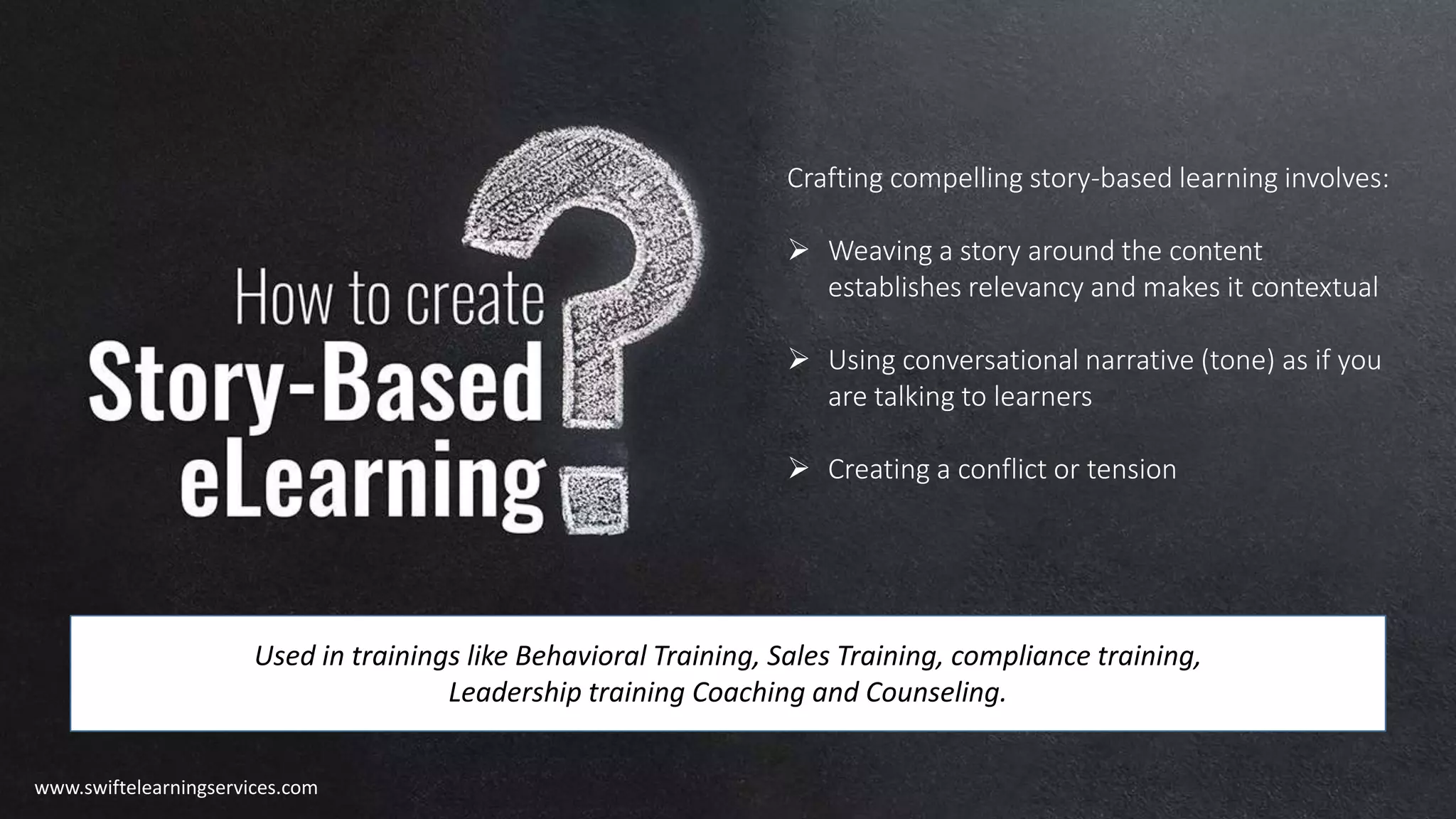
Crafting compelling story-based learning involves:
 Weaving a story around the content
establishes relevancy and makes it contextual
 Using conversational narrative (tone) as if you
are talking to learners
 Creating a conflict or tension
Used in trainings like Behavioral Training, Sales Training, compliance training,
Leadership training Coaching and Counseling.
www.swiftelearningservices.com
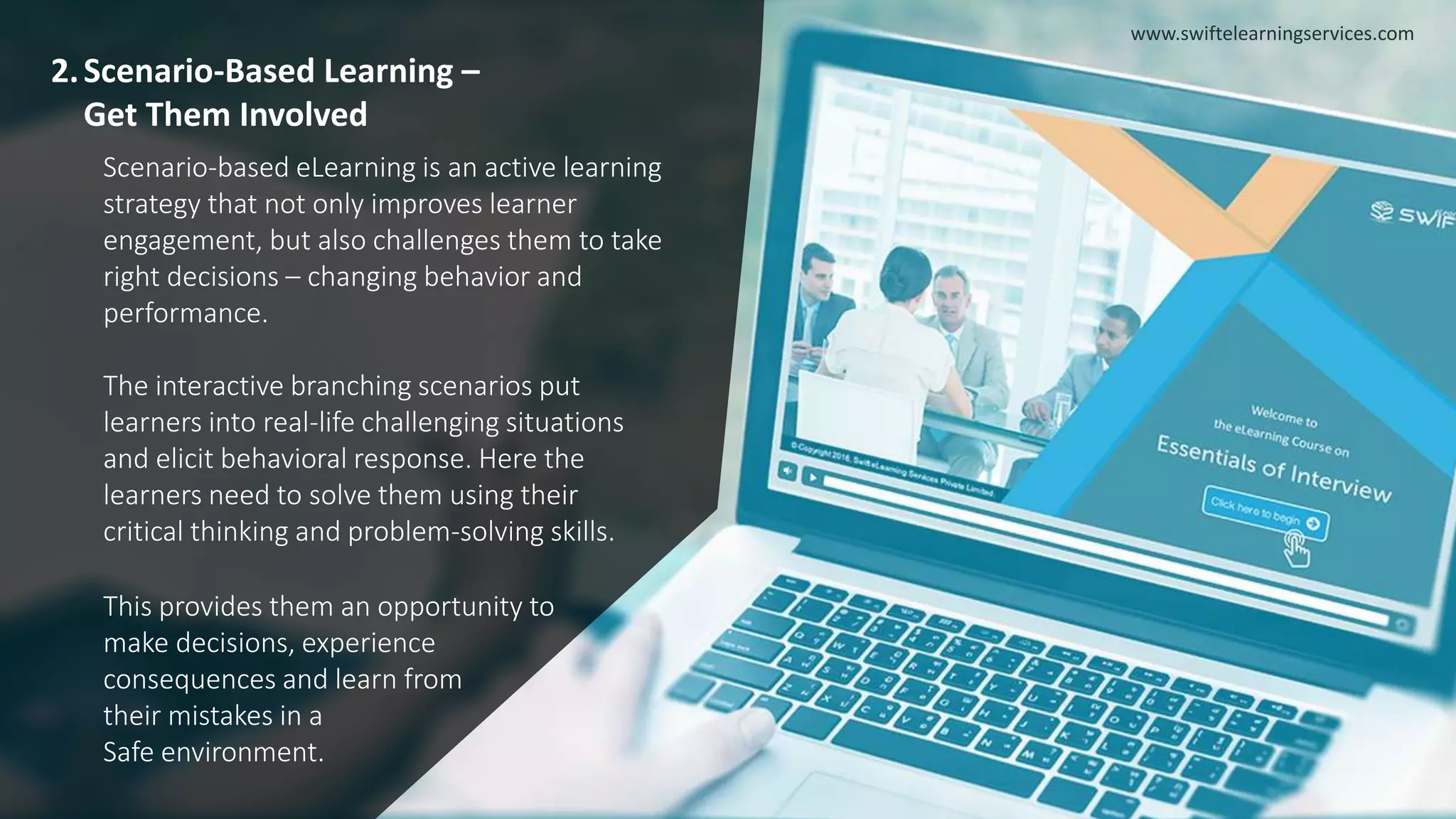
2.Scenario-Based Learning –
Get Them Involved
Scenario-based eLearning is an active learning
strategy that not only improves learner
engagement, but also challenges them to take
right decisions – changing behavior and
performance.
The interactive branching scenarios put
learners into real-life challenging situations
and elicit behavioral response. Here the
learners need to solve them using their
critical thinking and problem-solving skills.
This provides them an opportunity to
make decisions, experience
consequences and learn from
their mistakes in a
Safe environment.
www.swiftelearningservices.com
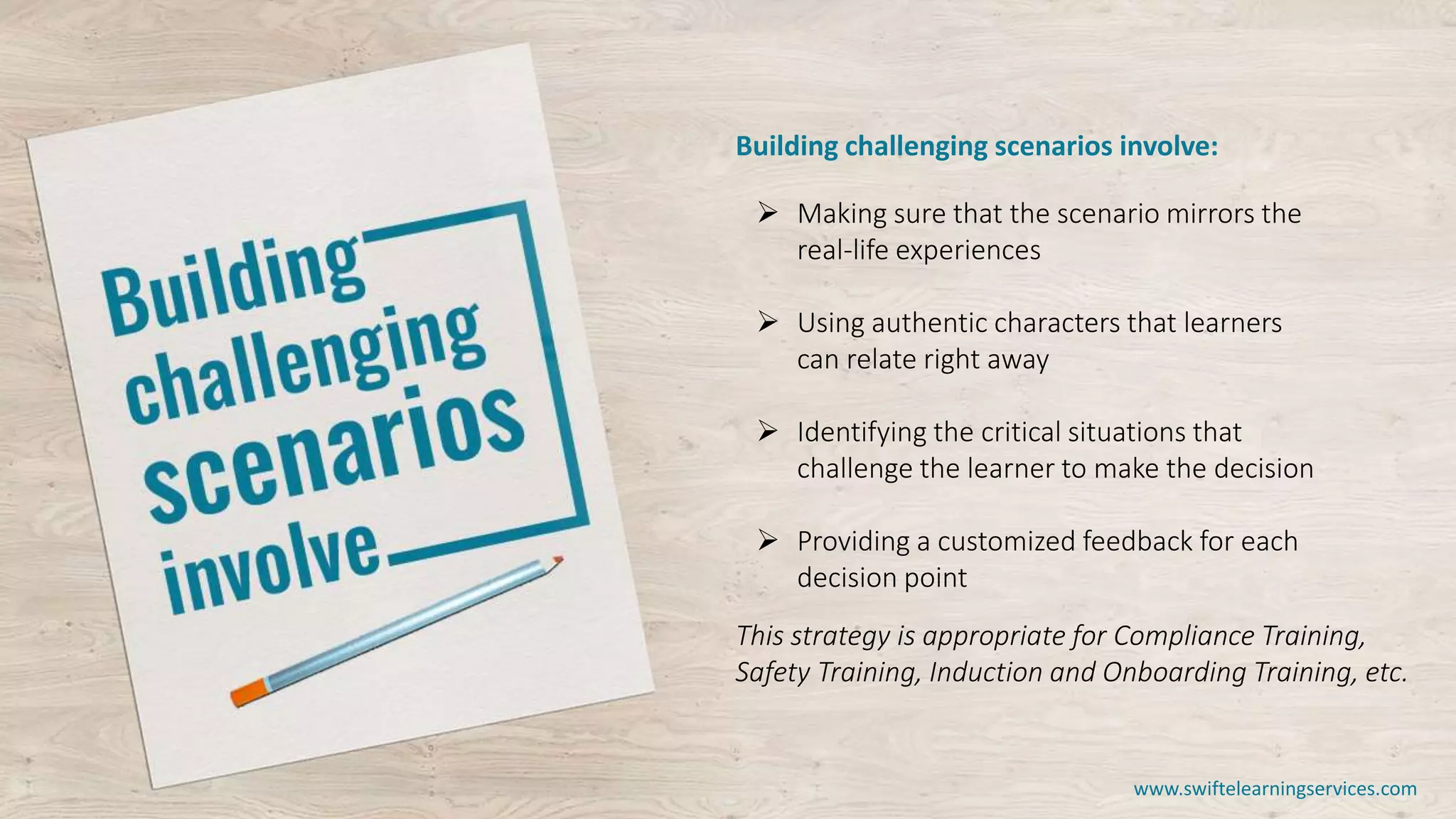
Building challenging scenarios involve:
 Making sure that the scenario mirrors the
real-life experiences
 Using authentic characters that learners
can relate right away
 Identifying the critical situations that
challenge the learner to make the decision
 Providing a customized feedback for each
decision point
This strategy is appropriate for Compliance Training,
Safety Training, Induction and Onboarding Training, etc.
www.swiftelearningservices.com
3.Microlearning – Providing Just-In-
Time Performance Support
Microlearning is an emerging instructional design strategy
that is designed to provide just-in-time performance
support as part of corporate training. This strategy is best
used to supplement formal training accessed on demand
to reinforce what was just taught.
Given the heavy distractions, low attention spans and
boring information dump makes no more sense to the
modern learners. In such cases, Microlearning can be the
best learning strategy that reduces cognitive overload.
However, the microlearning strategy is not a silver bullet
for training.
Microlearning could be a 5-7 minute bite sized learning
nugget with a key takeaway. For example, an interactive
video couple with augmented reality / virtual reality, an
infographic, a checklist/job aid, etc.
www.swiftelearningservices.com
To create an effective microlearning course, you need to:
 Analyze whether microlearning is really the good fit
 Identify the specific “Learning Objective” and make it
more objective focused
 Organize & Analyze the earning content
 Ruthlessly edit the learning content and keep what is
relevant and essential
 Use conversational tone with active voice
 Grab learner’s attention with a story, visual and/or context
This microlearning is the best strategy to deliver mobile
learning as part of refresher trainings. For example, Sales
Training and Soft-Skills Training.
www.swiftelearningservices.com
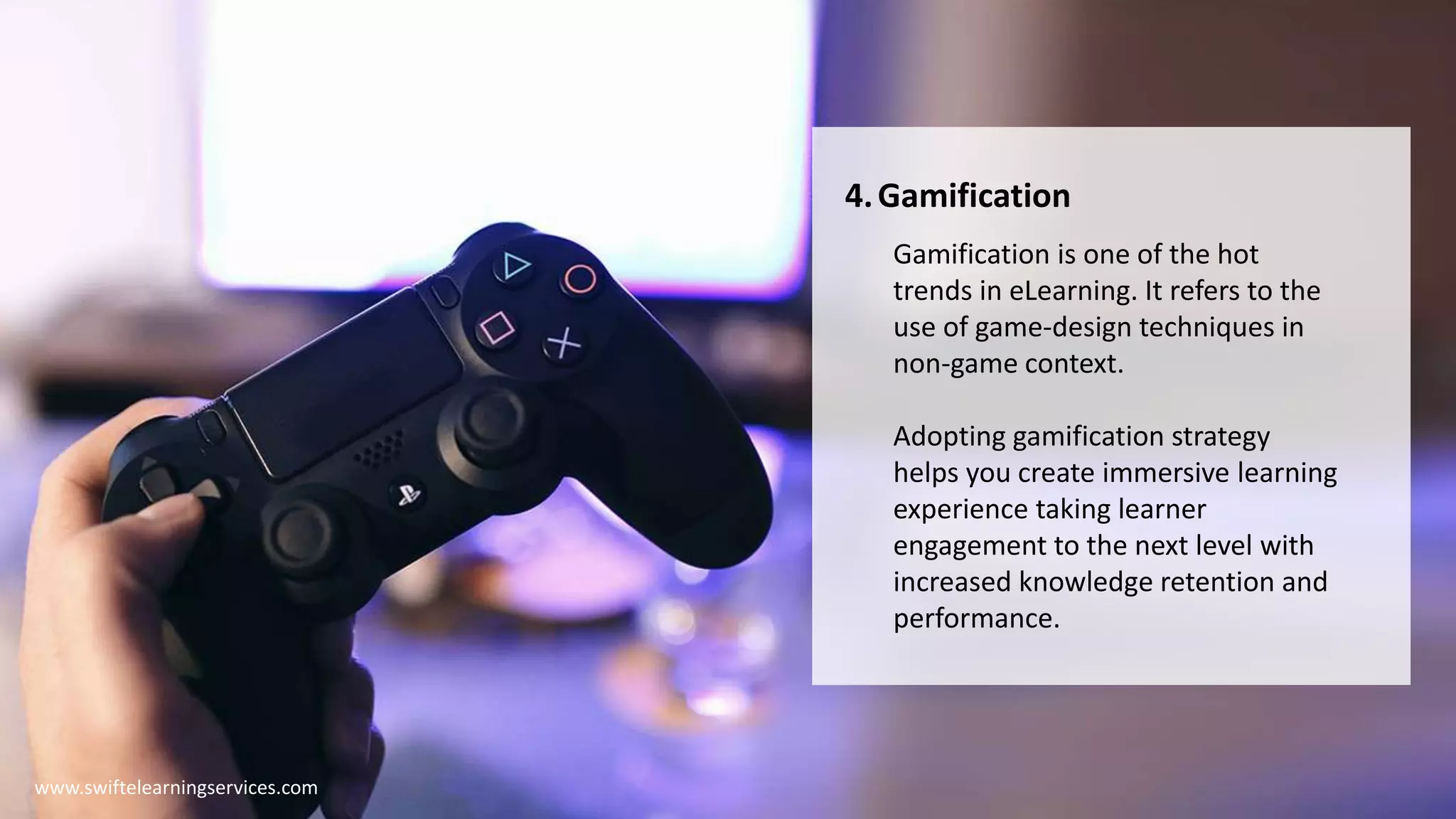
4.Gamification
Gamification is one of the hot
trends in eLearning. It refers to the
use of game-design techniques in
non-game context.
Adopting gamification strategy
helps you create immersive learning
experience taking learner
engagement to the next level with
increased knowledge retention and
performance.
www.swiftelearningservices.com
Analyze the need for gamification of eLearning:
 Is gamification apt for this subject (eLearning content)?
 What is the main idea or theme behind the gamification?
 Align the gamified elements with learning objectives
 Make the gamified elements more relevant and simple
 Incorporate gamified elements such as points, levels, badges and
leaderboards for intrinsic motivation, but go beyond it
 Provide clear instructions and ensure your learners understand the whole
concept before they start the game
 Use a compelling narrative with relatable characters, goals, challenges and
obstacles
 Challenge and excite the learners by offering reward points
 Let your learners experience the consequences for their decisions and sense
of accomplishment
 Eventually, evaluate the game to see how it works
Gamification can be used in Safety Training, Induction and Onboarding
Training, Compliance Training, Product Training, etc.
To design Gamified
eLearning courses,
you need to:
www.swiftelearningservices.com
Apart from these four instructional design
strategies, there are other strategies such as
case studies, reflective learning, inquiry-based
learning, analogies, mnemonics, etc.
However, the skill in creating impactful
eLearning courses lies in selecting the right
corporate instructional design strategy for
corporate training.
www.swiftelearningservices.com
Swift ELearning Services Pvt. Ltd.
Phone: +91 40 4026 5193
Email us at: info@swiftelearningservices.com
www.swiftelearningservices.com
We, at swift can help in designing your learning
needs
and bring you the best solutions in a cost effective
manner.
“
“

Instructional Design Strategies to Enhance eLearning for Corporate Training

  • 1.
    Proven Instructional Design Strategies toEnhance eLearning for Corporate Training4 Top www.swiftelearningservices.com
  • 2.
    Be it anygame, you need a right game plan or a strategy to succeed. And the same applies to eLearning design for corporate training. “eLearning when designed correctly with sound instructional design strategy has the potential to bring organizational excellence with a positive eLearning ROI. ” An instructional strategy is an action plan or a method to help people learn. It defines the approach to achieve learning objectives using various learning devices, techniques, resources, and various learning theories. In this we will take a closer look at the top 4 proven instructional design strategies to enhance online training experience. Note: You need to analyze the learning needs, learner profile and desired learning outcomes before you could finalize the learner-centered instructional strategy for your online training. www.swiftelearningservices.com
  • 3.
    1.Story-Based Learning – KeepThem Intrigued For instructional designers, designing eLearning content that keeps the learners engaged throughout the course is a challenging part. Story telling is the powerful approach to captivate your learner’s attention creating an engaging, emotional and perceptual learning experience.It contextualizes learning with interesting elements such as a strong narrative, interesting and thought-provoking plots, relatable characters, suspense and a strong message. Having said that story-based learning breaks the monotony and avoid Clicky- Clicky Bling-Bling in the eLearning courses. www.swiftelearningservices.com
  • 4.
    Crafting compelling story-basedlearning involves:  Weaving a story around the content establishes relevancy and makes it contextual  Using conversational narrative (tone) as if you are talking to learners  Creating a conflict or tension Used in trainings like Behavioral Training, Sales Training, compliance training, Leadership training Coaching and Counseling. www.swiftelearningservices.com
  • 5.
    2.Scenario-Based Learning – GetThem Involved Scenario-based eLearning is an active learning strategy that not only improves learner engagement, but also challenges them to take right decisions – changing behavior and performance. The interactive branching scenarios put learners into real-life challenging situations and elicit behavioral response. Here the learners need to solve them using their critical thinking and problem-solving skills. This provides them an opportunity to make decisions, experience consequences and learn from their mistakes in a Safe environment. www.swiftelearningservices.com
  • 6.
    Building challenging scenariosinvolve:  Making sure that the scenario mirrors the real-life experiences  Using authentic characters that learners can relate right away  Identifying the critical situations that challenge the learner to make the decision  Providing a customized feedback for each decision point This strategy is appropriate for Compliance Training, Safety Training, Induction and Onboarding Training, etc. www.swiftelearningservices.com
  • 7.
    3.Microlearning – ProvidingJust-In- Time Performance Support Microlearning is an emerging instructional design strategy that is designed to provide just-in-time performance support as part of corporate training. This strategy is best used to supplement formal training accessed on demand to reinforce what was just taught. Given the heavy distractions, low attention spans and boring information dump makes no more sense to the modern learners. In such cases, Microlearning can be the best learning strategy that reduces cognitive overload. However, the microlearning strategy is not a silver bullet for training. Microlearning could be a 5-7 minute bite sized learning nugget with a key takeaway. For example, an interactive video couple with augmented reality / virtual reality, an infographic, a checklist/job aid, etc. www.swiftelearningservices.com
  • 8.
    To create aneffective microlearning course, you need to:  Analyze whether microlearning is really the good fit  Identify the specific “Learning Objective” and make it more objective focused  Organize & Analyze the earning content  Ruthlessly edit the learning content and keep what is relevant and essential  Use conversational tone with active voice  Grab learner’s attention with a story, visual and/or context This microlearning is the best strategy to deliver mobile learning as part of refresher trainings. For example, Sales Training and Soft-Skills Training. www.swiftelearningservices.com
  • 9.
    4.Gamification Gamification is oneof the hot trends in eLearning. It refers to the use of game-design techniques in non-game context. Adopting gamification strategy helps you create immersive learning experience taking learner engagement to the next level with increased knowledge retention and performance. www.swiftelearningservices.com
  • 10.
    Analyze the needfor gamification of eLearning:  Is gamification apt for this subject (eLearning content)?  What is the main idea or theme behind the gamification?  Align the gamified elements with learning objectives  Make the gamified elements more relevant and simple  Incorporate gamified elements such as points, levels, badges and leaderboards for intrinsic motivation, but go beyond it  Provide clear instructions and ensure your learners understand the whole concept before they start the game  Use a compelling narrative with relatable characters, goals, challenges and obstacles  Challenge and excite the learners by offering reward points  Let your learners experience the consequences for their decisions and sense of accomplishment  Eventually, evaluate the game to see how it works Gamification can be used in Safety Training, Induction and Onboarding Training, Compliance Training, Product Training, etc. To design Gamified eLearning courses, you need to: www.swiftelearningservices.com
  • 11.
    Apart from thesefour instructional design strategies, there are other strategies such as case studies, reflective learning, inquiry-based learning, analogies, mnemonics, etc. However, the skill in creating impactful eLearning courses lies in selecting the right corporate instructional design strategy for corporate training. www.swiftelearningservices.com
  • 12.
    Swift ELearning ServicesPvt. Ltd. Phone: +91 40 4026 5193 Email us at: info@swiftelearningservices.com www.swiftelearningservices.com We, at swift can help in designing your learning needs and bring you the best solutions in a cost effective manner. “ “